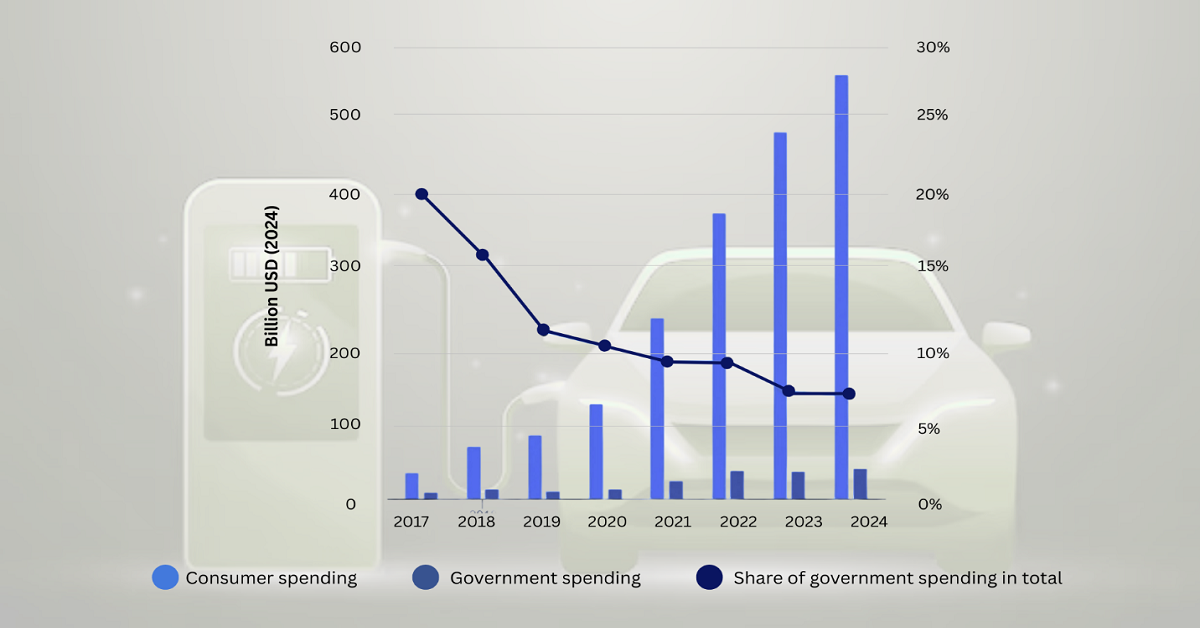
The automotive and mobility industry is attracting significant investment from a myriad of market players owing to the industry’s long-term growth potential. Conventional automakers, technological firms, start-ups, and governments are allocating capital into areas such as battery technologies and shared mobility solutions. According to Alliance for Automotive Innovation, globally automakers are planning to spend projected USD 1.2 trillion by 20230 to build and develop new battery-powered vehicles. This investment momentum is further reinforced by a surge in consumer adoption. In the last few years, there has been a sharp increase in worldwide consumer and government spending on electric cars, making the automotive and mobility ecosystem a highly attractive investment destination.
Global Consumer and Government Spending on Electric Cars, 2017-2024
Source: IEA
Key investment-driven trends in the automotive and mobility industry
Hydrogen mobility and alternative fuels
Companies are investing in incorporating hydrogen fuel cells and various other alternative fuels to lower the emissions from long-distance transport. There has been a vast adoption of hydrogen-powered trucks, trains, buses, etc., which are garnering interest owing to favorable characteristics such as storing more energy than batteries and faster refueling capacity. According to Environment Protection Agency in 2022, in the U.S., there are more than 50,000 hydrogen fuel cell electric forklifts operating. Furthermore, the Alameda Contra Costa Transit District is the largest bus district and started its 0-emission bus program with currently 36 hydrogen fuel cell buses in operation. By switching to zero-emission buses, the agency has driven more than 5 million miles and reduced carbon dioxide emissions by over 12,800 metric tons. These proven operational and environmental benefits are strengthening investor confidence and driving increased funding toward hydrogen mobility and alternative fuel infrastructure.
Autonomous driving and robo taxis
Various companies are pouring notable capital into autonomous driving and robo taxi technologies as the segment is viewed as a prominent long-term revenue engine. The inclusion of autonomous mobility promises a significant decrease in operating costs by eradicating the requirement of human drivers. Additionally, autonomous systems unlock new recurring revenue models, including mobility-as-a-service (MaaS) and subscription-based transport. Other than this, according to a report published by the World Economic Forum, robo taxis are predicted to remain 1st major commercial application of high-automation (L4) technology, garnering a share of 4% of new personal car sales by 2035. The report also predicts that by 2035, robotaxis will be operating at scale in roughly 40-80 cities worldwide, having the largest deployment in the U.S. and China.
Smart roads and V2X infrastructure
The smart roads and V2X infrastructure are emerging as significant investment areas, with governments and industries preparing for the next phase of connected mobility. Companies are developing vehicles capable of communicating with the traffic signals and other road users in real time, which can improve traffic flow. Government and municipalities are emphasizing the public-private investments in digital tolling and smart highways. In June 2024, the U.S. Department of Transportation Federal Highway Administration awarded USD 60 million in modern vehicle technology grants to accelerate the V2X deployment program and interoperable vehicle technologies. In the long term, V2X infrastructure is seen as a crucial enabler of logistics automation and smart city ecosystems, rendering high returns through improved asset utilization.
Predictive maintenance and vehicle health management
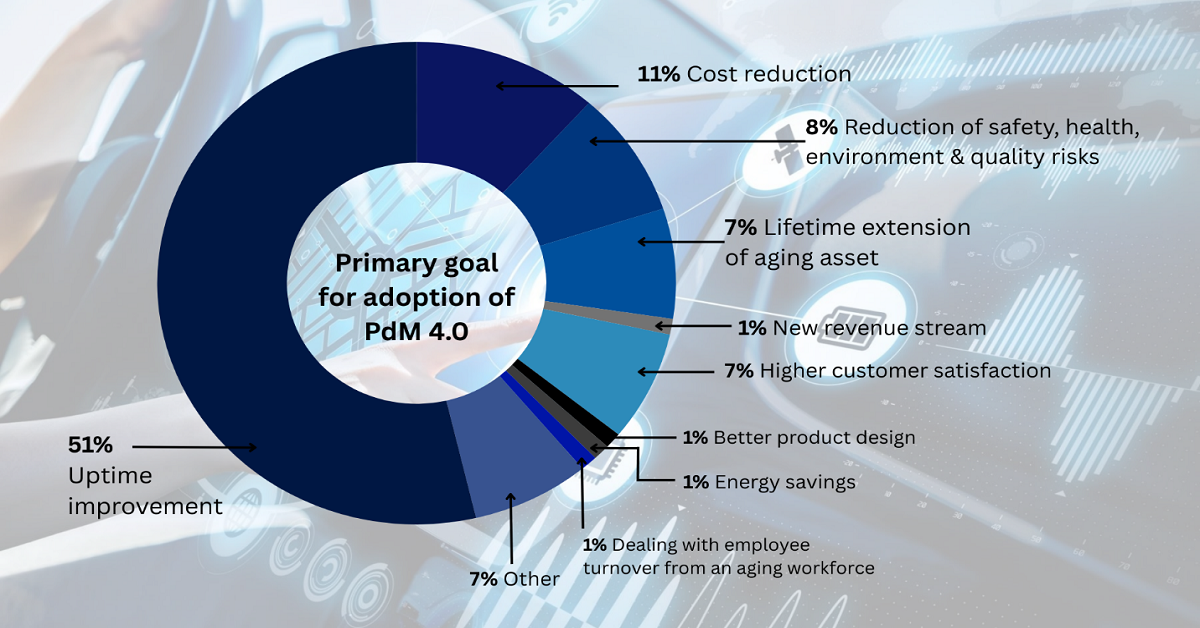
Various companies are allocating huge capital in predictive maintenance and vehicle health management as it renders direct cost savings and recurring revenue streams. These factors are making the market commercially attractive to the market players. With the usage of real time sensor data and AI analytics, owners can predict component wear and failures. Predictive maintenance also brings down repair and warranty costs by shifting from reactive or scheduled servicing to condition-based maintenance. These elements further extend vehicle operational life and enhance asset utilization. Moreover, the National Center for Manufacturing Sciences unveiled a report in September 2025 stating that 95% of the respondents in a survey reported predictive maintenance improved at least 1 pivotal value driver. A few of these parameters include vehicle uptime, extended asset life, reduced costs, lower safety risk, and higher customer satisfaction. These factors reinforce broad operational value from predictive systems.
Companies’ Goal for Adoption of PdM 4.0
Source: PWC
What We Do
Rising concerns for inflation, fear of recession, contracting revenues, shrinking profit margins, and growing cost pressure on logistics and supply chain has posed a profound stress test for every business organizations globally. We’re helping our clients by delivering integrated solutions based on thorough research, benchmarking, analysis, and strategic discernment to help businesses overcome these challenges and unearth hidden opportunities for sustainable growth and value creation over the coming years.
We have been a pedestal for our clients to embark on a journey towards success.