Unmanned Aerial Vehicles: Revolutionizing Skies with Technology and Innovation
From military operations to commercial use, UAVs provide real time data, cost savings, and enhanced capabilities across industries
Posted Date : 11 December 2025
Posted by : Ayushi Sharma
Unmanned Aerial Vehicles (UAVs), also known as drones, have drastically changed industries and redefined how we interact with the skies. From agriculture to military operations, UAVs provide unmatched versatility, efficiency, and innovation. This blog explores the evolution, applications, benefits, challenges, and future of UAVs, along with a comprehensive understanding of their impact.
A Historical Evolution of UAV Development
The concept of UAVs dates back to the early 1900s. During World War I, the U.S. military built the Kettering Bug, an unmanned aerial torpedo, though it had limited use. By World War II, drones such as the Radioplane OQ-2, used for target practice, had noted early advancements. The modern UAV era began in the 1980s with Israel's successful usage of drones for reconnaissance during conflicts, unlocking the way for today's sophisticated dynamic systems.
According to a 2023 report by the U.S. Department of Commerce’s International Trade Administration, the global market for unmanned aircraft systems (UAS) was valued at approximately $30 billion in 2022 and is expected to grow remarkably due to increasing commercial and defense applications. This growth is majorly driven by technological innovations, advancements in sensors, artificial intelligence, and battery life, making UAVs more easily accessible and capable.
Types of UAVs
There are several kinds of UAVs, each created for a specific function.
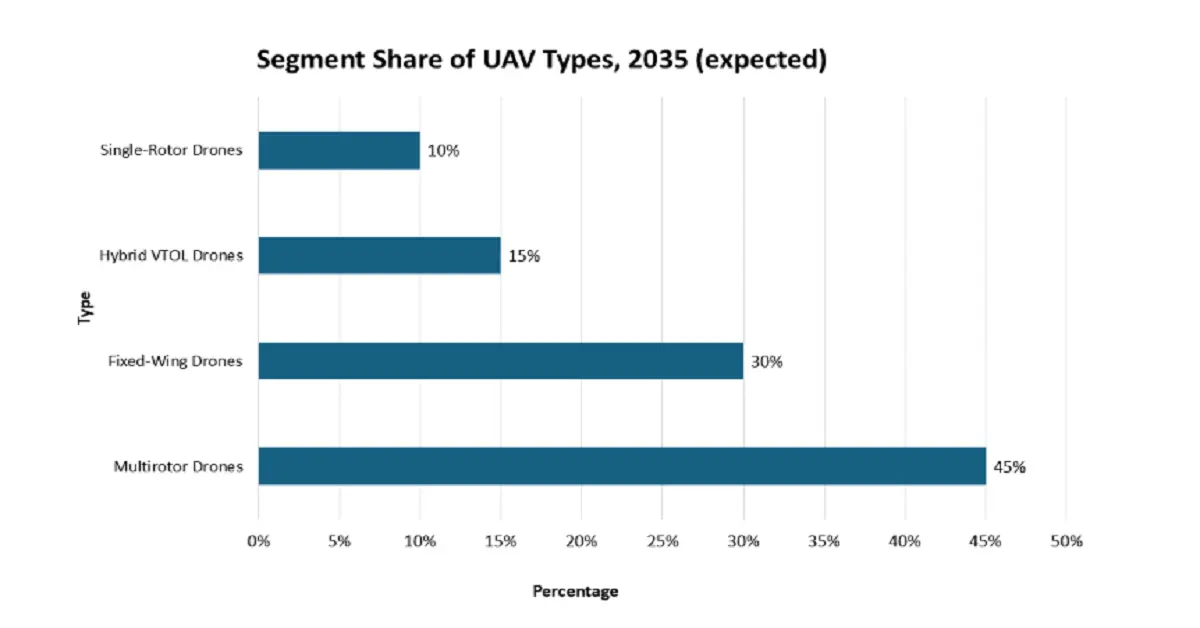
- Fixed-Wing Drones: These drones, shaped like conventional airplanes, are well-suited for covering long distances and are often used for aerial surveys and monitoring. Their design allows for extended flight durations; certain models, such as the AeroVironment Puma, can remain in the air for more than six hours.
- Multirotor Drones: Popular for their maneuverability, these drones (e.g., quadcopters) are used in photography, inspections, and short-range missions.
- Single-Rotor Drones: These operate very similarly to helicopters and usually have longer flight endurance as compared to multi-rotor types. However, they are less common due to their complexity.
- Hybrid VTOL Drones: Combining the features of fixed-wing and multi-rotor drones, these models are becoming more popular for their flexibility, especially in sectors such as logistics, where both vertical takeoff and long-range travel are needed.
Applications of UAVs
UAVs are now used across a wide range of industries, changing operations with their accuracy and effectiveness.
- Agriculture: Drones play a major role in transforming modern farming practices. They help monitor crop conditions, assess soil quality, and fine-tune irrigation efforts. According to the U.S. Department of Agriculture (USDA) in 2023, drones equipped with multispectral sensors can intensify crop yields by 10% to 15% by highlighting areas that need attention, whether it is pest treatment or water management. Companies like PrecisionHawk provide drone solutions capable of detecting plant stress that would otherwise go unnoticed by the human eye.
- Delivery and Logistics: Drones are playing an important role in managing last-mile deliveries within the logistics sector. In 2021, Amazon’s Prime Air got approval from the Federal Aviation Administration (FAA) to run delivery drones across the U.S., targeting deliveries of packages weighing under 5 pounds within 30 minutes. Meanwhile, Zipline has also been using drones since 2016 to provide essential medical supplies to remote regions of Africa. Until 2023, the company reported delivering more than one million medical supplies, including life-saving vaccines as well.
- Surveillance and Security: Drones have become vital tools for both defense and public safety. In 2022, the U.S. Department of Defense committed $7.2 billion to drone systems, according to the Congressional Research Service. Military models like the MQ-9 Reaper are used extensively for live surveillance and intelligence gathering. On the civilian side, UAVs are deployed for border control and emergency response. A 2025 report from the Department of Homeland Security highlighted how drones assist first responders with aerial assessments during disasters. During the 2020 bushfires in Australia, UAVs helped trace more than 2 million hectares, aiding firefighting teams on the ground.
- Environmental Monitoring: Drones are now widely used to observe natural habitats, follow wildlife movements, and evaluate the impact of environmental changes. A 2024 report by the U.S. Fish and Wildlife Service noted that UAVs played a key role in road inventory efforts for federal land management, cutting down survey durations by 40% compared to older techniques. In Africa, the World Wildlife Fund has used drones to help fight poaching, reporting a 30% drop-in illegal activity in areas where UAVs are actively used, according to its 2022 findings.
- Entertainment and Media: Drones have brought a noticeable shift to the world of filmmaking and live event production. With their capability to shoot aerial scenes at a much lower cost compared to helicopters, they have become an indispensable tool in the industry. According to Research Nester, the global market for drone services in media and entertainment reached $1.2 billion in 2022, largely fueled by the rising need for high-resolution aerial imagery.
Benefits of UAVs
UAVs offer numerous advantages as follows:
- Cost Savings: Using drones for tasks such as infrastructure inspection significantly cuts expenses. According to the Federal Aviation Administration (FAA), in 2025, inspecting structures like bridges with drones can be 50-70% cheaper than traditional, manual methods.
- Accessibility: Drones can be used in locations that are hazardous or hard to access, such as disaster zones, high-altitude regions, or active volcanic areas, without risking human lives.
- Data Accuracy: Equipped with advanced sensors, drones offer high-resolution data, enhancing decision-making in the agriculture and urban planning fields.
- Lower Environmental Footprint: Battery-powered drones generate no direct emissions. A 2023 report by the International Council on Clean Transportation pointed out that using drones for deliveries could cut carbon emissions by as much as 54% compared to traditional delivery trucks.
What Lies Ahead for UAVs
Economic Impact
UAVs are driving economic growth. The U.S. Department of Commerce reported in 2025 that the UAS market supports significant job creation, with the potential for 100,000 new drone-related jobs in the U.S. by 2027, according to the Association for Unmanned Vehicle Systems International. Globally, a 2023 PricewaterhouseCoopers study estimated that the drone industry could account for nearly $127 billion to the economy by 2030.
Ethical Considerations
With the increasing adoption of UAVs across sectors, important ethical concerns come into focus. In military use, drones have sparked debates about responsibility and decision-making in armed conflicts. A 2021 report by the United Nations called for clear global rules governing the use of autonomous weapons. In civilian settings, it's equally important to make sure that access to drone technology is fair. Without deliberate efforts, there’s a risk that technological advantages may widen the gap between developed and developing nations.
Contact Us