Managing Inflation
Our experts render valuable cognizance which is helpful for market players to fabricate a niche in inflationary ambiance. We are making them aware of the greatest opportunities to harness even in disguise. We work closely with the clients to enrich a transformational robust approach.
Increased inflation exerts a layered and wide influence on businesses and market participants on a large scale. Also, inflation reshapes both the long-term and short-term strategic planning for businesses. Inflation propels the cost of raw materials, logistics, and labor, which further increases the production costs. Furthermore, higher prices further weaken the consumer demand, mainly for discretionary goods. According to a report published by the Organization for Economic Co-operation and Development, median goods inflation in OECD countries surged from 0.8% to 1.8% between late 2024 and October 2025. Other than this, services inflation remained elevated at around 3.6% during the same period.
This type of prolonged inflationary push has resulted in cautious investor sentiment and moderated equity valuation. The global inflation is mainly propelled by the amalgamation of a myriad of factors, such as supply constraints, demand-side pressures, and other geopolitical disruptions. At the same time, several cost-push factors, such as increasing energy prices, increments in wages, etc., raise the production prices, prompting businesses to pass these costs on to consumers. For instance, in India, uneven cost pressures across various sectors affect businesses differently.
National Level Division Wise Inflation Rate (%)
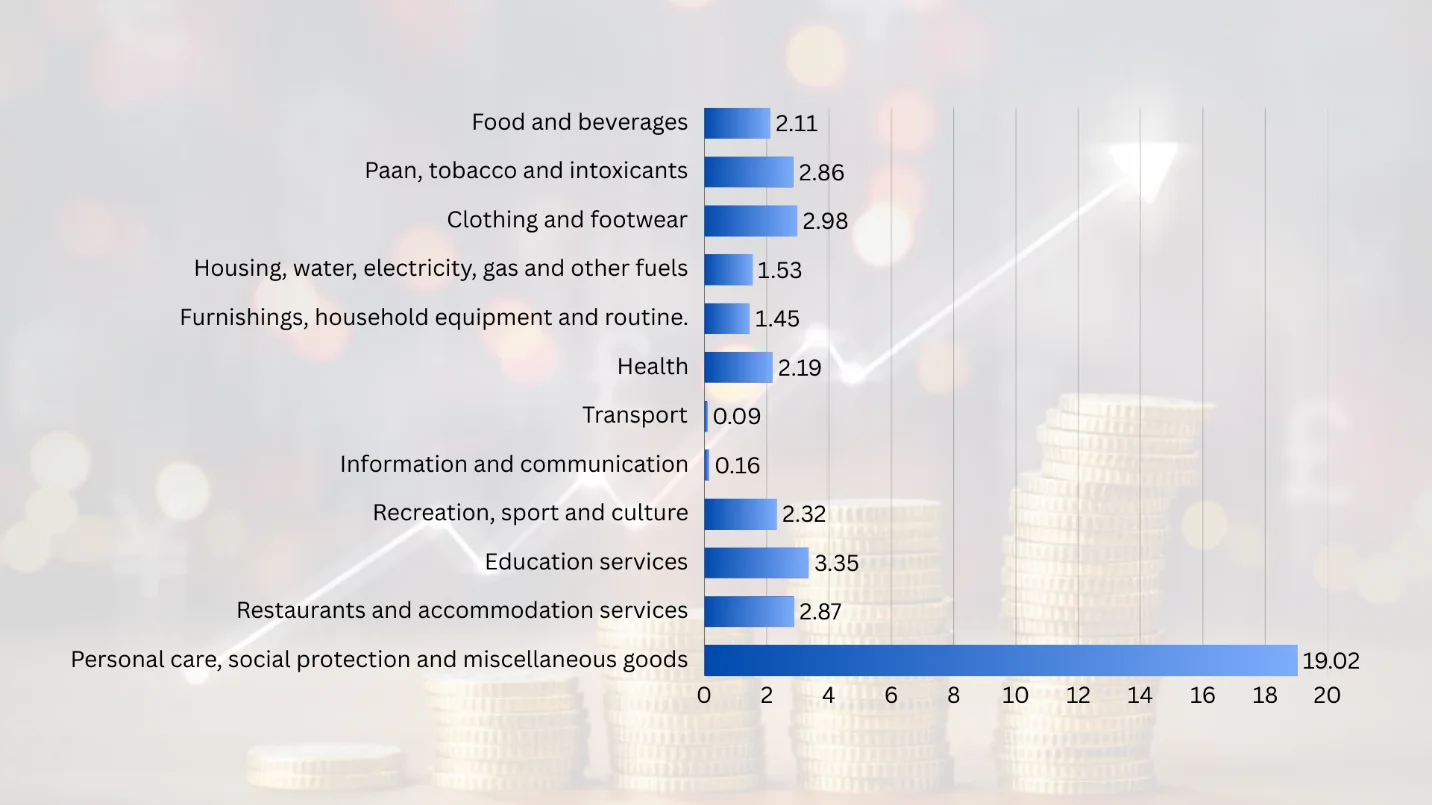
In tackling inflation, the market research report is significantly helpful in combating the consequences. In an inflationary environment, these reports render an exhaustive analysis of competitor planning, pricing trends, and other sector-specific complications. With a clear understanding of market elasticity and price sensitivity, companies can make adjustments in price without significantly impacting volumes of sales. In fact, these reports transform inflation from a challenge into an operationally achievable factor by equipping organizations with actionable intelligence and forward-looking insights.
Market research methodologies that help businesses mitigate inflationary pressures
Trend analysis and time series forecasting
Market research reports consist of intensive trend analysis, which studies sales performance and pricing patterns, to identify consistent patterns over time. Also, time series prediction is built on various historical parameters by utilizing statistical techniques to estimate what may occur in the future on the basis of previous trends. During the period of inflation, these significant methods become prominently imperative and help businesses project a surge in raw material costs and changes in interest rates. Other than this, in an inflationary environment, data-intensive forecasting supports dynamic pricing strategies, supplier negotiations, demand planning accuracy, and capital optimization. These are statistical exercises and tools that enhance resilience to increase operational efficiency and aid informed decision-making in uncertain economic conditions.
Consumer sentiment surveys and behavioral analysis
Various market research reports consist of consumer sentiment surveys that accumulate information regarding how assertive customers feel regarding their spending plans. Behavioral analysis comprises how buying patterns alter when economic conditions shift. During the period of inflation, consumers usually focus on crucial products such as healthcare, utilities, etc., while lowering their spending on various luxury or non-essential items. For a myriad of businesses, these insights are significantly useful, and by comprehending the preferences of the customer, companies can modify product offerings and change marketing strategies. In a market research report, behavioral analysis aids organizations in staying aligned with demand trends and handling customer loyalty.
Risk modelling and scenario analysis
These are imperative tools in a market research report, mainly during inflationary periods. For instance, risk modelling assesses potential financial and operational risks that might arise owing to inflation. These risks include higher transportation expenses, rising raw material costs, lowered consumer spending, or disruptions in supply chains. While the scenario analysis goes a step ahead by making different possible future situations, such as moderate, low, or high inflation scenarios. For each type of scenario, businesses can analyze how sales volumes and operating costs might change. These approaches help companies in preparing flexible pricing strategies, adjusting inventory planning, controlling operational costs, strengthening financial resilience, etc.
Demand forecast modelling
Market research reports play a pivotal role in making demand forecast modelling by rendering data-backed insights that enhance the reliability and accuracy of the projections. A detailed market research report consists of historical sales data and consumption patterns. Businesses can create realistic demand assumptions by getting knowledge of purchasing behavior. Other than this, the reports also provide insights on the industry benchmarks, competitor analysis, and regional demand patterns to enable businesses build robust forecasting models. This leads to better production planning, inventory management, budgeting, and strategic decision-making. This leads to better production planning, inventory management, budgeting, and strategic decision-making.
Market segment analysis
Market segment analysis in a report splits the market into segments into smaller groups on the basis of factors such as geography, income level, industry type, etc. The division is mainly valuable during inflation, when different customer groups react differently to higher prices. During the time of inflation, not all consumers are affected in the same way. This strategy helps the market players in numerous ways, such as targeted pricing strategies, product portfolio adjustments, focused marketing campaigns, and better resource allocation.
Geo-economic and regional demand analysis
These strategies help businesses comprehend how inflation affects regions, countries, and other customer segments in different ways. Inflation is not homogenous and its impact varies based on government policies and income levels. Geo-economic analysis examines wide economic factors such as trade policies and interest rate movements. This aids businesses in identifying more vulnerable markets to cost-related pressures and insights about the regions that might remain comparatively stable. Other than this, the regional demand analysis focuses on how the customer purchasing power and spending behavior change across the different locations. Also, such information helps in adjusting pricing strategies region-wise, reallocating inventory to stronger demand markets, and protecting profit margins by focusing on stable geographies.
Risk mitigation and sensitivity modelling
A market research report consists of risk mitigation strategies that enable businesses to prepare for inflation-driven uncertainties by analyzing the huge impact of economic variables on the financial performance. Sensitivity modelling helps quantify how even small changes in input costs, cash flow, and profitability. This allows firms to develop contingency plans, adjust pricing strategies, renegotiate supplier contracts, or hedge financial risks in advance. As a result, businesses move from reactive crisis management to proactive risk planning. This further helps in ensuring stability and resilience during prolonged inflationary cycles.
Handling inflation is not a short-term exercise but a prolonged strategic step for businesses across industries. Persistent services and goods inflation continues to frame consumer behavior and cost structures globally. In such an ambience, organizations depend on reactive price rises, which risk eroding the loyalty of the customer and compressing margins. Other than this, businesses are adopting a intelligence driven approach equipped with comprehensive market research. With the help of advanced forecasting models and segmentation frameworks, these reports render clarity. Amidst recurring fluctuations in the economy and volatility in the geopolitical environment, the ability to depend on evidence-based insights has become a significant criterion for businesses. The organizations that include research-led decision-making into their strategic framework are better equipped to find out inflationary pressures with confidence.


Contact Us