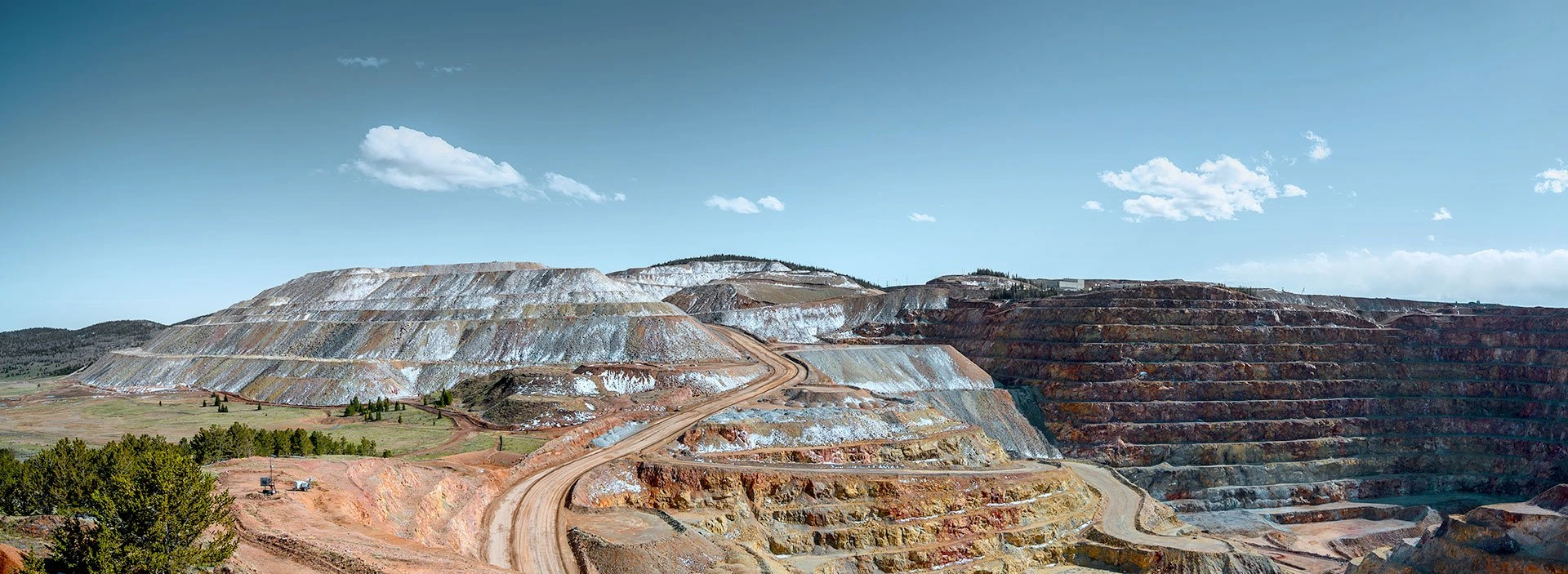
The mining industry is becoming significantly lucrative with burgeoning worldwide demand for crucial minerals and energy transition metals. Rapid electrification and electric vehicle manufacturing are prominently raising the demand for copper, nickel, rare earth elements, etc., are driving the sustained price strength. Advances in digital mining and ore processing technologies are further enhancing cost efficiency and productivity, making the sector significantly engaging to worldwide mining majors. A huge volume of metals, such as aluminum, chromium, and manganese, dominates the global output, highlighting their significant role in the myriad of industries.
Global Mining Output of These Metals (2021 - Over 181 Million Tonnes)

Source: World Economic Forum
Emerging Trends Shaping the Mining Industry
Smart mining and digital transformation
The mining industry is expeditiously embedding evolving digital technologies such as AI, automation, smart sensors, IoT, etc., in conducting mining operations. The swift inclusion of real-time data analytics, autonomous haul trucks, etc., is streamlining complicated operations, lowering costs, and enhancing safety. In November 2025, the U.S. Department of Energy declared up to USD 80 million in federal funding to establish mines of the future, rendering grounds for real-world testing of next-generation mining technologies. Such a type of initiative is projected to speed up the deployment of advanced sensing and automation across the mining operations, further strengthening domestic resource security.
Surge in processing of critical minerals
The increasing processing of critical minerals is attracting significant investments from worldwide industries. The extraction of critical minerals is crucial for clean energy technologies, electric vehicle manufacturing, and advanced electronics. There has been a growing demand for critical minerals and rare earth elements, which is emphasizing governments to enhance domestic processing capabilities to lower the dependence on a concentrated supply chain. Furthermore, rising technological advancements in mineral processing, such as solvent extraction, are nearing recovery rates, further lowering the impact on the environment. Global industries are investing in extracting critical minerals to guarantee prolonged supply security, aligning with industrial decarbonization goals. According to the World Resources Institute, the demand for critical minerals could surge 4 times by 2050 from 2022 levels.
Common Critical Minerals in Clean Technologies

Source: WRI.org
Brownfield optimization and mine life extension
Instead of developing entirely new greenfield sites, various mining operators are speeding up capital investment in the direction of extending the productive life of existing mines with the help of processing optimization. Modernization in data analytics and various ore sorting technologies is fostering companies to assess the previously uneconomic resources. Similarly, there are investments in plant debottlenecking and automation, which are lowering unit operating costs. According to a report published by The University of Queensland in January 2026, there has been increased investment in brownfield mining, and 366 brownfield sites across 58 countries are concentrated with copper, iron ore, and gold.
Resurgence of rare earth and strategic mineral projects
The strategic concerns over the highly centralized global supply chains are fostering the revitalized investments in rare earth elements. Various governments and consumers from industries are seeking to broaden sourcing to eradicate trade restrictions and geopolitical risks. Mining and processing projects globally are supporting policy incentives and rendering fast-tracked permitting frameworks. For instance, the Department of Industry, Science and Resources in Australia launched the Critical Minerals Facility, committing USD 1 billion to support high-priority critical minerals projects in 2023. Such targeted financing commitments signal the confidence of the government in value-added processing investments.
Share of Top Refining Country for 20 Energy-related Minerals

Source: IEA
Deep-sea and ultra-deep mining exploration
Researchers are suggesting that the high-quality mineral deposits on land are gradually becoming exorbitant to mine, and companies are adopting deep ocean mining as a source of metals. There has been significant investment to secure a prolonged access to critical metals as high-quality land-based mineral deposits. According to data published by the United Nations Economic Commission for Europe in April 2024, 21 billion dry metric tons of polymetallic nodules are present in areas such as the Clarion-Clipperton Zone (CCZ). This represents a significant underexplored reservoir of energy-transition metals.
What We Do
Rising concerns for inflation, fear of recession, contracting revenues, shrinking profit margins, and growing cost pressure on logistics and supply chain has posed a profound stress test for every business organizations globally. We’re helping our clients by delivering integrated solutions based on thorough research, benchmarking, analysis, and strategic discernment to help businesses overcome these challenges and unearth hidden opportunities for sustainable growth and value creation over the coming years.
We have been a pedestal for our clients to embark on a journey towards success.