Racing Tire Market Outlook:
Racing Tire Market size was worth USD 5.5 billion in 2025 and is expected to reach USD 9.5 billion by the end of 2035, growing at around 5.7% CAGR during the forecast period, i.e., 2026-2035. In 2026, the industry size of racing tire is assessed at USD 5.8 billion.
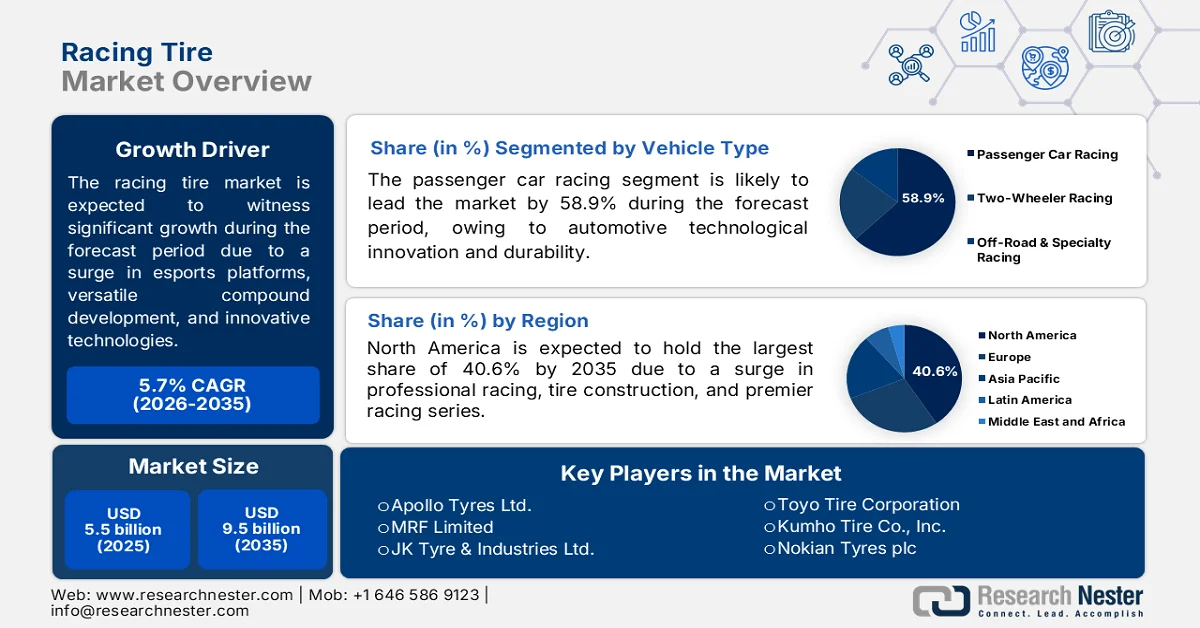
The global racing tire market is continuously expanding due to several factors, such as an increase in tire manufacturing, a rise in virtual racing and esports platforms, climate variability, broadening operational temperature windows, the development of versatile compounds, race tracks under single ownership, and reinforcement technologies. According to official statistics published by the International Conference on Industry of the Future and Smart Manufacturing in 2026, electric vehicles are approximately 15% to 20% heavier than comparable gasoline models, and this particular additional weight increases the load on every tire, thus accelerating the impact and wear handling during the manufacturing process. Besides, there has been a strong growth in the low rolling resistance tire industry by 11% since both fuel-economy regulations and vehicle makers have driven the increasing need for energy-efficient tires. Meanwhile, the ongoing supply chain dynamics for rubber tires are also responsible for bolstering the market demand globally.
2024 Rubber Tires Global Export and Import Analysis
|
Countries/ Components |
Export (USD) |
Import (USD) |
|
China |
2.6 billion |
- |
|
Thailand |
7.7 billion |
- |
|
Japan |
5. billion |
- |
|
U.S. |
- |
19.1 billion |
|
Germany |
- |
7.9 billion |
|
France |
- |
4.8 billion |
|
Global Trade Valuation |
99.9 billion |
|
|
Global Trade Share |
0.4% |
|
|
Product Complexity |
0.2 |
|
|
Export Growth |
0.5% |
|
Source: OEC
Furthermore, the artificial intelligence (AI)-driven virtual tire modeling replacement, physical prototype, the presence of direct-to-consumer trackside logistics platforms, and the existence of hyperlocalized compound libraries are a few trends that are responsible for fueling the market globally. As stated in an article published by the Sloan Management Review in August 2025, Michelin Group, which is a French multinational manufacturing organization, comprises more than 200 current AI-based use cases that readily support crucial functions and businesses. In addition, the company is focused on the aspect that both AI and data analytics tend to play an essential role in advancement, based on which 6,000 employees across 13 nations are presently operating. Therefore, the ultimate objective of this approach is to utilize AI for absorbing complexity and enhancing decision-making by the company’s workforce, thereby denoting an optimistic outlook for the market growth.
Key Racing Tire Market Insights Summary:
Regional Highlights:
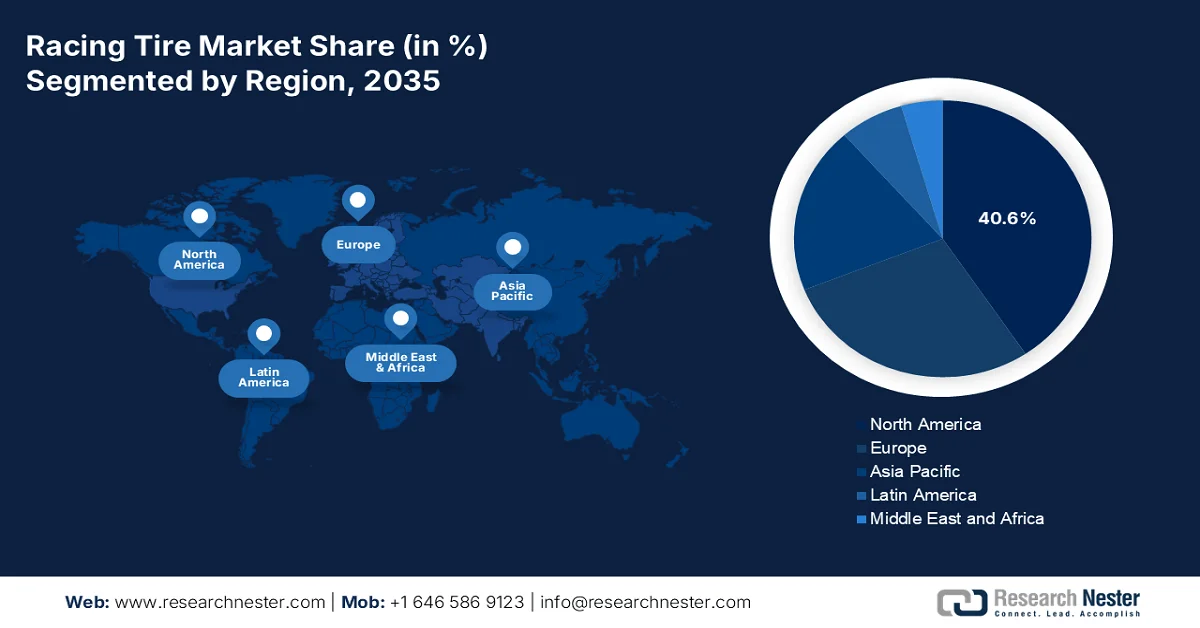
- North America is anticipated to command a 40.6% revenue share by 2035, attributed to the presence of premier racing series, expanding professional motorsports activities, and rising participation in track-day events
- Asia Pacific is projected to witness the fastest growth in the market throughout 2026–2035, spurred by rising investments in motorsport infrastructure, supportive government initiatives, and increasing motorsport popularity
- The racing tire market in the U.S. accounts for 13.8% share in North America, which is driven by an increase in drag racing participation, consistent aftermarket demand, and technological innovations in tire solutions.
- The racing tire market in Japan has grabbed 4.7% share in the Asia Pacific, owing to the establishment of conventional motorsport heritage, suitable development in tire technology, and manufacturer-centric championship.
Segment Insights:
- The passenger car racing segment is forecast to capture 58.9% of the racing tire market by 2035, fueled by advancements in automotive technology, enhanced vehicle safety innovations, and rising passenger vehicle manufacturing activities
- Within the tire type category, the slick tires sub-segment is expected to secure a considerable share during 2026–2035, reinforced by increasing adoption of tread-free high-performance tires designed to maximize road contact in motorsports
Key Growth Trends:
- Expansion in regional and national racing championships
- Focus on standardizing tire regulations
Major Challenges:
- Environmental sustainability pressures without performance sacrifice
- High barriers to entry for new competitors
Key Players: Pirelli & C. S.p.A. (Italy), Michelin (France), Bridgestone Corporation (Japan), Goodyear Tire & Rubber Company (U.S.), Hankook Tire & Technology Co., Ltd. (South Korea), Yokohama Rubber Co., Ltd. (Japan), Continental AG (Germany), Sumitomo Rubber Industries, Ltd. (Dunlop) (Japan), Cooper Tire & Rubber Company (U.S.), Toyo Tire Corporation (Japan), Kumho Tire Co., Inc. (South Korea), Nokian Tyres plc (Finland), Apollo Tyres Ltd. (India), MRF Limited (India), JK Tyre & Industries Ltd. (India), Maxxis International (Cheng Shin Rubber) (Taiwan), Giti Tire (Singapore), Silverstone Berhad (Malaysia), Hoosier Racing Tire Corp. (U.S.), Avon Tyres (UK), Maruti Suzuki India Limited (India), Prometeon Tyre Group (Italy).
Global Racing Tire Market Forecast and Regional Outlook:
Market Size & Growth Projections:
- 2025 Market Size: USD 5.5 billion
- 2026 Market Size: USD 5.8 billion
- Projected Market Size: USD 9.5 billion by 2035
- Growth Forecasts: 5.7% CAGR (2026-2035)
Key Regional Dynamics:
- Largest Region: North America (40.6% Share by 2035)
- Fastest Growing Region: Asia Pacific
- Dominating Countries: United States, Germany, Japan, China, Italy
- Emerging Countries: India, Thailand, Indonesia, Vietnam, Malaysia
Last updated on : 26 May, 2026
Racing Tire Market - Growth Drivers and Challenges
Growth Drivers
- Expansion in regional and national racing championships: The surge in these competitions across emerging economies is fueling the sustained demand for the racing tire market. According to official statistics published by the Create Happy Media Organization in October 2024, Formula One, which is considered a travelling circus with 24 outstanding yearly races, has significantly attracted fans, along with hosting more than 1,100 races for 74 seasons and 77 circuits across 34 countries. Besides, tourism and sports are emerging as the worldwide leisure, with German tourists accounting for 32 million sports-driven trips in a year, which caters to 55% of the country’s outbound travel. Therefore, with an increase in sports series and tourism, there is a huge growth opportunity for the market globally.
- Focus on standardizing tire regulations: The aspect of regulatory convergence across fragmented racing categories has effectively lowered unique tire specifications, based on which manufacturers are poised to optimize economies of scale, which is also driving the market globally. For instance, as per the 2026 U.S. Tire Manufacturers Association article, as of 2023, the European Commission (EC) Euro 7 Regulation was adopted for regulating performance requirements for tire abrasion, which is projected to focus on different types of passenger cars by the end of 2028. Additionally, this will be further followed by current passenger car tire variations by 2030. Likewise, the performance of both heavy vehicle and light commercial vehicle tires is expected to be regulated based on this policy between 2030 and 2034, which is enhancing the market exposure globally.
Challenges
- Environmental sustainability pressures without performance sacrifice: Environmental and motorsports responsibility have historically been challenging, and manufacturers in the market are currently facing immense pressure to reduce their ecological footprint without compromising on-track performance. Usually, racing tires generate significant waste, and for instance, a single Formula 1 weekend consumes the majority of tires, most of which are shredded or incinerated afterward because retreading or recycling degrades their structural and chemical consistency. Besides, the manufacturing process itself is energy-intensive, requiring specialized mixing mills, curing presses, and finishing equipment that emit volatile organic compounds and consume large amounts of electricity.
- High barriers to entry for new competitors: The racing tire market is structurally biased toward incumbent manufacturers with decades of proprietary knowledge, testing infrastructure, and relationship capital. Moreover, a new entrant needs to make a generous investment in dynamic tire testing machines, mobile laboratory units for track-side data collection, finite element analysis software validated against racing conditions, and purpose-built curing presses capable of producing prototype tires overnight. Beyond capital requirements, new brands experience an equally daunting experiential gap, which is that racing tire engineering depends on empirical data from different test laps across diverse tracks, weather conditions, and vehicle platforms, thus negatively impacting the market upliftment.
Racing Tire Market Size and Forecast:
| Report Attribute | Details |
|---|---|
|
Base Year |
2025 |
|
Forecast Year |
2026-2035 |
|
CAGR |
5.7% |
|
Base Year Market Size (2025) |
USD 5.5 billion |
|
Forecast Year Market Size (2035) |
USD 9.5 billion |
|
Regional Scope |
|
Racing Tire Market Segmentation:
Vehicle Type Segment Analysis
Based on vehicle type, the passenger car racing segment is anticipated to account for the largest share, at 58.9%, of the racing tire market by the end of 2035. The segment’s upliftment is primarily driven by advances in automotive technology, providing an essential testing ground for durability, and the escalation of vehicle safety technologies. In addition, global organizational contributions are also fueling the segment’s growth through increased manufacturing and production. For instance, in December 2025, Maruti Suzuki India Limited sold an overall 217,854 units of passenger vehicles, with domestic sales reaching a record high of 182,165 units. Besides, the sales to other manufacturers accounted for 9.950 units, along with 25,739 units in exports. Therefore, with all these, the organization’s total sales resulted in 2,351,139 units, which also generated the highest exports of 395,648 units, thus driving the segment’s growth globally.
Maruti Suzuki India Limited Passenger Car Sales Analysis, 2025
|
Categories
|
Models |
April-December |
December |
||
|
2024-2025 |
2025-2026 |
2024 |
2025 |
||
|
Sub-Segment |
|
|
|
|
|
|
Mini |
Alto, S-Presso |
89,642 |
76,044 |
7,418 |
14,225 |
|
Compact |
Wagon R, Swift, Ignis, Dzire, Celerio, and Baleno |
58,648 |
597,189 |
54,906 |
78,704 |
|
Mini + Compact Segment |
638,290 |
673,233 |
62,324 |
92,929 |
|
|
Mid-Size |
Ciaz |
5,861 |
1,980 |
464 |
- |
|
Total A: Passenger Cars |
644,151 |
675,213 |
62,788 |
92,929 |
|
|
Utility Vehicles |
XL6, Victoris, Jimmy, Invicto, Grand Vitara, Fronx, Ertiga, and Brezza |
528,963 |
541,266 |
55,651 |
73,818 |
|
Vans |
Eaco |
102,520 |
104,902 |
11,678 |
11,899 |
|
Total Domestic Sales Including PV |
1,275,634 |
1,321,381 |
130,117 |
178,646 |
|
|
Light Commercial Vehicles (LCV) |
Super Carry |
25,302 |
28,465 |
2,406 |
3,519 |
|
Total Domestic Passenger Vehicle (PV) Sales |
1,300,936 |
1,349,846 |
132,523 |
182,165 |
|
|
Other OEM Sales |
81,199 |
86,099 |
8,306 |
9,950 |
|
|
Total Domestic Sales (PV + LCV +OEM) |
1,382,135 |
1,435,945 |
140,829 |
192,115 |
|
|
Overall Export Sales |
247,496 |
310,559 |
37,419 |
25,739 |
|
|
Total Sales (Total Domestic + Export) |
1,629,631 |
1,746,504 |
178,248 |
217,854 |
|
Source: Maruti Suzuki India Limited
Tire Type Segment Analysis
During the forecast period, the slick tires sub-segment, part of the tire type, is projected to grab a considerable share in the market. The sub-segment’s growth is effectively driven by its importance as tread-free and perfectly smooth tires utilized in high-performance motorsports for maximizing the contact patch. For instance, in March 2025, Pirelli launched P Zero DHG, which is considered the latest generation of dry weather tires for utilization by GT2, GT3, and GT4 competing cars. These particular tires diminish tread grooves and increase the amount of rubber touching the road. In addition, the presence of the massive contact patch in these tires permits race cars to brake and also corner at high G-forces, along with enabling rapid acceleration. Therefore, with such benefits for racing cars and organizational contributions, these tires are gradually increasing globally.
Sales Channel Segment Analysis
The aftermarket sub-segment, which is part of the sales channel segment, is expected to grow rapidly in the market by the end of the stipulated timeline. The sub-segment’s development is highly propelled by readily encompassing all tire sales that occur outside of original equipment supplier contracts with racing series or constructor partnerships. Unlike the OEM channel, wherein tires are factory-fitted to new race cars or supplied under exclusive series agreements, the aftermarket serves teams, privateers, and individual racers who purchase tires independently from distributors, specialty retailers, or trackside vendors. Moreover, this particular channel is immensely crucial for amateur and club-level racing, where participants are not bound by manufacturer supply contracts and can freely choose among competing tire brands.
Our in-depth analysis of the racing tire includes the following segments:
|
Segment |
Subsegments |
|
Vehicle Type |
|
|
Tire Type |
|
|
Sales Channel |
|
|
Construction Type |
|
|
Application |
|
|
End use |
|

Vishnu Nair
Head - Global Business DevelopmentCustomize this report to your requirements — connect with our consultant for personalized insights and options.
Racing Tire Market - Regional Analysis
North America Market Insights
The racing tire market in North America is anticipated to garner the highest share of 40.6% by the end of 2035. The market’s upliftment in the region is primarily attributed to hosting premier racing series, an increase in tire construction, an expansion of professional racing, increased participation in track-day events, and the continuously growing popularity of historic and conventional racing series. According to official statistics published by the American Security Project in August 2025, the automotive industry readily accounts for 10% of the worldwide trade, which is increasingly driving the economy in the U.S. Besides, organizations in the region have generously invested more than USD 110 billion in electric vehicle and battery manufacturing. Therefore, based on the industry’s expansion, there has been a surge in racing events and competitions, which is proliferating the market in the region.
The racing tire market in the U.S. is growing significantly, owing to a deeply embedded stock car racing heritage, the presence of a massive track-day enthusiast community, a strong domestic tire manufacturing footprint, robust vintage racing events, and state-level economic incentives. As stated in the 2026 U.S. Tire Manufacturers Association article, the country comprises 11 key tire manufacturers and further constitutes 291,000 highly skilled regional workers. In addition, organizations in this particular manufacturing sector have generated more than USD 21 billion in direct wages for supporting transportation advancements and promoting the tire circularity market. Therefore, this commitment assists in optimizing the sustainability and performance of roads and readily ensures infrastructure demands for the upcoming years.
The seasonal racing aspect, robust winter motorsport and ice racing culture, the integration and proximity within racing series, suitable government strategies for sustainable tire recycling, and growth in the FIA-sanctioned event calendar are certain factors that are responsible for fueling the market in Canada. As per an article published by the Sport Information Resource Center in August 2025, the country readily hosts more than 250,000 sports events every year. In this regard, sports tourists spent USD 6.8 billion in overall spending across the nation, and this constituted long-lasting impacts for localized economies. Besides, the recreation and sport industry produced more than 259,000 employment opportunities as of 2022, which enhanced community appeal and knowledge retention for workers, thus driving the market upliftment in the country.
APAC Market Insights
The Asia Pacific in the racing tire market is expected to emerge as the fastest-growing region during the forecast period. The market’s development in the region is highly propelled by generous investments in motorsport infrastructure, government strategies, economic development and tourism, a rise in disposable incomes among the population, and an increase in motorsport popularity. According to official statistics published by the ASEAN Organization in March 2024, the gross exports of the automobile industry in the region accounted for USD 12.4 billion, along with USD 5.5 billion and a 4.4% growth in foreign value added in exports, and USD 6.9 billion and 56% in domestic value-added exports. Likewise, value-added exports for the industry in Cambodia constituted USD 8 million, thereby denoting a huge growth opportunity for the market in the region.
The racing tire market is gaining increased traction in Japan, owing to a robust localized motorsport culture, the growing demand for high-performance vehicles, significant investment in strengthening racing tire production capacity, production recovery for semiconductor shortages, and the growing popularity of electric vehicle racing sectors. The industry’s share in the country was worth USD 210.2 billion as of 2025, which is further predicted to be worth USD 220.3 million by 2026, and further reach USD 335.9 million by the end of 2035. As stated in an article published by the ITA in June 2023, electric vehicle sales in the country surged from 554 units as of 2021 to 27,221 units in 2022, demonstrating 46.3% of overall battery electric vehicle sales. Besides, the government offered USD 501 million to subsidies for purchasing the newest electric vehicles, thereby boosting the market development.
The aspects of strong technological advancements, sustainability leadership in manufacturing, sudden transition to high-performance green racing tires, the replacement of fossil-based synthetic rubber by polymers, and industrial initiatives are a few trends that are responsible for driving the market in South Korea. As per a data report published by the 2026 Observatory of Economic Complexity, the export of natural polymers significantly accounted for USD 24.8 million, while imports accounted for USD 263 million in the country. Moreover, based on the December 2023 ITA Government article, the manufacturing industry accounts for 25.5% of the country’s gross domestic product (GDP), and is also responsible for 90% of domestic exports. In addition, more than 80% of research and development readily focuses on manufacturing fields, thereby making it extremely suitable for fueling the market development.
Europe Market Insights
Europe in the racing tire market is projected to experience suitable growth and expansion by the end of the stipulated timeline. The market’s growth in the region is effectively driven by ongoing advancements in tire compound technologies, growth in club-specific motorsport, and an increase in the demand for sustainable manufacturing processes, which are aligned with the Green Deal strategy. According to official statistics published by the ICCT Organization in December 2025, the vehicle industry in the region constituted 10.6 million new car registrations as of 2024, along with 48% of SUV registrations, 108 g/km fleet-average carbon dioxide emissions from new passenger cars, 47% of lower carbon dioxide emissions, and 14% battery electric car registrations. Besides, Spain witnessed more than 8% of registrations and 6% in Austria, thereby denoting an optimistic outlook for the market development.
The racing tire market is gaining increased exposure in Germany, owing to the concentration of automotive manufacturers, suitable research capabilities for innovative materials, a strong automotive engineering talent pool, and centralized logistics for reinforcement. As stated in an article published by the German Trade & Invest (GTAI) in May 2025, the autonomous driving industry is forecasted to comprise 58 million units by the end of 2030. Besides, due to the presence of automotive manufacturers, the country increasingly produced 44% of regional electric vehicle units, in comparison to Belgium, France, Spain, and the rest of Europe. Additionally, the fast-charging network has expanded to 150 KW. Moreover, different companies witnessed a variety in autonomous registration, which is positively impacting the market expansion in the country.
Autonomous Registrations in Germany, 2025
|
Company Name |
Registration |
Registration Share |
|
Bosch |
3,026 |
6.2 |
|
Volkswagen |
2,525 |
5.2 |
|
Schaeffer |
991 |
2.0 |
|
BMW |
927 |
1.9 |
Source: GTAI
The growth in tire technology, organizational contributions, sustainable material development, suitable government support, research initiatives, an increase in vehicle manufacturing, and a focus on the circular economy are a few factors that are responsible for extending the market in France. As per a data report published by the CCFA Organization in 2023, 84 million vehicles were produced by Renault and Stellantis as of 2022, based on which the country grabbed 13% of the share in the electric car industry in the same year. Additionally, USD 6.1 billion has been provided as research and development expenditure by the automotive sector in the country. Simultaneously, USD 58 billion amounts to industrial automotive product exports as of 2022, while 82% of domestic passenger transport share has been significantly carried out by private cars, thus proliferating the market growth.
Key Racing Tire Market Players:
- Pirelli & C. S.p.A. (Italy)
- Michelin (France)
- Bridgestone Corporation (Japan)
- Goodyear Tire & Rubber Company (U.S.)
- Hankook Tire & Technology Co., Ltd. (South Korea)
- Yokohama Rubber Co., Ltd. (Japan)
- Continental AG (Germany)
- Sumitomo Rubber Industries, Ltd. (Dunlop) (Japan)
- Cooper Tire & Rubber Company (U.S.)
- Toyo Tire Corporation (Japan)
- Kumho Tire Co., Inc. (South Korea)
- Nokian Tyres plc (Finland)
- Apollo Tyres Ltd. (India)
- MRF Limited (India)
- JK Tyre & Industries Ltd. (India)
- Maxxis International (Cheng Shin Rubber) (Taiwan)
- Giti Tire (Singapore)
- Silverstone Berhad (Malaysia)
- Hoosier Racing Tire Corp. (U.S.)
- Avon Tyres (UK)
- Maruti Suzuki India Limited (India)
- Prometeon Tyre Group (Italy)
- Company Overview
- Business Strategy
- Key Product Offerings
- Financial Performance
- Key Performance Indicators
- Risk Analysis
- Recent Development
- Pirelli & C. S.p.A. maintains a dominant presence as the exclusive tire supplier for Formula 1, leveraging this platform to showcase its technological capabilities across global motorsport. The company continuously refines its racing tire compounds to balance performance degradation and thermal resilience across varying track conditions.
- Michelin focuses heavily on endurance racing championships such as Le Mans and WEC, where tire durability and consistency over long stints are paramount. The company also invests in sustainable material research for racing applications without compromising on-track performance.
- Bridgestone Corporation remains actively engaged in grassroots and professional motorsport series across Asia and North America, emphasizing precision engineering and driver feedback. The company applies lessons learned from racing to its broader high-performance consumer tire portfolio.
- Goodyear Tire & Rubber Company continues to strengthen its footprint in North America-based oval and stock car racing, where tire construction must withstand extreme banking and sustained high speeds. The company prioritizes predictable wear characteristics and structural integrity under aggressive driving conditions.
- Hankook Tire & Technology Co., Ltd. has expanded its motorsport involvement through partnerships with touring car and GT racing series across Europe and Asia. The company focuses on developing racing tires that offer balanced grip and handling predictability for both professional and amateur competitors.
Here is a list of key players operating in the global market:
The racing tire market remains highly concentrated, with Europe and Japan-based manufacturers dominating professional circuits. For instance, Pirelli in Italy and Michelin in France control the largest share through exclusive Formula 1 and MotoGP supply contracts, respectively. Key strategic initiatives include heavy investment in sustainable materials, with Michelin targeting bio-sourced compounds, while Bridgestone focuses on advanced recycling technologies. Simultaneously, Japan-specific manufacturers leverage precision engineering for motorcycle racing dominance. Besides, in November 2024, Prometeon Tyre Group renewed its partnership with Martin Macik Jr., a rally champion, for collaboration expansion, which readily followed his triumph at the 2025 Dakar Rally in the truck category on Prometeon S02 Rally. This particular renewal confirms the organization’s suitable commitment to motorsport, thus driving the racing tire industry’s growth.
Corporate Landscape of the Market:
Recent Developments
- In May 2026, Hankook Tire & Technology supplied its racing tire, Ventus F200, to HWA AG’s racing sedan HWA EVO.R for effectively competing in the 2026 Nürburgring 24 Hours in Germany.
- In December 2025, Goodyear expanded its partnership with Team De Rooy for the 2026 Dakar Rally, and successfully equipped the team with OFFROAD 375/90R22.5 tires, along with its innovative Tire Pressure Monitoring System (TPMS).
- In January 2025, Sumitomo Rubber Industries, Ltd. significantly signed a purchase-based agreement in Japan and acquired the DUNLOP trademark, as well as other suitable rights for four-wheelers in Europe, Oceania, and North America, from the Goodyear Tire & Rubber Company at USD 526 million.
- Report ID: 8582
- Published Date: May 26, 2026
- Report Format: PDF, PPT
- Explore a preview of key market trends and insights
- Review sample data tables and segment breakdowns
- Experience the quality of our visual data representations
- Evaluate our report structure and research methodology
- Get a glimpse of competitive landscape analysis
- Understand how regional forecasts are presented
- Assess the depth of company profiling and benchmarking
- Preview how actionable insights can support your strategy
Explore real data and analysis
Frequently Asked Questions (FAQ)
About this Report
Connect with our Expert


Report, 2026-2035



Copyright @ 2026 Research Nester. All Rights Reserved.
