Automotive MRO Market Outlook:
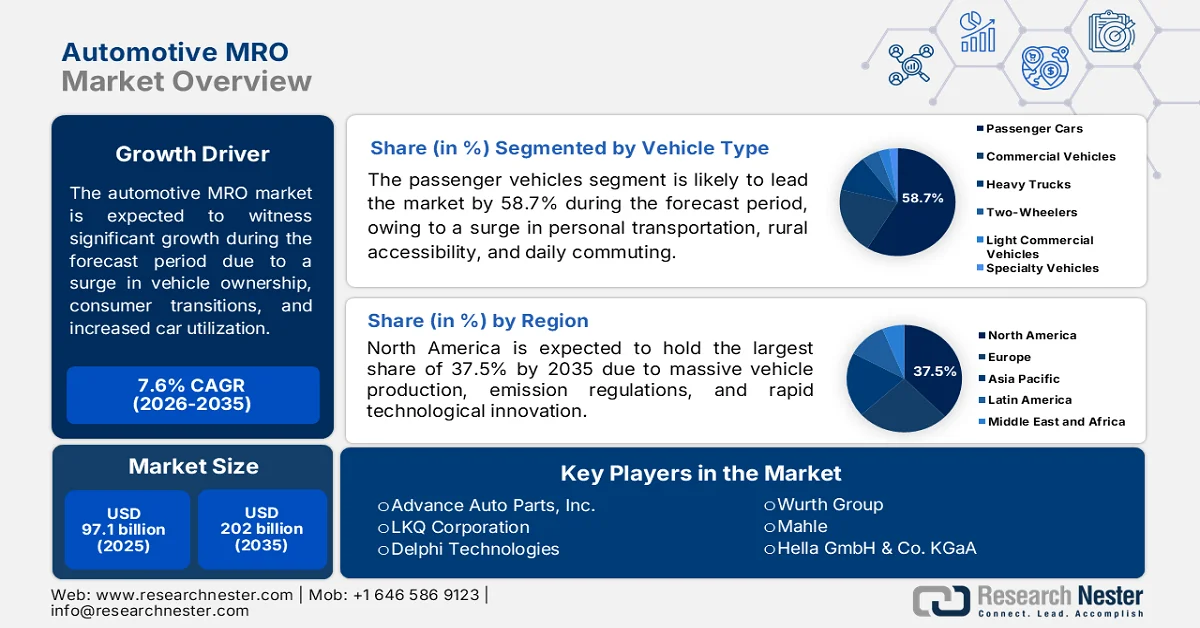
Automotive MRO Market size was valued at USD 97.1 billion in 2025 and is predicted to cross USD 202 billion by the end of 2035, expanding at more than 7.6% CAGR during the forecast period i.e., between 2026-2035. In 2026, the industry size of automotive MRO is estimated at USD 104.4 billion.
The global automotive MRO market is being readily reshaped due to supply chain realignments, demographic transitions in vehicle ownership, and the evolutionary nature of vehicle utilization patterns. According to official statistics published by the European Journal of Operational Research in September 2024, the automotive industry is considered a significant source of employment and economic activity, readily contributing 2.5% to 3% of the U.S. gross domestic product (GDP). Additionally, an estimated 1.5 billion direct employment opportunities exist, especially in auto manufacturing, along with further 7.2 million private sector jobs. Based on this continuous growth in the industry, there is a huge demand for different types of passenger cars, comprising various categories and expenses, which also denotes an optimistic outlook for the automotive MRO market growth.
Passenger Car Types and Expenses Analysis, 2022
|
Components |
Petrol 1.5 dm3 TSI 110 kW |
Diesel 2.0 dm3 TSI 110 kW |
Petrol and CNG 1.5 dm3 TGI 96 kW |
Petrol and PHEV 1.4 dm3 TSI 150 kW |
Petrol and MHV 1.5 dm3 TSI 110 kW |
Electric 80 kW |
||||
|
Vehicle Purchase Price |
22,796 |
27,360 |
23,196 |
34,396 |
25,836 |
54,396 |
||||
|
Selected Vehicle Service Life |
400,000 |
|||||||||
|
Average Hourly Price for Workshop Equipment and Maintenance |
37 |
41 |
||||||||
|
Mean Work Rime Repair for 1 Fault |
4 |
3.5 |
3.5 |
4 |
4 |
3.5 |
||||
|
Preventive Maintenance Interval |
15,000 |
20,000 |
||||||||
|
Average Working Time Per 1 Preventive Maintenance |
2 |
2 |
2.5 |
2.2 |
2.2 |
1.2 |
||||
|
Fuel Expenses |
31,376 |
23,485 |
26,312 |
23,101 |
30,784 |
17,584 |
||||
|
Operating Fluids, Oils, and Lubricants Expenses |
1,200 |
1,800 |
||||||||
|
Tires Expenses |
2,453 |
|||||||||
|
Accumulator Battery Expenses |
667 |
18,184 |
||||||||
|
Mandatory Expenses |
3,384 |
3,724 |
3,163 |
1,954 |
3,019 |
861 |
||||
|
Corrective Maintenance Expenses |
4,583 |
4,408 |
4,702 |
5,640 |
5,237 |
3,183 |
||||
|
Preventive Maintenance Expenses |
7,688 |
7,688 |
8,980 |
7,874 |
7,874 |
2,865 |
||||
|
Life Cycle Cumulative Expenses |
74,147 |
70,985 |
70,673 |
77,285 |
77,070 |
82,423 |
||||
|
Life Cycle Specific Expenses |
0.18 |
0.17 |
0.17 |
0.19 |
0.19 |
0.20 |
||||
Source: NLM
Furthermore, the transition from preventive to predictive maintenance, the aspect of subscription fatigue, OEM-based service approaches, 3D printing for on-demand replacement parts, and sustainability for fueling eco-certified maintenance operations are a few trends that are responsible for bolstering the automotive MRO market globally. As stated in an article published by the U.S. EPA Government in March 2026, both direct and indirect greenhouse gas emissions from transportation effectively accounted for 29% of overall emissions. Besides, in terms of only direct emissions, transportation is considered the largest contributor of 28% of emissions, particularly in the U.S. Moreover, transportation-based emissions from fossil fuel combustion surged by 19%, and as of 2022, the emission lowered by less than 1%, thereby enhancing the automotive MRO market demand globally.
Key Automotive MRO Market Insights Summary:
Regional Insights:
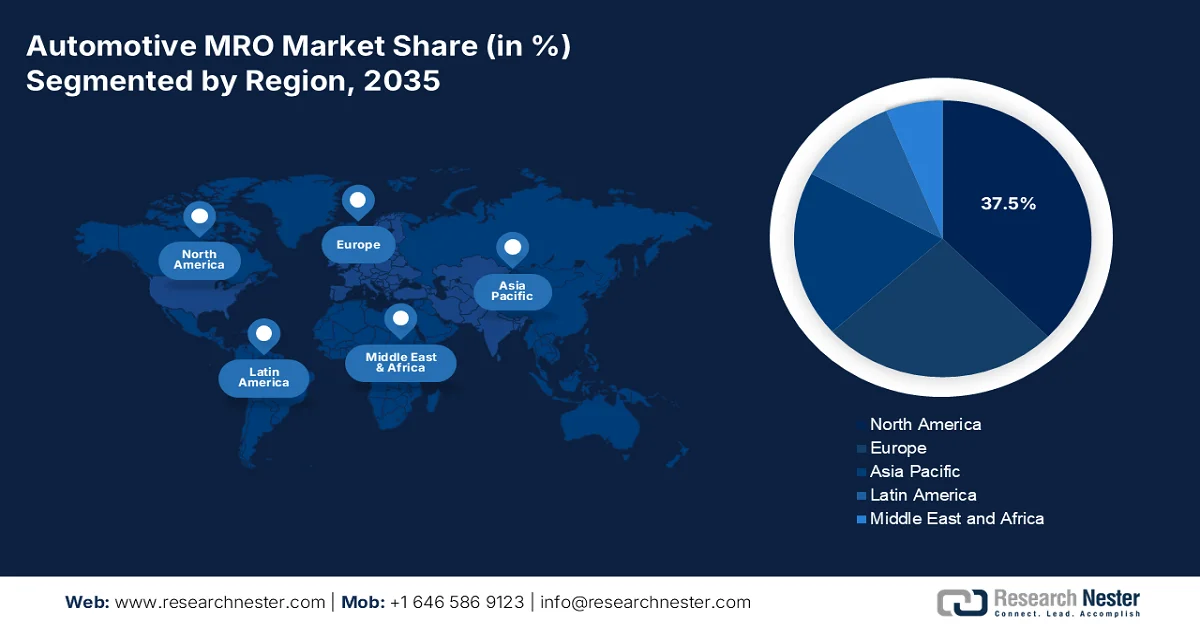
- North America automotive MRO market is projected to hold a dominant 37.5% share by 2035, attributed to the massive vehicle parc, strict safety and emission regulations, rapid technological adoption, aging vehicle fleet, and technological integration
- Asia Pacific is poised to witness the fastest growth in the market throughout 2026-2035, propelled by a surge in vehicle production, rising disposable incomes, expansion of the middle-class population, transition to electric vehicles, and enhancement of automotive safety along with environmental standards
Segment Insights:
- The passenger vehicles segment is anticipated to capture 58.7% of the automotive MRO market by 2035, reinforced by its dominant role in personal transportation for offering convenience, flexibility, and independence for daily commuting, rural accessibility, and emergency services
- The routine maintenance segment is expected to secure the second-largest share in the market during 2026-2035, fueled by the growing demand for preventive services, increasing vehicle lifespan, and rising consumer awareness regarding the economic advantages of regular vehicle upkeep
Key Growth Trends:
- Investments in infrastructure development
- Growth in two-wheeler vehicles
Major Challenges:
- Fragmented and inefficient supply chains
- Environmental and regulatory compliance burdens
Key Players: Robert Bosch GmbH (Germany), Continental AG (Germany), ZF Friedrichshafen AG (Germany), Denso Corporation (Japan), Valeo (France), Schaeffler AG (Germany), Aisin Corporation (Japan), Tenneco Inc. (U.S.), Magneti Marelli (Italy), Bridgestone Corporation (Japan), Michelin (France), Genuine Parts Company (U.S.), AutoZone, Inc. (U.S.), Advance Auto Parts, Inc. (U.S.), LKQ Corporation (U.S.), Delphi Technologies (UK), 3M Company (U.S.), Wurth Group (Germany), Mahle (Germany), Hella GmbH & Co. KGaA (Germany), Atlas Holdings (U.S.), REHAU Group (Switzerland), Agile Robotics (Germany), Fleetio (U.S.).
Global Automotive MRO Market Forecast and Regional Outlook:
Market Size & Growth Projections:
- 2025 Market Size: USD 97.1 billion
- 2026 Market Size: USD 104.4 billion
- Projected Market Size: USD 202 billion by 2035
- Growth Forecasts: 7.6% CAGR (2026–2035)
Key Regional Dynamics:
- Largest Region: North America (37.5% Share by 2035)
- Fastest Growing Region: Asia Pacific
- Dominating Countries: United States, China, Germany, Japan, India
- Emerging Countries: India, South Korea, Brazil, Mexico, Vietnam
Last updated on : 21 May, 2026
Automotive MRO Market - Growth Drivers and Challenges
Growth Drivers
- Investments in infrastructure development: The existence of large-scale infrastructure development projects, such as public transit expansion, bridge rehabilitation, urban development, and highway construction, is increasingly driving the automotive MRO market. Based on the July 2025 International Transport Forum article, countries that tend to spend less than 1% of their gross domestic product (GDP) on developing the latest inland transport facility are regarded as the most developed nations with mature transport systems. Besides, North Macedonia, Serbia, and China spent 2% of their GDP each on investing in road rehabilitation, highways, and related transport facilities. Meanwhile, Azerbaijan potentially attracted trade volume of nearly 230 million tons by upgrading transport hubs, which in turn, is proliferating the automotive MRO market upliftment.
- Growth in two-wheeler vehicles: These particular vehicles constitute the dominant form of personal mobility, especially across Africa, Latin America, and the Asia Pacific, which is also uplifting the automotive MRO market demand. As per an article published by the International Council on Clean Transportation in December 2025, over 85% of households in Indonesia, Thailand, and Vietnam, along with over 50% in India, readily own a two-wheeler. These vehicles serve diversified roles from regular commuting to taxi services and last-mile delivery across both rural and urban areas. Apart from this, China and India are considered the largest economies for these vehicles, significantly contributing to 28 million sales, which is over half of the 55 million global sales, thereby denoting an optimistic outlook for the automotive MRO market.
Challenges
- Fragmented and inefficient supply chains: The automotive MRO market operates through highly fragmented supply chains that create persistent inefficiencies for repair providers. Moreover, replacement parts, ranging from original equipment manufacturer components to aftermarket alternatives and recycled parts, flow through multiple intermediaries, including distributors, wholesalers, and logistics providers, before reaching the final service point. This particular fragmentation leads to several operational challenges: unpredictable delivery times, inconsistent parts quality across suppliers, inventory management difficulties, and complex returns processes for defective or incorrect components, thus limiting the automotive MRO market expansion.
- Environmental and regulatory compliance burdens: Facilities in the automotive MRO market readily operate under a rapid and complex network of environmental regulations that tend to impose necessary operational burdens. Moreover, repair shops usually generate different regulated waste streams, such as utilized oil, spent batteries, parts and cleaners, and contaminated solvents, each demanding suitable storage, documentation, handling, and disposal processes. Additionally, paint and body shops face stringent air quality regulations governing volatile organic compound emissions from painting operations. Apart from all these, compliance requires dedicated staff time for record-keeping, specialized storage equipment, contracts with licensed waste haulers, and regular facility inspections, which causes a hindrance to the market’s upliftment.
Automotive MRO Market Size and Forecast:
| Report Attribute | Details |
|---|---|
|
Base Year |
2025 |
|
Forecast Year |
2026-2035 |
|
CAGR |
7.6% |
|
Base Year Market Size (2025) |
USD 97.1 billion |
|
Forecast Year Market Size (2035) |
USD 202 billion |
|
Regional Scope |
|
Automotive MRO Market Segmentation:
Vehicle Type Segment analysis
Based on the vehicle type, the passenger vehicles segment is anticipated to grab the largest share of 58.7% in the automotive MRO market by the end of 2035. The segment’s upliftment is primarily attributed to its dominant role in personal transportation for offering convenience, unprecedented flexibility, and suitable independence for regular commuting, rural accessibility, and emergency services. For instance, as stated in the May 2026 Invest India Government article, there has been an estimated 9% increase in domestic passenger vehicle production, as well as quadricycles, two and three-wheelers, and commercial vehicles, between 2024 and 2025, which effectively reached 31 million units. Moreover, the share of electric vehicles in the country’s automotive industry is poised to reach more than 40% of share, while the foreign direct investment (FDI) inflow amounted to USD 37.8 billion in the industry in March 2025. Therefore, based on all these attributes, there is a huge growth opportunity and expansion of the segment globally.
Service Type Segment Analysis
During the forecast period, the routine maintenance segment, which is part of the service type, is projected to grab the second-largest share in the automotive MRO market. The segment’s growth is effectively driven by encompassing regularly scheduled, preventive services, including oil changes, tire rotations, fluid flushes, brake checks, and vehicle inspections. These services are typically performed at predetermined intervals and follow established protocols, making them predictable and essential for vehicle health. Besides, the rising average age of vehicles directly increases the frequency of required routine services as owners extend vehicle lifespans. Likewise, heightened consumer awareness about the economic benefits of preventive care encourages regular service adoption, while providers benefit from steady and recurring revenue streams through service contracts and customer loyalty programs, thus fueling the sub-segment’s growth.
Component Type Segment Analysis
The engine components segment, which is part of the component type, is expected to account for the third-largest share in the automotive MRO market by the end of the stipulated timeline. The segment’s development is highly propelled by foundational developmental blocks that readily function as the ultimate part of a vehicle for converting the chemical energy into mechanical kinetic energy. As stated in a data report published by the ACMA in September 2025, the automotive components industry is projected to reach a size of USD 200 billion by the end of 2030. This is highly fueled by innovations in alternative powertrain technologies, a rise in the need for premium automotive features, and a tactical position in the supply chain system. Moreover, the industry’s sales to OEMs are expected to surge from USD 62 billion as of 2024 to USD 89 billion by 2030, thereby making it suitable for boosting the segment’s exposure.
2024 Motor Vehicle Components Analysis
|
Countries/Components |
Export (USD) |
Import (USD) |
|
U.S. |
10.9 billion |
7.8 billion |
|
Germany |
10.5 billion |
9.0 billion |
|
China |
9.8 billion |
- |
|
Mexico |
- |
7.9 billion |
|
Global Trade Valuation |
99.5 billion |
|
|
Global Trade Share |
0.4% |
|
|
Product Complexity |
0.8 |
|
Source: OEC
Our in-depth analysis of the automotive MRO market includes the following segments:
|
Segment |
Subsegments |
|
Vehicle Type |
|
|
Service Type |
|
|
Component Type |
|
|
Service Provider |
|
|
Application |
|
|
Distribution Channel |
|

Vishnu Nair
Head - Global Business DevelopmentCustomize this report to your requirements — connect with our consultant for personalized insights and options.
Automotive MRO Market - Regional Analysis
North America Market Insights
North America in the automotive MRO market is anticipated to account for the highest share of 37.5% by the end of 2035. The market’s upliftment in the region is primarily attributed to the massive vehicle parc, strict safety and emission regulations, rapid technological adoption, aging vehicle fleet, and technological integration. According to official statistics published by the Argonne National Laboratory in 2024, the U.S. Department of Transportation (USDOT) has readily classified vehicle ranges from light-duty, with a weight of 0 to 14,000 lbs, which includes moving trucks, rental cars, and taxi cabs, along with medium-duty, ranging from 14,000 to 26,000 lbs, that are increasingly utilized in localized utility and delivery services. In addition, the USDOT has also classified heavy-duty fleets, with a 26,001 lbs weight, which are commonly utilized in commercial industries demanding huge hauling capabilities, thereby bolstering the automotive MRO market demand in the region.
2024 Cars, Tractors, and Trucks Export/Import Analysis in North America
|
Countries |
Export (USD) |
Import (USD) |
|
Mexico |
163.0 billion |
62.3 billion |
|
U.S. |
143.0 billion |
383.0 billion |
|
Canada |
56.2 billion |
87.8 billion |
|
Honduras |
69.7 million |
1.5 billion |
|
Guatemala |
63.6 million |
2.9 billion |
|
Dominican Republic |
42.8 million |
2.7 billion |
|
Panama |
29.8 million |
1.3 billion |
|
El Salvador |
26.9 million |
1.0 billion |
Source: OEC
The automotive MRO market is growing significantly in the U.S., owing to a significant aging vehicle fleet, complete recovery of vehicle miles driven, growth in specialized electric vehicle MRO, technological complexity, and right-to-repair capability, along with data accessibility. As stated in an article published by the World Resources Institute in April 2026, almost USD 200 billion in federal incentives have been announced in the country for electric vehicle manufacturing. However, there was a decline in electric vehicle sales by 4% as of 2025, based on which USD 19.9 billion has been planned in terms of manufacturing investments to re-establish the industry in the future. Besides, electric vehicles accounted for 9% of passenger cars, SUVs, and trucks in 2025, with more than 1.5 million sales for plug-in hybrid and battery electric vehicles. Moreover, this eventually resulted in suitable quarterly sales in the industry, which is responsible for boosting the automotive MRO market demand in the country.
2025 Electric Vehicle Quarterly Sales Analysis in the U.S.
|
Quarter |
Sales (USD) |
|
Quarter 1 |
372,219 |
|
Quarter 2 |
364,490 |
|
Quarter 3 |
481,996 |
|
Quarter 4 |
284,989 |
Source: World Resource Institute
The utilized vehicle exodus to the U.S., along with harsh geography and extreme climate, the electric vehicle adoption, highly consolidated e-commerce and distribution growth, and an increase in independent aftermarket share are certain factors that are responsible for boosting the automotive MRO market in Canada. As per an article published by the ITA in April 2026, the e-commerce retail trade sales in the country amounted to USD 3.8 billion as of 2020, which further increased to USD 41.7 billion in 2025, and is expected to reach USD 66.8 billion by the end of 2030. Besides, 68% of the population prefer and proactively seek out domestic products, while purchasing both offline and online, and this particular approach is intended to be considered while exporting products in the country, thereby making it suitable for driving the market’s growth and expansion.
APAC Market Insights
The Asia Pacific in the automotive MRO market is expected to emerge as the fastest-growing region during the forecast period. The market’s development in the region is highly propelled by a surge in vehicle production, a rise in disposable incomes, an increase in the middle-class population, a transition to electric vehicles, and the enhancement of automotive safety, along with environmental standards. According to official statistics published by the International Council on Clean Transportation in 2023, Thailand is projected to account for 20% to 25% of greenhouse gas emissions by the end of 2030, while Vietnam is focused on achieving 9% to 27% within the same duration. Based on this projection, 30% of domestic electric vehicle production in Thailand is poised to result in zero-emission vehicles, while Vietnam focuses on climate change adaptation and a green growth approach, thereby boosting the automotive MRO market in the overall region.
Present and Future Electric Vehicle Production in the Asia Pacific, 2022-2035
|
Countries |
Production Achievements |
||
|
Thailand |
2025: 30% of vehicle utilization and 10% of production |
2030: 50% vehicle utilization and 30% production |
2035: 100% vehicle utilization and 50% production |
|
Vietnam |
2022-2030: focus on production promotion and electric vehicle import |
2040: step-by-step production limitation and fossil fuel utilization for importing vehicles |
2050: 100% road motorization, which is powered by green and electric energy, along with electric buses and taxis |
|
Indonesia |
2025: 20% vehicle production |
2030: stock target of 2 m for PC electrified and 3 meter for MC electrified |
2035: 4 million 4-wheeler production, 2.5 million domestic use, 1.5 million export; 10.7 million motorcycle production, 9 million domestic use, and 1.7 million exports |
|
Philippines |
2030: 21% electric vehicles and 50% by 2040 |
Increase in e-vehicle adoption from 300,000 units by 2030 to 1.0 million units through clear regulations and increased awareness regarding the advantages of electric vehicles. |
|
|
Malaysia |
2030: governmental target, which includes 15% of the overall electric vehicle industry volume. |
||
Source: International Council on Clean Transportation
The automotive MRO market is gaining increased traction in China, owing to strong government policies, an increase in electric vehicle recycling facilities, sustainable MRO chemical development, domination in battery production, organizational partnerships, and regional battery diagnostics, along with remanufacturing hubs. As stated in an article published by the Kleinman Center for Energy Policy in October 2025, there are 50 electric battery policies in the country, based on which there was the successful purchase of 433% of electric vehicles as of 2024, in comparison to the U.S. Besides, the U.S. significantly imposed a 15% tariff on roughly USD 112 billion of the country’s imports. Moreover, the country comprises 24 lithium-ion battery-specific regulations, which are responsible for uplifting the market.
The aspects of aged commercial vehicles, a rise in vehicle ownership, optimized vehicle durability and supply chain dynamics, regulatory mandate for scan and digitalization tool adoption, surge in specialized electric vehicle demand, an expansion in e-commerce logistics, focus on battery recycling, and aging infrastructure are a few trends that are responsible for enhancing the automotive MRO market in Japan. The industry’s growth in the country amounted to USD 21.4 billion in 2024, which is further predicted to be worth USD 22.9 billion by 2026, and ultimately reach USD 34.8 billion by the end of 2035. Besides, as per the November 2025 ITA report, the country’s Ministry of Economy, Trade and Industry (METI) readily estimated the B2B e-commerce sales, which were worth USD 3.3 trillion as of 2024. Meanwhile, the B2C e-commerce was USD 176.8 billion, and the C2C e-commerce was USD 18 billion, thereby increasingly proliferating the market enhancement in the country.
C2C E-Commerce Industrial Analysis in Japan, 2018-2023
|
Year |
Industrial Growth (USD Billion) |
|
2018 |
9.9 |
|
2019 |
10.9 |
|
2020 |
12.3 |
|
2021 |
13.9 |
|
2022 |
14.8 |
|
2023 |
15.6 |
Source: ITA
Europe Market Insights
Europe in the automotive MRO market is projected to witness suitable expansion by the end of the stipulated timeline. The market’s growth in the region is effectively fueled by stringent environmental regulations, an increase in vehicle complexity, the accelerated shift to electric vehicles, suitable standards for emission reductions, and technological advancements. According to official statistics published by the Europe Environment Agency (EEA) in November 2025, more than 1.4 million new battery electric vehicles were registered in the region and accounted for 13.6% of the latest car registrations. In addition, 800,000 newest plug-in hybrid electric vehicles were also registered, catering to 7.3% of the latest car fleet, which further implied almost 2.2 million electric cars addition from 400,000 in the past years, thereby enhancing the market exposure.
New Registered Electric Cars in Europe, 2014-2024
|
Year |
Battery Electric Cars |
Plug-in Hybrid Cars |
Electric Cars Share |
|
2014 |
31,197 |
60,370 |
0.9% |
|
2015 |
46,857 |
84,115 |
1.2% |
|
2016 |
54,065 |
65,011 |
1.0% |
|
2017 |
83,491 |
88,334 |
1.4% |
|
2018 |
132,377 |
106,502 |
1.9% |
|
2019 |
242,966 |
137,632 |
2.9% |
|
2020 |
536,186 |
525,311 |
10.7% |
|
2021 |
878,092 |
862,569 |
18.0% |
|
2022 |
1,126,682 |
873,042 |
21.6% |
|
2023 |
1,545,768 |
824,608 |
22.5% |
|
2024 |
1,445,410 |
772,829 |
20.9% |
Source: EEA
The automotive MRO market is gaining increased exposure in Germany, owing to an increase in registered vehicles, consistent maintenance and repair demand, a surge in commercial vehicle density, the presence of automotive suppliers, suitable investments for ensuring innovations, growth in lubricants, and regulatory policies. As stated in an article published by the Clean Energy Wire in October 2024, there has been an upsurge in cars, reaching a record of 49.1 million at the beginning of 2024. Additionally, in the same year between January and August, there have been 0.3% few registrations of the newest cars. Despite this slight downfall, a 10-year comparison has demonstrated a significant increase in car density, accounting for 543 cars per 1,000 inhabitants in 2014 to 580 as of 2024. Therefore, with such an increase, the market is continuously expanding in the country.
The rapid motorization and growing vehicle parc, which is followed by an expansion in the independent aftermarket network, a rise in the demand for specialized car chemicals for manufacturing and production, the strategic location as a central regional logistics hub, and operational expenses, as well as competitive labor, are a few factors that are enhancing the automotive MRO market in Poland. As per an article published by the Polish Trade Government in April 2026, the automotive industry in the country readily exported vehicle-based products, with an overall valuation of USD 52.7 billion as of 2024. Besides, there are an estimated 205,000 people operating in the domestic industry, which is also enhancing the market growth and expansion. Moreover, the country is considered the 6th largest battery exporter, with an exceeded valuation of USD 8.1 billion, thus denoting an optimistic outlook for the market.
Key Automotive MRO Market Players:
- Robert Bosch GmbH (Germany)
- Continental AG (Germany)
- ZF Friedrichshafen AG (Germany)
- Denso Corporation (Japan)
- Valeo (France)
- Schaeffler AG (Germany)
- Aisin Corporation (Japan)
- Tenneco Inc. (U.S.)
- Magneti Marelli (Italy)
- Bridgestone Corporation (Japan)
- Michelin (France)
- Genuine Parts Company (U.S.)
- AutoZone, Inc. (U.S.)
- Advance Auto Parts, Inc. (U.S.)
- LKQ Corporation (U.S.)
- Delphi Technologies (UK)
- 3M Company (U.S.)
- Wurth Group (Germany)
- Mahle (Germany)
- Hella GmbH & Co. KGaA (Germany)
- Atlas Holdings (U.S.)
- REHAU Group (Switzerland)
- Agile Robotics (Germany)
- Fleetio (U.S.)
- Company Overview
- Business Strategy
- Key Product Offerings
- Financial Performance
- Key Performance Indicators
- Risk Analysis
- Recent Development
- Robert Bosch GmbH has strengthened its MRO presence through a vast network of independent repair workshops branded as Bosch Car Service. The company also supplies a wide range of replacement parts, diagnostic equipment, and aftermarket services for both conventional and electric vehicles.
- Continental AG has leveraged its original equipment expertise to supply high-quality aftermarket components, including braking systems, tires, and electronic controls. The company also provides digital solutions and technical training to support independent repair facilities worldwide.
- ZF Friedrichshafen AG offers a broad portfolio of remanufactured and new replacement parts for transmissions, axles, and steering systems through its aftermarket division. The company also provides diagnostic software and repair documentation to help workshops service modern, electronically controlled vehicles.
- Denso Corporation supplies a wide array of aftermarket components, including thermal systems, powertrain parts, and engine management electronics to repair shops globally. The company also collaborates with independent distributors to ensure the availability of its original equipment-quality replacement parts.
- Valeo increasingly provides aftermarket solutions focused on wiper systems, lighting, climate control, and electrical components for passenger and commercial vehicles. The company also offers technical support and training programs to help mechanics adapt to evolving vehicle technologies.
Here is a list of key players operating in the global automotive MRO market:
The global automotive MRO market is highly competitive, featuring a mix of diversified Tier-1 automotive suppliers and specialized aftermarket service providers. Key players are increasingly adopting strategic initiatives focused on digitalization and vertical integration. For instance, companies are launching AI-driven predictive maintenance platforms and acquiring software firms to enhance their repair execution capabilities. There is also a significant push towards expanding distribution networks by acquisitions and forming strategic partnerships with OEMs. For instance, in October 2024, Atlas Holdings signed an agreement with the REHAU Group for successfully acquiring REHAU Automotive. The purpose of this acquisition is focused on forming the latest global supplier for exterior vehicle components, which is positively impacting the automotive MRO industry across different regions.
Corporate Landscape of the Automotive MRO Market:
Recent Developments
- In March 2026, Robert Bosch GmbH effectively strengthened its U.S.-based mobility services portfolio by successfully acquiring Uptake Technologies, Inc., and created an escalation for capabilities in AI-specific predictive maintenance for vehicle fleets.
- In September 2025, Agile Robotics acquired the remaining shares of BMW Group’s spin-off idealworks, which readily underscored its ongoing confidence in innovation and technology.
- In March 2025, Fleetio completed the acquisition of Auto Integrate for a purchase price of USD 450 million, which is further valued at USD 1.5 billion for combined business operations for developing a consumer-centric platform to serve fleet operators across North America.
- Report ID: 8579
- Published Date: May 21, 2026
- Report Format: PDF, PPT
- Explore a preview of key market trends and insights
- Review sample data tables and segment breakdowns
- Experience the quality of our visual data representations
- Evaluate our report structure and research methodology
- Get a glimpse of competitive landscape analysis
- Understand how regional forecasts are presented
- Assess the depth of company profiling and benchmarking
- Preview how actionable insights can support your strategy
Explore real data and analysis
Frequently Asked Questions (FAQ)
About this Report
Connect with our Expert


Report, 2026-2035



Copyright @ 2026 Research Nester. All Rights Reserved.
