Global Wireless Charging in Automotive Applications for Smartphones Market
- An Outline of the Global Wireless Charging in Automotive Applications for Smartphones Market
- Market Definition and Segmentation
- Study Assumptions and Abbreviations
- Research Methodology & Approach
- Primary Research
- Secondary Research
- Data Triangulation
- SPSS Methodology
- Executive Summary
- Growth Drivers
- Major Roadblocks
- Opportunities
- Prevalent Trends
- Government Regulation
- Growth Outlook
- Competitive White Space Analysis – Identifying Untapped Market Gaps
- Risk Overview
- SWOT
- Technological Advancement
- Technology Maturity Matrix for Wireless Charging in Automotive Applications for Smartphones Market Recent News
- Regional Demand
- Global Wireless Charging in Automotive Applications for Smartphones by Geography – Strategic Comparative Analysis
- Strategic Segment Analysis: Wireless Charging in Automotive Applications for Smartphones Demand Landscape
- Wireless Charging in Automotive Applications for Smartphones Demand Trends Driven by Sustainability, Strategic Collaborations, and Regulatory Compliance (2026-2036)
- Root Cause Analysis (RCA) for discovering problems of the Wireless Charging in Automotive Applications for Smartphones Market
- Porter Five Forces
- PESTLE
- Comparative Positioning
- Global Wireless Charging in Automotive Applications for Smartphones – Key Player Analysis (2036)
- Competitive Landscape: Key Suppliers/Players
- Competitive Model: A Detailed Inside View for Investors
- Company Market Share, 2036 (%)
- Continental AG (Germany)
- Qualcomm Technologies, Inc. (U.S.)
- Samsung Electronics Co., Ltd. (South Korea)
- Panasonic Corporation (Japan)
- Hella GmbH & Co. KGaA (Germany)
- NXP Semiconductors N.V. (Netherlands)
- Infineon Technologies AG (Germany)
- Powermat Technologies Ltd. (Israel)
- Mojo Mobility, Inc. (U.S.)
- Aircharge (the UK)
- Global Wireless Charging in Automotive Applications for Smartphones Market Outlook
- Market Overview
- Market Revenue by Value (USD Thousand), Volume (Thousand Tons), and Compound Annual Growth Rate (CAGR)
- Wireless Charging in Automotive Applications for Smartphones Market Segmentation Analysis (2026-2036)
- By Technology
- Inductive Charging, Market Value (USD Thousand), and CAGR, 2026-2036F
- Resonant Charging, Market Value (USD Thousand), and CAGR, 2026-2036F
- RF-based Wireless Charging, Market Value (USD Thousand), and CAGR, 2026-2036F
- By Power Range
- Low Power (<5W), Market Value (USD Thousand), and CAGR, 2026-2036F
- Medium Power (5-15W), Market Value (USD Thousand), and CAGR, 2026-2036F
- High Power (>15W), Market Value (USD Thousand), and CAGR, 2026-2036F
- By Vehicle Type
- Passenger Cars, Market Value (USD Thousand), and CAGR, 2026-2036F
- Commercial Vehicles, Market Value (USD Thousand), and CAGR, 2026-2036F
- Others, Market Value (USD Thousand), and CAGR, 2026-2036F
- Regional Synopsis, Value (USD Thousand), 2026-2036
- North America Market Value (USD Thousand) and CAGR & Y-o-Y Growth Trend, 2026-2036F
- Europe Market Value (USD Thousand) and CAGR & Y-o-Y Growth Trend, 2026-2036F
- Asia Pacific Market Value (USD Thousand) and CAGR & Y-o-Y Growth Trend, 2026-2036F
- Latin America Market Value (USD Thousand) and CAGR & Y-o-Y Growth Trend, 2026-2036F
- Middle East and Africa Market Value (USD Thousand) and CAGR & Y-o-Y Growth Trend, 2026-2036F
- By Technology
- Market Overview
- North America Market
- Overview
- Market Value (USD Thousand), Current and Future Projections, 2026-2036
- Increment $ Opportunity Assessment, 2026-2036
- Segmentation (USD Thousand), 2026-2036, By
- By Technology
- Inductive Charging, Market Value (USD Thousand), and CAGR, 2026-2036F
- Resonant Charging, Market Value (USD Thousand), and CAGR, 2026-2036F
- RF-based Wireless Charging, Market Value (USD Thousand), and CAGR, 2026-2036F
- By Power Range
- Low Power (<5W), Market Value (USD Thousand), and CAGR, 2026-2036F
- Medium Power (5-15W), Market Value (USD Thousand), and CAGR, 2026-2036F
- High Power (>15W), Market Value (USD Thousand), and CAGR, 2026-2036F
- By Vehicle Type
- Passenger Cars, Market Value (USD Thousand), and CAGR, 2026-2036F
- Commercial Vehicles, Market Value (USD Thousand), and CAGR, 2026-2036F
- Others, Market Value (USD Thousand), and CAGR, 2026-2036F
- Country Level Analysis, Value (USD Thousand)
- U.S. Market Value (USD Thousand) and CAGR & Y-o-Y Growth Trend, 2026-2036F
- Canada Market Value (USD Thousand) and CAGR & Y-o-Y Growth Trend, 2026-2036F
- By Technology
- Overview
- Europe Market
- Overview
- Market Value (USD Thousand), Current and Future Projections, 2026-2036
- Increment $ Opportunity Assessment, 2026-2036
- Segmentation (USD Thousand), 2026-2036, By
- By Technology
- Inductive Charging, Market Value (USD Thousand), and CAGR, 2026-2036F
- Resonant Charging, Market Value (USD Thousand), and CAGR, 2026-2036F
- RF-based Wireless Charging, Market Value (USD Thousand), and CAGR, 2026-2036F
- By Power Range
- Low Power (<5W), Market Value (USD Thousand), and CAGR, 2026-2036F
- Medium Power (5-15W), Market Value (USD Thousand), and CAGR, 2026-2036F
- High Power (>15W), Market Value (USD Thousand), and CAGR, 2026-2036F
- By Vehicle Type
- Passenger Cars, Market Value (USD Thousand), and CAGR, 2026-2036F
- Commercial Vehicles, Market Value (USD Thousand), and CAGR, 2026-2036F
- Others, Market Value (USD Thousand), and CAGR, 2026-2036F
- Country Level Analysis, Value (USD Thousand)
- UK Market Value (USD Thousand) and CAGR & Y-o-Y Growth Trend, 2026-2036F
- Germany Market Value (USD Thousand) and CAGR & Y-o-Y Growth Trend, 2026-2036F
- France Market Value (USD Thousand) and CAGR & Y-o-Y Growth Trend, 2026-2036F
- Italy Market Value (USD Thousand) and CAGR & Y-o-Y Growth Trend, 2026-2036F
- Spain Market Value (USD Thousand) and CAGR & Y-o-Y Growth Trend, 2026-2036F
- Netherlands Market Value (USD Thousand) and CAGR & Y-o-Y Growth Trend, 2026-2036F
- Russia Market Value (USD Thousand) and CAGR & Y-o-Y Growth Trend, 2026-2036F
- Switzerland Market Value (USD Thousand) and CAGR & Y-o-Y Growth Trend, 2026-2036F
- Poland Market Value (USD Thousand) and CAGR & Y-o-Y Growth Trend, 2026-2036F
- Belgium Market Value (USD Thousand) and CAGR & Y-o-Y Growth Trend, 2026-2036F
- Rest of Europe Market Value (USD Thousand) and CAGR & Y-o-Y Growth Trend, 2026-2036F
- By Technology
- Overview
- Asia Pacific Market Excluding Japan
- Overview
- Market Value (USD Thousand), Current and Future Projections, 2026-2036
- Increment $ Opportunity Assessment, 2026-2036
- Segmentation (USD Thousand), 2026-2036, By
- By Technology
- Inductive Charging, Market Value (USD Thousand), and CAGR, 2026-2036F
- Resonant Charging, Market Value (USD Thousand), and CAGR, 2026-2036F
- RF-based Wireless Charging, Market Value (USD Thousand), and CAGR, 2026-2036F
- By Power Range
- Low Power (<5W), Market Value (USD Thousand), and CAGR, 2026-2036F
- Medium Power (5-15W), Market Value (USD Thousand), and CAGR, 2026-2036F
- High Power (>15W), Market Value (USD Thousand), and CAGR, 2026-2036F
- By Vehicle Type
- Passenger Cars, Market Value (USD Thousand), and CAGR, 2026-2036F
- Commercial Vehicles, Market Value (USD Thousand), and CAGR, 2026-2036F
- Others, Market Value (USD Thousand), and CAGR, 2026-2036F
- Country Level Analysis, Value (USD Thousand)
- China Market Value (USD Thousand) and CAGR & Y-o-Y Growth Trend, 2026-2036F
- India Market Value (USD Thousand) and CAGR & Y-o-Y Growth Trend, 2026-2036F
- South Korea Market Value (USD Thousand) and CAGR & Y-o-Y Growth Trend, 2026-2036F
- Australia Market Value (USD Thousand) and CAGR & Y-o-Y Growth Trend, 2026-2036F
- Indonesia Market Value (USD Thousand) and CAGR & Y-o-Y Growth Trend, 2026-2036F
- Malaysia Market Value (USD Thousand) and CAGR & Y-o-Y Growth Trend, 2026-2036F
- Vietnam Market Value (USD Thousand) and CAGR & Y-o-Y Growth Trend, 2026-2036F
- Thailand Market Value (USD Thousand) and CAGR & Y-o-Y Growth Trend, 2026-2036F
- Singapore Market Value (USD Thousand) and CAGR & Y-o-Y Growth Trend, 2026-2036F
- New Zealand Market Value (USD Thousand) and CAGR & Y-o-Y Growth Trend, 2026-2036F
- Rest of Asia Pacific Excluding Japan Market Value (USD Thousand) and CAGR & Y-o-Y Growth Trend, 2026-2036F
- By Technology
- Overview
- Japan Market
- Overview
- Market Value (USD Thousand), Current and Future Projections, 2026-2036
- Increment $ Opportunity Assessment, 2026-2036
- Segmentation (USD Thousand), 2026-2036, By
- By Technology
- Inductive Charging, Market Value (USD Thousand), and CAGR, 2026-2036F
- Resonant Charging, Market Value (USD Thousand), and CAGR, 2026-2036F
- RF-based Wireless Charging, Market Value (USD Thousand), and CAGR, 2026-2036F
- By Power Range
- Low Power (<5W), Market Value (USD Thousand), and CAGR, 2026-2036F
- Medium Power (5-15W), Market Value (USD Thousand), and CAGR, 2026-2036F
- High Power (>15W), Market Value (USD Thousand), and CAGR, 2026-2036F
- By Vehicle Type
- Passenger Cars, Market Value (USD Thousand), and CAGR, 2026-2036F
- Commercial Vehicles, Market Value (USD Thousand), and CAGR, 2026-2036F
- Others, Market Value (USD Thousand), and CAGR, 2026-2036F
- By Technology
- Overview
- Latin America Market
- Overview
- Market Value (USD Thousand), Current and Future Projections, 2026-2036
- Increment $ Opportunity Assessment, 2026-2036
- Year-on-Year Growth Forecast (%)
- Segmentation (USD Thousand), 2026-2036, By
- By Technology
- Inductive Charging, Market Value (USD Thousand), and CAGR, 2026-2036F
- Resonant Charging, Market Value (USD Thousand), and CAGR, 2026-2036F
- RF-based Wireless Charging, Market Value (USD Thousand), and CAGR, 2026-2036F
- By Power Range
- Low Power (<5W), Market Value (USD Thousand), and CAGR, 2026-2036F
- Medium Power (5-15W), Market Value (USD Thousand), and CAGR, 2026-2036F
- High Power (>15W), Market Value (USD Thousand), and CAGR, 2026-2036F
- By Vehicle Type
- Passenger Cars, Market Value (USD Thousand), and CAGR, 2026-2036F
- Commercial Vehicles, Market Value (USD Thousand), and CAGR, 2026-2036F
- Others, Market Value (USD Thousand), and CAGR, 2026-2036F
- Country Level Analysis, Value (USD Thousand)
- Brazil Market Value (USD Thousand) and CAGR & Y-o-Y Growth Trend, 2026-2036F
- Argentina Market Value (USD Thousand) and CAGR & Y-o-Y Growth Trend, 2026-2036F
- Mexico Market Value (USD Thousand) and CAGR & Y-o-Y Growth Trend, 2026-2036F
- Rest of Latin America Market Value (USD Thousand) and CAGR & Y-o-Y Growth Trend, 2026-2036F
- By Technology
- Overview
- Middle East & Africa Market
- Overview
- Market Value (USD Thousand), Current and Future Projections, 2026-2036
- Increment $ Opportunity Assessment, 2026-2036
- Year-on-Year Growth Forecast (%)
- Segmentation (USD Thousand), 2026-2036, By
- By Technology
- Inductive Charging, Market Value (USD Thousand), and CAGR, 2026-2036F
- Resonant Charging, Market Value (USD Thousand), and CAGR, 2026-2036F
- RF-based Wireless Charging, Market Value (USD Thousand), and CAGR, 2026-2036F
- By Power Range
- Low Power (<5W), Market Value (USD Thousand), and CAGR, 2026-2036F
- Medium Power (5-15W), Market Value (USD Thousand), and CAGR, 2026-2036F
- High Power (>15W), Market Value (USD Thousand), and CAGR, 2026-2036F
- By Vehicle Type
- Passenger Cars, Market Value (USD Thousand), and CAGR, 2026-2036F
- Commercial Vehicles, Market Value (USD Thousand), and CAGR, 2026-2036F
- Others, Market Value (USD Thousand), and CAGR, 2026-2036F
- Country Level Analysis, Value (USD Thousand)
- Saudi Arabia Market Value (USD Thousand) and CAGR & Y-o-Y Growth Trend, 2026-2036F
- UAE Market Value (USD Thousand) and CAGR & Y-o-Y Growth Trend, 2026-2036F
- Israel Market Value (USD Thousand) and CAGR & Y-o-Y Growth Trend, 2026-2036F
- Qatar Market Value (USD Thousand) and CAGR & Y-o-Y Growth Trend, 2026-2036F
- Kuwait Market Value (USD Thousand) and CAGR & Y-o-Y Growth Trend, 2026-2036F
- Oman Market Value (USD Thousand) and CAGR & Y-o-Y Growth Trend, 2026-2036F
- South Africa Market Value (USD Thousand) and CAGR & Y-o-Y Growth Trend, 2026-2036F
- Rest of Middle East & Africa Market Value (USD Thousand) and CAGR & Y-o-Y Growth Trend, 2026-2036F
- By Technology
- Overview
- Global Economic Scenario
- World Economic Outlook
- About Research Nester
- Our Global Clientele
- We Serve Clients Across World
Wireless Charging in Automotive Applications for Smartphones Market Outlook:
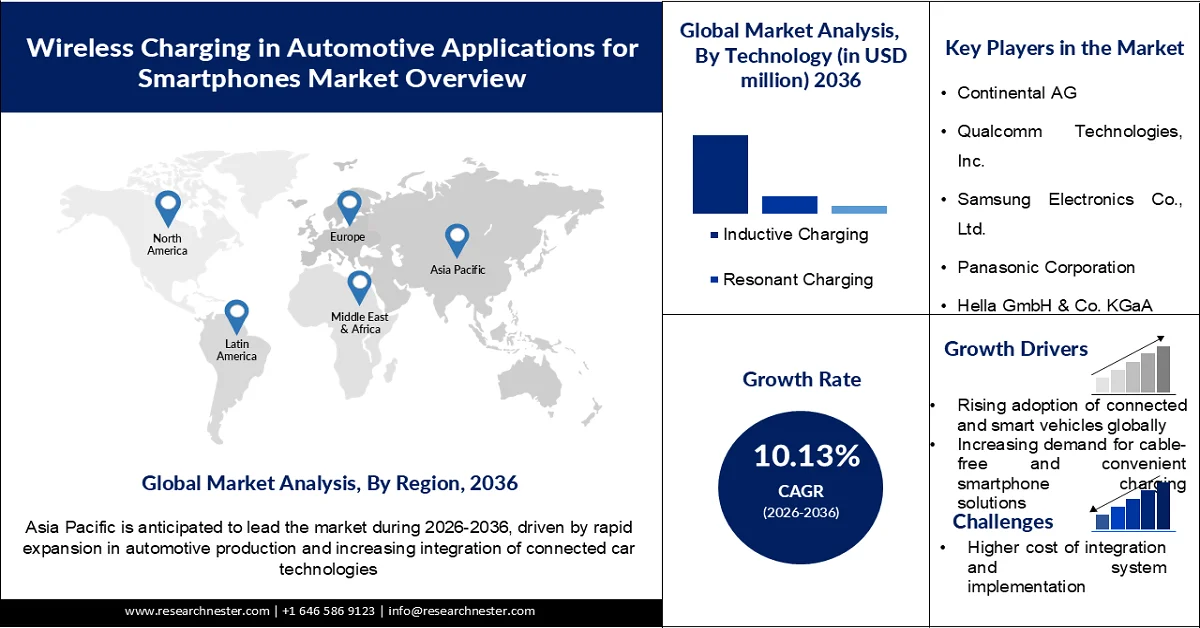
Wireless Charging in Automotive Applications for Smartphones Market is valued at USD 2.64 billion in 2025 and is projected to reach USD 7.81 billion by 2036, growing at a CAGR of 10.13% during the forecast period, i.e., 2026-2036. In 2026, the industry size of wireless charging in automotive applications for smartphones is evaluated at USD 2.97 billion.
The global market for wireless charging in automotive applications for smartphones market is expanding rapidly, driven largely by government‑backed electrification and smart‑mobility policies. These policies are accelerating EV adoption and prompting automakers to integrate advanced connectivity features, including in‑car wireless phone‑charging pads, as standard equipment. The U.S. federal government targets 50% of new passenger car and light truck sales to be electric vehicles by 2030, alongside 100% zero-emission vehicle acquisitions for the federal fleet by 2035. Public‑facing roadmaps from energy and transport agencies highlight large‑scale investments in EV infrastructure and grid‑integration systems, which indirectly support the proliferation of on‑board wireless charging for consumer devices. As electric and hybrid vehicles gain market share, each new model increasingly includes wireless‑charging capabilities to meet consumer demand for seamless, cable‑free device use. This alignment between regulatory‑driven vehicle electrification and premium‑convenience features makes in‑car smartphone wireless charging a key growth lever for the broader automotive electronics wireless charging in automotive applications for smartphones market. Consequently, the technology is shifting from a niche add‑on to a core feature in new vehicles, especially in passenger cars and high‑tech EVs. Government‑supported EV‑adoption targets and infrastructure‑development plans, therefore, function as the primary structural driver behind the global in‑vehicle wireless‑charging‑for‑smartphones market.
Key Wireless Charging in Automotive Applications for Smartphones Market Insights Summary:
Regional Highlights:
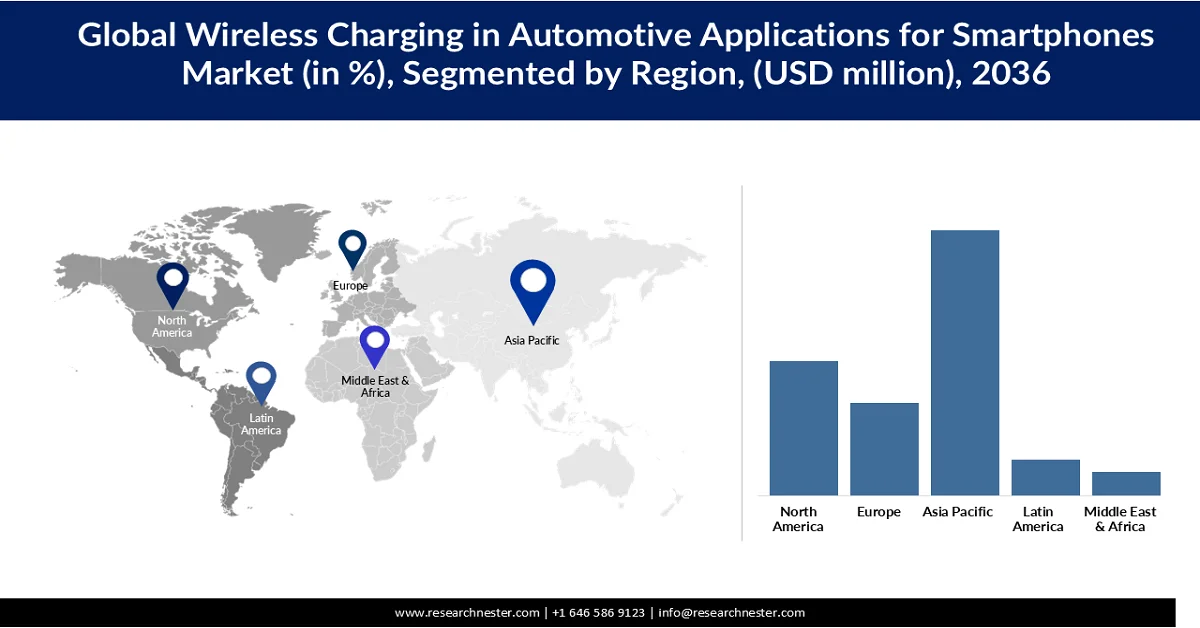
- Asia Pacific wireless charging in automotive applications for smartphones market is projected to capture 47.9% share by 2036, fueled by rapid expansion in automotive production and increasing integration of connected car technologies.
- North America is anticipated to account for 22.3% share by 2036, attributed to strong adoption of electric vehicles, advanced infotainment systems, and rising preference for seamless in-car connectivity.
Segment Insights:
- The inductive charging segment in the wireless charging in automotive applications for smartphones market is forecast to dominate with a 73% share by 2036, propelled by widespread adoption, reliability, and compatibility with established standards such as Qi.
- The medium power (5–15W) segment is expected to secure 65% share by 2036, impelled by its optimal balance between charging speed, efficiency, and safety for in-car. smartphone use
Key Growth Trends:
- Government incentives and funding
- Expanding charging infrastructure
Major Challenges:
- High integration costs and design constraints
- Charging efficiency and performance limitations
Key Players: Continental AG (Germany), Qualcomm Technologies, Inc. (U.S.), Samsung Electronics Co., Ltd. (South Korea), Panasonic Corporation (Japan), Hella GmbH & Co. KGaA (Germany), NXP Semiconductors N.V. (Netherlands), Infineon Technologies AG (Germany), Powermat Technologies Ltd. (Israel), Mojo Mobility, Inc. (U.S.), Aircharge (the UK).
Global Wireless Charging in Automotive Applications for Smartphones Market Forecast and Regional Outlook:
Market Size & Growth Projections:
- 2025 Market Size: USD 2.64 billion
- 2026 Market Size: USD 2.97 billion
- Projected Market Size: USD 7.81 billion by 2036
- Growth Forecasts: 10.13% CAGR (2026-2036)
Key Regional Dynamics:
- Largest Region: Asia Pacific (47.9% Share by 2036)
- Fastest Growing Region: Europe
- Dominating Countries: United States, China, Germany, Japan, South Korea
- Emerging Countries: India, Brazil, Mexico, Indonesia, Vietnam
Last updated on : 31 March, 2026
Wireless Charging in Automotive Applications for Smartphones Market - Growth Drivers and Challenges
Growth Drivers
- Government incentives and funding: Financial support and policy incentives are accelerating the integration of wireless charging systems in vehicles by encouraging investment in EVs and smart mobility technologies. Subsidies and R&D funding also enable automakers to adopt advanced in-car smartphone charging solutions, boosting wireless charging in automotive applications for smartphones market growth. Federal programs like the Bipartisan Infrastructure Law (BIL) and the Inflation Reduction Act (IRA) provide substantial financial support to accelerate EV adoption by reducing upfront costs and enabling infrastructure buildout. In January 2025, the U.S. Department of Transportation’s Federal Highway Administration (FHWA) announced USD 635 million in grants under the Bipartisan Infrastructure Law to expand EV charging and alternative fueling infrastructure. The funding supports 49 projects, enabling the deployment of over 11,500 EV charging ports and fueling stations across 27 states, four federally recognized tribes, and the District of Columbia.
- Expanding charging infrastructure: The rapid expansion of EV charging infrastructure is accelerating the adoption of connected and electrified vehicles, creating a favorable environment for integrating wireless smartphone charging systems in cars. As vehicles become more technologically advanced and user-centric, in-car wireless charging is increasingly included as a standard convenience feature, driving wireless charging in automotive applications for smartphones market growth. Rapid deployment of public charging stations addresses range anxiety, making EVs practical for everyday and long-distance travel nationwide. Public EV chargers have doubled to over 206,000 ports since 2021, with 38,000 new public chargers added in 2024 alone via federal and private efforts.
- Declining costs and rising demand: Lower production costs and improved supply chain efficiencies are making wireless charging systems more affordable for integration into modern vehicles. As economies of scale strengthen, automakers are increasingly offering this feature across mid-range and entry-level segments in addition to premium models. At the same time, rising consumer demand for convenience and clutter-free interiors is accelerating the shift toward cable-free charging solutions. The growing reliance on smartphones for navigation, entertainment, and connectivity within vehicles further supports adoption. Automakers are enhancing user experience through faster and more efficient charging technologies. Increasing competition among manufacturers is also driving innovation while maintaining competitive pricing. Collectively, these factors are significantly driving the growth of wireless charging for smartphones in automotive applications.
Challenges
- High integration costs and design constraints: Integrating wireless charging systems into vehicles involves additional costs related to components, design modifications, and compatibility with different smartphone models. Automakers must ensure optimal placement and alignment within limited cabin space, which can complicate interior design. Thermal management is another concern, as wireless charging generates heat that must be controlled to maintain safety and performance. These factors increase development complexity and can limit adoption, especially in budget vehicle segments. As a result, cost sensitivity remains a key challenge for widespread implementation.
- Charging efficiency and performance limitations: Wireless charging systems generally offer lower efficiency and slower charging speeds compared to wired alternatives, which can affect user satisfaction. Misalignment between the smartphone and the charging pad can further reduce performance and charging consistency. Interference from vehicle movement or vibrations may also impact charging stability during driving. Additionally, varying standards and device compatibility create challenges for seamless operation. These limitations can hinder user experience and slow down the adoption of wireless charging solutions in automotive applications.
Wireless Charging in Automotive Applications for Smartphones Market Size and Forecast:
| Report Attribute | Details |
|---|---|
|
Base Year |
2025 |
|
Forecast Year |
2026-2036 |
|
CAGR |
10.13% |
|
Base Year Market Size (2025) |
USD 2.64 billion |
|
Forecast Year Market Size (2036) |
USD 7.81 billion |
|
Regional Scope |
|
Wireless Charging in Automotive Applications for Smartphones Market Segmentation:
Technology Segment Analysis
The inductive charging segment is expected to hold 73% of the wireless charging in automotive applications for smartphones market share, due to its widespread adoption, reliability, and compatibility with established standards such as Qi. Automakers prefer inductive systems because they are cost-effective, easy to integrate into vehicle interiors, and support a wide range of smartphones. The technology offers stable performance with minimal alignment complexity compared to alternatives, enhancing user convenience. Continuous improvements in charging speed and efficiency are further strengthening its appeal. Additionally, its strong presence across both premium and mid-range vehicles is expanding the addressable market. As a result, inductive charging remains the primary contributor to segment expansion.
Power Range Segment Analysis
The medium power (5–15W) segment is expected to hold a 65% wireless charging in automotive applications for smartphones market share by 2036. It offers an optimal balance between charging speed, efficiency, and safety for in-car smartphone use and meets consumer expectations for faster charging without excessive heat generation, making it suitable for most automotive applications. Automakers widely adopt this range as it aligns with standard wireless charging specifications and ensures compatibility across devices. Its cost-effectiveness compared to high-power systems further supports integration across mid-range and premium vehicles. Additionally, consistent performance during driving conditions enhances user experience and reliability. As a result, the medium power segment holds a dominant share and significantly contributes to overall wireless charging in automotive applications for smartphones market expansion.
Passenger Car Segment Analysis
The passenger car segment is expected to grow with a CAGR of 10.08% between 2026 and 2036, due to the high volume of production and increasing consumer demand for advanced in-car convenience features. Automakers are increasingly integrating wireless smartphone charging systems as standard or optional features in passenger vehicles to enhance the user experience. Rising adoption of connected cars and smart infotainment systems is further supporting this trend. Additionally, growing consumer preference for comfort, convenience, and clutter-free interiors is accelerating demand. The expansion of electric and hybrid passenger vehicles is also contributing to higher integration of wireless charging technologies. As a result, passenger cars remain the primary contributor to overall wireless charging in automotive applications for smartphones market growth.
Our in-depth analysis of the wireless charging in automotive applications for smartphones market includes the following segments:
|
Segments |
Subsegments |
|
Technology |
|
|
Power Range |
|
|
Vehicle Type |
|

Vishnu Nair
Head - Global Business DevelopmentCustomize this report to your requirements — connect with our consultant for personalized insights and options.
Wireless Charging in Automotive Applications for Smartphones Market - Regional Analysis
Asia Pacific Market Insights
The wireless charging in automotive applications for smartphones market in the Asia Pacific is expected to grow with a market share of 47.9% by 2036, driven by rapid expansion in automotive production and increasing integration of connected car technologies. Rising smartphone penetration and demand for in-car convenience features are accelerating adoption across passenger vehicles. Additionally, growing EV adoption and government-backed smart mobility initiatives are creating a favorable ecosystem for wireless charging integration. Continuous advancements in inductive charging technology and cost reductions are further supporting wireless charging in automotive applications for smartphones market expansion across the region.
China's public charging infrastructure for electric vehicles expanded dramatically as of early 2024, supporting the nation's rapid transition to EVs despite ongoing barriers like charger access in rural areas. According to the 2024 ICCT report (data through 2023), China has built the world’s largest public charging infrastructure network, with its public charger base reaching 1 million units, accounting for 51% of the global total, and a combined rated power surpassing 56 gigawatts as of 2022. Moreover, China has developed the world’s largest public charging infrastructure network, with approximately 1 million public chargers representing 51% of the global total and a combined rated capacity exceeding 56 gigawatts as of 2022.
Japan market is growing steadily, driven by strong innovation in automotive and electronics technologies. The country is a major hub for R&D, with organizations allocating significant funding for next-generation automotive technologies, including wireless charging. Japan’s advanced automotive industry, led by companies such as Toyota and Honda, is actively integrating wireless charging systems into vehicles. Additionally, Japan's exports of electrical and electronic equipment were USD 101.96 billion during 2025, according to the United Nations COMTRADE database on international trade. As a result, Japan remains a key contributor to innovation and steady growth in the wireless charging in automotive applications for smartphones market.
North America Market Insights
North America wireless charging in automotive applications for smartphones market is expected to grow with a share of 22.3% by 2036, supported by strong adoption of electric vehicles, advanced infotainment systems, and increasing consumer preference for seamless in-car connectivity. The region benefits from a mature automotive ecosystem and early integration of wireless charging technologies in passenger vehicles. Growing investments in EV infrastructure and smart mobility solutions are further accelerating adoption. Additionally, the increasing reliance on smartphones for navigation, entertainment, and communication is driving demand for integrated wireless charging systems. Continuous technological advancements and premium vehicle penetration are reinforcing market growth across the region.
The U.S. market is witnessing robust growth, driven by the rapid expansion of EV infrastructure and high consumer demand for connected vehicle features. According to the International Energy Agency, the country had nearly 200,000 public EV charging points by the end of 2024, reflecting strong infrastructure development. Additionally, U.S. public charging ports reached 168,000 by June 2024, with significant year-on-year growth and widespread deployment across states. This expanding charging ecosystem is encouraging automakers to integrate wireless charging technologies in vehicles. Government initiatives and funding programs further support innovation and adoption, making the U.S. a key contributor to regional wireless charging in automotive applications for smartphones market growth.
Canada wireless charging in automotive applications for smartphones market is growing steadily, supported by increasing investments in clean transportation and EV infrastructure. The expansion of public charging networks across urban and highway corridors is improving accessibility and encouraging EV adoption. Canada is also part of the broader North American charging network expansion, which includes widespread deployment of charging stations across major regions, as highlighted by data from organizations such as the Federal Reserve Bank of Chicago. Rising environmental awareness and government-backed sustainability initiatives are further driving demand for advanced in-car technologies, including wireless smartphone charging. As EV adoption increases and connected vehicle ecosystems evolve, Canada continues to contribute to the steady growth of the market.
Europe Market Insights
The Europe market for wireless charging in automotive applications for smartphones market is expanding steadily, driven by rapid EV adoption, strong regulatory frameworks, and increasing integration of connected car technologies. The region has witnessed significant growth in charging infrastructure, with public EV charging points surpassing 1 million in 2024, growing over 35% year-on-year. Supportive policies such as the EU’s Alternative Fuels Infrastructure Regulation (AFIR) are accelerating deployment of charging networks and smart mobility solutions. Rising demand for convenience, premium in-car features, and seamless smartphone integration is further boosting adoption. Additionally, the expansion of connected ecosystems and digital infotainment systems is strengthening the wireless charging in automotive applications for smartphones market outlook across Europe.
Germany represents one of the leading wireless charging in automotive applications for smartphones market in Europe, supported by its strong automotive industry and aggressive EV adoption targets. The government aims to deploy 15 million electric vehicles by 2030, highlighting long-term growth potential. In 2023, the country already had 2.3 million EVs on the road, with EVs accounting for nearly 24.6% of new vehicle registrations. Charging infrastructure is expanding rapidly, with over 116,000 public charging points in 2023, reflecting a 30% annual increase. Additionally, government investments exceeding USD 2.9 billion in charging infrastructure by 2024 are accelerating deployment. This strong ecosystem of EV adoption, infrastructure expansion, and innovation is driving demand for in-vehicle wireless smartphone charging solutions.
France is witnessing steady growth, supported by government-backed electrification strategies and infrastructure expansion. The country had approximately 155,000 public charging points by 2024, making it one of the largest networks in Europe. France is also targeting 400,000 public charging stations by 2030, reflecting strong policy support for EV adoption. Rapid infrastructure expansion is evident, with tens of thousands of new chargers added annually, improving accessibility nationwide. Increasing EV penetration, coupled with consumer demand for advanced in-car connectivity and convenience features, is driving the integration of wireless charging technologies. As a result, France is emerging as a key contributor to the regional market’s steady growth.
Key Wireless Charging in Automotive Applications for Smartphones Market Players:
- Continental AG (Germany)
- Qualcomm Technologies, Inc. (U.S.)
- Samsung Electronics Co., Ltd. (South Korea)
- Panasonic Corporation (Japan)
- Hella GmbH & Co. KGaA (Germany)
- NXP Semiconductors N.V. (Netherlands)
- Infineon Technologies AG (Germany)
- Powermat Technologies Ltd. (Israel)
- Mojo Mobility, Inc. (U.S.)
- Aircharge (the UK)
- Company Overview
- Business Strategy
- Key Product Offerings
- Financial Performance
- Key Performance Indicators
- Risk Analysis
- Recent Development
- Regional Presence
- SWOT Analysis
- Continental AG is a leading automotive supplier integrating Qi-based wireless charging directly into vehicle interiors such as center consoles and dashboards. The company holds a strong market position due to early adoption and partnerships with major OEMs like Volkswagen and BMW. Its solutions emphasize seamless integration without compromising cabin design and space. Continental focuses heavily on improving charging efficiency, alignment tolerance, and thermal management. It has captured a notable share of the market through OEM-centric deployment strategies.
- Qualcomm Technologies plays a crucial role by developing high-efficiency wireless power transfer technologies and chipsets used in automotive charging systems. The company leverages its expertise in power management and electromagnetic resonance to enable faster charging (15W and above). Qualcomm collaborates with automakers and Tier-1 suppliers to integrate advanced charging solutions into connected vehicles. Its innovations also support multi-device charging and improved interoperability. This positions Qualcomm as a key enabler of next-generation in-car charging ecosystems.
- Samsung Electronics contributes through its leadership in Qi wireless charging technology, widely adopted in smartphones and extended into automotive applications. The company provides components and solutions that ensure compatibility between smartphones and in-car charging systems. Its strong ecosystem of mobile devices helps standardize wireless charging adoption across vehicles. Samsung also focuses on enhancing charging speed, safety, and device interoperability. Its presence strengthens the integration between consumer electronics and automotive platforms.
- Hella GmbH & Co. KGaA specializes in automotive electronics and has developed integrated wireless charging modules tailored for vehicle interiors. The company leverages its expertise in lighting and electronic systems to deliver compact, high-performance charging solutions. Hella focuses on safety, electromagnetic compatibility, and durability under automotive conditions. It works closely with OEMs to embed charging systems into next-generation vehicle designs. Its innovations support reliable performance even under vibration and temperature variations.
- Panasonic Corporation is a key player offering automotive-grade wireless charging systems and electronic components. The company focuses on delivering high-reliability solutions that meet strict automotive safety and quality standards. Panasonic collaborates with automakers to integrate wireless charging into infotainment and cockpit systems. It emphasizes energy efficiency, compact design, and long-term durability. Its broad expertise in automotive electronics strengthens its position in both OEM and aftermarket segments.
Below is the list of the key players operating in the global wireless charging in automotive applications for smartphones market:
Key players are accelerating the wireless charging in automotive applications for smartphones market by integrating advanced charging technologies directly into vehicle interiors, enhancing convenience and user experience. They are investing in faster, multi-device charging solutions aligned with standards like Qi, ensuring compatibility across a wide range of smartphones. Automakers and technology firms are forming strategic partnerships to embed wireless charging modules seamlessly into infotainment systems and center consoles. Additionally, continuous R&D is focused on improving charging efficiency, thermal management, and alignment tolerance to deliver reliable in-vehicle performance. Mergers, collaborations, and product innovations are further enabling companies to expand their global footprint and strengthen their competitive edge in this rapidly evolving segment.
Corporate Landscape of the Global Wireless Charging in Automotive Applications for Smartphones Market:
Recent Developments
- Qualcomm announced that its subsidiary, Qualcomm Technologies, Inc., has finalized the acquisition of Autotalks, a recognized leader in direct vehicle-to-everything (V2X) communication technologies. V2X solutions enabling seamless interaction between vehicles and their surrounding environment are playing an increasingly vital role in improving road safety and overall transportation efficiency. With this acquisition, automakers and the wider mobility ecosystem will benefit from access to a robust portfolio of production-ready, automotive-grade global V2X solutions, supporting deployment across vehicles, roadside infrastructure, and two-wheelers.
- Report ID: 8489
- Published Date: Mar 31, 2026
- Report Format: PDF, PPT
- Explore a preview of key market trends and insights
- Review sample data tables and segment breakdowns
- Experience the quality of our visual data representations
- Evaluate our report structure and research methodology
- Get a glimpse of competitive landscape analysis
- Understand how regional forecasts are presented
- Assess the depth of company profiling and benchmarking
- Preview how actionable insights can support your strategy
Explore real data and analysis
Frequently Asked Questions (FAQ)
About this Report
Connect with our Expert


Report, 2026-2036



Copyright @ 2026 Research Nester. All Rights Reserved.
