Private Electric Vehicle Charging Station Market Outlook:
Private Electric Vehicle Charging Station Market size was valued at USD 8.9 billion in 2025 and is poised to exceed USD 72.8 billion by the end of 2035, registering over 23.4% CAGR during the forecast period, i.e., 2026-2035. In 2026, the industry size of private electric vehicle charging station is assessed at USD 10.9 billion.
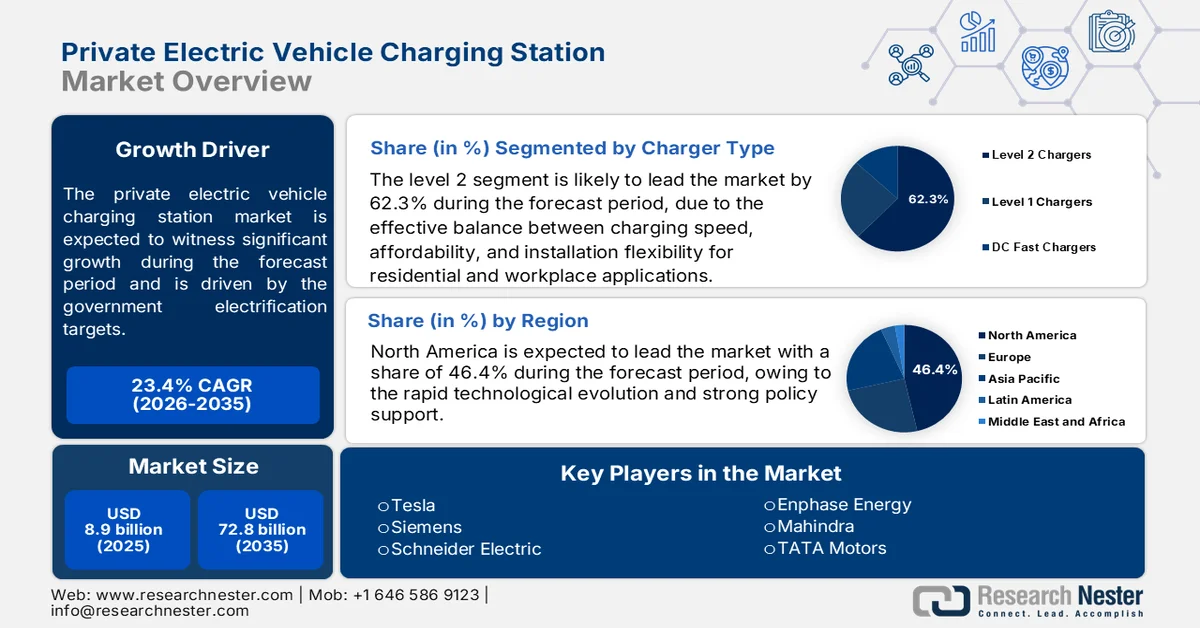
Private electric vehicle charging station demand is expanding in line with rising EV ownership, government electrification targets, and increasing investments in residential and workplace charging infrastructure. The market is largely supported by the fact that most EV charging activity occurs at private locations rather than public sites, making home and dedicated fleet charging a critical component of overall charging capacity. According to the International Energy Agency (IEA) 2025 data, global electric car sales exceeded 17 million units in 2024, representing continued growth from previous years and increasing the installed base requiring regular charging access. Government incentive programs, tax credits, and building electrification policies across North America, Europe, and Asia-Pacific are encouraging installation of private charging equipment in residential developments, commercial properties, and fleet depots.
The market is also benefiting from broader power-sector modernization and renewable energy integration initiatives. Private charging stations are increasingly being deployed alongside distributed energy resources, including rooftop solar systems and stationary battery storage, enabling users to manage energy costs and reduce peak-demand exposure. Meanwhile, the IEA reported that the global stock of electric cars surpassed 58 million vehicles in 2024, creating a substantial installed base that depends heavily on private charging availability. As vehicle adoption expands across mature and emerging markets, private charging infrastructure is expected to remain the primary charging channel, supporting both passenger vehicle owners and commercial fleet operators while complementing public charging network development.
Key Private Electric Vehicle Charging Station Market Insights Summary:
Regional Highlights:
- North America is anticipated to capture 46.4% share of the private electric vehicle charging station market by 2035, bolstered by the rapid adoption of smart, networked charging solutions integrated with home energy systems
- Asia Pacific is expected to witness rapid growth during 2026-2035, fueled by intense innovation in ultra-fast charging technologies and smart energy management systems
Segment Insights:
- Level 2 chargers are projected to account for 62.3% share of the private electric vehicle charging station market by 2035, supported by their effective balance between charging speed, affordability, and installation flexibility for residential and workplace applications.
- Residential homes are expected to maintain the largest share during 2026-2035, propelled by the convenience of overnight home charging and rising EV adoption.
Key Growth Trends:
- Rising government incentives for residential EV charging infrastructure
- Public investment in grid modernization and electrification
Major Challenges:
- High infrastructure costs
- Interoperability and standards
Key Players: Tesla (U.S.),Siemens (Germany),Schneider Electric (France),Enphase Energy (U.S.),Mahindra (India),TATA Motors (India).
Global Private Electric Vehicle Charging Station Market Forecast and Regional Outlook:
Market Size & Growth Projections:
- 2025 Market Size: USD 8.9 billion
- 2026 Market Size: USD 10.9 billion
- Projected Market Size: USD 72.8 billion by 2035
- Growth Forecasts: 23.4% CAGR (2026-2035)
Key Regional Dynamics:
- Largest Region: North America (46.4% share by 2035)
- Fastest Growing Region: Asia Pacific
- Dominating Countries: United States, China, Germany, Japan, Canada
- Emerging Countries: India, South Korea, Australia, Singapore, Thailand
Last updated on : 14 July, 2026
Private Electric Vehicle Charging Station Market - Growth Drivers and Challenges
Growth Drivers
- Rising government incentives for residential EV charging infrastructure: Government-funded incentive programs remain one of the strongest demand drivers for private EV charging stations. Financial support in the form of tax credits, rebates, grants, and installation subsidies reduces upfront costs for homeowners and businesses, accelerating charger deployment. In the United States, the Alternative Fuel Vehicle Refueling Property Credit provides a tax credit of up to 30% of charging equipment and installation costs in eligible locations, as per the IRS May 2026 data. Across Europe, several countries continue to offer grants for residential charger installations as part of broader transport decarbonization strategies. These measures improve charger affordability while supporting national EV adoption targets.
- Public investment in grid modernization and electrification: Government spending on electricity infrastructure is creating favorable conditions for private EV charger deployment. Modernized grids improve power reliability, increase network capacity, and support managed charging technologies. The U.S. Department of Energy June 2026 data announced approximately USD 3.46 billion in Grid Resilience and Innovation Partnerships (GRIP) funding to strengthen transmission and distribution systems. For charging equipment providers, grid modernization creates opportunities to offer advanced energy management solutions alongside charging hardware. Strong government investment in electricity systems is therefore emerging as a foundational driver supporting private EV charging station adoption.
Challenges
- High infrastructure costs: The capital required for manufacturing and deploying charging units is immense, from R&D to grid upgrades. Companies like Tesla address this by vertically integrating production and utilizing its Supercharger network to spread costs, while ChargePoint partners with property owners to share installation expenses, making market entry more feasible.
- Interoperability and standards: Lack of universal charging standards creates compatibility issues across vehicle models. Siemens tackles this by developing open-protocol charging systems that work with multiple networks, while ABB actively participates in standardization committees to ensure their equipment communicates seamlessly with various EV platforms and software ecosystems.
Private Electric Vehicle Charging Station Market Size and Forecast:
| Report Attribute | Details |
|---|---|
|
Base Year |
2025 |
|
Forecast Year |
2026-2035 |
|
CAGR |
23.4% |
|
Base Year Market Size (2025) |
USD 8.9 billion |
|
Forecast Year Market Size (2035) |
USD 72.8 billion |
|
Regional Scope |
|
Private Electric Vehicle Charging Station Market Segmentation:
Charger Type Segment Analysis
Level 2 chargers lead the charger type segment in the private electric vehicle charging station market and are poised to hold the regional revenue share of 62.3% by the end of 2035. The segment is driven because they provide an effective balance between charging speed, affordability, and installation flexibility for residential and workplace applications. Their compatibility with most battery-electric vehicles and plug-in hybrids makes them the preferred charging solution for daily use. Growing EV adoption is accelerating demand for this charger category. According to the Pubs Online March 2026 data, the U.S. will require 2.13 million Level 2 public chargers, in addition to an estimated 17 million consumer-installed home chargers, to support future EV deployment. This underscores the central role of Level 2 technology in expanding private charging infrastructure.
Installation Location Segment Analysis
Residential homes account for the largest share of the private electric vehicle charging station market, as most EV owners prefer the convenience of overnight charging at home. Home charging eliminates reliance on public infrastructure, lowers charging costs, and supports routine vehicle usage patterns. Growing EV adoption, favorable utility programs, and government incentives for home charger installation continue to strengthen this segment. According to the U.S. Department of Energy February 2026 data, about 80% of EV charging occurs at home, making residential properties the primary charging location for electric vehicle owners. As EV penetration increases globally, demand for reliable and smart residential charging solutions is expected to remain the key growth driver for private charging infrastructure.
Power Output Segment Analysis
The 7 kW–22 kW category dominates the private electric vehicle charging station market because it offers practical charging performance for residential homes, apartment complexes, and workplace installations. Chargers within this range can replenish vehicle batteries overnight or during working hours without requiring the high installation costs associated with DC fast charging systems. The segment benefits from increasing deployment of Level 2 charging solutions, which typically operate within this power range. According to the U.S. Department of Energy’s Alternative Fuels Data Center, the number of public EV charging ports in the United States surging, with Level 2 chargers accounting for the majority of installed ports, reinforcing demand for the 7 kW–22 kW range.
Our in-depth analysis of the private electric vehicle charging station market includes the following segments:
|
Segment |
Subsegments |
|
Power Output |
|
|
Charger Type |
|
|
Payment Method |
|
|
Installation Location |
|
|
End user |
|

Vishnu Nair
Head - Global Business DevelopmentCustomize this report to your requirements — connect with our consultant for personalized insights and options.
Private Electric Vehicle Charging Station Market - Regional Analysis
North America Market Insights
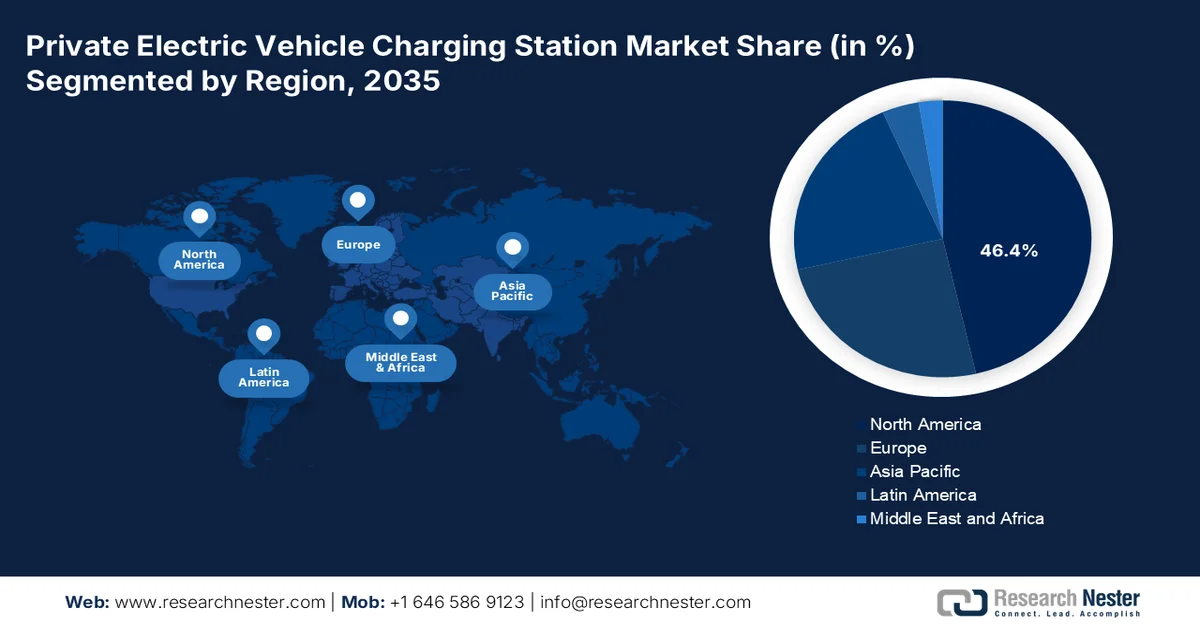
North America is dominating the private electric vehicle charging station market and is expected to hold the regional revenue share of 46.4% by the end of 2035. The region is characterized by rapid technological evolution and strong policy support. The region is witnessing a significant shift toward smart, networked charging solutions that integrate with home energy systems and enable load management. Driven by growing environmental consciousness and corporate sustainability goals, both residential and commercial adoption is accelerating. Key trends include the convergence of charging infrastructure with renewable energy sources like solar, the emergence of bidirectional charging capabilities, and increased collaboration between automakers, utilities, and technology firms to create seamless user experiences and enhance grid resilience.
The rising EV ownership encourages homeowners, multifamily housing operators, and commercial fleet managers to install dedicated charging infrastructure is shaping the private electric vehicle charging station market in the U.S. Demand is supported by federal incentives, workplace electrification initiatives, and increasing integration of charging systems with home energy management solutions. A key indicator of market potential is that the U.S. Energy Information Administration (EIA) December 2024 data reported battery-electric vehicles accounted for 7.4% of all new light-duty vehicle sales in 2024, up from previous years, expanding the addressable base for private charging installations. Growth opportunities are particularly strong in residential communities, corporate campuses, and fleet depots seeking reliable charging access.
The increasing EV adoption drives demand for residential, condominium, workplace, and fleet charging infrastructure is shaping the private electric vehicle charging station market in Canada. Federal and provincial programs supporting vehicle electrification, along with building policies encouraging EV-ready developments, are strengthening charger installations across urban and suburban areas. The Government of Canada March 2026 data reported that zero-emission vehicles represented 15.4% of all new electric vehicle registrations in 2024, reflecting continued expansion of the EV user base that relies heavily on private charging access. As EV ownership broadens nationwide, demand for home and commercial charging solutions is expected to remain strong.
APAC Market Insights
The Asia Pacific is projected to emerge rapidly during the assessed period, 2026 to 2035 in the private electric vehicle charging station market. the region is driven by the intense innovation in ultra-fast charging technologies and smart energy management systems. Key trends include aggressive infrastructure expansion in urban centers, integration with smart city initiatives, and growing adoption in residential complexes. There is significant collaboration between automakers, technology firms, and utility providers to develop customized solutions. The market is also characterized by varying regulatory frameworks, with some countries implementing strong mandates while others focus on incentive-based adoption, all contributing to a dynamic and competitive landscape.
The rising electric two-wheeler, passenger vehicle, and commercial fleet adoption increases the need for home and workplace charging solutions is shaping the private electric vehicle charging station market in India. Government initiatives promoting e-mobility, residential charging access, and electrification of transport are encouraging investments in private charging infrastructure across urban centers. The NITI Aayog August 2025 data recorded more than 2.08 million electric vehicle registrations in 2024, demonstrating strong growth in the EV fleet requiring regular charging access. This expanding vehicle base is creating sustained demand for private charging installations in residential and commercial settings.
The large and growing electric vehicle fleet is driving the private electric vehicle charging station market in China. Demand is being driven by residential charging installations in urban housing developments, workplace charging projects, and private charging solutions for commercial vehicle operators. According to data released by the Oxford Institute for Energy Studies in March 2026, new energy vehicle (NEV) production reached 16 million units in 2024, reflecting strong growth in the number of vehicles requiring regular charging access. The rapid expansion of the EV parc, combined with supportive electrification policies and smart-grid investments, is encouraging continued deployment of private charging infrastructure across residential and commercial applications.
Europe Market Insights
The Europe private electric vehicle charging station market is highly dynamic, driven by stringent environmental regulations and ambitious climate targets across the region. The market is characterized by strong standardization efforts, ensuring interoperability across borders for seamless user experience. A major focus is on integrating charging infrastructure with smart grid technologies and renewable energy sources to enhance sustainability. Key trends include the rapid deployment of workplace and multi-tenant residential charging solutions, alongside growing interest in bidirectional charging. Additionally, European utilities and automakers are forming strategic alliances to develop innovative business models, emphasizing energy management and grid services.
The strong focus on transport electrification, residential energy transition initiatives, and growing adoption of EVs by households and corporate fleets is driving the private electric vehicle charging station market in Germany. Demand for home and workplace charging infrastructure is increasing as property owners seek convenient charging access and compliance with EV-ready building requirements. The European Comission January 2025 data reported that 380,609 battery-electric passenger cars were newly registered in 2024, highlighting a substantial and growing vehicle base that depends heavily on private charging solutions. This trend is creating sustained opportunities for residential, multifamily, and commercial charging installations.
The UK private electric vehicle charging station market is witnessing steady growth as increasing numbers of households, landlords, and businesses install dedicated charging infrastructure to support vehicle electrification. Demand is strengthened by workplace charging requirements, residential charging convenience, and government policies encouraging the transition to zero-emission transport. According to the Fleet News April 2025 data, 1,334,246 licensed plug-in vehicles were on the road in the United Kingdom at the end of 2024, demonstrating a substantial installed EV base that relies heavily on private charging facilities. As EV ownership continues to expand, investment in home, multifamily residential, and workplace charging infrastructure is expected to remain a key market growth driver.
Key Private Electric Vehicle Charging Station Market Players:
- Tesla (U.S.)
- Siemens (Germany)
- Schneider Electric (France)
- Enphase Energy (U.S.)
- Mahindra (India)
- TATA Motors (India)
- Company Overview
- Business Strategy
- Key Product Offerings
- Financial Performance
- Key Performance Indicators
- Risk Analysis
- Recent Development
- Regional Presence
- SWOT Analysis
- Tesla integrates its ecosystem by linking its private electric vehicle charging station market data with vehicle telematics. This connectivity allows for smarter energy management and remote diagnostics. By utilizing station usage patterns, Tesla optimizes battery performance and charging schedules, ensuring efficiency.
- Siemens leverages its expertise in automation within the private electric vehicle charging station market to create intelligent charging infrastructure. Their systems utilize data analytics to manage grid loads and ensure stability. By incorporating real-time station data, Siemens enables predictive maintenance and efficient energy distribution.
- Schneider Electric focuses on energy management by integrating its solutions with the private electric vehicle charging station market. Their platforms use station data to balance energy consumption and integrate renewable sources seamlessly. This ensures efficient power usage and grid resilience.
- Enphase Energy connects its solar and storage systems with the private electric vehicle charging station market to create a comprehensive home energy ecosystem. Their technology utilizes station data to intelligently manage solar energy distribution, prioritizing EV charging during peak production.
- Mahindra is advancing its mobility solutions by incorporating data from the private electric vehicle charging station market. This integration aids in developing robust fleet management and optimizing charging infrastructure. By analyzing usage patterns, Mahindra enhances vehicle efficiency and supports the creation of a reliable charging network.
Here is a list of key players operating in the global private electric vehicle charging station market:
The global market for private electric vehicle charging stations is moderately consolidated, dominated by a mix of established automation giants and specialized energy firms. Key leaders leverage broad geographic footprints and comprehensive smart-home integration capabilities to secure market share. The competitive dynamics are characterized by intense innovation in power output, connectivity, and design aesthetics, with European and North American manufacturers holding strong regional positions. Differentiation increasingly hinges on bi-directional charging functionality, load management software, and seamless integration with photovoltaic systems, creating a clear divide between premium full-solution providers and value-focused alternatives.
Corporate Landscape of the Market:
Recent Developments
- In November 2025, Mahindra announced the plans to set up 250 electric vehicle charging stations, each with 180 kW, with over 1,000 charging points by the end of 2027. This is part of the company's vision to UNLIMIT electric mobility through its Charge_IN ultrafast charging network, aligning with the government’s priority of strengthening public EV charging infrastructure to accelerate EV adoption in India.
- In May 2025, TATA.ev inaugurated its first 10 TATA.ev MegaChargers. In association with ChargeZone and Statiq, the launch of these high-speed chargers shortly follows the commitment made by TATA.ev to boost e-mobility in India by more than doubling the number of available charge points to 400,000 by 2027.
- Report ID: 6548
- Published Date: Jul 14, 2026
- Report Format: PDF, PPT
- Explore a preview of key market trends and insights
- Review sample data tables and segment breakdowns
- Experience the quality of our visual data representations
- Evaluate our report structure and research methodology
- Get a glimpse of competitive landscape analysis
- Understand how regional forecasts are presented
- Assess the depth of company profiling and benchmarking
- Preview how actionable insights can support your strategy
Explore real data and analysis
Frequently Asked Questions (FAQ)
About this Report
Connect with our Expert


Report, 2026-2035



Copyright @ 2026 Research Nester. All Rights Reserved.
