Electric Vehicle Range Extender Market Outlook:
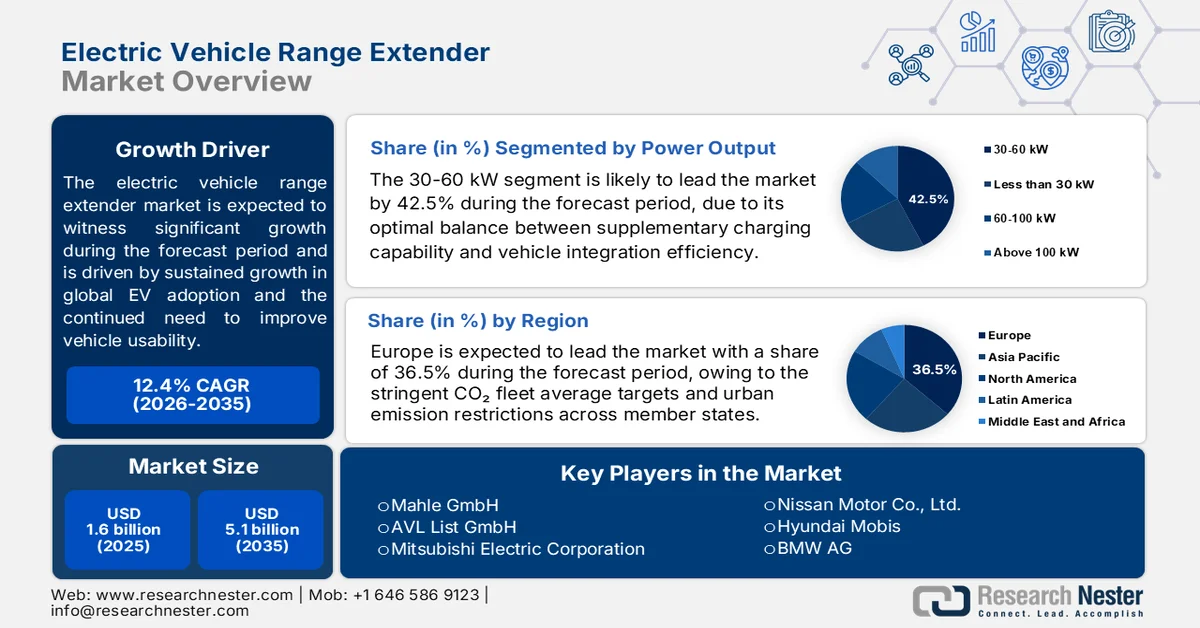
Electric Vehicle Range Extender Market size was valued at USD 1.6 billion in 2025 and is expected to cross USD 5.1 billion by the end of 2035, expanding at more than 12.4% CAGR during the forecast period, i.e., 2026-2035. In 2026, the industry size of electric vehicle range extender is estimated at USD 1.8 billion.
The electric vehicle range extender market is benefiting from sustained growth in global EV adoption and the continued need to improve vehicle usability across regions where charging infrastructure remains uneven. According to the International Energy Agency (IEA) May 2025 data, global electric car sales exceeded 17 million units, representing more than 20% of total new car sales worldwide. This rapid expansion is increasing demand for solutions that support longer travel distances, particularly in commercial fleets, light-duty logistics, and rural mobility applications where charging availability may be limited. The ICCT April 2025 data reports that the U.S. had more than 204,000 publicly accessible charging ports by 2024, yet charging coverage remains concentrated in urban corridors, creating operational challenges for long-distance and fleet users.
Government investments are also accelerating infrastructure deployment. The U.S. National Electric Vehicle Infrastructure (NEVI) Formula Program in February 2022 has allocated USD 5 billion to support charging networks across designated highway corridors, but nationwide deployment will require multiple years. As a result, vehicle manufacturers and fleet operators continue to evaluate technologies that can extend operational driving range while supporting compliance with emissions reduction objectives and improving asset utilization rates. Growing EV volumes, infrastructure expansion timelines, and stricter regulatory requirements collectively create favorable conditions for continued investment and commercialization activities across the electric vehicle range extender value chain.
Key Electric Vehicle Range Extender Market Insights Summary:
Regional Highlights:
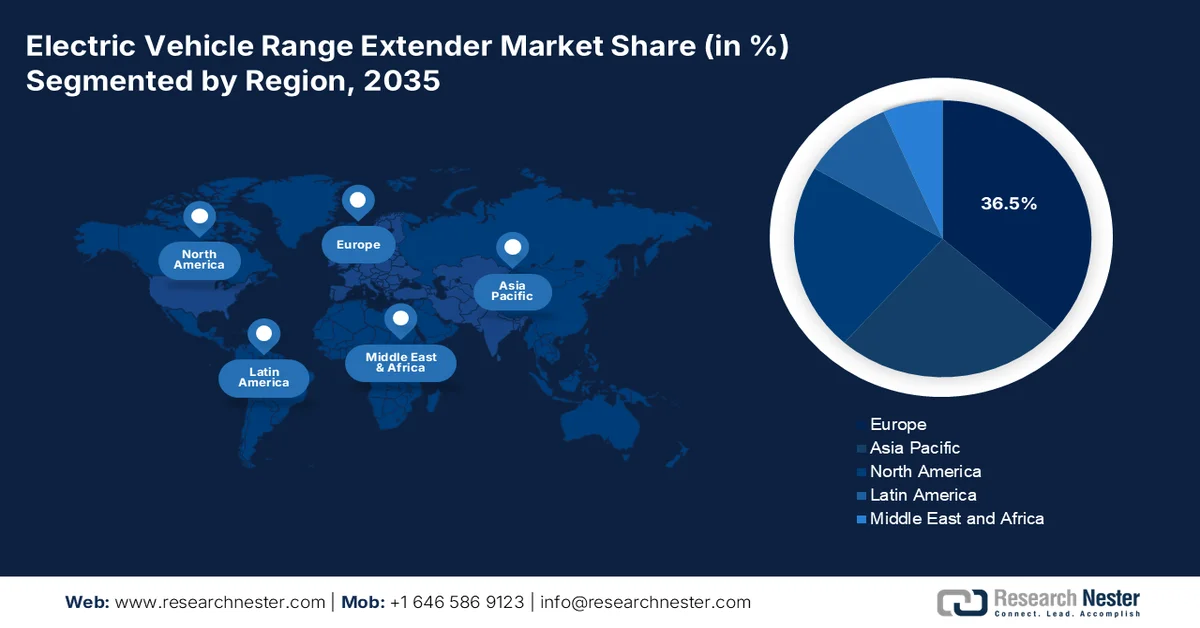
- By 2035, europe is anticipated to capture 36.5% of the electric vehicle range extender market, underpinned by stringent CO₂ fleet targets and urban emission restrictions across member states
- Asia Pacific is set to witness accelerated expansion across 2026–2035, fueled by integrated supply chains and rising preference for smaller battery packs paired with efficient low-displacement range extenders
Segment Insights:
- The 30–60 kW power segment of the electric vehicle range extender market is projected to account for 42.5% share by 2035, supported by its optimal balance between supplementary charging capability and vehicle integration efficiency
- The range extender engine/generator unit segment is forecast to secure the leading revenue share by 2035, attributed to its critical role in determining vehicle efficiency, fuel consumption, and overall range extension capability
Key Growth Trends:
- Government funding for freight and commercial vehicle electrification
- National grid modernization investments supporting EV expansion
Major Challenges:
- Stringent emissions and noise regulations
- Consumer perception and range anxiety transference
Key Players: Mahle GmbH (Germany), AVL List GmbH (Austria), Mitsubishi Electric Corporation (Japan), Nissan Motor Co., Ltd. (Japan), Hyundai Mobis (South Korea), BMW AG (Germany), Kubota Corporation (Japan), Fiat Powertrain Technologies (Italy), MAHLE Aftermarket Inc. (U.S.), Delta Electronics, Inc. (U.S.), Bosch Limited (India), Mahindra & Mahindra Ltd. (India), Lucid Group, Inc. (U.S.), Tesla, Inc. (U.S.), GKN Automotive (Melrose Industries) (UK), Nidec Corporation (Japan), LG Innotek (South Korea), Protean Electric (REE Automotive) (U.S.), IM Motor (China), ZF (Germany).
Global Electric Vehicle Range Extender Market Forecast and Regional Outlook:
Market Size & Growth Projections:
- 2025 Market Size: USD 1.6 billion
- 2026 Market Size: USD 1.8 billion
- Projected Market Size: USD 5.1 billion by 2035
- Growth Forecasts: 12.4% CAGR (2026-2035)
Key Regional Dynamics:
- Largest Region: Europe (36.5% Share by 2035)
- Fastest Growing Region: Asia Pacific
- Dominating Countries: China, Germany, United States, Japan, South Korea
- Emerging Countries: India, South Korea, Vietnam, Brazil, Indonesia
Last updated on : 3 June, 2026
Electric Vehicle Range Extender Market - Growth Drivers and Challenges
Growth Drivers
- Government funding for freight and commercial vehicle electrification: Demand for electric vehicle range extenders is being strengthened by public investment in commercial vehicle decarbonization programs, particularly where fleet operators require long-distance capability. The WRI April 2024 data indicated that nearly USD 1 billion is allocated through the Clean Heavy-Duty Vehicles Program in 2024 to support the deployment of zero-emission trucks and buses. Range extender systems offer an intermediate pathway for organizations electrifying large vehicle fleets while maintaining operational continuity. As government-funded vehicle replacement programs expand, OEMs and fleet managers increasingly evaluate extended-range architectures to maximize vehicle utilization rates and support service coverage in areas with limited charging availability.
- National grid modernization investments supporting EV expansion: Power grid investments are indirectly supporting demand for EV range extenders by enabling broader vehicle electrification while exposing transitional capacity constraints. The Climate Program Portal October 2024 data shows the U.S. Department of Energy announced up to USD 3.5 billion through the Grid Resilience and Innovation Partnerships (GRIP) Program to modernize electricity infrastructure. As EV adoption increases, utilities and fleet operators are managing challenges associated with peak electricity demand, charging loads, and regional grid reliability. Range extender-equipped vehicles provide additional operational flexibility where charging schedules may be affected by power constraints or infrastructure upgrades.
Challenges
- Stringent emissions and noise regulations: Regulatory fragmentation across markets forces manufacturers to develop multiple variants of the same range extender. Europe's Euro 7 norms demand near-zero particulate emissions from any onboard combustion source, while China's GB standards focus on different test cycles. Though the global electric vehicle range extender market is expected to grow, despite Euro 7 compliance in after-treatment systems.
- Consumer perception and range anxiety transference: Consumers purchasing EREVs often report a new form of anxiety, fear of the range extender activating loudly or consuming fuel. Manufacturers must overcome the perception that range extenders represent incomplete electrification. Surveys indicate potential EREV buyers worry about the resale value of dual-power trains.
Electric Vehicle Range Extender Market Size and Forecast:
| Report Attribute | Details |
|---|---|
|
Base Year |
2025 |
|
Forecast Year |
2026-2035 |
|
CAGR |
12.4% |
|
Base Year Market Size (2025) |
USD 1.6 billion |
|
Forecast Year Market Size (2035) |
USD 5.1 billion |
|
Regional Scope |
|
Electric Vehicle Range Extender Market Segmentation:
Power Output Segment Analysis
Under the power output, the 30-60 kW power is dominating in the electric vehicle range extender market and is poised to hold the share value of 42.5% by the end of 2035. The segment is driven due to its optimal balance between supplementary charging capability and vehicle integration efficiency. This power class is ideally suited for compact and mid-sized passenger EREVs as it provides sufficient on-demand electricity to maintain battery state of charge during highway cruising without overwhelming the vehicle's thermal or acoustic envelope. Major automakers favor this configuration because it extends real-world driving range by approximately 150–250 kilometers while preserving the electric-only driving experience. Furthermore, this power segment enables cost-effective platform sharing across multiple vehicle models, from sedans to light commercial vans. As charging infrastructure gaps persist globally, the 20–50 kW range extender represents the pragmatic "sweet spot" for mass-market electrification, balancing range confidence, vehicle affordability, and manufacturing simplicity. Its versatility explains its projected dominance through 2035.
Component Segment Analysis
The range extender engine/generator unit is leading the component in the electric vehicle range extender market, projected to hold the largest revenue share by 2035. This assembly serves as the physical heart of any range extender system, combining a combustion engine with a generator to convert fuel into electrical energy for the battery and electric motor. Its high share value stems from containing the most mechanically complex and material-intensive subsystems, including the engine block, crankshaft or eccentric shaft, alternator windings, and power rectification electronics. Automakers prioritize investment in this component because its efficiency directly determines the vehicle's fuel consumption, noise characteristics, and overall range extension capability. Unlike auxiliary components such as thermal management units or control modules, the engine/generator assembly cannot be commoditized easily, ensuring its continued revenue dominance through the forecast period.
Sales Channel Segment Analysis
OEM is leading the sales channel in the electric vehicle range extender market, as automakers integrate range extenders during vehicle assembly. According to the Italian Trade Agency June 2023 Report on the Development of China's Extended Range Electric Vehicle (EREV) Industry, EREV sales in China alone are expected to exceed 500,000 units by 2025. This factory-only production volume reinforces why aftermarket retrofits remain a niche channel. CAAM's collaboration with industry bodies highlights that Chinese OEMs, including Li Auto, Seres (AITO), and Leapmotor are driving mass production of factory-fit range extenders.
Our in-depth analysis of the electric vehicle range extender market includes the following segments:
|
Segment |
Subsegments |
|
Range Extender Type |
|
|
Vehicle Type |
|
|
Power Output |
|
|
Component |
|
|
Sales Channel |
|

Vishnu Nair
Head - Global Business DevelopmentCustomize this report to your requirements — connect with our consultant for personalized insights and options.
Electric Vehicle Range Extender Market - Regional Analysis
Europe Market Insights
The Europe is dominating the electric vehicle range extender market and is expected to hold the regional revenue share of 36.5% by the end of 2035. The market is shaped by stringent CO₂ fleet average targets and urban emission restrictions across member states. Automakers adopt range extenders to qualify for partial zero-emission vehicle compliance while maintaining long-distance capability for cross-border travel. Western European markets favor compact, low-displacement range extenders integrated into premium and commercial vehicles, prioritizing noise reduction and thermal efficiency. Eastern Europe shows stronger demand for range extenders in light commercial fleets due to slower charging infrastructure deployment. German and Austrian engineering firms lead development of rotary and hydrogen-based range extender technologies. The electric vehicle range extender market also benefits from standardization efforts across the European Union, enabling cross-border homologation of extended-range electric vehicles without per-country certification redundancies.
The rising EV adoption following changes in government incentive programs is driving the electric vehicle range extender market in Germany. According to the ITA November 2024 data, EV registrations increased significantly between 2019 and 2022, with the share of electric vehicles in new passenger car registrations rising from 3% in 2019 to 31.4% in 2022. However, following the gradual withdrawal of purchase subsidies for battery electric vehicles (BEVs) and plug-in hybrid electric vehicles (PHEVs), the EV share declined to 25% in 2023. This shift has heightened industry focus on solutions that improve vehicle practicality and driving flexibility. Range extender technologies can help address consumer concerns regarding travel range and charging accessibility, particularly in long-distance travel and commercial fleet applications, supporting continued electrification despite evolving incentive structures.
The UK electric vehicle range extender market is evolving alongside rapid expansion of the national charging network, although infrastructure distribution remains uneven across locations and charging speeds. According to the UK Department for Transport, 73,334 public electric vehicle charging devices were installed across the country as of January 2025. Of these, 14,448 chargers (20%) provided 50 kW or higher power, while a majority of charging devices were lower-powered units. The network also included 26,318 on-street chargers, accounting for 36% of total installations. Despite significant infrastructure growth, differences in charger availability, charging speed, and regional coverage continue to encourage interest in range extender technologies that can improve vehicle flexibility, support longer-distance travel, and reduce operational disruptions for commercial and private users.
APAC Market Insights
The Asia Pacific is projected to emerge rapidly during the assessed period, 2026 to 2035 in the electric vehicle range extender market. The market is driven by diverse market conditions across developed and emerging economies. China leads mass production of extended-range electric vehicles through domestic OEMs targeting cost-conscious consumers. Japan focuses on compact series hybrid systems for kei cars and light commercial vehicles, leveraging decades of small-displacement engine expertise. South Korea suppliers develop modular range extender kits for retrofitting existing commercial fleets. The region benefits from integrated supply chains spanning rotary engine components, power electronics, and thermal management systems. Price sensitivity across most Asia Pacific markets favors smaller battery packs paired with efficient, low-displacement range extenders over pure battery electric alternatives.
The rising electrification expansion across passenger and commercial vehicle segments while charging infrastructure continues to develop is driving the electric vehicle range extender market in India. According to the GOAN Every Day February 2025 data, more than 1.95 million electric vehicles were registered in India during 2024, marking substantial growth in the national EV fleet. In parallel, the PIB March 2026 data shows that 14,028 electric buses were approved under the PM e-Bus Sewa Scheme in 2024, strengthening the country's commitment to large-scale transport electrification. These developments are increasing interest in range extender technologies, particularly for commercial operators, intercity transportation, and regions where charging availability remains uneven. Range extenders can help improve vehicle utilization, operational flexibility, and route coverage as India advances toward broader electric mobility adoption.
The Japan electric vehicle range extender market is supported by government-backed electrification initiatives and investments aimed at strengthening charging infrastructure and next-generation mobility. According to Japan’s Ministry of Economy, Trade and Industry June 2024, the government allocated approximately ¥129.1 billion in FY2024 to promote the adoption of clean energy vehicles, including electric vehicles and charging infrastructure development. As Japan seeks to accelerate transport decarbonization while serving densely populated urban areas and longer regional travel corridors, range extender technologies are attracting interest for improving driving flexibility, supporting commercial operations, and addressing charging accessibility challenges during the ongoing transition toward broader vehicle electrification.
North America Market Insights
The North America electric vehicle range extender market is driven by vast rural distances and inconsistent charging infrastructure across the United States and Canada. Commercial fleet operators, including logistics companies and postal services, adopt range extenders to enable predictable daily range without extended charging downtime. Regulatory frameworks at federal and state levels favor series hybrid architectures that pair modest battery packs with compact combustion generators. Research institutions continue advancing rotary and hydrogen-based range extender technologies, focusing on weight reduction and thermal efficiency. As battery costs decline, range extenders increasingly appeal to cost-conscious fleet operators seeking lower upfront vehicle prices. Tier-1 suppliers partner with domestic automakers to integrate range extenders into light trucks and commercial vans across the region.
The rising vehicle electrification expands faster than charging coverage across many operating environments is shaping the electric vehicle range extender market in the U.S. According to the U.S. Energy Information AdministrationJanuary 2024 data, battery electric and plug-in hybrid vehicles accounted for 16.3% of new light-duty vehicle sales in the third quarter, reflecting a growing population of vehicles that require dependable long-distance mobility solutions. In parallel, the Federal Highway Administration January 2025 data announced USD 635 million in Charging and Fueling Infrastructure (CFI) grants in 2024 to accelerate charging deployment. As fleet operators, utilities, and commercial users transition toward electrified transportation, range extender systems are increasingly evaluated to support route flexibility, reduce charging-related downtime, and improve vehicle utilization in regions where infrastructure expansion remains in progress.
The growth in zero-emission vehicle adoption and substantial government investment in clean transportation infrastructure is driving the electric vehicle range extender market in Canada. According to RTE May 2026 data, zero-emission vehicles represented 17.7% of all new motor vehicle registrations in the fourth quarter of 2024, compared with 13.4% in the same quarter of 2023, indicating a rapidly expanding electrified vehicle base. Additionally, Government of Canada reported in February 2024 that the federal government had supported the installation of more than 50,000 EV chargers nationwide through various funding initiatives. As EV penetration increases across provinces with long travel distances and varying charging availability, fleet operators and vehicle manufacturers are assessing range extender technologies to improve operational flexibility, support intercity travel, and address infrastructure gaps during the ongoing transition to full electrification.
Key Electric Vehicle Range Extender Market Players:
- Mahle GmbH (Germany)
- AVL List GmbH (Austria)
- Mitsubishi Electric Corporation (Japan)
- Nissan Motor Co., Ltd. (Japan)
- Hyundai Mobis (South Korea)
- BMW AG (Germany)
- Kubota Corporation (Japan)
- Fiat Powertrain Technologies (Italy)
- MAHLE Aftermarket Inc. (U.S.)
- Delta Electronics, Inc. (U.S.)
- Bosch Limited (India)
- Mahindra & Mahindra Ltd. (India)
- Lucid Group, Inc. (U.S.)
- Tesla, Inc. (U.S.)
- GKN Automotive (Melrose Industries) (UK)
- Nidec Corporation (Japan)
- LG Innotek (South Korea)
- Protean Electric (REE Automotive) (U.S.)
- IM Motor (China)
- ZF (Germany)
- Company Overview
- Business Strategy
- Key Product Offerings
- Financial Performance
- Key Performance Indicators
- Risk Analysis
- Recent Development
- Regional Presence
- SWOT Analysis
- Mahle GmbH is a dominant player in the electric vehicle range extender market, leveraging its deep expertise in internal combustion engines and thermal management. The company has developed highly compact, vibration-optimized range extender modules based on small-capacity gasoline engines, specifically designed for series-hybrid electric vehicles.
- AVL List GmbH is a leading engineering powerhouse in the electric-vehicle range-extender market, known for its pioneering work in Wankel-type range extenders. Unlike conventional piston engines, AVL’s rotary range extender offers exceptional power density and ultra-low vibration, making it ideal for battery electric vehicles with limited packaging space.
- Mitsubishi Electric Corporation has carved a significant niche in the electric vehicle range extender market by focusing on high-efficiency power generation and intelligent control systems. The company’s range extender solutions integrate a proprietary permanent magnet synchronous generator with advanced inverter technology in real-world driving conditions.
- Nissan Motor Co., Ltd. is a pioneering automaker that redefined the electric vehicle range extender market with the introduction of its e-Power series hybrid system. Unlike traditional hybrids, Nissan’s approach uses a gasoline engine solely as a range extender to charge the battery, never directly driving the wheels, resulting in a pure EV driving feel.
- Hyundai Mobis has emerged as a major innovator in the electric vehicle range extender market by focusing on modular platform-agnostic range extender systems. As the parts and service arm of the Hyundai Motor Group, Mobis developed a scalable EREV Kit that can be retrofitted into existing battery EVs or integrated into new platforms.
Here is a list of key players operating in the global electric vehicle range extender market:
The electric vehicle range extender market is increasingly competitive, driven by the need to alleviate range anxiety and reduce battery costs. Key players are shifting from internal combustion engine generators to more efficient rotary, Wankel, and fuel cell technologies. Strategic initiatives include partnerships with OEMs for integrated chassis design, development of compact high-power-density units, and a focus on hybrid-specific platforms. While European and Japanese firms lead in advanced rotary units, Chinese and American manufacturers dominate in high-voltage battery-electric range extender (BEVx) systems. Simultaneously, South Korean and Indian players are aggressively scaling up cost-effective solutions for compact EVs, intensifying global rivalry.
Corporate Landscape of the Electric Vehicle Range Extender Market:
Recent Developments
- In March 2026, Renault has announced its futuREady strategy, including a new 800V RGEV medium 2.0 electric platform offering up to 750km range or 1,400km with a range extender. The automaker plans 26 new models by 2030, targeting 100% electrified sales in Europe and over two million vehicles sold worldwide.
- In October 2025, IM Motor presented the Stellar drive, a new range extender system for the redesigned LS6 and the upcoming LS9. A 66 kWh battery enables a pure electric range of 450 kilometres. The combined range stands at an impressive 1,500 kilometres.
- In April 2025, ZF announced the development of electric range extender systems and is expected to start production in 2026. The range extenders make electrified mobility attractive for broad group of buyers.
- Report ID: 8604
- Published Date: Jun 03, 2026
- Report Format: PDF, PPT
- Explore a preview of key market trends and insights
- Review sample data tables and segment breakdowns
- Experience the quality of our visual data representations
- Evaluate our report structure and research methodology
- Get a glimpse of competitive landscape analysis
- Understand how regional forecasts are presented
- Assess the depth of company profiling and benchmarking
- Preview how actionable insights can support your strategy
Explore real data and analysis
Frequently Asked Questions (FAQ)
About this Report
Connect with our Expert


Report, 2026-2035



Copyright @ 2026 Research Nester. All Rights Reserved.
