Vibration Monitoring Equipment Market Outlook:
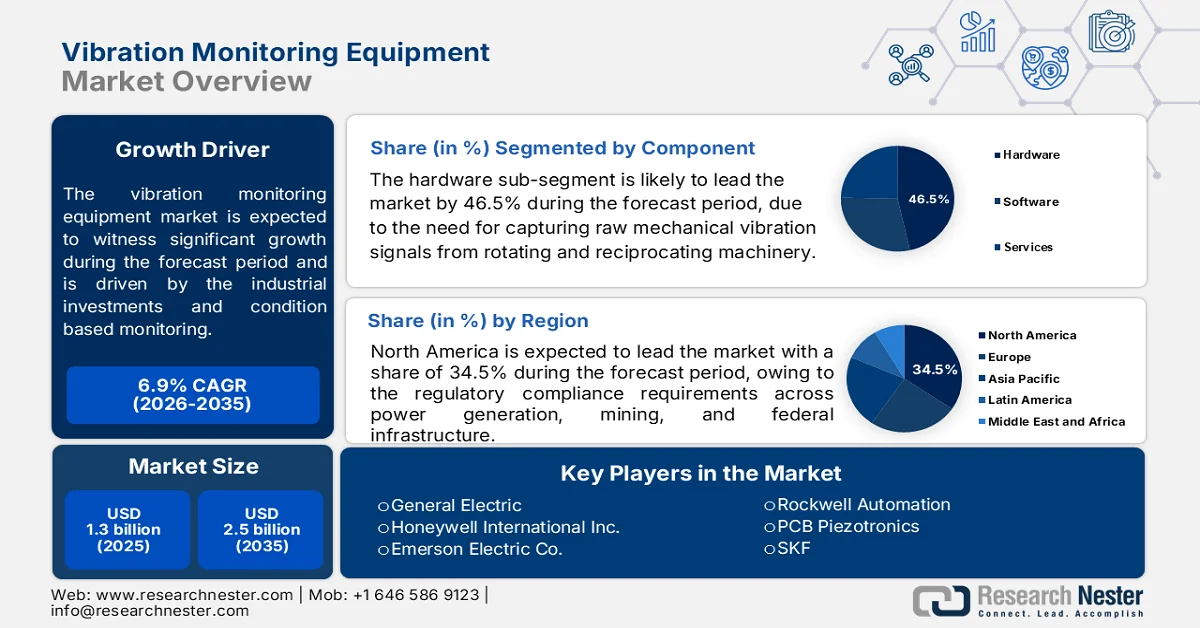
Vibration Monitoring Equipment Market size was valued at USD 1.3 billion in 2025 and is projected to reach USD 2.5 billion by the end of 2035, registering around 6.9% CAGR during the forecast period 2026 to 2035. In 2026, the industry size of vibration monitoring equipment is evaluated at USD 1.4 billion.
Industrial investment in predictive maintenance and condition-based monitoring is strengthening demand for vibration monitoring equipment market across various sectors. According to the Techrxiv December 2024 data, predictive maintenance programs can lower maintenance costs by 25% and reduce equipment breakdowns by 50%, creating measurable operational savings for heavy industries and utilities operating rotating machinery such as turbines, compressors, pumps, and motors. The U.S. Energy Information Administration's February 2024 data reported that U.S. utility-scale electricity generation exceeded 4.18 trillion kWh in 2024, sustaining a large installed base of rotating assets requiring continuous condition monitoring to avoid outages and efficiency losses. These initiatives are promoting the industrial operators to adopt vibration monitoring systems to improve asset utilization, reduce downtime, and meet stricter reliability and safety benchmarks across critical infrastructure environments.
Government-backed industrial modernization and energy transition programs are also supporting long-term procurement of vibration monitoring equipment. The IEA 2024 data stated that global investment in clean energy technologies and infrastructure surpassed USD 2 trillion, increasing the installation of wind turbines, hydroelectric systems, and grid infrastructure, where vibration diagnostics are essential for rotating asset reliability. Moreover, the manufacturing output-related employment in machinery, transportation equipment, and fabricated metal production continues to represent millions of operational roles, reinforcing ongoing demand for maintenance technologies that support uptime and workforce efficiency. The U.S. Department of Defense and NASA maintain extensive predictive maintenance programs for aerospace systems, naval assets, and mission-critical equipment, further driving procurement of advanced monitoring hardware and analytics platforms.
Key Vibration Monitoring Equipment Market Insights Summary:
Regional Highlights:
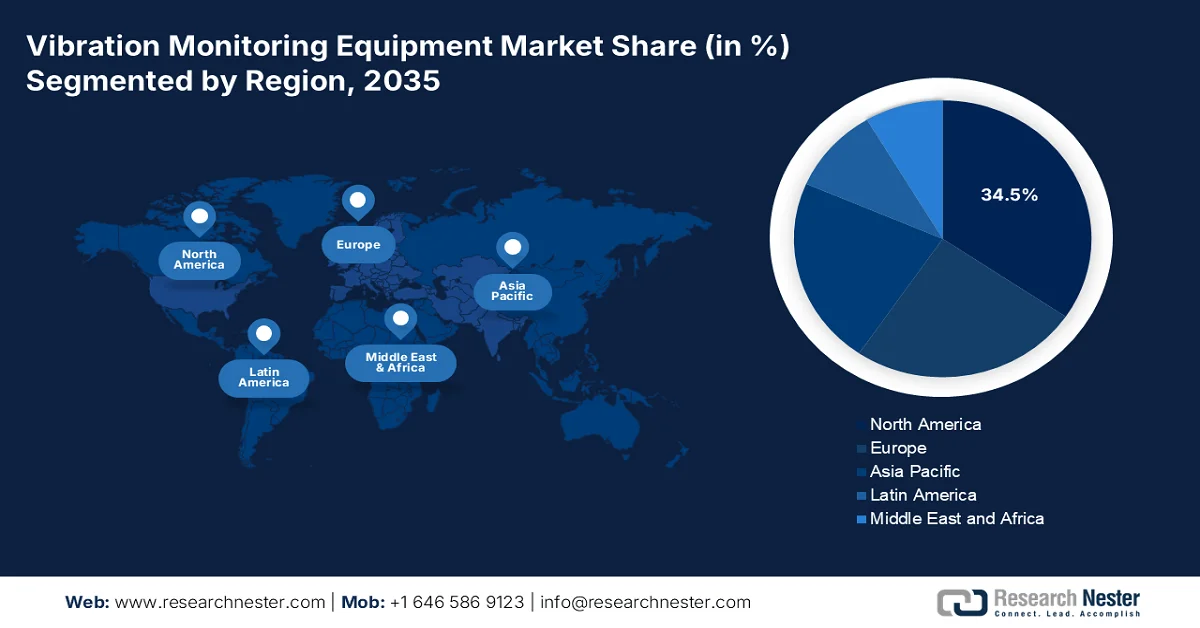
- North America vibration monitoring equipment market is anticipated to secure a 34.5% revenue share by 2035, propelled by stringent regulatory compliance requirements across power generation, mining, and federal infrastructure
- Asia Pacific is forecast to witness rapid expansion in the market during 2026-2035, fueled by accelerating industrialization, infrastructure modernization, and government-backed automation initiatives
Segment Insights:
- The hardware sub-segment is projected to capture 46.5% of the vibration monitoring equipment market share by 2035, attributed to its essential role in acquiring accurate mechanical vibration signals across rotating and reciprocating industrial machinery
- Wireless vibration monitoring is emerging as the leading technology segment in the forecast period, stimulated by advancements in self-powered battery-free sensor nodes and energy harvesting technologies reducing installation and maintenance costs
Key Growth Trends:
- Expansion of grid modernization programs
- Rising federal rail infrastructure investments
Major Challenges:
- Shortage of skilled technical personnel
- Cybersecurity risks in connected monitoring systems
Key Players: General Electric (U.S.), Honeywell International Inc. (U.S.), Emerson Electric Co. (U.S.), Rockwell Automation (U.S.), PCB Piezotronics (U.S.), SKF (Sweden), Siemens AG (Germany), Bruel & Kjaer (Denmark), Schaeffler Group (Germany), ABB Ltd (Switzerland), Mitsubishi Electric Corporation (Japan), RION Co., Ltd. (Japan), Nihon Onkyo Engineering Co., Ltd. (Japan), Meggitt SA (France), Weidmüller (Germany), Enviro Vibration Monitoring Systems (Australia), Istec (Netherlands), Terex (U.S.), Crystal Instruments (U.S.), READ Co., Ltd (Japan).
Global Vibration Monitoring Equipment Market Forecast and Regional Outlook:
Market Size & Growth Projections:
- 2025 Market Size: USD 1.3 billion
- 2026 Market Size: USD 1.4 billion
- Projected Market Size: USD 2.5 billion by 2035
- Growth Forecasts: 6.9% CAGR (2026-2035)
Key Regional Dynamics:
- Largest Region: North America (34.5% Share by 2035)
- Fastest Growing Region: Asia Pacific
- Dominating Countries: United States, China, Germany, Japan, India
- Emerging Countries: South Korea, Brazil, Mexico, Saudi Arabia, Indonesia
Last updated on : 29 May, 2026
Vibration Monitoring Equipment Market - Growth Drivers and Challenges
Growth Drivers
- Expansion of grid modernization programs: Large-scale public investment in electricity grid modernization is increasing demand for vibration monitoring equipment across substations, turbines, generators, transformers, and rotating grid assets. The U.S. Department of Energy (DOE) allocated more than USD 10.5 billion under the Grid Resilience and Innovation Partnerships Program to strengthen grid flexibility and infrastructure modernization. These investments require utilities to improve predictive maintenance capabilities for power generation and transmission equipment operating under continuous load conditions. Utilities are increasingly integrating vibration analytics with digital asset management systems to reduce unscheduled outages and extend equipment lifecycle performance. Power sector digital maintenance spending is expected to rise further as governments prioritize resilience against climate-related disruptions and aging infrastructure failures.
- Rising federal rail infrastructure investments: As per the U.S. Department of Transportation, October 2024 data, the Biden-Harris Administration announced USD 2.4 billion in new rail infrastructure funding under the Federal Railroad Administration to improve rail safety, freight efficiency, and passenger network reliability across the U.S. The projects include upgrades to rail corridors, bridges, tunnels, and freight infrastructure that rely heavily on rotating equipment wheel assemblies, track systems, and vibration-sensitive mechanical assets. These modernization activities are increasing the demand for vibration monitoring equipment used for predictive maintenance and real-time condition monitoring to minimize derailments, mechanical failures, and operational downtime.
Challenges
- Shortage of skilled technical personnel: The vibration monitoring industry faces a critical shortage of qualified technicians who can interpret complex vibration data and implement predictive maintenance programs. This staffing gap creates an indirect barrier for the new equipment manufacturers, as the customers hesitate to invest in systems that they lack the expertise to operate. Though the market is set to grow, the shortage of skilled technicians remains a persistent challenge in the vibration condition monitoring services market.
- Cybersecurity risks in connected monitoring systems: As vibration monitoring equipment becomes connected via Industrial IoT and cloud platforms, cybersecurity vulnerabilities have emerged as a critical challenge. New manufacturers must invest in robust security frameworks to protect customer data and prevent unauthorized access to industrial control systems. Top players have publicly addressed this challenge, noting that more connection points can create more entrance points for security threats in a connected enterprise environment.
Vibration Monitoring Equipment Market Size and Forecast:
| Report Attribute | Details |
|---|---|
|
Base Year |
2025 |
|
Forecast Year |
2026-2035 |
|
CAGR |
6.9% |
|
Base Year Market Size (2025) |
USD 1.3 billion |
|
Forecast Year Market Size (2035) |
USD 2.5 billion |
|
Regional Scope |
|
Vibration Monitoring Equipment Market Segmentation:
Component Segment Analysis
Within the component segment, the hardware sub-segment is poised to hold the largest share value of 46.5% by the end of 2035 in the vibration monitoring equipment market. The segment is driven by capturing raw mechanical vibration signals from rotating and reciprocating machinery such as turbines, motors, compressors, and pumps. The sensor’s role is critical because the accuracy, sensitivity, and frequency response of the entire predictive maintenance system depend entirely on the quality of the initial signal acquisition. The hardware sensors must withstand harsh industrial environments, including extreme temperatures, humidity, and electromagnetic interference. Advances in miniaturization, integrated electronics, and wireless connectivity have further cemented hardware sensors as the highest revenue sub-segment, as no monitoring solution, wired or wireless, can function without a reliable physical sensing element.
Technology Segment Analysis
Wireless vibration monitoring is leading the technology segment and is revolutionizing predictive maintenance by enabling self-powered battery-free sensor nodes. According to the NLM March 2022 data, the fully integrated systems where piezoelectric or electromagnetic energy harvesters convert ambient vibrations into usable power. For instance, a piezoelectric-based wireless platform operating at 0.25 g and 100 Hz successfully transmitted sensor data every 10 seconds, while another system powered by an electromagnetic harvester achieved transmission intervals under 60 seconds with a 30-second duty cycle. Further innovation includes a hybrid piezoelectric triboelectric unit generating 6.5 mW at 1 g and 25 Hz, where the triboelectric component simultaneously serves as an accelerometer. These developments eliminate battery replacement and reduce installation costs. As energy harvesting matures, wireless vibration monitoring will dominate industrial asset health management.
Application Segment Analysis
Under the application segment, the predictive maintenance sub-segment is leading in the vibration monitoring equipment market. The segment leverages vibration data to forecast equipment failures before they occur, minimizing downtime and repair costs. This application uses algorithms to analyze the vibration patterns for early signs of imbalance, misalignment, or bearing wear. According to the Techrxiv January 2025 data, predictive maintenance can reduce the maintenance cost by 40% and also decrease the unexpected equipment failures. These figures highlight the growing shift from reactive to proactive maintenance. As artificial intelligence integrates with vibration analytics, predictive maintenance remains the highest-value application in the vibration monitoring equipment market.
Our in-depth analysis of the vibration monitoring equipment market includes the following segments:
|
Segment |
Subsegments |
|
Component |
|
|
System Type |
|
|
Technology |
|
|
Application |
|
|
Industry Vertical |
|
|
Monitoring Process |
|
|
End user |
|

Vishnu Nair
Head - Global Business DevelopmentCustomize this report to your requirements — connect with our consultant for personalized insights and options.
Vibration Monitoring Equipment Market - Regional Analysis
North America Market Insights
North America is dominating the vibration monitoring equipment market and is poised to hold the regional revenue share of 34.5% by the end of 2035. The market is driven by the regulatory compliance requirements across power generation, mining, and federal infrastructure. The U.S. maintains stringent mandates for continuous vibration monitoring on safety-related pumps and motors in nuclear facilities, as well as mechanical integrity rules for underground mining ventilation systems. Federal guidelines also require condition monitoring for critical rotating machinery across thousands of government-owned buildings and installations. Canada follows with similar requirements for its nuclear fleet and oil sands extraction assets. Both countries face a persistent shortage of skilled vibration analysts, accelerating the transition from manual route-based measurements to permanent wireless online systems. Aging industrial infrastructure and workforce retirement further support steady replacement demand for modern monitoring equipment.
The rising federal infrastructure investment and increasing adoption of predictive maintenance across various sectors are driving the vibration monitoring equipment market in the U.S. As per the FAS January 2026 data, the U.S. Department of Energy announced up to USD 1 billion for the grid modernization projects under the Grid Resilience and Innovation Partnerships Program, supporting the reliability upgrades for the critical power infrastructure requiring continuous equipment monitoring. Additionally, the Federal Railroad Administration's June 2025 data reported more than USD 66 billion in rail funding through the Bipartisan Infrastructure Law, accelerating modernization of locomotives, rail systems, and maintenance operations. These investments are increasing the deployment of vibration monitoring systems to reduce downtime, improve asset performance, and strengthen operational safety across industrial and public infrastructure networks in the U.S.
Government backed investments in critical minerals, industrial automation, and clean energy infrastructure are shaping the vibration monitoring equipment market in Canada. In March 2023 data, the Government of Canada committed nearly USD 3.8 billion under the Critical Minerals Strategy to strengthen mining processing and battery supply chain infrastructure, increasing demand for predictive maintenance systems across heavy industrial equipment and processing facilities. Moreover, the Government of Canada's August 2025 data reported that clean electricity GDP is projected to reach USD 107 billion, which is driven by USD 58 billion in annual investments by 2030, supporting the deployment of monitoring technologies for turbines, generators, and grid infrastructure. These projects are encouraging industrial operators to adopt vibration monitoring systems to reduce operational downtime, improve equipment reliability, and enhance maintenance efficiency across mining utilities and manufacturing sectors.
APAC Market Insights
The Asia Pacific is projected to emerge rapidly during the assessed period, 2026 to 2035, in the vibration monitoring equipment market. The region is driven by industrialization, infrastructure modernization, and government-backed automation initiatives. China leads with large-scale deployment of condition monitoring across coal-fired power plants, steel mills, and high-speed rail networks. Japan focuses on predictive maintenance for aging industrial infrastructure, including chemical facilities and nuclear power stations. India is accelerating the adoption via capital subsidy programs for industrial automation in manufacturing clusters. Australia mandates vibration monitoring for defense platforms and mining conveyors. The transition from portable meters to wireless online systems is pronounced, supported by declining sensor costs and increasing availability of cloud-based analytics platforms customized for small and medium enterprises.
The rising investments in rail infrastructure, manufacturing automation, and power sector modernization are driving the vibration monitoring equipment market in India. According to the CRF 2025 data, the Government of India allocated approximately INR 2.65 lakh crore to the Ministry of Railways, supporting the modernization of rolling stock, freight corridors, and railway safety systems that require predictive maintenance technologies. Additionally, PIB January 2026 data shows that the Ministry of Heavy Industries approved USD 3.1 billion under the Production Linked Incentive (PLI) Scheme for automobile and advanced manufacturing sectors, accelerating deployment of automated industrial machinery and condition monitoring systems. These investments are increasing demand for vibration monitoring equipment to improve machinery reliability, reduce unplanned downtime, and enhance operational efficiency across transportation, manufacturing, and energy infrastructure sectors in India.
The Japan vibration monitoring equipment market reached USD 103.9 million in 2025 and is projected to reach USD 155.9 million by the end of 2035, expanding at a CAGR of 4%. In 2026, the market is estimated to reach USD 109.6 million. The nation is driven by investments in industrial automation and power infrastructure modernization. According to the APERC June 2024 data, the government allocated over USD 1 trillion for Green Transformation initiatives supporting renewable energy and the grid infrastructure projects requiring continuous equipment monitoring. These investments are increasing the adoption of vibration monitoring systems to improve the machinery reliability, reduce maintenance costs, and strengthen operational efficiency across manufacturing and energy sectors.
Europe Market Insights
The vibration monitoring equipment market in Europe is shaped by stringent energy efficiency regulations and a mature industrial base. The European Union mandates large companies to implement energy management systems with vibration monitoring, recognized as an enabling technology for maintaining motor-driven equipment efficiency. Germany leads adoption across automotive manufacturing and chemical processing, where precision and uptime are critical. The UK focuses on offshore wind turbine monitoring and nuclear fleet compliance. France prioritizes predictive maintenance for its nuclear power stations and aerospace manufacturing. Across Europe, the market is transitioning toward wireless battery-powered sensors that reduce installation costs and enable retrofitting on legacy equipment without extensive rewiring.
The increasing investments in \ industrial automation, energy transition projects, and smart manufacturing infrastructure are shaping the vibration monitoring equipment market in Germany. Germany’s Federal Ministry for Economic Affairs and Climate Action continued support for Industry 4.0 and energy efficiency modernization programs across the manufacturing facilities. Additionally, the government approved approximately USD 18.7 billion for rail infrastructure modernization via Deutsche Bahn investment initiatives, increasing demand for predictive maintenance technologies and equipment monitoring systems as per the Bundeswirtschaftsministerium 2024 data. These investments are accelerating the adoption of vibration monitoring solutions to improve operational reliability, reduce equipment failures, and support industrial productivity across transportation and manufacturing sectors.
The vibration monitoring equipment market in the UK is growing due to rising investments in rail modernization, offshore wind projects, and industrial asset management. According to the Policy Exchange September 2025 data, the UK government continued its USD 129 billion Integrated Rail Plan to improve rail infrastructure and operational reliability, increasing demand for predictive maintenance systems and monitoring technologies. Additionally, the Department for Energy Security and Net Zero supports expansion of offshore wind capacity under the Contracts for Difference scheme, strengthening deployment of vibration monitoring systems for turbines and rotating equipment. These initiatives are encouraging industries to adopt condition monitoring technologies to reduce downtime, improve equipment efficiency, and support infrastructure resilience across critical sectors.
Key Vibration Monitoring Equipment Market Players:
- General Electric (U.S.)
- Honeywell International Inc. (U.S.)
- Emerson Electric Co. (U.S.)
- Rockwell Automation (U.S.)
- PCB Piezotronics (U.S.)
- SKF (Sweden)
- Siemens AG (Germany)
- Bruel & Kjaer (Denmark)
- Schaeffler Group (Germany)
- ABB Ltd (Switzerland)
- Mitsubishi Electric Corporation (Japan)
- RION Co., Ltd. (Japan)
- Nihon Onkyo Engineering Co., Ltd. (Japan)
- Meggitt SA (France)
- Weidmüller (Germany)
- Enviro Vibration Monitoring Systems (Australia)
- Istec (Netherlands)
- Terex (U.S.)
- Crystal Instruments (U.S.)
- READ Co., Ltd (Japan)
- Company Overview
- Business Strategy
- Key Product Offerings
- Financial Performance
- Key Performance Indicators
- Risk Analysis
- Recent Development
- Regional Presence
- SWOT Analysis
- General Electric is a dominant force in the vibration monitoring equipment market, leveraging its deep expertise in industrial asset management. The company has integrated vibration sensors with its Predix platform to enable predictive maintenance across power generation, aviation, and oil & gas sectors. In 2024, the company has made a revenue USD 18,127 million.
- Honeywell International Inc. has strengthened its position in the vibration monitoring equipment market by embedding vibration analytics into its broader industrial automation ecosystem. The company adopts vibration monitoring equipment data within its Honeywell Connected Plant suite, enabling real-time asset health tracking across refineries and chemical plants.
- Emerson Electric Co. is a key innovator in the vibration monitoring equipment market, particularly through its AMS (Asset Monitoring System) suite. The company has advanced real-time vibration monitoring by adopting wireless vibration monitoring equipment data into its Plantweb digital ecosystem. According to the 2024 annual report, the company has made net sales of USD 18,016 million.
- Rockwell Automation plays a major role in the vibration monitoring equipment market by embedding vibration monitoring directly into its FactoryTalk and Allen‑Bradley control systems. The company adopts vibration monitoring equipment data through smart condition‑monitoring modules and wireless sensors, allowing real-time diagnostics on production line machinery.
- PCB Piezotronics is a specialized leader in the vibration monitoring equipment market, renowned for its high-precision piezoelectric accelerometers. The company has advanced real-time monitoring by adopting wireless vibration monitoring equipment data into its ICP® (Integrated Circuit Piezoelectric) sensor systems.
Here is a list of key players operating in the global vibration monitoring equipment market:
The global vibration monitoring equipment market is highly competitive, characterized by the presence of established industrial automation giants and specialized sensor manufacturers. Key players are pursuing strategic initiatives such as mergers and acquisitions to expand their product portfolios and geographic reach. For example, in December 2025, Istec acquires a majority share in Portuguese manufacturer EACH, reinforcing its strategic value chain. A major focus is the integration of IoT and AI for predictive maintenance solutions, enabling real-time asset health monitoring. Companies are also investing in wireless technology and cloud-based analytics to reduce installation costs and improve data accessibility. This shift from traditional route-based monitoring to continuous online monitoring is driving innovation, with firms differentiating themselves through software capabilities and system interoperability rather than hardware alone.
Corporate Landscape of the Vibration Monitoring Equipment Market:
Recent Developments
- In May 2026, Terex® has launched TRAC, a vibration analysis system, which is developed to provide a clearer insight into the performance, condition and long‑term integrity of screening equipment. The technology is now available across screening equipment through Finlay.
- In April 2026, Crystal Instruments introduced Ruby, an advanced wireless vibration sensor that is designed for industrial condition monitoring. The company showcases how Ruby delivers high-precision vibration measurements, scalable monitoring, and flexible deployment across the plant floor.
- In March 2026, READ Co., Ltd, announced the launch of Strix, which is a vibration measurement and analysis system capable of analyzing and measuring equipment vibrations. Strix is a system that uses vibration and acoustic sensors to measure equipment conditions and enables visualization and analysis of collected data through dedicated software.
- Report ID: 8589
- Published Date: May 29, 2026
- Report Format: PDF, PPT
- Explore a preview of key market trends and insights
- Review sample data tables and segment breakdowns
- Experience the quality of our visual data representations
- Evaluate our report structure and research methodology
- Get a glimpse of competitive landscape analysis
- Understand how regional forecasts are presented
- Assess the depth of company profiling and benchmarking
- Preview how actionable insights can support your strategy
Explore real data and analysis
Frequently Asked Questions (FAQ)
About this Report
Connect with our Expert


Report, 2026-2035



Copyright @ 2026 Research Nester. All Rights Reserved.
