Machine Condition Monitoring Market Outlook:
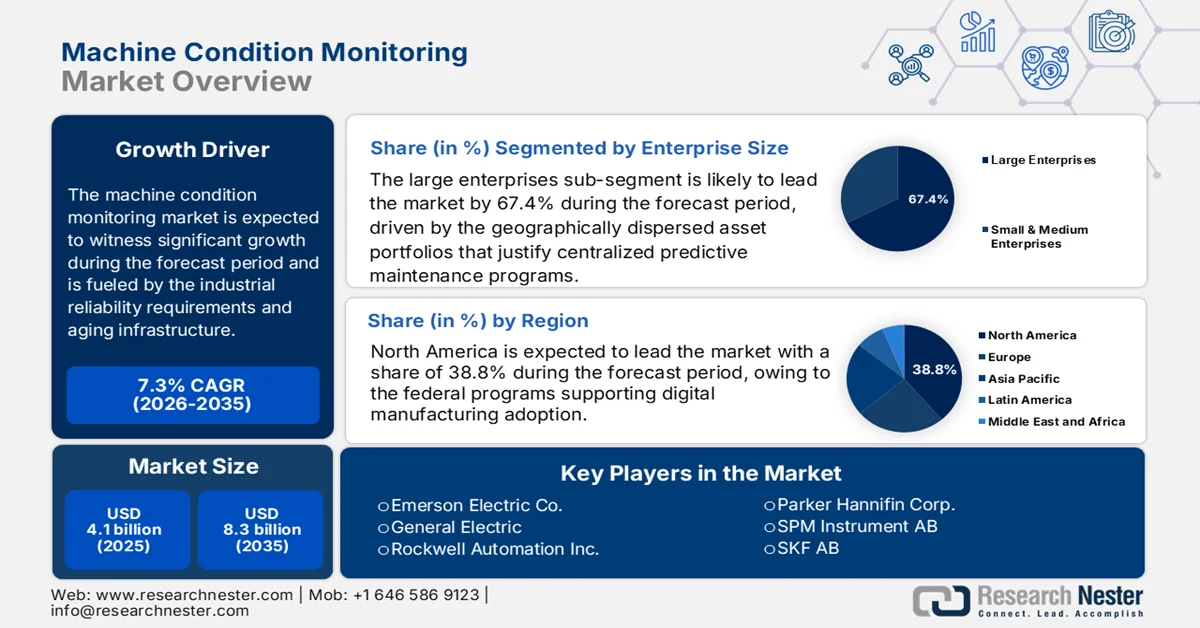
Machine Condition Monitoring Market size was valued at USD 4.1 billion in 2025 and is projected to reach USD 8.3 billion by the end of 2035, rising at a CAGR of 7.3% during the forecast period, i.e., 2026-2035. In 2026, the industry size of machine condition monitoring is assessed at USD 4.4 billion.
The machine condition monitoring market is shaped by the industrial reliability requirements, aging infrastructure, and increasing regulatory emphasis on workplace safety and energy efficiency. According to the Association for Advancing Automation, October 2025 data, the unplanned downtime across industrial sectors is estimated to cost manufacturers billions annually, with some facilities losing 5% to 20% of productive capacity due to equipment failure. This has led to wider adoption of predictive maintenance practices supported by condition monitoring systems, mainly in energy-intensive industries such as oil and gas, power generation, and heavy manufacturing. This trend is further reinforced by the increasing capital allocation toward the asset performance management systems aimed at extending equipment lifespan and improving operational continuity.
Besides infrastructure modernization, the industrial digitalization initiatives are reinforcing the demand in the market. According to the IEA July 2023 data, the global industrial energy consumption accounts for nearly 37% of total final energy use, increasing the importance of efficient equipment operation and lifecycle management. In parallel, government-backed programs such as the U.S. Advanced Manufacturing Office and the European Commission’s industrial strategy emphasize smart manufacturing and asset performance optimization as core priorities. These initiatives are supported by funding for sensor deployment, data integration, and industrial IoT adoption, which are foundational to condition monitoring systems. Furthermore, sectors such as transportation and utilities are integrating the monitoring solutions to comply with reliability and emissions targets. As regulatory compliance, cost control, and operational continuity remain central to industrial operations, demand for condition monitoring solutions is expected to maintain steady growth across both developed and emerging markets.
Key Machine Condition Monitoring Market Insights Summary:
Regional Highlights:
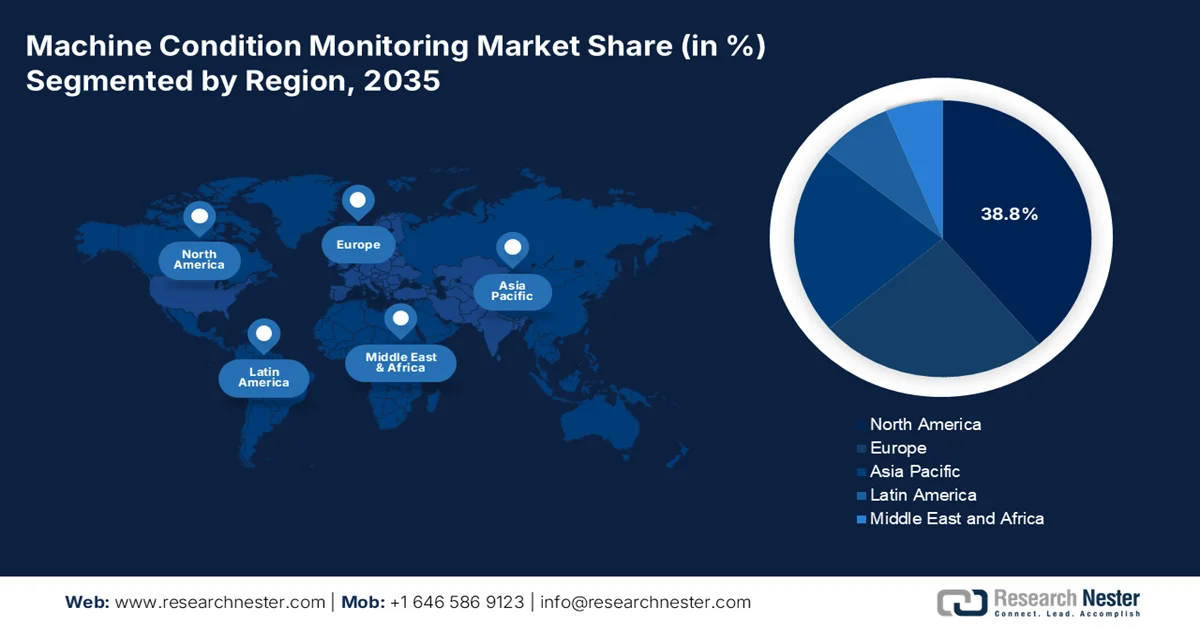
- North America machine condition monitoring market is anticipated to command a 38.8% share by 2035, propelled by aging industrial infrastructure, regulatory compliance mandates, and expanding digital manufacturing initiatives
- Asia Pacific is forecasted to witness the fastest growth at a CAGR of 8.5% during 2026–2035, fueled by rapid industrialization, large-scale infrastructure investments, and government-led digital manufacturing initiatives
Segment Insights:
- Large enterprises segment in the machine condition monitoring market is projected to account for a 67.4% share by 2035, driven by extensive capital resources and complex, geographically dispersed asset portfolios supporting centralized predictive maintenance programs
- Cloud based deployment segment is expected to gain significant traction over 2026–2035, owing to its ability to aggregate global asset data into unified analytics platforms enabling scalable predictive maintenance and reduced infrastructure costs
Key Growth Trends:
- Government investment in industrial modernization
- Growth in smart manufacturing initiatives
Major Challenges:
- Shortage of skilled personnel
- Data security and cybersecurity concerns
Key Players: Emerson Electric Co. (U.S.), General Electric (Baker Hughes) (U.S.), Rockwell Automation Inc. (U.S.), Parker Hannifin Corp. (U.S.), SPM Instrument AB (Sweden), SKF AB (Sweden), Siemens AG (Germany), Status Pro Maschinendiagnostik GmbH (Germany), Bruel & Kjaer Vibro GmbH (Germany), Schaeffler AG (Germany), GEA Group Aktiengesellschaft (Germany), Alfa Laval AB (Sweden), Mitsubishi Electric Corporation (Japan), Hitachi, Ltd. (Japan), NSK Ltd. (Japan), NTN Corporation (Japan), Azima DLI Corp. (U.S.).
Global Machine Condition Monitoring Market Forecast and Regional Outlook:
Market Size & Growth Projections:
- 2025 Market Size: USD 4.1 billion
- 2026 Market Size: USD 4.4 billion
- Projected Market Size: USD 8.3 billion by 2035
- Growth Forecasts: 7.3% CAGR (2026-2035)
Key Regional Dynamics:
- Largest Region: North America (38.8% Share by 2035)
- Fastest Growing Region: Asia Pacific
- Dominating Countries: United States, China, Germany, Japan, United Kingdom
- Emerging Countries: India, South Korea, Brazil, Mexico, Malaysia
Last updated on : 30 March, 2026
Machine Condition Monitoring Market - Growth Drivers and Challenges
Growth Drivers
- Government investment in industrial modernization: Government-led industrial modernization programs are significantly driving the demand for the machine condition monitoring market. According to the Department of Energy's July 2022 data, the Advanced Manufacturing Office allocated USD 137 million for small businesses, prioritizing projects such as clean energy, cybersecurity, high-energy physics, and more. These programs prioritize predictive maintenance technologies to enhance equipment uptime and reduce operational disruptions. Similarly, the Industry 5.0 in the EU emphasizes smart and resilient manufacturing systems supported by digital monitoring infrastructure. These investments are prompting industrial operators to adopt condition monitoring systems as part of compliance with efficiency benchmarks and modernization mandates.
- Growth in smart manufacturing initiatives: The smart manufacturing initiatives are driving the adoption of the machine condition monitoring market. According to the State Council of China’s November 2025 data, China has built more than 7,000 smart factories and has become the largest intelligent manufacturing base, emphasizing real-time data collection and predictive analytics for manufacturing efficiency. Moreover, in the U.S., the programs under the Manufacturing USA promote the digital transformation, including condition monitoring as a core capability. Similarly, the EU digital strategy includes funding for smart factories and industrial data platforms. These initiatives are enabling seamless integration of the sensors and monitoring systems into production environments.
- Expansion of predictive maintenance in public infrastructure: Public infrastructure operators are increasingly adopting predictive maintenance to ensure asset reliability and safety. The U.S. Department of Transportation and the Federal Railroad Administration have introduced programs promoting continuous monitoring of rail systems and rolling stock to reduce failures and accidents. The infrastructure investment and jobs act funding includes allocations for upgrading the transportation systems, including condition monitoring systems to maintain aging infrastructure. Similarly, water utilities and power grids are incorporating monitoring systems to maintain aging infrastructure. These investments create consistent demand for monitoring technologies across government-owned assets.
Challenges
- Shortage of skilled personnel: A significant challenge for the new players in the machine condition monitoring market is the shortage of skilled vibration analysts and data scientists. The market is shifting from simple data collection to advanced predictive analytics, yet there is a gap in the workforce trained to distinguish between benign anomalies and imminent failure indicators. This scarcity of expertise not only hinders customer adoption but also creates a barrier for new suppliers to invest heavily in training customer support and developing user-friendly automated analytics to compensate for the lack of on-site expertise at client facilities.
- Data security and cybersecurity concerns: As the machine condition monitoring market is increasingly adopted and connected via IIoT platforms and cloud-based analytics, companies face new cybersecurity vulnerabilities that represent a critical barrier to market entry. The industrial customers, mainly in critical infrastructure sectors such as oil and gas, power generation, are highly sensitive to the risk of unauthorized access, data breaches, or operational disruptions caused by cyberattacks. For new players, establishing credibility requires demonstrable compliance with rigorous security standards for data governance.
Machine Condition Monitoring Market Size and Forecast:
| Report Attribute | Details |
|---|---|
|
Base Year |
2025 |
|
Forecast Year |
2026-2035 |
|
CAGR |
7.3% |
|
Base Year Market Size (2025) |
USD 4.1 billion |
|
Forecast Year Market Size (2035) |
USD 8.3 billion |
|
Regional Scope |
|
Machine Condition Monitoring Market Segmentation:
Enterprise Size Segment Analysis
Within the enterprise size segment, the large enterprises dominate the machine condition monitoring market and are poised to hold the share value of 67.4% by the end of 2035. The segment is driven by their extensive capital resources and complex, geographically dispersed asset portfolios that justify centralized predictive maintenance programs. These organizations typically operate thousands of critical rotating machines across facilities, enabling economies of scale in sensor deployment, data integration, and reliability engineering expertise. The adoption is further spurred by the digital transformation initiatives that integrate condition monitoring with enterprise asset management systems. According to the American Council for an Energy Efficient Economy's May 2023 data, the U.S. accounted for 24% of the total energy consumption, part of which is used by the large manufacturing facilities, underscoring their concentrated reliance on high availability rotating equipment, where condition monitoring delivers the greatest return on investment.
Deployment Segment Analysis
The cloud based deployment segment in the machine condition monitoring market enabling enterprises to aggregate asset data across global operations into unified analytics platforms. This approach facilitates advanced machine learning applications that improve predictive accuracy over time while reducing the on premise infrastructure costs. Moreover, the industrial organizations increasingly favor cloud platforms for their scalability, cybersecurity enhancements, and ability to support remote workforce collaboration. The manufacturers implementing predictive maintenance solutions had adopted cloud-based condition monitoring platforms, highlighting the accelerating transition from traditional on-premises software to cloud native industrial IoT architecture.
Application Segment Analysis
Under the application segment, the rotating machinery is the largest subsegment in the machine condition monitoring market, encompassing turbines, compressors, pumps, motors, and gearboxes that form the operational backbone of industrial facilities. The criticality of these assets, where unplanned failures can result in production losses exceeding millions of dollars per day, necessitates continuous vibration, temperature, and lubrication monitoring. Advanced techniques now enable early detection of bearing degradation and misalignment with high precision. According to the U.S. Department of Energy 2022 data, the rotating machinery accounts for nearly 68% of all electricity consumed in the U.S. manufacturing sector, reinforcing the predictive maintenance for rotating assets, which remains the highest priority for industrial reliability programs.
Our in-depth analysis of the machine condition monitoring market includes the following segments:
|
Segment |
Subsegments |
|
Component |
|
|
Monitoring Type |
|
|
Technology |
|
|
Deployment |
|
|
Industry Vertical |
|
|
Enterprise Size |
|
|
Application |
|

Vishnu Nair
Head - Global Business DevelopmentCustomize this report to your requirements — connect with our consultant for personalized insights and options.
Machine Condition Monitoring Market - Regional Analysis
North America Market Insights
North America is dominating the machine condition monitoring market and is expected to hold the regional revenue share of 38.8% by the end of 2035. The region is driven by the aging industrial infrastructure, requiring extended operational life, regulatory compliance mandates in the nuclear and mining sectors, and federal programs supporting digital manufacturing adoption. The U.S. accounts for the majority of the regional revenue, with Canada contributing via its natural resources sector. The rising projects in smart manufacturing are directly supporting the condition monitoring deployments. On the other hand, in Canada, Natural Resources Canada has allocated a million dollars via its clean growth program for mining sector predictive maintenance initiatives.
The federal funding initiatives and stringent regulatory frameworks in critical infrastructure sectors are shaping the market in the U.S. According to the U.S. Department of Energy’s April 2023 data, USD 50 million in funding is allocated to incentivize smart manufacturing adoption among small and medium-sized facilities highlights the government’s push toward digital monitoring and predictive maintenance technologies to enhance industrial efficiency. On the other hand, Idaho National Laboratory's June 2024 data depicts that the nuclear power sector demonstrates a strong, regulatory-driven demand for online condition monitoring as mandated by the U.S. Nuclear Regulatory Commission under 10 CFR 50.55a and supported by standards such as ASME OM-2022, which govern in-service testing of critical components such as pumps and valves. However, studies indicate that nearly 90% of sensors maintain calibration without adjustment, supporting a shift toward condition-based monitoring to reduce operational burden. These data show a positive impact on market growth and expansion.
The strong government support for advanced manufacturing and industrial digitalization is fueling the machine condition monitoring market in Canada. According to the CMTS July 2023 data, the advanced manufacturing sector contributes USD 185 billion to GDP, supports 1.7 million jobs, and generates USD 360 billion in annual exports, underscoring its strategic importance to the national economy. To strengthen this base, the government has committed substantial funding, including USD 177 million to Next Generation Manufacturing Canada (NGen) and a total of USD 427 million toward the Global Innovation Cluster for Advanced Manufacturing, which focuses on technologies such as IoT, machine learning, and cybersecurity, core components of condition monitoring ecosystems. These initiatives are enabling manufacturers to integrate sensor-based monitoring, analytics, and automation into production systems, thus driving the market growth.
APAC Market Insights
The Asia Pacific is projected to emerge as the fastest-growing region in the machine condition monitoring market and is expected to expand at a CAGR of 8.5% during the assessed period, 2026 to 2035. The region is driven by the rapid industrialization, large-scale infrastructure investments, and government-led digital manufacturing initiatives across China, Japan, India south Korea, and Southeast Asian nations. China dominates the regional demand via its massive manufacturing base, which highlights the predictive maintenance adoption across automotive electronics and heavy machinery sectors. Japan's mature market benefits from its aging industrial infrastructure, with the Ministry of Economy, Trade, and Industry (METI) promoting IoT-based asset management under the Society 5.0 framework. Southeast Asia markets, particularly Malaysia, are emerging as manufacturing hubs with increasing adoption driven by foreign direct investment and national industrial master plans.
The large-scale government-led industrial digitalization initiatives are shaping the machine condition monitoring market in China. According to the People’s Republic of China, February 2025 data, the country has developed over 30,000 basic-level smart factories, along with 1,200 advanced-level and 230 excellence-level smart factories, reflecting a broad and structured push toward intelligent manufacturing. Moreover, these facilities incorporate advanced use cases such as AI-powered quality inspection, smart warehousing, and digital R&D, all of which rely heavily on real-time equipment monitoring and predictive maintenance systems. Further, the deployment of nearly 2,000 advanced industrial scenarios across more than 80% of manufacturing sectors further indicates deep integration of sensor technologies, data analytics, and automated monitoring solutions. This creates a strong demand for the market to ensure equipment reliability, optimize production efficiency, and reduce downtime.
The machine condition monitoring market in India is driven by large-scale deployment of AI-enabled monitoring technologies across Indian Railways, which is one of the country’s largest public sector operators. As per the PIB March 2026 report, the Indian Railways has installed 24 Wheel Impact Load Detector (WILD) systems and 25 Online Monitoring of Rolling Stock (OMRS) systems to enable real-time monitoring of wheel and bearing health, significantly improving predictive maintenance capabilities. Moreover, the Machine Vision Inspection Systems are being deployed1111 across multiple railway zones, while 3 Integrated Track Monitoring Systems (ITMS) are operational for AI-based inspection of track infrastructure. Emerging technologies such as drone-based thermal monitoring and the development of TRI Netra systems for enhanced locomotive visibility further demonstrate the integration of advanced sensors and analytics.
Europe Market Insights
The machine condition monitoring market in Europe is expanding significantly and is driven by the stringent industrial safety regulations, aging manufacturing infrastructure, and ambitious decarbonization targets requiring maximum operational efficiency from existing assets. The European Union’s Industrial Strategy emphasizes digital transformation, with the member states allocating substantial funding toward predictive maintenance adoption across automotive, aerospace, and heavy machinery sectors. Germany leads the adoption in the region with its dominant manufacturing base, followed by the UK and France. The key drivers include the EU Machinery Directive mandating safety-related monitoring. Cross-border standardization efforts and EU-funded research consortia continue to accelerate technology deployment across member states.
The performance of advanced manufacturing and an export-driven industrial base is shaping the machine condition monitoring market in Germany. According to the ITA August 2025 report, the country’s exports exceeded USD 1 trillion in 2023, reflecting sustained global demand for Germany's industrial goods and machinery, where equipment reliability and uptime are critical. Moreover, the government-backed initiatives such as Plattform Industrie 4.0 and Manufacturing-X are accelerating the adoption of IoT cloud platforms and interoperable data systems, all of which underpin condition monitoring deployments. On the other hand, more than half of German manufacturers have already invested in ERP, MES, and cloud-based systems, with up to 75% planning further MES investments by the end of 2026, indicating a strong pipeline for integrated monitoring solutions. These data show a strong demand for market growth.
Strong government commitment to advanced manufacturing and industrial digitalization is fueling the machine condition monitoring market in the UK. According to the UK Government's May 2022 data, the government aims to increase the annual business investment in the sector to £39 billion by the end of 2035. This rise signals an expansion in the manufacturing capacity and the technology adoption. Further USD 3.76 billion is dedicated to R&D programs over the next five years, which is expected to accelerate the deployment of sensor-based monitoring, predictive maintenance, and AI-driven analytics across industrial operations. Additionally, financial support mechanisms such as the £4 billion Industrial Strategy Growth Capital and the USD 37.3 billion National Wealth Fund are improving access to capital for large-scale automation and infrastructure upgrades. These data show a demand for the market across the manufacturing and infrastructure sectors.
Key Machine Condition Monitoring Market Players:
- Emerson Electric Co. (U.S.)
- General Electric (Baker Hughes) (U.S.)
- Rockwell Automation Inc. (U.S.)
- Parker Hannifin Corp. (U.S.)
- SPM Instrument AB (Sweden)
- SKF AB (Sweden)
- Siemens AG (Germany)
- Status Pro Maschinendiagnostik GmbH (Germany)
- Bruel & Kjaer Vibro GmbH (Germany)
- Schaeffler AG (Germany)
- GEA Group Aktiengesellschaft (Germany)
- Alfa Laval AB (Sweden)
- Mitsubishi Electric Corporation (Japan)
- Hitachi, Ltd. (Japan)
- NSK Ltd. (Japan)
- NTN Corporation (Japan)
- Azima DLI Corp. (U.S.)
- Honeywell International Inc. (U.S.)
- Sensata Technologies Inc. (Netherlands)
- i-Pulse Systems Sdn Bhd (Malaysia)
- Company Overview
- Business Strategy
- Key Product Offerings
- Financial Performance
- Key Performance Indicators
- Risk Analysis
- Recent Development
- Regional Presence
- SWOT Analysis
- Emerson Electric Co. is a dominant player in the machine condition monitoring market, leveraging its extensive industrial software portfolio mainly via the AMS suite. The company has strategically advanced the market by integrating wireless vibration sensors and IIoT connectivity into its Plantweb digital ecosystem. In 2024, the company made a net sale of USD 17,492 million.
- General Electric, primarily via its joint venture Baker Hughes, stands as a historic pioneer in the condition monitoring market. The company has made significant advancements by evolving from the traditional proximity probe systems to advanced digital twin technologies and cloud-based monitoring platforms.
- Rockwell Automation Inc has cemented its position in the machine condition monitoring market by embedding condition monitoring directly into the broader framework of the connected enterprise. Through its FactoryTalk Analytics and acquisition of predictive maintenance specialists, the company offers a unified platform that combines vibration, current, and temperature monitoring.
- Parker Hannifin Corp. has established a strong foothold in the machine condition monitoring market via its specialized division, Parker Hannifin. The company has made significant advancements by focusing on wireless battery-operated condition monitoring systems that cater to hard-to-reach assets in diverse industries. According to the 2024 annual report, the company has made a revenue of USD 20 billion.
- SPM Instrument AB is a specialized leader in the machine condition monitoring market, renowned for pioneering the Shock Pulse Method for rolling bearing diagnostics. The company has made significant advancements by combining its proprietary technology with high-definition infrared thermography and advanced spectrum analysis.
Here is a list of key players operating in the global machine condition monitoring market:
The machine condition monitoring market is highly competitive, defined by a mix of diversified industrial giants and specialized sensor providers. The key players are shifting from reactive maintenance to predictive analytics, leveraging IIoT AI and cloud-based platforms. Strategic initiatives include aggressive mergers and acquisitions to expand the technological portfolio, the development of wireless sensing technologies for remote monitoring, and the formation of partnerships with software firms to offer end-to-end asset health solutions. For example, in June 2024, SPM International, Sweden, announced the acquisition of Germany's condition monitoring expert Status Pro Maschinendiagnostik GmbH. This focus on digitalization and operational efficiency is intensifying market rivalry.
Corporate Landscape of the Machine Condition Monitoring Market:
Recent Developments
- In November 2025, NTN Bearing Corporation of America announced the launch of a powerful new condition monitoring solution designed to help industrial facilities optimize performance and reduce costly downtime – the NTN Guardian.
- In September 2025, GEA has launched its new digital service product, GEA InsightPartner EvoHDry, an advanced condition monitoring tool designed to improve production reliability and operational efficiency in dairy and beverage plants.
- In June 2025, Alfa Laval launches Clariot, an AI-based condition monitoring solution, precision-built for hygienic process equipment to deliver more accurate analysis and support. Clariot monitors equipment and processes, providing actionable insights that enhance uptime and optimize resource efficiency.
- Report ID: 8482
- Published Date: Mar 30, 2026
- Report Format: PDF, PPT
- Explore a preview of key market trends and insights
- Review sample data tables and segment breakdowns
- Experience the quality of our visual data representations
- Evaluate our report structure and research methodology
- Get a glimpse of competitive landscape analysis
- Understand how regional forecasts are presented
- Assess the depth of company profiling and benchmarking
- Preview how actionable insights can support your strategy
Explore real data and analysis
Frequently Asked Questions (FAQ)
About this Report
Connect with our Expert


Report, 2026-2035



Copyright @ 2026 Research Nester. All Rights Reserved.
