Machine Safety Market Outlook:
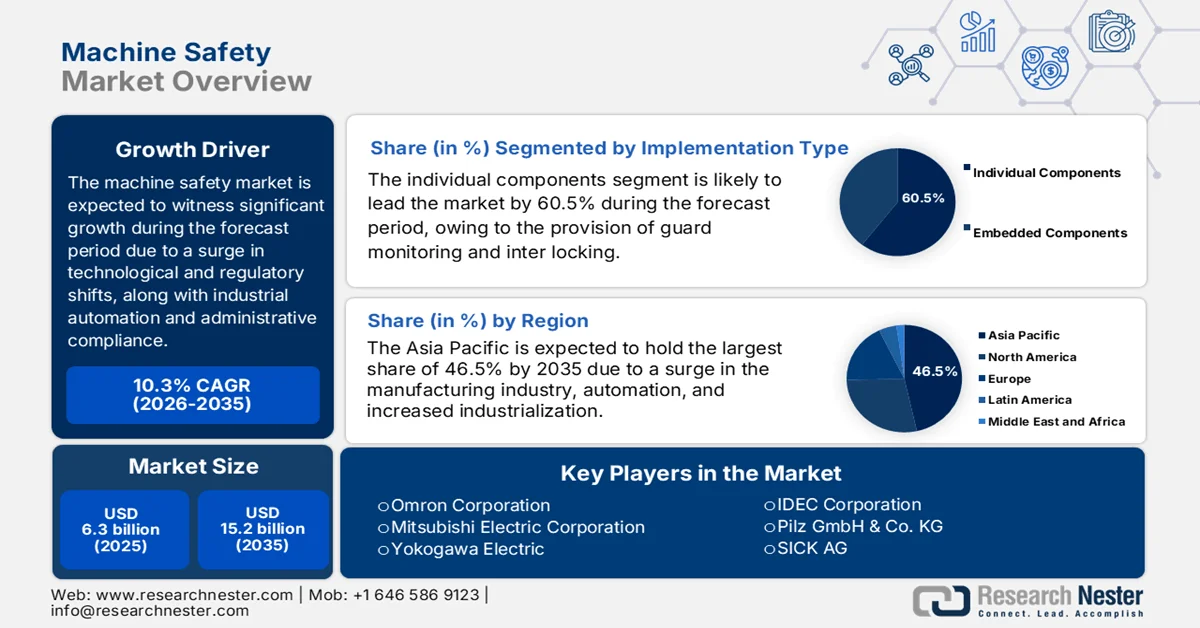
Machine Safety Market size was over USD 6.3 billion in 2025 and is expected to reach USD 15.2 billion by the end of 2035, growing at a CAGR of 10.3% during the forecast timeline, i.e., 2026-2035. In 2026, the industry size of machine safety is estimated at USD 6.9 billion.
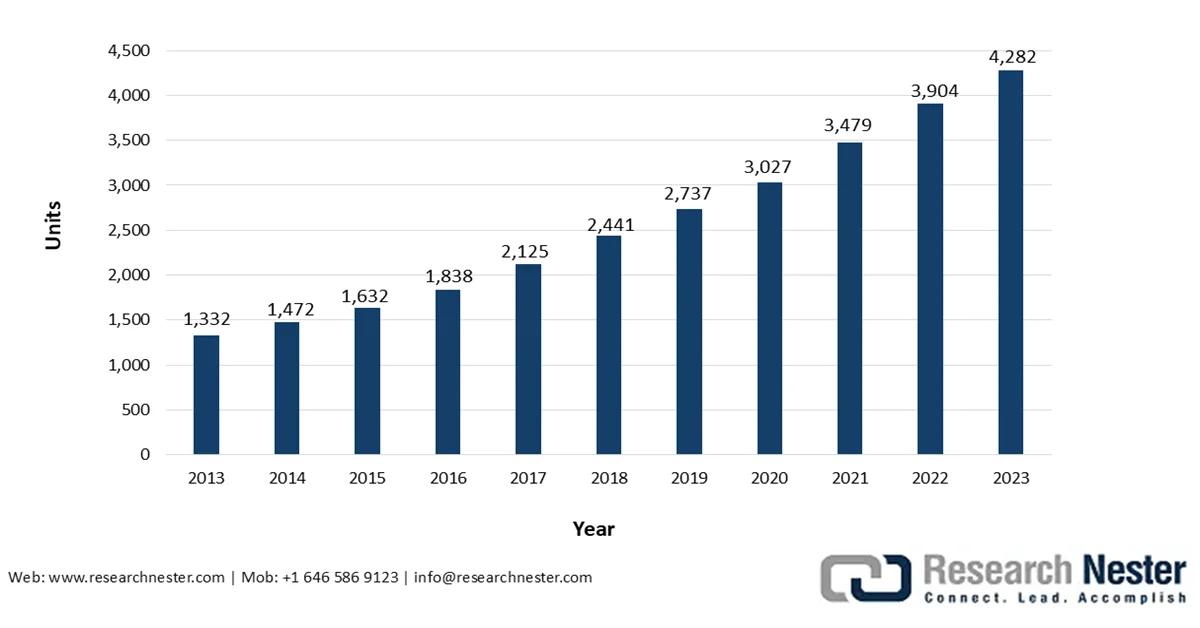
The worldwide machine safety market is gradually enhancing, highly driven by the convergence of regulatory, cultural, and technological shifts that expand beyond conventional growth factors. In addition, regulatory compliance and industrial automation are the newest dynamics that are also reshaping the market. According to official statistics published by the IFR Organization in September 2024, 4,281,585 units are operating in factories globally and demonstrating a 10% increase. Likewise, there has been an expansion in yearly installations by half a million units for the third consecutive year, and meanwhile, by region, 70% of all newly implemented robots as of 2023 have been successfully installed in Asia, 17% in Europe, as well as 10% in America. Besides, the yearly installation of 541,302 units as of 2023 is regarded as the second-highest, thereby creating a positive impact on the machine safety market expansion globally.
Operational Industrial Robots Yearly Stock Analysis (2013-2023)
Source: IFR Organization
Furthermore, the convergence of OT cybersecurity, functional safety, increased focus on physical safety fundamentals, the integration of safety and sustainability culture, along with the mandatory implementation of frontline-ready digitalized tools, are a few trends that are boosting the machine safety market globally. As stated in an article published by the Digital Regulation Platform Organization in July 2023, digital transformation has emerged as one of the global trends, based on which it has been estimated that 70% of the latest economic value is projected to be developed on digitally-driven platforms in the upcoming decade. Moreover, 30% of nations have significantly made progress in establishing an innovative stage of digitalized development, along with different maturity levels in domestic digital transformation initiatives. Therefore, with all these developments, the market is continuously expanding across different regions.
Key Machine Safety Market Insights Summary:
Regional Highlights:
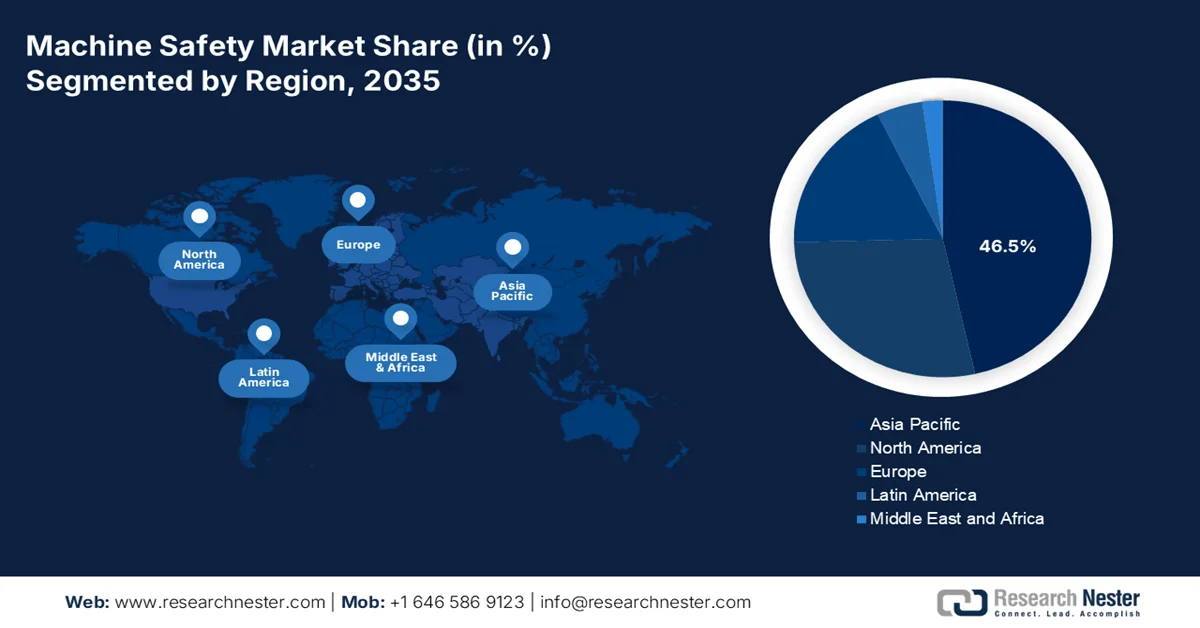
- Asia Pacific is anticipated to hold the leading position in the machine safety market with a 46.5% share by 2035, stimulated by accelerating industrialization and rising robotics adoption across manufacturing sectors.
- Europe is projected to emerge as the fastest-growing regional market throughout 2026–2035, reinforced by strong Industry 4.0 implementation and stringent regulatory frameworks for worker safety.
Segment Insights:
- The individual components segment is projected to account for 60.5% share in the machine safety market by 2035, propelled by the rising need for interlocking and guard monitoring systems that ensure automatic machine shutdown during hazardous situations.
- The hardware sub-segment is expected to secure the second-highest share in the market by 2035, impelled by the essential role of physical safety devices such as sensors, interlock switches, controllers, and emergency stop systems ensuring real-time machinery protection in industrial environments.
Key Growth Trends:
- Rapid expansion of industrial manufacturing
- Shift towards artificial intelligence (AI)
Major Challenges:
- Cybersecurity vulnerabilities in connected systems
- Skills shortage and training gaps
Key Players: Siemens, Schneider Electric, Rockwell Automation, ABB, Honeywell International, Emerson Electric Co., KEYENCE CORPORATION, Omron Corporation, Mitsubishi Electric Corporation, Yokogawa Electric Corporation, IDEC Corporation, Pilz GmbH & Co. KG, SICK AG.
Global Machine Safety Market Forecast and Regional Outlook:
Market Size & Growth Projections:
- 2025 Market Size: USD 6.3 billion
- 2026 Market Size: USD 6.9 billion
- Projected Market Size: USD 15.2 billion by 2035
- Growth Forecasts: 10.3% CAGR (2026-2035)
Key Regional Dynamics:
- Largest Region: Asia Pacific (46.5% Share by 2035)
- Fastest Growing Region: Europe
- Dominating Countries: United States, Germany, Japan, China, United Kingdom
- Emerging Countries: India, South Korea, Brazil, Mexico, Italy
Last updated on : 5 March, 2026
Machine Safety Market - Growth Drivers and Challenges
Growth Drivers
- Rapid expansion of industrial manufacturing: The escalating deployment of robots across manufacturing industries is one of the primary catalysts for sophisticated machine safety components, which is driving the machine safety market internationally. According to official statistics published by the IBEF Organization in November 2025, manufacturing is readily contributing nearly 16% to 17% of gross domestic product (GDP) and employing more than 27 million workers. This growth is effectively supported by governmental strategies, such as production-linked incentive (PLI) schemes and Make in India, with the country targeting manufacturing to account for 25% of GDP in the upcoming years, thereby making it suitable for uplifting the market in the country and other nations.
- Shift towards artificial intelligence (AI): This is a transformative driver for the machine safety market by significantly integrating AI for predictive risk assessment and transitioning safety management from reactive responses to proactive hazard reduction. Based on government estimates published by the Federal Reserve in October 2025, there are 4,049 data centers in the U.S. as of 2024, which is more than 2,250 in Europe, 484 in the UK, and 279 in China. Besides, the U.S. added 5.8 GW of data center capacity in the same year, in comparison to 1.6 GW in Europe and 0.2 GW in the UK. Moreover, in terms of a per capita basis, the U.S server base readily stands at 99.9 per 1,000 people, surpassing other advanced international economies and China. Meanwhile, there has been an increase in AI utilization across different data centers, thus proliferating the market expansion.
Cross-Country AI and Selected Technology Indices Comparative Analysis (2025)
|
Countries |
WIPRO GII |
IMF AI Preparedness Index |
Stanford Global AI Vibrancy Tool |
Oxford Insights GAIRI |
||||
|
Score |
Rank |
Score |
Rank |
Score |
Rank |
Score |
Rank |
|
|
U.S. |
62.4 |
3 |
0.77 |
3 |
70.06 |
1 |
87.03 |
1 |
|
Canada |
52.9 |
14 |
0.71 |
18 |
15.71 |
14 |
78.18 |
6 |
|
France |
55.4 |
12 |
0.7 |
22 |
22.54 |
6 |
79.36 |
4 |
|
Germany |
58.1 |
9 |
0.75 |
9 |
18.49 |
8 |
76.9 |
8 |
|
Italy |
45.3 |
26 |
0.62 |
36 |
14.11 |
22 |
71.22 |
25 |
|
Japan |
54.1 |
13 |
0.73 |
12 |
18.47 |
9 |
75.75 |
12 |
|
UK |
61 |
5 |
0.73 |
13 |
27.21 |
3 |
78.88 |
5 |
|
China |
56.3 |
11 |
0.64 |
30 |
40.17 |
2 |
72.01 |
23 |
|
India |
38.3 |
39 |
0.49 |
71 |
25.54 |
4 |
62.81 |
46 |
Source: Federal Reserve
- Emergence of safety-as-a-service model: Companies are increasingly open to adopting alternative acquisition models due to increased capital spending essential for purchasing advanced safety equipment outright. This particular model is gradually emerging as a suitable driver for the machine safety market accessibility and enabling organizations to improve cash flow and conserve capital, while continuing to access the latest safety technologies. Besides, companies across different regions are willing to implement safety equipment in the near future, thus making cost-effective access to high-quality technology. Moreover, rental options permit small-scale firms to benefit from the newest, completely maintained safety solutions and bridge the entry gap for innovative advanced protection, thereby uplifting the machine safety market.
Challenges
- Cybersecurity vulnerabilities in connected systems: The convergence of operational technology and information technology, while unlocking new possibilities for efficiency and predictive maintenance, brings significant new challenges for the machine safety market. As safety controllers and logic units become commonly connected to wider plant-level Ethernet networks, the isolation that previously secured these systems is vanishing, leaving them vulnerable to malicious actors who might disable emergency stops or alter safety settings. This development compels manufacturers to integrate robust security protocols directly into safety instrumentation, treating cyber threats as inherent mechanical hazards. Therefore, the presence of cybersecurity risks and suitable solutions to combat them is suitable for uplifting the machine safety market growth.
- Skills shortage and training gaps: The shortage of skilled labor and the need for extensive training programs present critical challenges to the machine safety market. Although automation and safety technologies can improve workplace conditions, companies often lack the internal expertise to maintain these complex systems effectively. The machine-building and engineering manufacturing sectors are facing a perfect storm of challenges, including a shrinking engineering workforce in Europe that is forcing companies to rethink how they operate. This skills gap manifests at multiple levels: engineers capable of designing compliant safety systems, technicians qualified to install and maintain advanced protective equipment, and operators trained to work safely alongside increasingly sophisticated automated systems.
Machine Safety Market Size and Forecast:
| Report Attribute | Details |
|---|---|
|
Base Year |
2025 |
|
Forecast Year |
2026-2035 |
|
CAGR |
10.3% |
|
Base Year Market Size (2025) |
USD 6.3 billion |
|
Forecast Year Market Size (2035) |
USD 15.2 billion |
|
Regional Scope |
|
Machine Safety Market Segmentation:
Implementation Type Segment Analysis
The individual components segment, as part of the implementation type, is anticipated to garner the highest share of 60.5% in the machine safety market by the end of 2035. The segment’s upliftment is highly driven by the aspects of interlocking and guard monitoring, which are important protective device types. These assist in overcoming critical situations by shutting the power off from the machine, thus driving the segment’s growth. According to official statistics published by NLM in May 2023, there are roughly 2.8 million illnesses and injuries within the private industry, particularly in the U.S., every year. Besides, the National Safety Council has estimated that work injuries usually cost companies USD 161.5 billion every year, from expenses including USD 50.7 billion for productivity and wage loss, USD 34.3 billion for medical expenses, and USD 52.0 billion for administrative expenses. Therefore, it is crucial to maintain machine protection by installing suitable devices, thus denoting a huge growth opportunity for the segment.
Offering Segment Analysis
By the end of the projected period, the hardware sub-segment, which is part of the offering segment, is projected to hold the second-highest share in the machine safety market. The sub-segment’s growth is highly fueled by its role as the foundational backbone of the machine safety market, encompassing the physical devices and components that provide direct protection against machinery hazards. This sub-segment includes presence-sensing safety sensors such as safety light curtains, laser scanners, safety edges, and safety mats; safety interlock switches, including non-contact, trapped key, and tongue interlock varieties; safety controllers, modules, and relays; programmable safety systems; emergency stop controls; two-hand safety controls; and physical machine guards. Moreover, the sub-segment’s growth is also driven by the non-negotiable requirement for reliable, real-time physical protection in industrial environments, thus suitable for market expansion.
Safety Type Segment Analysis
The functional safety segment in the machine safety market is expected to account for the third-highest share by the end of the stipulated timeline. The segment’s development is highly propelled by providing operators with far better control and operational metrics of the equipment that are underutilization. Besides, companies are adopting software development kits that comprise particular elements that connect to industrial machine safety. For instance, in June 2025, Accenture introduced AI Refinery distiller agentic framework and accompanying software development kits. This provides developers with an enterprise-based platform to rapidly develop, deploy, and scale up innovative AI agents for detecting risks in industrial settings of sensors and cameras. Therefore, with such organizational development, there is a huge growth opportunity for the market across different nations.
Our in-depth analysis of the machine safety market includes the following segments:
|
Segment |
Subsegments |
|
Implementation Type |
|
|
Offering |
|
|
Safety Type |
|
|
Application |
|
|
Component |
|
|
End use Industry |
|

Vishnu Nair
Head - Global Business DevelopmentCustomize this report to your requirements — connect with our consultant for personalized insights and options.
Machine Safety Market - Regional Analysis
APAC Market Insights
The Asia Pacific in the machine safety market is anticipated to garner the highest share of 46.5% by the end of 2035. The market’s upliftment in the region is highly attributed to rapid industrialization, expansion in the manufacturing sector, and an increase in the automation integration across countries, including South Korea, India, Japan, and China. According to official statistics published by the World Bank Group in August 2025, countries in the region have significantly increased the utilization of robots, accounting for an average number of robots per 1,000 manufacturing workers as of 2022. Additionally, there are 17 robots in the overall region, 12 in China, and 8 each across Vietnam, Thailand, and Malaysia. Therefore, with the increased robotics adoption, many countries, particularly Vietnam, witnessed massive gains in labor income and employment by almost 5% and 10%, respectively, thus driving the machine safety market growth.
The machine safety market in China is growing significantly, owing to strong government industrialization policies, stringent workplace safety regulations, especially under the Work Safety Law demanding comprehensive safety systems and machine guarding across all industrial facilities. As per the November 2025 State Council Information Office article, the country’s value-added industrial output extended by 4.9% year-on-year (YoY) in October 2025. Additionally, in the first 10 months of the same year, there has been an increase in the nation’s industrial output by 6.1% in comparison to 2023. Moreover, the industrial output is utilized to measure the activity of large-scale enterprises, each with a yearly business turnover of at least USD 2.8 million. Meanwhile, the manufacturing industry’s value-added output increased by 4.9%, thereby making it suitable for uplifting the market in the country.
The presence of an advanced semiconductor industry demanding sophisticated safety solutions, green manufacturing strategies, the adoption of AI-driven safety programs, and organizational developments are a few factors that are proliferating the machine safety market in South Korea. According to official statistics published by the ITA in September 2023, semiconductor chips are regarded as the country’s largest export product, accounting for 18.9% of overall exports as of 2022. As a result, the worldwide demand for chips in relation to innovative services and IT devices, such as cloud computing and AI, is expected to lead to continuous growth in the upcoming years. Besides, the country is one of the leaders in the memory chip fabrication, with SK Hynix and Samsung Electronics significantly accounting for 51% of the NAND flash industry and 73% of the international DRAM industry, thus denoting an optimistic outlook for the market growth.
Europe Market Insights
Europe in the machine safety market is expected to emerge as the fastest-growing region during the forecast period. The market’s development is highly propelled by leadership in Industry 4.0 adoption, the presence of stringent regulatory frameworks, a robust manufacturing base, and wide-ranging worker protection systems. According to official statistics published by OECD in February 2026, the manufacturing industry plays a critical role in the regional economy and readily employs over 30 million people, which is almost 16% of the overall value added. Therefore, there is a huge demand for machines to carry out manufacturing activities, resulting in a modernized industrial base and strengthened competitiveness. Moreover, tobacco, food, and beverages account for 13% of total manufacturing value, followed by trailers, semi-trailers, and motor vehicles, demonstrating just 1% of overall manufacturing value added, thus making it suitable for bolstering the market in the region.
The machine safety market in Germany is gaining increased traction, owing to an increase in electronics, industrial machinery, and automotive, along with stringent compliance with standards for safety controls and machine guarding. As stated in a data report published by the Germany Trade and Invest in 2025, the machinery and equipment sector in the country is worth USD 310 billion of the domestic turnover as of 2023, denoting 2.9% as value added share. In addition, the sector amounts to USD 9.9 billion in terms of overall domestic expenditure in the same year. Moreover, the sector accounts for 10.5% share of international machinery trade as of 2022, along with 81.3% of machinery turnover, significantly generated from global exports in 2023. Besides, the industry FDI throughout the country is also responsible for propelling the market in the upcoming years.
Machinery and Equipment FDI Yearly Project Analysis in Germany (2020-2023)
|
Year |
Number of Projects |
|
2020 |
101 |
|
2021 |
127 |
|
2022 |
112 |
|
2023 |
57 |
|
Total |
397 |
Source: Germany Trade and Invest
The aspects of wide-ranging risk assessments, safety system implementations across different industries, along with AI adoption for connected worker technologies, smart helmets, and safety monitoring, are responsible for boosting the machine safety market in the UK. As stated in an article published by the UK Tech in February 2025, smart machines from robotic surgeons to intelligent dishwashers tend to provide USD 195 billion to the country’s economy. Besides, the Smart Machines 2035 governmental strategy appointed the Robotics Growth Partnership committee, which proclaimed that the automated machinery would contribute to the British economy, for enhancing the staggering 20-fold by the end of 2035, denoting a rise from the present USD 8.3 billion valuation. Therefore, with such developments, there is a huge growth opportunity for the market in the overall country.
North America Market Insights
North America in the machine safety market is projected to witness considerable growth by the end of the stipulated period. The market’s growth in the region is highly driven by the presence of a massive industrial base, a strict regulatory environment focused on worker protection, an increase in robotics and automation implementation, and the need for sophisticated safety solutions. For instance, as per the February 2024 Association for Advancing Automation article, organizations in the region ordered 31,311 robots, which are valued at USD 1.9 billion. Additionally, this has represented an increase by 0.5% in units and well as 0.1% in revenue as of 2023. This upliftment in robotics has significantly marked stabilization after years of record-breaking and volatility growth. Besides, food and consumer goods in the region are the fastest-growing industry, with robots surging by 65%, thus boosting the market growth.
The machine safety market in the U.S. is gaining greater exposure, owing to a rise in the chemical industry, which facilitates high-stakes processes involving hazardous materials; an increase in government funding; and the role of administrative programs. Based on government estimates published by the CISA in February 2023, the chemical industry in the country significantly converts raw materials into over 70,000 diversified products that are crucial to more than 750,000 end users. The industry’s valuation is worth USD 486 billion, which is higher than the 25% of the overall GDP. Besides, the agricultural chemical sector is valued at USD 16.8 billion, with USD 30.7 billion as total shipments distributed. In addition, the continuous growth in domestic pesticides and fertilizers is also responsible for bolstering the market in the country.
Pesticides and Fertilizers Growth in the U.S. (2023)
|
Pesticides |
Fertilizers |
||
|
U.S. Agricultural Producers Expenditure |
USD 9 billion |
U.S. Agricultural Producers Expenditure |
USD 66.7 million |
|
Herbicides |
USD 5.1 billion |
U.S. Consumption |
22 million |
|
Insecticides |
USD 2.2 billion |
Nitrogen |
59% |
|
Fungicides |
USD 1.4 billion |
Potash |
22% |
|
Fumigants |
USD 0.1 billion |
Phosphate |
19% |
Source: CISA
The aspects of regulatory updates, evolving safety standards, technological integration, strategic investments, and government funding are certain factors that are uplifting the machine safety market in Canada. According to official statistics published by the ITA in August 2022, the government in the country declared that the 2022 budget featured almost USD 3.8 billion in funding for supporting mining efforts for more than 8 years. Additionally, the country has developed its very first critical mineral strategy, aiming to optimize the yield of metals to successfully reach net-zero emissions by the end of 2050. Besides, this particular plan comprises exploration programs, with an additional USD 1.5 billion as investment for new infrastructure. Therefore, with such investment and funding initiatives, the market is continuously expanding in the overall country.
Key Machine Safety Market Players:
- Siemens (Germany)
- Schneider Electric (France)
- Rockwell Automation (U.S.)
- ABB (Switzerland)
- Honeywell International (U.S.)
- Emerson Electric Co. (U.S.)
- KEYENCE CORPORATION (Japan)
- Omron Corporation (Japan)
- Mitsubishi Electric Corporation (Japan)
- Yokogawa Electric Corporation (Japan)
- IDEC Corporation (Japan)
- Pilz GmbH & Co. KG (Germany)
- SICK AG (Germany)
- EUCHNER GmbH + Co. KG (Germany)
- HIMA Paul Hildebrandt GmbH (Germany)
- Troax (Sweden)
- Fortress Interlocks (UK)
- Procter Brothers (UK)
- HIMA India (India)
- Komori Safety Device Lab (Malaysia)
- Company Overview
- Business Strategy
- Key Product Offerings
- Financial Performance
- Key Performance Indicators
- Risk Analysis
- Recent Development
- Regional Presence
- Siemens is a dominant force in the machine safety market, leveraging its comprehensive digital enterprise portfolio to integrate safety seamlessly into automated systems. The company is driving innovation with solutions, such as its next-generation SIMATIC safety modules and the SIMATIC AI Safety Suite, which uses machine learning for predictive monitoring and proactive risk management on high-speed production lines.
- Schneider Electric significantly maintains a strong market position by offering a wide array of machine safety solutions, including safety switches, PLCs, and integrated safety functions within its EcoStruxure architecture. The company focuses on delivering customizable and scalable safety systems that help industries like pharmaceuticals and manufacturing enhance operational safety while managing complex regulatory requirements.
- Rockwell Automation is a leading U.S.-based provider, shaping the market with its focus on connecting safety with operational data to improve productivity and reduce downtime. Its strategic initiatives include the development of platforms, such as GuardLink 3.0, which enhances connectivity and real-time risk detection across industrial machinery via Ethernet-based safety networks.
- ABB is one of the key global players in machine safety, known for integrating advanced safety controllers directly into collaborative robot (cobot) systems to ensure safe human-robot interaction on the factory floor. The company's strategy involves leveraging its deep expertise in both robotics and industrial automation to create adaptive safety technologies that meet the demands of flexible and modern production systems.
- Honeywell International is a major U.S.-based competitor, leveraging its extensive experience in industrial safety to offer a broad portfolio of machine safety products and connected solutions. The company is strategically focused on digital transformation, exemplified by its launch of AI-based safety management platforms that aim to streamline compliance and enhance workplace safety protocols through advanced analytics.
Here is a list of key players operating in the global machine safety market:
The worldwide machine safety market is extremely competitive and moderately consolidated, with the top five companies accounting for the majority of the market share. These particular industrial leaders, such as Rockwell Automation, Schneider Electric, and Siemens, have leveraged expanded portfolios ranging from light curtains and safety PLCs to implemented software solutions. Besides, their tactical strategies are readily focused on advancement through the adoption of predictive diagnostics and IIoT capabilities into safety systems. Meanwhile, in March 2025, Magna declared a suitable program by collaborating with NVIDIA for integrating the NVIDIA DRIVE AGX platform with the organization’s cutting-edge advanced technological solutions. This system operates on the safety-certified DriveOS operating system, and is developed on theBlackwell GPU architecture, thus proliferating the machine safety industry globally.
Corporate Landscape of the Machine Safety Market:
Recent Developments
- In October 2025, NVIDIA declared its partnership with Uber to upscale the world’s largest level 4-ready mobility network by utilizing its cutting-edge autonomous and robotaxi delivery fleets, which is known as the newest NVIDIA DRIVE AGX Hyperion 10 autonomous vehicle development platform, as well as the NVIDIA DRIVE AV software purpose-built for L4 autonomy.
- In August 2025, Commonwealth Fusion Systems (CFS) notified that it has successfully raised USD 863 million in a Series B2 fundraising since it has moved closer to emerging as the world’s first-ever company to readily commercialize fusion power.
- In January 2025, Cisco proclaimed the Cisco AI Defense, which is one of the pioneering solutions to safeguard and enable AI transformation within enterprises. Besides, new security threats and safety concerns are significantly emerging at an unprecedented speed, which present security solutions are unprepared to protect against, based on which this machine solution is suitable to secure, deploy, and develop AI application with confidence.
- Report ID: 8417
- Published Date: Mar 05, 2026
- Report Format: PDF, PPT
- Explore a preview of key market trends and insights
- Review sample data tables and segment breakdowns
- Experience the quality of our visual data representations
- Evaluate our report structure and research methodology
- Get a glimpse of competitive landscape analysis
- Understand how regional forecasts are presented
- Assess the depth of company profiling and benchmarking
- Preview how actionable insights can support your strategy
Explore real data and analysis
Frequently Asked Questions (FAQ)
About this Report
Connect with our Expert


Report, 2026-2035



Copyright @ 2026 Research Nester. All Rights Reserved.
