Temperature Monitoring System Market Outlook:
Temperature Monitoring System Market size was valued at USD 3.1 billion in 2025 and is anticipated to reach a significant value of USD 6.5 billion by the end of 2035, with a CAGR of 8.7% during the forecast period, i.e., 2026-2035. In 2026, the industry size of temperature monitoring system is assessed at USD 3.3 billion.
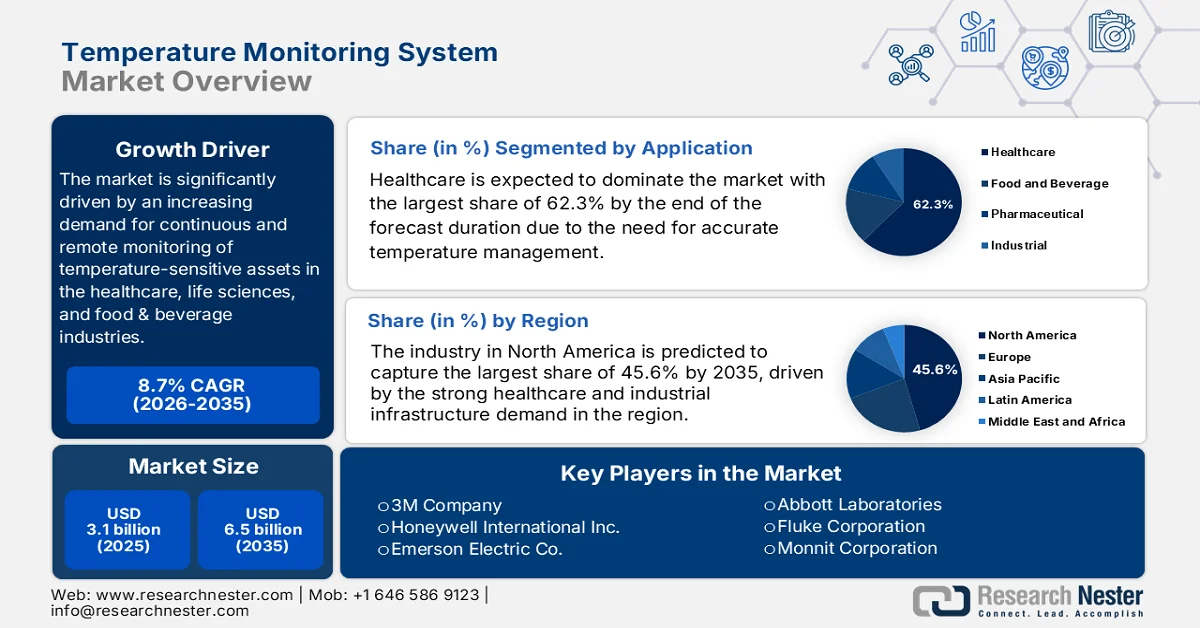
The global temperature monitoring system market is poised to witness exceptional growth, effectively driven by an increasing demand for continuous, real-time, and remote monitoring of temperature-sensitive assets in the healthcare, life sciences, industrial, and food & beverage sectors. According to the article published by the National Institute of Health (NIH) in March 2023, off-the-shelf wearable sensors can reliably monitor construction workers’ body temperature to detect health and safety risks. In a study across two large construction sites in Australia, three devices measuring at recommended body sites, i.e., axilla and tympanic, showed measurement biases of less than one when compared to hospital-grade thermometers, while maintaining worker comfort over full shifts. The sensors continuously transmitted real-time data to a central monitoring platform by enabling objective, long-duration tracking under actual working conditions. Therefore, these findings indicate that wearable temperature monitoring can be integrated into construction site safety protocols for a very proactive risk detection.
Furthermore, the rise of smart cold chain infrastructure, combined with the need to ensure the efficacy of vaccines, biologics, and perishable goods, fuels widespread adoption of smart sensor networks, thus benefiting the overall temperature monitoring system market. In November 2025, the article published by India Brand Equity Foundation (IBEF) revealed that India’s cold chain infrastructure is growing remarkably, with the main goal to support the storage and transport of temperature-sensitive agricultural produce, pharmaceuticals, and processed foods. As of 2024, the country had almost 8,689 cold storage facilities with a total capacity of 39.6 million MT. At the same time, government programs such as PMKSY, PMFME, and the agriculture infrastructure fund have facilitated more than 1,200 projects and sanctioned loans worth USD 7.8 billion to enhance cold storage, refrigerated transport, and related facilities. Integration of digital monitoring, AI, and solar-powered systems is readily improving efficiency, thus making it suitable for bolstering global market growth.
Key Temperature Monitoring System Market Insights Summary:
Regional Highlights:
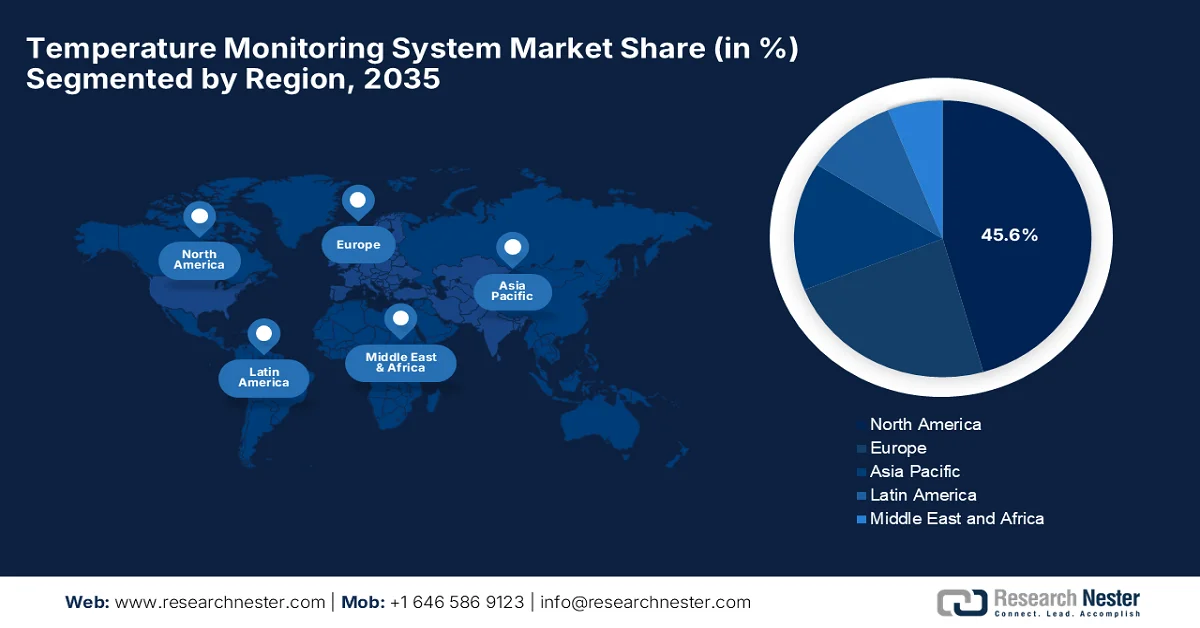
- North America temperature monitoring system market is projected to hold a dominant 45.6% share by 2035, reinforced by robust healthcare and pharmaceutical infrastructure alongside stringent regulatory frameworks propelling demand
- Asia Pacific is anticipated to witness the fastest growth through 2035, fueled by expanding industrial activities and increasing investments in healthcare and cold chain logistics accelerating adoption
Segment Insights:
- In the temperature monitoring system market, the healthcare segment is forecasted to capture a leading 62.3% share by 2035, attributed to the critical need for precise temperature control in medical and laboratory environments ensuring safety of temperature-sensitive products
- The data logger segment is expected to secure a significant revenue share by 2035, supported by rising integration with enterprise systems enhancing real-time monitoring and quality control capabilities
Key Growth Trends:
- Stringent regulatory requirements
- Technological advancements
Major Challenges:
- High initial investment and integration costs
- Data security and privacy concerns
Key Players: 3M Company (U.S.), Honeywell International Inc. (U.S.), Emerson Electric Co. (U.S.), Abbott Laboratories (U.S.), Fluke Corporation (U.S.), Monnit Corporation (U.S.), Sensitech Inc. (U.S.), Cooper Atkins Corporation (U.S.), Thermo Fisher Scientific Inc. (U.S.), DeltaTrak, Inc. (U.S.), Testo SE & Co. KGaA (Germany), Vaisala Oyj (Finland), Schneider Electric SE (France), Siemens AG (Germany), Omron Corporation (Japan), Berlinger & Co. (Switzerland), Fujitsu (Japan), Sector Alarm (Norway), ABB (Switzerland), eMarine (South Korea), Terumo Corporation (Japan), A&D Company Ltd. (Japan), Endress+Hauser Group (Switzerland), General Instruments (India), Elpro (Switzerland).
Global Temperature Monitoring System Market Forecast and Regional Outlook:
Market Size & Growth Projections:
- 2025 Market Size: USD 3.1 billion
- 2026 Market Size: USD 3.3 billion
- Projected Market Size: USD 6.5 billion by 2035
- Growth Forecasts: 8.7% CAGR (2026-2035)
Key Regional Dynamics:
- Largest Region: North America (45.6% Share by 2035)
- Fastest Growing Region: Asia Pacific
- Dominating Countries: United States, Germany, China, Japan, United Kingdom
- Emerging Countries: India, South Korea, Brazil, Mexico, Indonesia
Last updated on : 7 April, 2026
Temperature Monitoring System Market - Growth Drivers and Challenges
Growth Drivers
- Stringent regulatory requirements: The administrative bodies across different nations implement strict temperature compliance. As a result, industries need to keep a focus on product quality, safety standards, and audit-ready monitoring systems, driving adoption in the temperature monitoring system market. Based on the government data published in July 2024, automated temperature monitoring and back-to-base alarm systems are highly effective for maintaining vaccine cold chain integrity in line with the Strive for 5 guidelines. Besides, Victoria state government also stated that providers must use purpose-built refrigerators with continuous data loggers or automated systems to ensure vaccines remain between +2°C and +8°C. At the same time, these systems safeguard vaccine quality, reduce risks of wastage, and ensure compliance across all immunization service providers, thus positively impacting the market’s growth.
- Technological advancements: The integration of IoT-enabled sensors, wireless devices, and cloud platforms is reorganizing the growth dynamics of the temperature monitoring system market. Some of the key innovations are real-time monitoring & alerts, predictive analytics by utilizing AI, and remote access through cloud dashboards. These technologies improve efficiency and reduce manual intervention. In June 2024, Monnit announced that its cold chain IoT asset tracking solution had won the 2024 IoT Evolution Asset Tracking Award for innovation in automating asset monitoring. It is especially designed for food, pharmaceutical, and healthcare industries, and the system uses ALTA low-temperature and digital temperature sensors with the ALTA XL IoT Gateway to ensure compliance and protect sensitive assets, thus benefiting the overall temperature monitoring system market growth.
- Increasing need for remote monitoring: Industries are making a shift from manual operations to automated, continuous temperature monitoring systems. This offers benefits such as reduced human error and immediate alerts for deviations, especially critical in terms of labs, hospitals, warehouses, and server rooms. In December 2024, Monnit introduced eight new Next Wi-Fi Sensors, which extend IoT connectivity with stronger signals and a wider range through standard 802.11 b networks. The company also notes that these compact sensors cover different applications, i.e., temperature, humidity, motion detection, water presence, and open/closed monitoring, all managed through iMonnit dashboards. Hence, such innovations in the temperature monitoring system market denote that industries are accelerating the adoption of connected solutions to enhance operational efficiency and enable decision-making across critical environments.
Challenges
- High initial investment and integration costs: One of the major obstacles hindering growth in the temperature monitoring system market is the burgeoning investments for purchasing, installing, and integrating advanced monitoring solutions. Most of the systems consist of sensors, IoT-enabled devices, and cloud-based analytics platforms, which can be expensive for small and medium-sized firms. At the same time, integrating these systems with existing IT infrastructure requires specialized technical knowledge. Therefore, the complexity associated with aligning TMS with diverse industrial processes, regulatory frameworks, and data management systems in turn increases expenses. Hence, the existence of financial barriers can hinder adoption, ultimately slowing market growth.
- Data security and privacy concerns: The temperature monitoring systems depend on IoT devices and cloud platforms, which raise considerable data security concerns. Any type of unauthorized access, such as cyberattacks, can cause breaches regarding product storage conditions, operational processes, and supply chain integrity, in turn creating roadblocks for market expansion. In this context, organizations need to ensure proper encryption, secure authentication, and compliance with global data privacy regulations. Therefore, implementing reliable security protocols can be complex and resource-intensive, particularly in the case of SMEs who are lacking dedicated IT teams. Therefore, these concerns may limit adoption in the temperature monitoring system market, as companies have concerns regarding reputational and financial consequences of breaches.
Temperature Monitoring System Market Size and Forecast:
| Report Attribute | Details |
|---|---|
|
Base Year |
2025 |
|
Forecast Year |
2026-2035 |
|
CAGR |
8.7% |
|
Base Year Market Size (2025) |
USD 3.1 billion |
|
Forecast Year Market Size (2035) |
USD 6.5 billion |
|
Regional Scope |
|
Temperature Monitoring System Market Segmentation:
Application Segment Analysis
Based on the application, healthcare is expected to dominate the temperature monitoring system market with the largest share of 62.3% by the end of the forecast duration. The segment’s dominance is largely attributable to the essential need for accurate temperature management in hospitals, laboratories, and blood banks to safeguard temperature-sensitive products such as vaccines, biologics, and diagnostic samples. As per an article published by the Centers for Disease Control and Prevention (CDC) in April 2024, every vaccine storage unit is required to use a continuous monitoring digital data logger with buffered probes that closely reflect actual vaccine temperatures, logging at least every 30 minutes. It also stated that DDLs must include alarms for out-of-range conditions, low-battery indicators, and downloadable temperature data for review to ensure vaccine safety and regulatory compliance. Also, facilities are required to maintain backup devices and perform calibration testing every one to two years, safeguarding vaccines, reducing wastage, thus denoting a wider segment scope.
Component Type Segment Analysis
The data logger, which is a part of the component type segment, is predicted to grow with a considerable revenue share in the temperature monitoring system market by the end of 2035. These devices provide data recording and remote access, making them highly important for quality control. For instance, in August 2024, Vaisala announced the launch of the VDL200 data logger with a main goal to extend Ethernet connectivity for secure environmental monitoring in GxP-regulated applications. Besides, it also mentioned that the device measures temperature, humidity, and CO₂ with Power over Ethernet for simplified installation and reliable communication to the viewLinc continuous monitoring system. Therefore, such instances drive the segment’s growth by readily enhancing adoption in highly regulated industries wherein precise monitoring is critical. The integration of these data loggers with enterprise systems enables risk mitigation and improved quality control, thereby boosting their temperature monitoring system market demand.
Technology Segment Analysis
The non-contact systems in terms of technology are anticipated to capture a significant revenue share in the temperature monitoring system market over the forecasted years. The subtype provides rapid, hygienic temperature measurements without touching the object, thus positioning it as a gold standard for revenue generation in this sector. As of the March 2026 data from the U.S. Food & Drug Administration, non-contact infrared thermometers readily enable temperature measurement without physical contact, helping reduce cross-contamination and the spread of disease in healthcare settings. Besides, the article also noted that they are easy to use, quick to deliver results, and simple to clean, making them suitable for high-volume clinical environments. The article also underscored that their effectiveness depends on proper usage, as environmental conditions and handling can affect accuracy, denoting a positive temperature monitoring system market outlook.
Our in-depth analysis of the temperature monitoring system market includes the following segments:
|
Segment |
Subsegments |
|
Application |
|
|
Component Type |
|
|
Technology |
|
|
End use |
|

Vishnu Nair
Head - Global Business DevelopmentCustomize this report to your requirements — connect with our consultant for personalized insights and options.
Temperature Monitoring System Market - Regional Analysis
North America Market Insights
North America temperature monitoring system market is anticipated to garner the largest revenue share of 45.6% by the conclusion of the forecast period. The dominance of the region is effectively propelled by strong healthcare, pharmaceutical, and industrial infrastructure demand. The region also benefits from an improved technological infrastructure, strict regulatory standards, and the rising burden of chronic illnesses. In April 2023, Masimo announced that its Rad-G with Temperature has received the U.S. FDA 510(k) clearance, which enables wider clinical use. The handheld device combines pulse oximetry, respiration rate monitoring, and non-contact infrared thermometry in a single compact tool. Hence, with such continued innovations and regulatory support, the region is positioned for unprecedented growth in the upcoming years.
The advanced cold chain systems and growing investments in IoT-enabled monitoring technologies are strengthening the temperature monitoring system market in the U.S. The suitable policies in the country promote traceability and temperature control, whereas the strong research ecosystem promotes continued innovations, thereby boosting market growth. In November 2023, researchers of the National Institute of Standards and Technology presented a study on a temperature monitoring and airflow control system, which is especially prepared to improve environmental balance in greenhouses. Besides, the system leverages IEEE 1451 standards to enable interoperability between smart temperature sensors, an airflow controller, and a centralized monitoring application. Thus, this underscores a cost-effective, standards-based approach to enhancing the overall greenhouse productivity and environmental control.
There is a huge opportunity for the temperature monitoring system market in Canada, facilitated by the modernization of healthcare infrastructure and a stricter regulatory landscape for food safety. In this context, the Journal of Hospital Management and Health Policy article revealed that in December 2023, a study by the British Columbia Centre for Disease Control analyzed temperature variability within a healthcare facility in Vancouver during an extreme heat event using low-cost sensors. In this context, researchers found that while outdoor temperatures peaked at 47.6 ℃, indoor conditions differed greatly across floors and rooms. Therefore, these findings highlight that even with central air conditioning, heat exposure risks can vary widely within the same building. Hence, continuous monitoring of indoor temperatures can guide real-time protective measures, such as relocating patients or deploying portable cooling devices.
APAC Market Insights
The Asia Pacific temperature monitoring system market is expected to grow at the fastest rate during the forecast period. The region’s growth is largely attributable to industrial expansion, increasing healthcare spending, and rising demand for efficient cold chain logistics. Central countries are leading this growth, supported by significant investments in healthcare and food infrastructure. Global Cold Chain Alliance in August 2025 reported that the cold chain industry in the Asia Pacific grew at a significant rate, which is driven by urbanization, rising incomes, e-commerce, and demand for perishable foods and pharmaceuticals. Economies such as China, India, Japan, South Korea, and Australia are expanding cold storage, e.g., Australia’s refrigerated capacity rose from 8.4 million m³ in 2020 to 10.2 million m³ in 2023. Emerging markets such as Singapore and the Philippines anticipate 2× and double-digit growth in cold storage over the next decade, thus denoting a lucrative growth opportunity for temperature monitoring systems.
The rapid expansion of cold chain logistics and a nationwide push for industrial modernization are responsibly uplifting the temperature monitoring system market in China. Meanwhile, the massive growth of China's electric vehicle industry in the country has created a parallel demand for thermal management sensors. According to the article published by the Information Technology and Innovation Foundation in July 2024, China leads the global electric vehicle and battery industries, producing 62% of EVs and 77% of EV batteries in 2022, wherein the exports have risen by almost 851% from 2020 to 2023, with nearly 40% going to Europe. At the same time, the country dominates high-impact EV battery research, accounting for 65.4% of publications, whereas its share of global electric propulsion patents rose at a considerable rate, thus positively impacting the market’s growth.
The temperature monitoring system market in India is maintaining a strong position in the region, which is catalyzed by digital transformation. The shift toward advanced sensors and cloud-integrated platforms is replacing traditional manual logging to ensure the strict integrity of vaccine cold chains and sensitive biologics. In September 2023, the report published by Invest India stated that India’s cold chain infrastructure, which is a highly essential attribute for agriculture, food processing, and fisheries, is expanding rapidly to reduce post-harvest losses and improve food security. It also mentioned that the sector was valued at USD 22 billion in 2022 and is projected to reach a substantial value of USD 46.1 billion by the end of 2028, growing at a CAGR of 12.3%. On the other hand, government initiatives such as PMKSY, MIDH, PM Matsya Sampada Yojana, and NABARD credit support have developed modern storage, transportation, and processing facilities, benefiting the overall temperature monitoring system industry.
Europe Market Insights
Europe temperature monitoring system market has acquired a prominent position in the global dynamics based on factors such as advanced technology adoption, strict regulatory standards, and an emphasis on precise monitoring. The countries in the region benefit from a strong industrial base and leadership in pharmaceutical and healthcare technology, allowing an increased uptake. In July 2024, UPS Healthcare announced a total of USD 22 million investment with the main goal of expanding its temperature-controlled fleet across Europe by adding more than 200 dual-temperature vehicles to support the growing demand for cold chain logistics. Besides, this investment ensures reliable delivery of pharmaceutical products, which require proper temperature management, to wholesalers, hospitals, and pharmacies. The new vehicles maintain conditions between 2°C and 8 °C and 15°C and 25 °C and integrate GDP-compliant digital quality management systems for real-time monitoring, thus suitable for standard market growth.
The major shift toward Industry 4.0 and the increased integration of IoT-driven automation are solidifying the position of the temperature monitoring system market in Germany. The country’s extensive focus on energy efficiency and sustainable building management is progressively driving the adoption of intelligent thermal monitoring systems across the commercial as well as residential sectors. In April 2025, Deutsche Telekom entered into a tactical alliance with smart building firm Metr with a main goal to digitalise more than 120 heating systems in multifamily residences owned by Stadtsiedlung Heilbronn, Germany, using IoT-enabled remote monitoring and automated optimisation. The report highlighted that this particular system collects temperature and energy data through sensors, transmits it securely to the Metr platform on the Open Telekom Cloud, and deliberately applies machine-learning algorithms for efficiency improvements, thus making it suitable for standard market growth.
The temperature monitoring system market in the UK is undergoing a sophisticated digital transition, which is driven by the modernization of the national health service and the expansion of high-tech pharmaceutical manufacturing. As industries in the country showcase an increased priority towards remote monitoring, the market is evolving into a fully automated ecosystem. Based on the country’s government data published in October 2025, NHS Wales Shared Services Partnership, hosted by Velindre University NHS Trust, and it published a tender for a wireless electronic temperature monitoring system to manage all temperature-controlled areas in pathology laboratories, including blood transfusion and mortuaries. In addition, the contract was valued at USD 190,000, which includes VAT, and is set from April 2026 to March 2029, with possible extensions to March 2031, hence denoting a positive outlook for the market’s expansion and exposure.
Key Temperature Monitoring System Market Players:
- 3M Company (U.S.)
- Honeywell International Inc. (U.S.)
- Emerson Electric Co. (U.S.)
- Abbott Laboratories (U.S.)
- Fluke Corporation (U.S.)
- Monnit Corporation (U.S.)
- Sensitech Inc. (U.S.)
- Cooper‑Atkins Corporation (U.S.)
- Thermo Fisher Scientific Inc. (U.S.)
- DeltaTrak, Inc. (U.S.)
- Testo SE & Co. KGaA (Germany)
- Vaisala Oyj (Finland)
- Schneider Electric SE (France)
- Siemens AG (Germany)
- Omron Corporation (Japan)
- Berlinger & Co. (Switzerland)
- Fujitsu (Japan)
- Sector Alarm (Norway)
- ABB (Switzerland)
- eMarine (South Korea)
- Terumo Corporation (Japan)
- A&D Company Ltd. (Japan)
- Endress+Hauser Group (Switzerland)
- General Instruments (India)
- Elpro (Switzerland)
- Company Overview
- Business Strategy
- Key Product Offerings
- Financial Performance
- Key Performance Indicators
- Risk Analysis
- Recent Development
- Regional Presence
- SWOT Analysis
- 3M Company is a prominent firm that is leading in terms of diagnostic thermometers, digital monitors, and wireless sensor products used across healthcare and industrial applications. The company is highly focused on innovation, especially for clinical and cold chain environments, which is helping strengthen its position in sectors with strict quality controls.
- Honeywell International Inc. is considered to be the prominent multinational conglomerate company that has an efficient technology portfolio that includes advanced sensor and temperature monitoring solutions. Besides through its Honeywell Automation and Smart Monitoring segments, the firm delivers IoT‑enabled temperature tracking platforms that readily enhance operational safety and efficiency.
- Emerson Electric Co. is a central player that operates in automation, climate technologies, and commercial solutions. In this category, the firm is highly focused on precision sensing technologies and improved automation systems for industrial and commercial environments such as manufacturing, laboratories, and cold storage.
- Fluke Corporation is a subsidiary of Fortive and is globally recognized for its high‑quality industrial testing, measurement, and diagnostic instruments, especially infrared and contact thermometers. The firm’s products are extensively deployed in sectors such as electrical maintenance, construction, power, and food safety, wherein fast, accurate temperature measurement is highly essential.
- Sensitech Inc. is a subsidiary of Carrier Global Corporation and is a specialist provider of cold chain and supply chain monitoring solutions, delivering systems that are highly essential for pharmaceutical, food, and logistics applications. In addition, the firm emphasizes end‑to‑end supply chain visibility and compliance reporting to prevent spoilage and maintain product integrity.
Below is the list of some prominent players operating in the global temperature monitoring system market:
The temperature monitoring system market is considered to be a moderately consolidated landscape, which is being led by major industrial and healthcare technology corporations. These firms combine sensor hardware, IoT connectivity, and software platforms to meet regulatory and operational demands. Large players such as 3M, Honeywell, and Emerson leverage extensive R&D and global distribution to introduce improved monitoring solutions. At the same time, firms such as Testo, Vaisala, and Fluke are focused on precision instrumentation for industrial and laboratory environments. Strategic partnerships, acquisitions, and geographic expansion to capture growth in regulated sectors are some of the strategies adopted by players operating in this field. In August 2024, Sensitech announced the acquisition of Berlinger & Co.’s Monitoring Solutions business to solidify its cold chain visibility services for the pharma and life sciences sectors, thus denoting a positive market outlook.
Corporate Landscape of the Temperature Monitoring System Market:
Recent Developments
- In March 2026, Fujitsu developed the world’s first over 1‑megapixel dual‑band Type‑II superlattice infrared sensor, which is capable of detecting both MWIR and LWIR light with extreme sensitivity to thermal differences as small as 0.05°C. It enables precise monitoring day and night, supporting defense and disaster prevention.
- In November 2025, Sector Alarm introduced a new climate monitoring feature with temperature graphs for the indoor climate of every room. These sensors in shock detectors and smoke alarms now provide continuous temperature and humidity data.
- In September 2025, ABB entered into a partnership with eMarine to integrate 1,500 NINVA non-invasive temperature sensors into advanced maritime energy management systems. The sensors optimize heat recovery, cooling water, and ventilation systems, enabling measurable fuel savings and reduced CO₂ emissions.
- Report ID: 404
- Published Date: Apr 07, 2026
- Report Format: PDF, PPT
- Explore a preview of key market trends and insights
- Review sample data tables and segment breakdowns
- Experience the quality of our visual data representations
- Evaluate our report structure and research methodology
- Get a glimpse of competitive landscape analysis
- Understand how regional forecasts are presented
- Assess the depth of company profiling and benchmarking
- Preview how actionable insights can support your strategy
Explore real data and analysis
Frequently Asked Questions (FAQ)
About this Report
Connect with our Expert


Report, 2026-2035



Copyright @ 2026 Research Nester. All Rights Reserved.
