Robotic Flexible Part Feeding Systems Market Outlook:
Robotic Flexible Part Feeding Systems Market size was over USD 405.67 million in 2025 and is anticipated to cross USD 820.67 million by 2035, growing at more than 7.3% CAGR during the forecast period i.e., between 2026-2035. In the year 2026, the industry size of robotic flexible part feeding systems is assessed at USD 432.32 million.
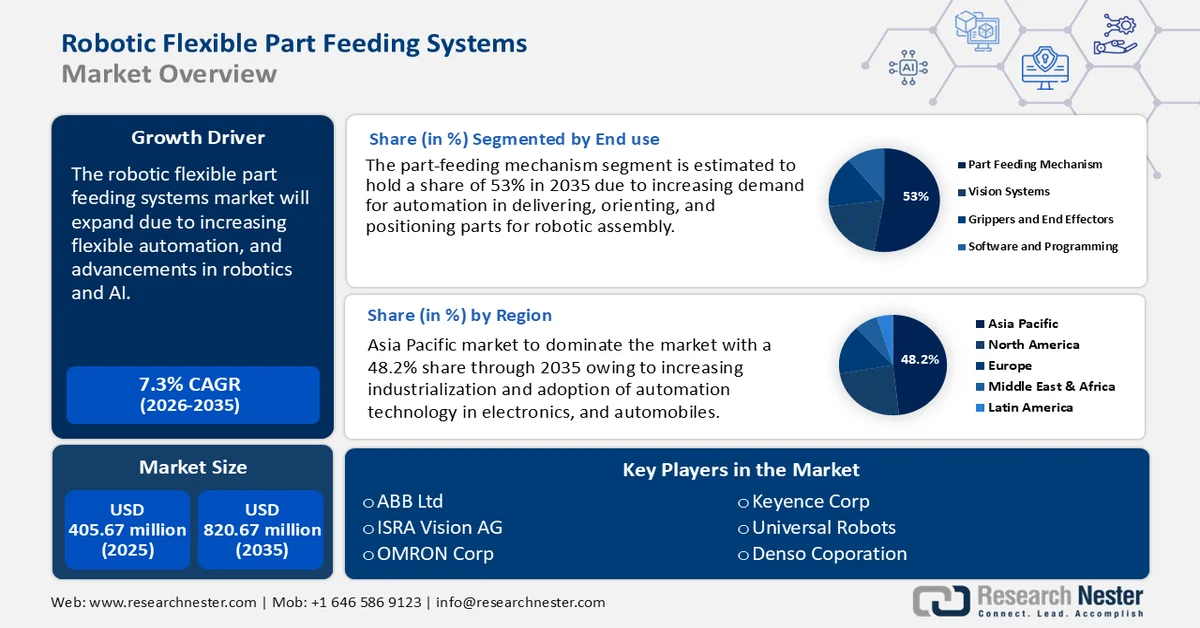
The increasing demand for flexible automation in various industries is fueling the growth of the robotic flexible part feeding systems market. The need for flexible feeders arises as traditional vibratory feeders used in manufacturing are rigid and require the realignment of different parts. Thus, manufacturers need adaptable systems that can handle different shapes and sizes without frequent hardware changes. The demand for robotic flexible part feeding systems is higher in the electronics, automotive, and medical industries as they require fast and flexible feeding solutions.
Additionally, consumer preferences for personalized products, such as custom electronics and automotive components, require adaptive production lines.
Moreover, the integration of AI-powered vision systems in flexible part feeding systems enhances precision and adaptability. It allows robots to handle parts with irregular shapes and orientations. The combination of machine learning algorithms further improves object recognition and reduces manual intervention in setup time. Further, advancements such as enhanced 3D vision systems help in accurate part detection, which reduces reliance on mechanical feeders.
Key Robotic Flexible Part Feeding Systems Market Insights Summary:
Regional Highlights:
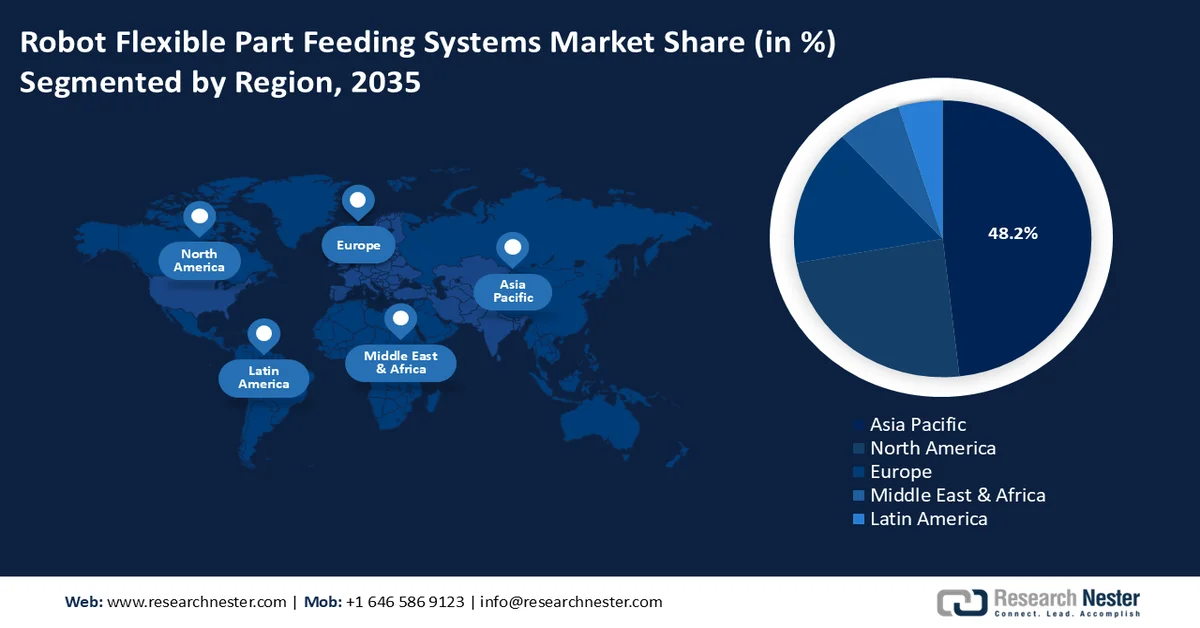
- Asia Pacific robotic flexible part feeding systems market is projected to secure over 48.2% revenue share by 2035, impelled by rapid industrialization and growing adoption of automation technologies across electronics and automotive manufacturing.
- North America is anticipated to witness substantial growth in the market during 2026-2035, fueled by rising demand for high-speed, precision automation in manufacturing.
Segment Insights:
- The part feeding mechanism segment is projected to capture over 53% share of the robotic flexible part feeding systems market by 2035, propelled by rising need for automated, vision-integrated solutions capable of handling diverse parts with minimal reconfiguration.
- The automotive segment is expected to retain the largest share of the market through 2035, driven by increasing demand for automation and precision in vehicle production.
Key Growth Trends:
- Industry 4.0 and smart manufacturing adoption
- Rising labor costs and workforce shortages
Major Challenges:
- High initial investment costs
- Complex integration processes
Key Players: Ashtech India, CHRYSO Inc, The Dow Chemical Company, Fosroc, Inc., Mapei S.p.A., PT Penta Chemicals Indonesia, Sika AG, SILKROAD GROUP, Thermax Limited, GCP Applied Technologies Inc.
Global Robotic Flexible Part Feeding Systems Market Forecast and Regional Outlook:
Market Size & Growth Projections:
- 2025 Market Size: USD 405.67 million
- 2026 Market Size: USD 432.32 million
- Projected Market Size: USD 820.67 million by 2035
- Growth Forecasts: 7.3% CAGR (2026-2035)
Key Regional Dynamics:
- Largest Region: Asia Pacific (48.2% Share by 2035)
- Fastest Growing Region: Asia Pacific
- Dominating Countries: Japan, Germany, United States, South Korea, China
- Emerging Countries: China, India, Japan, South Korea, Mexico
Last updated on : 25 February, 2026
Robotic Flexible Part Feeding Systems Market - Growth Drivers and Challenges
Growth Drivers
- Industry 4.0 and smart manufacturing adoption: The rise of smart manufacturing and industry 4.0 initiatives emphasizes the need for flexible automation systems to seamlessly integrate into digitalized production environments. Increased focus on automation, IoT, and AI-driven production is accelerating demand. Therefore, smart factories need intelligent part feeding systems that integrate with robotic systems and production lines. Moreover, data analytics and machine vision enable real-time optimization in flexible part feeders, improving efficiency.
- Rising labor costs and workforce shortages: Automation intends to reduce dependency on human laborers. The robots equipped with flexible part feeding systems can operate 24/7, which increases efficiency. Thus, the industries facing skilled labor shortages are investing in automated solutions to maintain productivity. Further, the rise of modern flexible feeding systems reduces the need for multiple feeders, which lowers overall capital expenditure. The faster changeovers and adaptability minimize downtime, increasing efficiency. This further leads to reduced production costs in manufacturing. One such example is the adoption of Flexibowl and Supata, which helps manufacturers to mitigate labor shortages and rising costs. These systems operate continuously with minimal human intervention, increasing productivity and reducing reliance on manual labor.
Challenges
- High initial investment costs: The cost of hardware, software, vision systems, and AI integration is expensive. Thus, implementing robotic flexible part feeding systems involving several components leads to high investment costs. The small and medium-sized enterprises may find it difficult to invest as they operate on a tighter financial budget.
- Complex integration processes: Compatibility issues arise while integrating flexible part feeders with existing robotic systems in the manufacturing setup. It often requires custom programming and configuration, which increases setup time and costs. Moreover, it can be difficult for vision-based feeding systems to detect accurately while handling certain delicate, transparent, or highly reflective parts. The incompatibility can limit the market opportunities and slow down-market penetration for manufacturers in the sector.
Robotic Flexible Part Feeding Systems Market Size and Forecast:
| Report Attribute | Details |
|---|---|
|
Base Year |
2025 |
|
Forecast Year |
2026-2035 |
|
CAGR |
7.3% |
|
Base Year Market Size (2025) |
USD 405.67 million |
|
Forecast Year Market Size (2035) |
USD 820.67 million |
|
Regional Scope |
|
Robotic Flexible Part Feeding Systems Market Segmentation:
Component Segment Analysis
Part feeding mechanism segment is set to capture over 53% robotic flexible part feeding systems market share by 2035. The part feeding mechanism in robot flexible part feeding systems is designed to automate the process of delivering, orienting, and positioning parts for robotic assembly. Unlike traditional vibratory bowl feeders, which require specific tooling for each part, flexible feeding systems use advanced vision and robotic technology to handle a wide variety of parts with minimal configuration.
End Use Segment Analysis
The automotive segment in robotic flexible part feeding systems market holds the largest market share through 2035 owing to increasing demand for automation and precision in vehicle production. The automobile industry is shifting towards fully automated assembly lines to improve efficiency, reduce labor costs, and improve quality. These systems eliminate the manual handling of small and complex parts, ensuring faster and more accurate production. For instance, Flexfactory AG developed the Flexfeeder X-Series that integrates a feeder, camera, and software streamlining the assembly of automotive components. This integration enables a smooth manufacturing process with less manpower and efficient performance.
Our in-depth analysis of the global robotic flexible part feeding systems market includes the following segments:
|
Component |
|
|
End use |
|
|
Application |
|

Vishnu Nair
Head - Global Business DevelopmentCustomize this report to your requirements — connect with our consultant for personalized insights and options.
Robotic Flexible Part Feeding Systems Market - Regional Analysis
Asia Pacific Market Insights
Asia Pacific robotic flexible part feeding systems market is likely to dominate revenue share of over 48.2% by 2035, attributed to rapid industrialization and increasing adoption of automation technologies in electronics, automobiles, and various manufacturing sectors. Countries such as China, Japan, and South Korea are investing heavily in smart factories and Industry 4.0 technologies. This surge is accompanied by a robust manufacturing sector and an increasing adoption of automation technologies, aiming to boost productivity.
China is one of the world’s largest manufacturing hubs and a key player in the robotic flexible part feeding systems market. The market growth can be attributed to rapid industrial automation and government initiatives, including Made in China 2025. This initiative is focused on upgrading the country’s manufacturing power and encouraging the establishment of high-tech industries. The automotive, electronics, and semiconductor industries are the major adopters of AI-powered flexible feeders. Key players, including Flexibowl, Asyril, and local robotic firms, are expanding operations to support smart manufacturing goals in China. Additionally, the 2024 World Robot Conference in Beijing showcased China’s advancements in robotic automation, highlighting its role in global manufacturing.
South Korea is rapidly expanding its robotic flexible part feeding systems market, driven by its strong presence of the automotive and electronics industries. Government initiatives such as Manufacturing Innovation 3.0 and Manufacturing Renaissance Vision play a very important role in innovation and automation solutions. According to the International Trade Administration Report 2023, the manufacturing industry in South Korea is anticipated to rise from USD 437 billion in 2018 to USD 678 billion by 2030. Moreover, companies are expanding their presence to support high-precision production needs. For instance, in 2023, Exotec expanded its robotics presence in Eastern Europe and South Korea by partnering with A1 Sorter to fulfill the rising demand for warehouse automation in the region.
North America Market Insights
North America is anticipated to register significant robotic flexible part feeding systems market growth from 2026 to 2035 due to the rising demand for high-speed, precision automation in manufacturing. The adoption of robotic flexible part feeding systems is prominent in medical device production, consumer electronics, and logistics automation. Companies such as ABB, Epson, and Flexfactory are expanding operations to meet industry needs for adaptable part-feeding solutions.
The U.S. robotic flexible part feeding systems market shows significant growth opportunities driven by increasing investments in advanced manufacturing and AI-driven automation. The demand for custom-made, low-volume production in medical devices, aerospace, and semiconductor industries is driving the adoption of these systems. Top key players in the U.S. are developing intelligent part-feeding solutions to enhance efficiency. For instance, Epson Robots has developed the IntelliFlex 80 and IntelliFlex 380 as part of flexible feeding systems. This series supports part sizes ranging from 3mm to 150mm. It is also compatible with simple to complex and delicate materials for consumer electronics and medical device production.
The robotic flexible part feeding systems market in Canada is growing due to the adoption of automation across several sectors. Manufacturers depend on these systems to counter labor shortages and enhance productivity. The automobile and aerospace sectors in Canada are the leading adopters of integrating flexible feeders for precise and varied component handling. Furthermore, government support for advanced manufacturing and innovation is accelerating adoption across industries. For instance, in June 2024, the Government of Canada launched NGen, a government-backed initiative to support 15 advanced manufacturing projects valued at USD 59 million. This fund will support 31 companies in Canada, driving innovation in robotics, AI, and smart factories.
Key Robotic Flexible Part Feeding Systems Market Players:
- ABB Ltd
- Company Overview
- Business Strategy
- Key Product Offerings
- Financial Performance
- Key Performance Indicators
- Risk Analysis
- Recent Developments
- Regional Presence
- SWOT Analysis
- ARS Srl Socio Unico
- Daifuku Co. Ltd.
- ISRA VISION AG
- Keyence Corp.
- OMRON Corp.
- DENSO Corporation
- Universal Robots
- RNA Automation Ltd.
- Teradyne Inc
The robotic flexible part feeding systems market is dominated by key players such as FANUC, ABB, Omron, and Asyril known for their advanced automation strategies. These companies lead in developing AI-driven, vision-integrated feeders that enhance flexibility and efficiency in manufacturing. Additionally, Flexfactory, RNA Automation, and Epson are expanding their offerings to support automation in electronics and medical devices. With ongoing innovations in smart robotics and Industry 4.0, these firms continue to shape the future of flexible part-feeding technology. Given below are some leading players in the robotic flexible part feeding systems market:
Recent Developments
- In January 2025, Robot System Products opened the first manufacturing factory in Chennai to boost the robotics market in India. This move aims to capitalize on India's emerging market, enhance cost competitiveness, and encourage local production. This move will make India the manufacturing hub for South Asia.
- In September 2024, ARS Automation announced the launch of industrial flexible feeding robot, FlexiBlow 20o for modern manufacturing. The FlexiBlow 200 has a compact design, capable of handling small parts ranging from 1 to 10 mm.
- Report ID: 7277
- Published Date: Feb 25, 2026
- Report Format: PDF, PPT
- Explore a preview of key market trends and insights
- Review sample data tables and segment breakdowns
- Experience the quality of our visual data representations
- Evaluate our report structure and research methodology
- Get a glimpse of competitive landscape analysis
- Understand how regional forecasts are presented
- Assess the depth of company profiling and benchmarking
- Preview how actionable insights can support your strategy
Explore real data and analysis
Frequently Asked Questions (FAQ)
About this Report
Connect with our Expert


Report, 2026-2035



Copyright @ 2026 Research Nester. All Rights Reserved.
