Retro-reflective Materials Market Outlook:
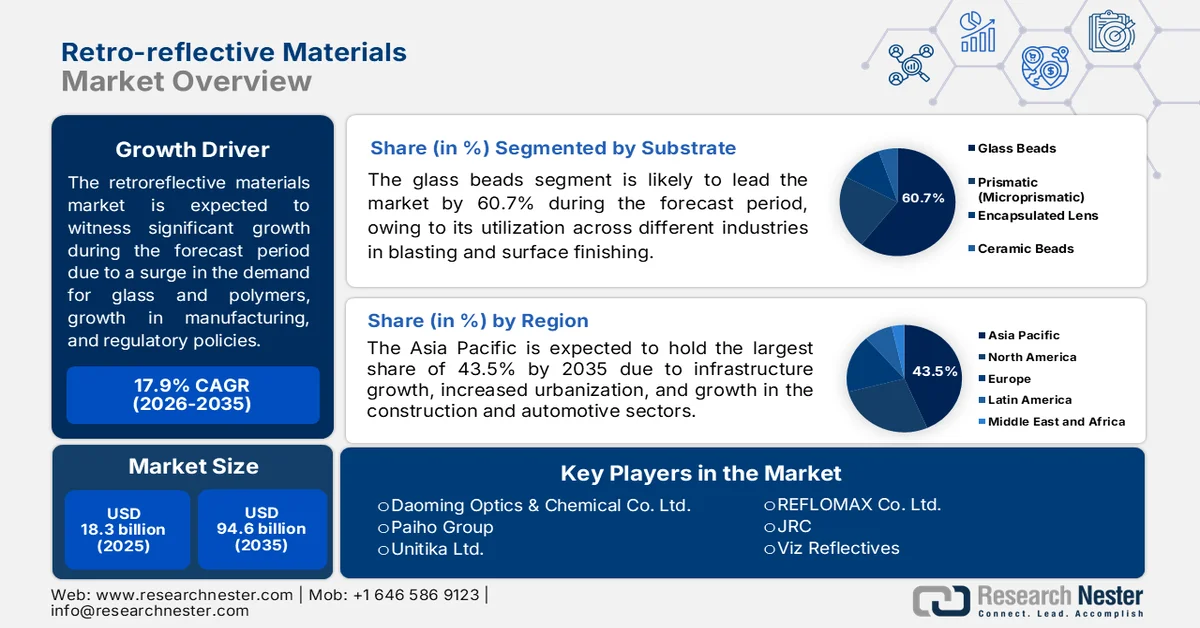
Retro-reflective Materials Market size was valued at USD 18.3 billion in 2025 and is poised to reach USD 94.6 billion by the end of 2035, expanding at around 17.9% CAGR during the forecast period i.e., 2026-2035. In 2026, the industry size of retro-reflective materials is evaluated at USD 21.5 billion.
The global retro-reflective materials market is continuously growing with raw material price volatility, government budget cycles, an increase in the demand for polymers and glass, yearly maintenance appropriations and seasonal installation windows, growth in the manufacturing industry, and regulatory fragmentation. According to official statistics published by NLM in February 2025, composite materials usually constitute more than 50% of the structure, especially in the aircraft industry. Besides, glass fiber-reinforced polymer and carbon fiber-reinforced polymer are increasingly prevalent, with Boeing 787′s utilization of an estimated 32 tons of composite materials. Furthermore, the continuous supply of glass and glassware through suitable trade dynamics is also responsible for driving the market growth and expansion across different countries.
2024 Glass and Glassware Global Export/Import Analysis
|
Countries/Components |
Export (USD) |
Import (USD) |
|
China |
23.4 billion |
5.1 billion |
|
Germany |
7.3 billion |
6.0 billion |
|
U.S. |
6.2 billion |
9.8 billion |
|
Global Trade Valuation |
85.4 billion |
|
|
Global Trade Share |
0.3% |
|
|
Product Complexity |
0.5 |
|
Source: OEC
Furthermore, the mainstream fashion and athleisure integration, customizable and printable reflective media for commercial branding, and the adoption with smart city infrastructure and IoT-based assets are certain trends that are proliferating the market globally. As stated in an article published by the OEC in January 2026, retailers and wholesalers in the Europe-based retail ecosystem solely comprise 5 million businesses and account for 11.5% of overall value added, while employing almost 30 million people. Besides, the retail ecosystem in the region plays an essential social and economic role, significantly contributing to gross domestic product (GDP) and employment by serving more than 450 million consumers regularly. Therefore, despite retro-reflective materials being crucial for infrastructure, these materials are rapidly incorporated in consumer goods production by retail manufacturers across different nations.
Key Retro-reflective Materials Market Insights Summary:
Regional Highlights:
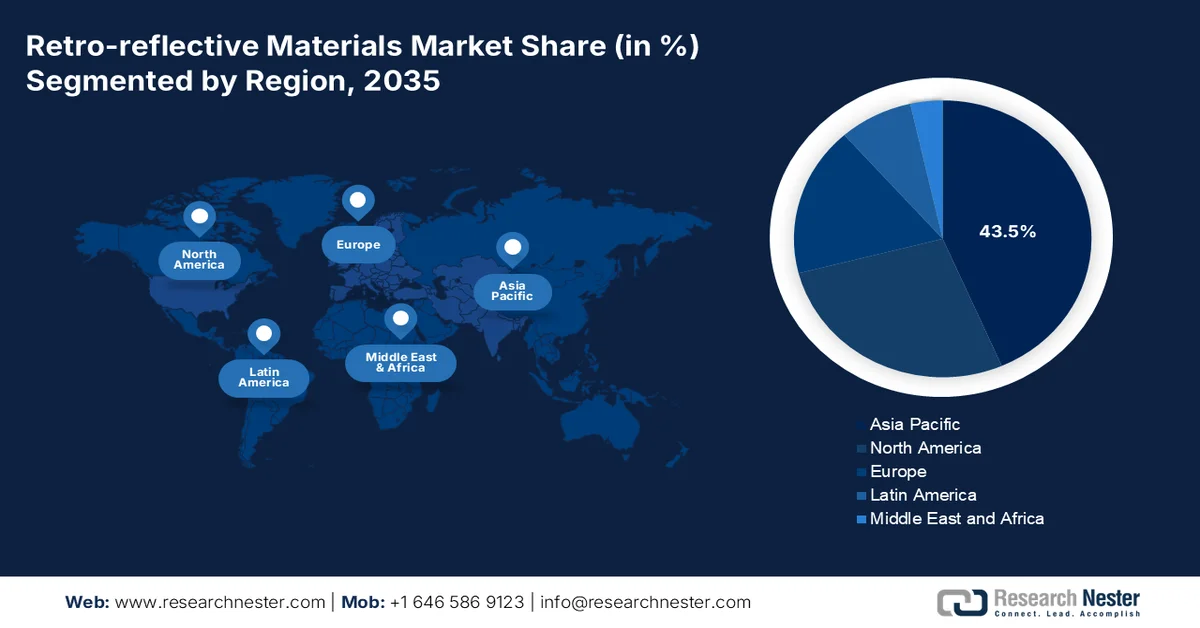
- The retro-reflective materials market in Asia Pacific is anticipated to account for a dominant 43.5% share by 2035, fostered by rapid urbanization, large-scale infrastructure investments, and expanding construction and automotive industries
- Europe is poised to witness the fastest growth throughout 2026–2035, accelerated by stringent transportation standards, rising adoption of premium microprismatic materials, and sustainability-focused plastics transition initiatives
Segment Insights:
- The glass beads sub-segment is projected to capture a leading 60.7% share of the retro-reflective materials market by 2035, bolstered by extensive utilization in surface finishing, abrasive blasting, and XRF analytical applications
- The high reflectivity sub-segment is expected to secure the second-largest share during the forecast period, stimulated by increasing demand for advanced microprismatic and optimized glass bead systems delivering superior optical performance under critical safety conditions
Key Growth Trends:
- Airport and aviation infrastructure applications
- Digitalization in manufacturing
Major Challenges:
- Counterfeit, substandard, and grey industry products
- Lengthening certification cycles versus rapid material innovation
Key Players: 3M (U.S.), Avery Dennison (U.S.), Orafol Europe GmbH (Germany), Nippon Carbide Industries Co. Inc. (Japan), Coats Group Plc (UK), Daoming Optics & Chemical Co. Ltd. (China), Paiho Group (Taiwan), Unitika Ltd. (Japan), REFLOMAX Co. Ltd. (South Korea), JRC (Japan), Viz Reflectives (UK), Crystal-optech (China), Changzhou Hua Risheng Reflective Material Co. (China), Madico (U.S.), Giolite-Lumian (Italy), Aura Optical Systems (U.S.), J-Long (Hong Kong), Shanghai Hanker (China), Yeagood (China), Top Colour Film Ltd (China/Asia-Pacific), Azumo, Inc. (U.S.), Sentinel Photonics (UK), Avery Dennison (U.S.), ispace EUROPE S.A. (Luxembourg).
Global Retro-reflective Materials Market Forecast and Regional Outlook:
Market Size & Growth Projections:
- 2025 Market Size: USD 18.3 billion
- 2026 Market Size: USD 21.5 billion
- Projected Market Size: USD 94.6 billion by 2035
- Growth Forecasts: 17.9% CAGR (2026-2035)
Key Regional Dynamics:
- Largest Region: Asia Pacific (43.5% Share by 2035)
- Fastest Growing Region: Europe
- Dominating Countries: United States, China, Germany, Japan, United Kingdom
- Emerging Countries: South Korea, Brazil, United Arab Emirates, Vietnam, Saudi Arabia
Last updated on : 13 May, 2026
Retro-reflective Materials Market - Growth Drivers and Challenges
Growth Drivers
- Airport and aviation infrastructure applications: This particular infrastructure is readily emerging as a significant driver for the retro-reflective materials market. According to official statistics published by the IEA Organization in 2026, aviation significantly accounted for 2.5% of global energy-driven carbon dioxide emissions as of 2023. Besides, during the COVID-19 pandemic, aviation-based emissions reached nearly 950 metric tons of carbon dioxide, which is more than 90% pre-COVID-19 levels. Therefore, to keep control of these, stakeholders are recommended to boost low-carbon fuel shares, optimize engine and airframe design, improve operations, and increasingly implement restraint solutions. Hence, this effectively proliferates the market demand to diminish emissions and carry out operations with low-carbon fuels and materials.
- Digitalization in manufacturing: This is a structurally important growth driver for the market by digitally transforming manufacturing processes. For instance, as stated by an article published by the ITA in September 2025, with over USD 165 billion invested as of 2024, along with the latest U.S.-India tactical technological partnerships, there has been growth in the demand for U.S. exports, particularly in robotics, technologies, IoT, artificial intelligence, and industrial automation. Besides, the National Investment Promotion and Facilitation Agency of India predicted that the industrial robotics industry in the country is projected to reach almost USD 264 million with a 2.9% growth rate by the end of 2028, thereby making it suitable for fueling the market demand, especially in the manufacturing sector.
- Expansion in rural roads and peri-urban networks: This is yet another growth driver for the market, increasingly focusing on ongoing formalization and expansion of road infrastructure. As per an article published by the Lurie Real Estate Center in December 2023, urban areas readily cater to 80% of the U.S. population and a huge share of the GDP. Besides, unlike these developed economies, where retro-reflective materials are primarily sold into maintenance and replacement cycles for existing sign inventories, developing nations are eventually building entirely new road networks, often converting unpaved rural routes to paved, marked highways for the first time. Therefore, with such developments across these regions, there is a huge growth opportunity for the market.
Challenges
- Counterfeit, substandard, and grey industry products: Despite stringent global safety standards, the retro-reflective materials market is flooded with non-compliant products, particularly in price-sensitive emerging economies and online B2B marketplaces. Unscrupulous manufacturers produce sheeting and tapes that mimic the visual appearance of certified 3M or Avery Dennison grades but fail catastrophically when measured for coefficient of retroreflection (RA), outdoor durability, or adhesion under wet or cold conditions. These counterfeit materials often enter government supply chains through low-bid procurement processes that lack rigorous field testing. The consequences range from tragic, with drivers failing to see a poorly reflective truck trailer at night, to financial, as legitimate brand owners lose hundreds of millions in diverted revenue.
- Lengthening certification cycles versus rapid material innovation: The aspect of safety certification is the industry’s double-edged sword. Compliance with standards, such as ASTM D4956, EN 12899, or China’s GB/T 18833 is non-negotiable for traffic signage, vehicle conspicuity, and high-visibility apparel. However, the approval process for a new retroreflective material formulation, including accelerated weathering, abrasion resistance, color fastness, and retroreflectivity retention, typically requires 18 to 36 months of real-time or laboratory-simulated aging before a notified body grants certification. This slow cycle directly conflicts with the speed of material science innovation, particularly in areas including bio-based resins, recyclable face films, or sensor-optimized prism geometries, thus limiting the market growth.
Retro-reflective Materials Market Size and Forecast:
| Report Attribute | Details |
|---|---|
|
Base Year |
2025 |
|
Forecast Year |
2026-2035 |
|
CAGR |
17.9% |
|
Base Year Market Size (2025) |
USD 18.3 billion |
|
Forecast Year Market Size (2035) |
USD 94.6 billion |
|
Regional Scope |
|
Retro-reflective Materials Market Segmentation:
Substrate Segment Analysis
Based on the substrate segment, the glass beads sub-segment is anticipated to capture the largest share, at 60.7%, in the retro-reflective materials market by the end of 2035. The sub-segment’s uplift is primarily attributed to its widespread use across various industrial processes, especially in surface finishing and abrasive blasting. According to official statistics published by Talanta in May 2025, glass beads are highly utilized for carrying out X-ray fluorescence spectrometry (XRF) analysis, with an X-ray tube of 2.4 kW of rhodium anode. For instance, in a Perl’X3 Philips instrument, powdered glasses are compacted as pearls by readily melting at 1,100 degrees Celsius, with a homogenous mixture of 0.3 g of powdered glass with 5.5 g Li2B4O7. Besides, modernized glass beads with different diameters, colors, and optic characteristics, thereby denoting a huge demand, which is positively driving the market growth.
Modern Glass Beads with Optic, Color, and Diameter, 2025
|
Optic & Color |
Diameter (mm) |
|
Transparent Yellow |
12.5 |
|
Transparent Light Red |
12.5 |
|
Transparent Dark Red |
12.5 |
|
Transparent Pink |
12.5 |
|
Transparent Green |
12.5 |
|
Transparent Purple |
12.5 |
|
Transparent Turquoise Blue |
12.5 |
|
Transparent Deep Blue |
12.5 |
|
Opaque White |
12.5 |
|
Opaque Yellow |
12.5 |
|
Opaque Brick Red |
5.8 |
|
Opaque Black |
12.5 |
Source: Talanta
Reflectivity Segment Analysis
The high reflectivity sub-segment, part of the reflectivity segment, is projected to grab the second-largest share in the market during the forecast period. The sub-segment’s growth is effectively driven by its pivotal role in representing the performance pinnacle of the industry, engineered for applications where safety margins are most critical, and failure carries the highest consequences. Unlike medium or low reflectivity grades, these premium materials utilize advanced microprismatic geometries or optimized glass bead systems to return an exceptionally high percentage of incident light directly to its source, even under challenging conditions such as heavy rain, fog, or extreme observation angles. This superior optical performance comes from precision-tooled cube corner designs and metallized backing layers that virtually eliminate light loss through absorption or scattering.
Technology Segment Analysis
By the end of the stipulated timeline, the microprismatic technology sub-segment, which is part of the technology segment, is expected to account for the third-largest share in the market. The sub-segment’s development is highly propelled by emerging as the most advanced engineering approach within retro-reflective materials, fundamentally differing from traditional glass bead systems in both optical physics and manufacturing complexity. Instead of relying on spherical glass particles that reflect light through refraction and a metallic backing, microprismatic materials employ precisely machined cube corner geometries, with tiny triangular prisms molded into a thin, transparent polymer film. Each cube corner acts as an optical retroreflector, capturing incoming light and returning it along a vector nearly parallel to its source through three internal total internal reflections.
Our in-depth analysis of the retro-reflective materials market includes the following segments:
|
Segment |
Subsegments |
|
Substrate |
|
|
Reflectivity |
|
|
Technology |
|
|
Product Type |
|
|
End user Industry |
|
|
Application |
|

Vishnu Nair
Head - Global Business DevelopmentCustomize this report to your requirements — connect with our consultant for personalized insights and options.
Retro-reflective Materials Market - Regional Analysis
APAC Market Insights
The Asia Pacific in the retro-reflective materials market is anticipated to garner the highest share of 43.5% by the end of 2035. The market’s upliftment in the region is primarily attributed to rapid urbanization, unprecedented infrastructure development, thriving construction and automotive industries across different countries, such as China, Japan, and India, along with an escalation in the need for high-performance reflective materials. According to official statistics published by the Infrastructure Asia Organization in 2026, the Developing Asia strategy is predicted to generously invest USD 26 trillion by the end of 2030, which is about USD 1.7 trillion every year. The purpose of the investment is focused on maintaining its growth momentum, addressing climate modifications, and eradicating poverty, thus creating a positive impact on the market’s growth in the overall region.
The retro-reflective materials market in China is growing significantly, owing to expansion in infrastructure and manufacturing dominance, setting a specific budget line for high-performance reflective sheeting, upgrading rural road safety, and increased expansion in manufacturing glass beads and microprismatic films. As stated in an article published by the State Council Information Office in November 2024, there has been an improvement in the country’s rural roads, with an overall length reaching 1.3 million kilometers. Besides, the length of these roads successfully reached 4.6 million kilometers by the end of 2023, readily accounting for 84.6% of the total road network length in the nation. Therefore, this convenient and safe transport network has resulted in an outstanding transformation in rural areas, thereby denoting an optimistic outlook for the market growth and demand.
The aspects of stringent compliance with occupational safety healthy standards, particularly in the industrial sector, increased focus on occupational health and safety, dependency on raw material imports, energy-based inputs, and industrial productivity are certain factors that are driving the retro-reflective materials market in Japan. Besides, the retroreflective materials industry in the country was worth USD 502.4 million as of 2025, which is further projected to be valued at USD 508.6 million by the end of 2026. Additionally, the industry in the nation is also predicted to be worth USD 2,101.3 million, along with a 16.2% growth rate by the end of 2035. Moreover, the World Integrated Trade Solution (WITS) has postulated the continuous raw materials export across global nations, thereby making it suitable for bolstering the market in the country.
Japan Raw Materials Exports, Imports, and Tariffs Analysis, 2022
|
Countries |
Export (USD) |
Import (USD) |
Export Product |
Import Product |
Comparison |
|
Global |
11,378,864.4 |
254,415,226.8 |
1.5 |
28.3 |
0.1 |
|
East Asia & Pacific |
8,441,240.9 |
84,804,775.9 |
2.2 |
18.6 |
- |
|
China |
2,892,507.9 |
4,215,097.9 |
2.0 |
2.2 |
0.06 |
|
North America |
1,223,368.1 |
32,026,231.4 |
0.8 |
29.8 |
- |
|
U.S. |
1,194,496.0 |
21,139,364.1 |
0.8 |
23.3 |
0.08 |
|
Vietnam |
1,059,663.3 |
2,879,450.2 |
5.6 |
10.9 |
0.4 |
|
UK |
111,662.8 |
188,273.1 |
1.0 |
2.7 |
0.1 |
|
Belgium |
97,746.5 |
57,040.8 |
1.4 |
0.8 |
0.06 |
Source: WITS
Europe Market Insights
Europe in the retro-reflective materials market is expected to emerge as the fastest-growing region during the forecast period. The market’s development in the region is highly propelled by regional directives, suitable standards across transportation, an increase in the preference for premium microprismatic materials, significant activities initiated by plastic manufacturers, environmental compliance demands, and strict quality expectations. According to official statistics published by NLM in February 2025, the Plastics Transition roadmap, introduced by plastic manufacturers in Europe forecasted the replacement of fossil-based plastics, assuming circular plastics to fulfill 25% of demand by the end of 2030 and 65% by 2050. Therefore, based on all these factors and increased focus on sustainability, there is a huge growth opportunity for the market in the overall region.
Year-Wise Europe Plastics Approach Based on Different Sources, 2021-2050
|
Plastic Type (USD per ton of production) |
2021 |
2030 |
2040 |
2050 |
|
CCU+H2-Based Plastics |
3,564.1 |
3,218.1 |
2,961.7 |
2,361.4 |
|
Plastics Made from Biomass |
3,340.5 |
2,778.2 |
2,216.8 |
1,650.7 |
|
Chemical Recycling |
2,894.6 |
2,113.3 |
1,677.9 |
1,395.4 |
|
Virgin Fossil Production |
1,641.4 |
1,503.8 |
1,432.0 |
1,242.4 |
|
Mechanical Recycling |
1,323,7 |
1,122.5 |
987.1 |
896.4 |
Source: NLM
The retro-reflective materials market in Germany is gaining increased traction, owing to the largest automotive manufacturer, innovative materials engineering expertise, strong infrastructure, and modernization programs. As stated in an article published by the Germany Trade & Invest (GTAI) in May 2025, the automotive industry in the country accounts for 1.3 million passenger electric vehicles as of 2024, marking the country's second-biggest producer globally. In addition, the nation caters to 24% of the overall domestic industrial revenue generated by the automotive sector. Likewise, the research and development growth in the overall region constitutes more than 60% of the nation’s automotive sector, along with 158,000 highly skilled personnel. Therefore, with this exposure in the industry, there is a huge demand for the market in the nation.
The unprecedented regional cohesion fund absorption, rapid motorway network expansion, modernization in legacy transportation infrastructure, road safety improvements, and the presence of a strong construction industry are a few trends that are responsible for boosting the market in Poland. As per an article published by the ITA in April 2026, the country’s government has planned to generously invest USD 50 billion in railway infrastructure, as well as USD 120 billion in road infrastructure. Besides, in terms of organizational contributions, GDDKiA effectively signed a suitable contract for a National System of Traffic Management valued at more than USD 52 billion, with the intention of monitoring express roads and highways in real time, thereby denoting an optimistic outlook for the market’s development.
North America Market Insights
North America in the retro-reflective materials market is projected to experience suitable growth by the end of the stipulated timeline. The market’s growth in the region is effectively driven by strict federal safety mandates, continuous technological upgradation towards premium microprismatic products, systematic infrastructure maintenance cycles, an increase in road construction, and the successful deployment of retroreflector units for pavement marking assessment. According to official statistics published by the Census Government in May 2026, the construction expenditure in the U.S. was estimated at the adjusted yearly rate of USD 2,185.5 billion or 0.6% in March 2026. This demonstrated an increase from USD 2,173.2 billion in February. In addition, construction in March was 1.6% above the previous year's estimate of USD 2,150.8 billion, thereby enhancing the market demand in the overall region.
The retro-reflective materials market in the U.S. is gaining increased exposure, owing to the presence of localized transportation agencies, regulatory policies, investment in transportation departments, systematic material replacement, and an expansion in defense manufacturing. As stated in an article published by the White House Government in April 2026, manufacturing in the country accounted for only 10% of the GDP as of 2024. Besides, the domestic defense and space industrial production has experienced modest growth, with an expansion in comprehensive industrial production by 60%. Moreover, utilizing the 90% of the upper bound of the Department of War’s (DOW) in 2024, the country’s defense expenditure is equivalent to 78% of overall spending, thus proliferating the market’s growth.
The sustained commitment to infrastructure modernization, robust investment in transportation through administrative programs, focus on public transit, trade corridors, and green infrastructure, automotive supply chain, the integration of cross-border freight, and the availability of eligible clean technology property are a few factors for fueling the market in Canada. As per an article published by the Government of Canada in November 2025, the Minister of Transport and Leader of the Government in the House of Commons and the Minister of International Trade provided USD 6 billion for more than 7 years for building the domestic infrastructure, along with USD 300 billion in exports. This funding was delivered by the partnership between Transport Canada and Canada Infrastructure Bank, along with Crown-Indigenous Relations and Northern Affairs Canada, the Canada-based North Economic Development Agency, and National Defense.
Key Retro-reflective Materials Market Players:
- 3M (U.S.)
- Avery Dennison (U.S.)
- Orafol Europe GmbH (Germany)
- Nippon Carbide Industries Co. Inc. (Japan)
- Coats Group Plc (UK)
- Daoming Optics & Chemical Co. Ltd. (China)
- Paiho Group (Taiwan)
- Unitika Ltd. (Japan)
- REFLOMAX Co. Ltd. (South Korea)
- JRC (Japan)
- Viz Reflectives (UK)
- Crystal-optech (China)
- Changzhou Hua Risheng Reflective Material Co. (China)
- Madico (U.S.)
- Giolite-Lumian (Italy)
- Aura Optical Systems (U.S.)
- J-Long (Hong Kong)
- Shanghai Hanker (China)
- Yeagood (China)
- Top Colour Film Ltd (China/Asia-Pacific)
- Azumo, Inc. (U.S.)
- Sentinel Photonics (UK)
- Avery Dennison (U.S.)
- ispace EUROPE S.A. (Luxembourg)
- Company Overview
- Business Strategy
- Key Product Offerings
- Financial Performance
- Key Performance Indicators
- Risk Analysis
- Recent Development
- 3M holds a dominant position in the premium microprismatic segment, leveraging its extensive patent portfolio and decades of optical engineering expertise to supply certified sheeting for federal highway and defense applications. The company continuously innovates toward sensor-compatible retro-reflective materials, anticipating the transition from human vision to autonomous vehicle perception systems.
- Avery Dennison competes aggressively in government and fleet conspicuity markets, often securing sole-source contracts through certified products that meet stringent DOT color and reflectivity specifications. The company differentiates through specialized adhesive technologies that ensure long-term durability across extreme temperature and moisture conditions.
- Orafol Europe GmbH serves as Europe's premier alternative to U.S.-based duopoly players, manufacturing high-performance prismatic films and tapes for traffic signage across the European Union. The company leverages its German engineering heritage to produce materials that excel in demanding weather conditions common to northern European infrastructure.
- Nippon Carbide Industries Co., Inc. is a veteran innovator in glass bead and microprismatic technologies, holding foundational patents that underpin much of the modern retroreflective sheeting industry. The company maintains a stronghold in Asian markets while also supplying specialized materials for marine and aerospace safety applications.
- Coats Group Plc focuses on the textile-embedded retroreflective thread and yarn segment, serving high-visibility workwear and sportswear manufacturers globally. The company integrates reflective performance with fabric comfort and wash durability, addressing the unique demands of personal protective apparel rather than rigid signage or tapes.
Here is a list of key players operating in the global market:
The retro-reflective materials market operates as a consolidated duopoly at the premium end, with 3M and Avery Dennison in the U.S. collectively commanding a suitable global market share. Likewise, the Asia Pacific remains the largest regional market, followed by Europe. Strategic initiatives among leading players focus on three key vectors, including product innovation toward microprismatic and eco-friendly formulations, vertical integration to secure raw material supply chains disrupted by geopolitical tensions in the Middle East, and geographic expansion into high-growth infrastructure markets across India and Southeast Asia. Besides, in February 2025, Sentinel Photonics strategically partnered with STARC4SYS, which marked a suitable step in the organization’s expansion strategy, particularly in Europe. Additionally, this partnership enabled Sentinel to unveil its cutting-edge LASERD® detection systems and its world-class FROST retro reflection protection solutions to the Roman-based defense and security economies, thus fueling the retro-reflective materials industry growth.
Corporate Landscape of the Market:
Recent Developments
- In September 2025, Azumo, Inc., and Cymmetrik Group partnered with each other and redefined manufacturing for next-generation display and lighting applications across consumer electronics, automotive, and industrial sectors.
- In May 2025, Liga Portugal declared Avery Dennison as its exclusive supporter of official sleeve badges, numbers, and names for all players, further expanding retail replica kits and marking Avery’s growing Embelex™ sports portfolio.
- In January 2025, ispace EUROPE S.A. and the Italy-based Space Agency (ASI) signed a payload-driven services agreement to transport to the Moon a Laser Retroreflector Array (LaRA2), enabling accurate position measurements through laser ranging.
- Report ID: 8565
- Published Date: May 13, 2026
- Report Format: PDF, PPT
- Explore a preview of key market trends and insights
- Review sample data tables and segment breakdowns
- Experience the quality of our visual data representations
- Evaluate our report structure and research methodology
- Get a glimpse of competitive landscape analysis
- Understand how regional forecasts are presented
- Assess the depth of company profiling and benchmarking
- Preview how actionable insights can support your strategy
Explore real data and analysis
Frequently Asked Questions (FAQ)
About this Report
Connect with our Expert


Report, 2026-2035



Copyright @ 2026 Research Nester. All Rights Reserved.
