Thermochromic Materials Market Outlook:
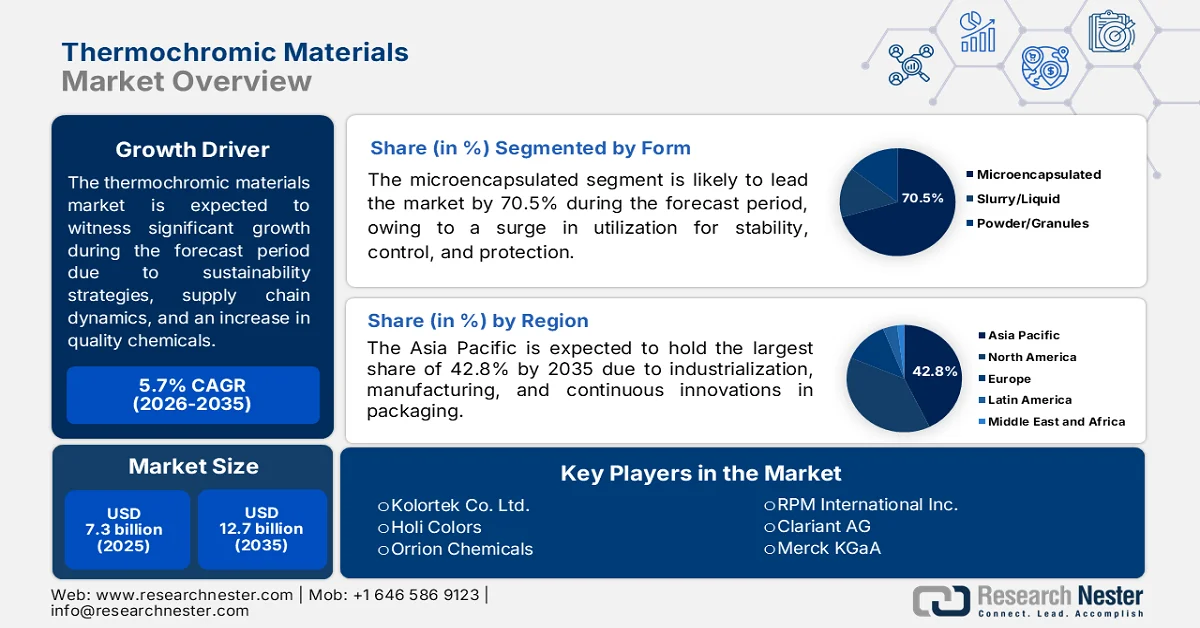
Thermochromic Materials Market size was valued at USD 7.3 billion in 2025 and is poised to reach USD 12.7 billion by the end of 2035, growing at a 5.7% CAGR during the forecast period, i.e., 2026-2035. In 2026, the industry size of thermochromic materials is estimated at USD 7.7 billion.
The global thermochromic materials market is being significantly reshaped by different foundational factors, including improvements in printable pastes and inks, sustainability pressures, an acceleration in alternative and qualified chemical materials, such as dyes, tactical supply chain reconfiguration, and suitable contributions by regional suppliers. According to official statistics published by the MDPI in August 2025, the worldwide synthetic dyes industry is continuously witnessing substantial expansion, with its valuation worth USD 7.1 billion as of 2024, which is further expected to reach USD 9.1 billion by the end of 2029, along with a 5% growth rate. Besides, as per the August 2023 NLM article, the global textile industry is significantly responsible for impacting the environment with more than 3.3 billion metric tons of greenhouse gas every year. Therefore, the dyeing process represents a suitable hotspot in the textile supply chain, thus proliferating the market growth.
2024 Reactive Dyes and Textile Global Export/Import Analysis
|
Countries/Components |
Reactive Dyes |
Textile |
||
|
Export (USD) |
Import (USD) |
Export (USD) |
Import (USD) |
|
|
India |
645.0 million |
- |
- |
- |
|
China |
209.0 million |
- |
268.0 billion |
- |
|
South Korea |
176.0 million |
- |
- |
- |
|
Bangladesh |
- |
283.0 million |
52.9 billion |
- |
|
Turkey |
- |
179.0 million |
- |
- |
|
Vietnam |
- |
- |
49.8 billion |
- |
|
U.S. |
- |
- |
- |
118.0 billion |
|
Germany |
- |
- |
- |
58.0 billion |
|
France |
- |
- |
- |
34.8 billion |
|
Global Trade Valuation |
1.5 billion |
837.0 billion |
||
|
Global Trade Share |
0.006% |
3.6% |
||
|
Product Complexity |
0.1 |
-0.5 |
||
|
Export Growth |
7.0% |
0.8% |
||
Source: OEC
Furthermore, the integration with digitalized technologies for hybrid smart solutions, personalization and customization in premium consumer products, and the availability of construction and roofing applications for energy efficiency are certain trends that are responsible for fueling the thermochromic materials market globally. As stated in an article published by Digital Chemical Engineering in September 2024, 68% of worldwide organizations tend to adopt Industry 4.0 as a top tactical priority, while the priority is extremely low for 10% of organizations. Meanwhile, 35.05 of chemical firms are in the rollout stage of the digitalization journey, in comparison to an industry average of 41%. Therefore, with progress towards digitalization, there is a huge growth opportunity for the market in personalizing and customizing dye-based products to potential consumers.
Key Thermochromic Materials Market Insights Summary:
Regional Highlights:
- Asia Pacific thermochromic materials market is projected to hold a dominant 42.8% share by 2035, propelled by rapid industrialization, strong textile manufacturing, and expanding smart packaging innovations
- Europe is anticipated to witness the fastest growth in the market throughout 2026–2035, impelled by stringent sustainability regulations, rising R&D investments, and accelerating adoption across automotive and construction industries
Segment Insights:
- The microencapsulated sub-segment is forecast to capture a leading 70.5% share of the thermochromic materials market by 2035, fueled by its growing utilization in controlling, stabilizing, and protecting active ingredient release across agriculture, pharmaceutical, and food industries
- The leuco dyes segment is expected to secure the second-largest share in the market during 2026–2035, owing to its versatility in transitioning between colored and colorless states alongside expanding global textile production
Key Growth Trends:
- Escalation in smart packaging for food and pharmaceuticals
- Functional fabrics adoption
Major Challenges:
- Limited durability and environmental degradation
- High manufacturing complexity and cost escalation
Key Players: 3M (U.S.), Sherwin-Williams (U.S.), LCR Hallcrest (U.S.), Chromatic Technologies Inc. (CTI) (U.S.), New Color Chemical Co. Ltd. (Japan), Matsui International Company, Inc. (Japan), SFXC (UK), Good Life Innovations Ltd. (UK), Smarter Materials (UK), Kolorjet Chemicals Pvt. Ltd. (India), Kolortek Co. Ltd. (China), Holi Colors (India), Orrion Chemicals (France), RPM International Inc. (U.S.), Clariant AG (Switzerland), Merck KGaA (Germany), Micron Colors (Australia), KolorMatrix (South Korea), KolorTech Malaysia (Malaysia), Sensient Technologies Corporation (U.S.), OliKrom (France), DIC Corporation (Japan), PPG (U.S.), Sun Chemical (U.S.).
Global Thermochromic Materials Market Forecast and Regional Outlook:
Market Size & Growth Projections:
- 2025 Market Size: USD 7.3 billion
- 2026 Market Size: USD 7.7 billion
- Projected Market Size: USD 12.7 billion by 2035
- Growth Forecasts: 5.7% CAGR (2026-2035)
Key Regional Dynamics:
- Largest Region: Asia Pacific (42.8% Share by 2035)
- Fastest Growing Region: Europe
- Dominating Countries: United States, China, Germany, Japan, India
- Emerging Countries: South Korea, Brazil, Italy, Vietnam, United Arab Emirates
Last updated on : 13 May, 2026
Thermochromic Materials Market - Growth Drivers and Challenges
Growth Drivers
- Escalation in smart packaging for food and pharmaceuticals: The global supply chain dynamic has heightened the need for non-electronic and visual temperature monitoring to enable regulatory compliance and product safety, which is fueling the thermochromic materials market growth. According to official statistics published by NLM in December 2023, the average monthly packaged goods consumption surged by 26%. In addition, the industry for intelligent food packaging, especially in the U.S., was worth USD 1.5 billion, while the worldwide industrial requirement for smart packaging was valued at USD 35.3 billion. Meanwhile, the smart packaging in the U.S. is predicted to grow at USD 3.6 billion, and USD 2.3 billion in Japan in the upcoming decades, thus making it suitable for market exposure.
- Functional fabrics adoption: The apparel and textile industry is readily emerging as yet another growth driver for the thermochromic materials market, further propelled by customer demand for technical aspects and interactive fashion. As stated in an article published by the United Nations University in May 2024, the apparel and garments sector significantly accounts for an estimated 2% of the worldwide gross domestic product (GDP). Additionally, the sector also employs roughly 60 to 70 million people, which is 2/3rd to 3/4th of the women population. Based on this, buyers determine the overall production process, depending on which 97% of profits for the fashion industry are earned by only 20 organizations, with the majority from the luxury segment, thus driving the thermochromic materials market expansion.
- Security printing and anti-counterfeiting demands: Government and corporate initiatives to combat counterfeiting represent a robust growth driver for the thermochromic materials market, particularly irreversible formulations that provide tamper-evident authentication. Besides, thermochromic inks and pigments are increasingly deployed in security printing applications for banknotes, identification documents, passports, and high-value product labels, where the color-change response to body heat or friction provides an easily verifiable yet difficult-to-replicate security feature. Unlike purely electronic authentication methods, thermochromic indicators require no specialized reading equipment, making them accessible for frontline verification by customs officers, retail staff, and consumers.
Challenges
- Limited durability and environmental degradation: The foremost technical roadblock facing the thermochromic materials market is the aspect of intrinsic vulnerability to environmental stressors. Most commercial formulations, particularly leuco dyes and liquid crystals, suffer from rapid degradation when exposed to ultraviolet radiation, extreme humidity, or mechanical abrasion. This inherent instability manifests as irreversible discoloration, diminished color-change contrast, and complete functional failure long before the intended service life of the host product. Besides, for industrial applications, such as automotive coatings or aerospace structural monitors, this lack of long-term reliability renders thermochromic solutions commercially unviable.
- High manufacturing complexity and cost escalation: The aspect of scaling thermochromic material production from laboratory success to industrial volume presents formidable engineering and economic barriers. The microencapsulation process, which is essential for protecting active components and enabling controlled color transition, requires precision equipment, tight temperature control, and specialized emulsification chemistry that few contract manufacturers possess. Besides, yield losses during encapsulation routinely reach significant percentages, driving up per-unit costs and creating supply inconsistencies. Additionally, the raw material supply chain remains fragmented, with key intermediates sourced from a limited number of specialty chemical producers, granting those suppliers disproportionate pricing power, thereby causing a hindrance in the thermochromic materials market growth.
Thermochromic Materials Market Size and Forecast:
| Report Attribute | Details |
|---|---|
|
Base Year |
2025 |
|
Forecast Year |
2026-2035 |
|
CAGR |
5.7% |
|
Base Year Market Size (2025) |
USD 7.3 billion |
|
Forecast Year Market Size (2035) |
USD 12.7 billion |
|
Regional Scope |
|
Thermochromic Materials Market Segmentation:
Form Segment Analysis
The microencapsulated sub-segment, part of the form segment, is anticipated to grab the highest share of 70.5% in the thermochromic materials market by the end of 2035. The sub-segment’s upliftment is primarily driven by its increased utilization for controlling, stabilizing, and protecting the release of active ingredients in industries such as agriculture, pharma, and food. According to official statistics published by the Journal of Molecular Liquids in August 2024, the encapsulation efficacy of microcapsules usually prepared by utilizing the solvent evaporation method tends to vary from 15% to 80%. Besides, in comparison to other methods, coacervation comprises a high encapsulation efficiency, effectively reaching a remarkable 99%. Therefore, microencapsulation exhibits suitable features, such as high productivity and efficiency, thus making it suitable for driving its growth.
Material/Formulation Segment Analysis
Based on the material/formulation, the leuco dyes segment is projected to garner the second-highest share in the thermochromic materials market during the forecast period. The segment’s growth is effectively fueled by its importance as versatile compounds, capable of transitioning between colored and colorless states. Besides, as stated in an article published by NLM in December 2022, the worldwide textiles production for footwear and clothing is projected to reach 102 million tons by the end of 2030. Simultaneously, the increased yearly production of 24 million tons of cotton fibers demand 2.6% of the global water supply and readily represents one of the largest uses of insecticides and pesticides. Therefore, the utilization of leuco dyes in these cases is suitable for enabling functional technologies, including thermal printing, security printing, smart textiles, and rewritable media.
Type Segment Analysis
By the end of the stipulated timeline, the irreversible sub-segment, which is part of the type segment, is expected to account for the third-highest share in the thermochromic materials market. The sub-segment’s development is highly attributed to its establishment as the dominant and high-growth category within the thermochromic materials landscape. Unlike reversible counterparts, irreversible materials undergo a permanent color transformation upon reaching a specific temperature threshold and do not return to their original state upon cooling, making them indispensable for applications requiring tamper-proof thermal records. The primary driver for this sub-segment is the escalating demand for smart packaging solutions, particularly in the food and beverage industry, where consumers can visually verify a product's temperature exposure history.
Our in-depth analysis of the thermochromic materials market includes the following segments:
|
Segment |
Subsegments |
|
Form |
|
|
Material/Formulation |
|
|
Type |
|
|
End use Industries |
|
|
Application |
|
|
Color Change Mechanism |
|

Vishnu Nair
Head - Global Business DevelopmentCustomize this report to your requirements — connect with our consultant for personalized insights and options.
Thermochromic Materials Market - Regional Analysis
APAC Market Insights
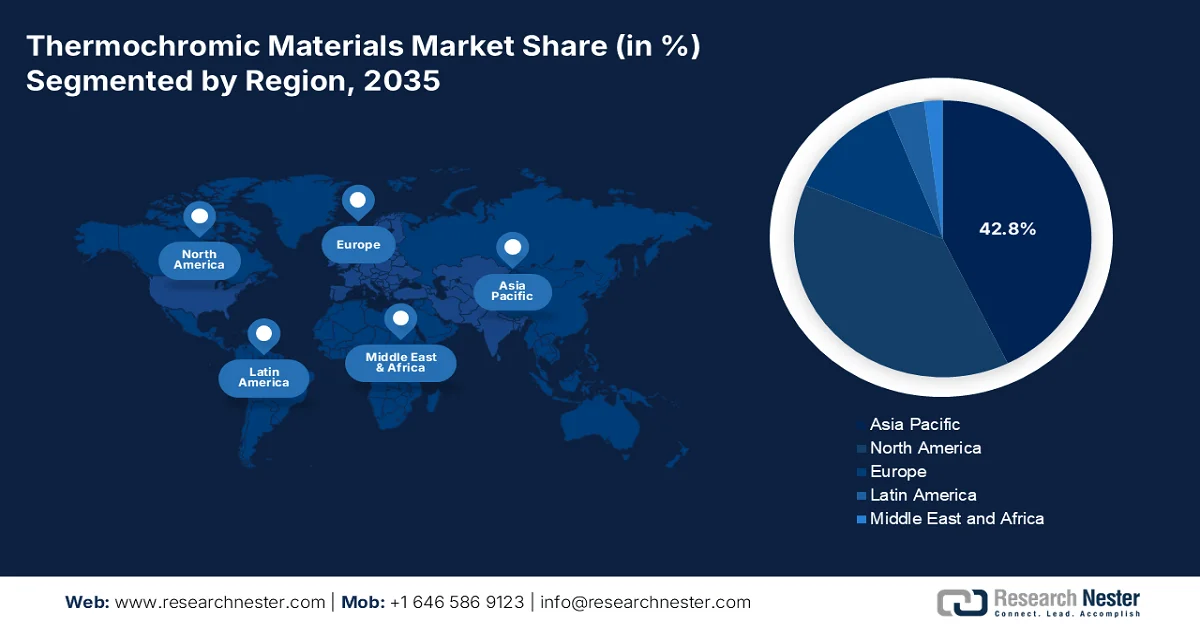
The Asia Pacific in the thermochromic materials market is anticipated to account for the largest share of 42.8% by the end of 2035. The market’s upliftment in the region is primarily driven by rapid industrialization, strong textile manufacturing, and ongoing innovations in packaging across major countries, the expanded production of smart textiles and temperature-sensitive inks, government strategies for sustainable manufacturing, and promoting industrial modernization. According to official statistics published by the International Finance Corporation in 2026, there has been an increase in home textile exports from India by 10.2%, which is expected to keep surging in the upcoming 5 years and eventually reach 10% of worldwide exports. Besides, the textile industry in South Asia accounted for 62 million tons as of 2022, which later on increased to 102 million tons in 2023, thus bolstering the market demand in the overall region.
The thermochromic materials market in China is growing significantly, owing to unparalleled manufacturing scale, expanded textile sector, strong packaging industry, the development of advanced materials, sustainable chemical processes, and an increase in the demand for interactive packaging. As stated in an article published by the State Council Information Office in January 2026, the value-added industrial output extended by 5.9% year-on-year as of 2025. Additionally, in December, the country’s industrial output increased by 5.2% YoY. This output is utilized to measure activities of large-scale enterprises, each with a yearly business turnover of almost USD 2.8 million. Besides, the value-added output of the nation’s equipment manufacturing industry upsurged by 9.2% and 9.4% for the high-tech manufacturing sector, thereby denoting an increase in the thermochromic materials market demand.
The aspects of extension in temperature-driven labels and smart packaging, especially in the domestic food and pharmaceutical industries, energy efficiency initiatives, a surge in the demand for quality building materials, and continuous raw material supply chain dynamics are certain factors that are responsible for driving the thermochromic materials market in Japan. Besides, the thermochromic materials industry in the country was worth USD 171.6 million as of 2025, which is further anticipated to be worth USD 192.5 million by the end of 2026, and eventually reach USD 475.2 million, with a 7.5% growth rate by 2035. As per an article published by the USDA Japan in April 2025, the food processing industry accounted for a 3.9% increase in the value of produced food as of 2024, significantly amounting to USD 174 billion, thus positively impacting the thermochromic materials market demand in the nation.
Europe Market Insights
Europe in the thermochromic materials market is expected to emerge as the fastest-growing region during the forecast period. The market’s development is highly attributed to the presence of a strict regulatory framework, robust emphasis on sustainable material advancement, generous investments in research and development, organizational collaboration, and the increased adoption in the automotive and construction industries. According to official statistics published by the Europe Construction Industry Federation in 2026, the region’s GDP surged by 1% as of 2024 and by 0.9% in area, which is followed by a further 0.4% growth rate for the overall construction sector. The robust increase in the sector accounted for 3.6% in Ireland, followed by 1.6% in Denmark and 1.5% in Portugal. Moreover, there was an increase in employment by 0.8% regionally and 0.9% based on area. Meanwhile, continuous investments in the sector have also resulted in increased thermochromic materials market demand.
Investment Opportunities in Construction Sector in Europe, 2017-2025b
|
Year |
Housebuilding (USD Billion) |
Civil Engineering (USD Billion) |
Non-Residential (USD Billion) |
Total Construction (USD Billion) |
|
2017 |
117.6 |
117.6 |
117.6 |
117.6 |
|
2018 |
122.0 |
123.7 |
122.5 |
122.3 |
|
2019 |
126.0 |
127.7 |
129.7 |
126.3 |
|
2020 |
117.7 |
129.0 |
119.7 |
119.7 |
|
2021 |
130.5 |
130.5 |
126.8 |
130.5 |
|
2022 |
133.5 |
139.9 |
122.4 |
134.8 |
|
2023 |
136.0 |
149.7 |
127.7 |
138.7 |
|
2024a |
128.8 |
160.2 |
128.7 |
134.8 |
|
2025b |
125.2 |
169.1 |
129.9 |
133.5 |
Source: Europe Construction Industry Federation
The thermochromic materials market in Germany is gaining increased traction, owing to the convergence of the automotive sector, innovative chemical manufacturing base, robust policy support for industrial modernization, suitable growth in the pharmaceutical industry, and readily prioritizing industrial strategies. As stated in an article published by the CEFIC Organization in 2024, both the chemical and pharmaceutical industries’ turnover in the country amounted to USD 265.2 billion as of 2023, along with research and development investment of USD 16.4 billion, and a capital expenditure of USD 11 billion. In addition, both industries combinedly comprise 2,094 number of organizations and 479,542 direct employees. Meanwhile, the country’s chemical industry is strong across segments, including polymers, specialties, inorganics, cosmetics, pharmaceuticals, petrochemicals, and agrochemicals, thereby denoting an optimistic outlook for the market development.
The rapid industrial modernization, regional cohesion fund absorption, the migration of manufacturing activities, substantial investment for sustainable chemical process and industrial upgradation, competitive labor, operational expenses, and significant foreign direct investment in automotive and packaging components are a few trends that are enhancing the thermochromic materials market in Poland. As per an article published by the CEFIC Organization in 2024, the country’s chemical industry is currently placed in the highest position, accounting for an overall share of 18%. In addition, the production sold of the industry amounts to USD 114.2 billion, along with 12,600 companies, 341,000 direct employees, and an overall investment of USD 6 billion. Moreover, the average yearly growth rate of sales of the industry accounted for 5.8% as of 2023, thereby making it suitable for proliferating the market development.
North America Market Insights
North America in the thermochromic materials market is projected to witness a considerable expansion by the end of the stipulated timeline. The market’s growth in the region is effectively fueled by strict food safety regulations, the pharmaceutical industry’s cold-chain monitoring demands, hybrid smart packaging, and an increase in the adoption of color-changing pigments in interactive consumer goods. According to official statistics published by NLM in December 2025, the scale of additive utilization is substantial in the region, with the U.S. Food and Drug Administration (FDA) enlisting more than 3,000 food additives. In addition, the food industry is estimated to enable 8,000 to 10,000 individual chemicals in the regional food system, while including self-confirmed and GRAS-based ingredients. Besides, the ongoing supply of pigments to and from the region is also driving the market in the region.
2024 Pigments Export and Import Analysis in North America
|
Countries |
Export (USD) |
Import (USD) |
|
U.S. |
179.0 million |
157.0 million |
|
Canada |
33.5 million |
42.6 million |
|
Mexico |
12.8 million |
61.7 million |
|
Costa Rica |
4.1 million |
4.1 million |
|
El Salvador |
2.7 million |
3.6 million |
|
Guatemala |
313,000 |
8.7 million |
|
Panama |
265,000 |
3.1 million |
|
Barbados |
162,000 |
- |
Source: OEC
The thermochromic materials market in the U.S. is gaining increased exposure, owing to the presence of strict FDA mandates for pharmaceutical compliance, nanotechnology and advanced manufacturing innovation, the consumer demand for smart packaging products, eco-friendly and sustainability formulations, and aerospace and automotive integration. As stated in an article published by the National Academics Organization in May 2025, the National Nanotechnology Initiative generously invested almost USD 40 billion as of 2022, while aggregating the revenue of private nanotechnology organizations, totaling almost USD 1 trillion in the same year. Therefore, nanotechnology as an innovation can enhance durability, responsiveness, and color-change precision, while ensuring suitable applications in smart textiles, all of which cater to the market upliftment.
The demand for temperature-sensitive indicators by the food packaging sector, the adoption of wearable technology and smart textiles, the preference for sustainable and eco-friendly products, growth in security printing, and the existence of a regional manufacturing base for supporting specialty chemicals are a few factors for boosting the thermochromic materials market in Canada. As per an article published by the Government of Canada in April 2026, to maintain sustainability, organizations from the apparel and fashion industry have readily adopted short-term targets based on their leadership, along with harmonizing the country’s overall objective of achieving 40% to 45% emission reduction by the end of 2030. Besides, the industry also comprises an estimated 850 businesses, further composed of medium and large-sized firms, effectively contributing to USD 1 billion of the GDP, thus making it suitable for driving the market growth.
Key Thermochromic Materials Market Players:
- 3M (U.S.)
- Sherwin-Williams (U.S.)
- LCR Hallcrest (U.S.)
- Chromatic Technologies Inc. (CTI) (U.S.)
- New Color Chemical Co. Ltd. (Japan)
- Matsui International Company, Inc. (Japan)
- SFXC (UK)
- Good Life Innovations Ltd. (UK)
- Smarter Materials (UK)
- Kolorjet Chemicals Pvt. Ltd. (India)
- Kolortek Co. Ltd. (China)
- Holi Colors (India)
- Orrion Chemicals (France)
- RPM International Inc. (U.S.)
- Clariant AG (Switzerland)
- Merck KGaA (Germany)
- Micron Colors (Australia)
- KolorMatrix (South Korea)
- KolorTech Malaysia (Malaysia)
- Sensient Technologies Corporation (U.S.)
- OliKrom (France)
- DIC Corporation (Japan)
- PPG (U.S.)
- Sun Chemical (U.S.)
- Company Overview
- Business Strategy
- Key Product Offerings
- Financial Performance
- Key Performance Indicators
- Risk Analysis
- Recent Development
- 3M leverages its broad expertise in advanced materials to develop thermochromic solutions that integrate into coatings and packaging. The company emphasizes innovation and sustainability, aligning its products with global demand for smart and eco-friendly materials.
- Sherwin-Williams incorporates thermochromic pigments into specialty coatings, enhancing functionality in decorative and industrial applications. Their focus is on expanding product versatility while maintaining high performance standards.
- LCR Hallcrest is recognized for its pioneering work in color-changing technologies, particularly in temperature-sensitive labels and indicators. The company continues to drive innovation in consumer safety and interactive product design.
- Chromatic Technologies Inc. (CTI) specializes in thermochromic inks and coatings, widely used in packaging and promotional products. Their strategy revolves around creating engaging consumer experiences through smart color-change effects.
- New Color Chemical Co. Ltd. focuses on precision pigments tailored for textiles and electronics. The company’s strength lies in its ability to deliver high-quality, reliable thermochromic materials for specialized applications.
Here is a list of key players operating in the global thermochromic materials market:
The thermochromic materials market is highly competitive, driven by innovation in smart coatings, packaging, and consumer goods. U.S. firms, such as 3M and CTI, lead with advanced R&D, while Europe-based players such as Clariant and Merck focus on specialty chemicals and sustainable solutions. Meanwhile, Japan-specific companies emphasize precision pigments for electronics and textiles, whereas emerging firms in India and Malaysia are expanding regional supply chains. Moreover, strategic initiatives include mergers, partnerships with the packaging and automotive industries, and investment in eco-friendly pigments. Besides, in June 2025, OliKrom unveiled self-healing thermochromic materials, particularly for the aeronautics industry, and revolutionized technical coatings with its intelligent pigments, thus driving the industry growth.
Corporate Landscape of the Market:
Recent Developments
- In August 2025, DIC Corporation established the newest production facility for coatings, effectively suitable for direct food contact materials, and further operated by an ink manufacturer, which was designed in compliance with the guiding principles of Hazard Analysis Critical Control Point (HACCP).
- In May 2024, PPG invested USD 300 million in advanced manufacturing, particularly in North America, and supported the increased demand for paints and coatings in the automotive sector.
- In March 2024, Sun Chemical introduced its complete range of polymers, additives, and pigments for the overall coatings industry, with increased focus on Paliocrom® aluminum effects line, a newly introduced waterborne resin, additive, and dryer.
- Report ID: 8564
- Published Date: May 13, 2026
- Report Format: PDF, PPT
- Explore a preview of key market trends and insights
- Review sample data tables and segment breakdowns
- Experience the quality of our visual data representations
- Evaluate our report structure and research methodology
- Get a glimpse of competitive landscape analysis
- Understand how regional forecasts are presented
- Assess the depth of company profiling and benchmarking
- Preview how actionable insights can support your strategy
Explore real data and analysis
Frequently Asked Questions (FAQ)
About this Report
Connect with our Expert


Report, 2026-2035


Copyright @ 2026 Research Nester. All Rights Reserved.
