Resuscitation Devices Market Outlook:
Resuscitation Devices Market size was over USD 6.1 billion in 2025 and is estimated to reach USD 12.9 billion by the end of 2035, expanding at a CAGR of 8.7% during the forecast timeline, i.e., 2026-2035. In 2026, the industry size of resuscitation devices is estimated at USD 6.6 billion.
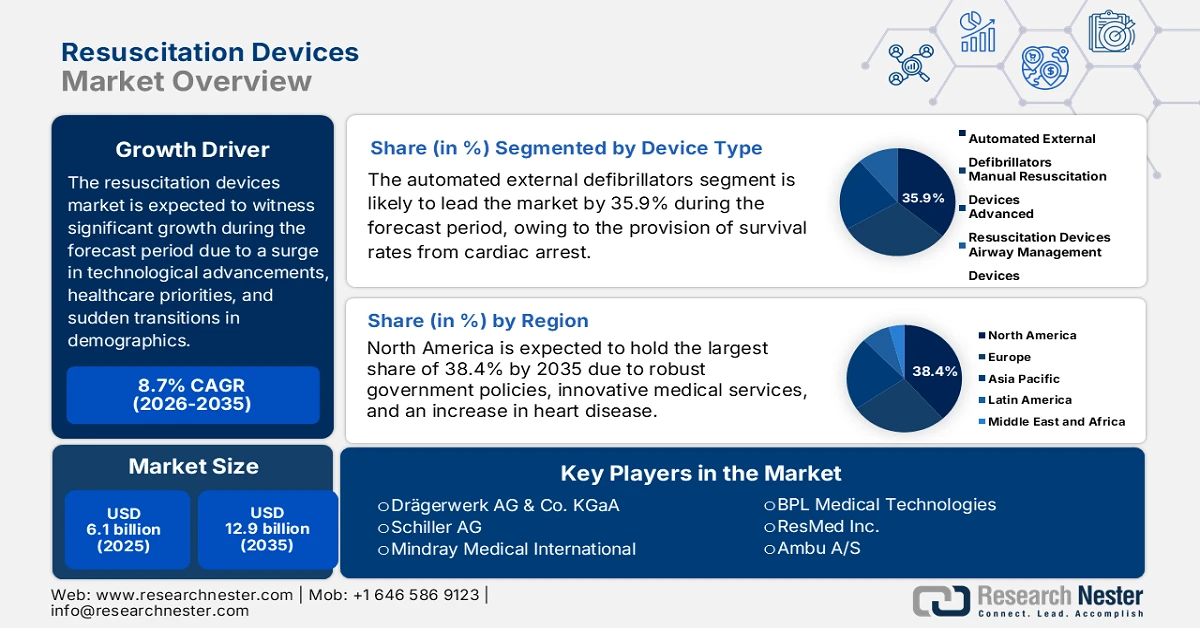
The international resuscitation devices market is rapidly evolving, highly fueled by technological innovation, modifying healthcare priorities, and demographic transitions. Besides, respiratory and cardiovascular emergencies are the leading causes of mortality globally, which is driving the market’s demand. According to official statistics published by the NLM in January 2022, chronic obstructive pulmonary disease (COPD) is one of the third-leading causes of death internationally, affecting 3.2 million individuals every year and also accounting for an outstanding 81.7% of the overall number of deaths from chronic respiratory disorders. In addition, pneumonia is also a notable cause of death among children aged more than 5 years and among adults aged 65 years of age. Moreover, lung cancer is one of the deadliest of all cancers, with a 5-year survival rate of just 10% to 20%, thus enhancing the resuscitation devices market’s requirement globally.
Furthermore, the integration of telemedicine with resuscitation devices, eco-friendly and sustainable device manufacturing, portability and miniaturization of devices, along with AI-driven predictive analytics in emergency care, are other trends that are proliferating the resuscitation devices market. As per an article published by NLM in April 2022, a clinical study has been conducted on 36 million working-aged individuals with private insurance claims, demonstrating an increase in telemedicine by 766%. Regarding this, 1.8 million physicians have estimated that an estimated 20% of all healthcare visits in the U.S. are conducted by telemedicine. Moreover, telemedicine is being bolstered across the U.S., while it has been further estimated from 16.7 million Medicare Advantage that the overall outpatient visits plummeted by 30%, thus denoting an optimistic outlook for the market.
Key Resuscitation Devices Market Insights Summary:
Regional Highlights:
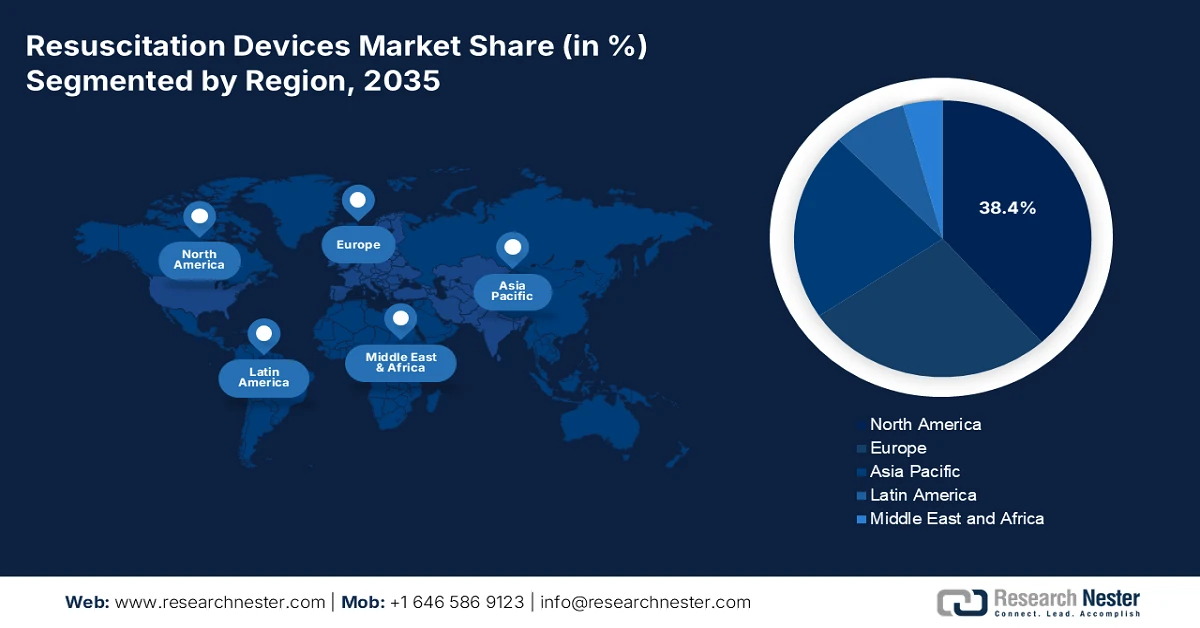
- North America is projected to account for 38.4% share by 2035 in the resuscitation devices market, underpinned by robust government backing, well-established emergency medical services, and the rising incidence of cardiac arrest.
- Asia Pacific is expected to register the fastest expansion over 2026–2035, accelerated by rapid uptake of advanced emergency medical technologies, increased public healthcare investments, and escalating cardiovascular disease prevalence.
Segment Insights:
- The automated external defibrillators segment within device type is anticipated to capture 35.9% share by 2035 in the resuscitation devices market, stimulated by their proven ability to markedly improve survival outcomes when deployed within minutes of sudden cardiac arrest.
- The hospitals sub-segment under end users is projected to secure the second-highest share by the end of the forecast period, strengthened by its central role in emergency and critical care delivery supported by advanced infrastructure and skilled medical personnel.
Key Growth Trends:
- Rise in international investment for emergency programs
- Increase in cardiac conditions
Major Challenges:
- High cost of advanced resuscitation devices
- Regulatory and compliance barriers
Key Players: Philips Healthcare (Netherlands), Medtronic plc (Ireland/U.S.), Zoll Medical Corporation (U.S.), Smiths Medical (UK), Cardiac Science Corporation (U.S.), Nihon Kohden Corporation (Japan), Asahi Kasei Corporation (Japan), GE Healthcare (U.S.), Drägerwerk AG & Co. KGaA (Germany), Schiller AG (Switzerland), Mindray Medical International (China), BPL Medical Technologies (India), ResMed Inc. (Australia), Ambu A/S (Denmark), Vyaire Medical Inc. (U.S.), Laerdal Medical (Norway), WEINMANN Emergency Medical Technology (Germany), Fukuda Denshi Co., Ltd. (Japan), Inovytec Medical Solutions (Israel), Straits Medical (Malaysia).
Global Resuscitation Devices Market Forecast and Regional Outlook:
Market Size & Growth Projections:
- 2025 Market Size: USD 6.1 billion
- 2026 Market Size: USD 6.6 billion
- Projected Market Size: USD 12.9 billion by 2035
- Growth Forecasts: 8.7% CAGR (2026-2035)
Key Regional Dynamics:
- Largest Region: North America (38.4% Share by 2035)
- Fastest Growing Region: Asia Pacific
- Dominating Countries: United States, China, United Kingdom, France, Japan
- Emerging Countries: India, South Korea, Brazil, Mexico, Indonesia
Last updated on : 3 February, 2026
Resuscitation Devices Market - Growth Drivers and Challenges
Growth Drivers
- Rise in international investment for emergency programs: Governments across different nations are allocating massive portions of healthcare budgets to emergency response infrastructure, which is positively impacting the resuscitation devices market. According to official statistics published by NLM in January 2023, USD 9.2 trillion has been readily invested in healthcare globally. In addition, the amount of resources devoted to the health industry, especially across high-income countries, is worth USD 7.3 trillion, which is 293.7 times the USD 24.8 billion spent across low-income nations. Besides, USD 43.1 billion has been readily invested in development assistance to maintain and optimize the health of patients suffering from severe diseases, thus making it suitable for uplifting the market internationally.
- Increase in cardiac conditions: The aspects of diabetes, obesity, and sedentary lifestyles are significantly contributing to higher rates of sudden cardiac arrest, fueling the demand for the resuscitation devices market globally. As per an article published by the WHO in 2026, cardiovascular diseases (CVD) are the leading cause of death worldwide, taking approximately 17.9 million lives every year. Additionally, over 4 out of 5 CVD deaths are owing to heart strokes and attacks, and 1/3rd of these deaths occur prematurely in people under 70 years of age. Besides, as stated in the January 2024 NLM article, of the 20.5 million CVD-based deaths, roughly 80% takes place in low-and middle-income nations. Meanwhile, ischemic heart disease is one of the causes of premature death, occurring across 146 countries for the male population and 98 countries for the female population, thus enhancing the resuscitation devices market’s expansion.
- Expansion in home healthcare solutions: With aging populations and a rise in the preference for home-based care, the demand for the resuscitation devices market has been effectively designed for domestic utilization. As stated in a data report published by the National Health India Organization in March 2022, conventionally, 60% to 80% need for homecare has been readily driven by senior citizens, effectively seeking supportive, long-lasting care at home. Besides, the international home healthcare industry is estimated to grow to USD 390 billion by the end of 2026 from approximately USD 275 billion. The escalated growth of this industry across both developed and developing nations is boosted by robust consumer preference, along with the adoption of digitalized tools and virtual care, thus positively impacting the market’s growth.
Challenges
- High cost of advanced resuscitation devices: One of the most significant challenges in the resuscitation devices market is the high cost associated with advanced resuscitation devices such as automated external defibrillators (AEDs), mechanical ventilators, and AI-enabled monitoring systems. These devices require sophisticated technology, rigorous testing, and compliance with international safety standards, which increases manufacturing costs. For hospitals in developed nations, procurement is manageable, but in low- and middle-income countries, affordability remains a barrier. Public healthcare systems often struggle to allocate sufficient budgets for widespread deployment, limiting access in rural and underserved areas. Additionally, training costs for healthcare professionals and maintenance expenses further add to the financial burden.
- Regulatory and compliance barriers: The resuscitation devices market faces complex regulatory hurdles, as medical devices must comply with stringent approval processes across different regions. In the U.S., the FDA requires extensive clinical trials and safety certifications, while Europe mandates CE marking under the regional Medical Device Regulation (MDR). In the Asia Pacific, countries such as China and India have their own regulatory frameworks through agencies such as the NMPA and CDSCO. These fragmented requirements create delays in product launches and increase costs for manufacturers, who must tailor compliance strategies for each market. Small-scale companies often struggle to meet these standards, limiting innovation and competition.
Resuscitation Devices Market Size and Forecast:
| Report Attribute | Details |
|---|---|
|
Base Year |
2025 |
|
Forecast Year |
2026-2035 |
|
CAGR |
8.7% |
|
Base Year Market Size (2025) |
USD 6.1 billion |
|
Forecast Year Market Size (2035) |
USD 12.9 billion |
|
Regional Scope |
|
Resuscitation Devices Market Segmentation:
Device Type Segment Analysis
The automated external defibrillators segment in the device type is anticipated to garner the largest share of 35.9% in the resuscitation devices market by the end of 2035. The segment’s upliftment is highly driven by the aspect of significantly boosting survival rates from sudden cardiac arrest when utilized within the first few minutes. According to official statistics published by NLM in October 2025, out-of-hospital cardiac arrest deliberately poses a substantial public health risk, impacting an estimated 400,000 individuals, particularly in the U.S. and considerably in Europe. Simultaneously, administering defibrillation within the first few minutes of a cardiac attack can significantly increase survival rates to more than 50%. Therefore, this creates an optimistic outlook for the market’s demand, based on which the segment is continuously evolving across different nations.
End user Segment Analysis
By the end of the forecast period, the hospitals sub-segment, which is part of the end user segment, is projected to hold the second-highest share in the resuscitation devices market. The sub-segment’s growth is highly fueled by its role as a primary center for emergency and critical care. Hospitals are equipped with advanced infrastructure, trained medical staff, and specialized departments such as intensive care units (ICUs) and emergency rooms, making them the most suitable environment for deploying resuscitation devices. Automated external defibrillators (AEDs), manual resuscitators, and airway management devices are widely used in hospital settings to address sudden cardiac arrest, respiratory failure, and trauma cases. The demand is further driven by the rising incidence of cardiovascular diseases, aging populations, and the increasing number of surgical procedures requiring anesthesia and airway support.
Application Segment Analysis
Based on the application, the cardiac arrest segment in the resuscitation devices market is expected to hold the third-highest share during the stipulated duration. The segment’s development is highly attributed to the aspect of remaining as one of the most critical health emergencies, with survival rates heavily dependent on immediate intervention using defibrillators and airway management devices. The growing prevalence of cardiovascular diseases, sedentary lifestyles, obesity, and diabetes has significantly increased the incidence of cardiac arrest worldwide. Resuscitation devices such as AEDs, manual resuscitators, and advanced defibrillators are essential tools for restoring heart rhythm and maintaining oxygen supply during emergencies. Public access defibrillation programs, supported by government mandates, have expanded the availability of AEDs in schools, airports, workplaces, and community centers, further driving demand.
Our in-depth analysis of the resuscitation devices market includes the following segments:
|
Segment |
Subsegments |
|
Device Type |
|
|
End user |
|
|
Applications |
|
|
Technology |
|
|
Distribution Channel |
|
|
Material Type |
|

Vishnu Nair
Head - Global Business DevelopmentCustomize this report to your requirements — connect with our consultant for personalized insights and options.
Resuscitation Devices Market - Regional Analysis
North America Market Insights
North America resuscitation devices market is anticipated to garner the highest share of 38.4% by the end of 2035. The market’s upliftment in the region is primarily attributed to strong government support, advanced emergency medical services, and an increase in cardiac arrest incidence. According to official statistics published by NLM in December 2025, out-of-hospital cardiac arrest happens roughly 356,000 times every year in the U.S., and the majority of these incidences are fatal, with previous survival rates being less than 10%. Besides, a clinical study was conducted on the U.S. population, wherein 8,523,980 deaths have been reported from sudden heart failure, demonstrating 49.4% of males and 50.6% of females. In addition, mortalities have been highest among 73.1% of non-Hispanics (NH), which is followed by 13.8% of NH Africa America, 8.7% of Hispanics or Latinos, 3.7% of NH Asia, and 0.5% of America-based India, thereby denoting a huge growth opportunity for the resuscitation devices market in the region.
The resuscitation devices market in the U.S. is growing significantly, owing to the presence of robust federal support, an increase in healthcare spending, along with an expansion in reimbursement policies. As per an article published by the NCBI in September 2024, almost 1/5th, which is 1,107 hospitals in the country, have significantly adopted some form of artificial intelligence since 2022. Moreover, it has been demonstrated that just 3.8% hospitals are high adopters, which is further followed by 6.2% as moderate, and 8.6% as low adopters. Besides, the artificial intelligence implementation rates in the nation are extremely high in optimizing workflow, accounting for 12.9%, and 9.5% for staff scheduling. Additionally, New Jersey is readily leading as the hospital AI-adopting state, accounting for 48.9%, thus denoting an optimistic outlook for the market’s growth.
The aspects of provincial and federal healthcare expenditure, rise in investments for critical care facilities, and national strategies for emergency preparedness, including the AED deployment in public and school infrastructures, are drivers that are proliferating the resuscitation devices market in Canada. As stated in an article published by the Health Systems Facts Organization in August 2025, the present health expenditure per capita in the country amounts to USD 6,255.0. This is followed by USD 929.0 per capita for out-of-pocket spending, 14.8% rate as out-of-pocket expenditure as a percentage of health spending. Besides, the domestic private health expenditure as a percentage of total health spending accounts for 28.7%, while the private health cost per capita is worth USD 1,800.6, thereby making it suitable for uplifting the market in the overall country.
Overall Healthcare Spending Analysis in Canada (2022)
|
Components |
Spending Amount (USD per capita) |
|
Health Expenditure |
|
|
Healthcare Expenditure as a GDP share |
|
|
Healthcare Expenditure by Financing Type |
|
Source: Health Systems Facts Organization
APAC Market Insights
The Asia Pacific resuscitation devices market is expected to emerge as the fastest-growing region during the forecast period. The market’s development in the region is highly propelled by the rapid adoption of innovative emergency medical technologies, government healthcare investments, and a rise in cardiovascular disease prevalence. Based on government estimates published by the EDB Government in June 2025, the region significantly makes up 60% of the global population, and by the end of 2030, 1 in 4 people is poised to be more than 60 years of age, likely to demand treatment for chronic mental conditions. At present, the medtech industry is the second-largest internationally, which is projected to grow at 10.5% every year by the end of 2030. Besides, the medtech manufacturing output in Singapore has reached USD 19.4 billion as of 2023, with more than 35 manufacturing facilities operated by international medtech leaders, thus making it suitable for proliferating the market in the overall region.
The resuscitation devices market in China is gaining increased traction, owing to an increase in government healthcare expenditure, an expansion in hospital and urbanization, the presence of a massive patient base, and a regulatory push. According to official statistics published by NLM in November 2023, it has been estimated that there are almost 330 million patients in the country suffering from cardiovascular diseases, which further includes 245 million of hypertension, 13 million of stroke, 45.3 million of peripheral artery disease, 11.3 million of coronary heart disease, and 8.9 million of heart failure. Additionally, this disorder also accounts for 5 million of pulmonary heart disease, 4.8 million of atrial fibrillation, 2.5 million of rheumatic heart disease, and 2 million of congenital heart disease. Therefore, with an increase in the prevalence of the disorder and associated diseases, there is a huge demand for the market in the country.
The existence of government emergency response programs, high cardiovascular burden, public and private partnerships, and community training approaches are factors that are driving the resuscitation devices market in India. Besides, as per an article published by NLM in December 2024, the country witnessed 1.4 million cancer incidences every year, at 100 cases per 100,000 people. Additionally, a lifetime challenge of suffering from cancer is present in 1 out of 9 individuals in the nation, and breast cancer is extremely common among women, while lung cancer is more common among the male population. Besides, for children, the cancer incidence ranges from 65 cases per million among girls to 95 cases per million among boys. Moreover, it has been predicted that by the end of 2040, 2 million new cases and more than 1 million deaths are poised to be attributed in the country, thereby increasing the market’s demand and expansion.
Europe Market Insights
Europe resuscitation devices market is projected to witness considerable growth by the end of the stipulated duration. The market’s growth in the region is highly driven by the presence of regional funding opportunities, government-funded emergency response programs, and a rise in heart diseases. According to official statistics published by the Europe Commission in October 2023, the administrative organization has deliberately signed an additional €500 million for international health, reinforcing the financing partnership. This partnership has launched among the Bill & Melinda Gates Foundation, the Europe Investment Bank (EIB), and the Europe Commission. In addition, €134 million has been generously invested to enhance localized manufacturing and equitable accessibility to ensure cost-effective, safe, and quality health products, thus denoting an optimistic outlook for the market’s growth.
The resuscitation devices market in Germany is gaining increased exposure, owing to the aspect of government spending to enable robust hospital infrastructure, while highlighting standardized CPR-based training programs. As stated in an article published by Statistisches Bundesamt (Destatis) in April 2023, the healthcare spending in the country significantly surged to EUR 474.1 billion, further amounting to EUR 5,699 per inhabitant. Besides, the healthcare spending per capita and overall health spending increased by 7.5%, which is suitable for bolstering the market’s requirement in the country. Moreover, the country’s Federal Statistical Office also reported that the country’s medical spending amounted to EUR 33.1 billion, further accounting for 13.2% of the GDP. This proportion denoted 0.2%-points, thus denoting a huge growth opportunity for the market in the country.
Overall Healthcare Expenditure by Funding in Germany (2023)
|
Funding Source |
Amount (EUR Billion) |
|
Statutory Health Insurance |
54 |
|
Households and Private Non-Profit Institutions |
13 |
|
Statutory Long-Term Care Insurance |
11 |
|
Public Budgets |
9 |
|
Private Health Insurance |
8 |
|
Other Funding Sources |
6 |
Source: Statistisches Bundesamt (Destatis)
The presence of ABPI partnerships, along with support provided by the NHS-based procurement, are factors that are responsible for boosting the resuscitation devices market in the UK. Based on government estimates published by the UK Government in December 2024, as of March 2023, there have been more than 1,879,000 people, which is 3% of the population, with a general practice diagnosis of coronary heart disease in England. In addition, the hospital admission rate for this particular disease decreased by 46% by the end of March 2024. There also exists a 3-fold difference in admission rates for the disease between unitary authorities and counties in England, with the highest rate accounting for 756.7 per 100,000 population in Tameside, along with the lowest of 231.5 per 100,000 population in Bournemouth, Poole, and Christchurch, thus bolstering the market’s exposure in the overall country.
Key Resuscitation Devices Market Players:
- Philips Healthcare (Netherlands)
- Medtronic plc (Ireland/U.S.)
- Zoll Medical Corporation (U.S.)
- Smiths Medical (UK)
- Cardiac Science Corporation (U.S.)
- Nihon Kohden Corporation (Japan)
- Asahi Kasei Corporation (Japan)
- GE Healthcare (U.S.)
- Drägerwerk AG & Co. KGaA (Germany)
- Schiller AG (Switzerland)
- Mindray Medical International (China)
- BPL Medical Technologies (India)
- ResMed Inc. (Australia)
- Ambu A/S (Denmark)
- Vyaire Medical Inc. (U.S.)
- Laerdal Medical (Norway)
- WEINMANN Emergency Medical Technology (Germany)
- Fukuda Denshi Co., Ltd. (Japan)
- Inovytec Medical Solutions (Israel)
- Straits Medical (Malaysia)
- Company Overview
- Business Strategy
- Key Product Offerings
- Financial Performance
- Key Performance Indicators
- Risk Analysis
- Recent Development
- Regional Presence
- Philips Healthcare is a global leader in medical technology, with a strong presence in resuscitation devices through its advanced automated external defibrillators (AEDs). The company emphasizes innovation in portable and connected solutions, making it a dominant player in both hospital and public access markets.
- Medtronic plc is one of the largest medical device companies worldwide, offering a wide range of resuscitation and cardiac care solutions. Its focus on integrating AI and digital health platforms into resuscitation devices strengthens its competitive edge in emergency care.
- Zoll Medical Corporation specializes in resuscitation and critical care technologies, particularly AEDs and advanced defibrillators. The company is recognized for its strong presence in emergency medical services and hospital-based resuscitation programs.
- Smiths Medical provides a broad portfolio of airway management and resuscitation devices, serving hospitals and emergency services globally. Its expertise in critical care equipment positions it as a key supplier in Europe and beyond.
- Cardiac Science Corporation is known for its AEDs and related resuscitation technologies, widely deployed in public spaces and healthcare facilities. The company has built a reputation for reliable, user-friendly devices that support rapid response in cardiac emergencies.
Here is a list of key players operating in the global resuscitation devices market:
The worldwide resuscitation devices market is highly competitive, with leading players such as Philips Healthcare, Medtronic, and Zoll Medical dominating through innovation and strategic partnerships. European firms like Drägerwerk and Schiller AG emphasize advanced airway management technologies, while Asia-based manufacturers, including Nihon Kohden and Mindray, leverage regional demand growth. Companies are investing in AI-enabled defibrillators, portable resuscitation systems, and expanding training programs to strengthen adoption. Besides, in January 2025, Bridgefield Capital announced that it has entered into an agreement to successfully acquire the Philips Emergency Care Business from Royal Philips N.V. The purpose is to invest in the emergency medical products, which are valued at more than USD 26 billion, thereby denoting a huge growth opportunity for the resuscitation devices industry globally.
Corporate Landscape of the Resuscitation Devices Market:
Recent Developments
- In September 2025, GE Healthcare declared a Distribution and Services Agreement (DSA) with CardioNavix, with the objective of bringing Flyrcado injection to patients internationally, including private cardiology practices at office as well as hospital image settings, thus expanding the reach of cardiac PET for the evaluation of suspected coronary artery disorder.
- In June 2025, Mercy Air 34 notified the implementation of the ZOLL AutoPulse NXT automated CPR devices into its air medical transport operations and gradually gained its first-ever responder status that effectively boosts emergency response and patient care capabilities.
- In October 2023, Medtronic plc has successfully received the U.S. Food and Drug Administration approval for the Aurora EV-ICD MRI SureScan, as well as Epsila EV MRI SureScan defibrillation, suitable for aiding severe and rapid heart rhythms, thus leading to sudden cardiac arrest.
- Report ID: 8375
- Published Date: Feb 03, 2026
- Report Format: PDF, PPT
- Explore a preview of key market trends and insights
- Review sample data tables and segment breakdowns
- Experience the quality of our visual data representations
- Evaluate our report structure and research methodology
- Get a glimpse of competitive landscape analysis
- Understand how regional forecasts are presented
- Assess the depth of company profiling and benchmarking
- Preview how actionable insights can support your strategy
Explore real data and analysis
Frequently Asked Questions (FAQ)
About this Report
Connect with our Expert


Report, 2026-2035



Copyright @ 2026 Research Nester. All Rights Reserved.
