Racquet Sports Equipment Market Outlook:
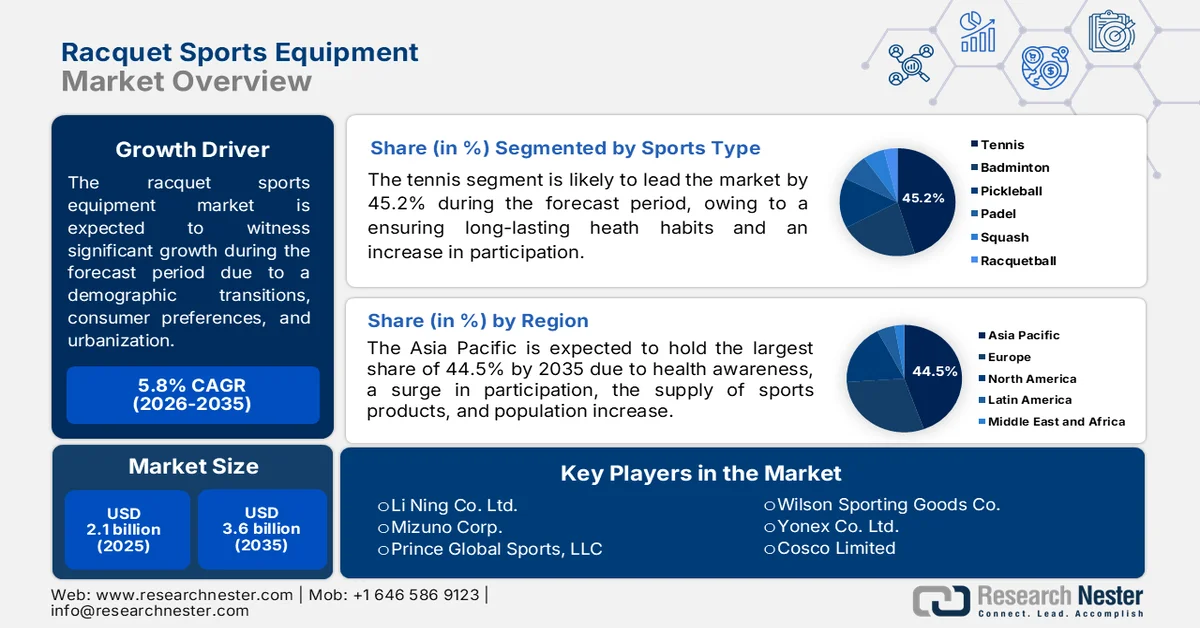
Racquet Sports Equipment Market size was over USD 2.1 billion in 2025 and is expected to reach USD 3.6 billion by the end of 2035, growing at around 5.8% CAGR during the forecast period i.e., 2026-2035. In 2026, the industry size of racquet sports equipment is estimated at USD 2.3 billion.
The worldwide racquet sports equipment market is increasingly shaped by a complex interplay of factors beyond standard demand and supply dynamics, including demographic transitions, technological advancements, evolving consumer behavior, increased urbanization, and professional tourism visibility. According to official statistics published by the World Economic Forum in January 2026, sports is projected to emerge as a USD 8.8 trillion economy by the end of 2050. Additionally, the global sports economy readily comprises over 15 distinct stakeholders across civil, private, and public society industries, effectively anchored by 4 core sectors and also supported by 5 connected industries. Moreover, in terms of revenue, due to physical inactivity, nature loss, and climate change, the economy’s revenue is expected to amount to USD 3,136 billion by the end of 2030 and further USD 7,201 billion by 2050, thus bolstering the market growth and demand globally.
Sports Economy Global Revenue Analysis, 2025-2050
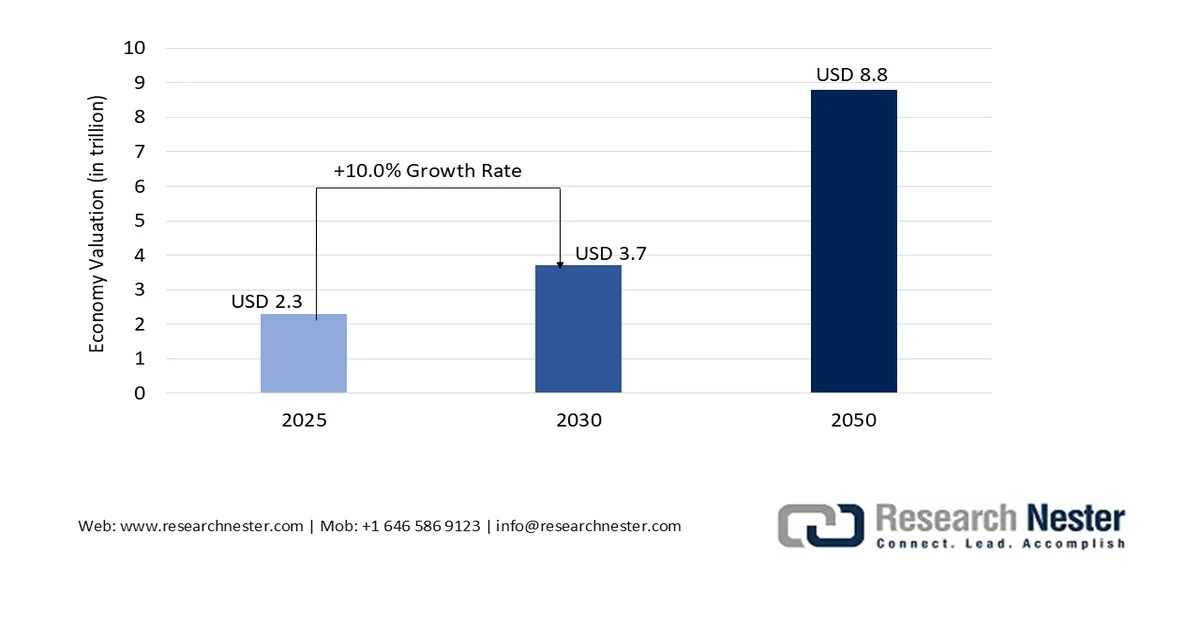
Source: World Economic Forum
Furthermore, the customization and direct-to-consumer personalization, along with bio-based and sustainable equipment, smart equipment tracking, hybrid sport crossover, and the presence of rental models are certain trends that are responsible for driving the market globally. As stated in an article published by NLM in July 2024, on average, Sweden spent USD 250 on sports equipment that also included clothing. Besides, the expenditures of different sports and activities greatly vary, but the demand for equipment is universal, and it is emerging to be extremely expensive. Based on this, the average family in America usually spends USD 883 every year for primary sports equipment, and of this, USD 154 is for equipment. Therefore, an increase in equipment spending is gradually enhancing the market growth and expansion across different regions.
Key Racquet Sports Equipment Market Insights Summary:
Regional Highlights:
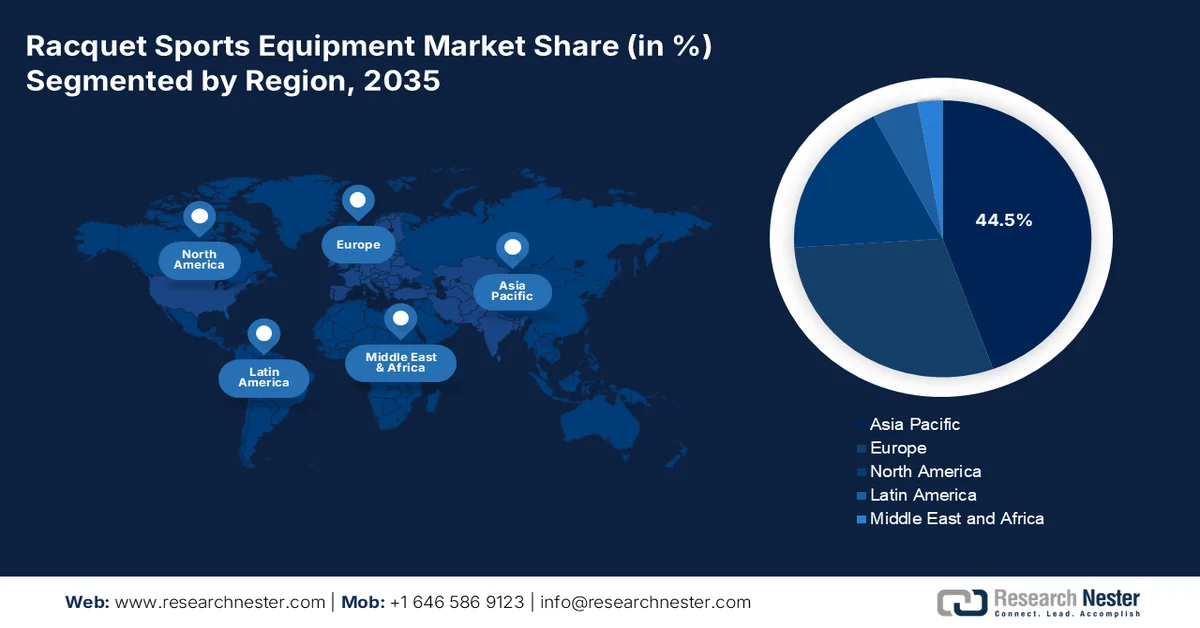
- Asia Pacific is anticipated to command a 44.5% share of the racquet sports equipment market by 2035, attributed to rising health awareness, expanding middle-class demographics, increasing tennis and badminton participation, and growing imports of sports products
- North America is poised to witness the fastest growth in the market throughout 2026-2035, propelled by rising consumer expenditure on sports infrastructure, accelerating pickleball adoption, and robust retail distribution networks
Segment Insights:
- The tennis segment is expected to account for a 45.2% share of the racquet sports equipment market by 2035, driven by the rising global participation in tennis and increasing engagement among core players
- The rackets/paddles sub-segment is projected to secure the second-highest share in the market during 2026-2035, fueled by growing emphasis on physical fitness and the essential role of paddles and rackets in enhancing sports performance
Key Growth Trends:
- Surge in women's participation
- Proliferation in youth academy
Major Challenges:
- Raw material supply chain volatility
- Counterfeit products and brand dilution
Key Players: BABOLAT VS SAS (France), Dunlop Sports (Japan/UK), Gamma Sports (U.S.), HEAD Sport GmbH (Austria), JOOLA (U.S./Germany), Karakal Worldwide Ltd. (UK), Li Ning Co. Ltd. (China), Mizuno Corp. (Japan), Prince Global Sports, LLC (U.S.), ProKennex (Taiwan), Selkirk Sport LLC (U.S.), Slazenger (UK), STIGA Sports AB (Sweden), Tamasu Co. Ltd. (Japan), Tecnifibre (France), VICTOR Rackets Industrial Corp. (Taiwan), Volkl Tennis (Germany), Wilson Sporting Goods Co. (U.S.), Yonex Co. Ltd. (Japan), Cosco Limited (India).
Global Racquet Sports Equipment Market Forecast and Regional Outlook:
Market Size & Growth Projections:
- 2025 Market Size: USD 2.1 billion
- 2026 Market Size: USD 2.3 billion
- Projected Market Size: USD 3.6 billion by 2035
- Growth Forecasts: 5.8% CAGR (2026-2035)
Key Regional Dynamics:
- Largest Region: Asia Pacific (44.5% Share by 2035)
- Fastest Growing Region: North America
- Dominating Countries: United States, China, Japan, Germany, United Kingdom
- Emerging Countries: India, South Korea, Brazil, Vietnam, Indonesia
Last updated on : 15 May, 2026
Racquet Sports Equipment Market - Growth Drivers and Challenges
Growth Drivers
- Surge in women's participation: The aspect of female participation in racquet sports is growing more rapidly than male participation across the majority of global economies, which is increasingly driving the racquet sports equipment market. According to official statistics published by the Women’s Sports Foundation in August 2025, women accounted for 49.2% of athlete participation in Tokyo, demonstrating an increase from 48.8%. Additionally, the Paralympic Games readily featured 1,891 record female athletes, significantly constituting 44.7% of the overall participation. This deliberately surpassed the previous record of 42% in Tokyo, thus demonstrating continuous efforts in enhancing women’s participation in sports activities. Therefore, this ongoing increase in women's participation is highly fueling the market’s growth and development.
- Proliferation in youth academy: Professional training academies, especially for junior players, are rapidly expanding across different regions, such as East Europe, the Middle East, and Asia. For instance, as per an article published by UNESCO in December 2024, the Sport Values in Every Classroom Toolkit led to a pilot evaluation of 10 contextualized modules across government-based schools in Odisha, which supported a generous grant of USD 20,000 from the administration. This particular accomplishment effectively marks a suitable step in extending the strategy’s reach and impact globally. Moreover, the academy contracts with equipment brands guarantee volume purchases, while academy-branded gear is sold to parents, thus creating additional revenue, which is positively boosting the market worldwide.
Challenges
- Raw material supply chain volatility: The racquet sports equipment market is heavily dependent on specialized raw materials, including high-modulus carbon fiber, graphite, Kevlar, titanium, and natural gut, making it acutely vulnerable to supply chain disruptions. These materials are sourced from a concentrated group of suppliers, primarily in Asia, creating geopolitical and logistical risks. Besides, any disruption at a single carbon fiber production facility or port closure can ripple through the entire industry, delaying manufacturing timelines for an entire season's product launches. Unlike bulk consumer goods, racquet sports equipment requires precision layering of composite sheets and controlled curing processes, based on which substitutes are not swapped without compromising performance characteristics.
- Counterfeit products and brand dilution: The market represents a persistent and sophisticated roadblock, particularly for premium brands that command high price points based on patented technology and professional endorsements. Moreover, illicit manufacturers, often operating from unregulated facilities in Southeast Asia, produce visually identical copies of popular racquet models using inferior materials that lack proper structural integrity. These counterfeit products infiltrate online marketplaces, discount retailers, and peer-to-peer selling platforms, deceiving price-sensitive consumers who believe they are purchasing authentic equipment. Besides, substandard counterfeit racquets can fail catastrophically during play, with broken frames or detached grips causing player injury, which damages trust in legitimate brand safety standards.
Racquet Sports Equipment Market Size and Forecast:
| Report Attribute | Details |
|---|---|
|
Base Year |
2025 |
|
Forecast Year |
2026-2035 |
|
CAGR |
5.8% |
|
Base Year Market Size (2025) |
USD 2.1 billion |
|
Forecast Year Market Size (2035) |
USD 3.6 billion |
|
Regional Scope |
|
Racquet Sports Equipment Market Segmentation:
Sports Type Segment Analysis
Based on the sports type, the tennis segment is anticipated to grab the highest share of 45.2% in the racquet sports equipment market by the end of 2035. The segment’s upliftment is primarily attributed to the growing participation, which is essential for fostering high-intensity and long-lasting health advantages. For instance, in February 2026, the USTA declared that tennis participation in the U.S. surged by 1.6 million as of 2025 and resulted in a total of 27.3 million players. Besides, tennis participation in the country grew by 54%, further adding almost 10 million players in 6 consecutive years of upliftment. Moreover, there has also been an increase in individuals playing more than 10 times, from 1.5 million to 14.5 million in 2025. This demonstrates that the overall participation has duly increased, with 53% considered as core players, thus driving the market’s demand globally.
U.S. Tennis Participation Analysis, 2025
|
Components |
Attributes |
|
Overall population participation |
27.3 million |
|
Total growth |
54.0% surge |
|
Core players existing |
14.5 million (playing 10 times every year) |
|
Retained players |
20.7 million |
|
First-time players |
4.9 million |
|
Black/Africa-based America |
+450,000 (14.0%) |
|
Asia/Pacific Islanders |
+260,000 (10.0%) |
|
Hispanic/Latino |
+550,000 (12.0%) |
|
Women population |
+1.1 million (10.0%) |
Source: USTA
Product Type Segment Analysis
The rackets/paddles sub-segment, part of the product type segment, is projected to grab the second-highest share in the market during the forecast period. The sub-segment’s growth is effectively fueled by its role as the most specialized and fundamental extension of players’ arms in sports, and also acting as the ultimate tool for controlling, striking, and generating speed on a shuttlecock or ball. As stated in an article published by NLM in May 2022, the World Health Organization (WHO) recommended adults or sportsperson to undertake 150 to 300 minutes of moderate to intensity or 75 to 150 minutes of vigorous-intensity physical activity every week. Besides, physical inactivity is effectively attributed to an overall expense of USD 57.3 billion to healthcare systems globally. Therefore, paddles play an essential role in optimizing physical fitness and ensuring health promotion, and the continuous supply of rackets globally are positively impacting the sub-segment’s demand.
2024 Lawn-Tennis Rackets Global Export and Import Analysis
|
Countries/Components |
Export (USD) |
Import (USD) |
|
China |
183.0 million |
- |
|
Germany |
29.4 million |
31.4 million |
|
France |
24.0 million |
- |
|
U.S. |
- |
61.7 million |
|
Japan |
- |
21.0 million |
|
Global Trade Valuation |
331.0 million |
|
|
Global Trade Share |
0.005% |
|
|
Export Growth |
4.9% |
|
Source: OEC
Distribution Channel Segment Analysis
By the end of the stipulated timeline, the offline sub-segment, which is part of the distribution channel segment, is expected to account for the third-highest share in the market. The sub-segment’s development is highly propelled by its emergence as the cornerstone of the market, driven by the inherently tactile and personalized nature of the product. Unlike many consumer goods, a racquet or paddle cannot be adequately evaluated through screen-based browsing. Besides, players must physically feel the grip circumference, swing the frame to assess balance and weight distribution, and experience vibration feedback during simulated strokes. Moreover, specialty racquet shops and full-service sporting goods retailers provide this critical hands-on experience, staffed by knowledgeable associates who can analyze a player's skill level, playing style, and physical attributes to recommend appropriate equipment.
Our in-depth analysis of the racquet sports equipment market includes the following segments:
|
Segment |
Subsegments |
|
Sports Type |
|
|
Product Type |
|
|
|
|
Material |
|
|
End user |
|
|
Price Tier |
|

Vishnu Nair
Head - Global Business DevelopmentCustomize this report to your requirements — connect with our consultant for personalized insights and options.
Racquet Sports Equipment Market - Regional Analysis
APAC Market Insights
The Asia Pacific in the racquet sports equipment market is anticipated to garner the largest share of 44.5% by the end of 2035. The market’s upliftment in the region is primarily driven by a rise in health awareness, growth in the middle-class population, an increase in tennis and badminton participation, and a surge in imported sports products. According to official statistics published by NLM in February 2023, a suitable proportion, accounting for an estimated 4% to 7% of the overall GDP, is generously invested in the regional healthcare industry across different countries. In this regard, as per the October 2023 ESCAP Organization data report, more than 1/3rd of the overall regional population is not effectively protected by a healthcare scheme. This denotes a huge opportunity for expanding health and medical services, which, in turn, is gradually enhancing the focus on sports activities for maintaining a standard lifestyle.
The market in India is growing significantly, owing to a massive consumption volume, government support for domestic manufacturing, the domestic production of polymer composites, supply dependency on sporting goods raw materials, and the sudden emergence of pickleball and tennis. As stated in an article published by the IBEF Organization in October 2025, the sports industry in the country comprises approximately 30,000 amateur players and almost 8,000 registered players across 18 states as of 2024. Based on this, pickleball is no longer considered a niche sport, as a usual badminton court tends to cost almost USD 17,400. In addition, a pickleball court can easily be set up with an investment of USD 3,500 to USD 5,800, with an increased presence in Bengaluru and Mumbai, thus bolstering the market demand in the overall country.
The aspects of surged revenue, the robust presence of an organized and institutional sports ecosystem, an increase in students’ engagement in sports, and suitable encouragement to take sports as a career choice in the future are certain factors that are responsible for enhancing the racquet sports equipment market in Japan. Based on this, as per the March 2025 Sasakawa Sports Foundation article, a survey was conducted, wherein 44.6% of the young population aged from 12 to 21 years are active members of sports clubs, particularly in local communities, as well as school and private sport clubs. Additionally, in terms of gender, boys cater to 52.5% of the sport club members, while girls account for 36.6%, demonstrating a difference of 15.9 percentage points. Moreover, in terms of school year, the largest membership rate was 71% during junior high school years, thus enhancing the market’s exposure throughout the country.
Sport Clubs Type for Children Aged 4-11 Years in Japan, 2021
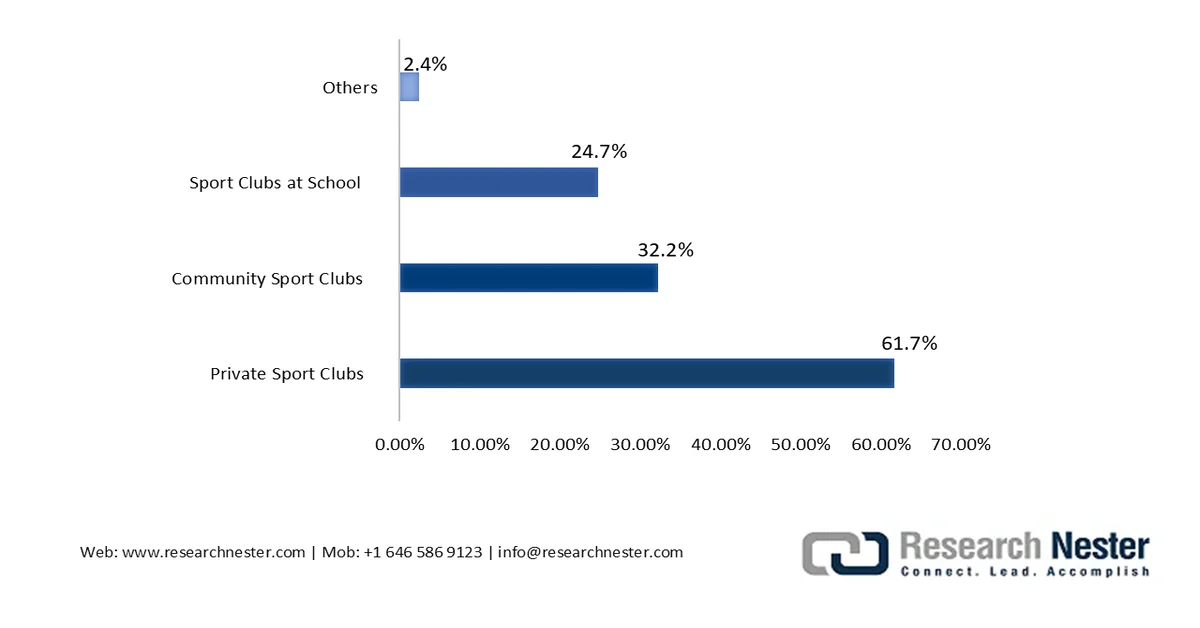
Source: Sasakawa Sports Foundation
North America Market Insights
North America in the racquet sports equipment market is expected to emerge as the fastest-growing region during the forecast period. The market’s development in the region is highly propelled by an increase in consumer spending on sports infrastructure, growth in participation across different racquet disciplines, the rapid rise in pickleball, in comparison to conventional badminton and tennis segments, and strong retail distribution networks. According to official statistics published by the Bank of America in February 2025, consumers in the region usually spend an average of USD 1,122 on sports every year, which encompasses athletic equipment to attending games. For instance, Super Bowl LVIII in Las Vegas resulted in a significant boost in average retail expenditure from visitors, accounting for almost 8% as of 2024, thereby steadily developing the market in the overall region.
The racquet sports equipment market in the U.S. is gaining increased traction, owing to an expansion in sports facilities, the pickleball craze, the adoption of advanced materials, and the presence of scholastic and youth programs. As stated in an article published by the Project Play Organization in May 2026, the youth sports participation in the country, effectively tracked by the federal government, surged to 58% as of 2024. This significantly marked a suitable 1-year increase and almost returned to its domestic level of 10 years ago. In addition, the federal government’s Healthy People 2030 Program successfully set an objective for 63% of children to participate in organized sports by the end of 2030. Besides, the Aspen Institute’s Project Play strategy readily embraced a domestic roundtable of 20 companies to make suitable commitments, thus enhancing the market’s development in the country.
The influence of national tennis icons, increased focus on leisure dynamics, and a rise in disposable incomes are a few trends that are responsible for driving the market in Canada. As per an article published by Tennis Canada in May 2026, tennis participation among the population aged between 12 and 17 years accounted for 14% in comparison to 2023. While the participation is continuously increasing across all population categories, the surge is highly witnessed among youth. For instance, as of 2025, almost 37% of the population and 29% of children aged under 12 years focused on racquet. Therefore, this particular rise successfully lifted tennis from the 5th position to 3rd as the most popular sport in the overall country. Therefore, with such an increase in this particular sport, there is a huge growing demand for the market.
Tennis Participation Attributes in Canada, 2025
|
Components |
Relevance |
|
Fun |
54.0% |
|
Socializing |
26.0% |
|
Health Benefits |
25.0% |
|
Current Players Planning to Keep Playing |
92.0% |
|
Population Planning to Play Tennis in 2026 |
35.0% |
|
People aged 26 to 34 years old planning to play |
63.0% |
|
25 to 34 years old intended to play |
53.0% |
|
State-Wise Domestic Participation Intent |
|
|
Population-Wise Domestic Participation Intent |
|
Source: Tennis Canada
Europe Market Insights
Europe in the racquet sports equipment market is projected to witness considerable expansion by the end of the stipulated timeline. The market’s growth in the region is effectively fueled by the regional production of badminton, tennis, and similar rackets, a surge in sports participation, and an increase in the need for premium equipment featuring innovative composite materials, including graphite and carbon fiber. For instance, as stated in the December 2025 Europe Sport article, citizens across 39 regional countries participated in the Europe Week of Sport, including the Neighborhood East and West Balkans. Besides, 7 sports events attracted 1,480 participants in games and outdoor sessions, particularly in Armenia, with the intention of promoting togetherness and health. Moreover, the ongoing graphite and carbon fiber supply for creating racquets is also enhancing the market growth in the overall region.
2024 Graphite and Carbon Fiber Export/Import Analysis in Europe
|
Countries |
Graphite (USD) |
Carbon Fiber (USD) |
||
|
Export |
Import |
Export |
Import |
|
|
Germany |
37.7 million |
51.7 million |
194.0 million |
300.0 million |
|
Norway |
10.7 million |
914,000 |
2.1 million |
2.9 million |
|
Netherlands |
9.4 million |
11.7 million |
22.7 million |
47.7 million |
|
Austria |
6.8 million |
15.1 million |
6.3 million |
11.7 million |
|
UK |
4.4 million |
6.2 million |
82.8 million |
144.0 million |
|
Czechia |
3.9 million |
4.4 million |
6.0 million |
6.8 million |
|
Spain |
2.2 million |
6.6 million |
61.2 million |
98.4 million |
|
Poland |
1.5 million |
33.7 million |
2.6 million |
15.5 million |
|
Hungary |
1.3 million |
- |
82.2 million |
38.5 million |
|
Sweden |
1.0 million |
4.7 million |
784,000 |
11.2 million |
Source: OEC
The racquet sports equipment market in Germany is gaining increased exposure, owing to an increase in the manufacturing facility, supply chain resilience, cost benefits, the presence of a robust sporting products industry, support from the chemical industry for advanced materials, strong consumer spending, and the existence of an advanced ecosystem. As stated in an article published by NLM in November 2025, the WHO’s physical activity guidelines focus on children and adolescents aged from 5 to 17 years, which readily corresponds to almost 60 minutes of moderate to vigorous intensity physical activity every day. Besides, this particular recommendation for adults is nearly 150 minutes of moderate intensity physical activity every week, along with 75 minutes of physical activity, thereby making it suitable for bolstering the market in the country.
The rise in padel, an increase in the young population profile, an upsurge in the demand for tourism, suitable government support for sports facilities, and lower industry saturation are certain trends that are proliferating the racquet sports equipment market in Spain. As per an article published by the Europe Commission in April 2026, the established age group as per the Youth Strategy 2030 ranges between 15 and 29 years in the country. Based on this age category, the country comprises an estimated population of 48,619,695 people as of January 2024, of which 7,871,257 are youth, roughly accounting for 16% of the overall population. In addition, 51% of the youth belong to the male population, which is followed by 49% of the female population. Therefore, with this generous presence of youth in the overall country, the market is gradually expanding and developing.
Key Racquet Sports Equipment Market Players:
- BABOLAT VS SAS (France)
- Dunlop Sports (Japan/UK)
- Gamma Sports (U.S.)
- HEAD Sport GmbH (Austria)
- JOOLA (U.S./Germany)
- Karakal Worldwide Ltd. (UK)
- Li Ning Co. Ltd. (China)
- Mizuno Corp. (Japan)
- Prince Global Sports, LLC (U.S.)
- ProKennex (Taiwan)
- Selkirk Sport LLC (U.S.)
- Slazenger (UK)
- STIGA Sports AB (Sweden)
- Tamasu Co. Ltd. (Japan)
- Tecnifibre (France)
- VICTOR Rackets Industrial Corp. (Taiwan)
- Volkl Tennis (Germany)
- Wilson Sporting Goods Co. (U.S.)
- Yonex Co. Ltd. (Japan)
- Cosco Limited (India)
- Company Overview
- Business Strategy
- Key Product Offerings
- Financial Performance
- Key Performance Indicators
- Risk Analysis
- Recent Development
- BABOLAT VS SAS is renowned for its deep heritage in tennis string technology and smart racquet integration. The company focuses on serving competitive players through continuous innovation in vibration dampening and frame feel.
- Dunlop Sports maintains a strong legacy in both tennis and squash equipment with a reputation for durability. The brand continues to evolve by introducing versatile racquet lines suitable for club-level and recreational players.
- Gamma Sports is widely recognized for its expertise in racquet accessories, particularly strings, grips, and stringing machines. The company supports the market by equipping both players and professional stringers with high-quality peripheral products.
- HEAD Sport GmbH leads in piezoelectric technology and adaptive racquet construction across multiple racquet sports. The brand aggressively expands into paddle and pickleball while retaining dominance in traditional tennis and squash segments.
- JOOLA has successfully pivoted from its table tennis roots to become a major force in pickleball equipment. The company leverages German engineering standards to produce paddles favored by competitive amateur and professional players alike.
Here is a list of key players operating in the global market:
The global racquet sports equipment market is highly competitive, characterized by a mix of heritage brands and agile specialists. Key players are focusing on material innovation and portfolio expansion to capture growth in emerging categories, such as pickleball and paddle. Besides, strategic initiatives include integrating advanced carbon fiber technologies to enhance power and control, as demonstrated by recent product launches from established firms. For instance, in December 2025, HEAD launched the latest RADICAL 2026 collection, comprising a line of paddle-based racquets, which are designed to cater to the demands of every player type. Additionally, this collection also comprises 4 models of combining versatility, control, and lightness, suitable for adapting to competitive players, thus denoting an optimistic outlook for the racquet sports equipment industry worldwide.
Corporate Landscape of the Market:
Recent Developments
- In May 2026, JOOLA unveiled R4LLy Pickleball shoes core collection, which is considered a suitable milestone introduction, providing full-size runs for both men and women in black and white colorways.
- In February 2026, Babolat released its ninth generation of the Pure Aero racquet franchise, known as Pure Aero Gen9, which is extremely suitable for players on the look for maximum spin.
- In February 2025, FIM Endurance World Championship’s promoter, Warner Bros. Discovery (WBD) Sports, expanded its long-term partnership with Dunlop for continuing to offer tires, support, and expertise to every team competing in the latest FIM Production World Trophy and the Superstock-based FIM Endurance World Cup.
- Report ID: 8567
- Published Date: May 15, 2026
- Report Format: PDF, PPT
- Explore a preview of key market trends and insights
- Review sample data tables and segment breakdowns
- Experience the quality of our visual data representations
- Evaluate our report structure and research methodology
- Get a glimpse of competitive landscape analysis
- Understand how regional forecasts are presented
- Assess the depth of company profiling and benchmarking
- Preview how actionable insights can support your strategy
Explore real data and analysis
Frequently Asked Questions (FAQ)
About this Report
Connect with our Expert


Report, 2026-2035



Copyright @ 2026 Research Nester. All Rights Reserved.
