Sports Eyewear Market Outlook:
Sports Eyewear Market size was valued at USD 16.2 billion in 2025 and is projected to reach USD 32.3 billion by the end of 2035, rising at a CAGR of 7.1% during the forecast period, i.e., 2026-2035. In 2026, the industry size of sports eyewear is evaluated at USD 17.4 billion.
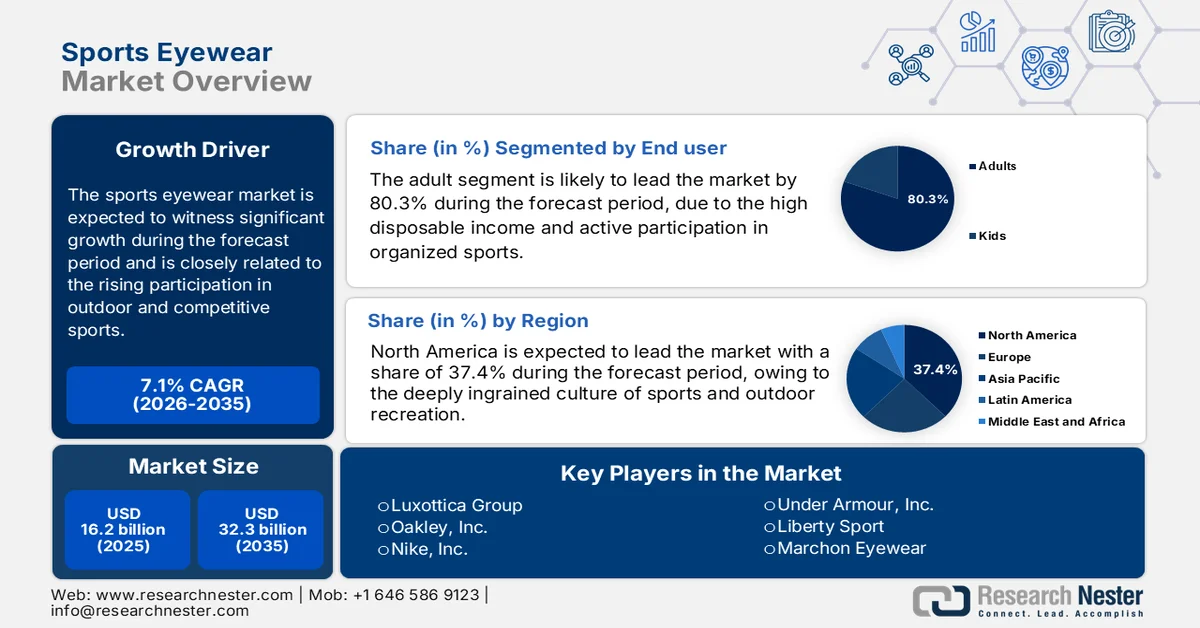
The global sports eyewear market is supported by the rising participation in outdoor and competitive sports, increasing ultraviolet exposure awareness, and regulatory emphasis on protective gear across amateur and professional segments. According to the Johns Hopkins Medicine 2026 data, nearly 3.5 million sports and recreation-related injuries are treated in the U.S. annually, with eye injuries representing a preventable subset via appropriate protective eyewear usage. Moreover, the American Academy of Ophthalmology report in March 2025 indicates that more than 30,000 sports-related eye injuries occur each year in the U.S. further the National Eye Institute highlights that prolonged UV exposure increases the risk of cataracts and other ocular conditions, reinforcing demand for certified UV-blocking eyewear in outdoor sports such as cycling, cricket, athletics, and water sports.
Besides, the international procurement and safety compliance frameworks are further reinforcing the structured demand for the market. According to the Outdoor Participation Trends report in 2022, the participants of outdoor recreation base grew by 2.2% in 2021 to 164.2 million participants, indicating a broader institutional and retail demand base for protective and performance eyewear across cycling, running, water sports, and team-based outdoor activities. This sustained participation growth strengthens the procurement cycles among school sports associations and specialty retailers, while also supporting the repeat replacement demand driven by the safety compliance and UV protection requirements. Further, the rising youth participation and organized league expansion are reinforcing long-term volume visibility for certified sports eyewear suppliers operating within regulated procurement frameworks.
Key Sports Eyewear Market Insights Summary:
Regional Highlights:
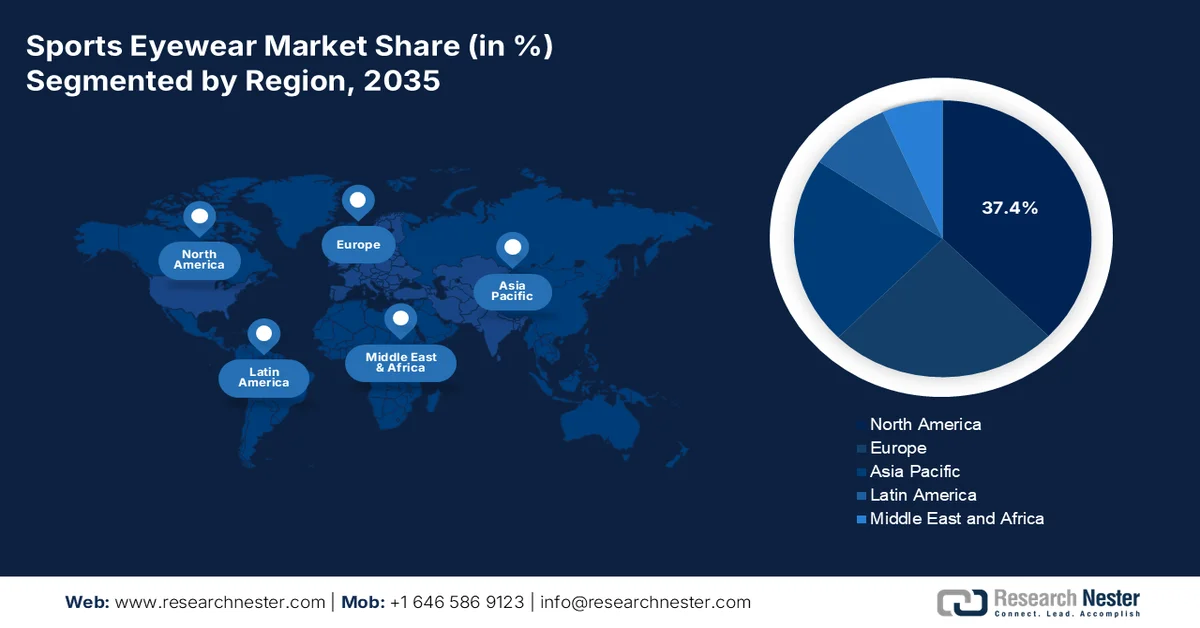
- North America is anticipated to command a 37.4% share of the sports eyewear market by 2035, attributed to a strong sports culture, advanced retail infrastructure, and growing consumer preference for premium protective eyewear technologies
- Asia Pacific is projected to record the fastest expansion at a CAGR of 7.1% during 2026–2035, supported by rising disposable incomes, expanding sports participation, and government initiatives encouraging fitness culture
Segment Insights:
- The adults segment in the sports eyewear market is expected to capture an 80.3% share by 2035, propelled by higher disposable income and strong engagement in organized sports and fitness activities
- Polarized lenses are set to lead the segment landscape across 2026–2035, stimulated by their ability to reduce glare and enhance visual clarity for outdoor sports activities
Key Growth Trends:
- Growth in organized sports participation
- Rising eye injur
Major Challenges:
- High product development and technology costs
- Changing consumer preferences
Key Players:Luxottica Group, Oakley, Inc., Nike, Inc., Under Armour, Inc., Liberty Sport, Marchon Eyewear, Safilo Group SpA, Adidas, MYKITA GmbH, Rudy Project, Julbo, Decathlon SA, Bliz Eyewear, Carl Zeiss, Swans / Yamamoto Kogaku, RobSol Indústria Óptica, VSP Vision, Fastrack / Titan, Bolle, UVEX.
Global Sports Eyewear Market Forecast and Regional Outlook:
Market Size & Growth Projections:
- 2025 Market Size: USD 16.2 billion
- 2026 Market Size: USD 17.4 billion
- Projected Market Size: USD 32.3 billion by 2035
- Growth Forecasts: 7.1% CAGR (2026-2035)
Key Regional Dynamics:
- Largest Region: North America (37.4% Share by 2035)
- Fastest Growing Region: Asia Pacific
- Dominating Countries: - United States, China, Germany, Japan, United Kingdom
- Emerging Countries: - India, South Korea, Brazil, Indonesia, Vietnam
Last updated on : 5 March, 2026
Sports Eyewear Market - Growth Drivers and Challenges
Growth Drivers
- Growth in organized sports participation: Government-backed participation programs are expanding the addressable base for protective sports equipment in the sports eyewear market. As per the SFIA February 2023 data, nearly 236.9 million U.S. people participated in at least one sport or fitness activity in 2023. Moreover, the public education systems allocate structured budgets for team sports equipment procurement, including protective eyewear in field hockey, lacrosse, baseball, and racquet sports. This large and active participation base strengthens the recurring procurement cycles within the school districts' collegiate athletic programs and community leagues, where compliance with protective equipment standards is increasingly formalized. Sustained growth in organized sports also enhances long-term replacement demand, as equipment refresh cycles are typically aligned with seasonal programs, safety audits, and budget renewals.
- Rising eye injury: Government initiatives targeting youth sports participation and safety standards are creating a sustained demand for sports eyewear market. The Frontiers August 2025 study depicts that nearly 55 million eye injuries occur worldwide annually, driving parental awareness of the need for protective equipment. Moreover, the national sports policy emphasizes the use of protective equipment across all levels of sports training from grassroots programs to elite competitions. This policy framework ensures high-performance eyewear becomes standard gear for young athletes. Further, the manufacturers supplying impact-resistant and pediatric-fit eyewear are positioned to benefit from policy-driven procurement mandates embedded within school sports and national training programs.
- Government sports infrastructure investment: Public spending on sports infrastructure directly increases the participation capacity, thereby driving the demand for the sports eyewear market. As per the report from the Outdoor Recreation Roundtable in November 2023, nearly USD 1 trillion is generated by the outdoor recreation industry. Further, the expanded pubic facilities correlate with the increased recreational activity. This expansion of publicly funded facilities increases sustained footfall across cycling tracks, community courts, and water sports centers, reinforcing demand for UV-protective and impact-resistant eyewear. For suppliers, infrastructure-backed participation growth provides long-term volume visibility, particularly in regions where municipal and federal recreation budgets are rising year over year.
Challenges
- High product development and technology costs: In the sports eyewear market, the product development with the advanced features such as polarization, photochromic lenses, and impact resistance requires substantial R&D investment that many new manufacturers cannot afford. Moreover, the market demands constant technological innovation to meet the athlete's expectations for performance enhancement and eye protection. Top companies invest millions in lens technology, creating an impact.
- Changing consumer preferences: The sports eyewear market is highly susceptible to shifting consumer tastes, where the products must balance performance functionality with aesthetic appeal. New entrants must continuously monitor and adapt to trends as sports eyewear increasingly serves inventory planning, precarious, and increases the risk of obsolescence. This volatility makes inventory planning precarious and increases the risk of obsolescence. Further, the companies must invest in market research and flexible production capabilities to respond quickly to trend shifts without excessive carrying costs.
Sports Eyewear Market Size and Forecast:
| Report Attribute | Details |
|---|---|
|
Base Year |
2025 |
|
Forecast Year |
2026-2035 |
|
CAGR |
7.1% |
|
Base Year Market Size (2025) |
USD 16.2 billion |
|
Forecast Year Market Size (2035) |
USD 32.3 billion |
|
Regional Scope |
|
Sports Eyewear Market Segmentation:
End user Segment Analysis
The adults sub-segment is dominating and is poised to hold the largest share value of 80.3% by the end of 2035 in the market. The segment is driven by the high disposable income and active participation in organized sports and fitness regimes. Adults are the primary consumers of premium technology-driven eyewear for activities such as cycling, running, and golf, where performance enhancement is valued. According to the U.S. BLS January 2023 data, the average consumer spending on athletic gear, game tables, and equipment reached USD 111.80 in 2021. This demonstrates the willingness to invest in quality gear, including specialized sports eyewear. Furthermore, this demographic often requires prescription lenses, driving demand for customized and photochromic options that combine vision correction with athletic performance.
Lens Technology Segment Analysis
The polarized lenses are the leading in the sports eyewear market during the forecast period 2026 to 2035. The segment dominance is due to their critical function of eliminating blinding glare from reflective surfaces such as water, roads, and snow, which drastically improves the visual clarity, reduces eye strain, and enhances the safety for athletes. This makes them the preferred choice for high participation activities such as fishing, cycling, and sailing. In addition, the increased participation in outdoor endurance sports and adventure tourism is reinforcing demand for glare-reduction technology across both professional and recreational users. Advancements in multi-layer polarization coatings and impact-resistant materials are further supporting segment growth by improving the durability, optical precision, and compatibility with prescription sports eyewear.
Product Type Segment Analysis
The sports sunglasses is driving the product type segment in the sports eyewear market. Their dominance is due to the essential role as the primary protective and performance-enhancing gear for the vast majority of outdoor sport including running, cycling, golf, and water sports. The sports sunglasses offer versatility for everyday training and competition, combining UV protection, impact resistance, and advanced optical technologies such as polarization. The massive scale of participation in outdoor activities directly fuels this demand. According to the U.S. BEA November 2024 data, fishing and boating are the major outdoor activities done in the U.S. and generated USD 36.8 billion in current-dollar reflecting the active purchase of protective eyewear. Further, the participation in cycling and hiking ensures a sustained and substantial market for durable, high-performance sports sunglasses.
Our in-depth analysis of the sports eyewear market includes the following segments:
|
Segment |
Subsegments |
|
Product Type |
|
|
Lens Technology |
|
|
Application |
|
|
Distribution Channel |
|
|
End user |
|
|
Price Range |
|

Vishnu Nair
Head - Global Business DevelopmentCustomize this report to your requirements — connect with our consultant for personalized insights and options.
Sports Eyewear Market - Regional Analysis
North America Market Insights
The North America is dominating and is expected to hold the regional revenue share of 37.4% by the end of 2035. The sports eyewear market in North America is underpinned by a deeply ingrained culture of sports and outdoor recreation. The region serves as a global hub for innovation and brand leadership, housing several of the world’s most influential manufacturers and benefiting from a well-established retail infrastructure that spans specialty sporting goods stores, optical chains, and direct-to-consumer e-commerce platforms. Moreover, the consumer demand is driven by a high level of awareness regarding the protective and performance-enhancing benefits of specialized eyewear, with a strong preference for the advanced lens technologies and premium, durable products.
The participation expansion is creating a structurally stronger demand base for sports eyewear market in U.S. across multiple activity categories. According to SFIA, 77.6% of people in the U.S. participated in sport or fitness activity in 2022, reflecting a 1.9% rise from 2021. Moreover, the sports categories typically require impact-resistant or glare-reduction eyewear, reinforcing structured retail and institutional procurement demand. On the other hand, the U.S. BEA November 2024 data depicts that outdoor recreation also contributed to economic activity, with arts, entertainment, recreation, accommodation, and food services generating USD 165.2 billion in the outdoor recreation value added in 2023. Further, the snow activities have contributed USD 7.7 billion nationally, supporting demand for ski goggles and UV-protective eyewear. The scale and geographic distribution of the outdoor economic activity indicate sustained replacement cycles and the regional specialization opportunities for sports eyewear suppliers.
The strong public investment in sport participation, rising outdoor recreation activity, and winter sports engagement is shaping the sports eyewear market in Canada. According to the Government of Canada's May 2025 data, the household spending on recreational services reached USD 5,231 in 2023, reflecting sustained consumer allocation toward sport and activity-related categories. On the other hand, the report from Statistics Canada in November 2023 has depicted that nearly 55% of people aged 12 and older reported participating in organized or non-organized sports, reinforcing a broad participation base that supports demand for protective and performance eyewear across youth and adult segments. Further, the strong winter activity participation and steady household recreation expenditure show a positive impact on the market growth in Canada.
APAC Market Insights
The Asia Pacific is anticipated to experience the fastest growth rate, registering a CAGR of 7.1% during the forecast period 2026 to 2035. The market is driven by the large and growing population, rising consumer disposable incomes, and increasing sports participation across key countries. Urbanization trends, combined with the government wellness initiatives and sport facility development programs, drive the sustained demand for the sports eyewear market in the Asia Pacific. The government policies promoting fitness culture create favorable conditions for market expansion. Moreover, the e-commerce growth across the region enhances the product accessibility with virtual try-on capabilities and competitive pricing, attracting younger, tech-oriented consumers. The convergence of manufacturing capacity, rising affluence, and policy support positions APAC for continued dominance in the global sports eyewear landscape.
The strong export performance, active population, and government initiatives for outdoor recreation are supporting the demand for the sports eyewear market in Japan. According to the OEC 2024 data, Japan exported USD 411 million worth of optical-related products, reflecting its established manufacturing base and international distribution strength in eyewear and lens components. Moreover, the recent innovation remains active, as demonstrated by Toray Industries’ launch of the Toraysee in October 2021, which is an Anti-Fog Cloth in Japan, targeting eyewear users seeking visibility enhancement in humid and high-exertion conditions. Anti-fog performance is relevant for cycling, winter sports, baseball, and running, where condensation can impair vision. Further, Japan presents a stable demand for performance-enhancing, UV-protective, and anti-fog sports eyewear solutions across both domestic and export-oriented channels.
The rising government investment in sports infrastructure and the export activity are fueling the sports eyewear market in India. As per the PIB February 2025 data, the Union Budget allocation for the Ministry of Youth Affairs and Sports increased to USD 373.7 million in 2024, reflecting 11% rise and marking the highest allocation. This sustained public investment strengthens the athlete training infrastructure and school-level sports participation, all of which contribute to the demand for protective and performance eyewear across cricket, badminton, athletics, and emerging outdoor sports. On the other hand, the OEC 2024 data shows that India exported approximately USD 41.4 million worth of optical-related products in 2024, indicating a developing manufacturing and export base. These data show a steady volume growth in impact-resistant and UV-protective sports eyewear across the India market.
Europe Market Insights
The sport eyewear market in Europe is expanding significantly and is driven by the mature and highly advanced landscape defined by the deep consumer engagement with sports and outdoor activities across diverse climatic and geographic conditions. The market benefits from a strong cycling culture, extensive winter sports participation, and growing running and outdoor fitness communities. Moreover, the consumers demonstrate particular advancements in the purchasing decisions, prioritizing advanced lens technologies, superior optical clarity, and compliance with stringent safety regulations over price considerations. Further, the presence of major industry players along with numerous specialized manufacturers creates a competitive environment that drives continuous innovation in materials.
The sports eyewear market in Germany is supported by the high organized sports participation, strong public funding for sports, and the large outdoor recreation base. According to the Federal Ministry for the Environment, Climate Action, Nature Conservation and Nuclear Safety, March 2025 data organized sport clubs in Germany accounted for 28.8 million memberships in 2023, reflecting broad participation across youth and adult categories. Federal support further reinforces structured demand by allocating millions annually in recent budgets toward elite sport and sport infrastructure development. On the other hand, strong participation in cycling, football, winter sports in Bavaria, and outdoor endurance activities drives recurring demand for impact-resistant, UV-protective, and performance-enhancing eyewear. The combination of club-based sport structures, federal funding mechanisms, and high recreation expenditure provides predictable procurement channels for sports eyewear suppliers operating in Germany’s institutional and specialty retail segments.
The high grassroots sports participation, structured public funding, and sustained recreation expenditure are driving the sports eyewear market in the UK. According to UK Coaching, September 2023 data, 63% of adults and 47% of children in England met the Chief Medical Officers’ physical activity guidelines, reflecting a broad and active participation base. Additionally, the UK Office for National Statistics reported that household expenditure on recreation and culture highlights the sustained consumer allocation toward sport and leisure activities. Strong engagement in football, cycling, cricket, rugby, and winter sports travel supports the demand for the impact resistant UV-protective and prescription-compatible sports eyewear. The presence of structured club systems and school sports programs provides stable procurement pathways for the manufacturers targeting institutional buyers and specialty retail networks across the UK.
Key Sports Eyewear Market Players:
- Luxottica Group (Italy)
- Oakley, Inc. (U.S.)
- Nike, Inc. (U.S.)
- Under Armour, Inc. (U.S.)
- Liberty Sport (U.S.)
- Marchon Eyewear (U.S.)
- Safilo Group SpA (Italy)
- Adidas (Germany)
- MYKITA GmbH (Germany)
- Rudy Project (Italy)
- Julbo (France)
- Decathlon SA (France)
- Bliz Eyewear (Sweden)
- Carl Zeiss (Germany)
- Swans / Yamamoto Kogaku (Japan)
- RobSol Indústria Óptica (Brazil)
- VSP Vision (U.S.)
- Fastrack / Titan (India)
- Bolle (France)
- UVEX (Germany)
- Company Overview
- Business Strategy
- Key Product Offerings
- Financial Performance
- Key Performance Indicators
- Risk Analysis
- Recent Development
- Regional Presence
- SWOT Analysis
- Luxottica Group exerts immense influence over the sports eyewear market via its ownership of category-leading brands. The company’s strategic initiatives focus heavily on technological integration and broadening its performance portfolio. These devices are designed to withstand the rigors of endurance sports, addressing challenges such as weight, sweat resistance, and battery life.
- Oakley, Inc. continues to set benchmarks for performance and innovation in the sports eyewear market. The brand's core strategic initiative revolves around proprietary lens technology, most notably PRIZM, which fine-tunes vision for specific environments to enhance athletic performance. Oakley's advancements are showcased in new models like the Sphaera and BiSphaera, which are engineered to offer athletes an extended field of view. In 2024, the company made a 30% growth in revenue.
- Nike, Inc. approaches the sports eyewear market by merging cutting-edge design with psychological and physiological benefits for athletes. Produced under license by Marchon, Nike’s recent advancements include the release of the electric pack featuring the computationally designed Nike Zeus and Nike Athena sunglasses.
- Under Armour, Inc. maintains its presence in the sports eyewear market via a strategic long-term licensing partnership. In a key move to ensure stability and product development continuity, Armour renewed its global licensing agreement with the Italian eyewear manufacturer Safilo Group. In 2025, the company made a revenue of USD 3,105,624 in North America.
- Liberty Sport has carved out a significant niche in the sports eyewear market by focusing on specialized, high-quality protective equipment. While perhaps less visible in the consumer fashion space than some competitors, the company is recognized as a key manufacturer of sport-oriented protective gear.
Here is a list of key players operating in the global market:
The global sports eyewear market is highly competitive, featuring a mix of the established optical giants and specialized performance brands. The landscape is dominated by the major groups such as Italy’s EssilorLuxottica, which leverages its vast scale and the portfolio, including Oakley and Bliz, to lead the industry. Further, the strategic initiatives are focused on the technological innovation in lens materials and design alongside market expansion via acquisition and sponsorships of elite athletes to enhance brand visibility and credibility. For example, in November 2025, Authentic announces a long-term partnership with Robsol for Reebok eyewear in Brazil. The key players from the U.S. and Europe maintain a stronghold while companies from regions such as Japan and Australia are gaining traction by catering to specific sports niches and regional outdoor lifestyles.
Corporate Landscape of the Sports Eyewear Market:
Recent Developments
- In December 2025, VSP Vision announced that it has completed the acquisition of Marcolin, a global leader in eyewear design, manufacturing, and distribution, from PAI Partners and other minority shareholders.
- In July 2025, the UVEX WINTER HOLDING GmbH & Co. KG announced the acquisition of majority investment of Warburg Pincus, the pioneer of private equity global growth investing. The owner families Winter and Grau will retain a significant minority stake and will be actively involved in the future growth of the business.
- In June 2025, Meta and Oakley have announced the collaboration to deliver a new category of Performance AI glasses, engineered to amplify human potential. The product has a built-in camera, open-ear speakers, an IPX4 water resistance rating and more, Oakley Meta HSTN represents the next evolution of AI glasses.
- Report ID: 8418
- Published Date: Mar 05, 2026
- Report Format: PDF, PPT
- Explore a preview of key market trends and insights
- Review sample data tables and segment breakdowns
- Experience the quality of our visual data representations
- Evaluate our report structure and research methodology
- Get a glimpse of competitive landscape analysis
- Understand how regional forecasts are presented
- Assess the depth of company profiling and benchmarking
- Preview how actionable insights can support your strategy
Explore real data and analysis
Frequently Asked Questions (FAQ)
About this Report
Connect with our Expert


Report, 2026-2035


Copyright @ 2026 Research Nester. All Rights Reserved.
