Artificial Grass Market Outlook:
Artificial Grass Market size was over USD 7.3 billion in 2025 and is estimated to reach USD 14.7 billion by the end of 2035, expanding at a CAGR of 8.1% during the forecast timeline, i.e., 2026-2035. In 2026, the industry size of artificial grass is assessed at USD 7.8 billion.
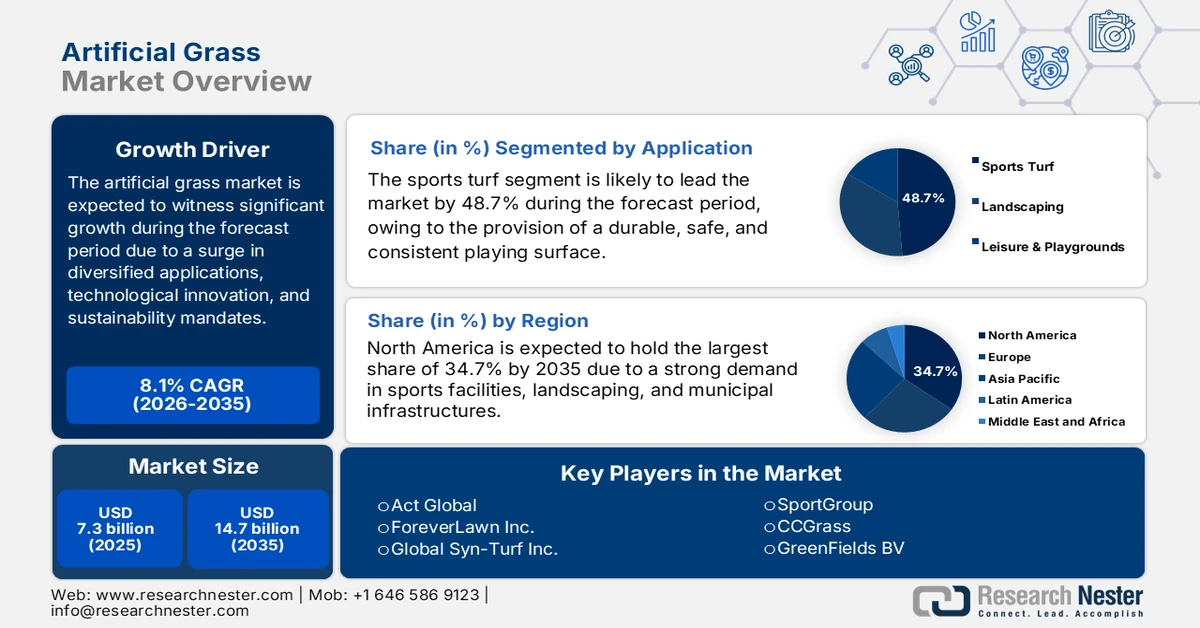
The international artificial grass market is gradually entering a new phase of maturity, readily characterized by diversification into non-sports applications, sustainability mandates, and technological advancements. According to official statistics published by the IJRTI Organization in April 2025, the international sports tourism industry was valued at more than USD 600 billion by the end of 2023. This led to diversification in tourism offerings and strengthening localized economies through employment opportunities, cultural exchange, and hospitality development. Moreover, UNWTO has reported that sports tourism is one of the fastest-growing segments in international tourism, contributing almost 10% of the overall tourism revenue. Besides, the revenue of worldwide sports tourism across different regions is also bolstering the artificial grass market exposure.
International Sports Tourism Revenue Analysis by Region (2013 versus 2023)
|
Regions |
2013 (USD Billion) |
2023 (USD Billion) |
|
North America |
120 |
160 |
|
Europe |
110 |
180 |
|
Asia Pacific |
80 |
150 |
|
Latin America |
35 |
70 |
|
Middle East |
20 |
40 |
Source: IJRTI Organization
Furthermore, the smart turf integration, circular economy practices, indoor applications, luxury landscaping, and hybrid turf systems are other factors uplifting the artificial grass market globally. As per an article published by The New Ledge Organization in August 2024, there have been more than 12,000 artificial turf fields in the U.S., with 1,200 to 1,500 being constructed every year. Based on this, the international industry for artificial turf has successfully reached more than USD 8 billion. However, artificial turfs cannot be recycled; massive swaths of plastic, that is 40,000 lbs in the average athletic field, frequently end up in landfills when the lifespan runs out. Besides, synthetic grass can be heated up to 20 to 50 degrees Fahrenheit more than natural gas. This tentatively keeps relatively cool when blades release water vapor as the temperature increases, thus making it suitable for bolstering the market’s growth.
Key Artificial Grass Market Insights Summary:
Regional Highlights:
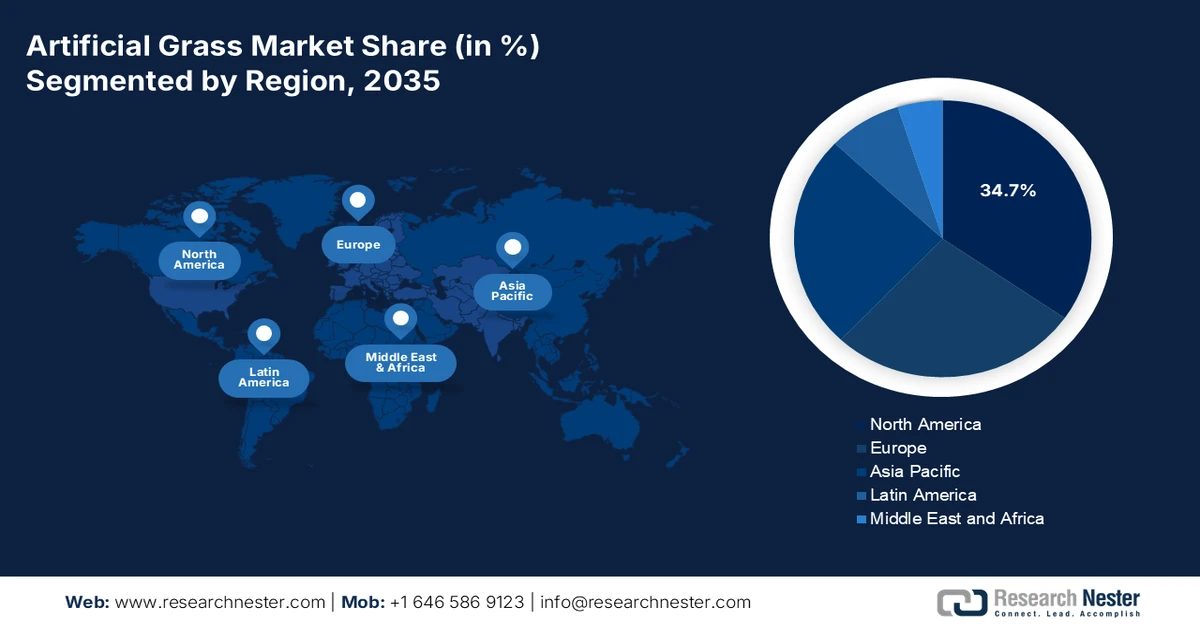
- North America is forecast to command 34.7% share by 2035 in the artificial grass market, underpinned by strong adoption across municipal infrastructure, landscaping, and sports facilities aimed at reducing water consumption amid drought concerns.
- Asia Pacific is poised to emerge as the fastest-growing region over 2026–2035, stimulated by rising sports infrastructure investments, sustainability-focused chemical innovations, and accelerating urbanization.
Segment Insights:
- Sports turf (application segment) is expected to secure a dominant 48.7% share by 2035 in the artificial grass market, aided by its capability to provide consistent, safe, and durable playing surfaces with reliable performance across diverse weather conditions.
- Commercial (end-use segment) is anticipated to hold the second-largest share by the end of the forecast period, strengthened by rising demand from hospitals, corporate campuses, educational institutions, and sports complexes seeking low-maintenance and high-durability turf solutions.
Key Growth Trends:
- Increase in urbanization
- Rise in international temperatures
Major Challenges:
- Environmental concerns and regulatory scrutiny
- Increase in initial installation expenses
Key Players:TenCate Grass, FieldTurf – Tarkett Group, SIS Pitches, SportGroup, CCGrass, GreenFields BV, Condor Grass, Victoria PLC, Act Global, ForeverLawn Inc., Global Syn-Turf Inc., Synthetic Turf International, Limonta Sport, Italgreen S.p.A., TigerTurf, Taishan Artificial Turf Industry Co., Ltd., Dongguan Gaopin Sports Goods Co., Ltd., Namgrass, Juta a.s., Samyang Corporation.
Global Artificial Grass Market Forecast and Regional Outlook:
Market Size & Growth Projections:
- 2025 Market Size: USD 7.3 billion
- 2026 Market Size: USD 7.8 billion
- Projected Market Size: USD 14.7 billion by 2035
- Growth Forecasts: 8.1% CAGR (2026-2035)
Key Regional Dynamics:
- Largest Region: North America (34.7% share by 2035)
- Fastest Growing Region: Asia Pacific
- Dominating Countries: United States, China, Germany, Japan, United Kingdom
- Emerging Countries: India, South Korea, Brazil, Saudi Arabia, Australia
Last updated on : 27 January, 2026
Artificial Grass Market - Growth Drivers and Challenges
Growth Drivers
- Increase in urbanization: The rapid expansion of municipal parks and smart cities is readily driving the need for low-maintenance landscaping solutions, which is bolstering the artificial grass market globally. For instance, as stated in a data report published by the OECD Organization in 2023, the Internet of Things (IoT) industry in smart cities is expected to grow from USD 300 billion to more than USD 650 billion by the end of 2026. Besides, in the U.S., cities are projected to invest USD 41 trillion in the upcoming two decades and readily gain advantage from digitalized technologies. Moreover, digitalized technologies in urban regions generate over 2.5 quintillion bytes of data, which is more than 50% of that deriving from IoT devices, thus denoting an optimistic outlook for the artificial grass market.
- Rise in international temperatures: The increase in worldwide temperatures, along with drought conditions are significantly pushing the adoption of turf as a climate-resistant alternative option to natural gas, which is boosting the artificial grass market’s expansion. According to official statistics published by the Climate Government in May 2025, there has been a surge in Earth’s temperature by an average of 0.11 degrees Fahrenheit per decade. In addition, 2024 was considered the warmest year, with temperatures rising 2.3 degrees Fahrenheit above the 20th century average of 57.0 degrees Fahrenheit. Additionally, it was 2.6 degrees Fahrenheit above the pre-industrial average of 56.7 degrees Fahrenheit, thereby denoting a huge growth opportunity for the market across different regions.
- Reduction in long-lasting maintenance expenses: The artificial grass market readily diminishes long-lasting maintenance costs for municipalities, schools, and stadiums, thereby making it a financially attractive option. As stated in a data report published by the Sustainable Communities and Waste Hub data report in November 2024, the worldwide synthetic turf industry has been witnessing substantial growth with market values increasing to USD 2.7 billion, and is further expected to grow at a 5.2% rate by the end of 2025. This particular growth is partly driven by the promotion of synthetic turf as a user-friendly and cost-effective alternative option to natural grass. This is highly suitable for both sports fields and residential lawns, thereby creating a positive impact for the market’s upliftment.
Challenges
- Environmental concerns and regulatory scrutiny: The artificial grass market witnesses increasing criticism, owing to its dependence on synthetic polymers such as polyethylene and polypropylene, which readily contribute to microplastic pollution. Besides, governments in North America and Europe are tightening regulations on synthetic turf, especially regarding infill materials, such as crumb rubber, which have been associated with environmental and health challenges. The Europe Chemicals Agency (ECHA) has already proposed restrictions on microplastics, which tend to directly impact turf manufacturers. In addition, the artificial grass industry significantly contributes to heat island effects in urban locations, raising sustainability concerns. Moreover, as cities implement stringent climate adaptation reforms, turf producers need to innovate with recyclable and bio-based alternatives to remain compliant.
- Increase in initial installation expenses: Despite long-lasting savings in maintenance, the artificial grass market needs generous upfront investments in comparison to natural grass. Installation expenses include specialized turf materials, infill systems, drainage solutions, and professional labor, frequently making projects prohibitively expensive for schools, municipalities, and small-scale sports clubs. In developing economies, where budget constraints are more pronounced, this particular cost barrier limits the market adoption. Furthermore, financing options for artificial turf projects remain restricted, with few government subsidies available outside of major sports infrastructure programs. This challenge is particularly acute in residential and commercial landscaping, where consumers weigh the cost against aesthetic preferences.
Artificial Grass Market Size and Forecast:
| Report Attribute | Details |
|---|---|
|
Base Year |
2025 |
|
Forecast Year |
2026-2035 |
|
CAGR |
8.1% |
|
Base Year Market Size (2025) |
USD 7.3 billion |
|
Forecast Year Market Size (2035) |
USD 14.7 billion |
|
Regional Scope |
|
Artificial Grass Market Segmentation:
Application Segment Analysis
The sports turf segment is anticipated to garner the highest share of 48.7% in the artificial grass market by the end of 2035. The sub-segment’s upliftment is highly driven by its importance for offering a consistent, safe, and durable playing surface that significantly operates regardless of weather conditions. This also eliminates mud, diminishes maintenance expenses, and provides year-round and superior performance for high-intensity sports. According to official statistics published by NLM in December 2024, microplastics are deliberately defined as solid plastic particles than 5 mm in size, while crumb rubber infill pieces are usually less than 1 mm in diameter. Based on this, it has been found that 50% of artificial turf fibers are sampled within less than 5 mm in size, which is classified as a source of microplastics, thereby denoting a huge growth opportunity for the sub-segment.
End use Segment Analysis
By the end of the forecast period, the commercial segment is projected to hold the second-largest share in the artificial grass market. The sub-segment’s growth is highly fueled by the need from hospital facilities, corporate campuses, educational institutions, and sports complexes. Moreover, commercial users readily prioritize artificial turf for its low maintenance, durability, and the ability to withstand strong foot traffic, thus making it suitable for recreational centers, training grounds, and stadiums. Unlike residential applications, commercial installations frequently demand large-scale projects with innovative drainage systems, eco-friendly infills, and shock pads to ensure safety and performance standards. Therefore, with such benefits, the sub-segment is poised to gain increased exposure in the global artificial grass market.
Type Segment Analysis
The tuft grass 10-25 mm segment is expected to account for the third-largest share in the artificial grass market during the stipulated duration. The segment’s development is extremely propelled by its increased utilization in the form of artificial grass, especially in high-performance applications and sports. Additionally, its medium pile height provides a suitable balance between aesthetics, playability, and durability, which makes it the most preferred option for tennis, hockey, football, and other multi-sport fields. Moreover, as per the August 2025 NLM article, non-rainfall inputs and dew, along with fog can ensure 1% to 25% of the localized water budget, particularly in semi-arid and arid environments, readily sustaining aid seedling establishment and biodiversity. Therefore, with such atmospheric moisture existence, the segment’s demand is gradually increasing internationally.
Our in-depth analysis of the artificial grass market includes the following segments:
|
Segment |
Subsegments |
|
Application |
|
|
End use |
|
|
Type |
|
|
Material |
|
|
Installation |
|
|
Infill |
|

Vishnu Nair
Head - Global Business DevelopmentCustomize this report to your requirements — connect with our consultant for personalized insights and options.
Artificial Grass Market - Regional Analysis
North America Market Insights
The North America artificial grass market is anticipated to account for the highest share of 34.7% by the end of 2035. The market’s upliftment in the region is highly attributed to its robust demand in municipal infrastructure, landscaping, and sports facilities. According to official statistics published by the WRA Organization in December 2022, artificial turf has emerged to be extremely popular in Colorado, significantly accounting for 24% of the artificial turf industry in the U.S. The ultimate objective is to diminish landscape water utilization in the face of water security challenges and unprecedented drought risks. Besides, a full-sized and 1.3-acre natural grass sports field can utilize almost 1.5 million gallons of water for irrigation every year, depending on geographic location. Therefore, the presence of artificial turf for sports activities denotes a huge growth opportunity for the artificial grass market in the region.
The artificial turf grass market in the U.S. is growing significantly due to expansion in sports infrastructure, the presence of water conservation policies, chemical innovation funding, and safety standards. As per an article published by NLM in August 2023, 50% of children and 10% of adolescents in the country effectively adhere to domestic guidelines for physical activity. Meanwhile, adolescents participating in organized team sports receive 23% to 60% of their respective moderate-to-vigorous physical activity (MVPA) from sports. Besides, adolescents domestically have access to more than 7 recreation or sports facilities, leading to being over 26% physically active. Moreover, as stated in the August 2025 EPA Government article, the average population utilizes over 300 gallons of water every day, and an estimated 70% is utilized indoors. Furthermore, freshwater withdrawals in the country are also denoting a huge demand for the market’s growth and expansion.
Freshwater Withdrawals Analysis in the U.S. (2025)
|
Source Type |
Withdrawal % |
|
Thermoelectric Power |
45 |
|
Irrigation |
32 |
|
Public Supply |
12 |
|
Self-Supplied Industrial |
5 |
|
Aquaculture |
3 |
|
Mining |
2 |
|
Self-Supplied Domestic |
1 |
Source: EPA Government
The artificial grass market in Canada is also growing, owing to the existence of municipal projects, urban landscaping, government clean energy investments, cold climate durability, and environmental programs. As per an article published by the Statistique Canada in July 2025, massive urban areas readily covered over 11,000 square kilometers of the country’s inland area, denoting a rise by 2.4%. Besides, 61% of the population resided in large urban POPCTRs in the country, and it continued to increase at a rapid pace by more than 5.8%, with increased growth rates in 26 of the 34 huge urban POPCTRs ranging between 5.3% and 22.3%. Meanwhile, land surface temperature metrics can be significantly estimated by utilizing Earth observation data, including thermal data from Landsat satellites at a 100-meter resolution, thereby denoting an optimistic outlook for the market in the country.
APAC Market Insights
The Asia Pacific artificial grass market is expected to emerge as the fastest-growing region during the forecast period. The market’s development in the region is highly propelled by sustainability-based chemical advancements, sports infrastructure investments, and an increase in urbanization. According to official statistics published by the Project Play Organization in 2025, the General Administration of Sport (GAS) in China is readily guided by the 14th Five-Year Plan for Sport Development, based on which the government spent ¥23.3 billion (USD 3.2 billion) on sport as of 2023. Additionally, the GAS oversees 20 sports management facilities, the provincial sports commission, along with the national training bureau and national teams. Moreover, China’s sports system offers support to the sports lottery, due to which there has been an expansion in fitness projects to over 600,000 villages, thus making it suitable for uplifting the market’s growth.
The artificial grass market in China is gaining increased exposure due to the prioritization of sustainable chemical production, along with an increase in organizations adopting artificial grass technologies. As per an article published by NLM in March 2024, there has been an increase in chemical registrations to 204 million, and it is continuing to grow at a rate of millions to more than 10 million yearly. Besides, the country has also emerged as the sole and largest producer of chemical substances, accounting for an estimated 40% and 37% of international chlorinated paraffins. Moreover, as stated in an article published by the ITIF Organization in April 2024, the country is leading in the chemicals industry sales, accounting for more than 40% of the international market, which is deliberately uplifting the market’s growth and expansion.
The artificial grass market in India is gaining increased exposure, owing to a rise in the demand for sports facilities under the Khelo India initiative, as well as government-based chemical innovation programs. Based on government estimates published by the PIB Government in June 2025, the country’s government initiated a record allocation of ₹3794 crores to the Ministry of Youth Affairs and Sports between 2025 and 2026. In addition, ₹2,191.0 crore has been provided to Central Sector Schemes that comprise the flagship Khelo India Programme, receiving ₹1,000 crore. Moreover, the budget provision to the country’s ministry amounted to ₹1643 crore, further denoting a rise by 130.9% between 2025 and 2026. Besides, since its initiation, the Khelo India- National Programme for Development of Sports has aimed to promote mass sporting excellence and participation, thereby driving the market’s demand in the country.
Europe Market Insights
Europe artificial grass market is projected to witness considerable growth by the end of the stipulated timeline. The market’s growth in the region is highly driven by the existence of sustainability initiatives, along with strong government-based chemical advancements. According to official statistics published by the SEI Organization in April 2025, the Europe Green Deal has significantly unveiled 150 policies that are aimed at ensuring an ambitious transformation in notable sectors, including food, transport, buildings, industry, and energy. Besides, in January 2025, 168 approaches have been successfully proposed by the regional Commission, of which 98 have been implemented by the Council and Parliament, and 37 are presently under negotiation. Moreover, as per the 2023 CEFIC Organization data report, with more than 1.2 million workers, €499 billion yearly turnover, and €9.4 billion research and innovation investments, the chemical industry in the region is also growing, which is positively driving the market’s expansion.
The artificial grass market in Germany is gaining increased traction due to sustainable chemical production, an increase in the need for green chemical solutions, and polymer compounds utilization in turf fibers. As stated in an article published by the Federal Ministry for Economic Affairs and Energy in February 2024, the Federal Ministry for Economic Affairs and Climate Action (BMWK) has significantly increased the availability of €3.5 billion from the Climate and Transformation Fund within the 2027 to 2036 duration for importing green hydrogen along with its derivatives. In addition, the federal government’s vision is focused on enhancing the demand for hydrogen in the country to readily foster the decarbonization aspect of industry, amounting to 95 TWh to 130 TWh yearly by the end of 2030, thereby making it suitable for bolstering the market’s exposure.
The artificial grass market in the UK is also growing, owing to the aspect of sports infrastructure modernization, especially with increased investment opportunities in rugby and football stadiums, along with municipal landscaping projects. Based on government estimates published by the UK Government in March 2025, almost 40% of funded projects comprise a multi-sport offer that ensures increased participation. In addition, the population in the country also benefits from upgraded sports infrastructures in local regions due to the £100 million investment strategy by the government. Besides, the cultural secretary declared a funding for the Bonnyrigg Rose Community Football Club, denoting a grassroots football facility in Scotland, supporting more than 700 players. The funding is poised to be invested in 2026, with £82.3 million allocated to projects in England, including £2 million uplift of the investment, thus bolstering the market.
Key Artificial Grass Market Players:
- TenCate Grass (Netherlands)
- FieldTurf – Tarkett Group (France)
- SIS Pitches (UK)
- SportGroup (Germany)
- CCGrass (China)
- GreenFields BV (Netherlands)
- Condor Grass (Netherlands)
- Victoria PLC (UK)
- Act Global (U.S.)
- ForeverLawn Inc. (U.S.)
- Global Syn-Turf Inc. (U.S.)
- Synthetic Turf International (U.S.)
- Limonta Sport (Italy)
- Italgreen S.p.A. (Italy)
- TigerTurf (Australia)
- Taishan Artificial Turf Industry Co., Ltd. (China)
- Dongguan Gaopin Sports Goods Co., Ltd. (China)
- Namgrass (Belgium)
- Juta a.s. (Czech Republic)
- Samyang Corporation (South Korea)
- Company Overview
- Business Strategy
- Key Product Offerings
- Financial Performance
- Key Performance Indicators
- Risk Analysis
- Recent Development
- Regional Presence
- TenCate Grass is recognized as one of the global leaders in artificial turf innovation, supplying advanced fiber technologies for sports and landscaping applications. Its strong R&D focus and partnerships with international sports federations have positioned it as a premium supplier in Europe and beyond.
- FieldTurf, part of Tarkett Group, is a pioneer in synthetic turf solutions, widely adopted in football, rugby, and multi-sport stadiums worldwide. The company emphasizes sustainability, offering recyclable turf systems and eco-friendly infill materials to meet European environmental standards.
- SIS Pitches specializes in hybrid and synthetic turf systems, with installations across major football clubs and international sporting venues. Its reputation for delivering FIFA-certified pitches has strengthened its market presence in Europe and the Middle East.
- SportGroup is a major player in sports and recreational surfacing, with brands such as Polytan under its portfolio. The company’s focus on durability and performance has made it a preferred supplier for Olympic venues and large-scale municipal projects.
- CCGrass is the world’s largest artificial grass manufacturer by production capacity, exporting to different countries. Leveraging cost efficiency and scale, it dominates the Asian market and has expanded aggressively into Europe and North America with FIFA-certified products.
Here is a list of key players operating in the global artificial grass market:
The global artificial grass market is highly competitive, with European players such as TenCate Grass, SportGroup, and Limonta Sport leading innovation, while U.S. firms, such as Act Global and ForeverLawn, focus on expanding distribution networks. Asia-based manufacturers, notably CCGrass and Taishan, leverage scale and cost efficiency to dominate exports. Strategic initiatives include mergers, partnerships with sports federations, and investments in eco-friendly turf technologies. Companies are increasingly aligning with sustainability mandates, introducing recyclable infill materials and UV-resistant fibers. Besides, in April 2025, Northwestern University declared its partnership with JMI Sports and Legends for the latest multi-year multimedia rights deal to support the new Ryan Field, Northwestern Athletics, and the comprehensive university campus, thus proliferating the artificial grass industry’s growth.
Corporate Landscape of the Artificial Grass Market:
Recent Developments
- In April 2025, BASF and Hagihara Industries, Inc. have successfully joined forces to create highly durable polyolefin yarns for artificial turf that is readily utilized in sports arenas, such as tennis courts, baseball fields, and football stadiums.
- In February 2025, AstroTurf Corporation declared that it has successfully acquired General Analytics to expand its presence in the Southwest, and General readily served as the official construction arm in Arizona.
- In April 2024, Bellinturf proclaimed the extension of its international operations with the commencement of the latest factory in Indonesia. This tactical move denotes a significant milestone in the organization’s expansion efforts, thus solidifying its position among notable players in the global market.
- Report ID: 8362
- Published Date: Jan 27, 2026
- Report Format: PDF, PPT
- Explore a preview of key market trends and insights
- Review sample data tables and segment breakdowns
- Experience the quality of our visual data representations
- Evaluate our report structure and research methodology
- Get a glimpse of competitive landscape analysis
- Understand how regional forecasts are presented
- Assess the depth of company profiling and benchmarking
- Preview how actionable insights can support your strategy
Explore real data and analysis
Frequently Asked Questions (FAQ)
About this Report
Connect with our Expert


Report, 2026-2035



Copyright @ 2026 Research Nester. All Rights Reserved.
