Petroleum Coke Market Outlook:
Petroleum Coke Market size was over USD 29.6 billion in 2025 and is poised to exceed USD 56.62 billion by 2035, witnessing over 6.7% CAGR during the forecast period i.e., between 2026-2035. In the year 2026, the industry size of petroleum coke is estimated at USD 31.38 billion.
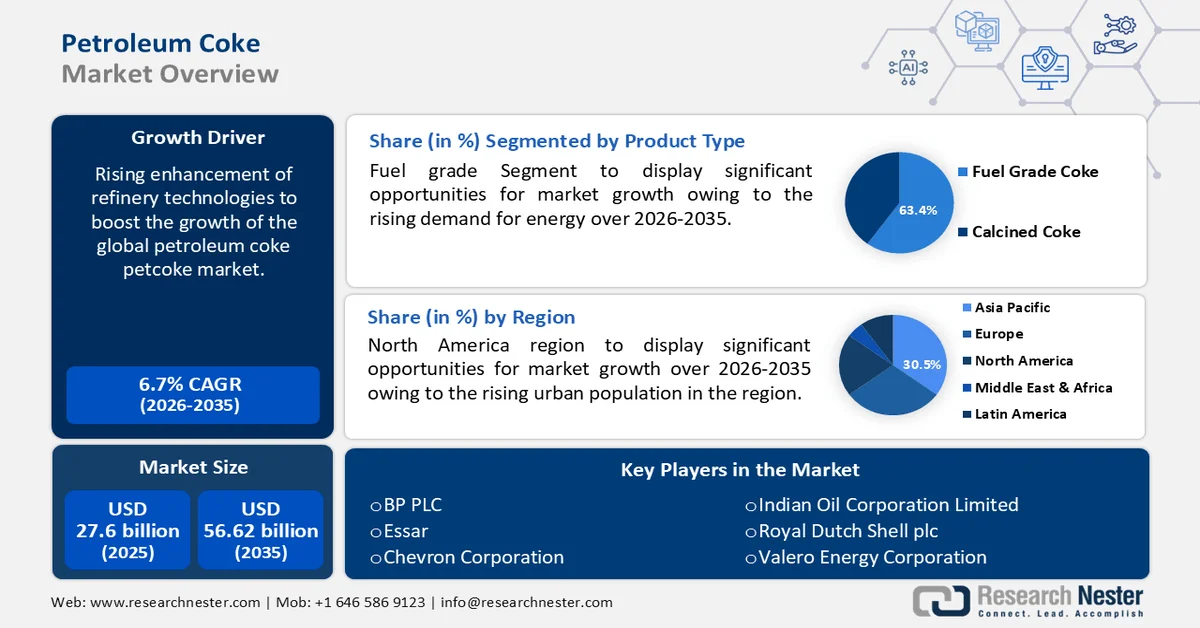
Petroleum coke industry has witnessed expansion due to a variety of factors, including its crucial relevance in the global energy and industrial landscape. The industry has been compelled to look for cleaner combustions as a result of growing environmental regulations on greenhouse emissions. In addition, petroleum coke has a higher calorific value than traditional coal, which has increased its allure. For instance, in February 2022, Reliance Industries Ltd. repurposed a USD 300 billion plant converting petroleum coke into synthesis gas to utilize it for producing blue hydrogen at USD 1.2-1.5 a kilogram as it is considered the cleanest fuel. This aims to incorporate the contribution of petroleum coke in creating sustainable solutions, making it preferable for industries seeking neutrality.
Furthermore, petroleum coke is a crucial component of metallurgical processes in the steel industry and thus serves as another thriving sector in emerging economies for market expansion. The strategic place for petroleum coke in the supply chain and improvements in refining technologies have made it easier to access and use for a variety of purposes. For instance, in June 2022, Texas A&M University and ExxonMobil researched a sophisticated technique to recover petroleum coke into a viable sustainable high-value referent. This approach is funded by the ExxonMobil Chemical Company. Thus, given the economic, regulatory, and technological factors, the petroleum coke market is probably going to experience steady growth.
Key Petroleum Coke Market Insights Summary:
Regional Highlights:
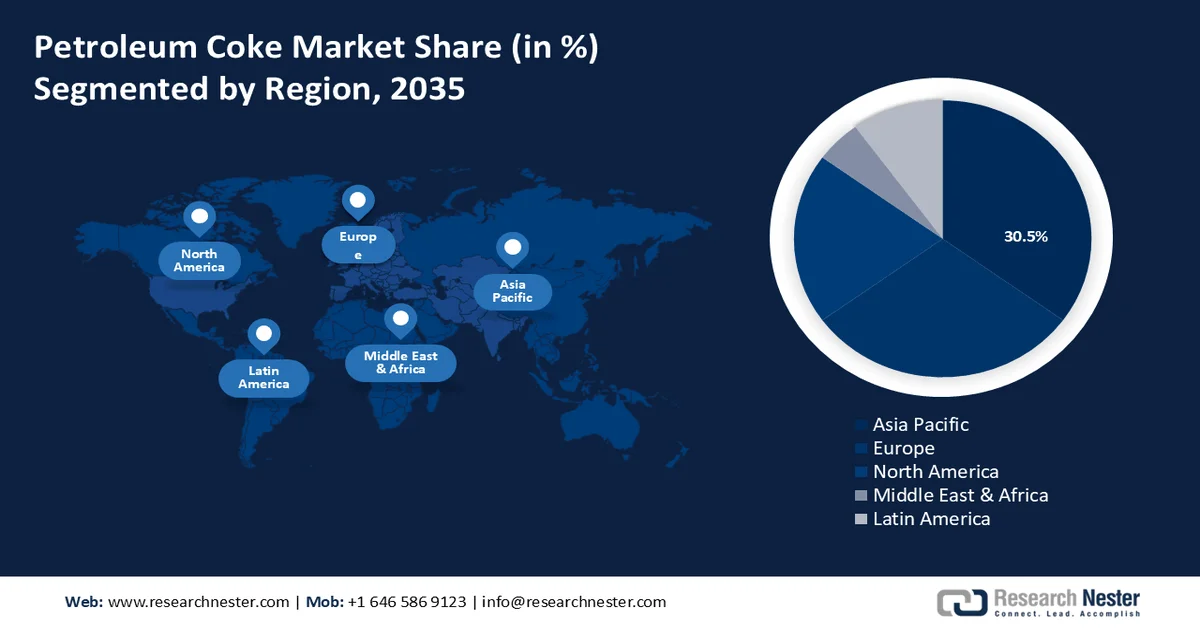
- North America is poised to hold over 30.5% share by 2035 in the petroleum coke market, driven by rising residential demand and cost-optimization strategies.
- Asia Pacific market is expected to expand considerably by 2035, impelled by growing industrialization and rising steel production.
Segment Insights:
- Fuel grade segment is projected to account for more than 63.4% share by 2035 in the petroleum coke market, owing to its superior combustion properties.
- Cement industry segment is anticipated to hold a significant share by 2035, propelled by its high calorific value and low ash content.
Key Growth Trends:
- Robust infrastructure development
- Increasing energy demand
Major Challenges:
- Global trade dynamics
- Rising health risks
Key Players: Polyplastics Co., Ltd., Sumitomo Chemical Co., Ltd., Toray Industries, Inc., Celanese Corporation, Kuraray Co., Ltd., Rogers Corporation, Ensinger GmbH, Panasonic Holdings Corporation, Syensqo, Ueno Fine Chemicals Industry, Ltd. and SEYANG POLYMER CORPORATION.
Global Petroleum Coke Market Forecast and Regional Outlook:
Market Size & Growth Projections:
- 2025 Market Size: USD 29.6 billion
- 2026 Market Size: USD 31.38 billion
- Projected Market Size: USD 56.62 billion by 2035
- Growth Forecasts: 6.7% CAGR (2026-2035)
Key Regional Dynamics:
- Largest Region: North America (30.5% Share by 2035)
- Fastest Growing Region: Asia Pacific
- Dominating Countries: United States, China, India, Saudi Arabia, Russia
- Emerging Countries: China, India, Japan, South Korea, Brazil
Last updated on : 25 February, 2026
Petroleum Coke Market - Growth Drivers and Challenges
Growth Drivers
-
Robust infrastructure development: The most vital growth driver in the petroleum coke market is its expanding infrastructural base, particularly within emerging economies with rapid urbanization and industrialization. Moreover, an investment in global infrastructure is estimated to surge over the coming years and thus will present a big market opportunity for petroleum coke as the industries seek reliable and cost-effective fuel sources. For instance, in March 2023, ExxonMobil announced the startup of its Beaumont refinery expansion project, adding 250,000 barrels per day of capacity at refining and petrochemical complexes along the U.S. Gulf Coast.
- Increasing energy demand: One of the main growth stimulants for the petroleum coke market is rising energy demand from populous nations. Thus, petroleum coke turns out to be an ideal substitute as it possesses a greater calorific when compared to traditional fuels. For instance, in May 2021, a report from the International Energy Agency predicted an increase in worldwide energy consumption of nearly 50% by 2050, and that petroleum coke plays a critical role in the ever-increasing energy needs of various sectors and power plants. In a nutshell, the ever-increasing demands of the growing world for fuel efficiency coupled with cheaper fuels have urged increasing incorporation for power generation using petroleum coke.
Challenges
- Global trade dynamics: This petroleum coke market faces challenges as a result of the volatility in the global trade system. Stringent policies on trade, tariffs, and geopolitical tensions could drastically influence the supply chain and price of petroleum coke. Uncertainty in the availability and cost may affect companies in holding stable operations and price strategy. Perhaps the trade disputes and tariffs disrupt the flow of petroleum coke between major producing and consuming countries, making the market vulnerable to what may prevent growth and profitability.
- Rising health risks: Among the predominant hurdles in the petroleum coke market that confronts, is health risks from combustion as it poses substantial hazards due to the release of pollutants such as sulfur dioxide and particulate matter. Consequently, it deteriorates the air quality and has adverse effects on public health. Regulatory bodies and environmental groups are imposing higher scrutiny that could bring in stricter regulations and a chance of legal liabilities on the part of industries delving into the use of petroleum coke. Thus, communities around industrial facilities are jeopardizing the ecosystem by the continued use of high-emitting fuels in its many applications.
Petroleum Coke Market Size and Forecast:
| Report Attribute | Details |
|---|---|
|
Base Year |
2025 |
|
Forecast Year |
2026-2035 |
|
CAGR |
6.7% |
|
Base Year Market Size (2025) |
USD 29.6 billion |
|
Forecast Year Market Size (2035) |
USD 56.62 billion |
|
Regional Scope |
|
Petroleum Coke Market Segmentation:
Grade (Fuel Grade, Calcine Petroleum coke)
In petroleum coke market, fuel grade segment is projected to hold revenue share of more than 63.4% by 2035. The fuel grade is extensively used in power generation and industrial processes. For instance, in May 2023, Emirates Global Aluminium signed a non-binding agreement with British oil firm BP to study options for reducing the emissions of the company's calcined petroleum coke supply chain. With industries constantly looking for efficient and reliable fuel sources, superior combustion properties of fuel-grade petroleum coke make them preferable. For instance, in November 2024, according to a research nester report, more than 75% of Petroleum coke generated globally is classified as fuel-grade. Thus, the fuel-grade petroleum coke would serve a vital function for the production of energy.
Application (Power Plants, Cement Industry, Steel Industry, Aluminum Industry, Others)
The cement industry would be the largest consumer in the petroleum coke market with a surge throughout 2035. Due to its high calorific value and low ash content, petroleum coke is considered a suitable choice for cement manufacturers looking to optimize energy and reduce the cost of production. For instance, in September 2020, International Cement Review published that, 80% of the fuels used in cement kilns worldwide are conventional, with petcoke making up 40–45% of this total. In addition, enhanced infrastructure development and urbanization strengthen the requirement for petroleum coke as an essential fuel in cement kilns.
Our in-depth analysis of the global petroleum coke market includes the following segments:
|
Grade |
|
|
Application |
|
|
Physical Form |
|

Vishnu Nair
Head - Global Business DevelopmentCustomize this report to your requirements — connect with our consultant for personalized insights and options.
Petroleum Coke Market - Regional Analysis
North America Market Statistics
In petroleum coke market, North America region is poised to hold over 30.5% share by the end of 2035. The uptake of petroleum coke in the region has been accelerated by the growing demand for residential spaces brought on by population growth. Furthermore, the petroleum coke industry needs to offer reasonably priced goods by strategizing to reduce operating expenses. In addition, the increasing advances in technologies research, and development efforts will propel the market.
The state-of-the-art facilities and refining capabilities of the U.S. ensure a steady supply of high-quality petroleum coke from the nation. The manufacturers aptly capitalize on the demand arising from developing economies. For instance, in November 2024, according to the data analyzed and published by the U.S. Census Bureau data, the average annual production of petroleum coke in the country remained unchanged (46 million tons) during 2014–2023. Furthermore, about 41 million tons of petroleum coke were exported from the US in 2023, which was marginally more than the 40 million tons that the country has exported on average over the previous years.
In Canada, the petroleum coke market landscape is influenced greatly due to the support of the local government. For instance, in March 2024, Ontario received USD 16.7 million from the local government to align with the goals of the federal Electricity Predevelopment Program by promoting the use of low-grade petroleum coke as a fuel for power plants. Under the initiative, electricity to up to 4,800,000 homes and businesses in Ontario could be provided. Thus, demand for petroleum coke for power generation may rise as a result of this action, which is a part of a larger initiative to improve energy security and sustainability in the area.
Asia Pacific Market Analysis
The Asia Pacific petroleum coke market is attributed to the growing industrialization, the presence of innumerable crude oil refineries, and steady economic growth are the main factors driving the growth. These factors have led to a high demand for energy and raw materials, including petroleum coke. Further increasing the product's use as a carbon source in the steel-making process is the region's expanding steel production brought on by extensive infrastructure development and construction.
To promote petroleum coke upscaling, the Government of India is expediting the permitting procedure for refineries and petroleum coke facilities. For instance, in September 2024, the government of India announced to give leeway in the import regulations for raw and calcined petroleum coke, increasing the range of permitted incoming shipments. The goal of the government's expanded import restrictions is to meet the growing demand for petroleum coke and guarantee a consistent supply for a range of industrial uses.
China's petroleum coke market is experiencing a significant upsurge owing to the extensive reach of the usage of petroleum coke across various industries. In addition, the import-export activities in the country are fostering market growth. For instance, the Observatory of Economic Complexity report revealed that China exported USD 1.71 billion in petroleum coke, ranking it as the 3rd biggest exporter of petroleum coke in the world making it the 33rd most exported product in China. In 2022, China imported USD 5.34 billion in petroleum coke, ranking it as the 1st biggest importer, making 66th most imported product in China.
Petroleum Coke Market Players:
- Oxbow Corporation
- Company Overview
- Business Strategy
- Key Product Offerings
- Financial Performance
- Key Performance Indicators
- Risk Analysis
- Recent Development
- Regional Presence
- SWOT Analysis
- Aminco Resources
- BP
- Chevron Corporation
- Exxon Mobil
- Husky Energy
- Philips 66 Company
- Reliance Industries
- Shell PLC
- Valero Energy Corp
- Shamokin Carbons
- Marathon Petroleum Corporation
The companies indulged in the petroleum coke market are representing a dynamic transition towards sustainable solutions to match the needs for energy efficiency. In addition, heavy investments are being made to revolutionize the competitive landscape. For instance, in November 2021, Oman, the largest crude exporter outside of Opec, announced that Sanvira Carbon FZC, the country's first petroleum coke calcining (CPC) project, had been completed at the Sohar Freezone. This project gathered an investment of USD 150 million. Thus, the growth trajectory in the petroleum coke market is soaring high, aligning with the changing requirements of the ecosystem.
Here's the list of some key players:
Recent Developments
- In November 2024, Saudi Aramco, SINOPEC, and Fujian Petrochemical Company Limited (FPCL) initiated construction on a new integrated refining and petrochemical complex in China. The facility is equipped with an oil refining unit of 16 million tons per year.
- In October 2023, Venezuela's state oil firm PDVSA reportedly signed two new contracts for the export of up to 1.6 million metric tons of petroleum coke with Latif Petrol, a Turkish company, and Reussi Trading, a St. Vincent and the Grenadines-based firm.
- Report ID: 6093
- Published Date: Feb 25, 2026
- Report Format: PDF, PPT
- Explore a preview of key market trends and insights
- Review sample data tables and segment breakdowns
- Experience the quality of our visual data representations
- Evaluate our report structure and research methodology
- Get a glimpse of competitive landscape analysis
- Understand how regional forecasts are presented
- Assess the depth of company profiling and benchmarking
- Preview how actionable insights can support your strategy
Explore real data and analysis
Frequently Asked Questions (FAQ)
About this Report
Connect with our Expert


Report, 2026-2035



Copyright @ 2026 Research Nester. All Rights Reserved.
