Li-Ion Battery for Grid Market Outlook:
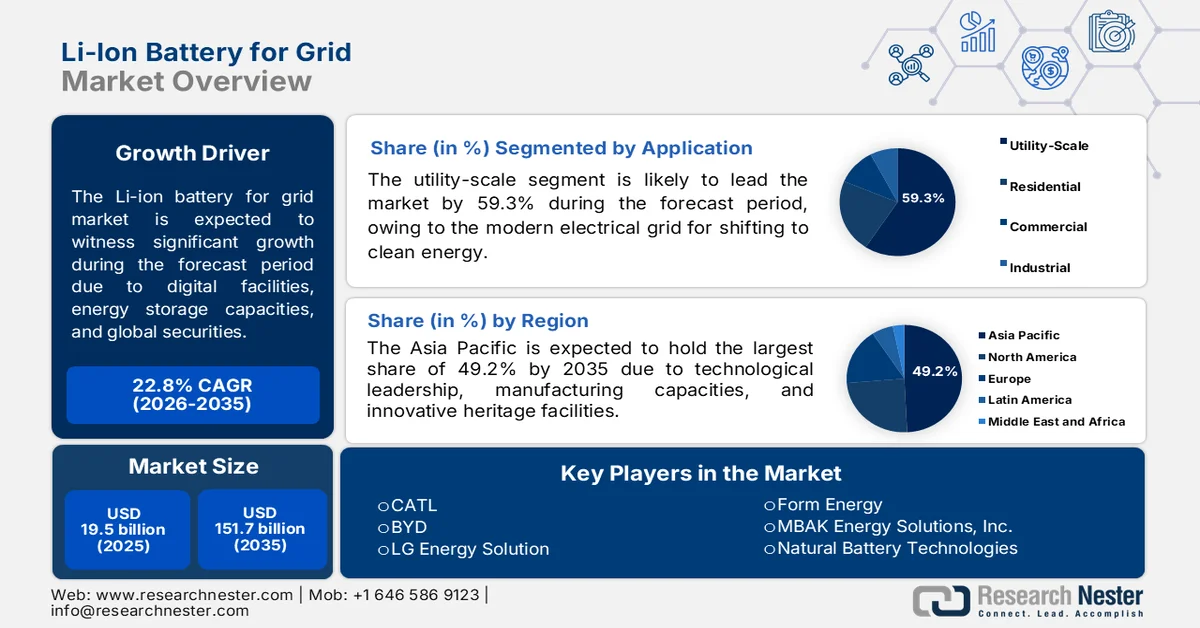
Li-Ion Battery for Grid Market size was over USD 19.5 billion in 2025 and is anticipated to exceed USD 151.7 billion by the end of 2035, growing at over 22.8% CAGR during the forecast period i.e., between 2026-2035. In 2026, the industry size of Li-ion battery for grid is assessed at USD 23.9 billion.
The global Li-ion battery for grid market is currently undergoing a paradigm shift, evolving from an extension of renewable integration to batteries for digital infrastructure, national security, and industrial competitiveness. According to an article published by NLM in November 2023, the worldwide battery electric vehicle fleet is predicted to surge from 1.2 million to 965 million by the end of 2050, thereby bolstering the material needs of battery manufacturing. Besides, the refining and mining of battery assembly, cell manufacturing, and materials altogether account for 10% to 30% of the overall life cycle emissions of such vehicles. Meanwhile, the continuous shipment of primary batteries and cells across different countries is also responsible for driving the market’s growth and exposure.
Global Primary Batteries and Cells Shipment, 2023
|
Countries |
Trade Value (USD 1,000) |
Quantity (Item) |
|
Netherlands |
1,379.4 |
557,978 |
|
China |
1,242.3 |
12,053,400 |
|
U.S. |
455.4 |
28,757 |
|
European Union |
362.8 |
50,929 |
|
UK |
343.7 |
8,525 |
|
Canada |
279.3 |
28,037 |
|
Sweden |
260.7 |
121 |
|
Australia |
157.4 |
24 |
|
South Africa |
154.0 |
12,660 |
|
France |
100.4 |
83,395 |
Source: WITS
Furthermore, the second-life repurposing gaining aspect, along with battery dominance, formal regulatory frameworks, artificial intelligence (AI)-based performance, digitalization, and tactical material security strategies, are a few trends that are responsible for enhancing the market globally. As stated in an article published by the IEA Organization in 2026, electric vehicles remain the ultimate source of worldwide battery deployment, which accounted for over 70% of the overall as of 2025. In addition, electric vehicle battery deployment significantly reached 1.2 TWh, indicating an increase of nearly 30%, in comparison to 2024. Meanwhile, the fastest growth derived from electric trucks, based on which the battery demand has more than doubled, thereby demonstrating an optimistic outlook for the market’s growth and expansion across different economies.
Key Li-Ion Battery for Grid Market Insights Summary:
Regional Highlights:
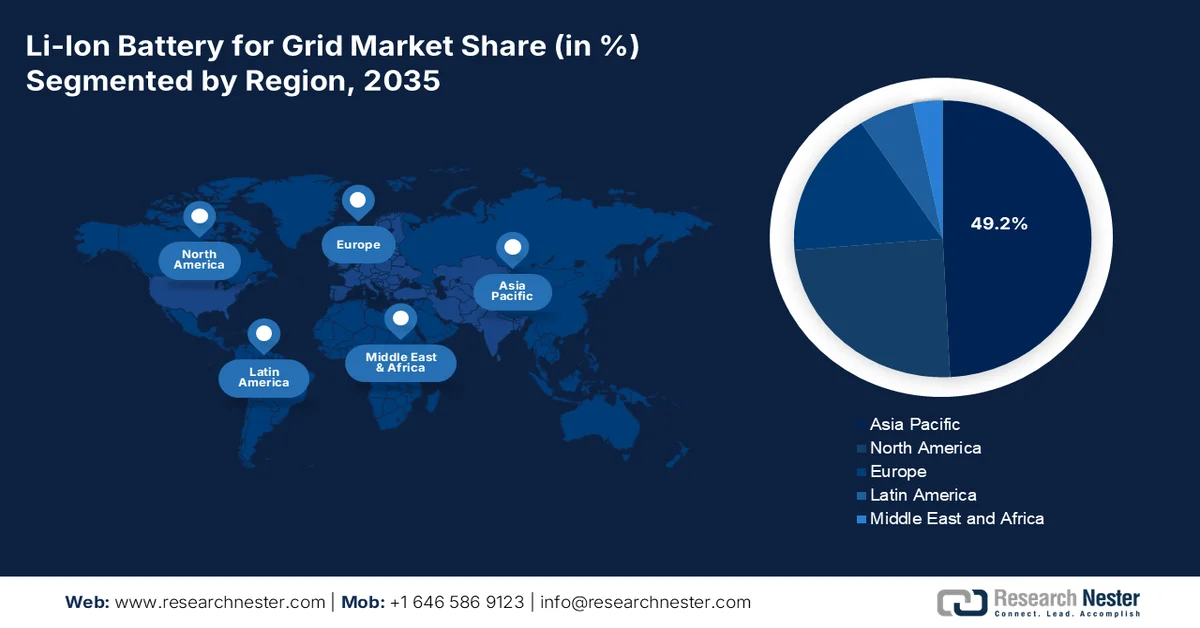
- The asia pacific region is projected to secure 49.2% share by 2035 in the li-ion battery for grid market, stimulated by Japan’s advanced battery heritage, South Korea’s technology leadership, and China’s manufacturing capacity
- Europe is anticipated to account for 17.1% share during the forecast period, strengthened by the rapid expansion of domestic battery manufacturing capacity, grid modernization mandates, and ambitious renewable energy targets
Segment Insights:
- The utility-scale sub-segment of the li-ion battery for grid market is forecast to hold 59.3% share by 2035, attributed to its importance for modernized electrical grids enabling the transition to clean energy
- The LFP battery Type segment is expected to represent 42.9% share during the forecast period, reinforced by its unmatched combination of environmental sustainability, exceptional longevity, and superior safety
Key Growth Trends:
- Increase in energy security
- Boost in mineral supply chain
Major Challenges:
- Raw material supply chain concentration and volatility
- Safety concerns and thermal runaway risks
Key Players: CATL (China),BYD (China),LG Energy Solution (South Korea),Samsung SDI (South Korea),Panasonic Holdings Corporation (Japan),ABB Ltd. (Switzerland),Hitachi Energy Ltd. (Switzerland/Japan),Leclanché SA (Switzerland),Sumitomo Electric Industries, Ltd. (Japan),Form Energy (U.S.),MBAK Energy Solutions, Inc. (U.S.),Natural Battery Technologies (India).
Global Li-Ion Battery for Grid Market Forecast and Regional Outlook:
Market Size & Growth Projections:
- 2025 Market Size: USD 19.5 billion
- 2026 Market Size: USD 23.9 billion
- Projected Market Size: USD 151.7 billion by 2035
- Growth Forecasts: 22.8% CAGR (2026-2035)
Key Regional Dynamics:
- Largest Region: Asia Pacific (49.2% share by 2035)
- Fastest Growing Region: Europe
- Dominating Countries: United States, China, Japan, Germany, South Korea
- Emerging Countries: India, Singapore, Canada, United Kingdom, Australia
Last updated on : 5 August, 2026
Li-Ion Battery for Grid Market - Growth Drivers and Challenges
Growth Drivers
- Increase in energy security: Geographic disruptions have effectively reframed energy storage as a critical security requirement, which is responsible for boosting the market globally. According to an article published by the World Economic Forum in June 2026, sustainability indicators are optimized by 0.6%, while enabling suitable dimensions, particularly for 1.8% for investment, 0.2% for infrastructure expansion, 1.1% for innovation, and 1.2% for regulatory coherence. Besides, this particular divergence has signaled a transition that is not constrained by technological availability, but by the ability of systems for deploying, financing, and integrating solutions at scale, thus proliferating the market exposure.
- Boost in mineral supply chain: The requirement for nickel, cobalt, and lithium accounts for committing the mining capacity, thus enhancing the Li-Ion battery for the grid market globally. As per an article published by CGEP in December 2023, at present the lithium industry is continuously adding the demand uplift of 250,000 to 300,000 tons of lithium carbonate equivalent (tLCE) every year, or almost half of the overall lithium supply of 540,000 (tLCE). Apart from this growth, estimates have been made regarding the supply deficit of the lithium-ion battery supply chain of 300,000 (tLCE) by the end of 2030 in terms of the business-as-usual need scenario. In this regard, Albemarle, the largest lithium producer, predicted a 500,000 (tLCE) deficit, while Deutsche Bank is poised to witness a 768,000 (tLCE) deficit by the end of 2030, thus positively ensuring growth opportunities for the market.
Challenges
- Raw material supply chain concentration and volatility: The lithium-ion battery supply chain remains perilously concentrated in a handful of countries, creating significant vulnerability to geopolitical disruptions, trade restrictions, and price manipulation. Besides, global battery manufacturing is concentrated in China, with similar dominance in midstream components, where China accounts for nearly the majority of cathode and anode active material capacity. This concentration exposes the market to supply shocks, export controls, and sudden price spikes that can undermine project economics and delay deployment timelines. The situation is exacerbated by the time lag between demand growth and new mining capacity, thus negatively impacting the market growth.
- Safety concerns and thermal runaway risks: Despite significant technological advancements, lithium-ion batteries remain susceptible to thermal runaway, indicating a chain reaction of exothermic decomposition that can lead to fires and explosions. Besides, grid-scale installations housing thousands of cells in confined spaces amplify these risks, as demonstrated by numerous high-profile fire incidents at BESS facilities in the U.S., South Korea, and Australia. These safety events have resulted in regulatory scrutiny, permitting delays, increased insurance premiums, and public opposition to new installations. The industry continues to invest in advanced battery management systems, fire suppression technologies, and safer chemistries, thus creating an optimistic outlook for the market.
Li-Ion Battery for Grid Market Size and Forecast:
| Report Attribute | Details |
|---|---|
|
Base Year |
2025 |
|
Forecast Year |
2026-2035 |
|
CAGR |
22.8% |
|
Base Year Market Size (2025) |
USD 19.5 billion |
|
Forecast Year Market Size (2035) |
USD 151.7 billion |
|
Regional Scope |
|
Li-Ion Battery for Grid Market Segmentation:
Application Segment Analysis
Based on the application segment, the utility-scale sub-segment is anticipated to garner the largest share of 59.3% in the Li-ion battery for grid market by the end of 2035. The sub-segment’s upliftment is primarily driven by its importance for modernized electrical grids, which primarily enables the transition to clean energy. As per an article published by the IEA Organization in May 2026, utility-scale battery storage constituted nearly 87 GW of worldwide battery capacity additions as of 2025, which further accounts for nearly 4/5th of the total capacity. Besides, about 24 GW of utility-scale battery storage was co-located with renewables directly. This catered to the share of capacity co-located with renewables falling below 30% since economic reforms, particularly in China, combatted wide-ranging co-location mandates, thus enhancing the sub-segment exposure.
Country-Wise Utility-Scale Installations, 2020-2025
|
Year/Country |
China (GW) |
U.S. (GW) |
Europe (GW) |
Australia (GW) |
Middle East (GW) |
Rest of World (GW) |
|
2020 |
0.9 |
1.1 |
0.6 |
- |
- |
1.5 |
|
2021 |
1.9 |
3.1 |
1.0 |
0.3 |
- |
1.0 |
|
2022 |
5.8 |
4.0 |
1.6 |
- |
- |
1.1 |
|
2023 |
19.4 |
8.0 |
2.4 |
0.8 |
- |
1.1 |
|
2024 |
43.4 |
10.3 |
4.1 |
0.6 |
0.9 |
1.1 |
|
2025 |
55.1 |
16.2 |
5.7 |
4.3 |
2.9 |
2.6 |
Source: IEA Organization
Battery Type Segment Analysis
During the forecast period, the LFP battery type segment is projected to account for the second-largest share of 42.9% in the Li-ion battery for grid market. The segment’s growth is effectively fueled by the provision of an unmatched combination of environmental sustainability, exceptional longevity, and superior safety in comparison to other lithium-ion chemistries. According to an article published by the Royal Society of Chemistry in June 2026, LFP batteries demand small iron volumes in comparison to 0.1% of steel. Besides, profit margins are significantly associated with present low-cost iron ores and high expenses, amounting to an estimated USD 27,000 per ton. This is further associated with low volume of specialized and high-purity iron battery precursors, thus demonstrating an optimistic outlook for the segment’s growth and exposure globally.
Storage Capacity Segment Analysis
The 100-500 MWh sub-segment under the storage capacity segment is expected to grab the third-largest share of 42.6% in the Li-ion battery for grid market by the end of the stipulated timeline. The sub-segment’s development is attributed to the aspect of bridging the gap between smaller distributed systems and massive utility-scale installations. This capacity range is particularly well-suited for regional grid support, load-shifting applications, and renewable integration at the community or municipal level. Besides, projects in this category often serve as backbone storage for mid-sized renewable farms or provide grid stabilization services for sub-regional transmission networks. The flexibility of this capacity band allows developers to balance project economics with operational needs, making it a versatile option for both utility and commercial and industrial applications.
Our in-depth analysis of the Li-ion battery for grid market includes the following segments:
|
Segment |
Subsegments |
|
Application |
|
|
|
|
Storage Capacity |
|
|
End user |
|

Vishnu Nair
Head - Global Business DevelopmentCustomize this report to your requirements — connect with our consultant for personalized insights and options.
Li-Ion Battery for Grid Market - Regional Analysis
APAC Market Insights
The Asia Pacific Li-ion battery for grid market is anticipated to garner the highest share of 49.2% by the end of 2035. The market’s upliftment in the region is primarily driven by Japan’s advanced heritage, South Korea’s technology leadership, and China’s manufacturing capacity. According to an article published by the Institute for Energy Economics and Financial Analysis in May 2026, there was a surge in the innovative chemistry cell battery demand in India from 28 GWh as of 2025, which is further predicted to be 272 GWh by the end of 2030. Based on this, the government unveiled a production-linked incentive (PLI) scheme and targeted 50 GWh of regional cell output as of 2025, of which 1.4 GWh has been successfully commissioned. Besides, there is a continuous supply chain system for importing and exporting lithium-ion batteries, which is also proliferating market exposure.
Lithium-ion Battery Export and Import Analysis in the Asia Pacific, 2024
|
Country |
Export (USD) |
Import (USD) |
|
China |
68.1 billion |
1.8 billion |
|
South Korea |
5.0 billion |
4.7 billion |
|
Japan |
3.6 billion |
2.7 billion |
|
Vietnam |
1.5 billion |
4.4 billion |
|
Malaysia |
1.3 billion |
425 million |
|
India |
119 million |
2.9 billion |
|
Indonesia |
545 million |
433 million |
|
Thailand |
21.6 million |
696 million |
Source: OEC
The China market is growing significantly, owing to cell manufacturing capacity, strong national storage targets, compulsory storage allocation policies, the presence of wide-ranging policy support, and the existence of the latest renewable projects. As stated in an article published by Energy Reports in June 2025, the overall installed capacity of pumped storage power stations in the country is predicted to reach 120 GW, indicating a 3.7-fold upsurge from the present level by the end of 2030. Besides, as per the National Energy Administration, the domestic installed capacity of renewable energy power generation surpassed 1.4 billion kilowatts. This eventually reached a year-on-year (YoY) increase of 20.8%, which further contributed to an estimated 49.9% of the overall installed capacity of power generation throughout the country, thus positively enhancing the market upliftment.
The aspects of expansions in distributed energy, renewable energy adoption, the demand for data centers and AI, tactical industry support, government policies, and opportunities for supply chain diversification are certain factors that are bolstering the market in South Korea. As per an article published by the Renewable Energy Institute Organization in 2026, the nation presently has a renewable energy capacity of 37 GW, and under the latest pledges, the capacity is predicted to increase to 100 GW in the coming 4 years. Besides, coal and gas readily accounted for 55% of the energy mix, along with an expectation of tripling renewable energy capacity by the end of 2030. Moreover, the government shut down 60 coal facilities, with the intention of ensuring energy shift, thus positively fueling the market growth.
Europe Market Insights
Europe Li-ion battery for grid market is expected to emerge as the fastest-growing region with a 17.1% share during the forecast period. The market’s development is highly propelled by the rapid development of domestic battery manufacturing capacity, grid modernization mandates, and ambitious renewable energy targets. According to official statistics published by the European Commission in June 2026, the establishment of the newest battery booster plant mobilized almost USD 1.7 billion (€1.5 billion) from regional emissions trading system revenues under the innovation fund. In addition, this booster facility assisted battery cell manufacturers in boosting production in the overall region. Besides, the facility also focuses on the production location within the European Economic Area (EEA) with a 10 GWh production capacity, thus bolstering the market’s development.
The Germany market is gaining increased traction, owing to the massive renewable fleet, ambitious storage capacities, robust industrial base, a surge in electricity cost, and suitable policy support. As stated in an article published by Clean Energy Wire Organization in January 2026, the capacity of renewable electricity generation installations in the country grew by 11% or almost 21 GW as of 2025. In this regard, solar capacity effectively stood at 117 GW within the same year, compared to 68.1 GW for onshore-based wind energy. Additionally, solar additions account for 16.4 GW, which is roughly split between systems installed on ground-based installations and buildings. Moreover, a yearly average of 19.6 GW of solar capacity is poised to be added in the upcoming years to achieve the expanded solar power target of 215 GW by the end of 2030, thus positively enhancing the market exposure.
The low base effect, grid modernization, renewable integration, and suitable government support are certain trends that are responsible for boosting the market in Russia. As per a data report published by Centrum Balticum in 2022, the government has aimed to increase the share of renewable energy sources 10 times in the upcoming 20 years by increasing the share in the overall installed capacity to 10% by the end of 2040. In addition, investment for renewables is predicted to amount to USD 12.7 billion (1 trillion Russian Rubles) by the end of 2035. Besides, the target share of renewable energy in the nation’s electricity generation accounted for 4.5% as of 2024. Moreover, wind and solar prices, along with power purchase agreement competition, readily contribute to grid parity, which is to be achieved in the coming 5 to 7 years, thus proliferating the market’s growth.
North America Market Insights
North America Li-ion battery for grid market is projected to witness a considerable share of 24.5% by the end of the stipulated timeline. The market’s growth in the region is effectively fueled by the presence of strong state-level and federal clean energy targets, the adoption of intermittent renewable sources, and grid modernization strategies. According to official statistics published by the EFI Organization in May 2024, the interconnection queue, in terms of new generators, accounted for over 2,600 GW of potential capacity. This significantly exceeds double the installed capacity of the overall present U.S.-based bulk power system. Besides, transmission-specific investment tax credits usually reduce expenses by 30%, which deliberately applies to high-voltage regional lines that are included in domestic plans, thus positively impacting the market’s expansion in the overall region.
The U.S. Li-ion battery for grid market is gaining increased exposure, owing to a surge in electricity demand from data centers and AI, along with enhanced and preserved tax incentives, technological maturation, rapid cost reduction, resilience benefits, and proven grid reliability. As stated in a data report published by the U.S. Energy Information Administration in March 2026, the country generated 4.4 thousand TWh of electricity as of 2025, indicating an increase of 2.8% from 2024. Besides, the net generation is closely related to the electricity demand, and the majority of growth in electricity derives from the commercial industry. Moreover, retail sales of electricity to consumers are the ultimate indicator of demand, which increased by 2.2% in residential, 2.9% in commercial, and 0.7% in industrial, thus boosting the market exposure in the country.
The federal clean electricity mandate, a rise in coal phaseout and electricity demand, energy arbitrage, resilience demands, grid modernization, and provincial procurement targets are a few trends that are responsible for driving the Li-ion battery for grid market in Canada. As per an article published by the Government of Canada in June 2026, the British Columbia-Yukon grid connection is an estimated 800 km, 200 kV, direct and high-voltage transmission line that connects Yukon’s grid to British Columbia. This particular project tends to support economic and industrial development, including the critical minerals industry, which is further supported by a USD 40 million investment from Natural Resources Canada. Meanwhile, the Alberta-Saskatchewan intertie constitutes enhancing and replacing the McNeill converter station with advanced technology for increasing the capacity by roughly 250 MW, thus enhancing the market exposure.
Key Li-Ion Battery for Grid Market Players:
- CATL (China)
- BYD (China)
- LG Energy Solution (South Korea)
- Samsung SDI (South Korea)
- Panasonic Holdings Corporation (Japan)
- ABB Ltd. (Switzerland)
- Hitachi Energy Ltd. (Switzerland/Japan)
- Leclanché SA (Switzerland)
- Sumitomo Electric Industries, Ltd. (Japan)
- Form Energy (U.S.)
- MBAK Energy Solutions, Inc. (U.S.)
- Natural Battery Technologies (India)
- Company Overview
- Business Strategy
- Key Product Offerings
- Financial Performance
- Key Performance Indicators
- Risk Analysis
- Recent Development
- Regional Presence
- SWOT Analysis
- CATL is the world's dominant manufacturer of grid-scale lithium-ion battery energy storage systems, offering comprehensive solutions for utility and commercial applications. The company's vertically integrated model and massive scale give it a high cost and supply chain advantage in the stationary storage sector.
- BYD is a major China-based manufacturer of lithium-ion battery energy storage systems for grid-scale, utility, and commercial applications. The company leverages its expertise in electric vehicle battery technology to deliver complete energy storage solutions for the grid market.
- LG Energy Solution is a leading South Korea-specific manufacturer of lithium-ion battery energy storage systems for grid and utility-scale applications. The company focuses on delivering high-performance, reliable storage solutions for renewable integration and grid stabilization.
- Samsung SDI is a key South Korea-based manufacturer of lithium-ion battery energy storage systems designed for utility-scale and commercial grid applications. The company emphasizes advanced cell technology and system reliability in its energy storage product portfolio.
- Panasonic Holdings Corporation is a prominent Japanese manufacturer of lithium-ion battery energy storage solutions for grid integration and industrial applications. The company combines its advanced cell technology with comprehensive system offerings for utility and commercial storage projects.
Here is a list of key players operating in the global market:
The Li-ion battery for grid market exhibits a consolidated yet evolving competitive landscape, with leading players leveraging technological innovation and manufacturing scale. Dominated by vertically integrated Asia-based manufacturers, particularly China's CATL and BYD, the market also features strong participation from established energy conglomerates, such as ABB and Hitachi. Moreover, key differentiators among manufacturers include chemistry specialization, system integration capabilities, and the capacity to secure large-scale, multi-gigawatt contracts. Besides, in September 2024, Panasonic Energy Co., Ltd. issued Panasonic Energy Ready, which readily commenced the mass production of 4680 automotive lithium-ion batteries, thereby making it suitable for fueling the Li-ion battery for grid industry.
Corporate Landscape of the Market:
Recent Developments
- In March 2026, Form Energy and Crusoe proclaimed a strategic capacity deal for delivering 12 GWh of multi-day energy storage systems for supporting the rapidly growing power demands for AI data centers.
- In October 2025, MBAK Energy Solutions, Inc. manufactured battery cells under the battery energy storage system contract fulfillment to an India-based power grid, which effectively delivered 20 units, along with a storage capacity of 100 Mwh.
- In June 2022, Natural Battery Technologies unveiled lithium-ion-specific inverter batteries for commercial and home utilization that doubled up as a standard solar energy storage system.
- Report ID: 8719
- Published Date: Aug 05, 2026
- Report Format: PDF, PPT
- Explore a preview of key market trends and insights
- Review sample data tables and segment breakdowns
- Experience the quality of our visual data representations
- Evaluate our report structure and research methodology
- Get a glimpse of competitive landscape analysis
- Understand how regional forecasts are presented
- Assess the depth of company profiling and benchmarking
- Preview how actionable insights can support your strategy
Explore real data and analysis
Frequently Asked Questions (FAQ)
About this Report
Connect with our Expert


Report, 2026-2035



Copyright @ 2026 Research Nester. All Rights Reserved.
