Ancillary Services for Battery Energy Storage Systems Market Outlook:
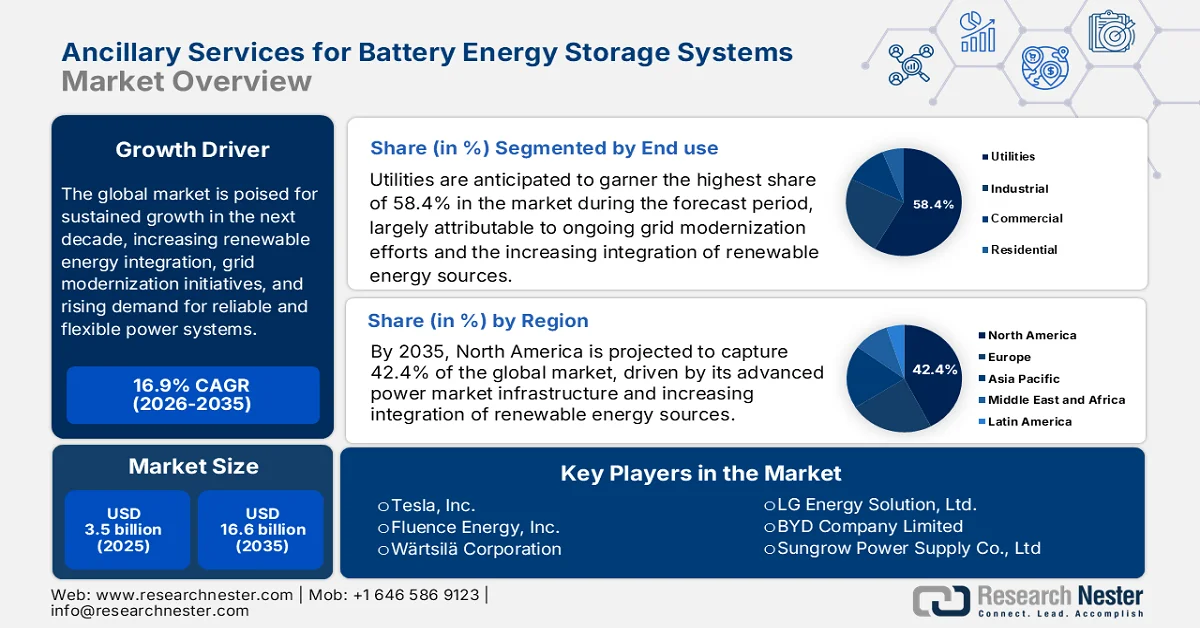
Ancillary Services for Battery Energy Storage Systems Market size was over USD 3.5 billion in 2025 and is expected to reach USD 16.6 billion by the end of 2035, growing at around 16.9% CAGR during the forecast period, i.e., 2026-2035. In 2026, the industry size of ancillary services for battery energy storage systems is evaluated USD 4 billion.
The primary growth catalyzing factor for the ancillary services for battery energy storage systems market is the increasing penetration of variable renewable energy into bulk power systems, which is directly elevating the need for fast frequency response, operating reserves, and grid stabilization services. For instance, in January 2025, the International Energy Agency (IEA) reported that global renewable electricity capacity is projected to more than double by 2030 by adding 4,600 GW, which is equivalent to the combined generation capacity of China, Europe, and Japan. It also mentioned that solar PV will drive nearly 80% of this growth, wherein wind, hydropower, bioenergy, and geothermal contribute the rest. In over 80% of countries, renewables will expand faster between 2025 and 2030 than in the previous five years, thus elevating the growth potential of the market.
Furthermore, both of the utilities and system operators are progressively integrating storage into market mechanisms, which were previously dominated by thermal power plants, improving dispatch efficiency and reducing reliance on conventional peaking assets. Advances in battery performance, digital control systems, and energy management platforms are also enhancing the ability of storage assets to provide multiple stacked services simultaneously. In 2026, IEA reported that battery storage is the fastest‑growing power technology, wherein 108 GW of new capacity was added in 2025, which is a 40% jump from 2024, making installed capacity 11 times higher when compared to 2021. Around 90% of deployments use LFP batteries, which, though less energy‑dense than EV chemistries, are cheaper and better suited for frequent cycling. In addition, about 80% of new capacity was utility‑scale, wherein China was leading at 60% of global additions, followed by the U.S. and Europe, while durations are lengthening to four hours or more to enhance grid flexibility, thus benefiting the overall ancillary services for battery energy storage systems market.
Key Ancillary Services for Battery Energy Storage Systems Market Insights Summary:
Regional Highlights:
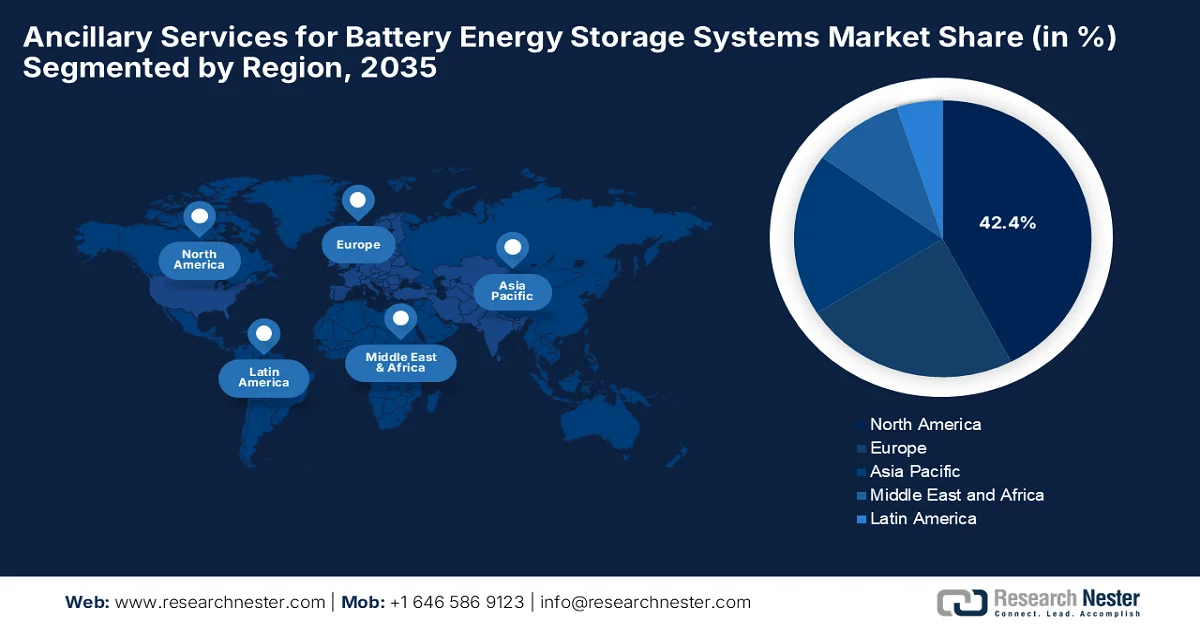
- North America ancillary services for battery energy storage systems market is projected to capture 42.4% of the market share by 2035, reinforced by advanced regulatory frameworks, well-developed electricity markets, and rising renewable energy adoption
- Asia Pacific is poised to witness the fastest growth in the market throughout 2026-2035, stimulated by rapid industrialization, strengthening energy security initiatives, and ambitious decarbonization targets
Segment Insights:
- The utilities segment is anticipated to command 58.4% of the ancillary services for battery energy storage systems market by 2035, underpinned by ongoing grid modernization efforts, increasing renewable energy integration, and the growing need for grid reliability amid rising system complexity
- By 2035, the frequency regulation segment is expected to secure a considerable share of the market, catalyzed by the increasing need to maintain grid frequency stability as renewable energy penetration continues to rise
Key Growth Trends:
- Grid stability requirements
- Electricity market liberalization and EV growth
Major Challenges:
- High capital and financing costs
- Battery degradation and lifecycle limitations
Key Players: Tesla, Inc. (U.S.), Fluence Energy, Inc. (U.S.), Siemens Energy (Germany), Wärtsilä Corporation (Finland), LG Energy Solution, Ltd. (South Korea), BYD Company Limited (China), Sungrow Power Supply Co., Ltd. (China), Hitachi Energy Ltd. (Switzerland), Saft Groupe S.A. (France), ABB Ltd. (Switzerland), Schneider Electric (France).
Global Ancillary Services for Battery Energy Storage Systems Market Forecast and Regional Outlook:
Market Size & Growth Projections:
- 2025 Market Size: USD 3.5 billion
- 2026 Market Size: USD 4 billion
- Projected Market Size: USD 16.6 billion by 2035
- Growth Forecasts: 16.9% CAGR (2026-2035)
Key Regional Dynamics:
- Largest Region: North America (42.4% Share by 2035)
- Fastest Growing Region: Asia Pacific
- Dominating Countries: United States, China, Japan, Germany, United Kingdom
- Emerging Countries: India, Australia, South Korea, Saudi Arabia, Singapore
Last updated on : 27 July, 2026
Ancillary Services for Battery Energy Storage Systems Market - Growth Drivers and Challenges
Growth Drivers
- Grid stability requirements: The rising need for grid stability services such as frequency regulation and voltage support is a major factor catalyzing the growth of the ancillary services for battery energy storage systems market. Battery energy storage systems offer millisecond-level response times, outperforming conventional generators, thereby making them highly suitable for ancillary markets. In June 2024, the U.S. Energy Information Administration stated that by the end of 2023, U.S. utilities operated 575 batteries totaling 15,814 MW, with plans to add another 35,953 MW by 2028, tripling capacity. In addition, the primary use case reported was arbitrage, and it covers 10,487 MW, where batteries shift electricity from low‑price to high‑price periods. The article also mentions that batteries support ancillary services such as frequency regulation, though most are used in multiple ways, reflecting their growing role in grid reliability and market optimization.
- Electricity market liberalization and EV growth: Electricity market liberalization and the creation of ancillary service industries readily enable battery storage operators to generate multiple sorts of revenue streams. Participation in fast frequency response, demand response, and capacity markets improves project economics, whereas the growing EV charging infrastructure increases load variability, thereby boosting demand for flexible storage-based grid support services globally. In February 2023, SolarEdge announced the launch of its first battery virtual power plant in Great Britain, which allows SolarEdge home battery owners to participate in the national grid ESO demand flexibility service. Through this program, households can earn financial incentives by using stored energy during peak demand events or exporting excess power back to the grid, thus denoting a positive outlook for ancillary services for battery energy storage systems market.
Global BESS Market Developments and Ancillary Services Opportunities: Key Industry Initiatives 2025-2026
|
Company |
Year |
Key Development |
Market Opportunity |
|
DHL Group |
2026 |
Expansion into New Energy logistics covering battery storage |
Supports scaling of the BESS deployment ecosystem and lifecycle service demand |
|
FlexGen |
2026 |
Acquisition of CES to expand BESS services and operations |
Enhances operational reliability, commissioning, and grid service availability |
|
Adani Group |
2025 |
Large-scale BESS project at Khavda integrated with RE plant |
Supports grid balancing, peak management, and renewable integration services |
Source: Company Official Press Releases
Challenges
- High capital and financing costs: The ancillary services for battery energy storage systems market is facing severe challenges in the form of huge capital investments. The utility-scale BESS projects need high expenditures on battery cells, inverters, power conversion systems, and grid interconnection infrastructure. The battery prices have been reducing, but still, the total project prices are very high due to the balance of system components and installation expenses. Therefore, financing such projects can also be difficult in the case of emerging markets in which ancillary services are still evolving. Apart from this, investors sometimes perceive uncertainty in long-term returns, especially in markets where frequency regulation or reserve service prices are volatile, ultimately slowing down large-scale deployment.
- Battery degradation and lifecycle limitations: This is another major burden for the ancillary services for battery energy storage systems market, which is affecting profitability. Frequent cycling, which is required for services such as frequency regulation and fast frequency response, accelerates battery wear and hence reduces overall lifespan. Therefore, this in turn leads to higher replacement and maintenance costs, which can impact project economics over time. Operators need to carefully balance revenue generation with battery health optimization, sometimes using advanced energy management systems. In competitive markets in which batteries are heavily dispatched, lifecycle limitations can reduce the overall profitability and increase uncertainty for investors.
Ancillary Services for Battery Energy Storage Systems Market Size and Forecast:
| Report Attribute | Details |
|---|---|
|
Base Year |
2025 |
|
Forecast Year |
2026-2035 |
|
CAGR |
16.9% |
|
Base Year Market Size (2025) |
USD 3.5 billion |
|
Forecast Year Market Size (2035) |
USD 16.6 billion |
|
Regional Scope |
|
Ancillary Services for Battery Energy Storage Systems Market Segmentation:
End use Segment Analysis
Under the end use segment, utilities are anticipated to garner the highest share of 58.4% in the ancillary services for battery energy storage systems market during the forecast period. The segment’s dominance is largely attributable to ongoing grid modernization efforts, the increasing integration of renewable energy sources, and the need to ensure system reliability amid rising grid complexity. In addition, utility-scale battery energy storage systems offer the most cost-efficient solution for delivering ancillary services on a large scale, thereby supporting the segment’s expansion. In December 2024, Ormat Technologies commenced commercial operations at its 20 MW/20 MWh Montague battery energy storage system in New Jersey. This facility was developed to provide ancillary services to the PJM market to help enhance grid reliability and support the integration of cleaner energy resources, thus supporting the segment’s dominance.
Service Type Segment Analysis
By the conclusion of 2035, frequency regulation is expected to attain a considerable share in the ancillary services for battery energy storage systems market. The segment’s growth is majorly propelled by the increasing need to maintain grid frequency stability as power systems integrate higher levels of renewable energy generation. Apart from this, battery energy storage systems are well-suited for frequency regulation due to their rapid response capabilities and high operational accuracy. In this context, Tata Power in April 2025 secured a contract to deploy a 100 MW battery energy storage system in order to support India's energy transition and grid modernization goals. This project is part of the company's broader multi-state energy storage strategy, and it is aimed at addressing renewable energy intermittency, reducing curtailment, and enhancing grid stability, thus making it suitable for the segment’s expansion.
Application Segment Analysis
The renewable integration, which is a part of the application, is predicted to grow with a considerable revenue share in the ancillary services for battery energy storage systems market during the discussed timeframe. The segment's upliftment is primarily driven by the accelerating deployment of renewable energy sources such as solar and wind power, which require flexible grid resources to manage their intermittent generation patterns. For instance, in May 2024, the Victory Pass Solar and Storage Project in Riverside County began delivering power with 200MW of solar generation and 200MWh of battery storage. It was also mentioned that under 15-year agreements, Central Coast Community Energy and Silicon Valley Clean Energy each receive half the output, serving nearly 165,000 homes combined. Furthermore, it represents a total of USD 434 million investment, and the project strengthens California’s clean energy future, thereby enhancing grid reliability.
Our in-depth analysis of the ancillary services for battery energy storage systems market includes the following segments:
|
Segment |
Subsegments |
|
End use |
|
|
Application |
|
|
Service Type |
|

Vishnu Nair
Head - Global Business DevelopmentCustomize this report to your requirements — connect with our consultant for personalized insights and options.
Ancillary Services for Battery Energy Storage Systems Market - Regional Analysis
North America Market Insights
North America ancillary services for battery energy storage systems market is predicted to account for the largest share of 42.4% during the discussed timeframe. The region’s leadership is mainly attributable to advanced regulatory frameworks, well-developed electricity markets, and the adoption of renewable energy sources. Established independent system operators and wholesale power markets have created transparent pathways for battery energy storage systems to participate in ancillary service markets. In this context, the U.S. Department of Defense, in September 2023, launched a USD 30 million Energy Storage Systems Campus, which was led by the University of Texas at Dallas with a consortium of universities, businesses, and national labs. It also mentions that this campus is a part of the SCALE initiative, and it aims to optimize lithium-ion batteries, accelerate next-gen battery development, and secure raw material supply, and thus is suitable for bolstering the market’s growth.
The favorable federal and state-level policies that encourage energy storage deployment and grid modernization initiatives are the visible trends reshaping the growth dynamics of the U.S. ancillary services for battery energy storage systems market. In the country, battery developers are capitalizing on diverse revenue-stacking opportunities, positioning energy storage as a gold standard of decentralized grid stability and decarbonization efforts. In May 2026, Nextpower announced the acquisition of Prevalon Energy for a total of USD 365 million, which marks its entry into the battery energy storage and AI data center industries. In addition, Prevalon brings over 6 GWh of deployed BESS systems and 1.3 GW of firm supply contracts, thereby strengthening Nextpower’s platform with advanced hardware, software, and grid stabilization solutions, hence making it suitable for standard market growth.
In Canada, the ancillary services for battery energy storage systems market has gained huge exposure as the country accelerates its grid modernization and net-zero emissions initiatives. Provinces in the country are turning to battery storage to enhance grid resilience, manage peak demand, and smoothly integrate growing capacities of variable renewable energy such as wind and solar. In May 2026, the government of Ontario announced the completion and commercial operation of the 250 MW Napanee BESS, which is one of the largest battery storage projects in Canada. It was developed under the independent electricity system operator’s competitive procurement process, and the facility can supply electricity to up to 250,000 homes during peak demand periods, strengthening grid reliability, thus denoting a huge opportunity for the ancillary services for battery energy storage systems market to grow.
APAC Market Insights
The Asia Pacific ancillary services for battery energy storage systems market is projected to grow at the fastest rate from 2026 to 2035. The region’s upliftment in this field is largely driven by a massive push for rapid industrialization, energy security, and aggressive decarbonization targets. Market momentum is also being supported by power market unbundling and national clean energy mandates, encouraging more players to establish their footprint in the region’s market. In March 2026, the article published by the Institute for Energy Economics & Financial Analysis stated that Japan’s grid-scale BESS pipeline surged from 70GW in mid-2024 to 170.8GW by the end of 2025, wherein 28.7GW were awarded grid contracts but only 0.62GW were physically connected. Government subsidies have supported 27 projects with a total of USD226 million in FY2024 and budgeted USD262 million for FY2025, hence indicating a positive market outlook.
Japan Grid-Scale BESS Industry Growth Trend: Installed and Under-Contract Capacity Expansion 2023-2025
|
Period |
Grid Connected BESS Capacity (GW) |
Total / Under Contract Capacity (GW) |
|
December 2023 |
0.01 |
2.89 |
|
March 2024 |
0.08 |
3.22 |
|
June 2024 |
0.08 |
4.42 |
|
September 2024 |
0.10 |
6.10 |
|
December 2024 |
0.17 |
7.83 |
|
March 2025 |
0.23 |
11.87 |
|
June 2025 |
0.25 |
17.55 |
|
September 2025 |
0.50 |
23.80 |
|
December 2025 |
0.62 |
28.08 |
Source: IEEFA
The nation's ambitious dual-carbon targets and the exponential build of ultra-large-scale solar and wind bases are the main factors responsibly boosting the ancillary services for battery energy storage systems market in China. The country’s market is highly structured through mandatory storage pairing policies for new renewable projects, provincial subsidy schemes, and the transition toward formalized spot electricity markets. Based on the government data published in September 2025, China introduced a three-year action plan 2025-2027 with a prime goal to accelerate new-type energy storage, targeting over 180 million kilowatts of installed capacity by 2027. In addition, this particular initiative is expected to drive a substantial USD 35.2 billion in direct investment, building on the 73.76 million kilowatts already installed by the end of 2024 and hence boosting innovation as well as standardization.
In India, the ancillary services for battery energy storage systems market gained enhanced traction as the country scales up its renewable energy capacity to meet ambitious national clean energy targets. The ancillary services for battery energy storage systems market is also propelled by forward-looking federal policy frameworks, standardized secondary and tertiary ancillary service regulations, and national mega-procurement tenders, which are aimed at building robust energy storage reserves. In March 2026, as stated by Press Information Bureau (PIB), the country’s government reaffirmed its focus on BESS as a critical enabler for achieving 500 GW of non-fossil fuel capacity by 2030 and supporting large-scale renewable energy integration. It also mentions that approximately 208 GWh of BESS will be required to ensure grid stability, reliable power supply, and efficient management of variable renewable generation. Furthermore, BESS will also play a key role in providing ancillary services such as frequency regulation, voltage control, and black start capability to maintain real-time grid balance.
Europe Market Insights
Europe ancillary services for battery energy storage systems market is one of the largest and most influential, which is driven by unbundled electricity directives, harmonized cross-border balancing platforms, and the structural phase-out of traditional coal and gas plants. This regulatory environment allows developers to implement advanced revenue-stacking strategies across multiple frequency and capacity markets. In June 2026, the European Commission established the battery booster facility by allocating a total of USD 1.62 billion from EU Emissions Trading System revenues through the innovation fund to support large-scale battery cell manufacturing in Europe. The initiative provides direct financial support, including interest-free loans of up to USD 540 million per project, to accelerate industrial deployment and strengthen Europe’s clean technology value chain, thus elevating the growth potential of the ancillary services for battery energy storage systems market.
The expansion of wind and solar generation is uplifting the ancillary services for battery energy storage systems market in Germany. In this context, battery energy storage is being increasingly integrated, whereas active participation of grid operators and the growing commercialization of storage assets are collectively shaping the country as a predominant hub for advanced ancillary service applications. In January 2023, Germany’s four transmission system operators, i.e., 50Hertz, Amprion, TenneT, and TransnetBW, launched a voluntary mechanism for large industrial consumers to contribute to grid stability. Industries can report load reduction potential, and it can help prevent or minimize controlled load shedding during critical electricity shortages. Hence, such instances denote the country’s shift toward a flexible, system-responsive grid where ancillary services are supported through coordinated use of storage and demand-side participation.
The UK ancillary services for battery energy storage systems market is projected to witness sustained growth as the power system adapts to increasing shares of wind and solar generation. The country operates a highly centralized and competitive flexibility market structure that proactively clears fast frequency products, thereby enabling battery storage to replace conventional thermal assets in system balancing roles. For instance, the UK energy regulator in February 2023 approved the consolidation of the Electricity System Operator’s dynamic containment, dynamic moderation, and dynamic regulation services into a unified set of balancing service terms and conditions. Besides, this decision streamlined the procurement framework under which these fast frequency response services are contracted, thereby enabling more efficient participation of flexible resources, including battery energy storage systems.
Key Ancillary Services for Battery Energy Storage Systems Market Players:
- Tesla, Inc. (U.S.)
- Fluence Energy, Inc. (U.S.)
- Siemens Energy (Germany)
- Wärtsilä Corporation (Finland)
- LG Energy Solution, Ltd. (South Korea)
- BYD Company Limited (China)
- Sungrow Power Supply Co., Ltd. (China)
- Hitachi Energy Ltd. (Switzerland)
- Saft Groupe S.A. (France)
- ABB Ltd. (Switzerland)
- Schneider Electric (France)
- Company Overview
- Business Strategy
- Key Product Offerings
- Financial Performance
- Key Performance Indicators
- Risk Analysis
- Recent Development
- Regional Presence
- SWOT Analysis
- Tesla, Inc. is one of the most influential players in the ancillary services for battery energy storage systems market, which benefits from its Megapack utility-scale storage systems. The company is highly focused on fast deployment of large-scale battery projects that support frequency regulation, peak shaving, and grid balancing.
- Fluence Energy, Inc. is yet another prominent player that is operating as a leading global energy storage integrator, jointly backed by Siemens and AES. Besides, the firm provides advanced software-driven storage platforms that enable participation in multiple ancillary services such as frequency response and spinning reserve.
- Wärtsilä Corporation plays a significant role in integrating battery storage with hybrid power systems and grid-balancing applications. Also, the company’s GEMS energy management platform is extensively used for optimizing ancillary service participation, which includes frequency regulation and reserve markets.
- BYD Company Limited is a major vertically integrated manufacturer which is offering batteries, energy storage systems, and electric mobility solutions. The firm supplies large-scale BESS projects which are used for grid stability, peak load management, and frequency control, particularly in China and especially in international markets.
- Sungrow Power Supply Co., Ltd. has registered itself as a predominant leader in inverter technology and energy storage system integration. The company provides turnkey BESS solutions that are especially designed for ancillary services such as frequency regulation, voltage support, and grid balancing.
Here is a list of key players operating in the global ancillary services for battery energy storage systems market:
The ancillary services for battery energy storage systems market consists of global battery manufacturers, energy storage integrators, and grid technology providers. Leading companies in this field are highly focused on expanding utility-scale storage deployments, enhancing battery management software, and developing advanced energy management platforms with a main goal of optimizing participation in frequency regulation and voltage support markets. Some of the growth strategies adopted by the leading pioneers include long-term partnerships with utilities and grid operators, investments in battery technologies, expansion of manufacturing capacity, and acquisitions that strengthen system integration capabilities. In June 2026, LIXTE Biotechnology announced the acquisition of NOMAD transportable power systems, which is the pioneer of mobile, utility‑grade 1 MW battery energy storage systems, and will rebrand as NOMAD Power Solutions.
Corporate Landscape of the Ancillary Services for Battery Energy Storage Systems Market:
Recent Developments
- In February 2026, Wärtsilä started building a 50 MW / 100 MWh energy storage system in Belgium by partnering with Gramme Storage 1 to strengthen grid stability and support the country’s renewable energy transition. This project is called Gramme 1, and is the first to participate in Belgium’s capacity remuneration mechanism, ensuring a reliable electricity supply through frequency and voltage support.
- In May 2026, Schneider Electric announced the launch of a battery energy storage system, which is designed to deliver scalable, resilient, and revenue‑generating energy storage from day one. The cell‑to‑grid‑to‑cell platform integrates utility‑grade infrastructure with advanced digital intelligence such as EMS, DERMS, PPC, and microgrid control.
- Report ID: 8699
- Published Date: Jul 27, 2026
- Report Format: PDF, PPT
- Explore a preview of key market trends and insights
- Review sample data tables and segment breakdowns
- Experience the quality of our visual data representations
- Evaluate our report structure and research methodology
- Get a glimpse of competitive landscape analysis
- Understand how regional forecasts are presented
- Assess the depth of company profiling and benchmarking
- Preview how actionable insights can support your strategy
Explore real data and analysis
Frequently Asked Questions (FAQ)
About this Report
Connect with our Expert


Report, 2026-2035



Copyright @ 2026 Research Nester. All Rights Reserved.
