Next-Generation Energy Storage Systems Market Outlook:
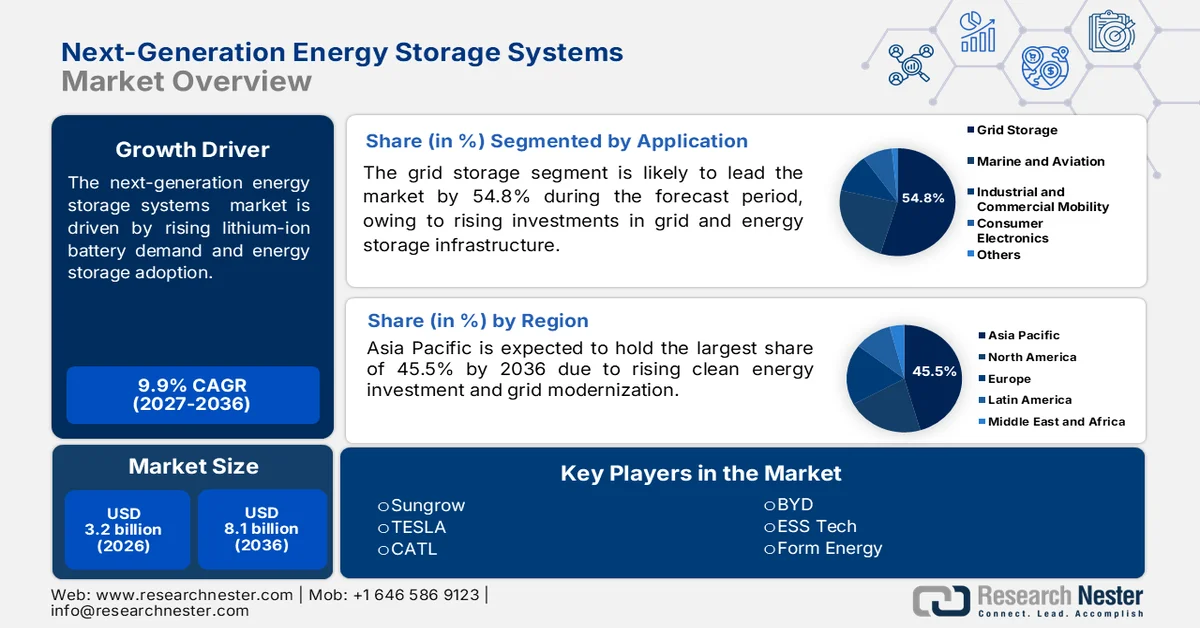
Next-Generation Energy Storage Systems Market size was valued at USD 3.2 billion in 2026 and is projected to cross USD 8.1 billion by the end of 2036, registering more than 9.9% CAGR during the forecast period, i.e., between 2027-2036. In 2027, the industry size of next-generation energy storage systems is evaluated at USD 3.5 billion.
The worldwide next-generation energy storage systems market is undergoing a fundamental transformation through factors, including grid integration, long-lasting technologies, traditional battery storage, and the dominance of lithium-ion. According to an article published by the IEA Organization in September 2026, the global lithium-ion battery sector is valued at more than USD 150 billion. This particular battery type has extended, with its increased incorporation in drones for robotics and defense, along with data centers, power grids, and the automotive industry. Besides, the yearly battery demand also grew 1,000 times, with a decline in average cell prices by 97%. Based on this, China is considered the largest car exporter and producer, accounting for more than 70% of electric car production and 85% of lithium-ion battery production. In this regard, the ongoing shipment of lithium carbonate as the ultimate raw material for battery manufacturing is also boosting the market’s exposure.
Country-Wise Shipment-Based Export of Lithium Carbonates, 2022
|
Country |
Trade Value (USD 1,000) |
Quantity (Kilograms) |
|
Chile |
8,258,836.7 |
198,631,000 |
|
China |
682,812.3 |
10,433,2000 |
|
Korea |
397,278.1 |
6,162,940 |
|
European Union |
296,494.6 |
8,457,730 |
|
Netherlands |
210,170.0 |
6,084,100 |
|
Belgium |
197,087.2 |
5,868,480 |
|
UK |
76,854.7 |
1,458,950 |
|
Germany |
48,220.7 |
2,159,800 |
|
France |
38,293.9 |
721,266 |
|
Bolivia |
37,835.4 |
630,003 |
Source: WITS
Furthermore, the transition from frequency regulation to energy arbitrage, long-term storage abilities, commercial deployment across different applications, an increase in solid-state batteries, and growth in AI data centers are a few trends that are responsible for enhancing the next-generation energy storage systems market globally. As stated in an article published by the IEA Organization in 2026, data centers effectively accounted for 1.5% of the global electricity demand as of 2025. This particular share is projected to rise by almost 3% by the end of 2030. This is poised to double the electricity demand from data centers to nearly 950 TWh. Besides, as per the February 2026 article, the average data center site, particularly in the U.S., covered almost 224 acres or 0.3 square miles, which is equivalent to an estimated size of 450 football fields as of 2024, thus boosting the market’s upliftment.
Key Next-Generation Energy Storage Systems Market Insights Summary:
Regional Highlights:
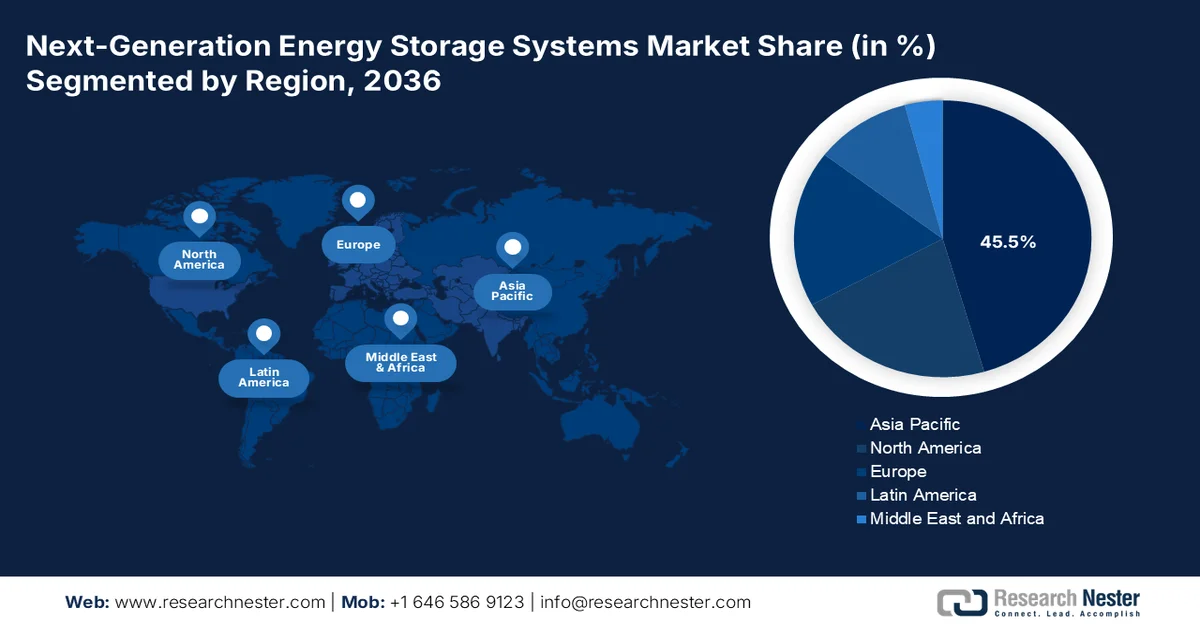
- Asia Pacific next-generation energy storage systems market is projected to hold the largest 45.5% share by 2036, supported by dominating industrial policy, renewable intermittency, and grid modernization
- Europe is poised to emerge as the fastest-growing region during the forecast period, fueled by volatility in electricity prices, grid infrastructure deferral, and suitable renewable intermittency management
Segment Insights:
- Grid storage sub-segment is projected to command a 54.8% share by 2036 in the next-generation energy storage systems market, owing to its role in balancing electricity demand and supply while supporting renewable energy integration and grid stability
- Solid-state batteries sub-segment is expected to secure a 51.9% share during the forecast period, propelled by the replacement of flammable liquid electrolytes with solid materials for enhanced safety, rapid charging, and higher energy density
Key Growth Trends:
- Thermal energy storage integration
- Storage value through capacity compensation
Major Challenges:
- Supply chain concentration and geopolitical risk
- Technology immaturity and performance uncertainty
Key Players: Sungrow, Tesla, CATL, BYD, Fluence, Form Energy, ESS Tech, Sumitomo Electric, Energy Vault, Invinity Energy Systems, Antora Energy, Ore Energy, Highview Power, Skeleton Technologies.
Global Next-Generation Energy Storage Systems Market Forecast and Regional Outlook:
Market Size & Growth Projections:
- 2026 Market Size: USD 3.2 billion
- 2027 Market Size: USD 3.5 billion
- Projected Market Size: USD 8.1 billion by 2036
- Growth Forecasts: 9.9% CAGR (2027-2036)
Key Regional Dynamics:
- Largest Region: Asia Pacific (45.5% Share by 2036)
- Fastest Growing Region: Europe
- Dominating Countries: China, United States, Japan, Germany, South Korea
- Emerging Countries: India, Australia, Canada, France, United Kingdom
Last updated on : 28 September, 2026
Next-Generation Energy Storage Systems Market - Growth Drivers and Challenges
Growth Drivers
- Thermal energy storage integration: This driver positively caters to the decarbonization of industrial heat, which effectively represents a massive energy demand compared to electricity in different industries. According to an article published by the World Economic Forum in January 2026, the electricity demand, especially in the U.S., is predicted to increase by 16% by the end of 2029, which is highly fueled by the large explosion of data centers that are powered by a boom in AI. In addition, data centers have the ability to account for 8% of Europe and 5% of U.S.-based electricity consumption by 2030, which is thrice the current share. Moreover, low-cost clean electricity generation have been readily deployed around different nations, thus making it suitable for bolstering the market’s upliftment.
- Storage value through capacity compensation: Capacity payment mechanisms tend to represent a structural shift in the valuation of storage assets, moving beyond energy dispatch revenues to compensate reliability and availability. Additionally, China's national framework for generation-side capacity compensation, followed by provincial implementation, creates a standing revenue stream that improves project bankability. Likewise, Portugal's capacity market similarly opens participation to storage and demand-side resources. This driver differs fundamentally from previous policy support because it establishes predictable, dispatch-independent compensation, thus proliferating the next-generation energy storage systems market demand.
Challenges
- Supply chain concentration and geopolitical risk: The next-generation energy storage systems market’s supply chain remains heavily concentrated in a single region, creating vulnerability to trade restrictions, export controls, and geopolitical tensions. Besides, manufacturers outside that region face higher costs, limited access to advanced cells, and dependence on imported components. Likewise, efforts to localize production require massive capital investment and years of factory construction. Meanwhile, until diversified supply chains mature, the global next-generation energy storage systems market remains exposed to disruptions that could delay projects, spike prices, and slow the energy transition.
- Technology immaturity and performance uncertainty: Many technologies in the next-generation energy storage systems market, such as solid-state, sodium-ion, iron-air, and flow batteries, remain unproven at scale. Based on this, performance degrades differently than laboratory conditions suggest, warranties are difficult to enforce, and bankability suffers when lenders lack confidence in long-term reliability. Besides, early adopters bear technology risk that established lithium-ion does not carry. This uncertainty slows adoption because utilities and investors prefer proven solutions, creating a paradox where next-generation technologies struggle to gain the deployment needed to prove themselves.
Next-Generation Energy Storage Systems Market Size and Forecast:
| Report Attribute | Details |
|---|---|
|
Base Year |
2026 |
|
Forecast Year |
2027-2036 |
|
CAGR |
9.9% |
|
Base Year Market Size (2026) |
USD 3.2 billion |
|
Forecast Year Market Size (2036) |
USD 8.1 billion |
|
Regional Scope |
|
Next-Generation Energy Storage Systems Market Segmentation:
Application Segment Analysis
The grid storage sub-segment, which is part of the application segment, is anticipated to garner the largest share of 54.8% in the next-generation energy storage systems market by the end of 2036. The sub-segment’s upliftment is primarily attributed to balancing electricity demand and supply, which further acts as the ultimate shock absorber for integrating renewable energy and maintaining power grid stability. According to an article published by the International Renewable Energy Agency in January 2026, the Utilities for Net Zero Alliance (UNEZA) has significantly reinforced its commitment and invested over USD 148 billion every year in renewables and grids. This also comprises investing an additional USD 66 billion per annum in renewables, along with USD 82 billion in storage and grids. Moreover, this commitment is associated with the objectives of the COP29 Global Energy Storage and Grids Pledge to refurbish 80 million kilometers of grid by 2040, thus boosting the sub-segment’s growth.
Technology Segment Analysis
During the forecast period, the solid-state batteries sub-segment under the technology segment is projected to grab the second-largest share of 51.9% in the next-generation energy storage systems market. The sub-segment’s growth is effectively fueled by replacing flammable liquid electrolytes with solid materials, while providing safety, rapid charging, and increased energy density, in comparison to conventional lithium-ion batteries. As stated in an article published by NLM in December 2024, Toyota is focused on offering cars with solid-state batteries, along with a range of 750 miles by the end of 2027. Besides, QuantumScape undertook 5 years and USD 100 million to select the correct material for the solid electrolyte in its battery, as well as an additional USD 200 million for developing prototypes, thus positively driving the sub-segment’s growth and demand.
End use Industry Segment Analysis
Based on the end use industry, the automotive segment is expected to account for the third-largest share of 50.6% in the next-generation energy storage systems market by the end of the stipulated timeline. The segment’s development is highly propelled by the transition toward electric mobility and the need for higher-performance, faster-charging, and safer battery technologies. Automotive manufacturers are increasingly adopting solid-state, sodium-ion, and advanced lithium-ion chemistries to extend driving range, reduce charging times, and improve vehicle safety. Beyond passenger vehicles, commercial fleets, buses, and two-wheelers contribute to demand. The automotive sector also drives innovation in battery management systems, thermal management, and fast-charging infrastructure, thus positively contributing towards the market’s exposure.
Our in-depth analysis of the next-generation energy storage systems market includes the following segments:
|
Segment |
Subsegments |
|
Application |
|
|
Technology |
|
|
End use Industry |
|

Vishnu Nair
Head - Global Business DevelopmentCustomize this report to your requirements — connect with our consultant for personalized insights and options.
Next-Generation Energy Storage Systems Market - Regional Analysis
APAC Market Insights
The Asia Pacific next-generation energy storage systems market is anticipated to grab the largest share of 45.5% by the end of 2036. The market’s upliftment in the region is primarily attributed to the dominating industrial policy, renewable intermittency, and grid modernization. According to an article published by the Asian Development Bank Organization in April 2025, clean energy investment in the region effectively grew by over 900% and reached USD 729.4 billion, which comprised 45% of worldwide investment. Besides, China accounted for a majority of this investment by associating with India and 7 other nations, wherein there was an increase in renewables by 75% of the latest national energy capacity addition as of 2022. Besides, the extension of digital grid infrastructure is crucial for integrating low-carbon electricity into domestic transmission and power generation systems.
The next-generation energy storage systems market in China is growing significantly, owing to installation capabilities, the establishment of a government framework, and an increase in the national lithium battery production for storage. As stated in an article published by the NLM in August 2022, organizations in the country effectively control half of the worldwide lithium production and ensure more than 70% of lithium-ion battery manufacturing. Based on this, the country also comprises 1.5 million tons of lithium reserves. Besides, the nation also effectively dominates the global mining of raw earth materials, with 97.7% of the production, while it also upholds a 51% stake in the global hard-rock lithium mine, especially at Greenbushes in West Australia. Therefore, with such increased capabilities, the market is continuously increasing in the overall country.
The policy momentum, in-depth battery research through energy storage programs, and renewable energy mandates integration with wind and solar capacity are certain factors for bolstering the next-generation energy storage systems market in India. As per a data report published by the PIB Government in August 2026, the country has effectively crossed 300 GW of non-fossil fuel-specific installed electricity generation capacity as of July 2026. This particular capacity includes 164.5 GW of solar power, which is followed by 58.1 GW of wind power, 57.2 GW of hydro power, 11.7 GW of bio-based power, and 8.7 GW of nuclear power. Besides, the non-fossil fuel electricity capacity share in the nation’s overall electricity generation has reached more than 54%. This particular momentum has achieved highlights through governmental transformation, with rapid progress towards gaining the 500 GW target of non-fossil capacity by the end of 2030, thus positively driving the next-generation energy storage systems market growth.
Europe Market Insights
Europe next-generation energy storage systems market is expected to emerge as the fastest-growing region during the forecast period. The market’s development is highly propelled by volatility in electricity prices, grid infrastructure deferral, and suitable renewable intermittency management. According to an article published by the European Environment Agency in July 2026, the region has successfully achieved its 20% renewable energy target, which further represented roughly 24.5% of the region’s finalized energy utilization. Based on this, solar panels on rooftops, wind turbines, and electric cars have become ordinary and common sights across the region, with fossil fuels continuing to remain the largest energy source. Besides, the replacement of fossil fuels with renewable sources, such as biomass, wind, and solar, assists in diminishing greenhouse gas emissions, thus proliferating the market development.
The next-generation energy storage systems market in the UK is gaining increased traction, owing to generous budget allocation for committing to long-term storage capacities, along with government strategy for battery communities. As per a data report published by the UK Government in November 2023, the domestic battery sector tends to address the national requirement that is focused on employing 100,000 people by the end of 2040. Besides, the construction of the newest gigafactory jointly created more than 5,000 employment opportunities and further increased the future yearly production capacity to roughly 52 GWh. Likewise, Nissan proclaimed that it led an additional USD 2.6 billion (£2 billion) investment, particularly in Sunderland, with two electric vehicle models, thereby making it suitable for gradually enhancing the market in the country.
The aspects of boosting the utility-scale segment, a focus on sustainable chemicals, and generous funding for energy storage are a few trends that are responsible for positively impacting the next-generation energy storage systems market in Germany. As per a data report published by the ITA in July 2026, the country significantly installed 42 MW of grid-scale battery energy storage systems as of 2025, which almost doubled last year’s 450 MW. In addition, there was growth in energy capacity, which rose from 1.6 GWh to 3.5 GWh in total. Besides, the government is readily committed to gaining 80% renewable electricity by the end of 2030. This evidently focuses on reshaping the energy system demands as well as constituting the sustained requirement for decarbonization support, and asset capabilities for grid stabilization, thus indicating an optimistic outlook for the market development.
North America Market Insights
North America next-generation energy storage systems market is predicted to account for a considerable share by the end of the stipulated timeline. The market’s growth in the region is effectively fueled by renewable energy adoption, grid modernization, the presence of investment tax credit, and the increased demand from data center electricity. According to an article published by the Congress Government in May 2026, the data center yearly energy utilization, especially in the U.S., was roughly 176 terawatt-hours as of 2023, which is an estimated 4.4% of the U.S. yearly electricity consumption. Besides, 1/2 or the majority of the electric power requirement of data centers originates from the electronic IT equipment operation. In this regard, a 100-megawatt data center in the U.S. tends to consume almost 2 million liters or 530,000 gallons per day, thereby making it suitable for enhancing the next-generation energy storage systems market growth.
National Power Draw from the IT Infrastructure and Equipment, 2024
|
Building and Infrastructure |
IT Equipment |
||
|
Infrastructure Type |
Capacity |
Equipment Type |
Capacity |
|
Cooling System |
40% |
Server |
40% |
|
Power Supply System |
10% |
Storage |
5% |
Source: Congress Government
The next-generation energy storage systems market in the U.S. is gaining increased exposure, owing to the tax credit system for energy communities, the virtual power plant aggregation, growth in AI-based data center load, and upscaling in national battery manufacturing. As stated in a data report published by the CSIS Organization in April 2026, battery production in the country increased from almost 10% to nearly 90% as of 2022. Besides, successfully meeting the predicted requirement at this particular scale demands a complex value chain that is poised to generate more than USD 400 billion in revenues by the end of 2030. This includes USD 34 billion for mining, USD 52 billion for refining, USD 110 billion for active materials and components, USD 121 billion for cells, USD 74 billion for packs, and USD 13 billion for recycling, thus enhancing the market’s demand.
The spread of electricity rates, remote diesel displacement, provincial utility rebate programs, the sovereign supply chain, and the integration of minerals and storage are a few factors that are positively uplifting the next-generation energy storage systems market in Canada. According to an article published by the Government of Canada in July 2026, the Minister of Energy and Natural Resources announced over USD 26 million in funding for 17 projects across Saskatchewan and Alberta. This funding positively supports escalating the deployment of clean technology, developing the workforce, industrial and regulatory capacity, and modernizing energy infrastructure and systems for the nation’s long-lasting energy security and economic growth. Meanwhile, the Smart Renewables and Electrification Pathways Program effectively supports renewable energy, energy storage, and grid modernization technologies, thus fueling the market growth.
Key Next-Generation Energy Storage Systems Market Players:
- Sungrow (China)
- Tesla (U.S.)
- CATL (China)
- BYD (China)
- Fluence (U.S.)
- Form Energy (U.S.)
- ESS Tech (U.S.)
- Sumitomo Electric (Japan)
- Energy Vault (Switzerland)
- Invinity Energy Systems (U.S.)
- Antora Energy (U.S.)
- Ore Energy (Netherlands)
- Highview Power (UK)
- Skeleton Technologies (Estonia)
- Company Overview
- Business Strategy
- Key Product Offerings
- Financial Performance
- Key Performance Indicators
- Risk Analysis
- Recent Development
- Regional Presence
- Sungrow manufactures utility-scale and commercial energy storage systems that integrate power conversion and battery management for grid applications. The company positions its storage platforms as modular, liquid-cooled solutions suited for renewable integration and peak shaving.
- Tesla designs and manufactures large-scale battery storage systems for utilities and commercial customers. Its storage products are engineered for grid stability, renewable firming, and rapid deployment at project sites.
- CATL produces advanced battery cells and integrated storage systems for utility and industrial applications. The company focuses on high-energy-density chemistries and long-duration platforms for grid-scale deployment.
- BYD manufactures battery energy storage systems spanning residential, commercial, and utility-scale segments. Its storage solutions emphasize vertical integration with its own battery cell production and power electronics.
- Fluence builds grid-scale and commercial energy storage platforms combining hardware, software, and digital intelligence. The company targets utilities and large energy users seeking flexible, multi-hour storage assets.
Here is a list of key players operating in the global next-generation energy storage systems market:
The next-generation energy storage systems market landscape is moderately consolidated at the top with a long tail of technology specialists. Sungrow, Tesla, and CATL lead global BESS integrator rankings, with BYD, Envision, and Trina Storage closely following. In this regard, competition differentiates on technology route, such as iron-air, flow, thermal, gravity, rather than scale alone. Besides, in August 2025, Sungrow unveiled its next-generation energy storage, known as the PowerTitan 3.0, with the intention of meeting demanding operation environments and climates of the Middle East and Africa. Additionally, this also integrated cutting-edge technologies in grid-formation, innovative battery design, and advanced thermal management, thus making it suitable for positively fueling the next-generation energy storage systems industry globally.
Corporate Landscape of the Market:
Recent Developments
- In July 2026, ESS Tech, Inc. launched the ESS Bridge™, which is a modular sodium-ion battery energy storage system designed for utilities, AI-driven data centers, critical infrastructure operators, and commercial and industrial customers.
- In March 2026, Siemens extended its data center partner ecosystem and successfully upscaled next-generation artificial intelligence infrastructure through strategic investment and collaboration with PhysicsX.
- In September 2025, Highview Power expanded its service by declaring two 3.2 GWh power facilities which are planned for development, especially in the UK, by the end of 2030, and further approved by Ofgem for receiving governmental support for energy storage.
- Report ID: 8770
- Published Date: Sep 28, 2026
- Report Format: PDF, PPT
- Explore a preview of key market trends and insights
- Review sample data tables and segment breakdowns
- Experience the quality of our visual data representations
- Evaluate our report structure and research methodology
- Get a glimpse of competitive landscape analysis
- Understand how regional forecasts are presented
- Assess the depth of company profiling and benchmarking
- Preview how actionable insights can support your strategy
Explore real data and analysis
Frequently Asked Questions (FAQ)
About this Report
Connect with our Expert


Report, 2027-2036



Copyright @ 2026 Research Nester. All Rights Reserved.
