Grid-forming Inverter Market Outlook:
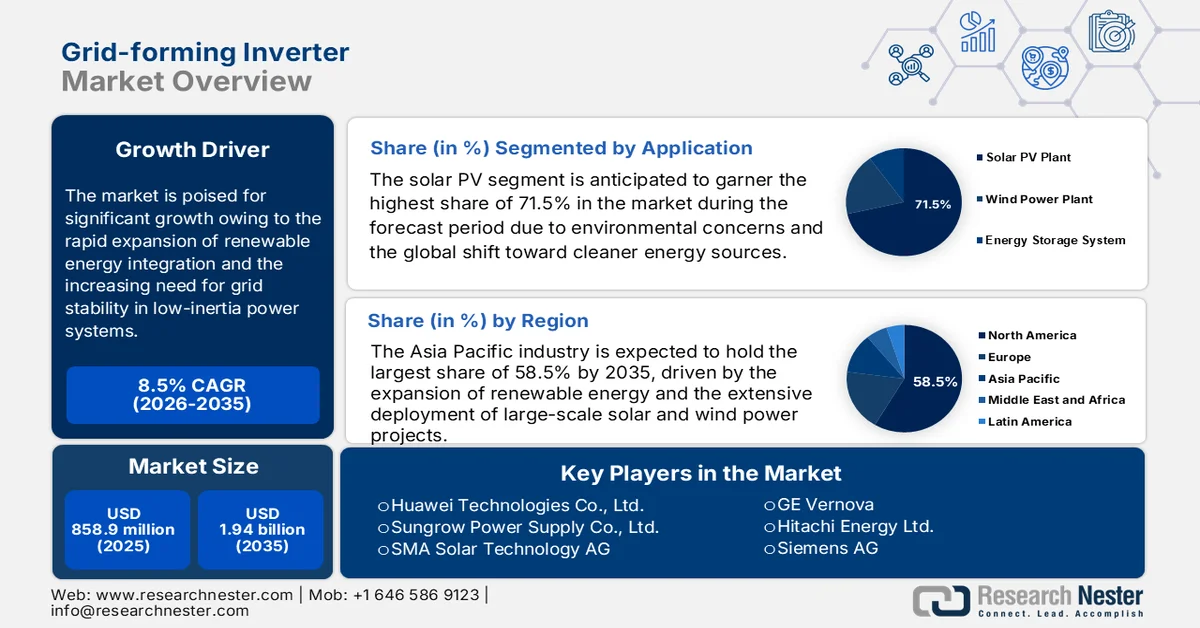
Grid-forming Inverter Market size was valued at USD 858.9 million in 2025 and is anticipated to reach USD 1.94 billion by the end of 2035, expanding at around 8.5% CAGR during the forecast period, i.e., 2026-2035. In 2026, the industry size of grid-forming inverter is assessed at USD 931.9 million.
The increasing integration of renewable energy sources, expanding deployment of energy storage systems, and the surging need for grid stability in modern power networks are catalyzing the grid-forming inverter market. In this context, the U.S. Energy Information Administration in February 2024 revealed that in 2024, U.S. developers planned to add 62.8 GW of new utility-scale generating capacity, representing a 55% increase from the 40.4 GW that was installed in 2023. Solar energy accounts for the largest share at 36.4 GW, which was 58% of planned additions, whereas battery storage contributes 14.3 GW, being 23%, meaning solar and storage together represent 81% of all new capacity additions. U.S. battery storage capacity is set to nearly double from 15.5 GW to approximately 29.8 GW, wherein Texas and California accounted for almost 82% of new storage deployments.
U.S. Utility-Scale Power Generation Capacity Additions in GW, 2024
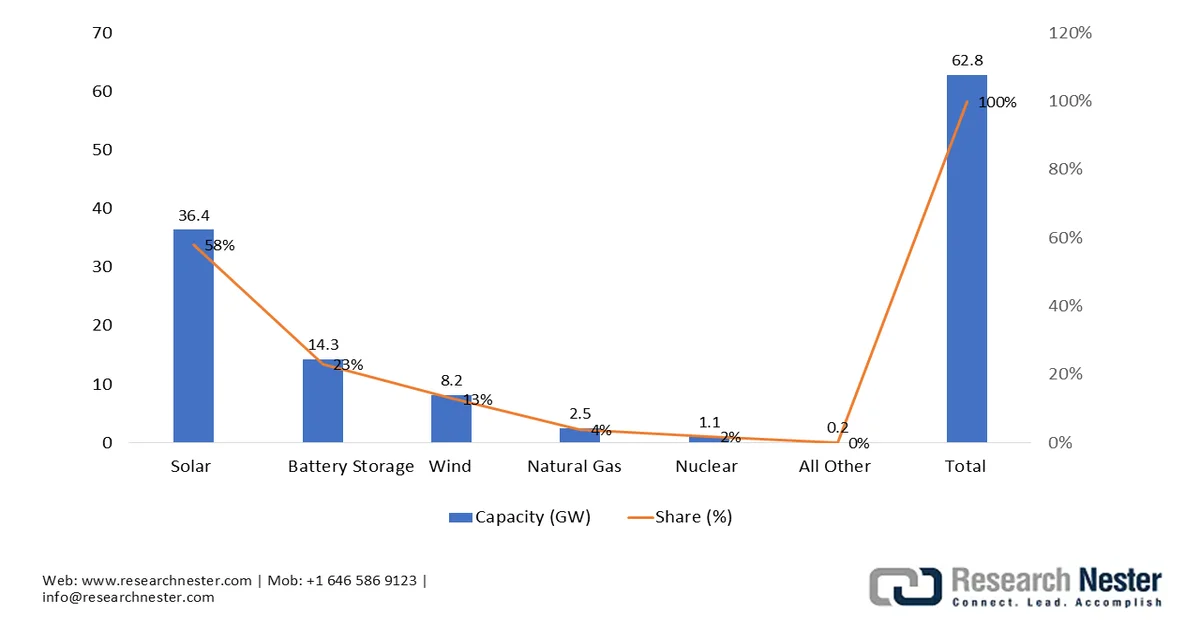
Source: EIA
Furthermore, the grid-forming inverter market benefits from the growing adoption across utility-scale renewable projects, commercial and industrial facilities, and islanded power systems, which is creating significant growth opportunities, thereby positioning these inverters as a critical component of future decentralized energy ecosystems. In this context, the International Energy Administration reported that renewable electricity capacity additions reached an estimated 507 GW in 2023, which is a 50% increase when compared to 2022, marking a structural acceleration in global renewable deployment driven by policy support across more than 130 countries. Therefore, with the continuation of this expansion, solar PV and wind are expected to capture around 96% of all new capacity additions through 2028, reflecting their increasing cost competitiveness and policy-driven scale-up across major economies, benefiting the market’s exposure.
Key Grid-forming Inverter Market Insights Summary:
Regional Highlights:
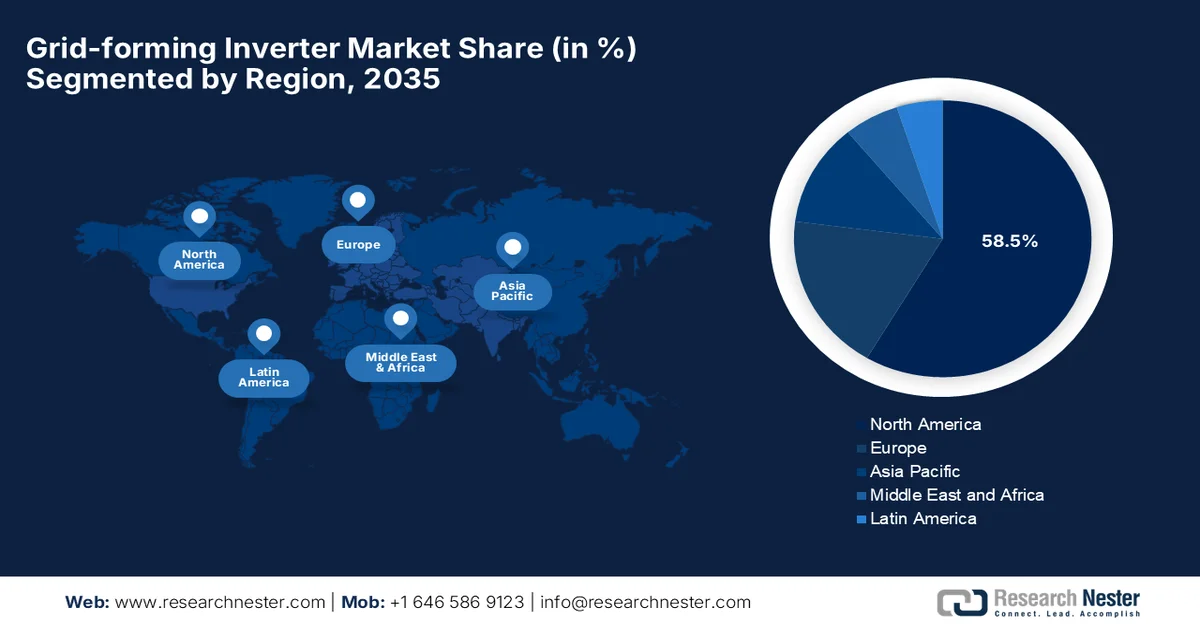
- The grid-forming inverter market in Asia Pacific is projected to capture 58.5% share by 2035, bolstered by the rapid transition from coal-fired generation to decentralized renewable energy deployment
- North America is expected to witness exponential growth throughout 2026-2035, underpinned by expanding utility-scale solar, wind, and battery energy storage installations across weak-grid regions
Segment Insights:
- The grid-forming inverter market solar PV segment is projected to account for 71.5% share by 2035, reinforced by the global transition toward cleaner energy sources
- The string inverter segment is anticipated to secure a considerable revenue share by 2035, fueled by its high efficiency, scalability, cost-effectiveness, and simple installation process
Key Growth Trends:
- Growth of battery energy storage systems
- Grid stability and system inertia deficits
Major Challenges:
- Technical complexity and grid integration
- Regulatory and standardization barriers
Key Players: Huawei Technologies Co., Ltd., Sungrow Power Supply Co., Ltd., SMA Solar Technology AG, GE Vernova, Hitachi Energy Ltd., Siemens AG, Enphase Energy.
Global Grid-forming Inverter Market Forecast and Regional Outlook:
Market Size & Growth Projections:
- 2025 Market Size: USD 858.9 million
- 2026 Market Size: USD 931.9 million
- Projected Market Size: USD 1.94 billion by 2035
- Growth Forecasts: 8.5% CAGR (2026-2035)
Key Regional Dynamics:
- Largest Region: Asia Pacific (58.5% Share by 2035)
- Fastest Growing Region: North America
- Dominating Countries: China, United States, Germany, Japan, South Korea
- Emerging Countries: India, Australia, Saudi Arabia, Brazil, United Arab Emirates
Last updated on : 27 July, 2026
Grid-forming Inverter Market - Growth Drivers and Challenges
Growth Drivers
- Growth of battery energy storage systems: The expanding deployment of battery energy storage systems is the main factor accelerating demand in the grid-forming inverter market. These inverters enable batteries to proactively regulate grid voltage and frequency, not just inject power. Therefore, this transforms storage from a passive backup resource into an active grid-support asset, thereby enhancing the flexibility and reliability of power systems. As per an article published by IEA in July 2023, global investment in battery energy storage surged past USD 20 billion in 2022, with the grid-scale projects making up over 65% of spending. Meanwhile, the largest growth in pumped-storage hydropower is concentrated in China, which has dominated final investment decisions for the past decade, far outpacing other regions, thus supporting extensive market growth.
- Grid stability and system inertia deficits: The retirement of fossil fuel and nuclear plants reduces rotational inertia in power systems, weakening frequency stability. Therefore, this leads to rapid frequency deviations and operational risks wherein the grid-forming inverters provide synthetic inertia and voltage support, especially in weak grids, driving growth in the market. In November 2023, ENTSO-E reports that future Continental Europe scenarios show increasing system splits and declining inertia, leading to reduced frequency stability in low-inertia grid conditions. Besides, this study found more cases where the rate of change of frequency exceeds 1 Hz/s from 2030 to 2040, indicating growing vulnerability to fast frequency deviations during disturbances. It concludes that without mitigation measures, system resilience will continue to decline, thus underscoring the need for stability solutions such as grid-forming and synthetic inertia technologies.
Challenges
- Technical complexity and grid integration: Assimilating these systems into existing power networks is a major burden hampering the growth of the grid-forming inverter market. These inverters need to establish voltage and frequency references, along with maintaining stability under continuously changing operating conditions. Apart from this, utilities and system operators face difficulties in validating the performance of these advanced controls across different types of grid scenarios. The lack of huge operational experience and standardized testing methods also complicates deployment. In addition, ensuring coordination between multiple grid-forming and grid-following resources requires control strategies. Therefore, these technical hurdles increase the development expenses and create uncertainty among stakeholders, ultimately causing limitations to widespread adoption in this field.
- Regulatory and standardization barriers: The absence of universally accepted standards and regulatory frameworks presents a major obstacle to the growth of the market. Most of the existing grid codes were developed around traditional synchronous generators and do not properly address the capabilities or requirements of inverter-based resources. Therefore, project developers and manufacturers face uncertainty regarding compliance, certification, and performance expectations. Regulatory bodies across different nations are still evaluating how grid-forming technologies should be integrated into future power systems. Hence, this absence of harmonized standards can lead to inconsistent requirements, higher certification costs, and hence delay project approvals.
Grid-forming Inverter Market Size and Forecast:
| Report Attribute | Details |
|---|---|
|
Base Year |
2025 |
|
Forecast Year |
2026-2035 |
|
CAGR |
8.5% |
|
Base Year Market Size (2025) |
USD 858.9 million |
|
Forecast Year Market Size (2035) |
USD 1.94 billion |
|
Regional Scope |
|
Grid-forming Inverter Market Segmentation:
Application Segment Analysis
The solar PV segment is anticipated to garner the highest share of 71.5% in the grid-forming inverter market during the forecast period. The environmental concerns and the global shift toward cleaner energy sources are driving the sub-segment’s leadership. Solar PV has become a leading technology in this transition due to its wide availability, scalability, and steadily decreasing costs. In February 2024, the article published by Press Information Bureau (PIB) reported that the country will dedicate the 300 MW Nokhra Solar Project in Rajasthan to the nation, built by NTPC Green Energy Ltd under the CPSU Scheme (Phase-II) with a total investment of USD 217 million. The project consists of more than 13 lakh solar PV modules installed under the Make in India program, and it strengthens Atmanirbhar Bharat and NTPC’s clean energy transition, thus denoting a wider segment scope.
Type Segment Analysis
By the conclusion of 2035, the string inverter is expected to grow with a considerable revenue share in the market. The growth of the segment is largely attributable to its position as a highly efficient and advanced inverter technology. In addition, string inverters are extensively adopted due to their scalability, cost-effectiveness, and simple installation process. Their high efficiency and reliability make them suitable for residential, commercial, and utility-scale solar applications, including grid-forming use cases. In this context, Sungrow in October 2023 introduced a portfolio of renewable energy products for India, which includes the innovative 1+X modular inverter, the SG320HX-20 string inverter, and the PowerTitan 2.0 energy storage system, all of which are suitable for utility-scale projects with stronger grid support and lower costs, hence denoting a positive scope for the segment’s growth.
Power Rating Segment Analysis
In the grid-forming inverter market, the 10 kW, which is under the power rating segment, is forecasted to attain a noteworthy share. These inverters with power ratings below 10 kW are widely used in homes and small businesses, propelled by their efficiency, affordability, and ease of installation. The increasing adoption of rooftop solar systems across residential sectors worldwide is also driving this growth. In addition, supportive government incentives and net-metering policies are encouraging residential solar adoption across multiple regions. Meanwhile, the rising electricity costs are encouraging households and small businesses to install rooftop PV systems with low-capacity inverters. Furthermore, technological advancements have improved the reliability and performance of sub-10 kW inverters, thus making them more attractive to end users.
Our in-depth analysis of the grid-forming inverter includes the following segments:
|
Segment |
Subsegments |
|
Application |
|
|
Type |
|
|
Power Rating |
|

Vishnu Nair
Head - Global Business DevelopmentCustomize this report to your requirements — connect with our consultant for personalized insights and options.
Grid-forming Inverter Market - Regional Analysis
APAC Market Insights
The Asia Pacific grid-forming inverter market is forecasted to attain a dominant share of 58.5% during the discussed timeframe. The region’s dominance is largely attributable to economies aggressively transitioning from coal-fired generation towards very massive, decentralized renewable energy deployment. Growth is also propelled by national clean energy targets and modernized grid connection codes that require developers to supply autonomous synthetic inertia and voltage support. In this context, the IEEJ Journal of Industry Applications in 2023 published a study on grid-forming inverters with silicon carbide, which highlights their prominent role in stabilizing low-inertia power grids as renewable penetration rises. In addition, a 30kVA SiC-based inverter using a 3-phase 3-level NPC topology was presented, which offers high efficiency and power density for both on-grid and off-grid operations, thus elevating the growth potential of the market.
The central government’s focus on constructing a modernized and new-type power system, which is capable of managing massive influxes of renewable energy, is driving the market in China. The country’s market is also strongly propelled by the rapid build-out of ultra-high-voltage transmission networks and mega-scale wind and solar bases in remote desert regions, which create weak grid conditions that require localized grid-building and synthetic inertia capabilities. In October 2025, China commissioned its first grid-forming wind-solar-storage system at the Houhai No. 3 in Shenzhen, marking a breakthrough in integrating renewable energy with urban distribution networks. It was developed by Hopewind Electric, Tsinghua University, and partners, and the project demonstrates advanced converters that actively regulate voltage and frequency, ensuring resilience in high-load urban grids. Hence, such instances denote that the country is making a shift toward grid-forming, stability-focused power systems as a primary part of its modern energy transition.
In India, the grid-forming inverter market is entering into a transformative phase of growth propelled by the nation's clean energy targets and the urgent need to stabilize an increasingly decentralized power grid. Market momentum is also accelerated by the integration of large-scale battery energy storage systems and pumped hydro storage, which serve as the foundational hardware required to deliver synthetic inertia and voltage support. In this context, PIB in March 2026 stated that India has set a target of 500 GW non-fossil capacity by 2030, wherein solar and wind form the bulk of this expansion. To integrate these intermittent sources, the government projects a need for 208 GWh of battery storage, supported by 35.8 GWh already under construction. Apart from this, policy measures include recognizing ESS in the electricity rules, financing support through the harmonized master list, thus suitable for bolstering the market’s expansion.
North America Market Insights
The North America market is poised for exponential growth, propelled by a surge in large-scale solar and wind installations across weak-grid areas. Operational scaling is being amplified by the massive deployment of utility-scale battery energy storage systems, which provide the immediate energy buffer required for inverters to supply synthetic inertia and black-start capabilities. In June 2022, the U.S. Department of Energy revealed that PNNL researchers developed a new computer model that simulates grid-forming inverters, which act like a translator to integrate renewable sources such as wind and solar into the grid. This innovation allows utility operators to safely test how new inverter-based resources can enhance resiliency and stability. In addition, it enables renewable power to actively support voltage and frequency, and this tool strengthens grid reliability, reduces outages, and advances the transition toward a resilient clean energy grid.
The accelerating retirement of aging baseload thermal plants and the concurrent expansion of large-scale renewable energy assets across low-inertia regions are responsible for uplifting the U.S. market. In addition, a rising domestic emphasis on energy security and grid hardening against severe weather is accelerating the integration of grid-forming hardware within critical infrastructure microgrids, military installations, and remote distribution networks across the country. In April 2026, Enphase Energy announced the expansion of the U.S. shipments of its IQ9N-3P and IQ8P-3P commercial microinverters, which offer higher efficiency, safety, and compliance with domestic content standards. These panel-level solutions eliminate single points of failure, simplify interconnection, and scale from under 100 kW to multi-hundred kW projects, hence denoting a positive market outlook.
In Canada, the grid-forming inverter market is gaining enhanced traction, primarily driven by the nation's aggressive push toward a net-zero electricity grid. Provincial utility operators are updating interconnection requirements to manage low-inertia conditions, which are caused by the retirement of fossil-fuel plants, making synthetic inertia and black-start features highly critical. For instance, in December 2025, Hitachi Energy announced a generous investment of USD 22 million to expand and modernize its transformer service operations in Ontario. The plan includes upgrading the Stoney Creek life-extension facility and acquiring a new Cambridge field service center to strengthen grid reliability. Hence, this particular investment supports Canada’s net-zero grid goals by enhancing the capacity to refurbish and maintain large power transformers.
Europe Market Insights
The Europe market has gained momentum, and it is evolving through specialized structural deployments as transmission operators adapt to a highly integrated, pan-regional electricity network. The region’s market is being reshaped by the high penetration of long-distance offshore wind corridors and complex cross-border interconnectors, which necessitate localized voltage reference points to maintain phase stability across different national jurisdictions. As of December 2025, the Horizon Europe call HORIZON-CL5-2026-03-D3-18 provides a total budget of USD 21.5 million with a main goal to advance grid-forming inverter technologies for resilient renewable-based grids. Each project can receive up to USD 10.7 million with funding rates of 70% for most entities and 100% for non-profits. It’s also mentioned that projects need to demonstrate innovative solutions across transmission and distribution levels, which include PV, wind, battery storage, and LVDC microgrids, with pilots in at least two Europe or associated countries.
A highly technical overhaul of its internal transmission network to accommodate the structural phase-out of traditional baseload generation is the main factor driving the growth of the market in Germany. The country’s market is also being influenced by the strategic expansion of multi-megawatt battery systems deployed at key transmission node intersections, utilizing grid-building capabilities to manage dynamic reactive current injection. In September 2025, Fraunhofer ISE, in collaboration with Germany’s four transmission system operators, announced the development of a test procedure for grid-forming inverters under the GFM Benchmark project. It also mentioned that seven manufacturers participated, with devices ranging from kilowatts to megawatts tested under normal and critical grid conditions, revealing both common behaviors and significant differences. Hence, Fraunhofer ISE strengthens the pathway for grid-forming inverters to support stability and remuneration opportunities in Europe’s evolving renewable-based power systems.
The UK grid-forming inverter market is projected for sustained growth as the country advances toward a low-carbon, renewable-based electricity system that requires enhanced grid stability and flexibility. The domestic landscape is also defined by the rapid growth of large-scale, islanded offshore wind farms in the North Sea that connect through long high-voltage cables, requiring localized synthetic strength to prevent voltage collapse at mainland injection points. In March 2025, NESO stated that Great Britain’s first grid-forming battery had gone live in Scotland under its Stability Phase 2 Pathfinder, which marks a major milestone in securing future network resilience. These advanced batteries mimic traditional generators by setting their own frequency and voltage, enabling greater integration of renewables while reducing carbon emissions. The initiative, which is worth USD 410 million, combines five synchronous condensers and five grid-forming batteries to deliver stability services.
Key Grid-forming Inverter Market Players:
- Huawei Technologies Co., Ltd. (China)
- Sungrow Power Supply Co., Ltd. (China)
- SMA Solar Technology AG (Germany)
- GE Vernova (U.S.)
- Hitachi Energy Ltd. (Switzerland)
- Siemens AG (Germany)
- Enphase Energy (U.S.)
- Company Overview
- Business Strategy
- Key Product Offerings
- Financial Performance
- Key Performance Indicators
- Risk Analysis
- Recent Development
- Regional Presence
- SWOT Analysis
- Huawei Technologies Co., Ltd. has emerged as one of the leading innovators in the market, propelled by its strong presence in utility-scale solar and battery energy storage systems. The company deliberately integrates advanced grid-forming capabilities into its smart string inverter and energy storage solutions, thereby enabling voltage and frequency regulation.
- Sungrow Power Supply Co., Ltd. is one of the world's largest inverter manufacturers and a prominent player in grid-forming technology for utility-scale renewable energy and energy storage applications. Besides, the firm developed grid-forming battery storage converters, which are capable of supporting weak grids and facilitating high renewable energy penetration.
- SMA Solar Technology AG is yet another prominent player in terms of inverter technology and has played a significant role in advancing grid-forming capabilities with its utility-scale storage and renewable integration solutions. The company's grid-forming inverters are especially designed to provide virtual synchronous machine functionality.
- GE Vernova benefits from its extensive expertise in terms of power generation, grid infrastructure, and renewable energy technologies to strengthen its position in the market. In addition, the company provides power conversion systems and energy storage solutions that incorporate grid-forming controls to support frequency response and black-start services.
- Hitachi Energy Ltd. has established itself as a foundational player in the market as it is highly focused on grid integration technologies, power electronics, and energy storage solutions. The company’s strategy is structured around innovation, digitalization, and collaborative partnerships with utilities and renewable developers.
Here is a list of key players operating in the global market:
The grid-forming inverter market hosts well-established power electronics, renewable energy, and grid technology providers who are competing intensely through innovation, tactical partnerships, and utility-scale project deployments. Huawei, Sungrow, SMA Solar Technology, GE Vernova, Hitachi Energy, and Siemens are making heavy investments in terms of advanced grid-forming controls, energy storage integration, digital monitoring platforms, and AI-based power management solutions. Collaborations with utilities and transmission operators, expansion of battery energy storage portfolios, and participation in grid modernization programs are certain growth strategies opted for by the market participants. For instance, in February 2026, DNV announced the acquisition of Smarter Power Solutions, which specializes in advanced grid-connection engineering, to establish a global center of excellence in Melbourne. This move strengthens DNV’s role in the Asia Pacific’s energy transition and enhances its ability to streamline complex grid integration processes.
Corporate Landscape of the Market:
Recent Developments
- In October 2025, Enphase Energy introduced a complete off-grid solar and battery solution in the U.S., combining IQ® Battery 5P, IQ8™ Series microinverters with Sunlight JumpStart™, and generator integration. This system allows homes to operate independently of the utility grid, ensuring reliable power even during outages.
- In April 2025, Hitachi Industrial Equipment Systems introduced a grid-forming inverter that recreates the stabilizing inertia once provided by large rotating generators, ensuring reliable frequency control as renewable energy grows. The system integrates solar power, battery storage, and advanced inverter technology to form both AC and DC microgrids.
- Report ID: 8700
- Published Date: Jul 27, 2026
- Report Format: PDF, PPT
- Explore a preview of key market trends and insights
- Review sample data tables and segment breakdowns
- Experience the quality of our visual data representations
- Evaluate our report structure and research methodology
- Get a glimpse of competitive landscape analysis
- Understand how regional forecasts are presented
- Assess the depth of company profiling and benchmarking
- Preview how actionable insights can support your strategy
Explore real data and analysis
Frequently Asked Questions (FAQ)
About this Report
Connect with our Expert


Report, 2026-2035



Copyright @ 2026 Research Nester. All Rights Reserved.
