Legal Analytics Market Outlook:
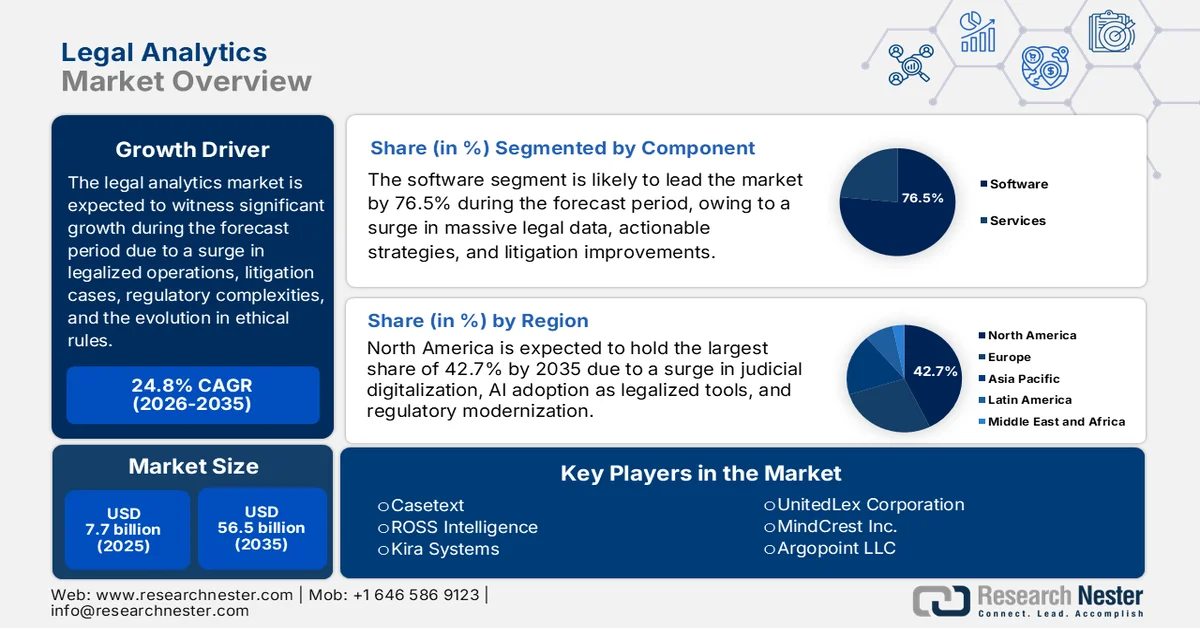
Legal Analytics Market size was valued at over USD 7.7 billion in 2025 and is projected to reach USD 56.5 billion by the end of 2035, significantly growing at a CAGR of 24.8% during the forecast period, i.e., 2026-2035. In 2026, the industry size of legal analytics is evaluated at USD 9.6 billion.
The global legal analytics market is significantly undergoing a fundamental transformation since data-based intelligence replaces experience-driven judgment across legalized operations. Besides, factors such as cost pressures, litigation volumes, regulatory complexity, legal and ethical rules evolution, judicial system digitalization rates, cybersecurity insurance, and merger and acquisition activities. According to official statistics published by the Legal Services Board in December 2025, the legal industry is continuously growing; for instance, the industry is expanding in the UK from USD 5.2 trillion to USD 6.5 trillion as of 2024. This particular has readily outperformed the economy, with legal services generously contributing USD 4.7 trillion to the domestic economy, demonstrating a 3.3% year-on-year (YoY) increase as of 2024. Therefore, with such economic evolution, the country is effectively growing across different nations.
Furthermore, the cloud-native deployment as a default architecture, agentic AI integration into legal workflows, pricing model innovation beyond subscription, the convergence of legal analytics with GRC platforms, along with the auditability and explainability as non-negotiable features, are certain trends that are responsible for boosting the legal analytics market globally. As stated in an article published by the Center on the Legal Profession at Harvard Education in February 2025, based on AI incorporation, the dominance of the billable hour business model, which is projected to account for almost 80% of fee arrangements, has significantly increased legal productivity. Besides, as an AI-based complaint resource system has the ability to diminish associate time from 16 hours down to 3 to 4 minutes, thus proliferating the market emergence.
Key Legal Analytics Market Insights Summary:
Regional Highlights:
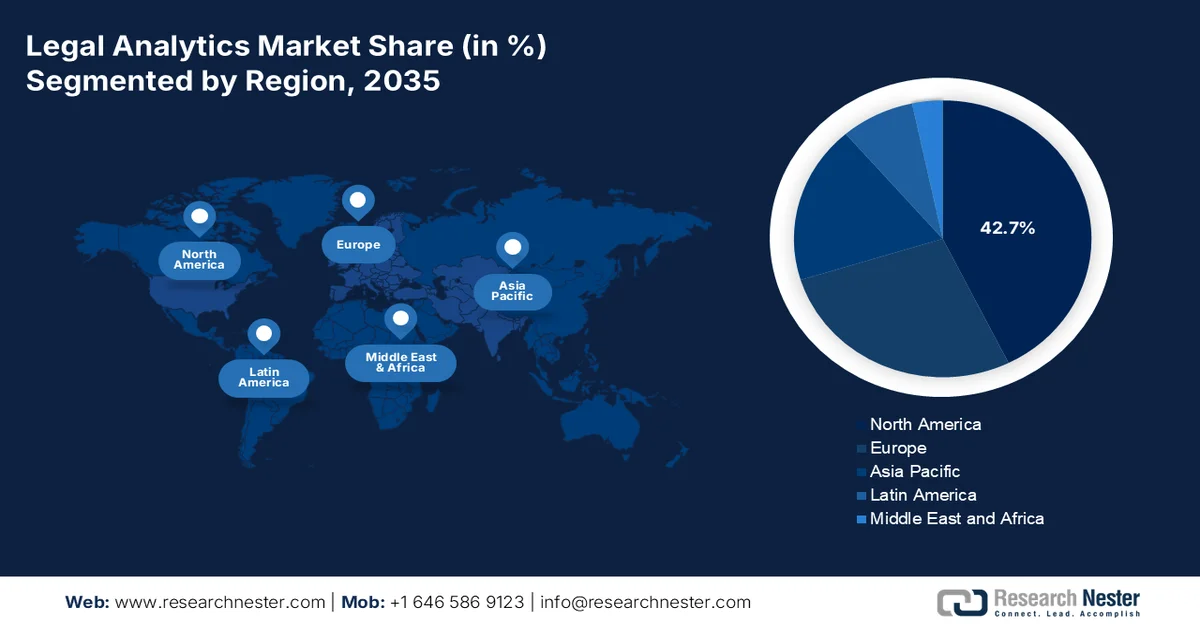
- North America in the legal analytics market is projected to dominate with a 42.7% share by 2035, driven by advanced judicial digitalization, rising litigation volumes, and strong adoption of AI-powered legal tools
- Asia Pacific is anticipated to witness the fastest growth during 2026–2035, fueled by expanding judicial digitalization initiatives, increasing cross-border disputes, and growing AI integration in legal workflows
Segment Insights:
- The software segment in the legal analytics market is projected to account for a dominant 76.5% share by 2035, propelled by its ability to transform vast legal data into actionable insights and enhance operational efficiency
- The cloud sub-segment is expected to secure the second-highest share during the forecast period 2026–2035, impelled by its provision of scalable, secure, and high-performance infrastructure for managing large volumes of legal data
Key Growth Trends:
- Escalation in cross-border regulatory divergence
- Increase in data proliferation from digital discovery
Major Challenges:
- Data silos and integration complexity
- Regulatory and ethical ambiguity in AI-driven legal predictions
Key Players: Thomson Reuters, LexisNexis/RELX Group, Wolters Kluwer, OpenText Corporation, IBM Corporation, Everlaw, Luminance Technologies, Casetext, ROSS Intelligence, Kira Systems, iManage, Litera, Mitratech, Relativity, Clio, UnitedLex Corporation, MindCrest Inc., Argopoint LLC, SpotDraft, Neota Logic, Credo AI.
Global Legal Analytics Market Forecast and Regional Outlook:
Market Size & Growth Projections:
- 2025 Market Size: USD 7.7 billion
- 2026 Market Size: USD 9.6 billion
- Projected Market Size: USD 56.5 billion by 2035
- Growth Forecasts: 24.8% CAGR (2026-2035)
Key Regional Dynamics:
- Largest Region: North America (42.7% Share by 2035)
- Fastest Growing Region: Asia Pacific
- Dominating Countries: United States, United Kingdom, Germany, Japan, China
- Emerging Countries: India, South Korea, Singapore, Brazil, United Arab Emirates
Last updated on : 21 April, 2026
Legal Analytics Market - Growth Drivers and Challenges
Growth Drivers
- Escalation in cross-border regulatory divergence: The fragmentation of the regulatory framework is increasingly driving the demand for the legal analytics market globally. According to official statistics published by the Harvard Law School Forum on Corporate Governance in August 2025, in terms of third-party risk, more than 90% of Foreign Corrupt Practices Act (FCPA) cases that readily involve misconduct by intermediaries. For instance, Airbus’s USD 3.9 billion settlement provides a stark reminder of unwanted activities that often go unseen while onboarding. Therefore, the presence of jurisdictions significantly enacts diversified rules for data privacy, financial crime compliance, ESG reporting, and AI governance, thereby making it suitable for bolstering the market growth.
- Increase in data proliferation from digital discovery: The exponential growth of electronically stored information (ESI) is usually generated by modernized business operations, which is positively fueling the legal analytics market. As stated in an article published by the Brookings in November 2025, data centers usually comprise more than 5,000 file servers within their hubs. Besides, with the continuous growth in generative AI, there is a huge reliance on data centers for processing information. In this regard, it has been predicted that the generative AI industry is escalating almost 40% per year and is further estimated to surge from USD 43.9 billion as of 2023 to nearly USD 1 trillion by the end of 2032. This particular growth is readily enhancing the digital demand, which is expanding the focus on data proliferation.
- Maturation in precedent analysis: The evolution of this analytics type has developed the latest and high-value cases, which are significantly bolstering the legal analytics market across different regions. Besides, modernized platforms currently analyze individual judges' ruling patterns, opposing counsel's historical success rates, and venue-specific procedural tendencies, providing strategic intelligence that directly influences case outcomes. This driver is distinct from general predictive analytics because it focuses on the human factors in legal proceedings rather than case law patterns. The driver gains force as more court dockets become digitized and accessible for analysis, which is a trend that continues as judicial systems worldwide modernize their records management.
Challenges
- Data silos and integration complexity: The most pervasive roadblock for the legal analytics market adoption in BFSI and other services is the fragmentation of data across legacy systems, external law firms, and disparate internal departments. Banks, insurance companies, and consulting firms typically store case histories, compliance records, and litigation outcomes in unconnected databases, often using outdated document management systems that lack application programming interface compatibility. Besides, when an organization attempts to deploy a unified legal analytics platform, the process of extracting, cleaning, and standardizing this heterogeneous data becomes a multi-year operational nightmare.
- Regulatory and ethical ambiguity in AI-driven legal predictions: The aspect of deploying predictive and prescriptive analytics within the highly regulated BFSI sector introduces profound legal and ethical uncertainties. Besides, regulatory bodies such as central banks and insurance commissions have yet to establish clear guidelines on whether algorithmic predictions of litigation outcomes or regulatory enforcement actions constitute legal advice or risk management tools. This ambiguity creates a compliance paradox, wherein a bank relies on an analytics platform that incorrectly predicts a low probability of a lawsuit, and that lawsuit results in material losses. This readily results in bearing liability, with focus on the software vendor, the bank's legal department, or the individual compliance officer. Furthermore, many legal analytics models are black-box systems, meaning their reasoning is not transparent to human auditors, which is causing a hindrance to the legal analytics market.
Legal Analytics Market Size and Forecast:
| Report Attribute | Details |
|---|---|
|
Base Year |
2025 |
|
Forecast Year |
2026-2035 |
|
CAGR |
24.8% |
|
Base Year Market Size (2025) |
USD 7.7 billion |
|
Forecast Year Market Size (2035) |
USD 56.5 billion |
|
Regional Scope |
|
Legal Analytics Market Segmentation:
Component Segment Analysis
Based on the component, the software segment is anticipated to garner the highest share of 76.5% in the legal analytics market by the end of 2035. The segment’s upliftment is primarily attributed to its importance for transforming massive amounts of legal data into enhancing operational efficiency, optimizing litigation outcomes, and actionable insights. Besides, organizations investing in enterprise-grade legal analytics platforms often find themselves locked into rigid architectures that cannot easily integrate newer capabilities such as generative AI or natural language processing enhancements. Furthermore, software interoperability remains a critical pain point, as legacy systems used by banks, insurance firms, and consulting houses were never designed to communicate with modern analytics platforms. This forces legal and compliance teams to manually export and re-import data, introducing errors and inefficiencies, thus fueling the segment exposure.
Deployment Mode Segment Analysis
During the forecast period, the cloud sub-segment, which is part of the deployment segment, is projected to account for the second-highest share in the legal analytics market. The sub-segment’s growth is highly driven by offering a high-performance, secure, and scalable infrastructure that is required to analyze, store, and process huge volumes of legalized data for tasks that are frequently unmanageable with on-premise and conventional systems. According to official statistics published by the ICRIER Organization in August 2024, the worldwide public cloud industry grew at 24%, from USD 351.4 billion to USD 669.2 billion as of 2023. Therefore, within this industry, SaaS significantly accounted for almost 62% of revenue, which is followed by 20% for IaaS and 18% for PaaS. Based on these cloud-specific services, the overall industry is further predicted to grow by 20% and reach USD 1,373.5 billion by the end of 2027, thus driving the sub-segment’s growth.
End user Segment Analysis
The corporates sub-segment, part of the end user segment, is expected to grab the third-highest share in the legal analytics market by the end of the stipulated timeline. The sub-segment’s development is highly propelled by corporates, particularly those in the BFSI and other services verticals, encounter unique obstacles when implementing legal analytics solutions across their legal and compliance departments. Internal resistance to change represents the foremost barrier, as experienced legal counsel and compliance officers often trust their professional judgment over algorithmic recommendations, viewing automated insights with skepticism or outright distrust. This cultural friction is amplified by concerns over job displacement, where senior legal professionals fear that predictive analytics could diminish their strategic value within the organization.
Our in-depth analysis of the legal analytics market includes the following segments:
|
Segment |
Subsegments |
|
Component |
|
|
Deployment Model |
|
|
End user |
|
|
Application |
|
|
Case Type |
|
|
Analytics Type |
|

Vishnu Nair
Head - Global Business DevelopmentCustomize this report to your requirements — connect with our consultant for personalized insights and options.
Legal Analytics Market - Regional Analysis
North America Market Insights
North America in the legal analytics market is anticipated to garner the largest share of 42.7% by the end of 2035. The market’s upliftment is primarily driven by the presence of advanced judicial digitalization, an increase in litigation volumes, the strong adoption of AI-driven legal tools by corporate legal departments, regulatory modernization, and concentrated vendor existence. According to official statistics published by the Association of America Universities in January 2026, the domestic administration has readily prevailed in 83 cases, demonstrating a success rate for the administration of just more than 35%. Additionally, this particular administration’s record optimized on appeal, particularly at the Supreme Court, wherein it has achieved suitable rulings in approximately 85% of cases. Moreover, over 75% of 400 cases have been reviewed in the region, thus bolstering the market growth.
The legal analytics market in the U.S. is growing significantly, owing to the transition from AI experimentation to operational infrastructure, the in-house power shift and legal work in-sourcing, increased investments in AI and technology, along with the demand for specialized and agentic AI legal agents. As stated in an article published by the Federal Reserve in April 2026, the Census Bureau demonstrated that almost 18% of domestic organizations increasingly adopted AI by the end of 2025, with a further increase in the incorporation rate by 68% in September. Besides, firms in the country have estimated that 78% of the domestic labor force operates in organizations that have implemented this particular technology, and nearly 546 operate at firms that utilize LLM. Therefore, with this continuous increase in AI incorporation, the market is gradually growing in the country.
Estimated AI Adoption Rate Analysis in the U.S., 2025
|
Scope |
Source Type |
Date |
Analysis Unit |
Estimation Type |
Estimate |
|
Artificial Intelligence |
BTOS |
December 2025 |
Firms |
Firm-based |
18% |
|
SBU |
November 2025 |
Firms |
Employment-driven |
78% |
|
|
Generative AI/LLMs |
RPS |
November 2025 |
Individuals |
Labor Force Share |
41% |
|
SBU |
November 2025 |
Firms |
Employment-based |
54% |
Source: Federal Reserve
The increased profitability focus and efficient requirement, exceptionally high AI adoption and time savings, the efficiency blocker as a driver for consolidation, and a vibrant legal technology and startup advancement are certain factors that are boosting the legal analytics market in Canada. As stated in an article published by the Government of Canada in April 2026, almost 2/3rd of the population indicated that AI has the suitable potential to cause harm to society, while 71% believe that it is a significant technology of public authorities. Therefore, the government in the country has effectively aimed to reassure the overall population are focused on a significant plan to manage and administer this emerging technology and ensure trust in a surging economic area. Therefore, with this increased growth in technology, the market is gradually expanding in the country.
APAC Market Insights
The Asia Pacific in the legal analytics market is expected to emerge as the fastest-growing region during the forecast period. The market’s development is highly propelled by strong government digitalization strategies across judicial systems, a rise in cross-border trade litigation, and the integration of AI into legalized workflows for compliance management. According to official statistics published by the UNDP Organization in December 2023, based on the Draft of the Environmental Procedure Act, projections have indicated that more than 1 billion people have the possibility to witness displacement by the end of 2050, owing to the impacts of climate change. Besides, an increase in modernizing court systems across economies, such as South Korea and Japan, also caters to the market development in the region.
The legal analytics market in China is gaining increased traction, owing to an increase in the digitalizing regulatory environment, an increase in the natural industrial average, a surge in mandating digitally implemented intelligent manufacturing adoption, and AI-based monitoring systems. As stated in an article published by the State Council Information Office in May 2024, the country has successfully been at the forefront of advancement by unveiling a series of smart manufacturing pilot strategies, leading 421 domestic showcase factories, which are complemented by a network of over 10,000 provincially based digital workshops and intelligent factories. Besides, manufacturing facilities effectively manage an influx of more than 8,000 latest regular orders, thereby enhancing the market’s demand for ensuring continuous administration of the manufacturing sector.
The aspects of rapid industrial modernization, strong import substitution policies, the digitalization of regulatory and legal processes, the increased adoption of digital compliance systems by organizations, and the effective mandate of a digital environment are a few trends that are responsible for fueling the legal analytics market in India. As per a data report published by Invest India in December 2025, the country’s GDP has significantly reached USD 4.2 trillion between 2024 and 2025, which has made it the ultimate economic powerhouse. In addition, the per capita GDP was worth USD 2,940, and the GDP, particularly in purchasing power parity (PPP) terms, steadily stood at USD 11,942. Besides, the services industry continued to grow rapidly by posting a formidable 7.2% advancements, thereby enhancing the market requirement in the country.
Europe Market Insights
Europe in the legal analytics market is projected to witness considerable growth by the end of the stipulated timeline. The market’s growth in the region is highly driven by the strict regulatory framework, cross-border litigation complexity, an increase in enforcement actions, the digitalized transformation of judicial systems, the convergence of environmental, social, and governance (ESG) compliance monitoring, and the integration of artificial intelligence in legal research. According to a data report published by the Digital Europe Organization in November 2023, 75% of regional organizations are focused on utilizing cloud computing services, AI, and big data. Besides, over 90% of small and medium-sized enterprises need to reach a basic level of digital intensity. Moreover, 100% of notable public services are readily available across online platforms for regional citizens and businesses, which is fueling the market growth.
The legal analytics market in Germany is gaining increased exposure, owing to governmental investments in industrial digitalization, an increase in legal technology adoption, the focus on intellectual property protection, and the federal structure. Based on government estimates published by the ITA in August 2025, the country’s digitalized economy rapidly grew in 2024, amounting to USD 250 billion, demonstrating a rise from USD 239 billion as of 2023. Despite this growth, the country is effectively below the regional average in public services digitalization for both citizens, which is 75.8 versus the regional 79.4 score, and businesses, for 78.6 versus 85.4. However, generous support through significant investment by the federal government is significantly optimizing the digitalized economy, thereby denoting a huge growth opportunity for the legal analytics market in the country.
The rapid modernization in the legal industry, suitable funds for industrial digitalization, increased focus on digital compliance, an increase in regulatory intelligence tools, strategic position as a logistics facility, and cross-border compliance requirements are factors for bolstering the legal analytics market in Poland. Based on government estimates published by the ITA in April 2026, the digital economy industry is estimated to be worth USD 44 billion, demonstrating a suitable potential for U.S.-based suppliers across overall economic segments. In addition, the digital economic activity valuation in the country is poised to increase to USD 123 billion by the end of 2030, along with being increasingly responsible for 9% of the domestic projected GDP. Therefore, in regard to this growth, the market is gradually gaining suitable exposure in the overall country.
Key Legal Analytics Market Players:
- Thomson Reuters (Canada)
- LexisNexis/RELX Group (UK)
- Wolters Kluwer (Netherlands)
- OpenText Corporation (Canada)
- IBM Corporation (U.S.)
- Everlaw (U.S.)
- Luminance Technologies (UK)
- Casetext (U.S.)
- ROSS Intelligence (U.S.)
- Kira Systems (Canada)
- iManage (U.S.)
- Litera (U.S.)
- Mitratech (U.S.)
- Relativity (U.S.)
- Clio (Canada)
- UnitedLex Corporation (U.S.)
- MindCrest Inc. (U.S.)
- Argopoint LLC (U.S.)
- SpotDraft (India)
- Neota Logic (U.S.)
- Credo AI (U.S.)
- Company Overview
- Business Strategy
- Key Product Offerings
- Financial Performance
- Key Performance Indicators
- Risk Analysis
- Recent Development
- Thomson Reuters has established itself as a dominant force in legal analytics by integrating generative AI capabilities into its flagship legal research platforms, fundamentally transforming how legal professionals analyze case law and statutes. The company continues to expand its market influence through strategic acquisitions of legal technology startups that enhance its predictive analytics and document review functionalities.
- LexisNexis/RELX Group leverages its vast repository of legal and regulatory content, combined with advanced analytics, to deliver litigation outcome predictions and judicial behavior insights to corporate legal departments and law firms worldwide. The company focuses on embedding machine learning algorithms directly into its research workflow, enabling legal professionals to uncover hidden patterns and precedents without leaving their primary research environment.
- Wolters Kluwer differentiates itself through deep vertical integration of legal analytics with compliance, tax, and accounting workflows, creating a unified platform for risk management professionals across the BFSI and other services sectors. The company prioritizes the development of prescriptive analytics tools that not only forecast legal outcomes but also recommend actionable next steps for mitigating regulatory exposure and litigation risk.
- OpenText Corporation applies its decades of expertise in enterprise information management to the legal analytics domain by offering solutions that analyze unstructured legal documents, emails, and contracts stored across corporate repositories. The company focuses on integrating legal analytics capabilities into its broader e-discovery and information governance suite, allowing organizations to extract actionable intelligence from dormant legal data.
- IBM Corporation brings its enterprise-grade artificial intelligence platform, Watson, to the legal analytics market, enabling natural language processing and cognitive search across massive legal document collections. The company emphasizes the explainability of its analytics outputs, ensuring that corporate legal teams can understand the rationale behind algorithmic predictions for regulatory compliance and litigation strategy purposes.
Here is a list of key players operating in the global legal analytics market:
The legal analytics market is fiercely competitive, anchored by established giants Thomson Reuters, LexisNexis, and Wolters Kluwer, which leverage decades of legal content expertise and vast customer bases. Moreover, strategic initiatives include aggressive acquisitions, such as Luminance acquiring LegalSifter to solidify contract analytics capabilities. Major players are embedding generative AI into core platforms, including Thomson Reuters, which reports its AI assistant CoCounsel now reaches one million professionals globally. Based on this, in August 2025, Reuters launched CoCounsel Legal, which features agentic guided workflows and in-depth research. This particular AI assistant enables lawyers to plan and deliver legalized research-based results that are significantly grounded in Practical and Westlaw Law content, which is driving the global legal analytics market.
Corporate Landscape of the Legal Analytics Market:
Recent Developments
- In August 2025, Wolters Kluwer Legal & Regulatory signed a licensing agreement with artificial intelligence-based legal platform Harvey for ensuring suitable accessibility to authoritative primary source legal content to support workflows.
- In April 2025, Credo AI and IBM collaborated with each other to ensure the latest Compliance Accelerators Add-on for IBM watsonx.governance for assisting worldwide enterprises to better manage AI-based regulatory compliance processes.
- In July 2024, LexisNexis® Legal & Professional successfully acquired Henchman to offer advanced technology that effectively enables law corporations and firms to rapidly extract insights from internal data repositories.
- Report ID: 8519
- Published Date: Apr 21, 2026
- Report Format: PDF, PPT
- Explore a preview of key market trends and insights
- Review sample data tables and segment breakdowns
- Experience the quality of our visual data representations
- Evaluate our report structure and research methodology
- Get a glimpse of competitive landscape analysis
- Understand how regional forecasts are presented
- Assess the depth of company profiling and benchmarking
- Preview how actionable insights can support your strategy
Explore real data and analysis
Frequently Asked Questions (FAQ)
About this Report
Connect with our Expert


Report, 2026-2035



Copyright @ 2026 Research Nester. All Rights Reserved.
