Augmented Analytics Market Outlook:
Augmented Analytics Market size was over USD 28.7 billion in 2025 and is estimated to reach USD 274.1 billion by the end of 2035, expanding at a CAGR of 28.5% during the forecast timeline, i.e., 2026-2035. In 2026, the industry size of augmented analytics is estimated at USD 36.8 billion.
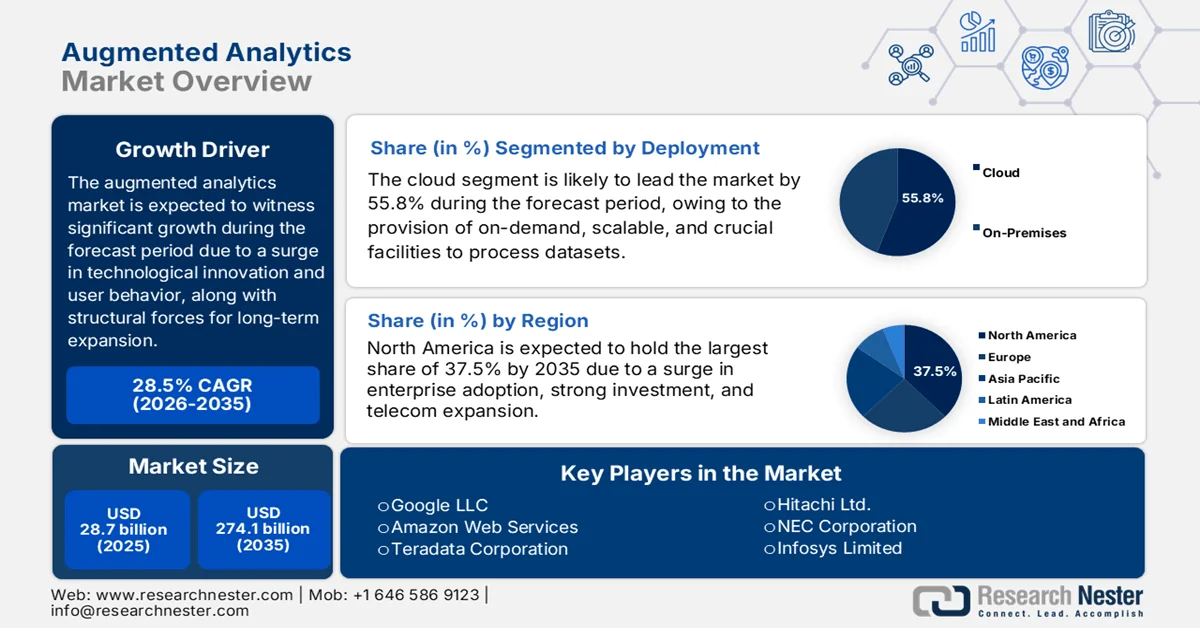
The international augmented analytics market is rapidly revolutionizing, shaped by a significant response to user behavior and technology, and other drivers highlighting structural forces that have propelled the long-lasting expansion. According to official statistics published by OECD in February 2026, artificial intelligence (AI) companies readily account for 61% of worldwide venture capital investment as of 2025. This generously amounted to USD 258.7 billion out of the total USD 427.1 billion, which has doubled by 30% since 2022. Besides, as of 2023, AI organizations have focused on IT facilities and hosting, which has effectively attracted the largest venture capital volumes, reaching USD 109.3 billion in 2025. Besides, the cumulative investment in this particular industry has totaled USD 256.1 billion, comprising differently aged individuals in various countries utilizing generative AI tools, which is positively impacting the market’s growth.
Individuals Utilizing Generative AI Tools Based on Age Factor (2025)
|
Countries |
Individuals Aged 16-74 Years |
Individuals Aged 16-24 Years |
Individuals Aged 55-74 Years |
|
Norway |
56.3 |
79.7 |
30.7 |
|
Denmark |
48.4 |
77.6 |
24.1 |
|
Switzerland |
47.0 |
78.6 |
22.0 |
|
Estonia |
46.6 |
82.8 |
15.9 |
|
Finland |
46.3 |
67.0 |
20.0 |
|
Ireland |
44.9 |
66.5 |
18.0 |
|
Netherlands |
44.7 |
73.6 |
19.3 |
|
Greece |
44.1 |
83.5 |
20.5 |
Source: OECD
Furthermore, the integration of AI tools, an increase in the natural language querying (NLQ) adoption, embedded analytics in business applications, and a focus on explainable AI (XAI) are trends that are responsible for bolstering the augmented analytics market globally. As per an article published by OECD in September 2025, 70% of countries utilized AI to optimize internal governmental processes, while 33% utilized it to boost policy implementation and design. Besides, AI has significantly contributed to medical and scientific breakthroughs, such as discovering the latest cancer treatments, based on which there has been an expected growth in catalyzing productivity by 1% to 7% in the international GDP by the end of 2033, thus denoting a 10-fold increase. Therefore, based on all such developments, there is a huge growth opportunity for the market across different nations.
Key Augmented Analytics Market Insights Summary:
Regional Highlights:
- North America is projected to command the highest 37.5% share by 2035 in the augmented analytics market, impelled by rising enterprise adoption, substantial investment inflows, and accelerating telecom expansion.
- Asia Pacific is poised to be the fastest-growing region throughout 2026–2035, attributable to government-backed digital transformation initiatives, expanding investment activities, and increasing prioritization of healthcare analytics.
Segment Insights:
- The cloud sub-segment is projected to account for a dominant 55.8% share by 2035 in the augmented analytics market, propelled by its capability to deliver scalable, on-demand infrastructure for processing vast datasets and operating advanced artificial intelligence.
- The large enterprises segment is expected to secure the second-largest share over the forecast period 2026–2035, stimulated by the escalating volume of enterprise-wide data generation necessitating advanced analytics for actionable insight extraction.
Key Growth Trends:
- Shift towards prescriptive analytics
- Expansion in edge computing
Major Challenges:
- Data privacy and security concerns
- High implementation costs and skill gaps
Key Players: Microsoft Corporation, IBM Corporation, Oracle Corporation, Salesforce Inc., SAS Institute Inc., QlikTech International AB, SAP SE, TIBCO Software Inc., ThoughtSpot Inc., MicroStrategy Inc., Google LLC, Amazon Web Services, Teradata Corporation.
Global Augmented Analytics Market Forecast and Regional Outlook:
Market Size & Growth Projections:
- 2025 Market Size: USD 28.7 billion
- 2026 Market Size: USD 36.8 billion
- Projected Market Size: USD 274.1 billion by 2035
- Growth Forecasts: 28.5% CAGR (2026-2035)
Key Regional Dynamics:
- Largest Region: North America (37.5% Share by 2035)
- Fastest Growing Region: Asia Pacific
- Dominating Countries: United States, China, Germany, United Kingdom, Japan
- Emerging Countries: India, Singapore, South Korea, United Arab Emirates, Canada
Last updated on : 23 February, 2026
Augmented Analytics Market - Growth Drivers and Challenges
Growth Drivers
- Shift towards prescriptive analytics: Enterprises are gradually moving beyond predictive and descriptive analytics toward prescriptive solutions that suggest actions, thus driving the augmented analytics market adoption across different industries. According to official statistics published by the Journal of Business Research in November 2025, the prescriptive analytics industry was valued at USD 9.5 billion as of 2024, which is further expected to grow by an estimated USD 82.3 billion by the end of 2034, thereby denoting a 24.2% yearly growth rate. Additionally, this surge is highly fueled by an increase in its demand across sectors, including retail, supply chain, and finance, wherein prescriptive tools assist in determining optimal actions under certain constraints, thus boosting the market’s expansion globally.
- Expansion in edge computing: The proliferation of edge computing-based devices tends to generate massive datasets, uplifting the demand for the augmented analytics market to interpret and process real-time information. As stated in an article published by Internet of Things and Cyber-Physical Systems in 2023, there has been an increase in interest and the adoption of cloud computing services to the extent that international cloud IP traffic accounts for over 90% of overall data center traffic. Besides, the global edge computing industry is worth USD 3.5 billion, and it is further expected to increase to USD 43.4 billion by the end of 2027. Therefore, this permits consumers to readily engage with compiled code at a source level optimally and safely, thereby making it suitable for the market’s growth.
- Increase in SME digitalization: SMEs are increasingly integrating cloud-native analytics platforms, owing to scalability and affordability, thereby positively contributing to the augmented analytics market expansion. For instance, in January 2026, Ant International is expected to support more than 2 billion digital cross-border transactions and AI-specific payments as of 2025 for merchants in its notable emerging markets. This included South Asia, the Middle East and Latin America (LATAM), and Southeast Asia, since the organization develops a comprehensive range of AI-driven digital financial and commerce solutions that have been tailored to these particular regional diversified demands. Therefore, with such organizational contributions, there is a huge growth opportunity for the market internationally.
Challenges
- Data privacy and security concerns: The augmented analytics market relies heavily on large-scale data collection, integration, and processing, often involving sensitive personal and enterprise information. With increasing regulatory frameworks such as GDPR in Europe and CCPA in California, organizations face significant compliance challenges. Enterprises must ensure that AI-driven analytics platforms adhere to strict privacy standards, which increases operational costs and slows adoption. Besides, cybersecurity risks also pose a major barrier, as breaches can compromise trust in analytics platforms. The complexity of securing multi-cloud and hybrid environments further complicates deployment, thus negatively impacting the market’s expansion.
- High implementation costs and skill gaps: Deploying augmented analytics solutions requires substantial investment in infrastructure, software, and skilled personnel. Many SMEs struggle to justify the high upfront costs, limiting adoption to large enterprises. Cloud-based solutions reduce some expenses, but integration with legacy systems remains costly and complex. Additionally, there is a global shortage of professionals skilled in AI, machine learning, and advanced analytics. Workforce training programs are insufficient to meet demand, creating a talent bottleneck. Organizations often face challenges in reskilling employees to use self-service analytics tools effectively. This skill gap slows down the democratization of data insights, one of the core promises of the augmented analytics market.
Augmented Analytics Market Size and Forecast:
| Report Attribute | Details |
|---|---|
|
Base Year |
2025 |
|
Forecast Year |
2026-2035 |
|
CAGR |
28.5% |
|
Base Year Market Size (2025) |
USD 28.7 billion |
|
Forecast Year Market Size (2035) |
USD 274.1 billion |
|
Regional Scope |
|
Augmented Analytics Market Segmentation:
Deployment Segment Analysis
The cloud sub-segment, which is part of the deployment segment, is anticipated to garner the largest share of 55.8% in the augmented analytics market by the end of 2035. The sub-segment’s upliftment is highly driven by its importance in offering the crucial, scalable, and on-demand infrastructure that is essential to process huge datasets and operate innovative artificial intelligence. According to official statistics published by the International Journal of Public Administration in the Digital Age in February 2025, based on cloud computation adoption, the success rate of e-government services usually stands at 35% in developed nations and falls to only 15% across developing countries. Besides, the U.S. General Services Administration has significantly gained a 72% cost saving as well as 99.9% less downtime by effectively switching to cloud services, thus driving the sub-segment’s growth internationally.
Organization Size Segment Analysis
The large enterprises segment in the augmented analytics market is projected to hold the second-largest share during the forecast duration. The segment’s growth is highly fueled by the sheer scale of data generated across diverse operations, requiring advanced analytics to extract actionable insights. Large organizations in BFSI, healthcare, manufacturing, and telecom increasingly rely on augmented analytics to enhance decision-making, reduce operational inefficiencies, and improve customer engagement. The availability of significant budgets allows these enterprises to invest in AI-powered platforms, cloud-native deployments, and workforce training programs. Moreover, regulatory compliance requirements push large-scale enterprises to adopt analytics solutions that ensure transparency and accuracy in reporting, thereby boosting the segment’s growth.
Components Segment Analysis
By the end of the stipulated timeline, the software sub-segment, which is part of the components segment, is expected to hold the third-largest share in the augmented analytics market. The sub-segment’s development is highly attributed to providing the core functionality for AI-driven data visualization, predictive modeling, and prescriptive analytics. Augmented analytics software enables organizations to democratize data insights, empowering non-technical users to generate reports and recommendations without IT dependency. Cloud-native software platforms further enhance scalability, allowing enterprises to integrate analytics seamlessly into existing workflows. Vendors such as Microsoft, SAP, IBM, and Salesforce continue to innovate by embedding augmented analytics into ERP, CRM, and productivity suites, expanding adoption across industries.
Our in-depth analysis of the augmented analytics market includes the following segments:
|
Segment |
Subsegments |
|
Deployment |
|
|
Organization Size |
|
|
Components |
|
|
Analytics Type |
|
|
Verticals |
|
|
End user Industry |
|

Vishnu Nair
Head - Global Business DevelopmentCustomize this report to your requirements — connect with our consultant for personalized insights and options.
Augmented Analytics Market - Regional Analysis
North America Market Insights
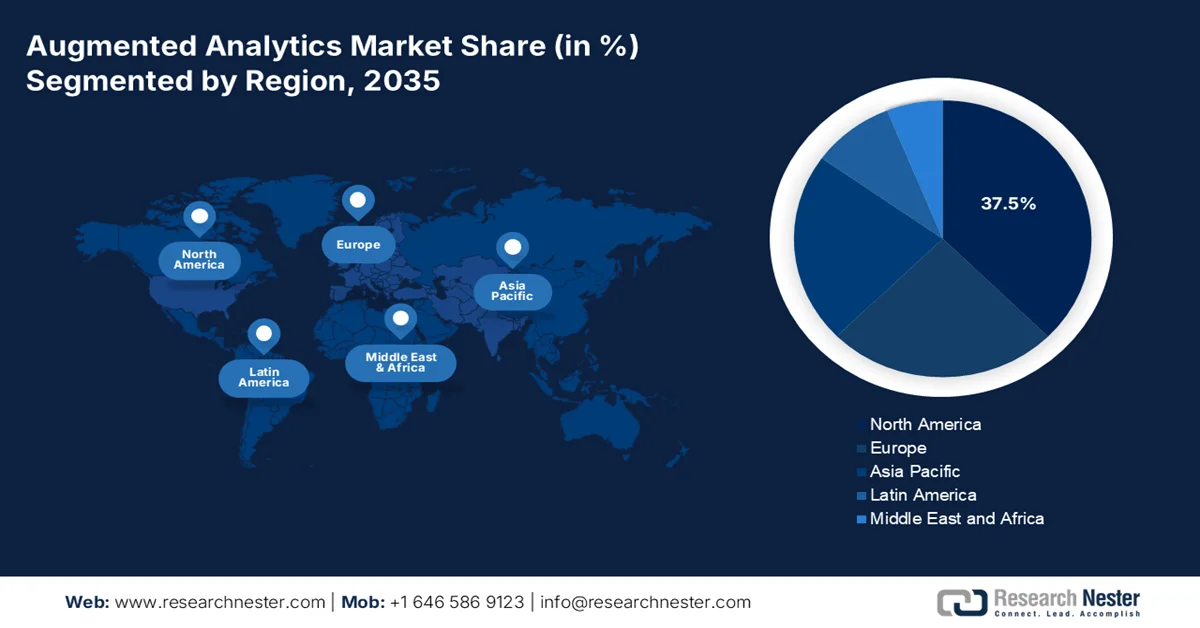
North America in the augmented analytics market is anticipated to garner the highest share of 37.5% by the end of 2035. The market’s upliftment in the region is highly fueled by an increase in enterprise implementation, robust investment provision, as well as an increase in telecom expansion. Based on government estimates published by the U.S. Census Bureau in May 2024, the revenue in the Internet Publishing and Broadcasting and Web Search Portals industry has soared by 181.9% from USD 120.2 billion to USD 338.7 billion as of 2022. Besides, there has been a rise in the demand for the internet from 86% to 95% as of 2023. In addition, the industry’s one-year revenue surged by USD 27.0 billion and further jumped by USD 66.1 billion. Therefore, with an increase in such telecommunication services, there is a huge growth opportunity for the market in the overall region.
Revenue Sources of Employer Firms for Wired Telecommunications Carriers in North America (2015-2022)
|
Years |
Fixed Local Telephony (USD Million) |
Basic Programming Package (USD Million) |
Internet Access Services (USD Million) |
|
2015 |
18,977 |
61,699 |
79,136 |
|
2016 |
19,648 |
64,492 |
88,395 |
|
2017 |
17,373 |
61,757 |
93,256 |
|
2018 |
15,037 |
61,339 |
96,461 |
|
2019 |
13,377 |
61,589 |
99,077 |
|
2020 |
12,477 |
61,114 |
102,893 |
|
2021 |
12,915 |
58,780 |
107,610 |
|
2022 |
13,369 |
50,704 |
115,758 |
Source: U.S. Census Bureau
The augmented analytics market in the U.S. is growing significantly, owing to the presence of broadband expansion programs, an upsurge in urban and rural enterprises, an increase in federal AI strategies, and the emphasis on trustworthy AI frameworks. As stated in an article published by the U.S. Government Accountability Office (GAO) in July 2025, across 11 selected agencies, the overall number of reported AI cases almost doubled from 571 as of 2023 to 1,110 in 2024. In addition, there has been an increase in generative AI cases by nearly 9-fold from 32 to 282. Besides, GAO selected 12 agencies that publicly revealed having utilized generative AI cases between 2023 and 2024. Therefore, with continuous expansion in AI utilization, administrative bodies in the country are making suitable progress, thus proliferating the augmented analytics market exposure.
An increase in the integration across manufacturing and healthcare sectors, enforcement of digital equity policies, industrial and government partnerships, and enabling SMEs and underserved communities to access analytics-based broadband services are factors uplifting the augmented analytics market in Canada. For instance, in December 2025, Coveo and the Government of Canada jointly declared the standard execution of a Memorandum of Understanding (MOU) to bolster the advancement and adoption of AI in the country. Through this partnership, the country’s government operated with Coveo to effectively modernize administrative operations by exploring suitable opportunities to deploy AI-specific experiences. Therefore, with such a partnership, the market in the country is gradually gaining increased importance and eventually enhancing its demand.
APAC Market Insights
The Asia Pacific augmented analytics market is expected to emerge as the fastest-growing region during the forecast period. The market’s development in the region is highly attributed to the existence of government-funded digital transformation programs, an increase in generous investments, and a surge in prioritizing healthcare analytics. According to official statistics published by NLM in June 2025, Vietnam has increasingly adopted AI, with the presence of systems, such as cardiology information systems, hospital information support systems (HISS), and electronic medical records (EMR), denoting 5% to 10% presence in the overall healthcare industry. Besides, the AI penetration varies significantly from 44% in Myanmar to 53% in the Philippines, 62% in Indonesia, 78% in Vietnam, 85% in Thailand, and 98% in Singapore, thus enhancing the market’s development in the overall region.
The augmented analytics market in China is gaining increased traction, owing to an upsurge in government spending for ICT expansion, SME integration, and enterprise integration, along with regulatory and healthcare push. According to official statistics published by the CSET in August 2023, the domestic AI-based company, iDeepWise, significantly received RMB 500,000 (USD 75,400) in cash rewards, along with RMB 20 million (USD 3 million) from the government in research and development subsidies for more than 3 years. Moreover, the country’s governmental officials reportedly set up 2,107 guidance funds, with a registered size of RMB 12.8 trillion (USD 1.8 trillion). In addition, this particular funding opportunity has been raised, amounting to RMB 6.5 trillion (USD 940 billion) from public and private sources, thus bolstering the market’s growth.
The aspects of expanded broadband facilities, SME adoption, governmental funding opportunities for ICT-based programs, AI advancement, and cloud-native programs are a few factors that are responsible for uplifting the augmented analytics market in India. Based on government estimates published by the PIB Government in December 2025, 5G services have been readily rolled out across domestic union territories and states and are available in 99.9% of the districts, with a population coverage of 85%. In addition, 5.0 lakh 5G Base Transceiver Stations (BTSs) have been successfully installed by Telecom Service Providers (TSPs) in the country. Moreover, there has been an increase in optical fiber cable length from 19.3 lakh route kilometer to 42.4 lakh route kilometer, thereby denoting an optimistic outlook for the overall market’s exposure in the nation.
Europe Market Insights
Europe in the augmented analytics market is projected to witness considerable growth by the end of the stipulated timeline. The market’s growth in the region is highly driven by the presence of digitalized innovation facilities, the provision of generous federal funding, regional digital transformation programs, along with an increase in cybersecurity framework solutions. According to official statistics published by NLM in August 2023, the healthcare industry usually witnesses 76% of cybersecurity breaches, owing to basic web application risks, system intrusions, and miscellaneous errors, leading to disrupted health services or compromised health data. Therefore, to combat this, the Europe Commission has proposed the Europe Health Data Space (EHDS) in 2022 to enhance care delivery services and optimize patients’ lives by providing citizens across Europe with suitable control over their personal health data in a secure and private environment.
The augmented analytics market in the UK is gaining increased exposure, owing to the presence of government digital transformation strategies, generous budget allocation to emerging technologies, and the enterprise adoption across healthcare and BFSI industries. Based on government estimates published by the UK Government in 2022, administrative organizations in the country are relentlessly and routinely targeted, and 777 incidents are readily managed by the National Cyber Security Center. In addition, nearly 40% of these incidents have been aimed at the public industry, and this upward trend demonstrates zero signs of abating, which is positively impacting the market’s exposure in the overall nation. Besides, government organizations in the country are continuously developing standard foundations to enhance their cyber resilience, thereby denoting a huge growth opportunity for the augmented analytics market.
The aspects of analytics and AI integration into domestic digital infrastructure, an increase in suitable funding opportunities, as well as a robust enterprise adoption in healthcare, BFSI, and manufacturing, are responsible for bolstering the augmented analytics market in Germany. As per an article published by the ITA in November 2024, the growth of the international AI in education industry is highly driven by an increase in the adoption of AI-based tools in universities and schools, with an estimated 29% of these institutions in the country adopting AI for student performance analytics, administrative automation, and personalized learning. Besides, governmental strategies, including the roughly USD 6 billion DigitalPakt Schule and the country’s AI Strategy with an estimated budget of USD 3.3 billion throughout 2025, are pivotal in boosting digital facilities and promoting AI literacy among students and educators, thus proliferating the market’s demand.
Key Augmented Analytics Market Players:
- Microsoft Corporation (U.S.)
- IBM Corporation (U.S.)
- Oracle Corporation (U.S.)
- Salesforce Inc. (U.S.)
- SAS Institute Inc. (U.S.)
- QlikTech International AB (Sweden)
- SAP SE (Germany)
- TIBCO Software Inc. (U.S.)
- ThoughtSpot Inc. (U.S.)
- MicroStrategy Inc. (U.S.)
- Google LLC (U.S.)
- Amazon Web Services (U.S.)
- Teradata Corporation (U.S.)
- Altair Engineering Inc. (U.S.)
- Hitachi Ltd. (Japan)
- NEC Corporation (Japan)
- Infosys Limited (India)
- Wipro Limited (India)
- Samsung SDS (South Korea)
- Atlassian Corporation Plc (Australia)
- Company Overview
- Business Strategy
- Key Product Offerings
- Financial Performance
- Key Performance Indicators
- Risk Analysis
- Recent Development
- Regional Presence
- Microsoft Corporation leverages its Azure cloud ecosystem to integrate augmented analytics across enterprise applications. Its Power BI platform continues to dominate with AI-driven visualization and predictive insights. Strategic investments in generative AI partnerships strengthen its leadership in analytics innovation.
- IBM Corporation’s augmented analytics solutions are anchored in Watson AI, enabling advanced predictive and prescriptive analytics. The company emphasizes hybrid cloud deployments to serve regulated industries. Ongoing R&D investments in trustworthy AI frameworks enhance its competitive edge.
- Oracle Corporation integrates augmented analytics into its Fusion Cloud applications, driving adoption in BFSI and manufacturing. Its autonomous database supports real-time analytics with reduced IT dependency. Strategic acquisitions expand Oracle’s analytics portfolio and global reach.
- Salesforce Inc. embeds augmented analytics into its Einstein AI platform, empowering CRM users with actionable insights. The company focuses on democratizing analytics for sales, marketing, and customer service teams. Partnerships with cloud providers enhance scalability and adoption across industries.
- SAS Institute Inc. remains a leader in advanced analytics, with strong capabilities in predictive modeling and AI-driven insights. Its augmented analytics solutions are widely adopted in healthcare and government sectors. Continuous investment in cloud-native platforms ensures relevance in a competitive market.
Here is a list of key players operating in the global augmented analytics market:
The global augmented analytics market is highly competitive, dominated by U.S. players such as Microsoft, IBM, Oracle, and Salesforce, which collectively hold the majority of the market share. Europe-based firms, including SAP and Qlik, strengthen their presence through AI-driven platforms, while Asia-specific companies such as NEC, Hitachi, Infosys, and Samsung SDS expand regional adoption. Besides, strategic initiatives include cloud-native deployments, AI integration, and vertical-specific solutions, while partnerships with governments for digital transformation, investments in R&D, and acquisitions of niche analytics startups are key strategies. For instance, in February 2026, VB Spine LLC declared the intent to acquire exclusive rights to Augmedic’s spine platform, xvision Spine System by readily adding augmented reality navigation to its growing enhanced visualization portfolio, thus bolstering the augmented analytics industry globally.
Corporate Landscape of the Augmented Analytics Market:
Recent Developments
- In February 2026, Infosys introduced its AI-first value framework to assist international enterprises in unlocking AI value at scale, along with harnessing the power of its industry-leading agentic and generative AI suite, known as Infosys Topaz.
- In October 2025, Fujitsu notified its latest advancements by introducing an interactive demonstration of AI-based technologies for human augmentation. Additionally, its AI technology has been designed for innovative skeleton recognition, and AI agents collaborate to provide, analyze, and digitize real-time suggestions for optimal human movements.
- In July 2025, Accenture and Microsoft Corporation co-invested in the creation of advanced generative AI-specific cyber solutions to assist organizations in combating threats and readily consolidate technological tools while improving operational expenses.
- Report ID: 8403
- Published Date: Feb 23, 2026
- Report Format: PDF, PPT
- Explore a preview of key market trends and insights
- Review sample data tables and segment breakdowns
- Experience the quality of our visual data representations
- Evaluate our report structure and research methodology
- Get a glimpse of competitive landscape analysis
- Understand how regional forecasts are presented
- Assess the depth of company profiling and benchmarking
- Preview how actionable insights can support your strategy
Explore real data and analysis
Frequently Asked Questions (FAQ)
About this Report
Connect with our Expert


Report, 2026-2035



Copyright @ 2026 Research Nester. All Rights Reserved.
