Big Data Analytics in Banking Market Outlook:
Big Data Analytics in Banking Market size was valued at over USD 11.3 billion in 2025 and is expected to reach USD 76 billion by the end of 2035, growing at a CAGR of 23.6% over 2026-2035. In 2026, the industry size of big data analytics in banking is evaluated at USD 13.9 billion.
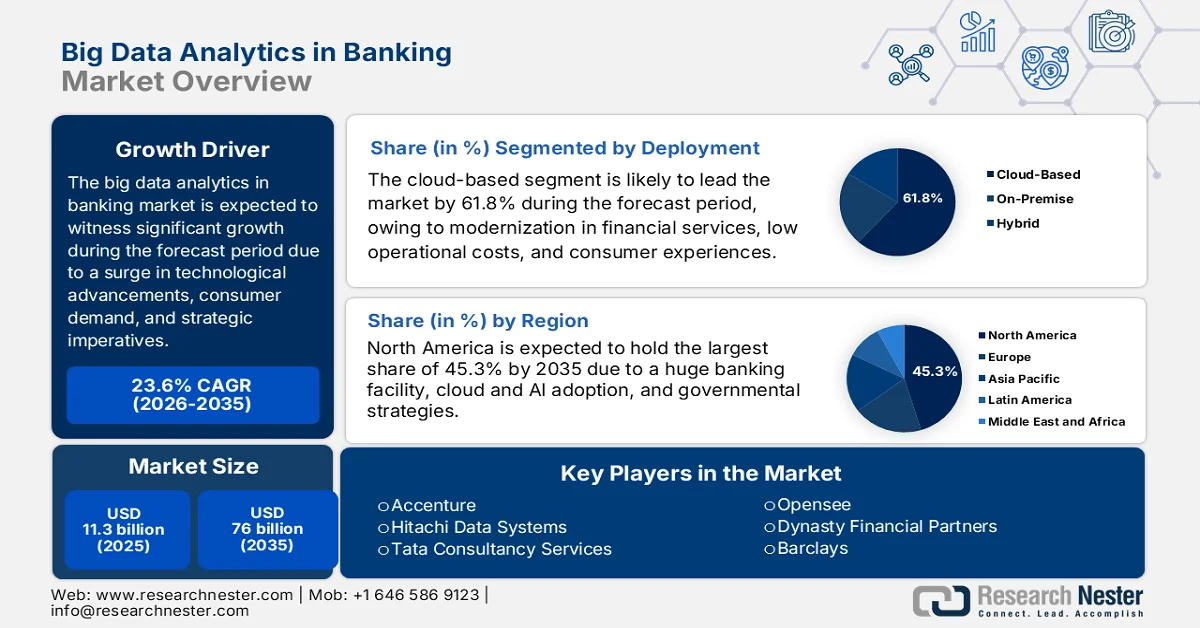
The global big data analytics in banking market is being readily reshaped by factors, including tactical imperatives, evolving consumer expectations, and technological advancements that expand beyond regulatory compliance and fraud detection. According to official statistics published by the SEC Government in March 2025, as of 2023, SWIFT effectively processed more than 44 million financial messages regularly and deliberately connecting over 11,000 financial institutions globally. In addition, the worldwide fintech investment has successfully reached more than USD 200 billion every year, which has positively reflected the finance industry’s growing importance. Besides, an estimated 59% of international foreign exchange reserves are held in the U.S. since 2024, which is positively impacting the market growth.
Furthermore, the autonomous and agentic AI financial operations, the emergence of multi-cloud and interoperable data architectures, and the transition from generative AI experimentation to consumer-centric and outcome-based AI are certain trends that are boosting the big data analytics in banking market worldwide. As stated in a data report published by the WJARR in May 2025, global banks at the highest maturity stage have effectively gained almost 25% revenue growth, along with 20% to 30% expense reductions, in comparison to institutions previously. Besides, the implementation of cloud-native platforms has ensured financial institutions to diminish their infrastructure costs by an average of 17% to 23%, while simultaneously optimizing consumer satisfaction metrics by 28%, thus making it suitable to make expansion in the market development across different regions.
Key Big Data Analytics in Banking Market Insights Summary:
Regional Highlights:
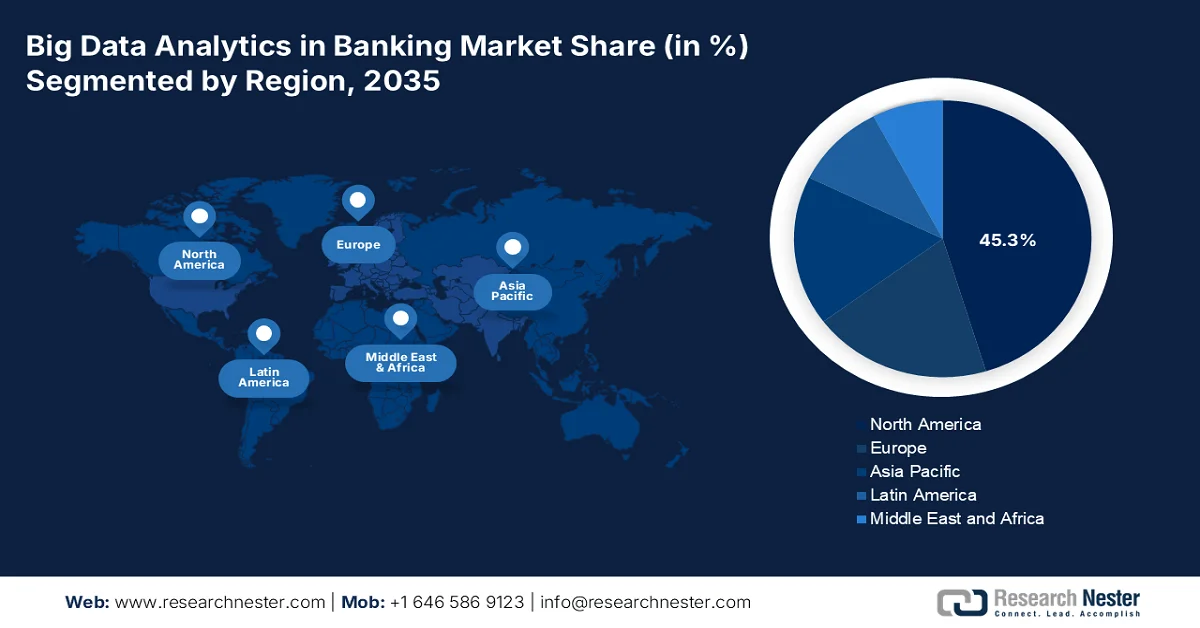
- North America big data analytics in banking market is projected to command a 45.3% share by 2035, attributed to advanced banking infrastructure, early AI and cloud adoption, and stringent regulatory compliance requirements
- Asia Pacific is poised to be the fastest-growing region over 2026–2035, propelled by rapid digital transformation, rising digital transactions, and expanding mobile and cloud banking adoption
Segment Insights:
- The cloud-based sub-segment in the big data analytics in banking market is anticipated to capture a 61.8% share by 2035, fueled by modernization of financial services, scalable infrastructure, and enhanced customer experience through continuous digital accessibility
- The artificial intelligence segment is expected to hold the second-largest share during the forecast period, impelled by improved fraud detection capabilities, operational efficiency, and personalized banking insights
Key Growth Trends:
- The imperative data monetization
- Escalation in open banking
Major Challenges:
- Data silos and legacy system integration
- Data privacy, security, and regulatory compliance
Key Players: IBM (U.S.), Microsoft (U.S.), Oracle (U.S.), SAP SE (Germany), Amazon Web Services (AWS) (U.S.), Google (U.S.), Teradata (U.S.), SAS Institute (U.S.), FICO (U.S.), Palantir Technologies (U.S.), Accenture (Ireland), Hitachi Data Systems (Japan), Tata Consultancy Services (TCS) (India), Infosys (India), H2O.ai (U.S.), Alteryx (U.S.), Splunk Enterprise (U.S.), Quantexa (UK), EXL (U.S.), Opensee (France), Dynasty Financial Partners (U.S.), Barclays (UK), CaxiaBank (Spain), Deutsche Bank (Germany)
Global Big Data Analytics in Banking Market Forecast and Regional Outlook:
Market Size & Growth Projections:
- 2025 Market Size: USD 11.3 billion
- 2026 Market Size: USD 13.9 billion
- Projected Market Size: USD 76 billion by 2035
- Growth Forecasts: 23.6% CAGR (2026-2035)
Key Regional Dynamics:
- Largest Region: North America (45.3% Share by 2035)
- Fastest Growing Region: Asia Pacific
- Dominating Countries: United States, China, United Kingdom, Germany, Japan
- Emerging Countries: India, Brazil, Indonesia, Vietnam, Mexico
Last updated on : 20 March, 2026
Big Data Analytics in Banking Market - Growth Drivers and Challenges
Growth Drivers
- The imperative data monetization: The tactical push for banks to monetize the massive and underutilized assets, along with data transformation for maintaining compliance, is positively driving the big data analytics in banking market globally. As per an article published by NLM in November 2022, the worldwide data monetization industry is valued at USD 2.1 billion, which is predicted to reach USD 15.5 billion by the end of 2030, along with a 22.1% growth rate. This industrial growth is highly driven by an increase in the generated data magnitude, emerging technological trends and opportunities, and data monetization awareness. These opportunities include Internet of Things (IoT), blockchain, cloud computing, and Business Intelligence and Analytics (BI&A), thus fueling the big data analytics in banking market expansion.
- Escalation in open banking: The evolution in open banking, powered by embedded finance, is yet another major growth for the big data analytics in banking market. Based on a data report published by OECD in 2022, over 90% of banking institutions have concluded API-based agreements with more than one electronic payment service providers due to the result of the Banking Law amendment. This particular aspect demands banks to effectively enable API connections within a certain duration after the law comes into effect. This particular framework led to an estimated 10% to 11% of digitally specific small businesses and consumers utilizing open banking in March 2022, denoting an upsurge by 6% to 7%. Additionally, there has been 11% of business penetration and 10% in retail, thereby denoting a huge growth opportunity for the market globally.
- Harnessing predictive intelligence for unstructured financial data: The ability to extract value from unstructured data, such as consumer service transcripts, contracts, emails, and documents, is becoming a crucial growth driver for the big data analytics in banking market. As stated in an article published by NLM in May 2024, different financial institutions have witnessed an increase in revenue, ranging between 5% and 15%, based on implementing customized approaches. Additionally, recognizing possible developmental measures for risks tends to diminish data-based risks, thereby making big data play an essential role in compliance and risk management. Moreover, big data also assists in developing the newest technologies, such as AI and blockchain, which is also proliferating the market expansion.
Challenges
- Data silos and legacy system integration: One of the most pervasive and persistent challenges in the big data analytics in banking market is the existence of fragmented data silos and outdated legacy infrastructure. Most established banks operate on core banking systems that were developed decades ago, often running on mainframe architectures that were never designed to communicate with modern cloud-native analytics platforms. Customer information, transaction histories, risk profiles, and product holdings are frequently scattered across disparate systems for retail banking, wealth management, credit cards, mortgages, and corporate banking, each with its own data formats, protocols, and access limitations. This fragmentation creates a fundamental obstacle to achieving the single customer view that is essential for effective personalization, cross-selling, and holistic risk assessment.
- Data privacy, security, and regulatory compliance: The highly regulated nature of the banking industry creates a complex web of compliance requirements that significantly complicate the deployment of the big data analytics in banking market solutions. Financial institutions must navigate a labyrinth of regulations, including the General Data Protection Regulation (GDPR) in Europe, the California Consumer Privacy Act (CCPA) in the U.S., the Gramm-Leach-Bliley Act (GLBA), Basel III capital requirements, Anti-Money Laundering (AML) directives, and numerous country-specific data sovereignty laws that mandate customer data remain within national borders. Each of these regulations imposes specific requirements on how data can be collected, stored, processed, and shared.
Big Data Analytics in Banking Market Size and Forecast:
| Report Attribute | Details |
|---|---|
|
Base Year |
2025 |
|
Forecast Year |
2026-2035 |
|
CAGR |
23.6% |
|
Base Year Market Size (2025) |
USD 11.3 billion |
|
Forecast Year Market Size (2035) |
USD 76 billion |
|
Regional Scope |
|
Big Data Analytics in Banking Market Segmentation:
Deployment Segment Analysis
The cloud-based sub-segment, part of the deployment segment, is anticipated to garner the largest share of 61.8% in the big data analytics in banking market by the end of 2035. The sub-segment’s upliftment is highly fueled by the aspects of modernizing financial services, providing optimized scalability, diminished operational expenses, along with enhanced superior customer experiences and security through 24/7 digital accessibility. Based on government estimates published by the PIB Government in June 2025, there has been an increase in internet connections in India from 251.5 million to 969.9 million as of 2024. Besides, 474,000 5G towers have been effectively installed, covering 99.6% of districts. Therefore, this enhanced internet installation significantly acts as a crucial and physical bridge that connects local devices to remote data centers, thereby serving as the essential facility for accessing cloud-based services.
Technology Segment Analysis
The artificial intelligence segment in the big data analytics in banking market is projected to account for the second-largest share during the forecast timeline. The segment’s growth is highly driven by enhancing operational efficacy, identifying fraud in real-time, and personalized customer experiences through predictive insights. According to official statistics published by the U.S. Department of the Treasury in December 2024, the Treasury’s Office of Payment Integrity within the Bureau of the Fiscal Service enhanced fraud detection processes by utilizing machine learning AI for expedition, resulting in USD 1 billion for recovering fraud and improper payments. Besides, 8 in 10, which is 78%, financial organizations have implemented generative AI, and 86% of organizations are expecting a moderate or significant increase in their model inventory, owing to this particular AI adoption, thus driving the segment’s growth.
Application Segment Analysis
By the end of the stipulated timeline, the fraud detection and management sub-segment, which is part of the application segment, is expected to hold the third-largest share in the big data analytics in banking market. The sub-segment’s development is highly propelled by the staggering scale of global financial crime and the increasing sophistication of criminal networks. Besides, the BIS Innovation Hub has been at the forefront of developing technological solutions, with projects such as Hertha demonstrating that payment system analytics can assist banks and payment service providers in identifying illicit accounts more effectively than they would otherwise identify, with particular effectiveness in spotting novel financial crime patterns. These analytics leverage advanced artificial intelligence and network analysis techniques to identify complex money laundering schemes that operate across multiple accounts and financial institutions.
Our in-depth analysis of the big data analytics in banking market includes the following segments:
|
Segment |
Subsegments |
|
Deployment |
|
|
Technology |
|
|
Application |
|
|
Component |
|
|
Analytics Type |
|
|
End user |
|

Vishnu Nair
Head - Global Business DevelopmentCustomize this report to your requirements — connect with our consultant for personalized insights and options.
Big Data Analytics in Banking Market - Regional Analysis
North America Market Insights
North America in the big data analytics in banking market is anticipated to garner the highest share of 45.3% by the end of 2035. The market’s upliftment in the region is highly driven by advanced banking infrastructure, early implementation of AI and cloud technologies, and the presence of a strict regulatory environment that significantly mandates sophisticated analytics for risk management and compliance. According to official statistics published by the International Monetary Fund in March 2024, the classification of banks in the region significantly follows the Federal Reserve’s supervisory and considers assets ranging between USD 10 billion and USD 100 billion. In addition, assets for large-scale banks in the region amount to USD 100 billion, as well as USD 10 billion for small-scale banks. This particular division tends to potentially result in a heterogeneous group of banks with different business models, thereby making it suitable for bolstering the market in the overall region.
The big data analytics in banking market in the U.S. is growing significantly, owing to modernization in investment, aggressive AI implementation, intensified competition from big tech and fintech, an increase in the consumer demand for personalization, and a tactical focus on security and data sovereignty. Based on government estimates published by the Federal Deposit Insurance Corporation (FDIC) in November 2025, almost 96% of households in the country are banked as of 2023. In addition, the 2023 FDIC National Survey of Unbanked and Underbanked Households demonstrated that 4.2% of households, representing 5.6 million households, effectively lacked a credit or bank union account. Besides, 66.2% of unbanked households depended on cash, while 33.8% relied on a combination of nonbank online payment services, including Cash App, Venmo, and PayPal, as well as prepaid cards, thus driving the big data analytics in banking market demand.
The growing adoption of data-based insights and fintech solutions, catalyzing innovation through regulatory evolutions, and the application of advanced analytics to core banking functions are certain factors that are bolstering the big data analytics in banking market in Canada. As stated in an article published by the NCFA in November 2025, the country has effectively moved forward with the Consumer-Driven Banking Act, with the Bank of Canada receiving USD 19.3 million for more than 2 years to develop and supervise the system. Besides, the USD 36.9 million previously provided investment to the Financial Consumer Agency of Canada (FCAC) is poised to be reprofiled to align with the transition. Moreover, to effectively support national security and cybersecurity functions, with USD 25.7 million for 5 years, along with USD 5 million to both the RCMP and CSIS, thus proliferating the market expansion.
APAC Market Insights
The Asia Pacific in the big data analytics in banking market is expected to emerge as the fastest-growing region during the forecast period. The market’s development in the region is highly propelled by rapid digital transformation across both emerging and mature economies, advancements in analytical insight, focus on cloud computing, mobile banking, a surge in digital transaction volumes, rise in smartphone penetration, and the presence of supportive government policies that are prompting digital finance. According to official statistics published by the Asia Banking and Finance in January 2026, the digital banking industry in the region is presently valued at USD 2.2 trillion in 2024, and is further projected to increase to USD 5.1 trillion by the end of 2033, along with a 9.4% growth rate. Therefore, with such development in the industry, there is a huge growth opportunity for the market in the overall region.
The big data analytics in banking market in China is gaining increased traction, owing to the existence of a huge banking industry, strong digital transformation, government-funded data infrastructure development, an integrated financing credit service platform network, enterprise-specific credit information, and accessibility to financial institutions. As per an article published by the State Council Information Office in June 2024, the overall assets of the country’s financial institutions increased by almost USD 66.9 trillion in March 2024. This deliberately demonstrates a year-on-year (YoY) increase by 8.5%, which denotes a huge growth opportunity for the market in the country. Besides, out of the total assets, the banking industry in the country effectively reached USD 62.3 trillion, denoting an 8.1% YoY, and meanwhile, assets of security institutions upsurged by 2.5% YoY to USD 2 trillion, thus creating an optimistic outlook for the big data analytics in banking market.
The aspects of digitalized public infrastructure, government-specific digital transformation, rapid fintech integration, increased accountability and transparency, and social media-based banking are certain factors that are developing the big data analytics in banking market in India. Based on government estimates published by the PIB Government in August 2025, the financial inclusion index has successfully risen to 67 as of 2025, denoting an increase by 24.3%. Besides, 559.8 million beneficiaries have been significantly registered under the Pradhan Mantri Jan Dhan Yojana, along with 665 million accounts have been opened within a month’s campaign for the Saturation of Financial Inclusion Schemes. Therefore, this increase in the index has effectively empowered the country, with the intention of initiating banking beyond branches, which is positively impacting the market growth.
Financial Inclusion Index Analysis in India (2021-2025)
|
Year |
Growth |
|
2021 |
53.9 |
|
2022 |
56.4 |
|
2023 |
60.1 |
|
2024 |
64.2 |
|
2025 |
67 |
Source: PIB Government
Europe Market Insights
Europe in the big data analytics in banking market is projected to witness considerable growth by the end of the stipulated duration. The market’s growth in the region is highly fueled by strict regulatory frameworks, escalation in digitalized transformation across financial institutions, and an increase in consumer demand for personalized banking services. According to official statistics published by the Europe Investment Bank in May 2023, 53% of firms in the region enhanced their digitalized presence in terms of offering services online between 2022 and 2023. Additionally, 69% of regional firms adopted digitalized technologies, such as big data analytics, AI, and advanced robotics. Moreover, 30% of microenterprises in the region significantly prioritized digitalization in comparison to 62% of large-scale firms, thereby making it suitable for bolstering the market in the region.
The big data analytics in banking market in Germany is gaining increased exposure, owing to the economic strength to provide substantial resources for technological investment across the banking industry, the existence of the domestic ecosystem for analytics deployment and development, along with the manufacturing strength and Industry 4.0 leadership. As stated in an article published by OECD in 2024, the scale-up finance policy is extremely targeted, with more than 80% of policy measures readily aiming to reach either 60.9% of firm populations or 21.7% of other targets. Besides, over 70% of the nation’s strategy to ensure suitable small and medium-sized enterprises accessibility for financing innovation processes, in comparison to 18% for generous investment. Therefore, with such developments in SME financing, the market is gradually expanding in the country.
A surge in digital transformation strategies, the continued evolution of London as a worldwide fintech facility, the widespread implementation of open banking standards, compelling conventional banks and fintech firms, the increased concentration of fintech talent and capital, and increased focus on financial innovation are responsible for boosting the big data analytics in banking market in the UK. Based on government estimates published by the UK Government in July 2025, financial services is one of the largest industries in the domestic economy, accounting for 9% of the overall economic output and offering 1.2 million employment opportunities across the country. Besides, the government’s approach to combat the Certification Regime through legislation and making necessary modifications to the banks’ Senior Managers Regime of almost 40% on average for insurers, thus fueling the market growth in the country.
Key Big Data Analytics in Banking Market Players:
- IBM (U.S.)
- Microsoft (U.S.)
- Oracle (U.S.)
- SAP SE (Germany)
- Amazon Web Services (AWS) (U.S.)
- Google (U.S.)
- Teradata (U.S.)
- SAS Institute (U.S.)
- FICO (U.S.)
- Palantir Technologies (U.S.)
- Accenture (Ireland)
- Hitachi Data Systems (Japan)
- Tata Consultancy Services (TCS) (India)
- Infosys (India)
- H2O.ai (U.S.)
- Alteryx (U.S.)
- Splunk Enterprise (U.S.)
- Quantexa (UK)
- EXL (U.S.)
- Opensee (France)
- Dynasty Financial Partners (U.S.)
- Barclays (UK)
- CaxiaBank (Spain)
- Deutsche Bank (Germany)
- Company Overview
- Business Strategy
- Key Product Offerings
- Financial Performance
- Key Performance Indicators
- Risk Analysis
- Recent Development
- Regional Presence
- IBM offers a comprehensive suite of AI-powered analytics solutions designed specifically for financial services, enabling banks to unify data across silos and derive actionable insights for fraud detection and risk management. The company's deep industry expertise and hybrid cloud approach allow financial institutions to deploy advanced analytics either on-premise or in the cloud, ensuring regulatory compliance while driving innovation.
- Microsoft provides financial institutions with a trusted cloud platform through Azure, delivering integrated analytics, AI, and business intelligence tools that help banks personalize customer experiences and optimize operations. The company's strong partnerships with leading system integrators and its commitment to regulatory compliance make Azure a preferred choice for banks undertaking large-scale digital transformation initiatives.
- Oracle offers a complete, pre-integrated analytics platform specifically tailored for the banking industry, combining powerful data management capabilities with built-in AI and machine learning for real-time risk analysis and compliance reporting. The company's cloud applications enable financial institutions to streamline operations, enhance customer insights, and accelerate innovation while maintaining the security and governance required in highly regulated environments.
- SAP SE delivers industry-specific analytics solutions that integrate seamlessly with core banking systems, providing financial institutions with a unified view of customer data, risk exposure, and operational performance across the enterprise. The company's focus on embedded analytics and real-time processing enables banks to make faster, more informed decisions while ensuring compliance with evolving regulatory requirements across global big data analytics in banking markets.
- Amazon Web Services (AWS) provides financial institutions with the most comprehensive and broadly adopted cloud platform, offering a wide array of analytics, machine learning, and data lake services that enable banks to process massive volumes of transaction data at scale. The company's secure, resilient infrastructure and extensive partner ecosystem help banks accelerate innovation, reduce costs, and bring new data-driven products to market faster while meeting stringent regulatory and compliance standards.
Here is a list of key players operating in the global big data analytics in banking market:
The competitive landscape of the big data analytics in banking market is characterized by a mix of established technology giants and specialized analytics firms. Leading players such as IBM, Microsoft, Oracle, and SAP dominate by offering comprehensive, cloud-based analytics platforms that integrate AI and machine learning for risk management, fraud detection, and customer personalization. These incumbents are pursuing aggressive strategies, including acquisitions to enhance capabilities, for instance, EXL's acquisition of ITI Data to expand data management expertise in banking. Besides, in March 2025, Dynasty Financial Partners expanded its investment banking business, demonstrating the development of the banking institutions, as well as the continued dynamic growth of its industry-leading platform, thereby proliferating the big data analytics in banking industry globally.
Corporate Landscape of the Big Data Analytics in Banking Market:
Recent Developments
- In February 2024, Barclays made development in its revised Climate Change Statement for making progress in its climate approaches and effectively focuses on clients proactively. This is projected to finance USD 1 trillion of the Sustainable and Transition Finance by the end of 2030.
- In June 2023, CaxiaBank introduced FXWallets, which is a banking service that permits consumers to open, immediately, and intuitively, and with no opening or maintenance expenses, as well as virtual accounts to receive and send global payments in over 50 currency pairs.
- In March 2023, Deutsche Bank significantly aimed for USD 576 billion in cumulative ESG-based investment and financing volumes as of 2025. This caters to new ambitions, including a corporate bank to support supply chain financing through USD 5.7 billion, along with USD 3.4 billion for an investment bank, and USD 8 billion to USD 11.5 billion for private bank Germany.
- Report ID: 8456
- Published Date: Mar 20, 2026
- Report Format: PDF, PPT
- Explore a preview of key market trends and insights
- Review sample data tables and segment breakdowns
- Experience the quality of our visual data representations
- Evaluate our report structure and research methodology
- Get a glimpse of competitive landscape analysis
- Understand how regional forecasts are presented
- Assess the depth of company profiling and benchmarking
- Preview how actionable insights can support your strategy
Explore real data and analysis
Frequently Asked Questions (FAQ)
About this Report
Connect with our Expert


Report, 2026-2035



Copyright @ 2026 Research Nester. All Rights Reserved.
