Instant Water Heater Market Outlook:
Instant Water Heater Market size was over USD 2.3 billion in 2025 and is anticipated to exceed USD 4 billion by the end of 2035, growing at over 5.8% CAGR during the forecast period, i.e., 2026-2035. In 2026, the industry size of instant water heater is assessed at USD 2.4 billion.
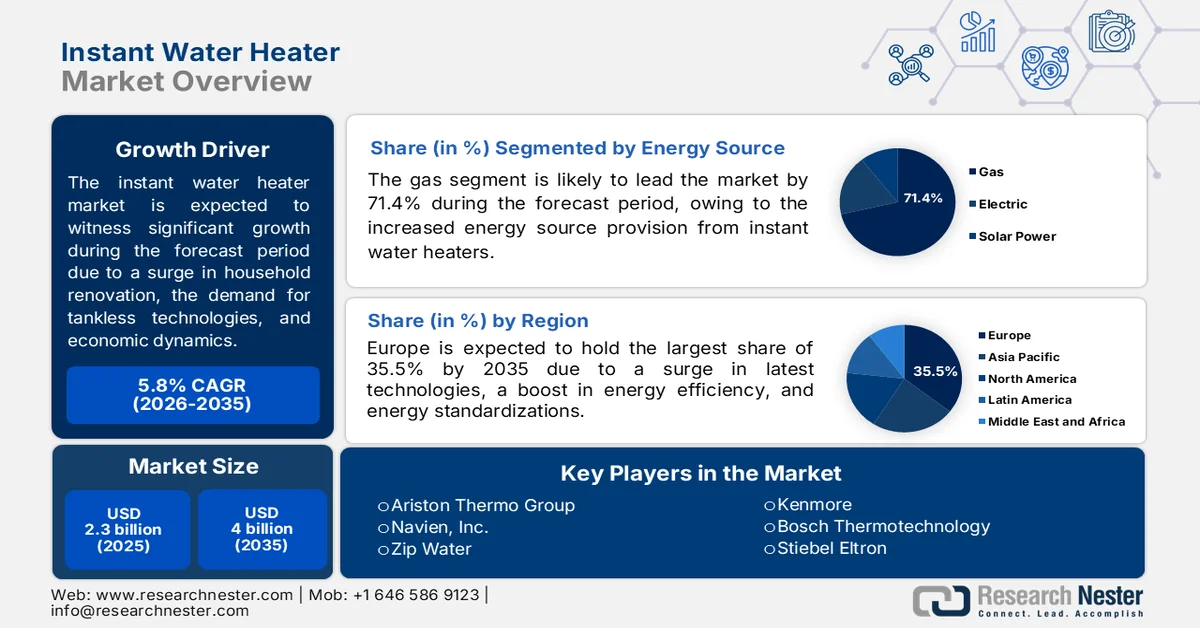
The global instant water heater market growth is driven by demographic transitions, climate variability, urban housing density regulations, the proliferation of home renovation, consumer awareness of tankless technologies, the demand for water heating systems, and economic impact on rental housing. According to official statistics published by OECD in 2022, there has been an increase in real house prices by more than 40%, with significant growth observed across Israel, New Zealand, Chile, Canada, Turkey, and Luxembourg, accounting for a surge by 75% as of 2022. In addition, in more than 20 nations, real house prices increased between 20% and 70% within the same timeline, with Poland, Korea, France, and Belgium recording a 14% mutual growth. Therefore, based on this growth in house prices, there has been a huge demand for electric-based instant water heaters, which denotes an optimistic outlook for the instant water heater market globally.
2024 Electric Instant, Immersion, and Storage Water Heater Global Export/Import Analysis
|
Countries/Components |
Export (USD) |
Import (USD) |
|
China |
1.2 billion |
- |
|
Mexico |
655 million |
- |
|
U.S. |
294 million |
929 million |
|
France |
- |
246 million |
|
Germany |
- |
236 million |
|
Global Trade Valuation |
4.2 billion |
|
|
Global Trade Share |
0.01% |
|
|
Product Complexity |
0.2 |
|
|
Export Growth |
2.0% |
|
Source: OEC
Furthermore, the integration with modular bathroom pods, rise in water heater services, the presence of direct-to-consumer digitalized showrooms, heat recovery systems from shower drain water, focus on bi-material heating chamber construction, and voice-specific temperature presets are a few trends that are responsible for driving the instant water heater market globally. As stated in an article published by the Department of Energy in May 2026, usually water heating readily accounts for almost 18% of a home’s energy utilization and is considered the second-largest energy expense. In this regard, consumers tend to lower water heating bills by utilizing less hot water and energy -saving approaches, while insulating water pipes and heaters, and purchasing an efficient model of water heater, thereby making it suitable for bolstering the market exposure across different regions.
Key Instant Water Heater Market Insights Summary:
Regional Highlights:
- Europe is projected to capture 35.5% share of the instant water heater market by 2035, reinforced by the replacement of outdated appliances alongside the adoption of smart heating technologies and energy-conservation standards
- North America is anticipated to witness the fastest growth throughout 2026-2035, accelerated by expanding commercial applications, rising gas-driven instant heater adoption, and increasing integration of app-controlled and Wi-Fi features
Segment Insights:
- The gas segment is estimated to dominate the instant water heater market with a 71.4% share by 2035, impelled by rising natural gas demand and the growing adoption of PNG- and LPG-powered tankless water heaters
- The point-of-use sub-segment is forecast to secure the second-largest share during 2026-2035, buoyed by localized hot water delivery that minimizes heat loss and water wastage
Key Growth Trends:
- Increase in water conservation
- Expansion of on-demand hot water
Major Challenges:
- High consumer sensitivity to electricity consumption
- Installation and infrastructure incompatibility
Key Players: Rinnai Corporation (Japan), Noritz Corporation (Japan), Takagi Industrial Co., Ltd. (Japan), Midea Group (China), Haier Group Corporation (China), A. O. Smith Corporation (U.S.), Rheem Manufacturing Company (U.S.), Bradford White Corporation (U.S.), Eccotemp Systems (U.S.), Kenmore (U.S.), Bosch Thermotechnology (Germany), Stiebel Eltron (Germany), Ariston Thermo Group (Italy), Navien, Inc. (South Korea), Zip Water (Australia), Crompton Greaves Consumer Electricals Ltd. (India), Bajaj Electricals Ltd. (India), Havells India Ltd. (India), V-Guard Industries Ltd. (India), Electrolux (Sweden), Ariston Group (Italy), Paloma Rheem Holdings Co., Ltd. (Japan).
Global Instant Water Heater Market Forecast and Regional Outlook:
Market Size & Growth Projections:
- 2025 Market Size: USD 2.3 billion
- 2026 Market Size: USD 2.4 billion
- Projected Market Size: USD 4 billion by 2035
- Growth Forecasts: 5.8% CAGR (2026-2035)
Key Regional Dynamics:
- Largest Region: Europe (35.5% Share by 2035)
- Fastest Growing Region: Asia Pacific
- Dominating Countries: United States, Germany, China, Japan, United Kingdom
- Emerging Countries: South Korea, Vietnam, Brazil, Mexico, Indonesia
Last updated on : 20 May, 2026
Instant Water Heater Market - Growth Drivers and Challenges
Growth Drivers
- Increase in water conservation: Governments across water-stressed locations have successfully expanded legislation by targeting hot water delivery systems for reducing wastage, which is positively impacting the instant water heater market growth globally. According to official statistics published by the Earth Organization in July 2023, more than 40% of the worldwide population is presently experiencing water shortages, and this is further predicted to expand in the upcoming years. Moreover, based on the August 2025 U.S. EPA Government article, an average family in America utilizes over 300 gallons of water every day, and an estimated 70% of this utilization occurs indoors. Likewise, outdoor water utilization caters to 30% of household usage, thereby increasingly focusing on water conservation technologies.
- Expansion of on-demand hot water: The aspect of consumer expectations for hot water availability and accessibility has fundamentally created a shift from scheduled utilization to ongoing demand, which is also fueling the instant water heater market. As stated in an article published by the MDPI in March 2024, economic and demographic growth are expected to result in a 55% increase in global water demand by the end of 2040. Besides, in terms of hot water demand, there was an upsurge between 8% and 16.4%, particularly in the residential sector, which demonstrated a 17% rise in hourly water utilization. Additionally, there has also been a consumption increase from 8.5% to 13.2%, along with 19.8% boost in consumed water, thereby denoting a huge growth opportunity for the instant water heater market.
Challenges
- High consumer sensitivity to electricity consumption: Despite being instant, these devices require high wattage to heat water on demand. This creates a fundamental consumer psychology barrier in the instant water heater market globally. Many households, particularly in price-sensitive markets, associate instant water heaters with spikes in monthly electricity bills. Unlike storage water heaters that heat once and retain warmth, instant units draw heavy power each time the tap opens. Besides, consumers often lack awareness about advanced energy-efficient technologies like electronic flow control or self-modulating heating elements. Consequently, they default to cheaper, lower-wattage storage heaters, believing those are more economical. This perception persists even when actual usage patterns, such as short bathing durations or low hot water volume needs, would favor instant technology.
- Installation and infrastructure incompatibility: The instant water heater market demands specific electrical and plumbing conditions that many residential buildings, especially older ones, do not meet. The most common roadblock is an inadequate wiring gauge. These units require thicker copper wiring to handle high amperage without overheating or tripping circuit breakers. In many developing nations and even in older urban housing stock of developed countries, bathrooms are wired with thinner conductors intended only for lighting and low-power devices. Moreover, retrofitting requires opening walls, replacing conduits, and hiring licensed electricians, which can cost more than the appliance price itself. Furthermore, instant heaters need dedicated earthing (grounding) for safety, which is frequently missing, thus restricting the market expansion.
Instant Water Heater Market Size and Forecast:
| Report Attribute | Details |
|---|---|
|
Base Year |
2025 |
|
Forecast Year |
2026-2035 |
|
CAGR |
5.8% |
|
Base Year Market Size (2025) |
USD 2.3 billion |
|
Forecast Year Market Size (2035) |
USD 4 billion |
|
Regional Scope |
|
Instant Water Heater Market Segmentation:
Energy Source Segment Analysis
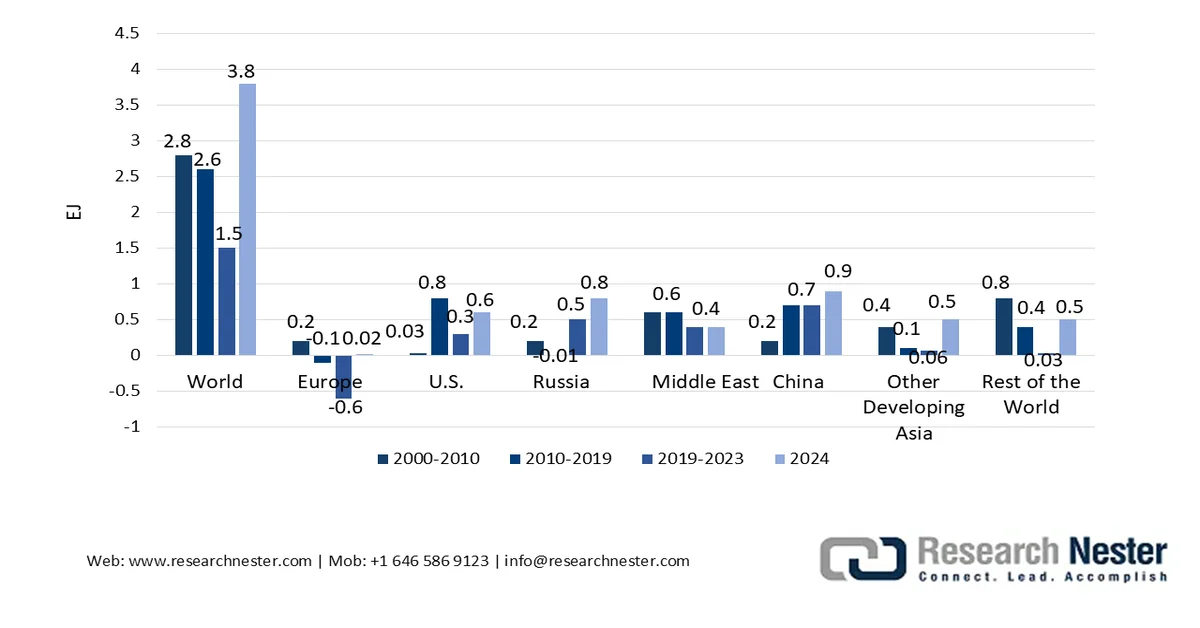
Based on the energy source, the gas segment is anticipated to grab the largest share of 71.4% in the instant water heater market by the end of 2035. The segment’s upliftment is highly fueled by its importance as the ultimate energy source that fuels instantaneous water heaters, such as tankless geysers, by burning either piped natural gas (PNG) or liquid petroleum gas (LPG). According to official statistics published by the IEA Organization in 2025, there has been an increase in the demand for natural gas by 2.7% or 115 billion cubic meters, which is readily equivalent to almost 4 EJ as of 2024. Based on this growing demand, development and emerging market economies, especially in Asia, catered to nearly 40% of additional gas demand in the same year due to ongoing economic upliftment, thereby making it suitable for driving the market’s growth across different regions.
Natural Gas Demand by Region, 2000-2024
Source: IEA Organization
Installation Type Segment Analysis
During the forecast period, the point-of-use sub-segment, part of the installation type, is projected to grab the second-largest share in the instant water heater market. The sub-segment’s growth is primarily driven by aligning perfectly with how consumers actually live. Most households require hot water at specific and isolated points, such as a shower and a kitchen sink, rather than throughout the entire home simultaneously. Besides, wall-mounted units mount directly above or near the point of demand, eliminating the long pipe runs that cause heat loss and water wastage in centralized systems. This localized approach means no energy is wasted heating water that cools down traveling through pipes, and no cold water is flushed down the drain while waiting for hot water to arrive.
Distribution Channel Segment Analysis
The offline sub-segment, which is part of the distribution channel segment, is expected to account for the third-largest share in the instant water heater market by the end of the stipulated timeline. The sub-segment’s development is highly propelled by the fundamental requirement of physical inspection before purchase. Unlike smartphones or headphones, an instant water heater involves tangible considerations that cannot be adequately conveyed through digital media: actual unit size relative to bathroom wall space, build quality feel of external casing material, tactile response of control knobs or digital interfaces, and visual matching with existing bathroom fixtures. Besides, consumers are eager to witness the unit mounted on a display wall to understand its real-world footprint, thus driving the sub-segment’s exposure.
Our in-depth analysis of the instant water heater market includes the following segments:
|
Segment |
Subsegments |
|
Energy Source |
|
|
Installation Type |
|
|
|
|
Product Type |
|
|
Application |
|
|
Capacity |
|

Vishnu Nair
Head - Global Business DevelopmentCustomize this report to your requirements — connect with our consultant for personalized insights and options.
Instant Water Heater Market - Regional Analysis
Europe Market Insights
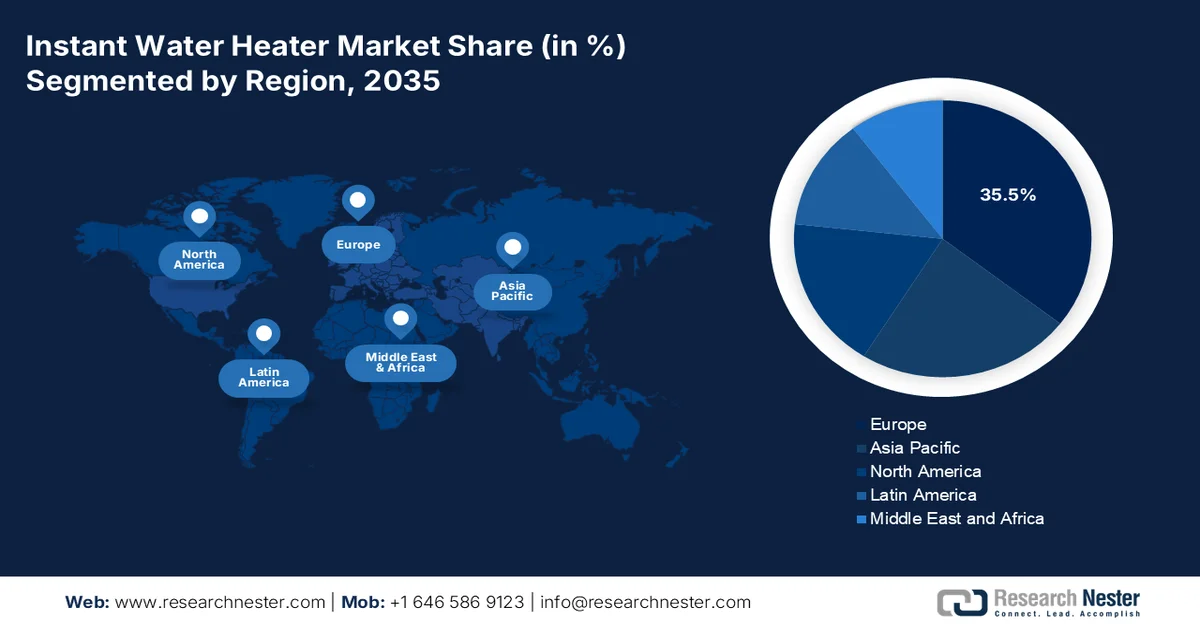
Europe in the instant water heater market is anticipated to account for the highest share of 35.5% by the end of 2035. The market’s upliftment is primarily attributed to the replacement of obsolete appliances as well as the launch of the newest technologies with boosted energy efficiency, the presence of condensing technology, smart heating technologies, and energy-conservation standards. According to official statistics published by Results in Engineering in September 2023, 60% of the advanced technology patent share resides in the region’s discrete manufacturing, which is followed by 30% in machinery and 15% in the electronics industry. Besides, the region comprises 2,678,772 manufacturing organizations, accounting for 6%, among the overall 44,336,484 regional companies. In this regard, the region constitutes superheated water boilers manufacturing and supply facilities, which are boosting the market’s exposure.
2024 Super-Heated Water Boilers Export and Import Analysis in Europe
|
Countries |
Export (USD) |
Import (USD) |
|
Finland |
64.9 million |
880,000 |
|
Germany |
22.6 million |
5.1 million |
|
Italy |
11.3 million |
1.4 million |
|
Austria |
10.8 million |
1.4 million |
|
Poland |
5.9 million |
2.2 million |
|
Switzerland |
4.4 million |
6.6 million |
|
Sweden |
3.9 million |
5.0 million |
|
Denmark |
3.6 million |
1.2 million |
|
Norway |
3.4 million |
1.1 million |
Source: OEC
The instant water heater market in Germany is growing significantly, owing to the dominant production, an increase in consumer base, a robust regulatory framework, technological leadership, and a surge in consumer awareness. As stated in an article published by the Renewable Energy Institute in July 2022, the Buildings Energy Act was revised in March 2024, with the objective of obligating Efficiency Standard 55 for the newest building construction in January 2023. In addition, the law also stipulated that the newly introduced heating systems are poised to offer 65% of the heating demand, especially from renewable energy sources. Moreover, the government is also focused on replacing old gas heating systems with heat pumps. Therefore, with such developments and administration contribution, the instant water heater market is continuously expanding in the country.
The escalated replacement cycle, robust policy support for energy transition, the growing demand for renewable integration, and suitable innovations in technology are certain factors that are responsible for fueling the instant water heater market in France. As per an article published by Business France in 2023, renewable energy is regarded as the third main source of energy in the country, accounting for a 15.4% energy mix share. Besides, the renewable energy production has nearly doubled due to continuous growth in biogas, heat pumps, photovoltaics, and wind power. Additionally, these sectors cater to only 3% of the primary production in the country, which represented 40% as of 2023. Moreover, this further indicated a 10.8% surge, in comparison to 2022, effectively accounting for 25% of overall primary energy production, thus enhancing the instant water heater market exposure.
North America Market Insights
North America in the instant water heater market is expected to emerge as the fastest-growing region during the forecast period. The market’s development in the region is highly propelled by the commercial application, which is fueled by fitness centers, restaurants, and hotels, the presence of gas-driven instant heaters, cost-effective natural gas, and the adoption of app-controlled and Wi-Fi features. According to official statistics published by the U.S. EPA Government in March 2026, the natural gas production, especially in the U.S., effectively reached the latest record, increasing from 5.3 to 118.5 billion cubic feet per day. Based on this growth, Haynesville, Permian, and Appalachia, altogether accounted for 67% of the overall marketed gas production in the country as of 2025, and witnessed an 81% growth in 2024. Therefore, this continuous natural gas production has led to the demand for instantaneous gas water heaters, which is positively fueling the instant water heater market in the overall region.
2024 Instantaneous Gas Water Heaters Export and Import Analysis in North America
|
Countries |
Export (USD) |
Import (USD) |
|
Mexico |
85.1 million |
125 million |
|
U.S. |
61.3 million |
731 million |
|
Canada |
7.1 million |
112 million |
|
Costa Rica |
51,400 |
1.0 million |
|
Guatemala |
22,600 |
533,000 |
|
El Salvador |
21,700 |
- |
|
Dominican Republic |
- |
3.0 million |
|
Panama |
- |
871,000 |
Source: OEC
The instant water heater market in the U.S. is gaining increased traction, owing to extreme fragmentation, an increase in housing construction, suitable electrical configurations, standardized storage facilities for water heaters, minimal space demand, and mounting orientations. As stated in an article published by the Census Government in April 2026, the country comprises 1,372,000 building permits, along with 1,502,000 housing facilities, and 1,366,000 housing completions. Besides, in terms of privately-owned housing, there has been a surge by 10.8% after the revised approximate of 1,353,000 in February and 1,355,000 target in March 2025. Simultaneously, single-family housing commences at a rate of 1,032,000, demonstrating a 9.7% increase from 941,000 in February, thereby denoting a huge growth opportunity for the market in the country.
The increased prevalence of seasonal secondary residences, the existence of conventional storage water benefits, continuous electricity supply to overcome freezing, maintaining pilot lights, the adoption of seasonal occupancy, massive landscape, and generous funding opportunities are a few trends that are fueling the instant water heater market in Canada. As per an article published by the Canada Center for Housing Rights in April 2024, there has been the provision of USD 15 billion for the Apartment Construction Loan Program, along with USD 6 billion for the newest Canada Housing Infrastructure Fund. Additionally, the country’s government has also offered USD 4.3 billion for more than 7 years to the Urban, Rural, and North-based Indigenous housing strategy, USD 1.5 billion for each of the latest Canada Rental Protection Fund and Co-operative Housing Development Program. Therefore, with such generous investment and funding programs, the market is gradually growing in the country.
APAC Market Insights
The Asia Pacific in the instant water heater market is projected to experience suitable growth and expansion by the end of the stipulated timeline. The market’s growth in the region is effectively driven by rapid urbanization, a rise in disposable incomes, an increase in the need for energy-efficient appliances, industrial expansion, and a rise in the middle-class population. Based on a data report published by the PIB Government in January 2022, electronics manufacturing in India has grown from USD 537.1 billion to USD 67.3 billion, owing to sustainable manufacturing encouragement by policymakers. Besides, the industry in the country is small-sized, with a domestic valuation of USD 75 billion, which is projected to reach USD 300 billion by the end of 2026. Therefore, with this increased focus on manufacturing, the market is expected to grow in the overall region.
The instant water heater market in China is gaining increased exposure, owing to the dominant production capacity, the massive presence of a domestic consumption base, suitable government support for energy efficiency, and technological advancements. As stated in an article published by the IEA SHC Organization in September 2024, there are 396,332 glazed water collectors in the country as of 2022. Additionally, the country, in general, accounts for 66.1% of worldwide new installations, along with 73.1% of overall installed capacity in operation. Meanwhile, the nation’s urbanization rate has improved, with the majority of inhabitants residing in cities, with suitable energy and electricity supplies even in remote rural locations. Besides, high-rise buildings have successfully replaced the actual ground-floor scattered buildings, thereby denoting an optimistic outlook for the market’s growth.
The aspects of energy consumption in households, governmental initiatives, suitable incentives for reducing financial burden, an increase in heat pump installation, suitable trade dynamics, and a robust position in adopting precise electronics components are a few factors that are enhancing the instant water heater market in Japan. As per a data report published by the Ministry of Economy, Trade, and Industry (METI) in January 2024, the space heating equipment caters to 55% of air conditioners in detached houses and 61% in apartments. Simultaneously, in the case of a water heater, heat pumps account for 25% in detached houses and 3% in apartments. Besides, the population in the country constitutes a habitual bath pattern, based on which water heaters effectively occupies 33% of the overall household energy consumption, thus ensuring differentiation in subsidy for owners, which positively impacts the market growth.
Subsidy Analysis for Owners in Japan, 2022-2023
|
Appliance Type |
Subsidy for Owners (2022) (USD per unit) |
Subsidy for Owners (2023) (USD per unit) |
|
Heat Pump Water Heater |
314 |
628.6 |
|
Hybrid Water Heater |
314 |
817.1 |
|
Residential Fuel Cell |
942.9 |
1,257.1 |
Source: METI
Key Instant Water Heater Market Players:
- Rinnai Corporation (Japan)
- Noritz Corporation (Japan)
- Takagi Industrial Co., Ltd. (Japan)
- Midea Group (China)
- Haier Group Corporation (China)
- A. O. Smith Corporation (U.S.)
- Rheem Manufacturing Company (U.S.)
- Bradford White Corporation (U.S.)
- Eccotemp Systems (U.S.)
- Kenmore (U.S.)
- Bosch Thermotechnology (Germany)
- Stiebel Eltron (Germany)
- Ariston Thermo Group (Italy)
- Navien, Inc. (South Korea)
- Zip Water (Australia)
- Crompton Greaves Consumer Electricals Ltd. (India)
- Bajaj Electricals Ltd. (India)
- Havells India Ltd. (India)
- V-Guard Industries Ltd. (India)
- Electrolux (Sweden)
- Ariston Group (Italy)
- Paloma Rheem Holdings Co., Ltd. (Japan)
- Company Overview
- Business Strategy
- Key Product Offerings
- Financial Performance
- Key Performance Indicators
- Risk Analysis
- Recent Development
- Rinnai Corporation holds a strong position in the instant water heater market through its advanced gas condensing technology and energy-efficient product portfolio. The company continues to expand its global footprint by focusing on residential and commercial applications across multiple continents.
- Noritz Corporation is recognized as a pioneer in tankless water heating, offering a comprehensive range of indoor and outdoor instant water heater models. The company differentiates itself through reliability and long product lifecycles, appealing to quality-conscious consumers worldwide.
- Takagi Industrial Co., Ltd. specializes exclusively in tankless water heaters, concentrating its engineering resources entirely on gas-fired instant heating systems. The company maintains a loyal customer base among homeowners and contractors who prioritize durability and consistent thermal performance.
- Midea Group leverages its massive manufacturing scale and vertical integration to offer competitively priced electric instant water heaters in emerging markets. The company invests in smart connectivity features, integrating its water heaters into broader home appliance ecosystems.
- Haier Group Corporation strengthens its instant water heater portfolio through continuous innovation in corrosion-resistant heating elements and compact structural designs. The company benefits from its extensive distribution network and after-sales service infrastructure across Asia and Europe.
Here is a list of key players operating in the global instant water heater market:
The global instant water heater market is highly competitive, characterized by the presence of established multinational corporations and agile regional specialists. Key players are increasingly focusing on energy efficiency and smart technology integration to gain an edge. Likewise, strategic initiatives include the development of condensing technology for gas units to achieve higher efficiency ratings, the incorporation of Wi-Fi and mobile app connectivity for usage monitoring, and the expansion of distribution networks in high-growth Asian markets. Besides, in December 2025, Ariston Group signed an agreement with subsidiaries of Carrier Global Corporation and successfully acquired 100% of the shares of Riello Group SpA as well as Riello America LLC. The purpose of this agreement was to strengthen the company’s role in Italy-based climate comfort industry and gradually enhance its worldwide expertise in combustion technologies, thus boosting the instant water heater industry.
Corporate Landscape of the Market:
Recent Developments
- In May 2026, Rinnai launched its latest wide-ranging production, additions, and initiatives in hot water heating units and heat pumps in the form of both electric and gas, along with a 12-year warranty, technical and design services, and electric storage heaters.
- In December 2025, Paloma Rheem Holdings Co., Ltd. and Groupe Atlantics signed an agreement under which Paloma acquired a majority stake in Atlantic to enhance international competition, ensure consumer focus, and enable commitment to innovation.
- In July 2024, Haier Smart Home successfully acquired Electrolux Group in Sweden, with the intention of grabbing 100% equity interest in Electrolux South Africa Proprietary Limited for an enterprise valuation of approximately USD 2.8 billion and readily engage in the water heater business.
- Report ID: 8575
- Published Date: May 20, 2026
- Report Format: PDF, PPT
- Explore a preview of key market trends and insights
- Review sample data tables and segment breakdowns
- Experience the quality of our visual data representations
- Evaluate our report structure and research methodology
- Get a glimpse of competitive landscape analysis
- Understand how regional forecasts are presented
- Assess the depth of company profiling and benchmarking
- Preview how actionable insights can support your strategy
Explore real data and analysis
Frequently Asked Questions (FAQ)
About this Report
Connect with our Expert


Report, 2026-2035



Copyright @ 2026 Research Nester. All Rights Reserved.
