Hispanic Food Market Outlook:
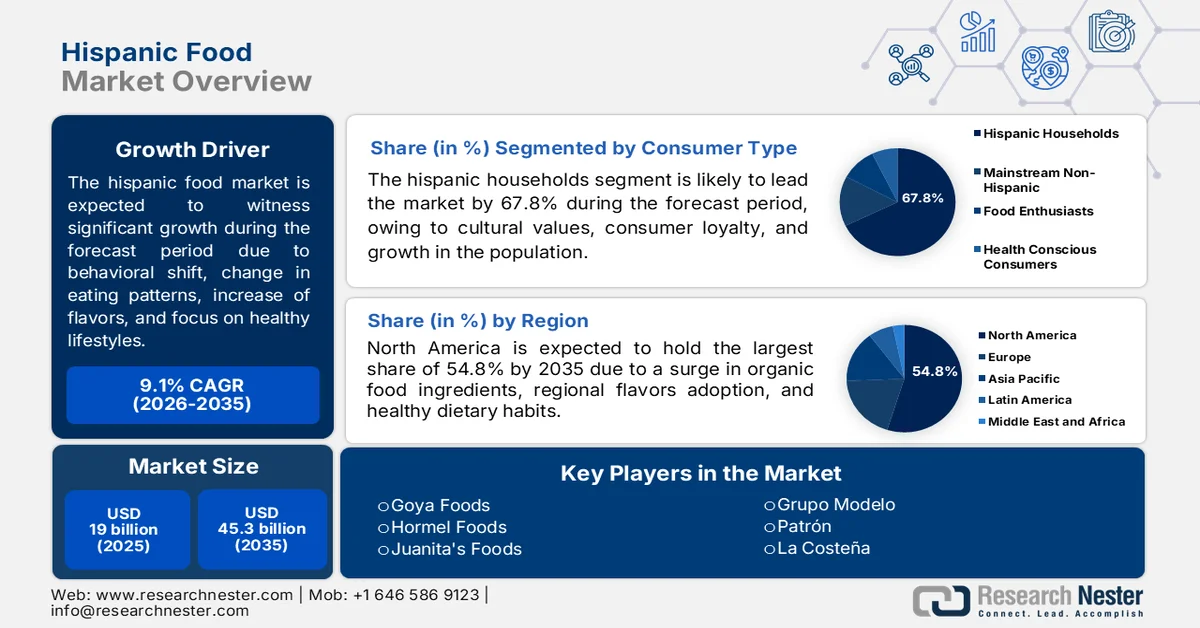
Hispanic Food Market size was valued at USD 19 billion in 2025 and is projected to reach USD 45.3 billion by the end of 2035, registering around 9.1% CAGR during the forecast period, i.e., 2026-2035. In 2026, the industry size of hispanic food is evaluated at USD 20.7 billion.
The worldwide hispanic food market is readily undergoing a fundamental shift, highly driven by three factors, including behavioral transformation among young consumers, an increase in GLP-1 medications and protein-based eating habits, along with mainstreaming food flavors that are overtaken by ethnic cuisines. According to official statistics published by NLM in January 2022, 81% of adolescents are increasingly interested in substituting localized foods with non-localized foods. Moreover, in terms of pricing strategy, this particular population are willing to replace non-local snacks with local alternatives, accounting for 10% of snacks and 5% of drinks. Besides, as per the January 2026 NLM article, there has been an increase by 700% for GLP-1 prescriptions, especially among people without diabetes as of 2023. This increase is fueled by strong clinical trial data efficiency, which is also responsible for driving the overall hispanic food market growth.
Furthermore, the gluten-free tortilla innovation for product reformulation, street food culture that is driving retail conversion, along with cross-cultural fusion products emerging as notable differentiator are a few trends that are also responsible for bolstering the hispanic food market globally. As stated in an article published by NLM in September 2025, expanded weather phenomena, such as flash droughts have deliberately led to 25% reduction in winter yields, particularly in the U.S., with similar declines in other regions. Based on this, there is a huge growing demand for gluten-free products, especially among the current population. These products include, millet, amaranth, sorghum, and quinoa, as well as legumes such as soybean, increasingly provide suitable options for expanding food systems, thus positively fueling the market upliftment.
2024 Soyabean Global Export and Import Analysis
|
Countries/Components |
Export (USD) |
Import (USD) |
|
Brazil |
44.5 billion |
- |
|
U.S. |
24.3 billion |
- |
|
Paraguay |
3.2 billion |
- |
|
China |
- |
47.6 billion |
|
Argentina |
- |
3.1 billion |
|
Mexico |
- |
3.0 billion |
|
Global Trade Valuation |
81.5 billion |
|
|
Global Trade Share |
0.2% |
|
Source: OEC
Key Hispanic Food Market Insights Summary:
Regional Highlights:
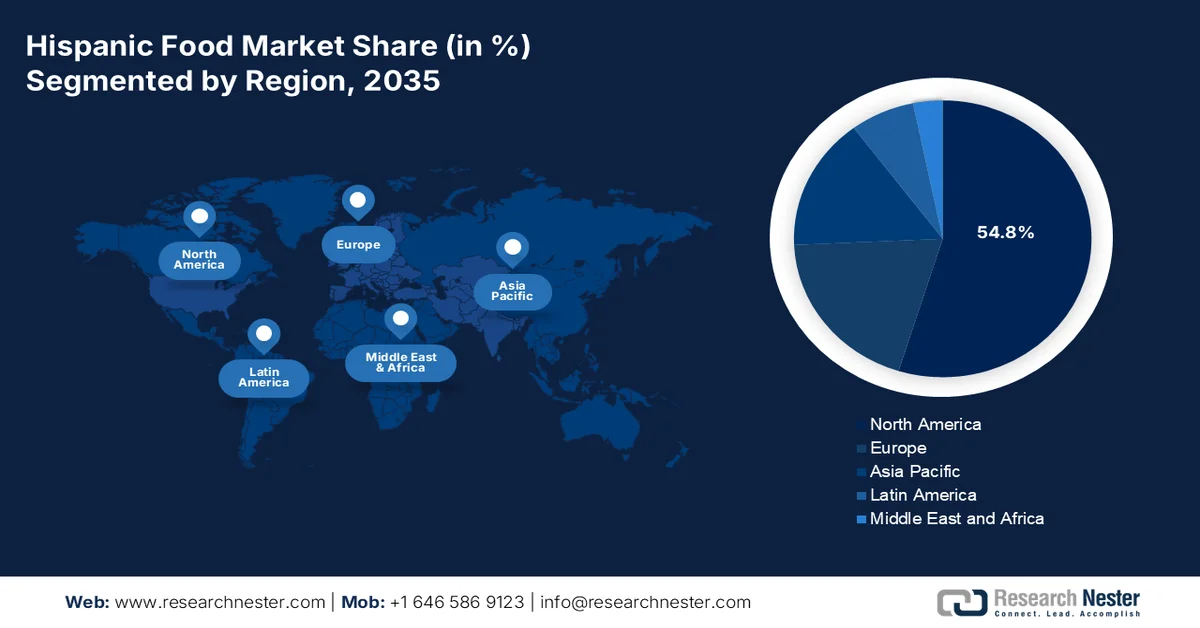
- North America region hispanic food market is forecast to account for 54.8% share by 2035, driven by the expanding Hispanic population base, rising preference for regional flavors, and heightened emphasis on food security across U.S. households
- Asia Pacific is anticipated to register the fastest growth in the market throughout 2026-2035, catalyzed by increasing globalization, higher middle-class disposable incomes, evolving dietary habits, and surging popularity of international cuisines
Segment Insights:
- The hispanic food market hispanic households segment is projected to capture 67.8% share by 2035, propelled by strong family-oriented purchasing behavior, rapid Hispanic population expansion, and heightened consumer loyalty
- The ambient/shelf-stable sub-segment is anticipated to secure the second-highest share in the market throughout 2026-2035, fueled by cost-efficient distribution, reduced spoilage risks, and the absence of cold-chain infrastructure requirements
Key Growth Trends:
- Lifestyle modification and urbanization
- Rising demand for protein-based meal solutions
Major Challenges
- Navigating evolving labeling regulations
- Second-generation consumer acculturation
Key Players: Kraft Heinz, ConAgra Brands, General Mills, PepsiCo (Frito-Lay), Gruma, Grupo Lala, Grupo Modelo, Patrón, La Costeña, Goya Foods, Hormel Foods, Juanita's Foods, Olé Mexican Foods, Insignia International (Flagship Food Group), 7-Eleven (Laredo Taco Company), Taco Bell (Yum! Brands), On The Border Mexican Grill & Cantina, Baja Fresh Mexican Grill, Del Taco, Bocadeli, El Latino, McCormick & Company Inc., Alsea, S.A.B. de C.V.
Global Hispanic Food Market Forecast and Regional Outlook:
Market Size & Growth Projections:
- 2025 Market Size: USD 19 billion
- 2026 Market Size: USD 20.7 billion
- Projected Market Size: USD 45.3 billion by 2035
- Growth Forecasts: 9.1% CAGR (2026-2035)
Key Regional Dynamics:
- Largest Region: North America (54.8% Share by 2035)
- Fastest Growing Region: Asia Pacific
- Dominating Countries: United States, Mexico, Spain, Canada, Brazil
- Emerging Countries: China, India, Germany, United Kingdom, Japan
Last updated on : 19 May, 2026
Hispanic Food Market - Growth Drivers and Challenges
Growth Drivers
- Lifestyle modification and urbanization: The continuous global urbanization approach has resulted to a substantial surge in the demand for convenient food stations and disposable incomes, which is proliferating the hispanic food market globally. According to official statistics published by the NIH in May 2025, an estimated 47.7% of adults in the U.S. were diagnosed with hypertension in August 2023, with an increased prevalence among 50.8% of men and 44.6% of women. Additionally, in the same year, roughly 40.3% of adults were categorized as obese, with enhanced 46.4% prevalence among individuals aged between 40 and 59 years. Besides, chronic kidney disease at present has affected 14% of the adult population, which further surged among 34% of individuals aged more than 65 years, thereby denoting a huge focus on healthy lifestyles.
- Rising demand for protein-based meal solutions: The boost in protein-specific eating patterns is effectively creating an increased demand for the hispanic food market, which is formulated with high protein food products. As stated in an article published by NLM in March 2024, the vegetable-based protein source increasingly dominates an estimated 60% of the global protein supply, with remaining contributions deriving animal-specific proteins, such as fish, dairy, poultry, and meat. Based on this, approximately 50% of proteins in the U.S. originates from animal products, wherein the per capita meat consumption is thrice the worldwide average. Therefore, with such increased focus on protein products, there is a huge growth and expansion opportunity for the market.
Challenges
- Navigating evolving labeling regulations: The hispanic food market operates at the intersection of increasingly complex food labeling requirements across different jurisdictions. Besides, labeling terms such as authentic, traditional, artisanal, and regional origin claims face varying degrees of regulatory scrutiny. Moreover, a product labeled as Mexican salsa may require specific documentation of ingredient sourcing or production methods if regulators begin enforcing stricter standards of identity. Health claims regarding traditional ingredients touted for wellness benefits face particular scrutiny, which is a brand marketing hibiscus tea for its blood pressure benefits could trigger FDA drug-claim enforcement if not carefully worded.
- Second-generation consumer acculturation: Second-generation hispanic consumers, those born in the destination country to immigrant parents, present a complex and paradoxical challenge. These consumers are fully bilingual, navigate mainstream American culture seamlessly, and hold significant purchasing power. However, their relationship with Hispanic foods differs fundamentally from their parents' generation. They may purchase Hispanic staples less frequently, substitute mainstream alternatives for convenience, or seek specific products only for holiday cooking rather than daily meals. They are also more likely to order Hispanic food from restaurants rather than prepare it at home using packaged ingredients. This behavioral shift threatens the volume base of retail packaged goods, thereby negatively impacting the hispanic food market growth.
Hispanic Food Market Size and Forecast:
| Report Attribute | Details |
|---|---|
|
Base Year |
2025 |
|
Forecast Year |
2026-2035 |
|
CAGR |
9.1% |
|
Base Year Market Size (2025) |
USD 19 billion |
|
Forecast Year Market Size (2035) |
USD 45.3 billion |
|
Regional Scope |
|
Hispanic Food Market Segmentation:
Consumer Type Segment Analysis
Based on the consumer type, the hispanic households segment is anticipated to garner the highest share of 67.8% in the hispanic food market by the end of 2035. The segment’s upliftment is primarily attributed to its importance to the U.S. economy and social fabric, highly fueled by robust family values, growing population, and increased consumer loyalty. According to official statistics published by Census Government in June 2024, the hispanic population significantly accounted for 71% of the total U.S. population growth, which is driven by a surge in hispanic births between 2022 and 2023. Besides, Hispanics of any race continued to grow by more than 65 million, demonstrating an upsurge of 1.1 million or 1.8% from the previous year. Additionally, this particular growth is effectively contributed to the country’s overall population benefit of 1.6 million as of 2023, thus positively impacting the segment’s growth.
Hispanic and Non-Hispanic Population Comparison in U.S. Metro Areas, 2022-2023
|
Metropolitan Area |
2023 Population |
2022-2023 Population Change |
2022-2023 Population Change % |
||||||
|
Total |
Non-Hispanic |
Hispanic |
Total |
Non-Hispanic |
Hispanic |
Total |
Non-Hispanic |
Hispanic |
|
|
Philadelphia-Camden-Wilmington |
6,246,160 |
5,565,228 |
680,932 |
3,414 |
-11,990 |
15,404 |
0.05% |
-0.2% |
2.3% |
|
Boston-Cambridge-Newton |
4,919,179 |
4,301,215 |
617,964 |
16,153 |
-511 |
16,664 |
0.3% |
-0.01% |
2.7% |
|
Riverside-San Bernardino-Ontario |
4,688,053 |
2,168,589 |
2,519,464 |
18,904 |
-19,836 |
38,740 |
0.4% |
-0.9% |
1.5% |
|
Sacramento-Roseville-Folsom |
2,420,608 |
1,863,156 |
557,452 |
3,349 |
-2,823 |
6,172 |
0.1% |
-0.1% |
1.1% |
|
Virginia Beach-Chesapeake-Norfolk |
1,787,169 |
1,639,844 |
147,325 |
1,779 |
-2,527 |
4,306 |
0.1% |
-0.1% |
3.0% |
|
Providence-Warwick |
1,677,803 |
1,419,704 |
258,099 |
4,217 |
-3,694 |
7,911 |
0.2% |
-0.2% |
3.1% |
|
Milwaukee-Waukesha |
1,560,424 |
1,369,479 |
190,945 |
1,296 |
-2,028 |
3,324 |
0.08% |
-0.1% |
1.7% |
|
Louisville/Jefferson County |
1,365,557 |
1,270,175 |
95,382 |
4,257 |
-84 |
4,341 |
0.3% |
-0.01% |
4.7% |
|
Salt Lake City-Murray |
1,267,864 |
1,009,387 |
258,477 |
1,340 |
-4,215 |
5,555 |
0.1% |
-0.4% |
2.2% |
|
Fresno |
1,180,020 |
521,438 |
658,582 |
4,332 |
-3,450 |
7,782 |
0.3% |
-0.66 |
1.2% |
|
Hartford-West Hartford-East Hartford |
1,151,543 |
962,510 |
189,033 |
3,493 |
-259 |
3,752 |
0.3% |
-0.03% |
2.0% |
Source: Census Government
Format Segment Analysis
During the forecast period, the ambient/shelf-stable sub-segment, part of the format segment, is projected to grab the second-highest share in the hispanic food market. The sub-segment’s growth is effectively driven by the logistical and economic advantages inherent to products that do not require cold-chain infrastructure for storage, transportation, or retail display. Besides, canned beans, jarred salsas, shelf-stable tortillas, dried chilies, and packaged rice can be distributed to any retail outlet, from premium urban supermarkets to rural convenience stores, without the need for expensive refrigerated or frozen display cases. This universal retail fit ensures deep market penetration across all geographic and socioeconomic tiers. Moreover, for retailers, shelf-stable products present minimal spoilage risk, extended inventory holding periods, and simplified supply chain management compared to fresh or frozen alternatives.
Distribution Channel Segment Analysis
The supermarkets and hypermarkets segment, which is part of the distribution channel, is expected to account for the third-highest share in the hispanic food market by the end of the stipulated timeline. The segment’s development is highly propelled by its necessity stemming from structural investments made by major retail chains over the past decade, which have systematically expanded multicultural shelf sections, product assortments, and promotional resources dedicated to hispanic foods. This commitment creates a powerful self-reinforcing cycle: broader and more authentic product ranges attract more hispanic shoppers, which in turn provides retailers with the sales justification for further category expansion. Moreover, the success of this channel is also rooted in the shopping preferences of hispanic consumers, thus proliferating the hispanic food market expansion.
Our in-depth analysis of the hispanic food market includes the following segments:
|
Segment |
Subsegments |
|
Consumer Type |
|
|
Format |
|
|
Distribution Channel |
|
|
Product Type |
|
|
Health & Wellness |
|
|
Packaging Type |
|

Vishnu Nair
Head - Global Business DevelopmentCustomize this report to your requirements — connect with our consultant for personalized insights and options.
Hispanic Food Market - Regional Analysis
North America Market Insights
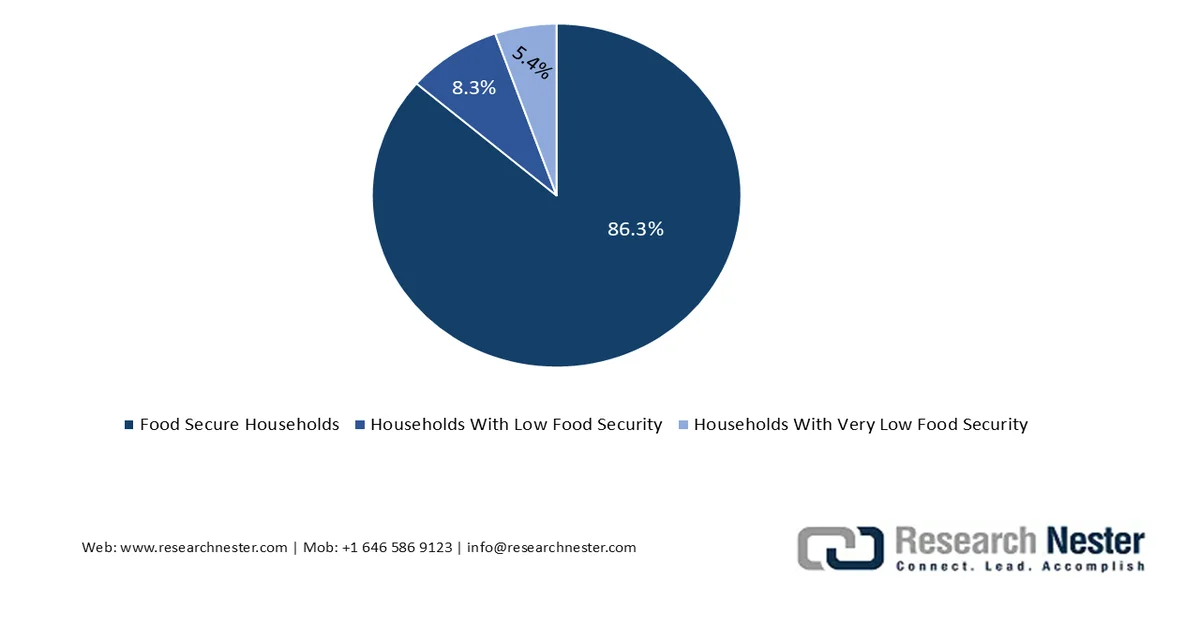
North America in the hispanic food market is anticipated to grab the largest share of 54.8% by the end of 2035. The market’s upliftment in the region is primarily attributed to expansion in the hispanic population base for creating the organic growth demand, along with consumers increasingly adopting regional flavors, which is part of their daily dietary patterns. According to official statistics published by NLM in December 2022, in terms of dietary patterns, approximately 14.8% households with children, which is 13.8 million, has effectively met food insecurities by the U.S. Department of Agriculture (USDA) Economic Research Service. In this regard, food insecurity was higher for 17.2% of hispanic and 7.1% of non-hispanic. Additionally, the prevalence among 15.3% children aged under 6 years was higher than the usual 10.5% of average U.S.-based households, thus enhancing the focus on food security, based on which the market demand in the region is high.
Food Security Status Across U.S. Households, 2024
Source: USDA Government
The hispanic food market in the U.S. is growing significantly, owing to expanded demographic scale and purchasing power, the adoption of home cooking by the young generation, as well as focus on fusion advancements and mainstream integration. As stated in a data report published by the USDA Government in February 2023, the U.S.-India fusion, as promoted by Social Ltd., readily procured 10 suitable domestic food ingredients for fusion food menu and significantly sold 990 fusion dishes across 8 restaurants, and also reached 12 million consumers through digital marketing solutions. Moreover, the organization procured a combination of 463 kilograms of different domestic-based ingredients, such as tree nuts, dried fruits, Washington apples, and duck. This particular fusion outperformed in Bangalore and New Delhi, thereby positively driving the hispanic food market growth.
U.S. Ingredients for Fusion Procurement, 2023
|
Ingredient Type |
Volume Utilized (kg) |
|
Walnuts |
30 |
|
Almonds |
30 |
|
Pecans |
30 |
|
Blueberries |
30 |
|
Pistachios |
30 |
|
Cranberries |
30 |
|
Duck |
36 |
|
Washington Apples |
147 |
|
Red Kidney Beans (Canned) |
100 |
|
Total |
463 |
Source: USDA Government
The rapid expansion in the multicultural population base, an increase in Latin America-based restaurant chain, growth in foodservice, and a surge in the interest for diversified flavors and worldwide cuisines are certain factors for fueling the hispanic food market in Canada. As per an article published by the Government of Canada in 2026, the Multiculturalism and Anti-Racism Program generously approved USD 14.1 million for more than 2 years to support 150 projects under the Organizational Capacity Building. In addition, the Program also offered USD 10.8 million for supporting 521 events across the country, with the objective to promote interfaith or intercultural understanding, celebrate a particular community’s culture and history, as well as understand suitable discussions on religious discrimination, diversity racism, and multiculturalism, thus denoting an optimistic outlook for the market expansion.
APAC Market Insights
The Asia Pacific in the hispanic food market is expected to emerge as the fastest-growing region during the forecast period. The market’s development in the region is highly propelled by increased globalization, a rise in the middle-class disposable incomes, changes in dietary preferences, and a surge in the popularity of global cuisines. According to official statistics published by the Asia Productivity Organization in February 2026, Chengdu, one of the major facilities in China’s food services sector, comprises more than 11,768 outlets and significantly employs an estimated 225,204 people as of 2023. The facility’s food service industry generated USD 18.9 billion in revenue as of 2024, which readily accounted for 5.8% of the gross domestic product (GDP). Additionally, the industry also catered to 2.4% of the country’s overall food services sector, thus denoting a huge growth opportunity for the market in the region.
The hispanic food market in Australia is gaining increased traction, owing to the presence of the massive multicultural population, the sustained demand for authentic ingredients, the sophisticated retail sector for embracing global food categories, the robust food and agricultural processing facility, and the regional trade dynamics for food imports. As stated in an article published by the Department of Agriculture, Fisheries, and Forestry (DAFF) in 2026, the agriculture economy of the country accounts for 68.3% of water consumption, which is 11,760 gigaliters between 2023 and 2024. In addition, the economy also comprises 57.1% of land utilization, which is 439 million hectares, followed by 12.4% of goods and services exports, amounting to USD 80.2 billion between 2024 and 2025. Likewise, the economy constitutes 2.2% of value-added GDP and 5.6% of rural employment, along with 2.1% of domestic employment, thus enhancing the market development in the country.
The aspects of the availability of international flavors, an expansion in the urban development for boosting restaurants from different regions, the strong internet infrastructure exposure, the government’s emphasis in increasing food tourism, developments in the food and beverage industry, and suitable trade dynamics are a few trends that are responsible for boosting the hispanic food market in Japan. As per an article published by the Europe-Japan Center for Industrial Corporation in 2026, the food and beverage industry in the country effectively represents almost USD 479.2 billion in consumer base as of 2023. Besides, based on the Ministry of Agriculture, Forestry and Fisheries, retail sales generously amounted to USD 310.8 billion by the end of 2024, along with USD 419.4 billion for wholesale, and USD 152.0 billion for the food service sector. Apart from these, the continuous boost in the domestic urbanization is also proliferating the market growth and demand in the country.
Japan Urbanization Trends, 2009-2025
|
Years |
Urban Population (Total %) |
|
2009-2010 |
66% |
|
2011-2012 |
67% |
|
2013-2014 |
91.3% |
|
2015-2016 |
93.5% |
|
2016-2017 |
94.3% |
|
2018-2020 |
91.6%-91.8% |
|
2021-2025 |
91.9%-92% |
Europe Market Insights
Europe in the hispanic food market is projected to witness suitable expansion by the end of the stipulated timeline. The market’s growth in the region is effectively fueled by the sudden shift from niche enthic stores to mainstream supermarkets, an expansion in the population, the influence of Spanish cuisine, focus on health by consuming staples, and an upsurge in quinoa cultivation. According to official statistics published by the Europe Commission in March 2022, the traditional cultivation areas of quinoa in the region are located in the Puno Region in Peru and the Southern Altiplano of Bolivia, accounting for 4,200 m and 3,650 m above sea level, respectively. Besides, the U.S. was the ultimate producer of this product, which the region continued the overall expansion process, thus positively contributing to the ongoing supply chain dynamics globally.
2024 Quinoa Export and Import Analysis in Europe
|
Countries |
Export (USD) |
Import (USD) |
|
Spain |
9.0 million |
7.9 million |
|
Netherlands |
8.1 million |
17.3 million |
|
Germany |
6.7 million |
19.9 million |
|
Italy |
6.6 million |
14.9 million |
|
Belgium |
4.1 million |
6.8 million |
|
France |
4.0 million |
11.9 million |
|
Slovenia |
1.2 million |
2.2 million |
|
Poland |
1.0 million |
2.1 million |
|
Austria |
1.0 million |
2.2 million |
|
Sweden |
971,000 |
2.0 million |
Source: OEC
The hispanic food market in the UK is gaining increased exposure, owing to the multicultural and diversified population, high development of the retail industry, availability of ingredients, rise in the ethnic food industry, growth in the foodservice sector, and the young population’s interest in global food trends. Based on government estimates published by the ITA in February 2026, the agri-food industry’s contribution to the country’s GDP was valued at USD 195 billion as of 2023. Besides, in 2025, 4.1 million domestic people were employed in the industry, accounting for 11.7% of the total employment. Moreover, there has been a surge in prices for non-alcoholic beverages by 4.5% in December 2025, and meanwhile the overall consumer spending on alcoholic drinks and food was worth USD 376.5 billion as of 2023. Therefore, based on all these aspects, the market is continuously expanding in the overall country.
The linguistic and historic association with Latin America culinary, significant immigration, an increase in the need for authentic regional ingredients, an expansion in the tourist destination, and the rapid modernization of the retail industry are certain trends that are proliferating the hispanic food market in Spain. As per a data report published by the USDA Government in November 2025, the food distribution industry in the country experienced an effective resurgence, with the launch of 244 newest stores between January and April 2025, demonstrating a 25% increase in comparison to 2024. Besides, the country’s overall agricultural products import reached USD 65.2 billion, and 57% of these imports originated from Europe. Moreover, the domestic food processing sector’s output valuation was worth USD 181 billion, with USD 57 billion for food exports, USD 18 billion for trade surplus, and 474,600 employees, thereby making it suitable for driving the hispanic food market growth.
Key Hispanic Food Market Players:
- Kraft Heinz (U.S.)
- ConAgra Brands (U.S.)
- General Mills (U.S.)
- PepsiCo (Frito-Lay) (U.S.)
- Gruma (Mexico)
- Grupo Lala (Mexico)
- Grupo Modelo (Mexico)
- Patrón (Mexico)
- La Costeña (Mexico)
- Goya Foods (U.S.)
- Hormel Foods (U.S.)
- Juanita's Foods (U.S.)
- Olé Mexican Foods (U.S.)
- Insignia International (Flagship Food Group) (U.S.)
- 7-Eleven (Laredo Taco Company) (U.S.)
- Taco Bell (Yum! Brands) (U.S.)
- On The Border Mexican Grill & Cantina (U.S.)
- Baja Fresh Mexican Grill (U.S.)
- Del Taco (U.S.)
- Bocadeli (El Salvador)
- El Latino (U.S.)
- McCormick & Company Inc. (U.S.)
- Alsea, S.A.B. de C.V (Mexico)
- Company Overview
- Business Strategy
- Key Product Offerings
- Financial Performance
- Key Performance Indicators
- Risk Analysis
- Recent Development
- Kraft Heinz maintains a measured presence in the hispanic food category through its core condiment and sauce portfolio. The company focuses on product consistency and shelf stability to serve mainstream consumers exploring Latin American flavors.
- ConAgra Brands addresses the hispanic food segment through its frozen meals and shelf-stable vegetable product lines. The company emphasizes convenience and household familiarity in its approach to multicultural offerings.
- General Mills operates in the hispanic food space primarily through its Old El Paso brand of Mexican-inspired meal kits and sauces. The company focuses on adapting traditional recipes for broader consumer appeal and ease of home preparation.
- PepsiCo (Frito-Lay) is part of the hispanic food market through its snack division, which produces tortilla chips and other Latin-inspired snack products. The company leverages its extensive distribution network to make these products widely available across retail formats.
- Gruma is a foundational player in the hispanic food market as a leading producer of corn flour and tortillas. The company supplies both retail consumers and foodservice operators with essential ingredients for traditional Latin American cooking.
Here is a list of key players operating in the global hispanic food market:
The global hispanic food market is highly competitive, with a mix of large multinational food corporations and specialized regional players. Key strategic initiatives include portfolio streamlining, where companies, such as Insignia International are focusing on core brands and discontinuing underperforming SKUs to improve efficiency. There is also a strong emphasis on product innovation, with major brands, including General Mills and PepsiCo investing in better-for-you and authentic offerings, such as organic and plant-based alternatives, to attract younger, health-conscious consumers. Besides, in January 2025, PepsiCo, Inc. successfully acquired Gazra Food Ventures LLC, dba Siete Foods for USD 1.2 billion. The purpose was to expand suitable choices for its consumers without compromising taste and readily transforming its portfolio, thus positively fueling the hispanic food industry globally.
Corporate Landscape of the Hispanic Food Market:
Recent Developments
- In April 2026, El Latino partnered with private equity firm, Apex Capital, indicating the inspiring and the newest milestone its growth objective by developing a robust foundation of quality, trust, and deep consumer relationships.
- In January 2026, McCormick & Company Inc. effectively acquired an additional 25%ownership-based interest in McCormick de Mexico from Grupo Herdez and further increased its ownership to 75%.
- In April 2025, Alsea, S.A.B. de C.V signed a development-specific agreement with Chipotle Mexican Grill to launch restaurants in Mexico, and the very-first location is projected to open within 2026, with suitable plans to explore industrial expansions in the country.
- Report ID: 8573
- Published Date: May 19, 2026
- Report Format: PDF, PPT
- Explore a preview of key market trends and insights
- Review sample data tables and segment breakdowns
- Experience the quality of our visual data representations
- Evaluate our report structure and research methodology
- Get a glimpse of competitive landscape analysis
- Understand how regional forecasts are presented
- Assess the depth of company profiling and benchmarking
- Preview how actionable insights can support your strategy
Explore real data and analysis
Frequently Asked Questions (FAQ)
About this Report
Connect with our Expert


Report, 2026-2035



Copyright @ 2026 Research Nester. All Rights Reserved.
