EV Battery Swapping Market Outlook:
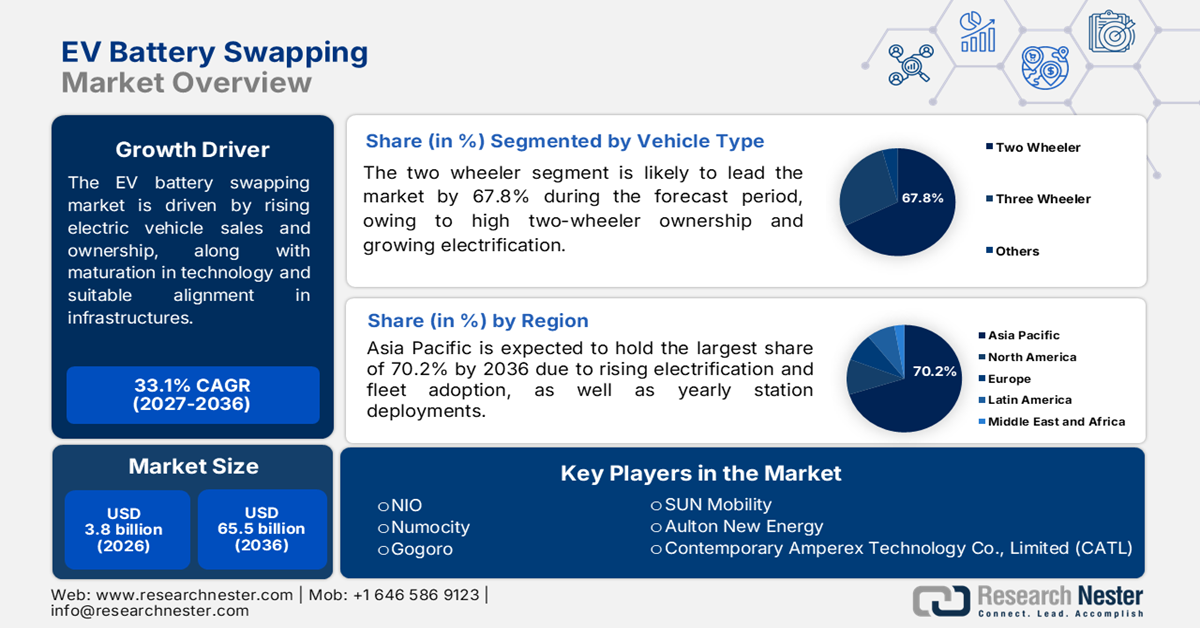
EV Battery Swapping Market size was over USD 3.8 billion in 2026 and is anticipated to exceed USD 65.5 billion by the end of 2036, growing at over 33.1% CAGR during the forecast period i.e., between 2027-2036. In 2027, the industry size of EV battery swapping is estimated at USD 5 billion.
The global market is continuously witnessing structural transformation through technology maturation, infrastructure realignment, fleet operational requirements, and an increase in vehicle ownership. According to an article published by the IEA in 2025, 17 million electric cars were purchased across nations as of 2024, representing an increase of over 25%. In addition, 3.5 million cars were sold in the same year, compared to 2023, effectively outnumbering overall sales. Based on this, China significantly maintained its position, with sales surpassing 11 million, which is more than the sales 2 years back. Likewise, sales also continued to increase in the U.S., accounting for 1/4th of the growth. Besides, there was a sudden boost in sales of almost 40%, reaching 1.3 million, which is close to 1.6 million U.S. sales, thus positively enhancing the market demand.
Global Electric Car Sales Analysis, 2020-2024
|
Country |
2020 (Million) |
2021 (Million) |
2022 (Million) |
2023 (Million) |
2024 (Million) |
|
China BEV |
0.9 |
2.7 |
4.4 |
5.4 |
6.4 |
|
China PHEV |
0.2 |
0.5 |
1.5 |
2.7 |
4.9 |
|
Europe BEV |
0.8 |
1.2 |
1.6 |
2.2 |
2.2 |
|
Europe PHEV |
0.6 |
1.1 |
1.0 |
1.0 |
1.0 |
|
U.S. BEV |
0.2 |
0.5 |
0.8 |
1.1 |
1.2 |
|
U.S. PHEV |
0.1 |
0.2 |
0.2 |
0.3 |
0.3 |
|
Rest of World BEV |
0.1 |
0.2 |
0.5 |
0.8 |
1.0 |
|
Rest of World PHEV |
0.1 |
0.1 |
0.1 |
0.2 |
0.3 |
Source: IEA
Furthermore, the presence of cross-brand networks, a surge in battery service models, and the existence of swap stations as distributed energy assets are a few trends that are responsible for bolstering the market globally. As stated in an article published by Transport Policy in August 2025, the maximum construction capacity for battery swapping stations, along with charging facilities, is poised to reach 62.4 thousand units and 28.3 million units, respectively. Besides, the growth in electric vehicle sales has been high in China, based on which the country has readily installed a total of 11.8 million charging stations. In addition, the number of battery electric vehicles reached 18.1 million as of June 2024 in the nation, owing to which there is a rise in battery swapping stations. Therefore, based on these trends, the market is continuously expanding across different regions.
Key EV Battery Swapping Market Insights Summary:
Regional Highlights:
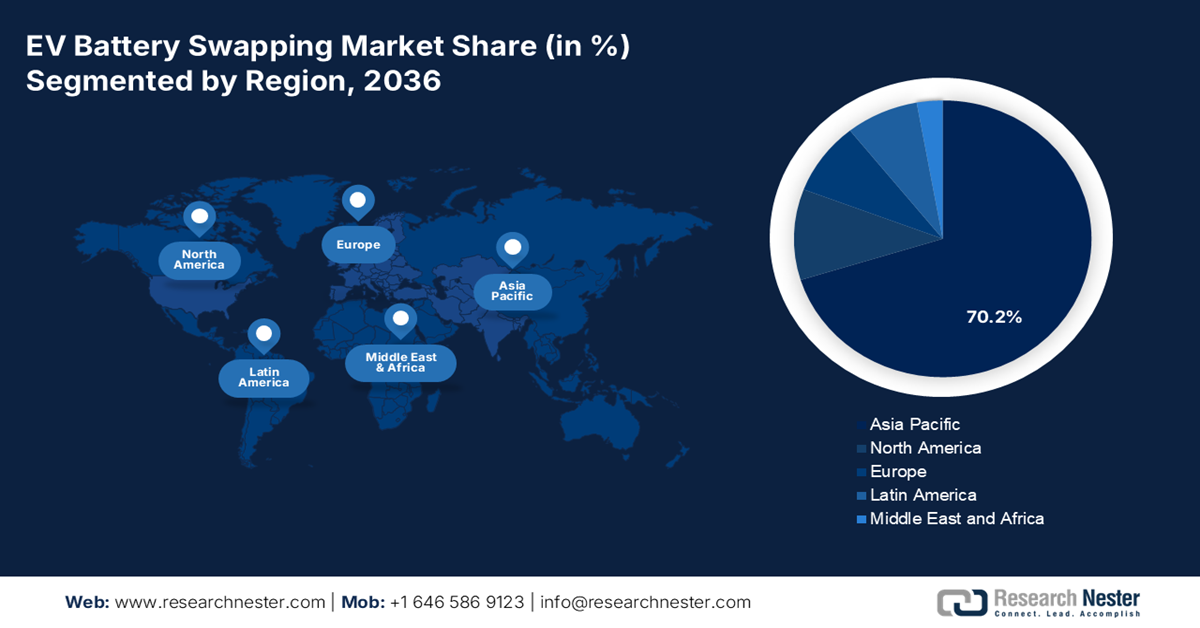
- Asia Pacific is projected to lead the EV battery swapping market with a 70.2% share by 2036, propelled by expanding station deployments, declining battery pack costs, and accelerating fleet electrification.
- Europe is anticipated to experience the fastest regional growth during the forecast period, driven by zero-emission mandates, rising battery replenishment demand, expanding battery services, and government-backed industrial investment.
Segment Insights:
- The two-wheeler segment is forecast to hold a 67.8% share of the EV battery swapping market by 2036, benefiting from affordable and flexible mobility solutions that support daily commuting, taxi operations, and last-mile delivery services while advancing fleet electrification.
- The subscription model sub-segment is poised for substantial growth during 2027-2036, owing to battery-as-a-service solutions that lower initial vehicle expenses, transfer battery ownership risks to providers, and offer predictable operating costs with convenient access to charged battery packs.
Key Growth Trends:
- Battery cost and consumer affordability
- Regulatory support and standardization progress
Major Challenges:
- Battery degradation and ownership risk
- Vehicle compatibility limitations
Key Players: Aulton New Energy, Gogoro, SUN Mobility, Numocity.
Global EV Battery Swapping Market Forecast and Regional Outlook:
Market Size & Growth Projections:
- 2026 Market Size: USD 3.8 billion
- 2027 Market Size: USD 5 billion
- Projected Market Size: USD 65.5 billion by 2036
- Growth Forecasts: 33.1% CAGR (2027-2036)
Key Regional Dynamics:
- Largest Region: Asia Pacific (70.2% share by 2036)
- Fastest Growing Region: Europe
- Dominating Countries: China, India, Japan, South Korea, United States
- Emerging Countries: Indonesia, Vietnam, Thailand, Germany, France
Last updated on : 25 September, 2026
EV Battery Swapping Market - Growth Drivers and Challenges
Growth Drivers
- Battery cost and consumer affordability: This particular driver constitutes an optimistic impact on battery and vehicle decoupling, which in turn is bolstering the EV battery swapping market globally. As per an article published by Alexandria Engineering Journal in September 2025, the U.S. Department of Energy declared a reduction in the payers’ pricing of lithium-ion batteries by almost 90% from USD 1,355 per kWh to USD 153 per kWh as of 2023. Simultaneously, the ICCT Organization projected the battery expense of USD 122 per kWh in 2023 to be lowered to USD 91 per kWh by the end of 2027 and further reduced to USD 67 per kWh by 2032. Besides, in the case of fuel cell vehicles and battery electric vehicles, the pack-level and cell-level battery expenses reached USD 84 and USD 70 per kWh, thus proliferating the market growth.
- Regulatory support and standardization progress: This is gradually removing the interoperability barriers that have historically fragmented the market. International frameworks currently address functional, interface, data, and operational interoperability, alongside compatibility with legacy systems and scalability requirements. Besides, regional standards efforts further reinforce this momentum, with technical specifications emerging for battery swap systems and mobile charging. While standards adoption still lags behind infrastructure deployment, the existence of formal frameworks reduces the risk that current investments will become stranded by incompatible future systems. This transition from proprietary experimentation to institutionalized infrastructure signals that battery swapping is maturing into a recognized and investable segment.
Challenges
- Battery degradation and ownership risk: Swappable batteries usually degrade over repeated charge-discharge cycles, and ownership of this risk creates operational challenges in the EB battery swapping market. Therefore, operators must manage battery health across a shared pool, replacing degraded packs before they compromise vehicle performance or safety. Besides, determining fair pricing for battery usage while accounting for degradation adds complexity to subscription and pay-per-use models. Moreover, disputes over battery condition between operators and users, unclear warranty coverage, and the difficulty of tracking individual pack history across multiple swaps further complicate operations. These factors increase costs and create friction in service delivery for both operators and end-users.
- Vehicle compatibility limitations: Most automakers design vehicles with fixed battery architectures optimized for plug-in charging, not swapping. Additionally, retrofitting existing EV models for swappable batteries requires significant engineering changes, structural modifications, and recertification, which manufacturers are reluctant to undertake. Hence, new vehicles must be designed from the ground up for swapping compatibility, limiting the addressable fleet to specific models from willing OEMs. This compatibility bottleneck restricts consumer choice, slows adoption, and forces swapping operators to partner with a narrow set of automakers, reducing competitive pressure and innovation across the broader EV battery swapping market.
EV Battery Swapping Market Size and Forecast:
| Report Attribute | Details |
|---|---|
|
Base Year |
2026 |
|
Forecast Period |
2027-2036 |
|
CAGR |
33.1% |
|
Base Year Market Size (2026) |
USD 3.8 billion |
|
Forecast Year Market Size (2036) |
USD 65.5 billion |
|
Regional Scope |
|
EV Battery Swapping Market Segmentation:
Vehicle Type Segment Analysis
The two wheeler segment is anticipated to garner the largest share of 67.8% in the market by the end of 2036. The segment’s upliftment is primarily attributed to the provision of flexible, cost-effective, crucial, and regular transportation by completing cross-town trips rapidly, in comparison to cars in heavy traffic. According to an article published by the International Council on Clean Transportation in December 2025, more than 85% of households, especially in Indonesia, Thailand, and Vietnam, along with over 50% of India-based households, effectively own two-wheelers. These particular vehicles readily serve diversified roles, primarily from daily commuting to taxi and last-mile delivery services in rural and urban areas. Besides, the electrification of the two-wheeler fleet is poised to ensure suitable benefits in decarbonizing the road transportation industry, thus boosting the segment.
Type Segment Analysis
The subscription model sub-segment, which is part of the type segment, is predicted to account for a considerable share in the EV battery swapping market during the forecast period. The sub-segment’s growth is effectively driven by significantly representing a battery-as-a-service offering where users pay recurring fees to access swappable batteries rather than purchasing them outright. Additionally, this particular model reduces upfront vehicle costs, transfers battery ownership and degradation risk to the service provider, and ensures users always have access to fully charged packs. Moreover, it appeals primarily to fleet operators and individual riders seeking predictable operating expenses and freedom from battery maintenance concerns, thus demonstrating a huge growth opportunity for the sub-segment.
Station Type Segment Analysis
By the end of the stipulated timeline, the automated sub-segment under the station type segment is expected to grab a suitable share in the EV battery swapping market. The sub-segment’s development is highly propelled by the ability to cover swapping stations that operate with minimal or no human intervention. These stations use robotic arms, automated guided vehicles, or mechanical systems to remove depleted batteries and install charged ones. Meanwhile, automation improves swap speed, reduces labor costs, enhances safety by eliminating manual handling, and enables continuous operation. Moreover, this sub-segment is gaining traction among high-volume fleet depots and urban locations where efficiency and throughput are critical, which is also responsible for bolstering the market.
Our in-depth analysis of the market includes the following segments:
|
Segment |
Subsegments |
|
Vehicle Type |
|
|
Type |
|
|
Station Type |
|

Vishnu Nair
Head - Global Business DevelopmentCustomize this report to your requirements — connect with our consultant for personalized insights and options.
EV Battery Swapping Market - Regional Analysis
APAC Market Insights
The Asia Pacific EV battery swapping market is anticipated to garner the highest share of 70.2% by the end of 2036. The market’s upliftment in the region is primarily attributed to an increase in yearly station deployments, reduced battery pack expenses, and an upsurge in fleet electrification. According to a data report published by the IEA Organization in June 2026, the demand for energy significantly increased by almost 40%, while electricity requirements also grew rapidly, particularly in Southeast Asia. Besides, there has been an increase in renewables, with fossil fuels continuing to dominate and meeting more than 70% of energy needs growth. Moreover, electrification accounted for 23% of finalized energy consumption, which is readily higher than the worldwide average, thereby making it suitable for positively impacting the market’s upliftment in the region.
The market in China is growing significantly, owing to the most mature infrastructure base, suitable electrification mandates, policy support by the government, and standardized battery interfaces. As stated in an article published by the Renewable Institute Organization in 2026, the 2026 to 2030 15th Five-Year Plan effectively identified energy storage as a notable enabler of massive solar and wind integration by setting an estimated target of 3.5 TW of overall renewable generation capacity by the end of 2030, which further includes over 2.8 TW of wind and solar. Additionally, the country has successfully commenced planning a substantial energy storage base, which reached 136 GW of operational new energy storage as of 2025. Therefore, based on these capacities, the market is continuously expanding in the overall nation.
The aspects of an increase in swap station installations, generous fund allocation, the regulatory push for interoperability, high-precision components, and an expansion in localized assembly are certain frameworks that are enhancing the EV battery swapping market in India. As per an article published by the PIB Government in August 2026, a total of USD 209,247.4 million (Rs. 2,000 crore) was allocated under the PM E-DRIVE Scheme. This is evidently suitable for deploying electric vehicle public charging stations across a pan-India basis. Besides, an overall 42,035 electric vehicles were purchased in Assam, which comprises 8,003 electric vehicles purchased in Cachar district. Additionally, a total of 40,009 electric vehicles have been significantly incentivized in the city with a reimbursement of USD 10.3 billion (₹ 99.10 crore), specifically for OEMs, thus positively uplifting the market in the country.
Europe Market Insights
Europe EV battery swapping market is expected to emerge as the fastest-growing region during the forecast period. The market’s development in the region is highly fueled by the demand for energy replenishments, the presence of zero-emission mandates, the availability of battery services, and organizational contributions. According to an article published by the European Commission in June 2026, the administrative body successfully established the new Battery Booster Facility C(2026) 3828/2. In addition, the body also mobilized almost USD 1.7 billion (€1.5 billion) from regional emissions trading system revenues. This particular fund provision assisted regional battery cell manufacturers to enhance production. Besides, this booster facility is focused on catalyzing private investment, expanding the region’s industrial competitiveness, and escalating industrial deployment, thus proliferating the market development.
The EV battery swapping market is gaining increased traction in Germany, owing to the existence of automotive headquarters, the presence of a logistics corridor network, funding programs for zero-emission commercial vehicle infrastructure, and the introduction of swapping platforms. As stated in an article published by the European Commission in January 2026, the EV incentive program has ensured transition to climate-friendly mobility by targeting households with low and middle incomes. In this regard, the country has significantly allocated an estimated USD 3.4 billion (€3 billion) towards an incentive scheme under the program. Through this allocation, the nation is focused on providing suitable support for approximately 800,000 vehicles by the end of 2029, thus creating a huge growth opportunity for the market to expand in the country.
The expansion of food delivery and ride-hailing platforms, government incentives under the Transition 5.0 plan, and a surge in rapid electrification are a few trends that are responsible for boosting the EV battery swapping market in Italy. As per a data report published by the European Alternative Fuel Observatory in January 2026, the electric vehicle sector in the country continuously displayed growing momentum, with battery electric vehicles (BEVs) and plug-in hybrid electric vehicles (PHEVs) jointly accounting for 12.7% of overall passenger car registrations. Besides, the overall passenger car industry effectively registered 1,525,722 new passenger cars as of 2025, while SUV registrations continued to dominate by accounting for almost 58% of registrations. Moreover, hybrids are continuing to be the powertrain in the nation and constituting 44.1% of registrations, which demonstrated an increase from 40% as of 2024, thus enhancing the market demand.
North America Market Insights
North America EV battery swapping market is projected to account for a considerable share by the end of the stipulated timeline. The market’s growth in the region is effectively driven by an increase in commercial vehicles, the objective to achieve zero-emission, the development of containerized and mobile swap units, and maintaining fleet vehicle utilization. According to an article published by the U.S. Environmental Protection Agency in February 2026, the fuel economy of new vehicles increased, especially in the U.S., by 0.1 mpg to a record high of 27.2 mpg as of 2024. In addition, the average new vehicle fuel economy has improved in 16 out of the previous 20 years and also surged by 41% in comparison to past years. Meanwhile, the production of vehicles and evolution in vehicle technology are also responsible for boosting the market exposure in the region.
The EV battery swapping market in the U.S. is gaining increased exposure, owing to operational efficiency for highly utilized commercial fleets, risk mitigation for two-wheelers, voluntary lock solutions, and a surge in battery production. As stated in an article published by the Department of Energy (DOE) in August 2026, the department announced an investment of USD 500 million for securing the overall region’s battery and critical mineral supply chains. Additionally, under this investment, projects are making advancements for expanding the domestic supply dynamics, which is followed by reducing dependency on international sources, making innovations in regional energy dominance, and boosting national security. Therefore, based on generous investment opportunities to increasingly focus on mineral and battery capacities, the market is expanding in the country.
Cold-climate battery degradation, the presence of electric vehicle models, reliability of charging facilities, generous fund provision for expanding battery life, and integration with circular energy ecosystems are certain trends that are responsible for enhancing the market in Canada. As per an article published by the Government of Canada in July 2026, the domestic automotive sector is at the forefront of undergoing a shift towards evolutionary supply chains, with over 90% of vehicles and 60% of auto parts presently exported to the U.S. As a result, the government initiated an investment of USD 70 million for strengthening the electric vehicle battery supply chain, particularly in Quebec. Additionally, the government also offered USD 760.9 million to Volta Energy Solutions Canada Inc. (VESC) for upgrading and ensuring the production of copper foil for battery cells, thus positively contributing to the market’s growth.
Key EV Battery Swapping Market Players:
- NIO (China)
- Contemporary Amperex Technology Co., Limited (CATL) (China)
- Aulton New Energy (China)
- Gogoro (Taiwan)
- SUN Mobility (India)
- Numocity (India)
- Company Overview
- Business Strategy
- Key Product Offerings
- Financial Performance
- Key Performance Indicators
- Risk Analysis
- Recent Development
- Regional Presence
- NIO manufactures electric vehicles with integrated battery swapping capability and operates its own Power Swap Station network as an end-market solution. The company offers Battery-as-a-Service subscriptions, allowing users to swap depleted packs for charged ones without owning the battery.
- Contemporary Amperex Technology Co., Limited (CATL) manufactures standardized swappable battery blocks under its EVOGO and Choco-SEB product lines for electric passenger and commercial vehicles. The company provides complete battery swapping solutions combining its swap blocks, station equipment, and service platform for fleet and consumer applications.
- Aulton New Energy manufactures automated battery swapping stations and operates a shared swapping network for multiple EV brands. The company focuses on fleet-oriented swap services with proprietary robotic technology and interoperable battery packs.
- Gogoro manufactures electric two-wheelers and operates the Gogoro Network, a battery swapping ecosystem for scooters and light electric vehicles. The company provides its swapping infrastructure and energy platform as a complete end-market solution for urban mobility.
- SUN Mobility manufactures modular battery swapping stations and smart batteries for electric two-wheelers, three-wheelers, and small commercial vehicles. The company delivers an interoperable swapping network as a service for fleet operators and individual riders.
Here is a list of key players operating in the global market:
The market is moderately consolidated, with a handful of vertically integrated players dominating station deployments and vehicle compatibility. Meanwhile, NIO leads globally through its battery-as-a-service model, while Ample focuses on modular, automaker-agnostic swapping stations. Likewise, CATL leverages its battery manufacturing scale through its EVOGO/Choco-SEB solutions, and Aulton operates an extensive station network across multiple China-based cities. Besides, in December 2024, CATL launched 2 standardized battery models, including #20 and #25, by effectively collaborating with almost 100 partners. This eventually demonstrated a standard step towards electric vehicle battery swapping, based on which the overall industry gained increased exposure.
Corporate Landscape of the Market:
Recent Developments
- In February 2026, NIO accomplished its 100 millionth battery swap by effectively delivering a user driver on an ET5 touring from China, based on constituting an average of 3 minutes and delivering cumulative energy through different swaps.
- In December 2023, Gogoro Inc. unveiled the battery swapping ecosystem in India and also launched a domestic crossover smartscooter, that were initially made available to B2B consumers in Goa and Delhi.
- In December 2023, Stellantis and Ample significantly signed a binding deal and established a partnership in electric vehicle battery charging technology, eventually capable of delivering a fully charged electric vehicle battery within 5 minutes.
- Report ID: 8765
- Published Date: Sep 25, 2026
- Report Format: PDF, PPT
- Explore a preview of key market trends and insights
- Review sample data tables and segment breakdowns
- Experience the quality of our visual data representations
- Evaluate our report structure and research methodology
- Get a glimpse of competitive landscape analysis
- Understand how regional forecasts are presented
- Assess the depth of company profiling and benchmarking
- Preview how actionable insights can support your strategy
Explore real data and analysis
Frequently Asked Questions (FAQ)
About this Report
Connect with our Expert


Report, 2027-2036



Copyright @ 2026 Research Nester. All Rights Reserved.
