Global Automotive Lithium-ion Battery Market
1. An Outline of the Global Automotive Lithium-ion Battery Market
1.1. Market Definition and Segmentation
1.2. Study Assumptions and Abbreviations
2. Research Methodology & Approach
2.1. Primary Research
2.2. Secondary Research
2.3. Data Triangulation
2.4. SPSS Methodology
3. Executive Summary
4. Growth Drivers
5. Major Roadblocks
6. Opportunities
7. Prevalent Trends
8. Government Regulation
9. Growth Outlook
10. Competitive White Space Analysis – Identifying Untapped Market Gaps
11. Risk Overview
12. SWOT
13. Technological Advancement
14. Technology Maturity Matrix for the Automotive Lithium-ion Battery Market: Recent News
15. Regional Demand
16. Global Automotive Lithium-ion Battery by Geography – Strategic Comparative Analysis
17. Strategic Segment Analysis: Automotive Lithium-ion Battery Demand Landscape
18. Automotive Lithium-ion Battery Demand Trends Driven by rising EV production, increasing charging infrastructure expansion, and continuous technological advancements. (2026-2035)
19. Root Cause Analysis (RCA) for discovering problems of the Automotive Lithium-ion Battery Market
20. Porter Five Forces
21. PESTLE
22. Comparative Positioning
23. Global Automotive Lithium-ion Battery – Key Player Analysis (2035)
24. Competitive Landscape: Key Suppliers/Players
25. Competitive Model: A Detailed Inside View for Investors
26. Company Market Share, 2035 (%)
26.1. Contemporary Amperex Technology Co., Limited (CATL) (China)
26.2. LG Energy Solution, Ltd. (South Korea)
26.3. Samsung SDI Co., Ltd. (South Korea)
26.4. SK On Co., Ltd. (South Korea)
26.5. Panasonic Holdings Corporation (Japan)
26.6. Prime Planet Energy & Solutions, Inc. (Japan)
26.7. GS Yuasa Corporation (Japan)
26.8. Toshiba Corporation (Japan)
26.9. Murata Manufacturing Co., Ltd. (Japan)
26.10. EnerSys (U.S.)
27. Global Automotive Lithium-ion Battery Market Outlook
27.1. Market Overview
27.1.1. Market Revenue by Value (USD billion), and Compound Annual Growth Rate (CAGR)
27.2. Automotive Lithium-ion Battery Market Segmentation Analysis (2026-2035)
27.2.1. By Battery Chemistry
27.2.1.1. Lithium Nickel Manganese Cobalt, Market Value (USD 2035), and CAGR, 2026-2035F
27.2.1.2. Lithium Iron Phosphate, Market Value (USD 2035), and CAGR, 2026-2035F
27.2.1.3. Lithium Nickel Cobalt Aluminum Oxide, Market Value (USD 2035), and CAGR, 2026-2035F
27.2.1.4. Lithium Manganese Oxide, Market Value (USD 2035), and CAGR, 2026-2035F
27.2.2. By Vehicle Type
27.2.2.1. Battery Electric Vehicles, Market Value (USD 2035), and CAGR, 2026-2035F
27.2.2.2. Plug-in Hybrid Electric Vehicles, Market Value (USD 2035), and CAGR, 2026-2035F
27.2.2.3. Hybrid Electric Vehicles, Market Value (USD 2035), and CAGR, 2026-2035F
27.2.3. By Capacity
27.2.3.1. Below 30 kWh, Market Value (USD 2035), and CAGR, 2026-2035F
27.2.3.2. 30 kWh to 60 kWh, Market Value (USD 2035), and CAGR, 2026-2035F
27.2.3.3. Above 60 kWh, Market Value (USD 2035), and CAGR, 2026-2035F
27.2.4. By Sales Channel
27.2.4.1. OEM Supply, Market Value (USD 2035), and CAGR, 2026-2035F
27.2.4.2. Aftermarket, Market Value (USD 2035), and CAGR, 2026-2035F
27.2.5. Regional Synopsis, Value (USD 2035), 2026-2035
27.2.5.1. North America Market Value (USD 2035) and CAGR & Y-o-Y Growth Trend, 2026-2035F
27.2.5.2. Europe Market Value (USD 2035) and CAGR & Y-o-Y Growth Trend, 2026-2035F
27.2.5.3. Asia Pacific, excluding Japan Market Value (USD 2035) and CAGR & Y-o-Y Growth Trend, 2026-2035F
27.2.5.4. Latin America Market Value (USD 2035) and CAGR & Y-o-Y Growth Trend, 2026-2035F
27.2.5.5. Middle East and Africa Market Value (USD 2035) and CAGR & Y-o-Y Growth Trend, 2026-2035F
28. North America Market
28.1. Overview
28.1.1. Market Value (USD 2035), Current and Future Projections, 2026-2035
28.1.2. Increment $ Opportunity Assessment, 2026-2035
28.2. Segmentation (USD 2035), 2026-2035, By
28.2.1. By Battery Chemistry
28.2.1.1. Lithium Nickel Manganese Cobalt, Market Value (USD 2035), and CAGR, 2026-2035F
28.2.1.2. Lithium Iron Phosphate, Market Value (USD 2035), and CAGR, 2026-2035F
28.2.1.3. Lithium Nickel Cobalt Aluminum Oxide, Market Value (USD 2035), and CAGR, 2026-2035F
28.2.1.4. Lithium Manganese Oxide, Market Value (USD 2035), and CAGR, 2026-2035F
28.2.2. By Vehicle Type
28.2.2.1. Battery Electric Vehicles, Market Value (USD 2035), and CAGR, 2026-2035F
28.2.2.2. Plug-in Hybrid Electric Vehicles, Market Value (USD 2035), and CAGR, 2026-2035F
28.2.2.3. Hybrid Electric Vehicles, Market Value (USD 2035), and CAGR, 2026-2035F
28.2.3. By Capacity
28.2.3.1. Below 30 kWh, Market Value (USD 2035), and CAGR, 2026-2035F
28.2.3.2. 30 kWh to 60 kWh, Market Value (USD 2035), and CAGR, 2026-2035F
28.2.3.3. Above 60 kWh, Market Value (USD 2035), and CAGR, 2026-2035F
28.2.4. By Sales Channel
28.2.4.1. OEM Supply, Market Value (USD 2035), and CAGR, 2026-2035F
28.2.4.2. Aftermarket, Market Value (USD 2035), and CAGR, 2026-2035F
28.2.5. Country Level Analysis, Value (USD 2035)
28.2.5.1. U.S. Market Value (USD 2035) and CAGR & Y-o-Y Growth Trend, 2026-2035F
28.2.5.2. Canada Market Value (USD 2035) and CAGR & Y-o-Y Growth Trend, 2026-2035F
29. Europe Market
29.1. Overview
29.1.1. Market Value (USD 2035), Current and Future Projections, 2026-2035
29.1.2. Increment $ Opportunity Assessment, 2026-2035
29.2. Segmentation (USD 2035), 2026-2035, By
29.2.1. By Battery Chemistry
29.2.1.1. Lithium Nickel Manganese Cobalt, Market Value (USD 2035), and CAGR, 2026-2035F
29.2.1.2. Lithium Iron Phosphate, Market Value (USD 2035), and CAGR, 2026-2035F
29.2.1.3. Lithium Nickel Cobalt Aluminum Oxide, Market Value (USD 2035), and CAGR, 2026-2035F
29.2.1.4. Lithium Manganese Oxide, Market Value (USD 2035), and CAGR, 2026-2035F
29.2.2. By Vehicle Type
29.2.2.1. Battery Electric Vehicles, Market Value (USD 2035), and CAGR, 2026-2035F
29.2.2.2. Plug-in Hybrid Electric Vehicles, Market Value (USD 2035), and CAGR, 2026-2035F
29.2.2.3. Hybrid Electric Vehicles, Market Value (USD 2035), and CAGR, 2026-2035F
29.2.3. By Capacity
29.2.3.1. Below 30 kWh, Market Value (USD 2035), and CAGR, 2026-2035F
29.2.3.2. 30 kWh to 60 kWh, Market Value (USD 2035), and CAGR, 2026-2035F
29.2.3.3. Above 60 kWh, Market Value (USD 2035), and CAGR, 2026-2035F
29.2.4. By Sales Channel
29.2.4.1. OEM Supply, Market Value (USD 2035), and CAGR, 2026-2035F
29.2.4.2. Aftermarket, Market Value (USD 2035), and CAGR, 2026-2035F
29.2.5. Country Level Analysis, Value (USD 2035)
29.2.5.1. UK Market Value (USD 2035) and CAGR & Y-o-Y Growth Trend, 2026-2035F
29.2.5.2. Germany Market Value (USD 2035) and CAGR & Y-o-Y Growth Trend, 2026-2035F
29.2.5.3. France Market Value (USD 2035) and CAGR & Y-o-Y Growth Trend, 2026-2035F
29.2.5.4. Italy Market Value (USD 2035) and CAGR & Y-o-Y Growth Trend, 2026-2035F
29.2.5.5. Spain Market Value (USD 2035) and CAGR & Y-o-Y Growth Trend, 2026-2035F
29.2.5.6. Netherlands Market Value (USD 2035) and CAGR & Y-o-Y Growth Trend, 2026-2035F
29.2.5.7. Russia Market Value (USD 2035) and CAGR & Y-o-Y Growth Trend, 2026-2035F
29.2.5.8. Switzerland Market Value (USD 2035) and CAGR & Y-o-Y Growth Trend, 2026-2035F
29.2.5.9. Poland Market Value (USD 2035) and CAGR & Y-o-Y Growth Trend, 2026-2035F
29.2.5.10. Belgium Market Value (USD 2035) and CAGR & Y-o-Y Growth Trend, 2026-2035F
29.2.5.11. Rest of Europe Market Value (USD 2035) and CAGR & Y-o-Y Growth Trend, 2026-2035F
30. Asia Pacific Market
30.1. Overview
30.1.1. Market Value (USD 2035), Current and Future Projections, 2026-2035
30.1.2. Increment $ Opportunity Assessment, 2026-2035
30.2. Segmentation (USD 2035), 2026-2035, By
30.2.1. By Battery Chemistry
30.2.1.1. Lithium Nickel Manganese Cobalt, Market Value (USD 2035), and CAGR, 2026-2035F
30.2.1.2. Lithium Iron Phosphate, Market Value (USD 2035), and CAGR, 2026-2035F
30.2.1.3. Lithium Nickel Cobalt Aluminum Oxide, Market Value (USD 2035), and CAGR, 2026-2035F
30.2.1.4. Lithium Manganese Oxide, Market Value (USD 2035), and CAGR, 2026-2035F
30.2.2. By Vehicle Type
30.2.2.1. Battery Electric Vehicles, Market Value (USD 2035), and CAGR, 2026-2035F
30.2.2.2. Plug-in Hybrid Electric Vehicles, Market Value (USD 2035), and CAGR, 2026-2035F
30.2.2.3. Hybrid Electric Vehicles, Market Value (USD 2035), and CAGR, 2026-2035F
30.2.3. By Capacity
30.2.3.1. Below 30 kWh, Market Value (USD 2035), and CAGR, 2026-2035F
30.2.3.2. 30 kWh to 60 kWh, Market Value (USD 2035), and CAGR, 2026-2035F
30.2.3.3. Above 60 kWh, Market Value (USD 2035), and CAGR, 2026-2035F
30.2.4. By Sales Channel
30.2.4.1. OEM Supply, Market Value (USD 2035), and CAGR, 2026-2035F
30.2.4.2. Aftermarket, Market Value (USD 2035), and CAGR, 2026-2035F
30.2.5. Country Level Analysis, Value (USD 2035)
30.2.5.1. China Market Value (USD 2035) and CAGR & Y-o-Y Growth Trend, 2026-2035F
30.2.5.2. Japan Market Value (USD 2035) and CAGR & Y-o-Y Growth Trend, 2026-2035F
30.2.5.3. India Market Value (USD 2035) and CAGR & Y-o-Y Growth Trend, 2026-2035F
30.2.5.4. South Korea Market Value (USD 2035) and CAGR & Y-o-Y Growth Trend, 2026-2035F
30.2.5.5. Australia Market Value (USD 2035) and CAGR & Y-o-Y Growth Trend, 2026-2035F
30.2.5.6. Indonesia Market Value (USD 2035) and CAGR & Y-o-Y Growth Trend, 2026-2035F
30.2.5.7. Malaysia Market Value (USD 2035) and CAGR & Y-o-Y Growth Trend, 2026-2035F
30.2.5.8. Vietnam Market Value (USD 2035) and CAGR & Y-o-Y Growth Trend, 2026-2035F
30.2.5.9. Thailand Market Value (USD 2035) and CAGR & Y-o-Y Growth Trend, 2026-2035F
30.2.5.10. Singapore Market Value (USD 2035) and CAGR & Y-o-Y Growth Trend, 2026-2035F
30.2.5.11. New Zealand Market Value (USD 2035) and CAGR & Y-o-Y Growth Trend, 2026-2035F
30.2.5.12. Rest of Asia Pacific Excluding Japan Market Value (USD 2035) and CAGR & Y-o-Y Growth Trend, 2026-2035F
31. Latin America Market
31.1. Overview
31.1.1. Market Value (USD 2035), Current and Future Projections, 2026-2035
31.1.2. Increment $ Opportunity Assessment, 2026-2035
31.1.3. Year-on-Year Growth Forecast (%)
31.2. Segmentation (USD 2035), 2026-2035, By
31.2.1. By Battery Chemistry
31.2.1.1. Lithium Nickel Manganese Cobalt, Market Value (USD 2035), and CAGR, 2026-2035F
31.2.1.2. Lithium Iron Phosphate, Market Value (USD 2035), and CAGR, 2026-2035F
31.2.1.3. Lithium Nickel Cobalt Aluminum Oxide, Market Value (USD 2035), and CAGR, 2026-2035F
31.2.1.4. Lithium Manganese Oxide, Market Value (USD 2035), and CAGR, 2026-2035F
31.2.2. By Vehicle Type
31.2.2.1. Battery Electric Vehicles, Market Value (USD 2035), and CAGR, 2026-2035F
31.2.2.2. Plug-in Hybrid Electric Vehicles, Market Value (USD 2035), and CAGR, 2026-2035F
31.2.2.3. Hybrid Electric Vehicles, Market Value (USD 2035), and CAGR, 2026-2035F
31.2.3. By Capacity
31.2.3.1. Below 30 kWh, Market Value (USD 2035), and CAGR, 2026-2035F
31.2.3.2. 30 kWh to 60 kWh, Market Value (USD 2035), and CAGR, 2026-2035F
31.2.3.3. Above 60 kWh, Market Value (USD 2035), and CAGR, 2026-2035F
31.2.4. By Sales Channel
31.2.4.1. OEM Supply, Market Value (USD 2035), and CAGR, 2026-2035F
31.2.4.2. Aftermarket, Market Value (USD 2035), and CAGR, 2026-2035F
31.2.5. Country Level Analysis, Value (USD 2035)
31.2.5.1. Brazil Market Value (USD 2035) and CAGR & Y-o-Y Growth Trend, 2026-2035F
31.2.5.2. Argentina Market Value (USD 2035) and CAGR & Y-o-Y Growth Trend, 2026-2035F
31.2.5.3. Mexico Market Value (USD 2035) and CAGR & Y-o-Y Growth Trend, 2026-2035F
31.2.5.4. Rest of Latin America Market Value (USD 2035) and CAGR & Y-o-Y Growth Trend, 2026-2035F
32. Middle East & Africa Market
32.1. Overview
32.1.1. Market Value (USD 2035), Current and Future Projections, 2026-2035
32.1.2. Increment $ Opportunity Assessment, 2026-2035
32.1.3. Year-on-Year Growth Forecast (%)
32.2. Segmentation (USD 2035), 2026-2035, By
32.2.1. By Battery Chemistry
32.2.1.1. Lithium Nickel Manganese Cobalt, Market Value (USD 2035), and CAGR, 2026-2035F
32.2.1.2. Lithium Iron Phosphate, Market Value (USD 2035), and CAGR, 2026-2035F
32.2.1.3. Lithium Nickel Cobalt Aluminum Oxide, Market Value (USD 2035), and CAGR, 2026-2035F
32.2.1.4. Lithium Manganese Oxide, Market Value (USD 2035), and CAGR, 2026-2035F
32.2.2. By Vehicle Type
32.2.2.1. Battery Electric Vehicles, Market Value (USD 2035), and CAGR, 2026-2035F
32.2.2.2. Plug-in Hybrid Electric Vehicles, Market Value (USD 2035), and CAGR, 2026-2035F
32.2.2.3. Hybrid Electric Vehicles, Market Value (USD 2035), and CAGR, 2026-2035F
32.2.3. By Capacity
32.2.3.1. Below 30 kWh, Market Value (USD 2035), and CAGR, 2026-2035F
32.2.3.2. 30 kWh to 60 kWh, Market Value (USD 2035), and CAGR, 2026-2035F
32.2.3.3. Above 60 kWh, Market Value (USD 2035), and CAGR, 2026-2035F
32.2.4. By Sales Channel
32.2.4.1. OEM Supply, Market Value (USD 2035), and CAGR, 2026-2035F
32.2.4.2. Aftermarket, Market Value (USD 2035), and CAGR, 2026-2035F
32.2.5. Country Level Analysis, Value (USD 2035)
32.2.5.1. Saudi Arabia Market Value (USD 2035) and CAGR & Y-o-Y Growth Trend, 2026-2035F
32.2.5.2. UAE Market Value (USD 2035) and CAGR & Y-o-Y Growth Trend, 2026-2035F
32.2.5.3. Israel Market Value (USD 2035) and CAGR & Y-o-Y Growth Trend, 2026-2035F
32.2.5.4. Qatar Market Value (USD 2035) and CAGR & Y-o-Y Growth Trend, 2026-2035F
32.2.5.5. Kuwait Market Value (USD 2035) and CAGR & Y-o-Y Growth Trend, 2026-2035F
32.2.5.6. Oman Market Value (USD 2035) and CAGR & Y-o-Y Growth Trend, 2026-2035F
32.2.5.7. South Africa Market Value (USD 2035) and CAGR & Y-o-Y Growth Trend, 2026-2035F
32.2.5.8. Rest of Middle East & Africa Market Value (USD 2035) and CAGR & Y-o-Y Growth Trend, 2026-2035F
33. Global Economic Scenario
33.1. World Economic Outlook
34. About Research Nester
34.1. Our Global Clientele
34.2. We Serve Clients Across World
Automotive Lithium-ion Battery Market Outlook:
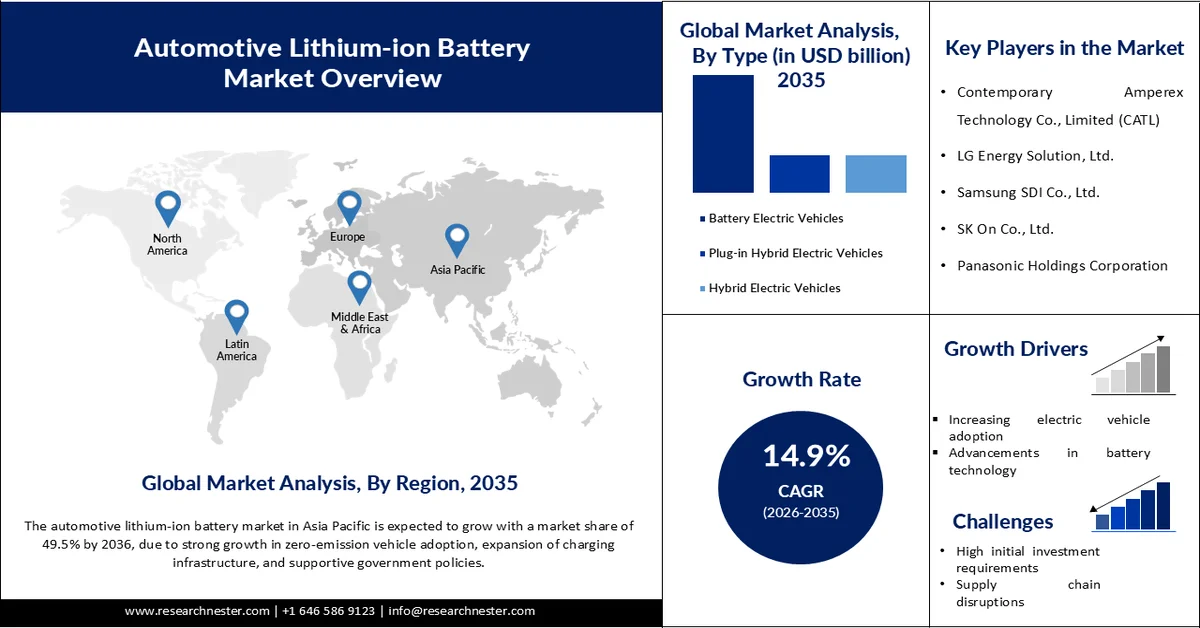
Automotive Lithium-ion Battery Market size was valued at USD 72.90 billion in 2025 and is projected to reach USD 292.37 billion by the end of 2035, growing at a CAGR of 14.9% during the forecast period, i.e., 2026-2035. In 2026, the industry size of automotive lithium-ion battery is estimated at USD 83.76 billion.
The global transition towards clean energy is boosting the adoption of zero-emission vehicles, including EVs, BEVs, and hybrids. This is directly creating a high-earning environment for automotive lithium-ion battery manufacturers. The International Energy Agency disclosed that the electric car market reached a new peak in 2025, with sales rising by 20% from 2024 to cross 20 million units. This represented that the electric car sales share in total car sales increased to 25%. Governments across major automotive markets are supporting EV adoption through purchase incentives and tax credits, leading to high battery electric vehicle sales. The rising investments in charging infrastructure are also contributing to the increasing sales of lithium-ion batteries.
Further, Europe witnessed a strong recovery, with sales growing by 30% to over 4 million after remaining flat in 2024, supported by stricter EU emission standards. Beyond the major markets, over half of the 2 million electric cars sold in 2025 were in regions such as Latin America, Asia Pacific, and the Middle East, where EVs have now exceeded a 10% share of car sales. Thus, the clean transportation boom is poised to double the revenues of advanced lithium-ion battery manufacturers in the years ahead.
Key Automotive Lithium-ion Battery Market Insights Summary:
Regional Highlights:
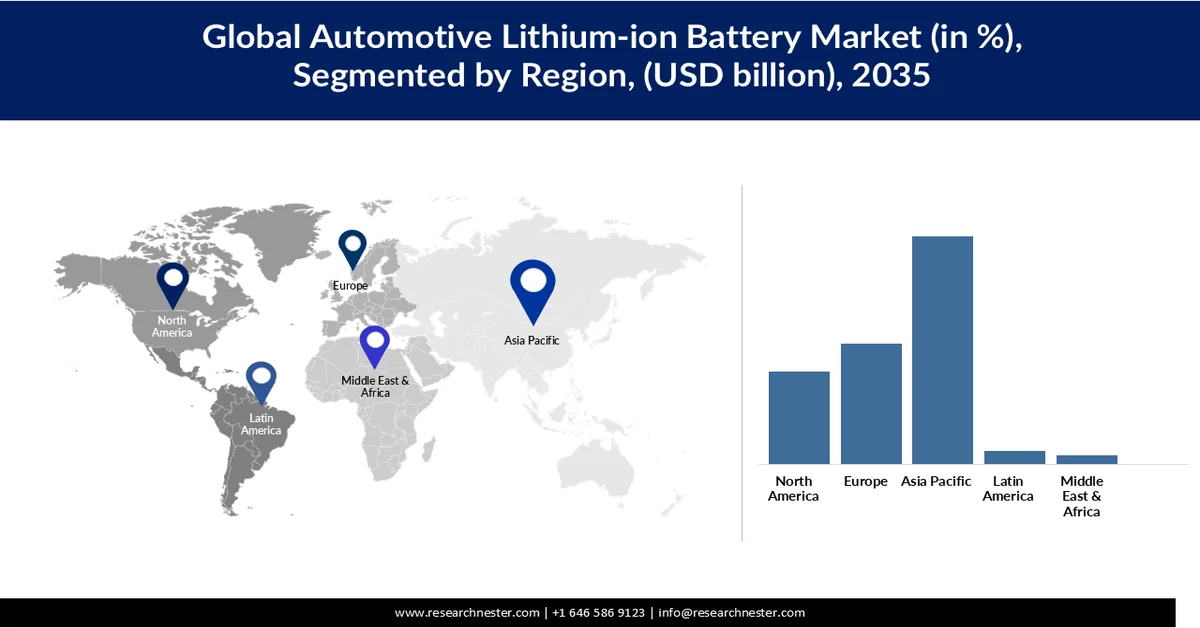
- Asia Pacific is anticipated to secure 49.5% market share by 2035, reinforced by robust EV adoption and extensive battery manufacturing capabilities across major economies
- Europe is forecast to account for 26.5% of the global automotive lithium-ion battery market share by 2035, stimulated by stringent clean energy mandates and the accelerating production of electric vehicles
- The North America automotive lithium-ion battery market is expected to increase at a CAGR of 13.9% from 2026 to 2035, mainly owing to the rise in EV adoption
- Japan is projected to capture nearly 2.1% of the global automotive lithium-ion battery market share by 2035, supported by continuous technological advancements
Segment Insights:
- The automotive lithium-ion battery market's battery electric vehicles (BEVs) segment is projected to command 60.1% share by 2035, attributed to BEVs' complete dependence on lithium-ion battery systems for propulsion
- The lithium nickel manganese cobalt segment is likely to hold 40.5% of the global market share by 2035, supported by continuous research and development efforts enhancing battery performance and cost-efficiency
Key Growth Trends:
- Expansion of charging infrastructure
- Advancements in battery technology
Major Challenges:
- Volatility in raw material costs
- High initial investment requirements
Key Players: Contemporary Amperex Technology Co., Limited (CATL), LG Energy Solution, Ltd., Samsung SDI Co., Ltd., SK On Co., Ltd., Panasonic Holdings Corporation, Prime Planet Energy & Solutions, Inc., GS Yuasa Corporation, Toshiba Corporation, Murata Manufacturing Co., Ltd., EnerSys.
Global Automotive Lithium-ion Battery Market Forecast and Regional Outlook:
Market Size & Growth Projections:
- 2025 Market Size: USD 72.90 billion
- 2026 Market Size: USD 83.76 billion
- Projected Market Size: USD 292.37 billion by 2035
- Growth Forecasts: 14.9% CAGR (2026-2035)
Key Regional Dynamics:
- Largest Region: Asia Pacific (49.5% Share by 2035)
- Fastest Growing Region: North America
- Dominating Countries: China, United States, Japan, South Korea, Germany
- Emerging Countries: India, Canada, United Kingdom, France, Italy
Last updated on : 25 June, 2026
Automotive Lithium-ion Battery Market - Growth Drivers and Challenges
Growth Drivers
- Expansion of charging infrastructure: The rapid expansion of charging infrastructure is creating a lucrative ecosystem for automotive lithium-ion battery producers. The International Council on Clean Transportation (ICCT) estimates that by the end of 2024, around 204,000 public and workplace charging points for light-duty vehicles were installed across the U.S. Between 2019 and 2024, this non-residential charging network expanded at an average annual rate of about 25%. This indicates that governments, utilities, and private companies’ increasing investments in the deployment of public charging stations are supporting the sales of advanced battery technologies. Looking ahead, planned investments by retailers, automobile manufacturers, and charging companies include 164,000 additional fast chargers and about 1.5 million Level 2 chargers, covering a large portion of the infrastructure expected to be required by 2030.
- Advancements in battery technology: The continuous advancements in battery technology are poised to boost the revenues of key market players in the years ahead. Battery manufacturers are investing heavily in research and development to enhance their products. In March 2026, GS Yuasa Corporation announced that its newly developed lithium-ion battery, EHW4GA, has been selected for use in hybrid versions of Toyota’s new RAV4 in international markets. The battery cells and modules are produced by Blue Energy Co., Ltd., a company within the GS Yuasa Group. Such technological advancements boost the performance and cost-effectiveness of lithium-ion batteries.
- Stringent emission regulations: The stringent emission regulations are significantly accelerating the adoption of electric vehicles. The regulatory authorities across North America, Europe, and Asia Pacific are implementing increasingly strict standards to reduce greenhouse gas emissions and address climate change concerns. Considering fuel economy trends, automakers are focusing on the production of zero-emission vehicles, which directly fuels the sales of lithium-ion batteries.
Challenges
- Volatility in raw material costs: Volatility in raw material prices is one of the major roadblocks to the trade of automotive lithium-ion batteries. Batteries rely heavily on critical minerals such as lithium, nickel, cobalt, manganese, and graphite, which are supplied from several regions. The increasing cross-border tensions are affecting the supply chain. The fluctuating crude oil prices are also contributing to these challenges. However, strategic collaborations are expected to aid key players in increasing their sales in the long term.
- High initial investment requirements: The installation of advanced automotive lithium-ion battery technologies requires high costs. Establishing a competitive battery manufacturing ecosystem demands substantial financial resources. The need for modern manufacturing infrastructure and technologies adds to the final costs of the automotive lithium-ion batteries. Many small entrepreneurs often refrain from investing in these technologies owing to budget constraints. Technological innovations and supportive government policies are expected to aid manufacturers in boosting their production cost-effectively.
Automotive Lithium-ion Battery Market Size and Forecast:
| Report Attribute | Details |
|---|---|
|
Base Year |
2025 |
|
Forecast Year |
2026-2035 |
|
CAGR |
14.9% |
|
Base Year Market Size (2025) |
USD 72.90 billion |
|
Forecast Year Market Size (2035) |
USD 292.37 billion |
|
Regional Scope |
|
Automotive Lithium-ion Battery Market Segmentation:
Vehicle Type Segment Analysis
The battery electric vehicles (BEVs) segment is projected to capture 60.1% of the automotive lithium-ion battery market through 2035. BEV’s complete reliance on lithium-ion battery systems as the primary source of propulsion drives the segmental growth. According to the International Energy Agency (IEA), 2025 saw strong growth in battery electric cars, with their share rising to 65% of total electric vehicle sales. Norway continued to lead globally, with around 97% of new car sales being electric. Nearly all of these were battery electric vehicles, while plug-in hybrids accounted for less than 2%, bringing the country close to its goal of selling only zero-emission cars. Thus, rising BEV production and registration are set to boost the sales of automotive lithium-ion batteries in the coming years.
Battery Chemistry Segment Analysis
The lithium nickel manganese cobalt segment is estimated to hold 40.5% of the global market share throughout the forecast period. The superior balance of energy density, performance, and cost-efficiency is boosting the trade of lithium nickel manganese cobalt batteries. In May 2025, General Motors and LG Energy Solution announced a major collaboration to commercialize lithium manganese-rich (LMR) prismatic battery cells. GM aims to become the first automaker to use this technology in its electric trucks and full-size SUVs. Thus, research and development are expected to enhance the automotive lithium nickel manganese cobalt batteries.
Sales Channel Segment Analysis
The OEM supply segment is poised to account for the largest share of the market by 2035. The electric vehicles, plug-in hybrid vehicles, and hybrid vehicles rely on highly sophisticated battery systems, which drives automakers to work closely with original battery manufacturers to ensure seamless integration. The performance requirements also boost the sales of OEM-developed lithium-ion batteries. The rise in global electric vehicle sales is projected to aid OEM supply to remain the dominant sales channel throughout the forecast period.
Our in-depth analysis of the automotive lithium-ion battery includes the following segments:
|
Segments |
Subsegments |
|
Battery Chemistry |
|
|
Vehicle Type |
|
|
Capacity |
|
|
Sales Channel |
|

Vishnu Nair
Head - Global Business DevelopmentCustomize this report to your requirements — connect with our consultant for personalized insights and options.
Automotive Lithium-ion Battery Market - Regional Analysis
Asia Pacific Market Insights
Asia Pacific is projected to capture 49.5% of the global automotive lithium-ion battery market share through 2035. The strong electric vehicle adoption and extensive battery manufacturing capabilities are boosting the trade of lithium-ion batteries. The supportive government policies promoting transportation electrification are also expected to drive the sales of lithium-ion batteries. The Institute for Energy Economics and Financial Analysis (IEEFA) states that India aims to raise EV adoption by 2030, targeting 30% of private car sales, 70% of commercial vehicles, 40% of buses, and 80% of two- and three-wheelers. Thus, the rise in EV adoption in Asia Pacific economies such as India, China, Japan, and South Korea is poised to double the revenues of lithium-ion battery manufacturers.
The China market is estimated to be valued at USD 29.5 billion in 2026. The country is one of the largest producers and consumers of electric vehicle batteries, owing to the strong presence of zero-emission vehicles. The International Energy Agency reveals that China sold over 13 million electric cars in 2025, retaining its position as the largest global market and accounting for about 60% of worldwide EV sales. The strong government support and investments in clean energy transportation are accelerating the sales of automotive lithium-ion batteries.
The Japan market for automotive lithium-ion batteries is poised to reach USD 573.70 million by the end of 2035. The country’s zero-emission goals and supportive government policies & subsidies are propelling the sales of EVs. High electrification of public and private transportation is directly boosting the trade of lithium-ion batteries. The increasing expansion of international battery manufacturing companies is also contributing to the overall market growth.
Japan Market Insights
The Japan automotive lithium-ion battery market is estimated to be valued at USD 165.66 million in 2026. The country’s advanced technological expertise and strong automotive manufacturing capabilities are directly boosting the sales of lithium-ion batteries. The growing focus on carbon neutrality, vehicle electrification, and sustainable transportation is boosting the trade of advanced lithium-ion batteries in Japan. Further, the strong presence of several leading battery manufacturers and automotive companies pushes the overall market growth.
In January 2025, Mazda Motor Corporation announced that it is set to build a new battery module and pack plant in Iwakuni City. The facility is anticipated to produce modules and packs using cylindrical lithium-ion battery cells supplied by Panasonic Energy. The plant is planned to have an annual production capacity of 10 GWh and is estimated to support Mazda’s first battery electric vehicle (BEV) on a dedicated EV platform. Such strategic movements are boosting employment in the country and also expanding the application of lithium-ion batteries.
Japan Automotive Lithium-ion Battery Market Size and Forecast
|
Report Attribute |
Details |
|
Base Year Market Size (2025) |
USD 144.30 million |
|
Forecast Year Market Size (2035) |
USD 573.70 million |
|
CAGR (2026-2035) |
14.8% |
Europe Market Insights
Europe is estimated to hold 26.5% of the global market share throughout the study period. The clean energy goals and expanding electric vehicle production are boosting the sales of automotive lithium-ion battery technologies. European governments and regulatory bodies continue to promote vehicle electrification through stringent carbon emission standards, fuel economy requirements, and long-term climate targets. This opens high-earning opportunities for automotive lithium-ion battery manufacturers.
The UK automotive lithium-ion battery market is driven by the country’s transition toward a low-carbon transportation system. The International Energy Agency reports that electric car sales in the UK grew by over 25% in 2025, making up more than one-third of all new car sales, up from one-quarter in 2024. Of these, nearly 500,000 were battery electric vehicles, accounting for about 23% of total new car sales. Thus, the UK is an investment-worthy market for both domestic and international battery-producing companies.
The Germany market for automotive lithium-ion batteries is estimated to be driven by the strong automotive manufacturing base and leadership in vehicle engineering. The concentration of globally recognized automotive brands increases the trade of advanced lithium-ion batteries. IEA disclosed that in 2025, the EV car sales in Germany grew by 50%. Tax benefits and affordability mainly boost the trade of electric cars and, consequently, lithium-ion batteries.
North America Market Insights
North America is poised to hold 20.1% of the global market share by the end of the study period. The transition toward vehicle electrification and sustainable transportation is boosting the trade of lithium-ion batteries. Automakers across North America are expanding their electric vehicle portfolios to meet evolving consumer preferences and comply with tightening environmental regulations aimed at reducing transportation-related emissions. The U.S., followed by Canada, is supporting the North America market growth.
The U.S. market for automotive lithium-ion batteries is projected to be driven by strong electric vehicle adoption and extensive investments in domestic battery production. According to the U.S. Energy Information Administration (EIA), the combined share of hybrid, plug-in hybrid, and battery electric vehicles in new light-duty vehicle sales in the U.S. rose from 19.1% in the second quarter of 2024 to 21.2% in the third quarter. The booming adoption of zero-emission vehicles is poised to fuel the sales of lithium-ion batteries.
U.S. Electric and Hybrid Vehicle Market Share Growth
|
Vehicle type |
Market share in 2Q24 |
Market share in 3Q24 |
Note |
|
BEV sales |
7.4% |
8.9% |
BEV sales drove much of the increase in the electric and hybrid vehicle market share. |
|
Hybrid vehicle sales |
- |
10.6% |
Hybrid vehicles reached a record share of the U.S. LDV market in 3Q24. |
U.S. EIA
The Canada market growth is supported by its significant electric vehicle and battery manufacturing ecosystem. The country has abundant reserves of rare earth elements in battery production, such as lithium, nickel, cobalt, and graphite, which directly create a profitable environment for the development of the automotive lithium-ion batteries. Further, the supportive government policies and initiatives for clean energy are contributing to the overall market growth.
Key Automotive Lithium-ion Battery Market Players:
- Contemporary Amperex Technology Co., Limited (CATL) (China)
- LG Energy Solution, Ltd. (South Korea)
- Samsung SDI Co., Ltd. (South Korea)
- SK On Co., Ltd. (South Korea)
- Panasonic Holdings Corporation (Japan)
- Prime Planet Energy & Solutions, Inc. (Japan)
- GS Yuasa Corporation (Japan)
- Toshiba Corporation (Japan)
- Murata Manufacturing Co., Ltd. (Japan)
- EnerSys (U.S.)
- Company Overview
- Business Strategy
- Key Product Offerings
- Financial Performance
- Key Performance Indicators
- Risk Analysis
- Recent Development
- Regional Presence
- SWOT Analysis
- Contemporary Amperex Technology Co., Limited (CATL) is a leading global battery manufacturer with a strong presence across the electric vehicle value chain. The company focuses on large-scale production, advanced battery technologies, and international expansion to strengthen its market position. Through continuous investments in research, manufacturing facilities, and strategic partnerships with major automakers, CATL has established itself as one of the most influential participants in the automotive lithium-ion battery industry.
- LG Energy Solution is a prominent battery producer serving automotive manufacturers across multiple regions. The company emphasizes technological innovation, production capacity expansion, and long-term customer relationships to maintain competitiveness. Its broad manufacturing footprint and strong focus on next-generation battery development enable it to support the growing global demand for electric vehicle batteries while strengthening its position in the evolving mobility landscape.
- Samsung SDI Co., Ltd is recognized for its focus on high-performance battery solutions and advanced manufacturing capabilities. The company continues to invest in battery innovation, operational efficiency, and global production expansion to support electric vehicle market growth. Strong collaborations with automotive manufacturers and ongoing research initiatives help Samsung SDI enhance its competitive position within the automotive lithium-ion battery sector.
- SK On Co., Ltd has rapidly expanded its presence in the automotive battery market through strategic investments and partnerships with global vehicle manufacturers. The company focuses on increasing manufacturing capacity, improving battery performance, and strengthening supply chain capabilities. Its commitment to technological advancement and international expansion supports its growing role in supplying batteries for next-generation electric vehicles worldwide.
- Panasonic Holdings Corporation maintains a strong position in the market through its extensive experience in battery development and manufacturing. The company prioritizes innovation, quality improvement, and production efficiency to meet evolving industry requirements. Strategic collaborations with leading automotive manufacturers and continued investment in advanced battery technologies reinforce Panasonic's competitiveness in the global electric mobility ecosystem.
Below is the list of the key players, among several others, operating in the market:
The strong presence of regional and international companies characterizes the automotive lithium-ion battery market. The key players are investing heavily in R&D activities to introduce next-gen solutions. They are also entering into strategic collaborations with others to enhance their product offerings. Leading companies are increasingly focusing on the development of advanced battery chemistries and solid-state batteries to reach a wider audience base. Some gigantic companies are exploring opportunities in high-potential economies to earn lucrative returns. Thus, both organic and inorganic marketing strategies are projected to double the revenues of key players in the years ahead.
Corporate Landscape of the Global Market:
Recent Developments
- In February 2026, CHANGAN Automobile, in collaboration with CATL, unveiled the world’s first mass-produced passenger vehicle powered by sodium-ion batteries. This launch marks a significant move toward a dual-chemistry approach, where sodium-ion and lithium-ion batteries work together to meet varied customer requirements.
- In October 2025, Toshiba Corporation introduced the SCiB™ 24V battery pack (P25H20-3), a lithium-ion solution that can be used on its own or combined in series and parallel configurations (up to 48V, 5.76 kWh) to meet different power needs. Designed to support high-load operations such as engine starting, it is suitable for marine vessels, commercial vehicles such as buses and trucks, and heavy equipment used in construction and agriculture.
- Report ID: 8631
- Published Date: Jun 25, 2026
- Report Format: PDF, PPT
- Explore a preview of key market trends and insights
- Review sample data tables and segment breakdowns
- Experience the quality of our visual data representations
- Evaluate our report structure and research methodology
- Get a glimpse of competitive landscape analysis
- Understand how regional forecasts are presented
- Assess the depth of company profiling and benchmarking
- Preview how actionable insights can support your strategy
Explore real data and analysis
Frequently Asked Questions (FAQ)
About this Report
Connect with our Expert


Report, 2026-2035



Copyright @ 2026 Research Nester. All Rights Reserved.
