Embedded Analytics Market Outlook:
Embedded Analytics Market size was valued at USD 23.4 billion in 2025 and is expected to grow to USD 88.3 billion by 2035, expanding at a CAGR of 15.9% during the forecast period, i.e., 2026-2035. In 2026, the industry size of embedded analytics is estimated at USD 27.1 billion.
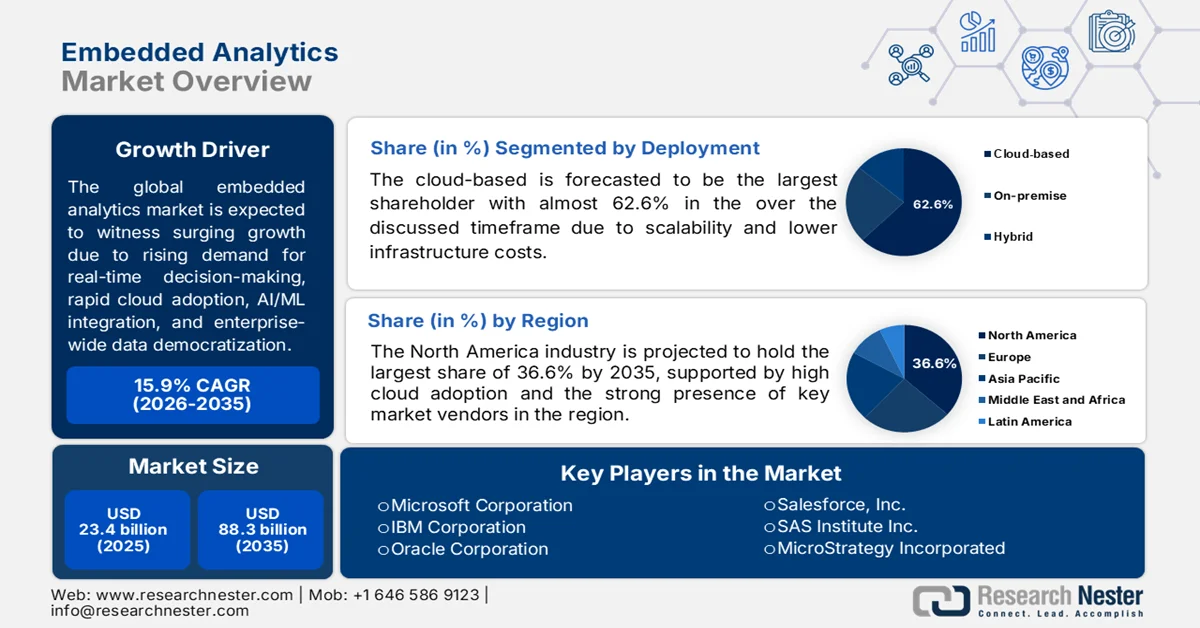
The embedded analytics market is expected to witness surging growth in the upcoming decade as organizations are seeking integrated data-driven understandings directly into their applications, workflows, and enterprise platforms. This shift is primarily being driven by the heightened demand for real-time decision-making, improved operational efficiency, and enhanced user experiences across industries such as healthcare, finance, retail, and manufacturing. In September 2024, Salesforce introduced Tableau Einstein, which is an AI-based analytics platform built on the Salesforce ecosystem and enhanced by Agentforce. The company notes that it transforms raw data into actionable data by embedding autonomous agents directly into workflows, enabling teams to answer, engage, and act on data in real time, thus positively impacting the market’s growth.
Furthermore, vendors across the globe are highly focused on embedding advanced visualization, AI-based analytics, and self-service capabilities into business applications to reduce dependency on standalone BI tools. As a result, the solutions from the embedded analytics market have become a core component of digital transformation strategies, reshaping how organizations consume and act on data within their daily operations. In September 2024, Oracle announced the launch of more than 50 new AI agents and advanced AI-powered features across its Fusion Cloud Applications Suite, enhancing finance, HR, supply chain, sales, marketing, and service. These embedded capabilities automate workflows and accelerate decision-making, all at no extra cost, thus contributing to extensive market growth.
Key Embedded Analytics Market Insights Summary:
Regional Highlights:
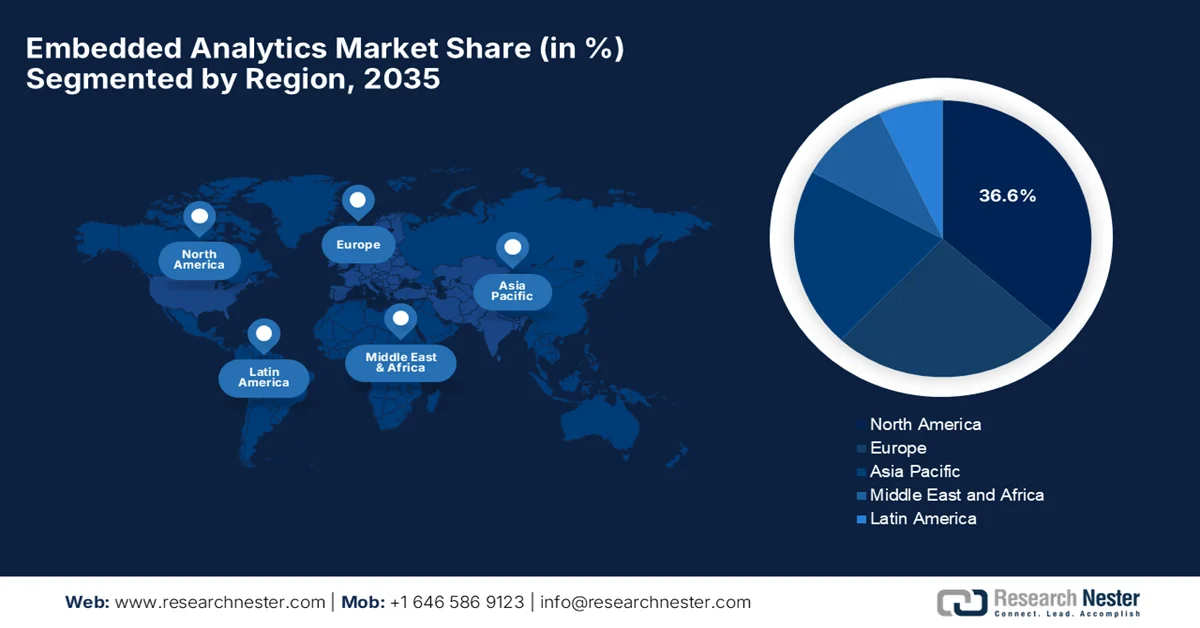
- The embedded analytics market in North America is projected to command a 36.6% share by 2035, bolstered by strong cloud adoption, presence of major vendors, and mature enterprise IT ecosystems
- Asia Pacific is anticipated to witness the fastest expansion over the forecast period 2026-2035, fueled by government-backed digital infrastructure initiatives and increasing adoption of low-code and headless BI tools
Segment Insights:
- The cloud-based segment in the embedded analytics market is expected to hold a dominant share of 62.6% by 2035, propelled by scalability, lower infrastructure cost, and seamless integration into SaaS ecosystems
- Large enterprises segment is projected to secure a considerable share by 2035, driven by complex data ecosystems, higher IT budgets, and rising demand for embedded decision intelligence across departments
Key Growth Trends:
- Digital transformation initiatives
- Rising cloud and SaaS adoption
Major Challenges:
- High development and implementation costs
- Shortage of skilled professionals
Key Players: Microsoft Corporation, IBM Corporation, Oracle Corporation, Salesforce, Inc., SAS Institute Inc., MicroStrategy Incorporated, Sisense Inc., GoodData Corporation, ThoughtSpot Inc., Domo Inc., SAP SE, QlikTech International AB, TIBCO Software Inc., Google LLC, Infor, Qrvey, Information Builders / IBI, Omni, Explo, Zoho Corporation, Yellowfin International Pty Ltd, Hitachi Vantara, Samsung SDS, Fusionex Group.
Global Embedded Analytics Market Forecast and Regional Outlook:
Market Size & Growth Projections:
- 2025 Market Size: USD 23.4 billion
- 2026 Market Size: USD 27.1 billion
- Projected Market Size: USD 88.3 billion by 2035
- Growth Forecasts: 15.9% CAGR (2026-2035)
Key Regional Dynamics:
- Largest Region: North America (36.6% Share by 2035)
- Fastest Growing Region: Asia Pacific
- Dominating Countries: United States, China, Germany, United Kingdom, Japan
- Emerging Countries: India, South Korea, Singapore, Brazil, United Arab Emirates
Last updated on : 1 May, 2026
Embedded Analytics Market - Growth Drivers and Challenges
Growth Drivers
- Digital transformation initiatives: Enterprises across industries are undergoing digital transformation to modernize processes and improve efficiency. In this context, embedded analytics plays a prominent role by integrating the understanding of data into core business applications. As per an article published by Press Information Bureau (PIB) in June 2025, digitalization in India has transformed the country’s growth trajectory by expanding internet access, digital payments, and e-governance services. The initiatives such as BharatNet, UPI, DigiLocker, and UMANG technology have bridged rural-urban divides and made services more inclusive. The report also stated that in April 2025 alone, UPI processed almost 18.68 billion transactions, which were worth USD 297 billion, showing the scale of digital finance, thus positively impacting the embedded analytics market.
- Rising cloud and SaaS adoption: The expedited progression towards cloud computing is one of the important growth drivers for the embedded analytics market globally. These solutions make it easier to embed scalable analytics capabilities into applications without heavy upfront investment, encouraging widespread adoption in this field. In April 2023, the official data published by Open Access Government stated that cloud computing is efficiently driving digital transformation by enabling enterprises to migrate up to 60% of their infrastructure to the cloud, thereby introducing scalability and resilience. With these solutions, businesses can gain agility, cost savings, and access to advanced automation technologies, thus positively benefiting the market’s growth and exposure.
- Growth of big data and IoT ecosystems: The upliftment of IoT devices and big data ecosystems generates huge volumes of information. Therefore, solutions from the embedded analytics market help organizations to process and visualize this data directly within operational systems. This enables faster insights from connected devices and large datasets, supporting improved monitoring. In May 2025, Qlik announced the expansion of its embedded AI capabilities with the main goal of helping enterprises move from fragmented insights to real-time execution. The platform consists of tools such as the discovery agent, advanced forecasting, write table, and table recipe, and it enables anomaly detection, sharper predictions, faster data prep, and immediate action. Hence, such innovations increase demand for integrated platforms that enable faster decision-making at scale, fueling business in the embedded analytics market.
Challenges
- High development and implementation costs: The aspect of both development and deployment of embedded analytics solutions can be costlier, especially for small and medium-sized enterprises operating in the embedded analytics market. Costs are for software licensing, infrastructure, customization, integration, and ongoing maintenance. Apart from these, the advanced features such as AI-based insights and actual analytics also intensify these expenses. In addition, companies need to hire skilled professionals, such as data engineers and developers, to build and manage these systems. It is observed that cloud-based solutions have reduced some cost barriers, but the total cost of ownership is very high for complex deployments. The existence of this financial burden can create hesitation among organizations in adopting embedded analytics.
- Shortage of skilled professionals: This is yet another major burden for the embedded analytics market since the implementation requires a combination of knowledge in terms of data science, software development, and domain knowledge. But there is a global shortage of professionals with these interdisciplinary skills. In this context, organizations in this field find it struggling to find talent who are capable of designing, integrating, and maintaining embedded analytics solutions. The existence of this skills gap can delay projects, increase costs, and limit innovation. At the same time, training existing employees is an option, but it requires time and investment. As analytics technologies are continuously evolving, keeping up with new tools and methodologies becomes challenging, thereby exacerbating the talent shortage and impacting the overall growth of the embedded analytics market in the next decade.
Embedded Analytics Market Size and Forecast:
| Report Attribute | Details |
|---|---|
|
Base Year |
2025 |
|
Forecast Year |
2026-2035 |
|
CAGR |
15.9% |
|
Base Year Market Size (2025) |
USD 23.4 billion |
|
Forecast Year Market Size (2035) |
USD 88.3 billion |
|
Regional Scope |
|
Embedded Analytics Market Segmentation:
Deployment Segment Analysis
The cloud-based segment is forecasted to be the largest shareholder with almost 62.6% in the embedded analytics market over the discussed timeframe. The segment’s dominance is mainly propelled by scalability, lower infrastructure cost, and seamless integration into SaaS ecosystems. Governments and global institutions emphasize cloud adoption as part of digital transformation strategies, improving accessibility and interoperability. In April 2026, SAS announced the advancement of its cloud-native data management foundation to help enterprises operationalize AI with trust and governance built in. SAS Viya embeds lineage, transparency, and performance directly into workflows, and it enables organizations to prepare, govern, and activate data seamlessly across distributed environments, thus contributing to a wider segment expansion in the upcoming decade.
Organization Size Segment Analysis
On the basis of organization size, large enterprises are anticipated to grow with a considerable share in the embedded analytics market by the end of 2035. The segment’s upliftment is mainly attributable to complex data ecosystems, higher IT budgets, and the need for embedded decision intelligence across departments. These organizations are proactively integrating analytics into ERP and CRM systems in order to improve operational efficiency. Apart from these, large-scale enterprises also benefit most from structured data governance and embedded analytics frameworks due to their distributed system architectures. The swiftly expanding use of AI and machine learning within embedded analytics deliberately enhances predictive decision-making and automation at scale. In addition, the constant need for regulatory compliance and risk management is efficiently driving investment in advanced data governance and monitoring tools.
End user Analysis Segment Analysis
By the conclusion of the forecast period, IT and telecommunications in the end user category are projected to have a noteworthy share in the embedded analytics market. The segment’s growth in this field is mainly propelled by its heavy reliance on data-driven operations and real-time decision-making. Especially in the telecom sector, analytics helps companies better understand customer behavior through usage patterns, billing data, and location insights, allowing for more suitable services and efficient resource allocation. In January 2026, AT&T introduced IoT network intelligence at CES 2026, which offers enterprises deeper visibility into their connected ecosystems. This particular solution provides device-level KPIs, location-based performance insights, and anomaly detection powered by machine learning to optimize IoT operations with 4G and 5G support, hence creating an optimistic market opportunity.
Our in-depth analysis of the embedded analytics market includes the following segments:
|
Segment |
Subsegments |
|
Deployment |
|
|
Organization Size |
|
|
End user |
|
|
Application |
|
|
Component |
|

Vishnu Nair
Head - Global Business DevelopmentCustomize this report to your requirements — connect with our consultant for personalized insights and options.
Embedded Analytics Market - Regional Analysis
North America Market Insights
The embedded analytics market in North America is anticipated to achieve the largest share of 36.6% during the forecast period. The region’s upliftment in this field is mainly propelled by strong cloud adoption, the presence of major vendors, and mature enterprise IT ecosystems. The region continues steady expansion owing to the AI-enabled analytics and SaaS penetration. For instance, in February 2024, Oracle announced the launch of its enterprise communications platform, which brings actual communications to its industry cloud applications. ECP has been built on Oracle Cloud Infrastructure, and it connects IoT devices, edge systems, and networks to streamline operations and deliver immersive, secure communication experiences. Therefore, such instances denote that the region is shifting toward cloud-native and AI-enabled analytics ecosystems, prompting encouraging growth opportunities for players.
The integration of cultivated business intelligence directly into core enterprise applications such as ERP and CRM systems is the catalyst for the embedded analytics market in the U.S. This shift is primarily fueled by self-service tools and low-code frameworks, which are democratizing data access across sectors such as BFSI, healthcare, and retail. In March 2023, Microsoft introduced Dynamics 365 Copilot, which is the world’s first copilot in both CRM and ERP that brings generative AI to every line of business. The company notes that Copilot automates repetitive tasks such as email drafting, meeting summaries, customer queries, and product listings, freeing workers to focus on higher-value work. Hence, these advancements by the leading pioneers position the country at the forefront of revenue generation in this regional market.
In Canada, the embedded analytics market is poised for soaring growth, majorly driven by a strong preference for digital transformation and the widespread integration of business intelligence into enterprise-level workflows. Apart from this, the sectors, i.e., BFSI, healthcare, and retail, are leveraging these embedded tools with the main goal of enhancing customer experiences and streamlining operational decision-making. Based on the 2026 released official data from Slashdot, embedded analytics platforms in Canada are focused on integrating self-service BI and low-code tools directly into enterprise applications, enabling users to generate insights within CRM and ERP workflows without switching systems. It also mentioned that platforms such as Microsoft Power BI, Sisense, and Looker demonstrate this shift by embedding dashboards, AI-assisted exploration, and API-driven analytics into business applications, thus suitable for standard market growth.
APAC Market Insights
The Asia Pacific embedded analytics market is likely to exhibit surging growth during the stipulated timeframe. The region’s progress in this field is largely due to government agendas that are promoting smart city and digital infrastructure initiatives. This growth is especially driven by the convergence of headless BI and low-code tools, which are democratizing data access, allowing local platform providers to scale suitable solutions for enterprises. Based on the government data published in May 2025, the Smart Nation & Digital Government Industry Briefing underscored Singapore’s focus on next-generation digital governance. The country has invested almost USD 1 billion in cloud applications, whereas nearly 45% of spending will be co-developed with industry partners, hence driving unprecedented growth in the region’s market.
The aggressive integration of analytics within its massive industrial and manufacturing sectors, driven by national digital transformation strategies, is readily uplifting the embedded analytics market in China. This evolution is supported by a prominent local ecosystem of cloud leaders and specialized AI startups who are deploying predictive and prescriptive engines to enhance decision-making across different services. Based on the government data published in January 2026, China has set a bold target to secure a reliable supply of core AI technologies by 2027, making sure its industrial scale remains at the global forefront. Besides, the article notes that the action plan calls for deploying 3 to 5 general-purpose large AI models in manufacturing, building 100 high-quality datasets, and promoting 500 application scenarios. In addition, this particular initiative aims to cultivate globally influential enterprises, strengthen AI chip innovation, and embed large models into production processes.
In India, the embedded analytics market is extensively supported by organizations that are opting for cloud-based deployment models in everyday workflows, significantly benefiting the BFSI, healthcare, and retail industries. This market growth is efficiently propelled by advancements in AI, machine learning, and edge computing, which facilitate predictive and prescriptive analytics within existing business applications. In October 2025, the article published by PIB stated that the SOAR program is a landmark initiative that was launched to embed AI literacy and skill development into the country’s education system. It offers structured modules on ethical AI use and machine learning basics, supported by a Centre of Excellence in AI for education. The article also stated that by June 2025, more than 1,480 apprentices had been trained in AI-related roles, thus suitable for bolstering the country’s market growth.
Europe Market Insights
The Europe embedded analytics market is poised to acquire a prominent position in the global dynamics, mostly attributable to a mature landscape that has a higher priority towards data governance, compliance, and security. Apart from this, the region’s Industry 4.0 frameworks and smart manufacturing initiatives are accelerating the adoption of AI-augmented prescriptive modules and predictive maintenance tools. In June 2025, Siemens announced a partnership with Sachsenmilch Leppersdorf GmbH to deploy Senseye predictive maintenance by using AI algorithms to detect machine issues early and reduce costly downtime. This pilot project saved the company in the low six figures by identifying a faulty pump before failure, ensuring 24/7 production of 4.7 million liters of milk daily. Hence, such instances denote that the region is opting for AI-enabled predictive maintenance embedded within industrial systems to improve efficiency and enable real-time decision-making under strong governance frameworks.
The utilization of analytics directly within operational systems such as ERP, MES, and supply chain platforms is responsibly uplifting the embedded analytics market in Germany. The country’s market benefits from BI adoption and more by its integration into engineering-heavy workflows, where data is treated as an operational input rather than a reporting layer. In April 2023, at HANNOVER MESSE 2023 in Germany, SAP introduced new supply chain advancements with a collective goal to strengthen resilience and sustainability. The digital manufacturing is embedded with AI in SAP, and it enables predictive insights, defect detection, and paperless production, whereas 3D product viewer capabilities streamline assembly and maintenance. At the same time, SAP also introduced sustainability-focused tools such as responsible design and production, helping companies comply with packaging guidelines and ESG goals, thus positively benefiting the embedded analytics industry.
The embedded analytics market in the UK is evolving around a strong services-driven economy in which the financial services, public administration, and healthcare are integrating analytics directly into operational and customer-facing applications. On the other hand, the country’s emphasis on regulatory compliance, especially in terms of financial reporting, data protection, and auditability, is reshaping the design of embedded analytics solutions toward transparent and governance-ready architectures. Based on the government data published in August 2025, its project data analytics and AI framework is actively embedding analytics and AI directly into project delivery processes, moving from traditional reporting. Tools such as the AI-powered Scout system are being tested to streamline project reviews and improve predictive insights for risk management and delivery performance, thus positively impacting the market’s expansion in the UK.
Key Embedded Analytics Market Players:
- Microsoft Corporation (U.S.)
- IBM Corporation (U.S.)
- Oracle Corporation (U.S.)
- Salesforce, Inc. (U.S.)
- SAS Institute Inc. (U.S.)
- MicroStrategy Incorporated (U.S.)
- Sisense Inc. (U.S.)
- GoodData Corporation (U.S.)
- ThoughtSpot Inc. (U.S.)
- Domo Inc. (U.S.)
- SAP SE (Germany)
- QlikTech International AB (Sweden)
- TIBCO Software Inc. (U.S.)
- Google LLC (U.S.)
- Infor (U.S.)
- Qrvey (U.S.)
- Information Builders / IBI (U.S.)
- Omni (U.S.)
- Explo (U.S.)
- Zoho Corporation (India)
- Yellowfin International Pty Ltd (Australia)
- Hitachi Vantara (Japan)
- Samsung SDS (South Korea)
- Fusionex Group (Malaysia)
- Company Overview
- Business Strategy
- Key Product Offerings
- Financial Performance
- Key Performance Indicators
- Risk Analysis
- Recent Development
- Regional Presence
- SWOT Analysis
- Microsoft Corporation has established itself as a dominant force in embedded analytics through its Power BI ecosystem, which integrates properly with Azure and other enterprise tools. The company’s strategy is highly structured around deep ecosystem integration, enabling organizations to embed analytics directly into applications.
- SAP SE is a strong, prominent player in this sector that has a foothold in ERP systems to embed analytics directly into core business processes. Through platforms such as SAP Analytics Cloud, the firm is extensively focused on operational analytics embedded within enterprise applications.
- IBM Corporation is a foundational player in the sector that emphasizes AI-based analytics, automation, and data governance by targeting large enterprises with complex data environments. The company’s embedded analytics capabilities are mostly a part of larger data fabric and AI ecosystems, which enable organizations to integrate insights into applications securely.
- Sisense Inc. is a specialized leader that is focused heavily on embedded analytics, with a strong reputation for developer-first design and API-driven architecture. In addition, the firm’s platform enables companies to embed highly customizable dashboards and analytics into applications with a very minimal coding effort.
- QlikTech International AB is highly focused on embedded analytics through its associative data engine and self-service BI capabilities. At the same time, the company’s approach emphasizes data discovery and interactive analytics embedded into workflows, allowing users to explore data intuitively.
Below is the list of some prominent players operating in the global market:
The embedded analytics market is being dominated by global technology leaders along with some of the specialized analytics vendors. Companies such as Microsoft, SAP, and IBM benefit from strong ecosystems and cloud platforms, whereas other players such as Sisense, Qlik, and ThoughtSpot are highly focused on developer-friendly and AI-based embedding capabilities. Strategic initiatives adopted by the companies in the sector are heavy investments in AI and machine learning, cloud-native architectures, and API-first platforms to enhance integration and scalability. Apart from these partnerships, acquisitions, and product innovation are central to expanding capabilities and market reach. In October 2025, Omni announced the acquisition of Explo to strengthen its unified analytics platform and expand capabilities for both internal and customer-facing use cases, thus benefiting the market’s exposure.
Corporate Landscape of the Embedded Analytics Market:
Recent Developments
- In April 2026, Qrvey introduced a new perpetual licensing model for its AI-native embedded analytics platform, which gives SaaS companies long-term cost predictability and flexibility as they scale. This option complements subscription pricing, enabling software makers to align investments with growth strategies.
- In March 2026, IBI announced the launch of the new WebFOCUS® data & analytics platform, by combining enterprise-grade reporting with modern data intelligence to unify fragmented information into trusted insights. This integrated solution strengthens organizations to reduce costs, improve data quality, and fuel AI initiatives with reliable, governed data.
- Report ID: 8549
- Published Date: May 01, 2026
- Report Format: PDF, PPT
- Explore a preview of key market trends and insights
- Review sample data tables and segment breakdowns
- Experience the quality of our visual data representations
- Evaluate our report structure and research methodology
- Get a glimpse of competitive landscape analysis
- Understand how regional forecasts are presented
- Assess the depth of company profiling and benchmarking
- Preview how actionable insights can support your strategy
Explore real data and analysis
Frequently Asked Questions (FAQ)
About this Report
Connect with our Expert


Report, 2026-2035



Copyright @ 2026 Research Nester. All Rights Reserved.
