Drug Discovery Services Market Outlook:
Drug Discovery Services Market size was over USD 20.2 billion in 2025 and is poised to exceed USD 41.6 billion by the end of 2035, growing at over 7.5% CAGR during the forecast period, i.e., 2026-2035. In 2026, the industry size of drug discovery services is estimated at USD 21.7 billion.
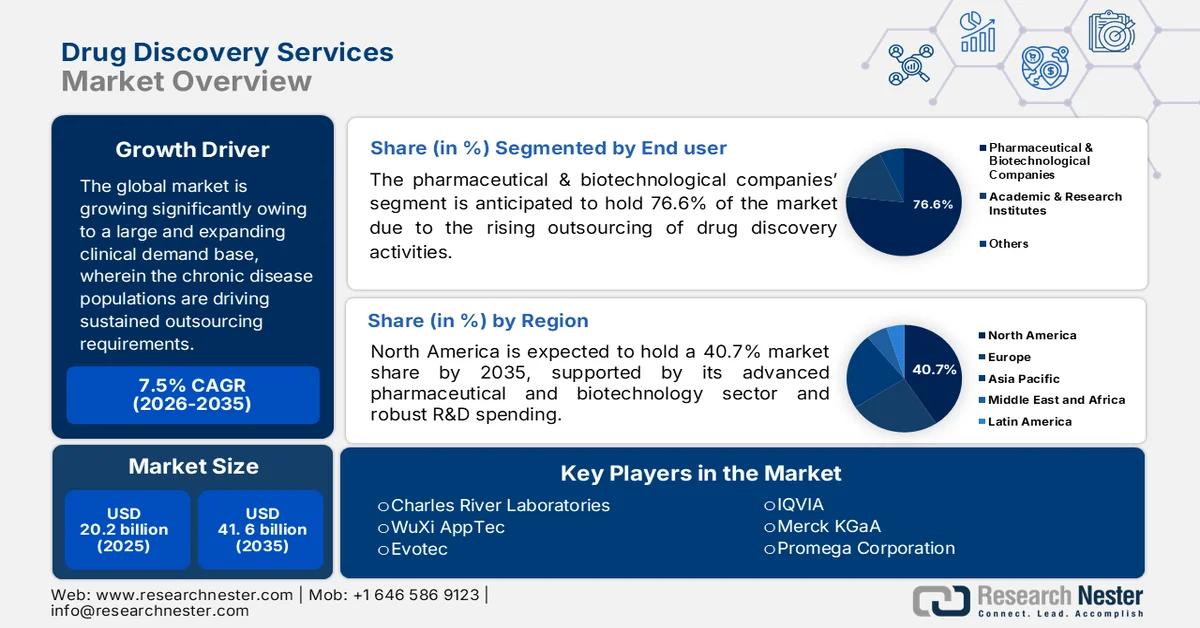
The global drug discovery services market activity is supported by a large and expanding clinical demand base, wherein the chronic disease populations are driving sustained outsourcing requirements across research organizations, pharmaceutical companies, biotechnology firms, and healthcare systems. In April 2025, the Centers for Disease Control and Prevention (CDC) stated that in 2023, 76.4% of adults in the U.S., which is approximately 194 million people, reported having one or more chronic conditions. The article also outlined that 51.4% of the U.S. adults, which is approximately 130 million people, reported having multiple chronic conditions. Adults with one or more chronic conditions increased from 52.5% to 59.5%. Hence, this growing burden is creating continued demand for new therapies and development programs.
Furthermore, rising pharmaceutical expenditure and heightening demand for advanced therapies drive substantial investment in drug discovery services, which include research outsourcing, clinical development, and innovative technologies. On the other hand, the high-cost treatments also increase the need for cost-effective drug discovery solutions to accelerate new medicine development. According to the article published by the Organization for Economic Co-operation and Development in November 2025, in 2023, retail pharmaceutical expenditure averaged a total of USD 766 per capita across OECD countries, adjusted for purchasing power differences. The report also stated that the U.S. recorded the highest spending at USD 1,713 per capita, followed by Germany at USD 1,158 and Switzerland at USD 1,061. Governments and compulsory insurance schemes financed nearly 60% of retail pharmaceutical spending on average, whereas household out-of-pocket payments accounted for about 38%, thus elevating the growth potential of the market.
Key Drug Discovery Services Market Insights Summary:
Regional Highlights:
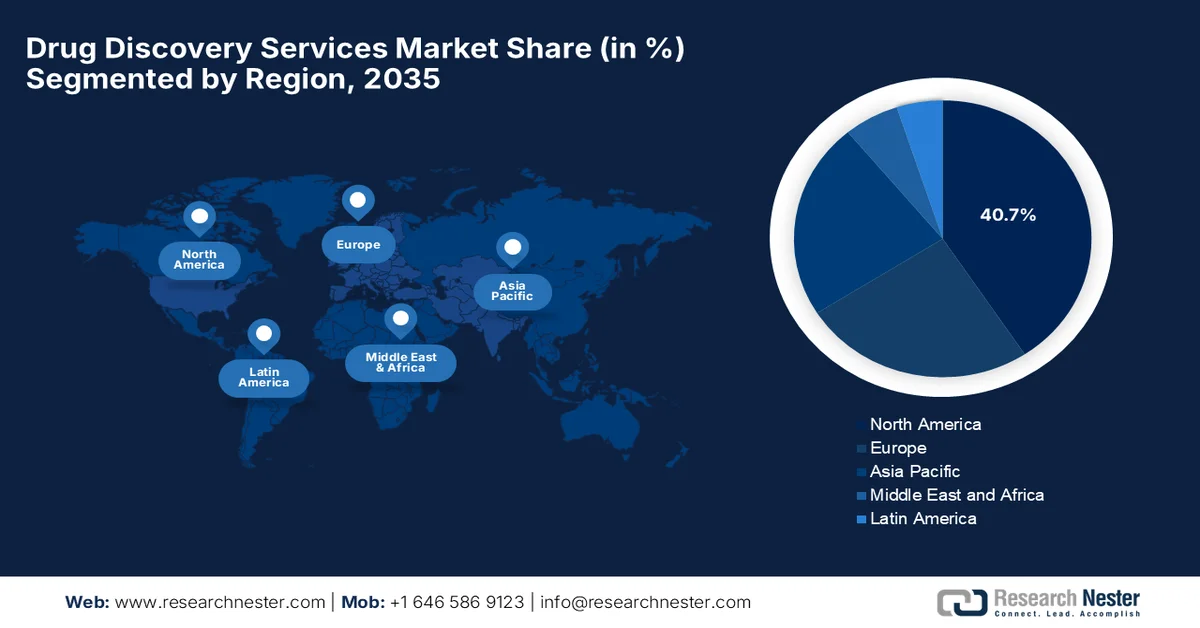
- North America is projected to capture 40.7% share by 2035 in the drug discovery services market, underpinned by an advanced pharmaceutical and biotechnology sector along with heavy investments in research and development
- Asia Pacific is anticipated to witness considerable growth throughout 2026-2035, supported by the ongoing shift of pharmaceutical research activities toward emerging economies with lower operational and manufacturing costs
Segment Insights:
- The pharmaceutical & biotechnological companies segment is projected to account for 76.6% share by 2035 in the drug discovery services market, reinforced by increasing investments in research and development (R&D) and the rising outsourcing of drug discovery activities to specialized service providers
- The oncology segment is expected to secure a considerable revenue share throughout 2026-2035, fueled by the rising global cancer burden and increasing investments in oncology drug research and development
Key Growth Trends:
- AI and machine learning integration
- Rising outsourcing of core research
Major Challenges:
- High R&D attrition and technical complexity
- Complex intellectual property and collaboration management
Key Players: Charles River Laboratories, WuXi AppTec, Evotec, IQVIA, Merck KGaA, Promega Corporation, Jubilant Biosys Limited, Pierre Fabre.
Global Drug Discovery Services Market Forecast and Regional Outlook:
Market Size & Growth Projections:
- 2025 Market Size: USD 20.2 billion
- 2026 Market Size: USD 21.7 billion
- Projected Market Size: USD 41.6 billion by 2035
- Growth Forecasts: 7.5% CAGR (2026-2035)
Key Regional Dynamics:
- Largest Region: North America (40.7% Share by 2035)
- Fastest Growing Region: Asia Pacific
- Dominating Countries: United States, Germany, Japan, United Kingdom, China
- Emerging Countries: India, South Korea, Singapore, Australia, Saudi Arabia
Last updated on : 14 July, 2026
Drug Discovery Services Market - Growth Drivers and Challenges
Growth Drivers
- AI and machine learning integration: The surge in AI adoption, along with deep machine learning algorithms, is revolutionizing early-stage drug design workflows. Service providers utilize these advanced computational platforms to screen virtual chemical compounds in days, accurately predict target-binding affinities, and minimize laboratory errors, thus driving the growth of the drug discovery services market. For instance, Pierre Fabre Laboratories and Iktos in January 2026 announced a partnership to integrate AI-based generative design and automated chemistry technologies with oncology expertise to accelerate the discovery of novel small-molecule drug candidates. This collaboration aims to improve the speed, efficiency, and success rate of drug discovery by combining computational innovation with medicinal chemistry and preclinical development.
- Rising outsourcing of core research: Pharmaceutical companies across different nations are making a shift from expensive laboratories toward long-term partnerships with contract research organizations. Outsourcing critical drug discovery phases allows biopharma firms to instantly leverage specialized scientific expertise, access flexible operational capacity, and remarkably reduce the time required to advance a compound from concept to trial. In April 2023, Sygnature Discovery and Daewoong Pharmaceutical entered a research collaboration with the main goal of accelerating the discovery of novel small molecules targeting autoimmune diseases. Under this collaboration, Sygnature will provide integrated drug discovery expertise, thus making it suitable for bolstering the overall market.
Challenges
- High R&D attrition and technical complexity: This is the major bottleneck for the market due to the high attrition rates of early-stage research. Much lower concentration of preclinical candidate molecules successfully advances to human clinical trials, which imposes massive operational costs for failed projects on CROs. Also, developing and validating novel target assays such as complex phenotypic screens for intricate neurodegenerative diseases regularly demands months of intensive lab work before downstream workflows can even begin. In addition, a sudden shift in disease biology or failure in target validation forces service providers to completely restart experiments, thus creating hesitation among players to make investments in this sector.
- Complex intellectual property and collaboration management: Managing intellectual property rights is also a major operational hurdle in terms of collaborative drug discovery projects. Pharmaceutical companies are transitioning from simple fee-for-service contracts to deep, strategic risk-sharing partnerships and ownership boundaries of newly discovered molecular structures. This aspect of legal and operational friction frequently originates when determining whether the client or the service provider owns the foundational data, machine learning algorithms, or assay techniques developed during the project. This complexity is further intensified by the rising use of public-private consortia and multi-party academic collaborations, thus negatively impacting the market expansion.
Drug Discovery Services Market Size and Forecast:
| Report Attribute | Details |
|---|---|
|
Base Year |
2025 |
|
Forecast Year |
2026-2035 |
|
CAGR |
7.5% |
|
Base Year Market Size (2025) |
USD 20.2 billion |
|
Forecast Year Market Size (2035) |
USD 41.6 billion |
|
Regional Scope |
|
Drug Discovery Services Market Segmentation:
End user Segment Analysis
The pharmaceutical & biotechnological companies’ segment is anticipated to hold 76.6% of the end user category in the drug discovery services market during the discussed timeframe. The segment’s dominant position is propelled mainly by increasing investments in research and development (R&D) and the rising outsourcing of drug discovery activities to specialized service providers. In addition, the expanding pipeline of biologics, precision medicines, and treatments for chronic and rare diseases continues to strengthen demand for drug discovery services. In May 2024, Sanofi, OpenAI, and Formation Bio announced a collaboration to develop AI-powered software with the main goal of accelerating drug development and helping deploy novel medicines to patients more efficiently. It combines Sanofi's proprietary data, Formation Bio's AI-driven drug development platform, and OpenAI's advanced AI models and expertise, and the partnership aims to create customized AI solutions across the pharmaceutical lifecycle.
Therapeutic Area Segment Analysis
In terms of therapeutic area, oncology is projected to hold a considerable revenue share and grow in the market during the forecast period. The growth of the segment is largely propelled by the rising global cancer burden and increasing investments in oncology drug research and development. Also, the growing adoption of precision medicine and immuno-oncology approaches and the expanding number of clinical candidates targeting various cancer types are positioning the segment for sustained growth. In May 2025, the article published by the National Institutes of Health (NIH) stated that there was a total of 20 million newly registered cancer cases in 2022, whereas it is predicted to reach a substantial 33 million by 2050. Hence, with such a growing burden, the demand for drug discovery services also accelerates.
Drug Type Segment Analysis
The small molecules are expected to hold a considerable share of the drug type segment in the market by the end of 2035. Their well-established manufacturing processes, favorable oral bioavailability, and lower production costs when compared to biologics are certain factors driving the segment’s leadership. In addition, pharmaceutical and biotechnology companies are outsourcing medicinal chemistry, hit-to-lead optimization, lead optimization, and preclinical discovery activities to specialized drug discovery service providers. In July 2024, Evotec and Pfizer announced a multi-year research collaboration to advance early-stage drug discovery for metabolic and infectious diseases in France. This research will be conducted at Evotec's France-based facilities, including Campus Curie in Toulouse, thereby leveraging advanced capabilities in screening, biology, proteomics, and metabolomics.
Our in-depth analysis of the drug discovery services market includes the following segments:
|
Segment |
Subsegments |
|
End user |
|
|
Therapeutic Area |
|
|
Drug Type |
|
|
Discovery Phase |
|

Vishnu Nair
Head - Global Business DevelopmentCustomize this report to your requirements — connect with our consultant for personalized insights and options.
Drug Discovery Services Market - Regional Analysis
North America Market Insights
North America drug discovery services market is projected to dominate with a total share of 40.7% during the forecast period. The dominant position of the region is propelled by an advanced pharmaceutical and biotechnology sector, along with heavy investments in research and development. In addition, widespread outsourcing of drug discovery processes by pharmaceutical companies looking to minimize operational costs and accelerate product time to market also fuels market expansion. In October 2024, ARPA-H announced the launch of the CATALYST program with the main goal of developing advanced computer models that predict drug safety and efficacy before clinical trials begin. This initiative aims to reduce drug development failures, improve preclinical testing accuracy, and decrease reliance on animal studies by using human physiology-based in silico tools.
An extensive network of prominent pharmaceutical corporations and agile biotechnology startups is driving the upliftment of the U.S. drug discovery services market. The country’s market also benefits from strong venture capital funding and favorable regulatory frameworks that streamline the translation of laboratory discoveries into clinical candidates. According to the article published by the ITIF Organization in December 2025, NIH-funded research provides the foundation for major biopharmaceutical improvements by supporting basic science, translational research, and innovation partnerships that lead to new medicines and technologies. It makes generous investments in areas such as mRNA vaccines, CRISPR gene editing, cancer therapies, and biotechnology startups, and thus NIH helps bridge the gap between discovery and commercialization, hence driving extensive growth of drug discovery services.
NIH Research Funding Allocation FY 2024: Budget Distribution Across R&D and Scientific Programs
|
Type |
FY 2024 Operating Plan (USD) |
|
RPGs |
26,534,000,000 |
|
Research Centers |
2,779,000,000 |
|
Other Research Grants |
3,180,000,000 |
|
Research Training |
1,001,000,000 |
|
R&D Contracts |
3,912,000,000 |
|
Intramural Research |
5,181,000,000 |
|
Research Mgmt & Support |
2,467,000,000 |
|
All Other |
2,385,000,000 |
|
Total NIH Budget Authority |
47,439,000,000 |
Source: NIH
The Canada drug discovery services market is gaining enhanced traction, which is facilitated by strong government-backed research grants and specialized innovation hubs across major provinces. The country also benefits from public-private partnerships and collaborative consortia that help bridge the gap between early-stage laboratory discoveries and commercial development. For instance, Conscience in March 2026 announced the launch of the AI-based Medicines (AIM) Program to support AI and computational approaches that accelerate drug discovery and development. The initiative will fund domestic researchers, academic institutions, and companies developing digital tools for areas such as target identification, manufacturing optimization, clinical trial design, and patient monitoring, thus making it suitable for standard market growth.
APAC Market Insights
The Asia Pacific market is anticipated to grow at a considerable rate over the forecast years. The region’s growth is mainly attributable to a strong shift of pharmaceutical research activities toward emerging economies with lower operational and manufacturing costs. The region also benefits from a vast patient pool for clinical enrollment, accelerating recruitment timelines and target validation processes for multinational developers. In December 2024, Takeda and Tohoku University announced the launch of Project Souten, which is a strategic alliance to accelerate drug development through advanced clinical trial networks, digital tools, and integrated medical data infrastructure. The initiative aims to improve patient access to clinical trials, enhance clinical development efficiency, and strengthen Japan’s drug discovery capabilities with the assistance of AI, healthcare data, and regional medical networks.
The transition from manufacturing generic drugs to pioneering first-in-class therapeutic innovations is the main factor propelling the growth of the market in China. The sector benefits heavily from substantial domestic venture capital, proactive government policies supporting high-tech biopharma zones, and an immense pool of highly skilled, returning scientific talent. Based on the government data published in September 2025, China has emerged as the world’s second-largest contributor to new drug development, with domestic drug candidates accounting for more than one-fifth of the global pipeline. Advancements in terms of innovative medicines, including cancer therapies such as Zanubrutinib, along with breakthroughs in medical devices and advanced treatments, have strengthened China’s healthcare innovation capabilities.
The India drug discovery services market is projected for solid growth in the upcoming years, which is driven by a shifting focus from generic drug manufacturing toward innovative, proprietary research and development. In addition, government initiatives that are supporting biotechnology parks, along with a massive and diverse patient population for clinical validation, position India as an attractive hub for global pharmaceutical companies that are looking for outsourcing capabilities. In this context, the country’s government in April 2026 highlighted certain policies and innovation initiatives which are aimed at transforming the country from a global generics leader into a biopharma innovation hub. The event emphasized growth in biosimilars, specialty medicines, AI-based drug discovery, industry-academia collaboration, and initiatives such as Biopharma Shakti and PRIP to strengthen research capabilities.
Europe Market Insights
The Europe market is expected to grow at a significant rate in the global landscape. The region primarily benefits from substantial public and private research funding and a strong focus on advanced biologics. In addition, a continent-wide focus on digital health has accelerated the integration of artificial intelligence and automated workflows into early-stage target validation and hit identification in the major biopharma hubs. In June 2026, the Novo Nordisk Foundation announced the launch of the CardioMetabolic Bridge initiative to accelerate drug discovery and development of next-generation therapies for cardiometabolic diseases across Europe. It is backed by up to USD 60 - 70 million over six years, and the program will support academic research projects through funding, mentorship, and access to advanced facilities.
The powerful industrial manufacturing base, heavy corporate R&D investments, and exceptional engineering and scientific expertise are driving the growth of Germany drug discovery services market. The country’s market also benefits from a robust clinical trial infrastructure and rapid domestic adoption of artificial intelligence for predictive toxicology. For instance, in April 2023, Boehringer Ingelheim inaugurated its Biologicals Development Center in Biberach, Germany, with a total investment of USD 378 million to strengthen biopharmaceutical research and development capabilities. This advanced facility will support more than 500 scientists in developing next-generation biological medicines, including antibodies and therapeutic proteins, from laboratory research to clinical study supply.
The UK drug discovery services market is growing significantly on account of substantial venture capital inflows, robust government backing through UK research and innovation, and pioneering improvements in genomics and data-driven medicine. In addition, close collaboration between elite universities, life science clusters, and the National Health Service (NHS) provides an unparalleled opportunity for accelerating translational research and developing biologics and advanced therapeutics. In June 2025, the country’s government launched the OpenBind consortium to establish the world’s largest dataset on drug-protein interactions and accelerate AI-based drug discovery. This initiative is backed by up to USD 10.8 million from the Sovereign AI Unit; it aims to train advanced AI models, reduce drug development costs, and solidify the UK’s position as a global life sciences innovation hub.
Key Drug Discovery Services Market Players:
- Charles River Laboratories (U.S.)
- WuXi AppTec (China)
- Evotec (Germany)
- IQVIA (U.S.)
- Merck KGaA (Germany)
- Promega Corporation (U.S.)
- Jubilant Biosys Limited (India)
- Pierre Fabre (France)
- Company Overview
- Business Strategy
- Key Product Offerings
- Financial Performance
- Key Performance Indicators
- Risk Analysis
- Recent Development
- Regional Presence
- SWOT Analysis
- Charles River Laboratories is a worldwide leader in terms of preclinical drug discovery and development services. The company offers integrated solutions in small molecules, biologics, cell and gene therapy, and advanced research models, which allows a faster progression of drug candidates from discovery to clinical development.
- WuXi AppTec is identified as one of the largest global providers of integrated drug discovery, development, and manufacturing services. In addition, the firm provides end-to-end capabilities that span chemistry, biology, screening, translational medicine, and laboratory testing.
- Evotec SE is a prominent drug discovery services provider that offers integrated platforms across various stages of drug development. Through partnerships with pharmaceutical and biotechnology companies, the company supports the development of therapeutics across areas, i.e., oncology, neuroscience, immunology, and metabolic diseases.
- IQVIA Holdings Inc. is a global life sciences services company that is expanding its drug discovery capabilities through integrated research platforms and clinical development knowledge. The firm’s services cover early discovery, translational research, clinical trials, and commercialization support.
- Merck KGaA provides advanced life science solutions to support drug discovery through technologies in screening, assay development, organoid models, synthetic chemistry, and laboratory research. In addition, the firm has been strengthening its position in biology by expanding capabilities in areas such as 3D cell culture, biologics research, and high-throughput discovery platforms.
Here is a list of key players operating in the global market:
The drug discovery services market is hosting leading global CROs and integrated research providers who are competing through broad scientific capabilities, technology platforms, and global delivery networks. Major players are highly focused on integrated discovery pipelines covering target identification, screening, medicinal chemistry, and preclinical support. Apart from this, regional specialists compete through niche expertise and flexible service models. Global leaders secure strong positions through scale, partnerships, and prominent service portfolios. For instance, in February 2026, IQVIA announced an agreement to acquire selected drug discovery assets from Charles River Laboratories, which includes five sites specializing in in vitro drug discovery services, new approach methodologies, and a small-molecule AI platform. Therefore, the acquisition expands IQVIA’s capabilities into a fully integrated end-to-end drug discovery platform.
Corporate Landscape of the Market:
Recent Developments
- In October 2025, Merck entered into a partnership with Promega to co-develop advanced 3D cell culture and organoid-based drug discovery technologies by combining Merck’s chemistry and organoid expertise with Promega’s assay and reporter technologies.
- In October 2024, Jubilant Biosys entered a strategic partnership with Pierre Fabre to acquire an 80% stake in Jasmin and expand its drug discovery capabilities in biologics and antibody-drug conjugates through a Centre of Excellence in Saint Julien, France.
- Report ID: 8671
- Published Date: Jul 14, 2026
- Report Format: PDF, PPT
- Explore a preview of key market trends and insights
- Review sample data tables and segment breakdowns
- Experience the quality of our visual data representations
- Evaluate our report structure and research methodology
- Get a glimpse of competitive landscape analysis
- Understand how regional forecasts are presented
- Assess the depth of company profiling and benchmarking
- Preview how actionable insights can support your strategy
Explore real data and analysis
Frequently Asked Questions (FAQ)
About this Report
Connect with our Expert


Report, 2026-2035



Copyright @ 2026 Research Nester. All Rights Reserved.
