Dairy Testing Market Outlook:
Dairy Testing Market size was valued at over USD 8.3 billion in 2025 and is expected to reach USD 17.7 billion by the end of 2035, growing at a CAGR of 8.8% during the forecast period, i.e., 2026-2035. In 2026, the industry size of dairy testing is estimated at USD 9 billion.
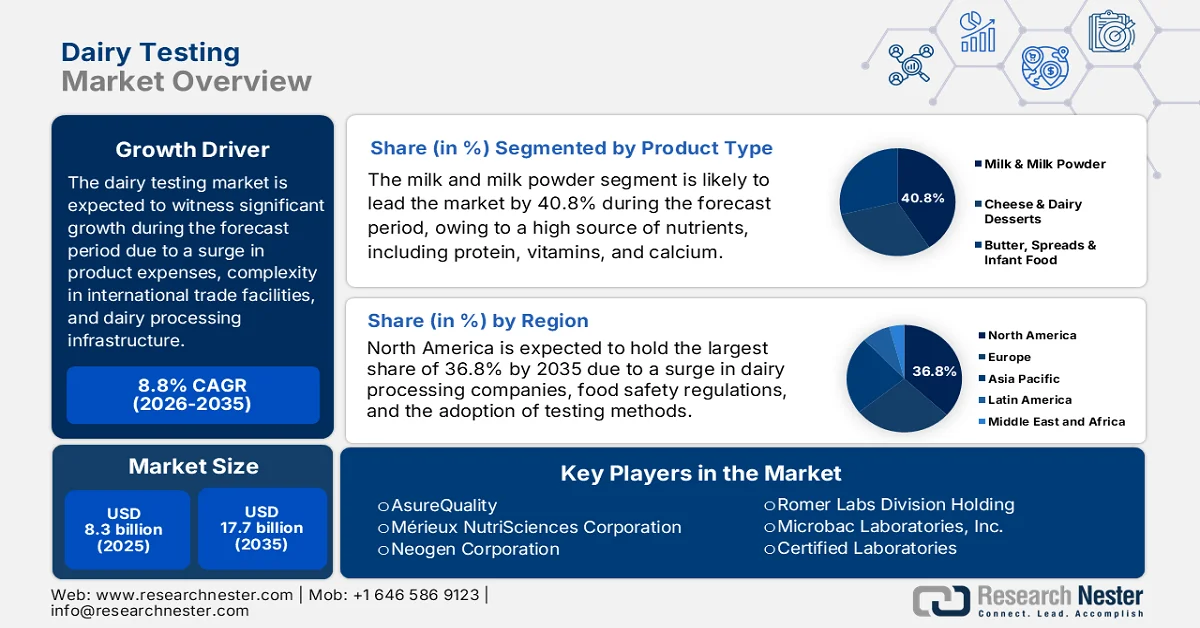
The global dairy testing market is deliberately shaped by logistical, economic, and structural factors, including rising product recall costs, increasing complexity in foreign trade documentation, and the consolidation of dairy processing hubs into mega-diaries that demand central testing contracts. According to official statistics published by the OECD in July 2025, worldwide milk production, comprising 4% from goats, sheep, and camels, 15% from buffalo, and 8% from cows, is expected to grow at 1.8% per annum. This is highly driven by a surge in yields every year, with a surge in the number of cows projected to be moderate. Besides, the milk production across 3 major dairy exporters, such as the U.S., Europe, and New Zealand, is forecasted to jointly enhance their exports by almost 70% of milk exports globally. Moreover, the consumption of both fresh and processed dairy products across different regions is also boosting the dairy testing market growth.
Global Per Capita Fresh and Processed Dairy Products Analysis (2022-2024 and 2034)
|
World and Countries |
Fresh Dairy Products (Kilograms/Person) |
Processed Dairy Products (Kilograms/Person) |
||
|
2022-2024 |
2034 |
2022-2024 |
2034 |
|
|
World |
9.3 |
11.0 |
3.6 |
4.0 |
|
China |
2.4 |
2.9 |
1.2 |
1.4 |
|
Sub-Sahara Africa |
2.7 |
2.7 |
0.4 |
0.4 |
|
Latin America and the Caribbean |
9.2 |
9.4 |
5.5 |
6.2 |
|
U.S. |
9.0 |
8.1 |
12.2 |
13.5 |
|
Europe |
11.5 |
10.6 |
13.0 |
13.3 |
|
India |
19.2 |
26.3 |
2.8 |
3.6 |
Source: OECD
Furthermore, the presence of subscription-based testing-as-a-service (TaaS) models, decentralized on-farm rapid testing kits, and the aspect of testing for non-conventional contaminants, such as nanomaterials and microplastics, are a few trends that are responsible for bolstering the dairy testing market globally. As stated in an article published by the Journal of Hazardous Materials Letters in November 2024, the highest microplastics contamination levels in both human breast milk and dairy products have been identified to be almost 2,590 MPs/L. Besides, it has also been demonstrated that present analytical methods for identifying such contaminants in dairy products frequently fail to adhere to green analytical chemistry principles, with scores accounting for below 0.58 on the AGREE scale. Therefore, to overcome this, policymakers have enforced strict regulations to ensure food quality, which is positively fueling the market growth.
Key Dairy Testing Market Insights Summary:
Regional Highlights:
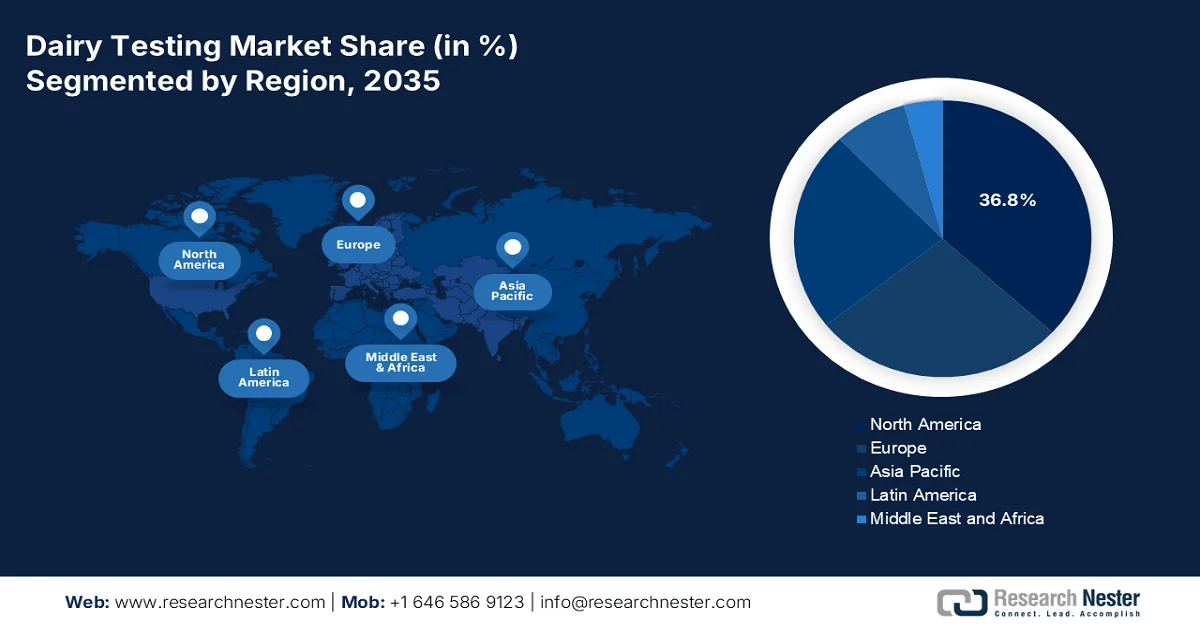
- North America dairy testing market is projected to hold a dominant 36.8% share by 2035, attributable to stringent food safety regulations, strong presence of dairy processors, and rapid adoption of advanced testing technologies.
- Asia Pacific is anticipated to witness the fastest expansion in the forecast period to 2035, impelled by rising dairy consumption, increasing urbanization, and growing awareness regarding food quality and safety.
Segment Insights:
- Milk and milk powder segment in the dairy testing market is expected to capture a leading 40.8% share by 2035, driven by its nutritional significance and rising global production supporting demand for long shelf-life dairy products.
- Rapid testing (PCR) sub-segment is projected to secure the second-largest share during the forecast period to 2035, propelled by the growing need for accurate and rapid detection of adulterants in milk.
Key Growth Trends:
- Expansion of plant-based dairy alternatives
- Climate-driven mycotoxin proliferation in feed grains
Major Challenges:
- Shortage of skilled technical workforce
- Rapidly evolving contaminants and adulteration techniques
Key Players: Eurofins Scientific (Luxembourg), SGS Institut Fresenius (Germany), Intertek Group plc (UK), Bureau Veritas (France), TÜV SÜD (Germany), TÜV NORD GROUP (Germany), ALS Limited (Australia), AsureQuality (New Zealand), Mérieux NutriSciences Corporation (U.S.), Neogen Corporation (U.S.), Romer Labs Division Holding (Austria), Microbac Laboratories, Inc. (U.S.), Certified Laboratories (U.S.), Agrolab Group (Netherlands), Dairy One (U.S.), Fare Labs (India), Lactanet (Canada), Doctors' Analytical Laboratories Pvt. Ltd. (India), Cvr Labs Private Limited (India), Lilaba Analytical Laboratories (India), trinamiX GmbH (Germany), Rock River Laboratory, Inc. (U.S.), SGS (Switzerland).
Global Dairy Testing Market Forecast and Regional Outlook:
Market Size & Growth Projections:
- 2025 Market Size: USD 8.3 billion
- 2026 Market Size: USD 9 billion
- Projected Market Size: USD 17.7 billion by 2035
- Growth Forecasts: 8.8% CAGR (2026-2035)
Key Regional Dynamics:
- Largest Region: North America (36.8% Share by 2035)
- Fastest Growing Region: Asia Pacific
- Dominating Countries: United States, Germany, Japan, China, United Kingdom
- Emerging Countries: Japan, South Korea, Brazil, Mexico, Italy
Last updated on : 15 April, 2026
Dairy Testing Market - Growth Drivers and Challenges
Growth Drivers
- Expansion of plant-based dairy alternatives: The increasing growth of plant-based dairy alternatives, such as coconut, soy, almond, and oat milk, has effectively created an unexpected need for the dairy testing market. According to official statistics published by NLM in January 2026, the popularity of plant-specific dairy alternatives is continuously rising, with a yearly growth rate of 7.9% as of 2022, and is further expected to exhibit a 9.9% growth by the end of 2033. In addition, the worldwide plant-based dairy alternatives industry was worth 28.5 billion as of 2023, and it successfully reached USD 32.3 billion by the end of 2025. Plant-based dairy alternatives, such as soybeans, are useful in increasing the overall phenolics by 28.5% when fermented for a short time span, while long hours of fermentation for 72 hours led to a 78% increase, thus proliferating the dairy testing market growth.
- Climate-driven mycotoxin proliferation in feed grains: The aspect of climate modification is deliberately causing irregular weather patterns, including unseasonal rains and droughts, that are increasingly promoting aflatoxin-based molds growth on corn, which in turn is enhancing the dairy testing market demand globally. As per an article published by the Grain & Oil Science and Technology in March 2023, at present, over 400 mycotoxins have been recognized and stated as low-molecular-weight toxic compounds that are produced as secondary metabolites by a few filamentous fungi. Besides, mycotoxin-based fungal species usually damage 1/4th, which is 25%, of total agricultural products globally. Based on this, aflatoxins are the most common mycotoxins, owing to their carcinogenic activity, high toxicity, and frequent occurrence in feedstuffs and various foods.
- Growth of perishable dairy needing shelf-life validation: The explosion of direct-to-consumer dairy subscriptions and online grocery delivery has fundamentally modified shelf-life demands, which denotes an optimistic outlook for the dairy testing market. As per an article published by the Journal of Rural Studies in July 2023, 30% of farmers in the U.S. utilize the internet as the ultimate source for business purposes. Additionally, the U.S. Department of Agriculture (USDA)'s Local Food Marketing Practice reported that online sales as a direct-to-consumer industry channel accounted for 6% of direct-to-consumer sales by domestic farms. This particularly increased by 10.4%, which denotes a huge growth opportunity for the dairy testing market. Likewise, farmers also utilize web-based technologies, which are equally responsible for fueling the market expansion.
Challenges
- Shortage of skilled technical workforce: The modernized dairy testing market requires professionals skilled in microbiology, chromatography, molecular biology, and data interpretation. However, there is a global shortage of qualified laboratory technicians and analysts willing to work in the food testing sector, which often pays less than pharmaceuticals or clinical diagnostics. This shortage is particularly acute in rural dairy-producing regions, where most collection and initial testing occur. Turnover rates are high, leading to inconsistent test results, documentation errors, and increased risk of false negatives or positives. Automation and AI-based testing systems could mitigate this, but their implementation requires even higher technical expertise to operate and maintain.
- Rapidly evolving contaminants and adulteration techniques: As testing methods optimize, fraudulent actors develop more sophisticated adulteration strategies to evade detection, which negatively impacts the dairy testing market. For instance, the utilization of nitrogen-based non-protein compounds to mask low protein content or the addition of melamine analogs not yet covered by standard screening panels. Besides, emerging environmental contaminants, such as per- and polyfluoroalkyl substances (PFAS), microplastics, and veterinary drug metabolites, are increasingly found in raw milk, yet they lack standardized testing protocols. These dynamic forces test labs to continuously update reference libraries, acquire new reagents, and validate novel detection methods.
Dairy Testing Market Size and Forecast:
| Report Attribute | Details |
|---|---|
|
Base Year |
2025 |
|
Forecast Year |
2026-2035 |
|
CAGR |
8.8% |
|
Base Year Market Size (2025) |
USD 8.3 billion |
|
Forecast Year Market Size (2035) |
USD 17.7 billion |
|
Regional Scope |
|
Dairy Testing Market Segmentation:
Product Type Segment Analysis
The milk and milk powder segment in the dairy testing market is anticipated to garner the largest share of 40.8% by the end of 2035. The segment’s upliftment is primarily driven by its importance as a crucial source of high-quality vitamins, calcium, and protein to support immune function, aid in muscle repair, and strengthen bones. Based on government estimates published by the USDA in 2026, the 10-year average production of milk powder between 2016 and 2025 accounts for 4.4 million metric tons, along with a production of 4.42 million metric tons between 2024 and 2025 across different regions. Therefore, with this surge in production, there is a huge demand for milk powder that provides cost-effectiveness, superior convenience, long-lasting shelf-life, while effectively maintaining nutritional value to fresh milk. Besides, the milk powder production varies across different economies, demonstrating the growth and the demand to focus on expanding the production.
Milk Powder Production Country Analysis (2025-2026)
|
Country |
Global Production |
Overall Production (Metric Tons) |
|
New Zealand |
32% |
1.4 million |
|
China |
26% |
1.1 million |
|
Europe |
14% |
600,000 |
|
Brazil |
13% |
595,000 |
|
Argentina |
4% |
182,000 |
|
Mexico |
3% |
125,000 |
|
Indonesia |
2% |
77,000 |
|
Belarus |
1% |
64,000 |
|
Chile |
1% |
63,000 |
|
U.S. |
1% |
60,000 |
Source: USDA
Technology Segment Analysis
The rapid testing (PCR) sub-segment, part of the technology segment, is projected to grab the second-largest share in the dairy testing market during the forecast period. The sub-segment’s growth is highly driven by the aspect of offering gold-standard accuracy with increased turnaround duration at the suitable point of care. According to official statistics published by the Journal of Agriculture and Food Research in June 2023, India is considered one of the highest milk production nations, with a yearly production of almost 127 million tons. However, due to health advantages, the continuous increase in the need for milk production has led to the malpractice of synthetic-based milk. Likewise, the addition of adulterants to natural milk and nutrient manipulation has created a concern for health, which is fueling the sub-segment’s requirement globally.
Testing Type Segment Analysis
By the end of the stipulated timeline, the safety testing segment, which is part of the testing type, is expected to account for the third-largest share in the dairy testing market. The segment’s development is highly propelled by the aspect of ensuring systems and products are extremely safe for consumer utilization, along with overcoming damage, legal liabilities, and injuries to brand reputation. As stated in an article published by the Frontiers Organization in June 2025, safety testing enables premium-quality raw milk or high-quality milk, which is referred to as raw milk with an overall bacterial count, usually ranging less than 100,000 cfu/mL, along with less than 400,000 cells/mL of low somatic cell count, optimal fat and protein composition, as well as the absence of chemical residues and antibiotic, and the presence of proper hygiene, thus driving the testing method’s exposure.
Our in-depth analysis of the dairy testing market includes the following segments:
|
Segment |
Subsegments |
|
|
|
Technology |
|
|
Testing Type |
|
|
Contaminant |
|
|
End user |
|
|
Supply Chain Stage |
|

Vishnu Nair
Head - Global Business DevelopmentCustomize this report to your requirements — connect with our consultant for personalized insights and options.
Dairy Testing Market - Regional Analysis
North America Market Insights
North America in the dairy testing market is anticipated to garner the highest share of 36.8% by the end of 2035. The market’s upliftment is primarily attributed to a highly regulated food safety environment, the presence of the majority of dairy processing organizations, and the rapid adoption of innovative rapid testing methods for replacing conventional culture-based techniques. According to official statistics published by the USDA Government in February 2026, milk is readily produced across 50 cities in the U.S. Therefore, farmers in the country have successfully adopted robotic and precision dairy farming, which has positively increased domestic farmers’ dairy net returns by 13% on average. Therefore, with the increased presence of technologies for dairy farming in the country, the market is gaining massive exposure in the overall region.
The dairy testing market in the U.S. is growing significantly, owing to the increased focus on the FDA Food Safety Modernization Act (FSMA) enforcement, growth in the per capita dairy consumption, retailer-based private label testing requirements, and the incorporation of rapid testing technology for throughput efficiency. Based on government estimates published by Congress in June 2025, there has been an upsurge in milk production by 33% to 226.4 billion pounds of milk as of 2024, based on milk cows’ stabilization by nearly 9 million head. Besides, there has been a decrease in the domestic per capita consumption of fluid milk from 29 gallons every year to 16 gallons per year, demonstrating a 45% decline. Despite this decrease, the yearly average domestic per capita consumption of dairy products increased from 55 pounds to 84 pounds, indicating a 53% surge, which is responsible for bolstering the dairy testing market growth.
State-Wise Milk Production Analysis in the U.S. (2025)
|
State |
Production (Million) |
|
California |
3,311 |
|
Texas |
1,494 |
|
Washington |
454 |
|
Oregon |
203 |
|
Idaho |
1,469 |
|
Colorado |
443 |
|
Arizona |
381 |
|
New Mexico |
457 |
|
Kansas |
441 |
|
South Dakota |
453 |
|
Minnesota |
869 |
|
Iowa |
492 |
|
Wisconsin |
2,643 |
|
Illinois |
135 |
|
Michigan |
1,028 |
|
Indiana |
382 |
|
Ohio |
466 |
|
Pennsylvania |
777 |
|
New York |
1,343 |
|
Vermont |
204 |
|
Virginia |
111 |
|
Georgia |
173 |
|
Florida |
165 |
Source: KCUR Organization
The existence of the supply-based quality verification system, export certification requirements for foreign economy accessibility, grade standards enforcement for quality differentiation, and the vitamin fortification compliance testing are certain factors that are driving the dairy testing market in Canada. As per an article published by Dairy Farmers of Canada in October 2025, the population in the country usually counts 9,000 domestic dairy farmers for delivering a continuous supply of milk from farms that are produced based on certain standards. Besides, dairy supports over 270,000 employment opportunities and significantly contributes USD 28 billion to the nation’s GDP. Apart from these, the country’s government has put forth microbial and chemical standards for raw milk production and consumption, which is also proliferating the dairy testing market growth in the country.
Chemical and Microbiological Standards for Raw Milk in Canada (2026)
|
Parameter Type |
Standard |
|
Temperature |
More than 0 degrees Celsius and less than or equal to 4 degree Celsius for milk comprising in bulk tank. |
|
Bacteria Count |
Maximum 50,000 mesophilic aerobic colony-forming cow milk units per milliliter. 321,000 individual bacterial count for goat milk when tested utilizing Flow Cell Cytometry on a Bactoscan. |
|
Somatic Cells |
Maximum 400,000 per ml for cow milk, and 1,500,000 per ml for goat milk. |
|
Veterinary Drug Residues |
Negative for the presence of veterinary drug residues and inhibitory substance residues as tested by an approved screening method or testing below the MRL by an approved quantitative method. |
|
Cryoscopy |
Maximum for 0.525-degree Hortvet for cow milk, and 0.554-degree Hortvet for goat milk. |
Source: Agriculture and Agri-Food Canada
APAC Market Insights
The Asia Pacific in the dairy testing market is expected to emerge as the fastest-growing region during the forecast period. The market’s development in the region is highly propelled by a rise in dairy consumption across emerging countries, an increase in urbanization, the upscaling of automated laboratories, and the growing consumer awareness regarding food quality and safety. According to official statistics published by OECD in July 2025, there has been an increase in milk production, particularly in India, by 3% that successfully reached 227 million tons in 2024. Therefore, due to this increase, significant growth in milk solids is projected to increase to 30 kg per capita in the country. Besides, both the present and future milk yield in India and China are also responsible for developing the dairy testing market demand in the overall region.
Milk Yield Analysis in China and India (2022-2024 and 2034)
|
Countries |
Milk Yield (Tons per Animal) |
|
|
2022-2024 |
2034 |
|
|
India |
2.0 |
2.5 |
|
China |
2.8 |
3.1 |
Source: OECD
The dairy testing market in China is gaining increased traction, owing to the effective implementation of strong governmental traceability mandates, an increase in the demand for substantial testing volume for both imported production verification and domestic production, stringent residue restrictions, focus on food safety standards, and organizational contributions. For instance, in December 2025, the Consumer Goods Forum (CGF) introduced the 2025 edition of the CGF China Green Consumer Goods Selection Guide, which is the newest framework for supporting the growth of a scalable, consistent, and credible green consumption ecosystem in the country. Therefore, with this establishment, there is increased focus on green life cycle, green production, green materials, green logistics, and green packaging, which denotes a positive impact on the market development in the nation.
The aspects of expansion in the yearly milk production, an increase in testing requirements for milk and milk products, the presence of an organized dairy industry, focus on testing equipment and export opportunities, and governmental strategies are factors that are developing the dairy testing market in India. As per an article published by the PIB Government in May 2025, there has been a rise in milk production by 63.5% from 146.3 million tons to 239.2 million tons. This is equivalent to maintaining an outstanding yearly growth rate of 5.7% in the past 10 years. Besides, Uttar Pradesh is considered one of the top milk production states, effectively contributing 16.2% of the overall domestic milk output. This is followed by West Bengal demonstrating a rapid growth by recording a 9.7% rate between 2023 and 2024, based on which, there is a huge growth opportunity for the dairy testing market in the country.
Europe Market Insights
Europe in the dairy testing market is projected to witness considerable growth by the end of the stipulated timeline. The market’s growth in the region is highly fueled by the presence of strict food safety regulations, an increase in the adoption of digitalized traceability platforms, rapid testing technologies, and laboratory automation, along with robust investment in advanced testing facilities by dairy processors. According to official statistics published by the Journal of Dairy Science in November 2025, the region contributes to a majority of the global dairy industry by effectively producing an approximate 160.8 million tons of milk as of 2023. In addition, this further caters to over 20% of the world’s overall milk production, which is driving the market demand. This particular growth is highly driven by climate policy, modifications in consumer expectations, and an increase in agroecological practices.
The dairy testing market in Germany is gaining increased exposure, owing to the presence of the largest accredited food testing laboratories, increased concentration of industrial facilities, an upsurge in processed milk every year, suitable funding programs for supporting testing technologies, and robust export orientation. As stated in an article published by the Observatory of Economic Complexity (OEC) in March 2026, the country is regarded as both the highest importer and exporter of milk, accounting for USD 2.1 billion and USD 1.6 billion as of 2024. Based on the March 2025 Europe Dairy Association data report, the total milk delivery in 2023 was 1,45.1 million tons, including 2.7 million in imports, 23.9 million in exports, and 0.7% in terms of change stocks. Simultaneously, the delivery accounted for 145.4 million tons as of 2024, with 2.8 million imports, 22.5 million exports, and 0.3% stock change. Moreover, it was 145 million tons in 2025, with 2.8 million imports, 22 million exports, and 0.1% stock change, thus fueling the market exposure.
An increase in milk production, creating the suitable demand for quality assurance testing, a surge in export volumes to non-regional economies, an expansion in adopting testing protocols to meet both destination and standards of domestic requirements, and increased focus on food safety infrastructure are a few trends that are responsible for boosting the dairy testing market in Poland. Based on an article published by the Polish Trade Government in September 2025, the dairy industry in the country recorded a surge in its exports by almost USD 2.4 billion as of 2025, which is 14% more than the previous year. Regarding this increasing growth, dairy cows in the country accounted for 1.9 million head in May 2025, which is 0.4% less than 2024. Besides, the nation’s largest herds are located in Mazowieckie and Podlaskie Voivodeships, accounting for 22% share each, which is followed by 15% in Wielkopolskie, and 8% in Warmińsko-Mazurskie, thereby making it suitable for enhancing the market exposure.
Key Dairy Testing Market Players:
- Eurofins Scientific (Luxembourg)
- SGS Institut Fresenius (Germany)
- Intertek Group plc (UK)
- Bureau Veritas (France)
- TÜV SÜD (Germany)
- TÜV NORD GROUP (Germany)
- ALS Limited (Australia)
- AsureQuality (New Zealand)
- Mérieux NutriSciences Corporation (U.S.)
- Neogen Corporation (U.S.)
- Romer Labs Division Holding (Austria)
- Microbac Laboratories, Inc. (U.S.)
- Certified Laboratories (U.S.)
- Agrolab Group (Netherlands)
- Dairy One (U.S.)
- Fare Labs (India)
- Lactanet (Canada)
- Doctors' Analytical Laboratories Pvt. Ltd. (India)
- Cvr Labs Private Limited (India)
- Lilaba Analytical Laboratories (India)
- trinamiX GmbH (Germany)
- Rock River Laboratory, Inc. (U.S.)
- SGS (Switzerland)
- Company Overview
- Business Strategy
- Key Product Offerings
- Financial Performance
- Key Performance Indicators
- Risk Analysis
- Recent Development
- Regional Presence
- Eurofins Scientific operates one of the most extensive global networks of food testing laboratories, offering comprehensive dairy safety and quality analysis services. The company is known for its advanced molecular biology and chromatography capabilities, which enable rapid detection of pathogens, antibiotics, and adulterants in milk and dairy products.
- SGS Institut Fresenius leverages its German precision and technical expertise to provide accredited dairy testing services across the entire supply chain, from farm-level raw milk to finished packaged products. The company focuses on method validation and regulatory compliance, helping dairy exporters meet stringent European Union and international food safety standards.
- Intertek Group plc provides integrated dairy testing solutions that combine laboratory analysis with supply chain auditing and certification services. The company supports dairy processors in reducing recall risks by offering customized testing protocols for contaminants, nutritional labeling, and shelf-life validation.
- Bureau Veritas applies its strong heritage in quality assurance to the dairy sector, delivering microbiological and chemical testing through a decentralized network of regional laboratories. The company emphasizes speed and accuracy, enabling dairy producers to achieve faster product release without compromising safety compliance.
- TÜV SÜD extends its industrial testing expertise into the food sector by offering specialized dairy safety audits and residue analysis services. The company differentiates itself through its focus on risk-based testing strategies and technical training programs for dairy quality assurance teams.
Here is a list of key players operating in the global dairy testing market:
The global dairy testing market is moderately consolidated, with key players such as Eurofins Scientific, SGS Institut Fresenius, and Intertek Group plc holding significant market share due to their extensive laboratory networks and comprehensive testing portfolios. These companies have established strong reputations for compliance expertise and global reach, which are critical for serving multinational dairy processors and meeting stringent food safety regulations. Besides, in January 2026, trinamiX GmbH and Eurofins Agro Testing jointly created a mobile feed analysis solution for the equine industry to ensure forage testing for pastures and stables across Europe. This has successfully empowered equine nutritionists, veterinary professionals, and forage dealer to undertake informed decisions based on actual nutritional insights, which is positively uplifting the dairy testing industry worldwide.
Corporate Landscape of the Dairy Testing Market:
Recent Developments
- In February 2026, Intertek Greater China introduced the latest capacity for identifying cereulide in the domestic Shanghai food laboratory to support the safety of milk as well as baby food products across the overall region.
- In November 2025, Rock River Laboratory, Inc. effectively acquired Deveron agronomic and environmental assets to incorporate its very own family-run laboratory network, which is duly supported by over 50 years of agricultural experience, and in association with Woods End Laboratories to provide science-specific tools and data.
- In October 2025, SGS signed a global cooperative deal with Yili Group to significantly strengthen full-chain mutual trust and readily promote worldwide standardization across dairy innovation, sustainability, safety, and production.
- Report ID: 8515
- Published Date: Apr 15, 2026
- Report Format: PDF, PPT
- Explore a preview of key market trends and insights
- Review sample data tables and segment breakdowns
- Experience the quality of our visual data representations
- Evaluate our report structure and research methodology
- Get a glimpse of competitive landscape analysis
- Understand how regional forecasts are presented
- Assess the depth of company profiling and benchmarking
- Preview how actionable insights can support your strategy
Explore real data and analysis
Frequently Asked Questions (FAQ)
About this Report
Connect with our Expert


Report, 2026-2035



Copyright @ 2026 Research Nester. All Rights Reserved.
