Cut Flower Packaging Market Outlook:
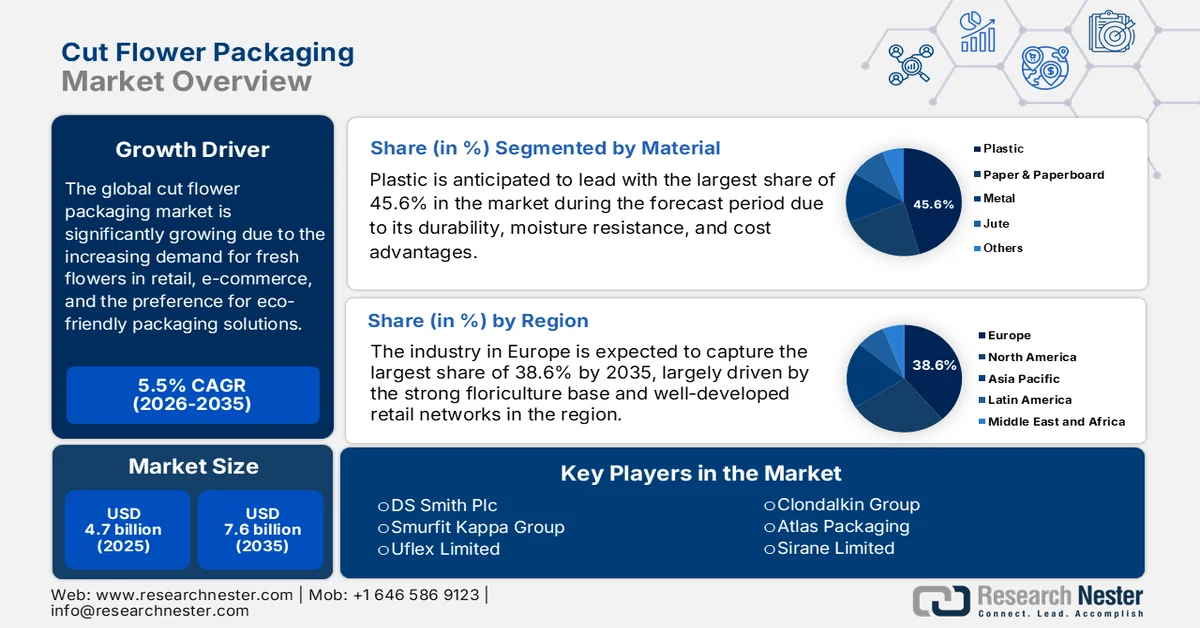
Cut Flower Packaging Market size was valued at USD 4.7 billion in 2025 and is projected to reach USD 7.6 billion by the end of 2035, rising at a CAGR of 5.5% during the forecast period, i.e., 2026-2035. In 2026, the industry size of cut flower packaging is estimated at USD 4.9 billion.
The global cut flower packaging market is witnessing noteworthy growth on account of increasing demand for fresh flowers in retail and e-commerce. This has led to significant trade flows, allowing firms to generate consistent revenue across different countries and regions. As per the official statistics published by Observatory of Economic Complexity (OEC) in 2024, global trade in cut flowers reached a total of USD 9.3 billion, reflecting a 1.01% growth from 2023. The Netherlands led global exports at USD 4.2 billion which was, followed by Colombia with USD 1.4 billion and Ecuador with USD 950 million. Meanwhile, the U.S. was the top importer at USD 1.6 billion, and cut flowers ranked 381/1222 products, with a low product complexity index of -1.7, highlighting the trade reliance on established exporters. Hence, these trade volumes underscore the strong demand for protective packaging and export-ready assembly lines globally.
2024 Global Cut Flower Trade Statistics: Top Global Exporters
|
Country |
Export Value USD |
|
Netherlands |
4.2 billion |
|
Colombia |
1.4 billion |
|
Ecuador |
950 million |
|
Kenya |
780 million |
|
Ethiopia |
285 million |
|
China |
185 million |
|
Italy |
138 million |
|
Canada |
111 million |
|
Malaysia |
90.8 million |
|
Thailand |
84.9 million |
|
Spain |
81 million |
|
Israel |
47 million |
Source: OEC
2024 Global Cut Flower Trade Statistics: Top Global Importers
|
Country |
Import Value |
|
U.S. |
1.6 billion |
|
Germany |
1.3 billion |
|
Netherlands |
944 million |
|
UK |
743 million |
|
France |
390 million |
|
Russia |
383 million |
|
Japan |
279 million |
|
Poland |
261 million |
|
Italy |
230 million |
|
Kazakhstan |
221 million |
Source: OEC
Expansion in international cut flower production and exports is stimulating growth in the cut flower packaging market as suppliers look for efficient solutions for transporting perishable products worldwide. In this context the article published by the Indian Council for Agricultural Research (ICAR) in September 2024 stated that the global floriculture industry, spanning cut flowers, potted plants, and ornamental foliage, was valued at USD 57.5 billion in 2024 and is growing at 10% on yearly basis, with the Netherlands, U.S., Thailand, China, and the UK leading production and trade. Besides, Europe and North America account for the majority of consumption, whereas Germany, the U.S., the UK, the Netherlands, France, and Switzerland together consume nearly 80% of global flower output. India occupies 285,000 ha, which is 35% of the global floriculture area, and produced 947,000 tons of cut flowers in 2023‑24, which is cultivated under both open fields and advanced polyhouse systems. Overall, floriculture production is rapidly expanding, driving the need for efficient packaging solutions.
Key Cut Flower Packaging Market Insights Summary:
Regional Highlights:
- Europe is projected to dominate the cut flower packaging market with a 38.6% share by 2035, attributed to stringent sustainability regulations and a well-established floriculture ecosystem.
- North America is expected to witness notable expansion in the forecast period 2026–2035, propelled by the rapid growth of e-commerce and increasing demand for extended freshness solutions.
Segment Insights:
- Plastic segment in the cut flower packaging market is projected to account for a 45.6% share by 2035, driven by its durability, moisture resistance, and cost efficiency in preserving flower quality during transit.
- Sleeves segment is anticipated to capture a significant share over 2026–2035, fueled by their lightweight nature, customization capabilities, and enhanced product visibility for retail appeal.
Key Growth Trends:
- Growth in retail & e‑commerce channels
- Consumer preference for aesthetic & customized packaging
Major Challenges:
- Perishability and short shelf life
- Temperature and cold chain management
Key Players: DS Smith Plc (UK), Smurfit Kappa Group (Ireland), Uflex Limited (India), Clondalkin Group (Netherlands), Atlas Packaging (UK), Sirane Limited (UK), Mos Packaging Printing Factory (China), A·ROO Company LLC (U.S.), Koen Pack (Netherlands), FloPak (Spain), Robert Mann Packaging (U.S.), Hawaii Box & Packaging (U.S.), Pacombi Group (Netherlands), Packaging Industries Ltd (Kenya), Dilpack Kenya (Kenya), Village Farms International (Canada), Seaman Paper (U.S.), FloraLife (U.S.), Chrysal International (Netherlands), Stora Enso Oyj (Finland), Mondi Group (Austria), Smurfit Westrock (Europe), GleePackaging (Europe), Nature‑Pack (Europe).
Global Cut Flower Packaging Market Forecast and Regional Outlook:
Market Size & Growth Projections:
- 2025 Market Size: USD 4.7 billion
- 2026 Market Size: USD 4.9 billion
- Projected Market Size: USD 7.6 billion by 2035
- Growth Forecasts: 5.5% CAGR (2026-2035)
Key Regional Dynamics:
- Largest Region: Europe (38.6% Share by 2035)
- Fastest Growing Region: North America
- Dominating Countries: United States, Germany, Netherlands, China, Japan
- Emerging Countries: India, Brazil, South Korea, Mexico, Indonesia
Last updated on : 26 March, 2026
Cut Flower Packaging Market - Growth Drivers and Challenges
Growth Drivers
- Growth in retail & e‑commerce channels: The escalating sales of cut flowers through supermarkets, gift shops, and especially online flower delivery platforms are driving demand for transit‑ready packaging such as boxes, cartons, and protective wraps. Consumers prefer ready‑to‑display, pre‑wrapped bouquets for convenience, which benefits the overall cut flower packaging market. According to the article published by the U.S. Department of Agriculture (USDA) in May 2024, New Jersey’s floriculture sales totaled USD 308 million in 2023, ranking fifth highest in the U.S. The state is house of 275 growers; it stood fourteenth in grower numbers nationwide, and its 4,164 acres of open production ranked third. Bedding and garden plants led the category with USD 184 million in sales, hence denoting a positive outlook for the cut flower packaging market’s growth and exposure.
- Consumer preference for aesthetic & customized packaging: Packaging is mostly used as a branding and presentation tool, especially in terms of premium floral products and gifting segments. Attractive wraps and boxes enhance the perceived value and appeal, driving the cut flower packaging market growth. Seasonal gifting holidays cause demand surges for decorative packaging solutions. As per an article published by the National Institute of Health in May 2023, a study analyzed the customer satisfaction influencing flower purchasing behavior in Shanghai, China, using 838 survey responses and a binary logit model. It found that service satisfaction positively affects purchases, whereas satisfaction with price and promotional methods negatively impacts buying behavior. The effect of satisfaction varies depending on the consumer’s purchase purpose, i.e., gift, hobby, or decoration, which reflects the role of purchase intent. Therefore, these findings suggest that flower merchants should tailor products in order to meet altering customer needs and enhance satisfaction.
- Shift toward sustainable & eco‑friendly materials: Environmental awareness and regulations are restricting single‑use plastics, which is prompting shifts toward biodegradable, recyclable, and compostable packaging materials. On the other hand, sustainable packaging is becoming a selling point for eco‑aware consumers as well as retailers. As per the article published by the American Society of Florists in June 2023, a study in the U.S. study found that consumers mostly prefer buying flowers from businesses that use sustainable practices and are willing to pay a premium for them. Besides the locally sourced flowers, composting floral waste was the most valued attribute, wherein many respondents were willing to pay 10% to 25% more for these practices. In addition, factors such as organic products, recyclable materials, and fair-trade sourcing also influenced purchase decisions, thus denoting a positive outlook for the cut flower packaging market.
Challenges
- Perishability and short shelf life: The cut flowers are inherently perishable; therefore, their visual appeal and freshness deteriorate soon after harvest. Maintaining proper safety during transport and storage is highly essential, as improper handling can lead to wilting, discoloration, or loss of fragrance. Also, the aspect of packaging highly essential role in slowing degradation by controlling moisture, oxygen, and ethylene exposure. Designing packaging that effectively preserves freshness without overcomplicating the process logistics is challenging for firms operating in this sector. In this context, growers and exporters in the cut flower packaging market are suggested to balance protective functionality with cost, as well as transport efficiency. Failure to address these concerns directly impacts shelf life and can lead to loss, especially in terms of high-volume international trade.
- Temperature and cold chain management: Maintaining the optimal temperature from farm to consumer delivery is an important factor in cut flower logistics. Flowers are sensitive to heat, cold, and fluctuations, which can cause premature aging, wilting, or microbial growth. Therefore, packaging alone cannot fully protect flowers; thus, an effective cold chain infrastructure, including refrigerated transport, storage, and retail display, is necessary. In most of the regions, especially in developing markets, consistent cold chain facilities are limited or unreliable making it challenging for firms in the cut flower packaging market. Packaging should complement refrigeration by providing insulation, moisture control, and ethylene absorption. These requirements increase both cost and complexity. Moreover, long-distance shipping or export to international markets necessitates packaging solutions that can maintain ideal conditions for several days.
Cut Flower Packaging Market Size and Forecast:
| Report Attribute | Details |
|---|---|
|
Base Year |
2025 |
|
Forecast Year |
2026-2035 |
|
CAGR |
5.5% |
|
Base Year Market Size (2025) |
USD 4.7 billion |
|
Forecast Year Market Size (2035) |
USD 7.6 billion |
|
Regional Scope |
|
Cut Flower Packaging Market Segmentation:
Material Segment Analysis
Plastic, which is under the material segment, is anticipated to lead the entire cut flower packaging market with the largest share of 45.6% during the forecast period. The dominance of the segment is largely driven by its durability, moisture resistance, and cost advantages that help maintain flower quality during handling and transit, especially for retail and e‑commerce deliveries. According to the article published by Sustainable Flowers Research Organization in December 2024, there has been a continued reliance on plastics in the cut-flower industry, especially among large-scale retailers and online floral suppliers, due to their cost-effectiveness and protective qualities. It also stated that the government policies, consumer preferences, and retailer targets for recyclability, reuse, and composability are efficiently driving gradual shifts toward sustainable packaging practices. The study encourages improving waste management, labeling clarity, and florist training to support a circular economy in floriculture.
Product Type Segment Analysis
In the product type category, the sleeves are expected to garner a lucrative revenue share in the cut flower packaging market during the discussed timeframe. The segment’s progress in this sector is largely propelled by their lightweight, easy-to-customize, for example, branding and design, and providing adequate protection while showcasing flowers, which is important for retail shelves and bouquet presentation. In addition, sleeves facilitate easier handling and stacking during transportation, reducing damage to delicate blooms. Also, their transparency allows consumers to view the product, enhancing purchase appeal and supporting impulse buying in retail environments. Custom-printed sleeves serve as an effective marketing tool, which efficiently solidifies brand identity and seasonal promotions. Furthermore, sleeves are compatible with automated packing systems, improving efficiency and reducing labor costs in floriculture supply chains, hence denoting a wider segment scope.
Flower Type Segment Analysis
The bouquet segment, which is under the flower type segment in the cut flower packaging market, is predicted to grow with a significant revenue share by the conclusion of 2035. The rising demand for pre-arranged, visually appealing arrangements for gifting and retail display is a main factor behind the subtype’s leadership. These solutions preserve flower freshness, support retail display, and meet increasing consumer demand, ultimately driving sustained growth and adoption of specialized cut flower packaging. In addition, the continued introduction of breathable films and hydration wraps is enabling bouquets to maintain freshness for up to 5 to 7 days in terms of long-distance shipping, making them more viable for cross-border e-commerce. Furthermore, retailers are opting for customized bouquet packaging with brand-specific designs and QR codes, thereby enhancing customer engagement, hence positively impacting the segment’s growth.
Our in-depth analysis of the cut flower packaging market includes the following segments:
|
Segment |
Subsegments |
|
Material |
|
|
Product Type |
|
|
Flower Type |
|
|
Sales Channel |
|

Vishnu Nair
Head - Global Business DevelopmentCustomize this report to your requirements — connect with our consultant for personalized insights and options.
Cut Flower Packaging Market - Regional Analysis
Europe Market Insights
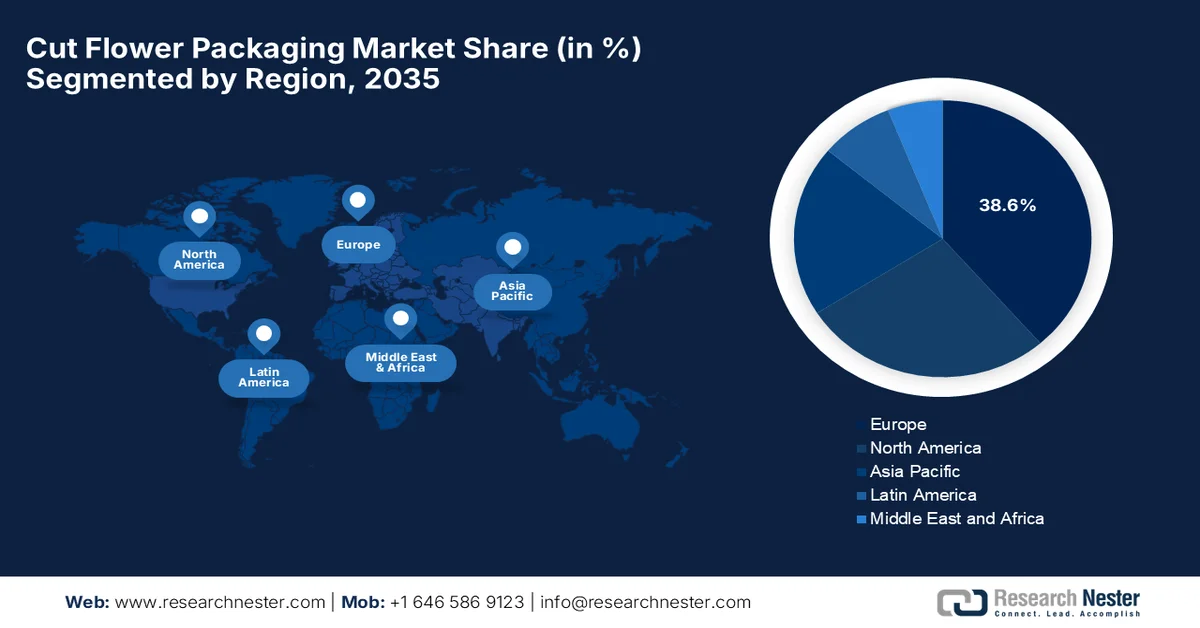
The cut flower packaging market in Europe is anticipated to garner the largest revenue share of 38.6% by the end of the forecast duration. The dominance of the region is effectively attributable to a strong floriculture base, well-developed retail networks, and stringent sustainability norms that push demand for protective and decorative packaging. The region is supported by strong demand for flowers used in celebrations, decoration, and gifting. In February 2024, the European Commission approved and launched the FloriPEFCR, setting harmonised rules for calculating the environmental footprint of cut flowers and potted plants. It was developed with partners such as Wageningen University & Research, Royal FloraHolland, and Union Fleurs, and it establishes a unified methodology using 16 environmental indicators. This new standard enables the floriculture sector to consistently measure and reduce its environmental impact, thereby supporting global sustainability goals.
The Netherlands cut flower packaging market is growing exponentially, registering itself as a predominant exporter in the global dynamics. The country’s floriculture base is driving high demand for specialized packaging and eco-friendly solutions for international logistics. The country also benefits from a highly organized logistics network, which is centered around major flower auctions, in which advanced packaging solutions are essential for maintaining the cold chain and shelf life during transit. According to the official statistics published by World Integrated Trade Solution in 2023, the Netherlands exported fresh cut flowers and buds at a total worth of USD 4.5 billion, totaling about 642 million kg globally. Besides, the largest export destination was Germany, followed by the UK and France. Other notable markets were Russia Federation, Poland, and Switzerland. Hence, these statistical data highlight the Netherlands’ dominant role as a global hub for floriculture trade, particularly within Europe.
Netherlands Fresh Cut Flower Exports by Country (2023): Trade Value and Volume
|
Partner Country |
Trade Value (USD ‘000) |
Quantity (Kg) |
|
World |
4,646,724.31 |
642,215,000 |
|
Germany |
1,312,420.76 |
147,074,000 |
|
UK |
508,035.47 |
65,673,300 |
|
France |
451,079.18 |
85,785,700 |
|
Russia - Federation |
242,014.89 |
26,209,400 |
|
Poland |
170,531.31 |
26,442,200 |
|
Switzerland |
142,250.86 |
10,740,200 |
|
Belgium |
129,421.54 |
18,112,400 |
|
U.S. |
117,447.68 |
8,790,950 |
|
Austria |
110,481.49 |
9,905,210 |
Source: WITS
As a primary consumer and a strategic logistics hub, the cut flower packaging market in Germany has gained increased exposure. The country’s market is making a shift toward eco-friendly packaging influenced by the strict environmental regulations and consumer preference for recyclable paper-based materials. Meanwhile, there has been a rise in premium gifting and event-based demand, due to which major global packaging firms are readily making investments in the sector. According to the Observatory of Economic Complexity (OEC) in 2024, Germany exported cut flowers worth USD 57.3 million, ranking 15th globally, and the Netherlands was its top destination. At the same time, Germany imported USD 1.3 billion, making it the world’s second-largest importer of cut flowers. Therefore, this strong import dependence highlights Germany’s role as a major consumption and distribution hub in the region.
Germany Cut Flowers Trade Statistics 2024: Exports, Imports, Key Markets & Growth Trends
|
Category |
Metric |
Value |
Global rank |
|
Exports |
Total Value |
USD 57.3million |
855 / 1,222 (products) |
|
Global Share |
0.61% |
15 / 170 (countries) |
|
|
Top Destination |
Netherlands |
USD 31.1 million |
|
|
Austria |
USD 7.7 million |
||
|
Belgium |
USD 5.4 million |
||
|
Hungary |
USD 1.9 million |
||
|
France |
USD 1.3 million |
||
|
Fastest Growing Export Market |
Hungary |
+USD 1.4 million |
|
|
Other Growth markets |
Bulgaria |
+USD 1.06 million |
|
|
Canada |
+USD 361K |
||
|
Imports |
Total Value |
USD 1.38Billion |
191 / 1,222 (products) |
|
Global Share |
14.70% |
2 / 206 (countries) |
|
|
Top Origin |
Netherlands |
USD 1.2 Billion |
|
|
Kenya |
USD 34.2 million |
||
|
Italy |
USD 19.5 million |
||
|
Ecuador |
USD 7.3 million |
||
|
Belgium |
USD 4.9 million |
||
|
Fastest Growing Import Origin |
Netherlands |
+USD 61.8 million |
|
|
Kenya |
+ USD 4.7 million |
||
|
Belgium |
+ USD 1.9 million |
Source: OEC
North America Market Insights
North America cut flower packaging market is projected to see significant growth over the forecast period, fueled by the expansion of e-commerce, which is driving innovations that preserve freshness during longer deliveries. In this context, the Society of American Florists states that the U.S. floriculture industry has shown noteworthy growth, with total spending on flowers, seeds, and potted plants reaching USD 71.0 billion in 2024, up from USD 68.9 billion in 2023, whereas the per capita spending rose to USD 260.97. It underscored that the sector comprises around 11,744 retail florist shops, around 600 floral wholesale operations, along with 10,216 domestic floriculture growers across the top 28 states as of 2023-2024 data. In addition, these growers generated a total sales value of USD 6.7 billion in 2023, thus reflecting the surging domestic demand for floriculture products, driving the need for efficient packaging solutions.
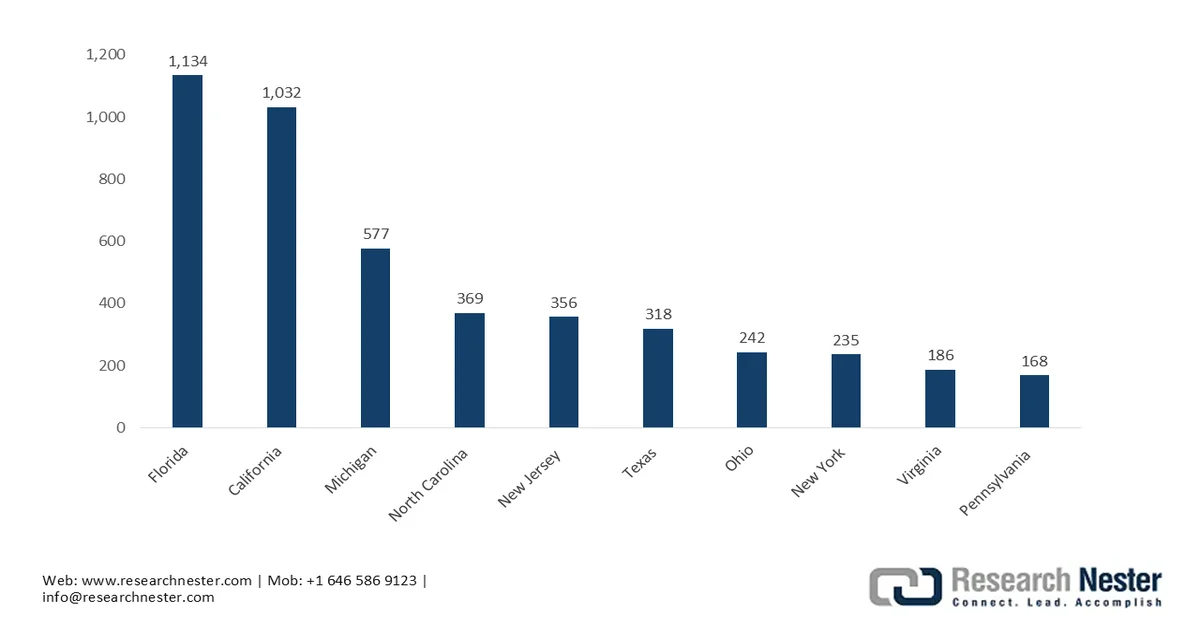
The extensive domestic floriculture consumption and a structural shift toward online flower sales are certain drivers responsible for uplifting the overall cut flower packaging market in the U.S. Market growth is largely propelled by the increasing popularity of floral gifting for holidays and special events, necessitating packaging that combines appearance with superior protective capabilities. In February 2026, a USDA article disclosed that in 2024, the U.S. floriculture industry showcased tremendous growth, wherein the total sales across all floriculture crops reached a significant value, with annual bedding and garden plants accounting for the largest share at USD 2.5 billion, and was followed by potted flowering plants and foliage plants. The report also stated that Florida and California led in sales, together representing 32% of the national total, whereas Michigan, California, and Florida had the highest number of operations, hence suitable for standard cut flower packaging market growth.
Top 10 U.S. States by Floriculture Sales in USD Million 2024: Revenue Trends for Flower and Packaging Sectors
Source: USDA
The primary emphasis on cold chain reliability to serve its geographically dispersed population is uplifting the cut flower packaging market in Canada. Innovation in this sector is mostly focused on developing durable and lightweight formats that efficiently protect floral integrity. The strong government backing for flower growers and plastic reduction mandates is also supporting the country’s cut flower packaging market growth. Based on the government data, its 2023 regulatory framework for plastic packaging and single-use plastics has set recycled content requirements and labelling rules for recyclability and compostability, thereby supporting the country’s zero plastic waste agenda. The article underscores that federal measures complement provincial and territorial extended producer responsibility policies, ensuring coordinated collection, recycling, and end-of-life management. The framework mandates minimum recycled content in packaging, accurate recyclability labelling, and strict standards for compostability claims, hence driving design improvements and sustainable practices.
APAC Market Insights
In the Asia Pacific, the cut flower packaging market is largely supported by rising urbanization and a burgeoning export industry in countries such as China, India, and Japan. A primary driver for the region is the deep-rooted social and religious relevance of floral gifting for weddings and festivals, which necessitates a diverse range of packaging formats. As per the data published by the government of Australia in February 2026, the country’s packaging regulation framework has been updated, which is mandatory and supported by all state and territory governments to reduce environmental impacts. Businesses that are earning more than USD 5 million must either join the Australian Packaging Covenant, report under the National Environment Protection used packaging materials or participate in an approved equivalent program. Therefore, this framework covers packaging made from plastic, glass, paper, cardboard, and metals, requiring designs that improve recyclability and reduce litter, hence suitable for bolstering the region’s cut flower packaging market growth.
The domestic floriculture sector is boosting the overall cut flower packaging market in China. The rising middle class and the continued expansion of floral platforms have heightened the demand for specialized packaging. As per the government data published in May 2023, the country announced its plans to modernize its flower industry by 2035 by targeting annual sales of more than USD 100 billion. This strategy is led by government agencies such as the National Forestry and Grassland Administration and the Ministry of Agriculture, focused on protecting germplasm resources and boosting the overall home-bred varieties to 25% cut flower packaging market share. Besides, it also focuses on strengthening seed innovation, optimizing supply chains, and advancing digitalization. As one of the prominent flower producers and consumers, the country deliberately aims to elevate quality and expand global trade, hence expanding the utilization of cut flower packaging solutions.
The cut flower packaging market in India is entering into a new phase of growth, positively impacted by the large production capabilities and the deep-rooted cultural importance of flowers in weddings, festivals, and religious ceremonies. India Brand Equity Foundation (IBEF) in December 2025 disclosed that the country’s floriculture sector in 2025 covered almost 285,000 hectares with production exceeding 3.2 million MT, making it the world’s second-largest producer. Besides, Tamil Nadu, Karnataka, Madhya Pradesh, and West Bengal are dominating in terms of cultivation, whereas the initiatives, such as Mizoram’s Anthurium exports, reflect the rural prosperity and global potential. On the other hand, exports rose from USD 186 million in FY21 to a total of USD 233 million in FY25, driven mainly by cut flowers and foliage. Influenced by the rising urban demand, greenhouse technology, and government support, floriculture is evolving into an export-oriented industry that strengthens the country’s packaging sector.
Key Cut Flower Packaging Market Players:
- DS Smith Plc (UK)
- Smurfit Kappa Group (Ireland)
- Uflex Limited (India)
- Clondalkin Group (Netherlands)
- Atlas Packaging (UK)
- Sirane Limited (UK)
- Mos Packaging Printing Factory (China)
- A·ROO Company LLC (U.S.)
- Koen Pack (Netherlands)
- FloPak (Spain)
- Robert Mann Packaging (U.S.)
- Hawaii Box & Packaging (U.S.)
- Pacombi Group (Netherlands)
- Packaging Industries Ltd (Kenya)
- Dilpack Kenya (Kenya)
- Village Farms International (Canada)
- Seaman Paper (U.S.)
- FloraLife (U.S.)
- Chrysal International (Netherlands)
- Stora Enso Oyj (Finland)
- Mondi Group (Austria)
- Smurfit Westrock (Europe)
- GleePackaging (Europe)
- Nature‑Pack (Europe)
- Company Overview
- Business Strategy
- Key Product Offerings
- Financial Performance
- Key Performance Indicators
- Risk Analysis
- Recent Development
- Regional Presence
- SWOT Analysis
- DS Smith is a leading provider of sustainable fiber‑based packaging solutions, which includes corrugated boxes and e‑commerce cut flower packaging. The company’s packaging solutions focus on durability, moisture retention, and recyclability. DS Smith also collaborates with floral distributors to deliver moisture‑resistant and recyclable bouquet boxes and sleeves.
- Smurfit Kappa Group is one of the biggest global cut flower packaging market packaging suppliers, which is offering a wide portfolio of paper‑based floral packaging solutions. The firm serves florists, retailers, and exporters with products especially designed for optimal protection and shelf appeal.
- Uflex Limited is a major company active in the cut flower sector with innovations such as its active modified atmospheric packaging film, which deliberately extends freshness for floriculture logistics. The company’s technologies maintain freshness over extended transport routes while enhancing protective performance.
- Clondalkin Group is operating in floral packaging through Clondalkin Flexible Packaging, and it specializes in flexible wraps and sleeves that protect cut flowers during storage and transit. The company is pursuing distinct tactical strategies such as investing in customizable designs and protective films for both traditional retail florists and e‑commerce floral delivery services.
- Atlas Packaging is yet another prominent supplier of corrugated cardboard solutions, which are used for boxes, cartons, and protective transit packaging in the cut flower industry. The company’s products are engineered for mechanical protection and load stability, which are critical for long‑distance flower transport.
Below is the list of some prominent players operating in the global cut flower packaging market:
The cut flower packaging market consists of both large multinational packaging manufacturers and specialized regional suppliers, which are supporting the floriculture hubs worldwide. Key pioneers in this field, such as DS Smith, Smurfit Kappa, and Uflex, are highly focused on sustainable, recyclable, and high‑performance materials to meet evolving retailer and consumer expectations. At the same time, regional suppliers such as A·ROO Company and FloPak differentiate themselves through customized designs and niche floral packaging offerings. Innovation in terms of biodegradable films, moisture‑control solutions, and strengthened distribution networks are major strategies which are adopted by the key players in this sector. In November 2025, Chrysal International announced the acquisition of Spring from Holland, which is a company well-known for its flower and plant care products, spray paints, and a strong florist cut flower packaging market network to leverage its global reach and sustainability expertise.
Corporate Landscape of the Cut Flower Packaging Market:
Recent Developments
- In October 2025, Village Farms International unveiled a cannabis packaging innovation through its Pure Sunfarms brand, i.e., a one-way aroma valve. This pressure-activated valve lets consumers smell the flower by gently squeezing the pouch.
- In August 2025, Seaman Paper introduced SatinWrap Floral, which is a premium waxed floral tissue paper line highly suitable for florists and distributors. The collection includes 14 FSC-certified in-stock colors and 6 curated assortments for seasonal occasions.
- In November 2024, FloraLife, which is a division of Smithers-Oasis, announced the launch of new sustainable packaging for its flower food packets in North America. The film is made with 51.3% recycled materials, combining post-consumer 32% and post-industrial 19.3% recycled content.
- Report ID: 4554
- Published Date: Mar 26, 2026
- Report Format: PDF, PPT
- Explore a preview of key market trends and insights
- Review sample data tables and segment breakdowns
- Experience the quality of our visual data representations
- Evaluate our report structure and research methodology
- Get a glimpse of competitive landscape analysis
- Understand how regional forecasts are presented
- Assess the depth of company profiling and benchmarking
- Preview how actionable insights can support your strategy
Explore real data and analysis
Frequently Asked Questions (FAQ)
About this Report
Connect with our Expert


Report, 2026-2035



Copyright @ 2026 Research Nester. All Rights Reserved.
