Compressed Air Energy Storage Market Outlook:
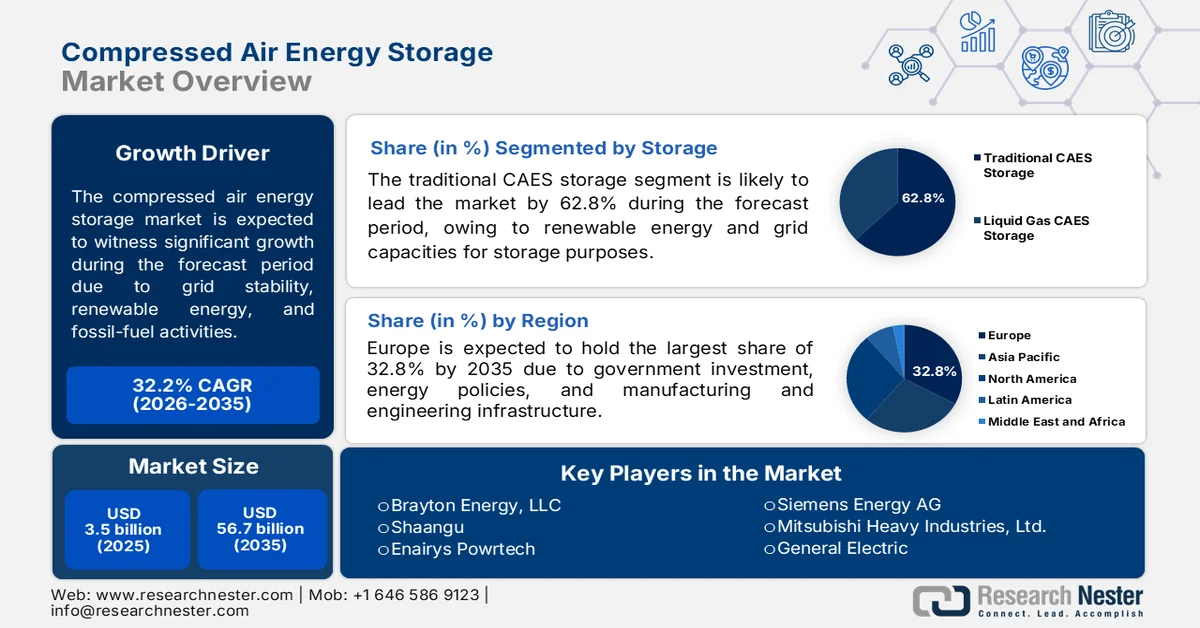
Compressed Air Energy Storage Market size was valued at USD 3.5 billion in 2025 and is predicted to exceed USD 56.7 billion by the end of 2035, registering over 32.2% CAGR during the forecast period i.e., between 2026-2035. In 2026, the industry size of compressed air energy storage is evaluated at USD 4.6 billion.
The worldwide compressed air energy storage market is presently witnessing a significant transformation, which is driven by the urgent demand for grid stability, as well as renewable energy adoption, technological cost reductions, and the convergence of energy security and aging fossil-fuel facilities. According to an article published by the IEA Organization in 2026, more than 1,500 GW of renewable as well as shortage and large-load projects are presently stalled in grid queues globally. The aspect of catering to the electricity demand by the end of 2030 is poised to require an increase in the yearly grid investment by roughly 50% over the same duration from the current USD 400 billion. Besides, grid-based technology solutions tend to unlock suitable capacity for connecting 450 to 700 GW of projects, thus positively bolstering the compressed air energy storage market growth.
Technology Upgrades for Hosting Grid Capacity Globally, 2025
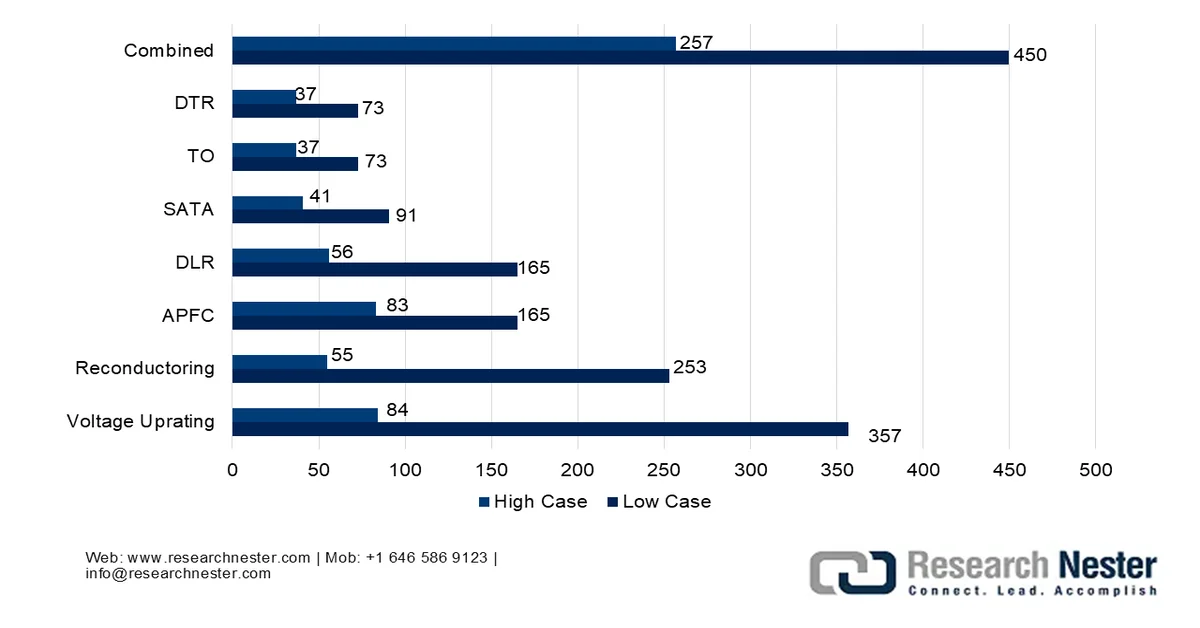
Source: IEA Organization
Furthermore, the presence of multi- and hybrid energy systems, along with artificial intelligence (AI)-based optimization, digital twin technology, an expansion in site development and geological storage options, and regulatory and legislative recognition as a tactical asset are a few trends that are responsible for bolstering the compressed air energy storage market globally. As stated in an article published by the World Resources Institute in December 2025, the worldwide investment in clean energy has shifted from 17% year-on-year (YoY) as of 2022 to a 6% surge in 2025. This recorded an overall energy investment of USD 3.3 trillion in the same year, with USD 2.2 trillion for clean energy. Besides, investment in both fossil fuels and clean energy is readily differing every year, thereby denoting a huge growth opportunity for the compressed air energy storage market across different economies.
Annual Global Investment in Fossil Fuel and Clean Energy, 2015-2025
|
Year |
Fossil Fuel (USD Billion) |
Clean Energy (USD Billion) |
|
2015 |
1,493 |
1,209 |
|
2016 |
1,228 |
1,262 |
|
2017 |
1,208 |
1,284 |
|
2018 |
1,211 |
1,282 |
|
2019 |
1,165 |
1,288 |
|
2020 |
972 |
1,268 |
|
2021 |
1,038 |
1,393 |
|
2022 |
1,113 |
1,630 |
|
2023 |
1,177 |
1,871 |
|
2024 |
1,198 |
2,033 |
|
2025e |
1,148 |
2,154 |
Source: World Resources Institute
Key Compressed Air Energy Storage Market Insights Summary:
Regional Highlights:
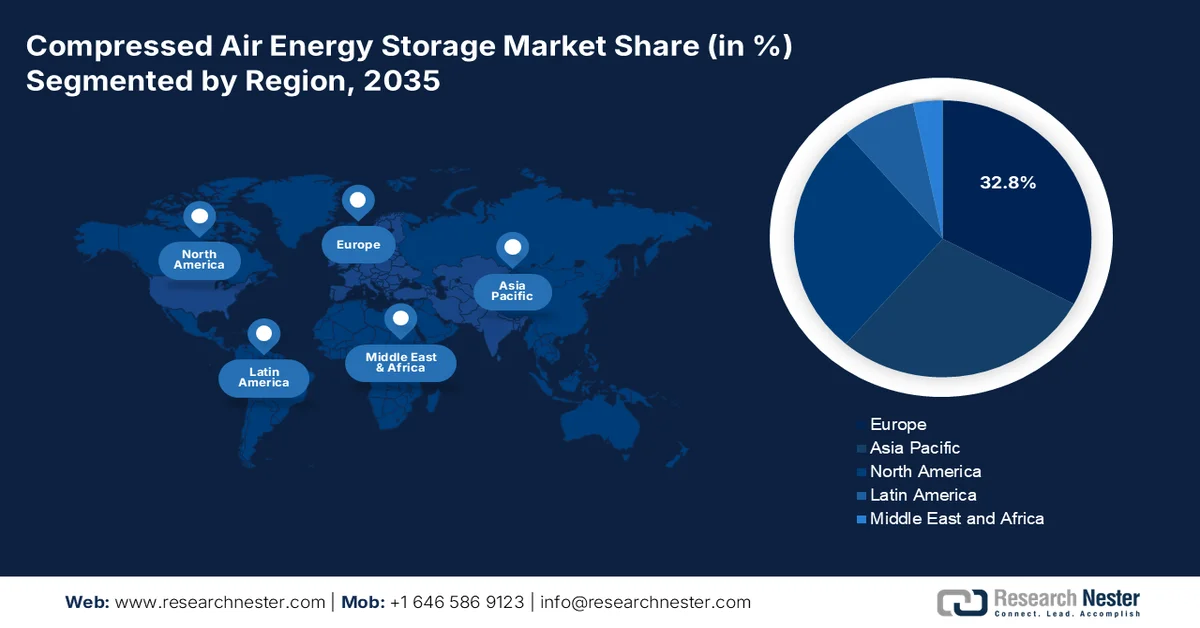
- The compressed air energy storage market in Europe is anticipated to secure the largest 32.8% share by 2035, underpinned by renewable energy adoption mandates, government investment in energy infrastructure modernization, and established engineering and manufacturing capabilities
- North America is forecast to attain a 27.5% share during the forecast period, accelerated by supportive regulatory frameworks, clean energy adoption, decarbonization initiatives, and government-backed energy strategies
Segment Insights:
- The compressed air energy storage market is projected to see the traditional CAES storage sub-segment account for the largest 62.8% share by 2035, propelled by its ability to enhance grid stability through storing surplus renewable energy in underground caverns
- The power stations sub-segment is expected to capture the second-largest 48.5% share by 2035, supported by the increasing utilization of abandoned coal mines for air energy storage systems and rising global electricity demand
Key Growth Trends:
- Renewable energy integration
- Replacement of peaker plants
Major Challenges:
- Increased capital expenses and long payback duration
- Geographical restrictions and site-specific constraints
Key Players: Hydrostor Inc., Siemens Energy AG, Mitsubishi Heavy Industries, Ltd., General Electric, ABB Ltd., MAN Energy Solutions SE (Everllence), Storelectric Ltd., ALACAES SA, General Compression Ltd., Augwind, BaroMar, Brayton Energy, LLC, Shaangu, Enairys Powrtech, California Community Power.
Global Compressed Air Energy Storage Market Forecast and Regional Outlook:
Market Size & Growth Projections:
- 2025 Market Size: USD 3.5 billion
- 2026 Market Size: USD 4.6 billion
- Projected Market Size: USD 56.7 billion by 2035
- Growth Forecasts: 32.2% CAGR (2026-2035)
Key Regional Dynamics:
- Largest Region: Europe (32.8% share by 2035)
- Fastest Growing Region: North America
- Dominating Countries: United States, China, Germany, United Kingdom, Canada
- Emerging Countries: India, Japan, South Korea, Australia, Saudi Arabia
Last updated on : 28 July, 2026
Compressed Air Energy Storage Market - Growth Drivers and Challenges
Growth Drivers
- Renewable energy integration: The rapid expansion of intermittent renewable energy sources, including solar and wind, is considered the foremost driver for the compressed air energy storage market globally. As per the 2025 IEA Organization article, the worldwide yearly renewable capacity shipment gradually increased by 16%, reaching 800 gigawatts as of 2025. Based on this, solar photovoltaic readily accounted for over three-quarters of the newest renewable capacity additions, which is followed by 20% of wind energy. In addition, solar additions deliberately surged by nearly 12% in 2025, which surpassed 600 GW. Likewise, there was an increase in the yearly wind capacity by almost 40% as of 2024, which readily set the latest record at about 160 GW, thereby making it suitable for boosting the market’s exposure.
- Replacement of peaker plants: This is also considered a significant driver for the compressed air energy storage market, which impends the retirement of aging natural gas peaker facilities. As stated in an article published by Futures in June 2023, natural gas is regarded as the third most utilized fuel in the world, which is highly responsible for 22% of overall primary energy utilization globally. In addition, it is effectively utilized for reasons, including abundance, cheapness, and a boom in shale gas, especially in the U.S., aiding price reduction over the past decades. Meanwhile, natural gas is also utilized as a high-energy density fuel and can be easily transported, thereby making it suitable for fueling compressed air energy storage market market growth and expansion.
Challenges
- Increased capital expenses and long payback duration: The compressed air energy storage market is constrained by prohibitive upfront capital expenditure requirements, which significantly limit commercial scalability. These systems demand substantial investment in specialized turbomachinery, large-scale underground storage site preparation, and extensive surface infrastructure development. The high initial outlay, combined with extended development lead times and long payback periods, makes project financing particularly challenging. This financial barrier is especially acute when competing against lithium-ion battery systems that have achieved dramatic cost reductions and established supply chain advantages, creating a persistent economic disadvantage for CAES technology in most market segments.
- Geographical restrictions and site-specific constraints: The compressed air energy storage market deployment is fundamentally constrained by the availability of suitable geological formations, as the technology traditionally requires naturally occurring, geologically stable, and well-sealed underground storage spaces. Salt caverns, while ideal, are geographically limited, and alternative options such as depleted oil reservoirs or aquifers present complex geological characteristics including low permeability, high water saturation, and significant engineering risks. The absence of appropriate geological formations in many regions effectively restricts market expansion, driving research into alternative methods of site adaptation and system miniaturization, though these solutions remain largely unproven at commercial scale.
Compressed Air Energy Storage Market Size and Forecast:
| Report Attribute | Details |
|---|---|
|
Base Year |
2025 |
|
Forecast Year |
2026-2035 |
|
CAGR |
32.2% |
|
Base Year Market Size (2025) |
USD 3.5 billion |
|
Forecast Year Market Size (2035) |
USD 56.7 billion |
|
Regional Scope |
|
Compressed Air Energy Storage Market Segmentation:
Storage Segment Analysis
The traditional CAES storage sub-segment under the storage segment is anticipated to garner the largest share of 62.8% in the compressed air energy storage market by the end of 2035. The sub-segment’s upliftment is primarily fueled by the provision of crucial grid stability by readily storing surplus or off-peak renewable energy in underground caverns, especially as pressurized gas. According to an article published by Energy Conversion and Management: X in October 2025, the yearly compressed air energy storage research growth rate accounted for 20.6% globally. Besides, hybrid storage systems, along with RES, are gradually rising, owing to robust performance indicators, including round-trip efficiencies of almost 90%, as well as levelized costs, amounting to USD 0.2 per kWh. Therefore, with such growth in research and performance efficacies, there is a huge growth opportunity for the sub-segment globally.
Application Segment Analysis
During the forecast period, the power stations sub-segment, which is part of the application segment, is projected to account for the second-largest share of 48.5% in the compressed air energy storage market. The sub-segment’s growth is effectively fueled by the aspect of using underground spaces of abandoned coal mines for air energy storage systems, which deliberately indicates a promising and feasible option. As per an article published by Dow to Earth Organization in July 2026, the electricity demand is projected to surge by 3.6% in 2026 and further to 3.8% by the end of 2027 globally. This growth is highly driven by a rise in consumption from data centers, household appliances, air conditioning, industry, and electric vehicles. In addition, the worldwide electricity consumption is expected to rise from 28,600 TWh to 30,700 TWh by 2027, thus positively impacting the sub-segment’s growth.
Type Segment Analysis
Based on the type segment, the diabatic sub-segment in the compressed air energy storage market is expected to garner the third-largest share of 46.6% by the end of the stipulated timeline. The sub-segment’s development is highly driven by releasing heat during the air compression phase and discharging it into the atmosphere, rather than storing it for later use. This conventional approach requires supplementary fuel, typically natural gas, to reheat the air before expansion in the turbine during the discharge cycle. While this fuel dependency results in lower overall round-trip efficiency and raises environmental considerations due to associated emissions, diabatic systems benefit from proven operational history, mature supply chains, and reduced capital expenditures compared to advanced storage types. Consequently, these systems remain a viable and cost-effective solution for large-scale utility applications seeking dependable grid support and load management.
Our in-depth analysis of the compressed air energy storage market includes the following segments:
|
Segment |
Subsegments |
|
Storage |
|
|
Application |
|
|
Type |
|

Vishnu Nair
Head - Global Business DevelopmentCustomize this report to your requirements — connect with our consultant for personalized insights and options.
Compressed Air Energy Storage Market - Regional Analysis
Europe Market Insights
Europe compressed air energy storage market is anticipated to grab the highest share of 32.8% by the end of 2035. The market’s upliftment in the region is primarily fueled by the presence of renewable energy adoption mandates, generous government investment in energy infrastructure modernization, and the existence of established engineering and manufacturing proficiencies. According to an article published by European Environment Agency in April 2026, renewables effectively account for 25.2% of finalized energy consumption in the region as of 2024, which denotes nearly 1 percentage point from 2023. Besides, the share of renewables is projected to continue rising and is projected to meet the regional minimum objective of 42.5% by the end of 2030. This is poised to demand double average deployment rates in comparison to the past decade and ensure the transformation of a regional energy system, thus proliferating the compressed air energy storage market exposure.
Yearly Renewable Energy Progress in Europe, 2019-2030
|
Year |
Growth % |
|
2019 |
19.9 |
|
2020 |
22.0 |
|
2021 |
21.9 |
|
2022 |
23.0 |
|
2023 |
24.6 |
|
2024 |
25.2 |
|
2025 |
28.1 |
|
2026 |
31.0 |
|
2027 |
33.9 |
|
2028 |
36.8 |
|
2029 |
39.6 |
|
2030 |
42.5 |
Source: European Environment Agency
The Germany compressed air energy storage market is growing significantly, owing to renewable integration demands, research leadership in advanced technologies, the presence of depleted gas fields, expanded industrial manufacturing base, and the robust need for grid-stabilizing energy storage solutions. As per an article published by the Clean Energy Wire Organization in July 2026, the country has aimed to cover 80% of its electricity consumption with renewable sources by the end of 2030. Additionally, the volume of uncompensated and curtailed electricity is poised to be capped between 10% and 20% of yearly production. Moreover, from 2027, small-scale rooftop solar installations are poised to continue to receive a feed-in tariff for the first 3 years, along with a low rate in comparison to the present support, thereby making it suitable for boosting compressed air energy storage market development.
The rapid expansion of solar photovoltaic capacity, the existence of projects related to environmental permitting and assessment phases, the strengthening of wind portfolios, and suitable benefits from regional tactical autonomy strategies are a few factors that are responsible for driving the compressed air energy storage market in Spain. As stated in an article published by Invest in Spain in December 2022, the Government of Spain proclaimed 3 grant-based programs that are dedicated to wind turbine blade recycling, hydroelectric renovation, and circular economy wind repowering. This is readily possible with the joint provision of USD 253.9 million (€222.5 million) in terms of NextGenerationEU funds that are managed through the resilience, transformation, and recovery plan, thus positively fueling the market growth in the nation.
North America Market Insights
North America compressed air energy storage market is expected to emerge as the fastest-growing region with a share of 27.5% during the forecast period. The presence of supportive regulatory frameworks, development activities, the adoption of clean energy technologies, a focus on decarbonization, and government strategies highly propels the market’s development in the region. According to an article published by the U.S. Department of Energy in July 2026, the U.S. witnessed an increase in the demand for electricity by almost 30%. This is owing to growth in the consumer integration of electrical products, including incandescent lighting, computers, and air conditioners. Besides, in terms of technological transformations, such as electrification, new domestic manufacturing, data center expansion, and artificial intelligence, the U.S. is gradually returning to a rise in electricity demand. This will eventually cater to upliftment in overall energy requirements, growing by roughly 15% to 20% in the upcoming decade.
The U.S. compressed air energy storage market is gaining increased traction due to robust federal financial support, federal tax incentives, state-level long-duration storage mandates, repurposing opportunities, favorable geology aspects, and the need for grid stability. As stated in an article published by the Department of Energy in July 2026, the national electric grid is considered an engineering marvel, which comprises over 9,200 electric generating units. Additionally, this further comprises more than 1 million megawatts of generating capacity that is connected to over 600,000 miles of transmission lines. Besides, the country is focused on modernizing the grid and making it extremely resilient and smart through the utilization of cutting-edge controls, technologies, and equipment. This is suitable for working and communicating to readily deliver efficient and reliable electricity, thus bolstering market development in the country.
The provision of direct investments from the government, the development of first-of-a-kind projects, the requirements of provincial grid balancing, suitable support for domestic technology development, and significant pathways to hydrogen adoption are certain trends that are responsible for fueling the compressed air energy storage market in Canada. As per an article published by Natural Resources Canada in May 2024, there is a boom in the country’s interest in low-carbon hydrogen, with an estimated 80 production projects declared. This readily represents an interest of more than USD 100 billion in potential investment, which is dedicated to developing clean energy opportunities. Besides, the Hydrogen Strategy constitutes the ultimate product of 3 years of analysis and engagement that involves more than 1,000 national stakeholders and experts, thus effectively contributing to the market’s expansion.
APAC Market Insights
The Asia Pacific compressed air energy storage market is projected to witness a considerable share of 28.5% by the end of the stipulated timeline. The market’s expansion in the region is effectively driven by an increase in urbanization, rapid industrialization, and strong renewable energy targets. According to an article published by Renewable and Sustainable Energy Reviews in October 2025, the region successfully led worldwide energy growth as of 2023 with 327.8 GW of the latest capacity. In this regard, China accounted for the highest share of overall renewable capacity and yearly additions across bioenergy, hydropower, wind, and solar technologies. Additionally, the country also remained the largest emitter of global greenhouse gas emissions and readily produced an estimated 30% of worldwide emissions, thereby demonstrating a huge growth opportunity for the market in the region.
The China compressed air energy storage market is gaining increased exposure, owing to substantial government investments, ambitious renewable energy targets, the National Development and Reform Commission prioritizing energy storage as a tactical industry, and industrial decarbonization. As stated in an article published by the State Council in September 2025, the country has aimed to gain over 180 million kilowatts of installed energy storage capacity by the end of 2027. This is predicted to drive an estimated USD 35.2 billion (250 billion yuan) in direct project investment as per a plan jointly unveiled by the National Development and Reform Commission and the National Energy Administration. This plan comprised 21 notable measures, which included upscaling energy storage applications in grid infrastructure and power generation, along with optimizing standardization and an escalation in technological advancement.
2025 Energy Share and Investment Analysis of China
|
Components |
Share % and Investment (USD) |
|
2025 Share |
28,502 GDP per capita |
|
GDP |
18% |
|
Population |
17% |
|
GDP Share |
4.4% |
|
Investment per Capita |
USD 627 |
Source: IEA Organization
The aspects of rapid industrialization, the urgent demand for integrating an expansion in renewable energy capacity, prioritizing energy limitation for achieving national energy security objectives, and participation in sustainable chemical processes are a few trends that are responsible for bolstering the compressed air energy storage market in India. As stated in a data report published by the PIB Government in January 2026, in terms of energy transition, natural gas pipelines readily surpassed 25,400 km, which enabled almost 100% of CGP geographical coverage in the nation. Besides, the ethanol blending successfully reached 19.0% in ESY between 2024 and 2025, which approached the 20% domestic target. Moreover, the PMUY coverage strengthened across 104 million households with a rise in liquid petroleum gas refill rates, thus positively fueling the market expansion.
Key Compressed Air Energy Storage Market Players:
- Hydrostor Inc. (Canada)
- Siemens Energy AG (Germany)
- Mitsubishi Heavy Industries, Ltd. (Japan)
- General Electric (U.S.)
- ABB Ltd. (Switzerland)
- MAN Energy Solutions SE (Everllence) (Germany)
- Storelectric Ltd. (UK)
- ALACAES SA (Switzerland)
- General Compression Ltd. (U.S.)
- Augwind (Israel)
- BaroMar (Israel)
- Brayton Energy, LLC (U.S.)
- Shaangu (China)
- Enairys Powrtech (Switzerland)
- California Community Power (California)
- Company Overview
- Business Strategy
- Key Product Offerings
- Financial Performance
- Key Performance Indicators
- Risk Analysis
- Recent Development
- Regional Presence
- SWOT Analysis
- Hydrostor Inc. is a leading global developer and operator of advanced compressed air energy storage (A-CAES) systems, with a proven patented technology that uses compressed air and water to store energy for long durations. The company is actively scaling its project pipeline across North America, Australia, and Europe, with flagship projects nearing construction that demonstrate the technology's viability for grid reliability and supporting growing electricity demand.
- Siemens Energy AG is a leading global energy technology company that provides critical engineering capabilities and technology portfolios for developing large-scale, efficient, and cost-competitive CAES systems integrated with hydrogen-compatible power generation. The company is actively collaborating with developers such as EnergyPathways to design modular, scalable, multi-day CAES systems that can utilize excess renewable power, confirming the commercial viability of major projects like the UK's MESH facility.
- Mitsubishi Heavy Industries, Ltd. is a significant player in the energy sector listed among key companies in the CAES and energy storage markets, with activities in developing related technologies and systems. The company is included among the major global firms operating in the compressed air and CO2 energy storage sectors, reflecting its engagement in advancing these storage solutions.
- General Electric is a key participant in the CAES market, recognized for its long-term research and development in the technology, particularly through initiatives integrating CAES with hybrid systems combining gas and renewable resources. The company has collaborated on projects such as the ADELE adiabatic CAES demonstration, focusing on developing advanced turbomachinery and thermal storage solutions to improve storage efficiency and enable CO2-free power generation.
- ABB Ltd. is a leading global technology company that provides essential automation, grid integration, and power solutions for the broader energy storage ecosystem, encompassing technologies, including compressed air energy storage. The company is listed as a key player in the grid-scale energy storage system market, which includes CAES, highlighting its role in providing the electrical and control infrastructure necessary for integrating large-scale storage assets into power grids.
Here is a list of key players operating in the global compressed air energy storage market:
The compressed air energy storage market features a moderately consolidated landscape with a mix of established energy infrastructure giants and specialized technology developers. Companies such as Hydrostor, Siemens Energy, and Mitsubishi Heavy Industries compete based on proprietary adiabatic system designs, turbomachinery efficiency, and project deployment experience. Hydrostor leads with A-CAES technology deployment in North America and Australia, while Siemens Energy provides turbine solutions integrated with digital controls. Besides, in January 2023, Central Coast Community Energy (3CE) signed a 25-year power purchase deal with Hydrostor Inc. for a compressed air energy storage project, which was valued at almost USD 1 billion and delivered 200 MW and 1,600 MWh of energy storage, thus bolstering the compressed air energy storage industry globally.
Corporate Landscape of the Market:
Recent Developments
- In February 2026, California Community Power (CC Power) and Hydrostor signed a deal for the procurement of a 50 MW and 400 MWh portion of the proposed 500 MW and 4,000 MWh Willow Rock long-term energy storage project in California.
- In January 2024, Eneco and Corre Energy signed a suitable agreement for the joint development and investment in Corre’s first compressed air energy storage project in Germany.
- In June 2023, Storelectric Ltd. successfully purchased TES CAES Technology Ltd., which expanded its portfolio of CAES intellectual property and also strengthened its offerings in integrated projects and energy storage.
- Report ID: 8702
- Published Date: Jul 28, 2026
- Report Format: PDF, PPT
- Explore a preview of key market trends and insights
- Review sample data tables and segment breakdowns
- Experience the quality of our visual data representations
- Evaluate our report structure and research methodology
- Get a glimpse of competitive landscape analysis
- Understand how regional forecasts are presented
- Assess the depth of company profiling and benchmarking
- Preview how actionable insights can support your strategy
Explore real data and analysis
Frequently Asked Questions (FAQ)
About this Report
Connect with our Expert


Report, 2026-2035



Copyright @ 2026 Research Nester. All Rights Reserved.
