Vessel Energy Storage System Market Outlook:
Vessel Energy Storage System Market size was valued at USD 4.1 billion in 2026 and is anticipated to reach USD 26.2 billion by the end of 2036, expanding at around 20.5% CAGR during the forecast period, i.e., 2027-2036. In 2027, the industry size of vessel energy storage system is assessed at USD 4.9 billion.
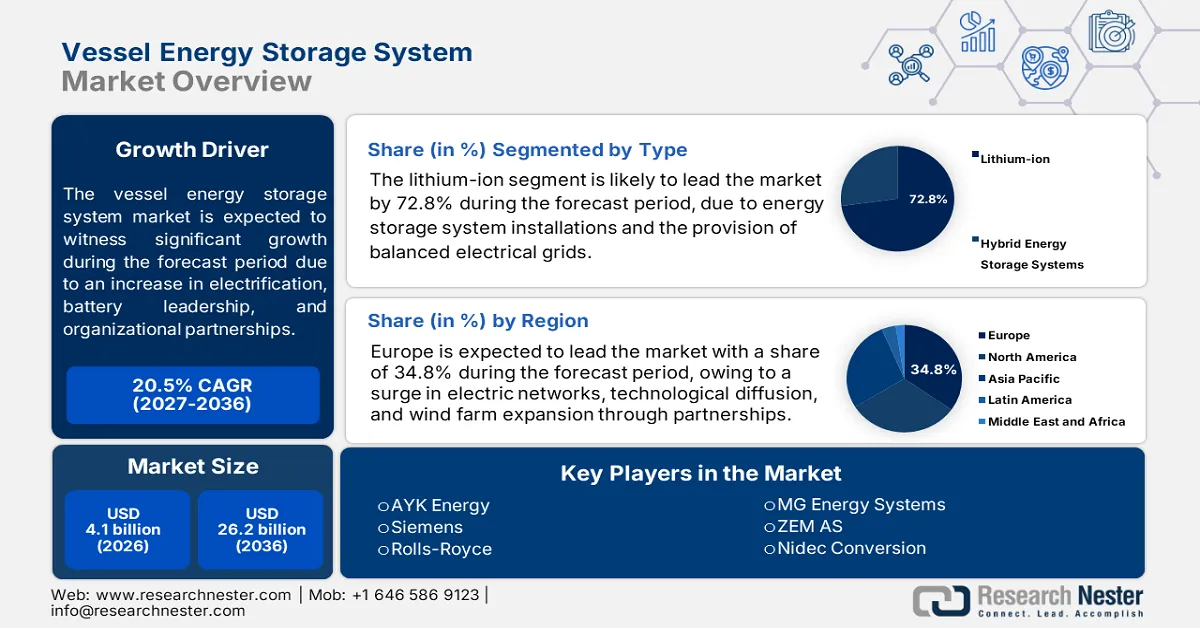
The global vessel energy storage system market is highly propelled by a confluence of technological, regulatory, and tactical factors, such as an increase in electrification for naval, advanced financing instruments, cost-effective battery leadership, and a surge in organizational partnerships. According to an article published by Renewable and Sustainable Energy Reviews in May 2023, the Yara Birkeland, an electric and autonomous container ship, was readily powered by a 6.7 MWh lithium-ion battery with green hydroelectric power, and is further predicted to replace approximately 40,000 diesel truck trips every year. The purpose of this to effectively diminish carbon dioxide and nitrogen oxide emissions. Therefore, based on the battery and power systems, there is a huge demand in the market, particularly for the maritime industry globally.
Furthermore, the LFP chemistry is gaining increased momentum over nickel manganese cobalt, along with an escalation in the retrofit sector as a structural growth vector, and an increase in battery energy storage systems are certain trends that are highly responsible for fueling the market globally. As per an article published by the IEA Organization in 2026, at present, battery storage is considered the rapid power technology, with the deployment of 108 GW of the latest battery storage capacity as of 2025, indicating more than 40% growth in 2024. In this regard, lithium-iron phosphate batteries tend to account for almost 90% of total deployments, usually better suited and cheaper for frequent cycling, thus continuously proliferating the market’s growth and exposure.
Worldwide Battery Storage Capacity Additions, 2020-2025
|
Year |
Utility-Scale (GW) |
Behind-the-Meter (GW) |
|
2020 |
3.8 |
2.3 |
|
2021 |
6.4 |
3.1 |
|
2022 |
12.2 |
6.1 |
|
2023 |
32.2 |
11.8 |
|
2024 |
63.2 |
14.1 |
|
2025 |
86.8 |
20.9 |
Source: IEA Organization
Key Vessel Energy Storage System Market Insights Summary:
Regional Highlights:
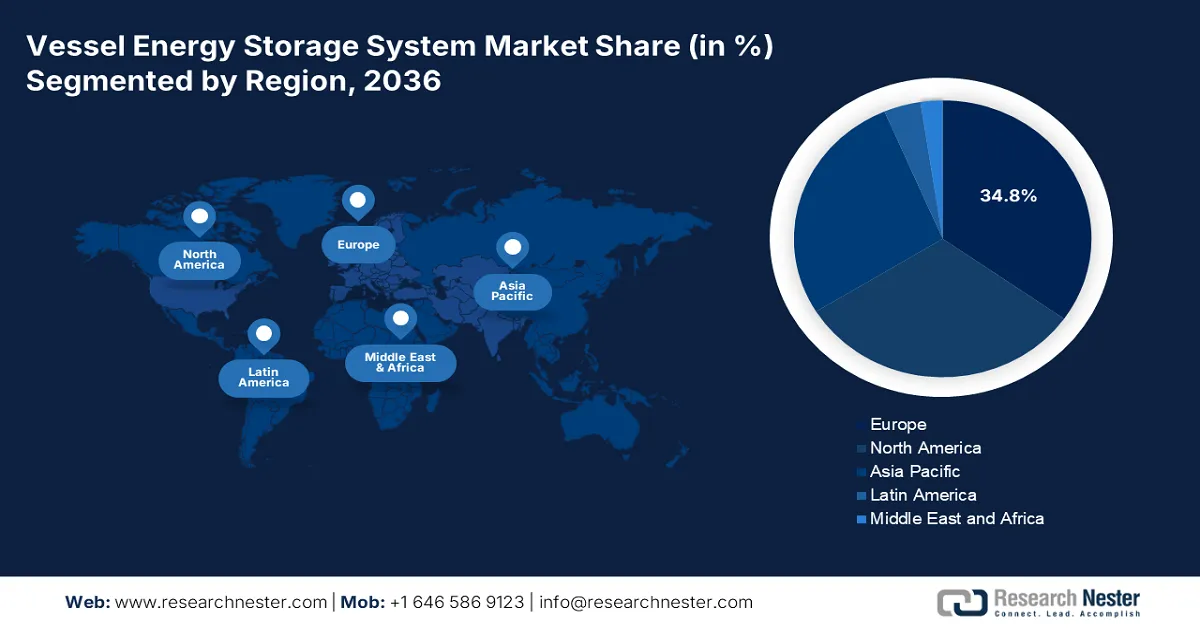
- Europe is projected to command a 34.8% share by 2036 in the vessel energy storage system market, supported by shipyard expertise, expanding electric networks, technological diffusion, and partnerships for wind-farm development.
- Asia Pacific is poised to achieve a 27.4% share during 2027-2036, propelled by battery-cost leadership, naval contracts, zero-emission subsidies, and revenue models for floating grid infrastructure.
Segment Insights:
- The lithium-ion segment is projected to command a 72.8% share by 2036 in the vessel energy storage system market, supported by the growing importance of energy storage for reliable backup, renewable power storage, and grid balancing.
- The hybrid configuration segment is expected to secure a 55.3% share over the forecast period, owing to its ability to combine conventional generators with battery storage and renewable inputs for optimized fuel consumption, lower emissions, and greater operational flexibility.
Key Growth Trends:
- Storage operational benefits
- Strict regional and global environmental regulations
Major Challenges:
- Regulatory fragmentation and safety standard gaps
- High capital expenditure and financial uncertainty
Key Players: Corvus Energy (Norway), ABB (Switzerland), Wärtsilä (Finland), Leclanché (Switzerland), AYK Energy (China), Siemens (Germany), Rolls-Royce (UK), Kongsberg Maritime (Norway), EST-Floattech (Netherlands), MG Energy Systems (Denmark), ZEM AS (Norway), Nidec Conversion (Japan), GE Power Conversion (U.S.), EVE (China), PowerX (Japan), Magnus Marin (Sweden), SAFT (France).
Global Vessel Energy Storage System Market Forecast and Regional Outlook:
Market Size & Growth Projections:
- 2026 Market Size: USD 4.1 billion
- 2027 Market Size: USD 4.9 billion
- Projected Market Size: USD 26.2 billion by 2036
- Growth Forecasts: 20.5% CAGR (2027-2036)
Key Regional Dynamics:
- Largest Region: Europe (34.8% Share by 2036)
- Fastest Growing Region: Asia Pacific
- Dominating Countries: China, United States, Japan, South Korea, Germany
- Emerging Countries: India, UK, Canada, Netherlands, Norway
Last updated on : 4 September, 2026
Vessel Energy Storage System Market - Growth Drivers and Challenges
Growth Drivers
- Storage operational benefits: The demonstrable operational and economic advantages of energy storage are considered a major growth driver for the vessel energy storage system market. According to an article published by the SEIA Organization in March 2026, the U.S. significantly added 57.6 GWh of battery storage capacity as of 2025, and is further projected to constitute 600 GWh in overall capacity by the end of 2030. Besides, domestic battery manufacturing noted that the electric vehicle industry is eventually prompting suppliers to shift their production aspects to stationary energy storage. In addition, this is expected to gradually double the projection for overall battery capacity by the end of the same year, thereby demonstrating an optimistic outlook for the market’s growth.
- Strict regional and global environmental regulations: The tightening framework of international and regional environmental regulations serves as a primary catalyst for the vessel energy storage system market adoption. Besides, mandates targeting greenhouse gas intensity and local emissions are compelling ship operators to seek immediate technological solutions for compliance. Moreover, energy storage systems offer a direct pathway to meet these requirements by enabling peak load shaving, optimizing engine efficiency, and allowing zero-emission maneuvering in sensitive port areas. The regulatory landscape is creating a clear competitive divide, where early adopters gain preferential port access and improved charter rates, while laggards face escalating operational restrictions.
Challenges
- Regulatory fragmentation and safety standard gaps: A significant barrier to the vessel energy storage system market is the absence of cohesive, mandatory international safety standards for marine battery systems. Unlike onshore power supply, which benefits from established international norms, the regulatory framework for shipboard energy storage remains fragmented and largely optional. This lack of clear, binding rules creates uncertainty for shipowners concerning critical issues like fire prevention, crew training, and emergency response protocols. The primary safety concern is the risk of thermal runaway in lithium-ion batteries, which can lead to fires that are extremely difficult to control in a maritime environment. This regulatory void fosters hesitation, potentially slowing the adoption of the technology as stakeholders await more definitive and universally accepted safety and installation guidelines.
- High capital expenditure and financial uncertainty: The significant upfront investment required for marine battery systems presents a formidable financial obstacle for the vessel energy storage system market, especially for operators with tight cash flows. The high capital expenditure is often viewed as a major risk, compounded by the fear of rapid technological obsolescence and the difficulty in accurately forecasting future fuel savings to justify the initial cost. Besides, conventional loan structures frequently fail to account for the long-term operational benefits, making it challenging to secure financing. This financial uncertainty hinders investment, particularly for retrofitting existing vessels, as owners weigh the substantial initial costs against the perceived and unproven return on investment in a rapidly evolving technology landscape.
Vessel Energy Storage System Market Size and Forecast:
| Report Attribute | Details |
|---|---|
|
Base Year |
2026 |
|
Forecast Period |
2027-2036 |
|
CAGR |
20.5% |
|
Base Year Market Size (2026) |
USD 4.1 billion |
|
Forecast Year Market Size (2036) |
USD 26.2 billion |
|
Regional Scope |
|
Vessel Energy Storage System Market Segmentation:
Type Segment Analysis
Based on type, the lithium-ion segment is anticipated to grab the largest share of 72.8% in the vessel energy storage system market by the end of 2036. The segment’s upliftment is primarily fueled by the importance of energy storage systems as critical tools for providing reliable backup, storing renewable power, and balancing electricity grids. According to the 2023 IEA Organization data report, there was an increase in automotive lithium-ion battery demand by almost 65% to 550 GWh as of 2022, from nearly 330 GWh in 2021. This eventually led to a continuous growth in electric passenger car sales, with latest registrations surging by 55%. Besides, the lithium demand surpassed the supply despite the 180% upsurge in production. Simultaneously, almost 60% of lithium carbonate, 30% of cobalt, and 10% of nickel demand catered to electric vehicle batteries, thus bolstering the sub-segment’s growth.
Country-Wise Lithium Carbonate Export and Import Shipment, 2022
|
Country |
Export |
Import |
||
|
Trade Value (USD 1,000) |
Quantity (Kilograms) |
Trade Value (USD 1,000) |
Quantity (Kilograms) |
|
|
Chile |
8,258,836.7 |
198,631,000 |
189.1 |
6,480 |
|
China |
682,812.3 |
10,433,200 |
6,729,763.0 |
136,093,000 |
|
Korea |
397,278.1 |
6,162,940 |
1,740,524.4 |
48,531,900 |
|
European Union |
296,494.6 |
8,457,730 |
341,305.2 |
15,611,400 |
|
Netherlands |
210,170.0 |
6,084,100 |
200,406.1 |
6,802,670 |
|
Belgium |
197,087.2 |
5,868,480 |
121,149.7 |
5,795,580 |
Source: WITS
Energy Source Segment Analysis
During the stipulated timeline, the hybrid configuration sub-segment under the energy source segment is expected to register second-largest share of 55.3% in the vessel energy storage system market. The sub-segment’s development is effectively attributed to combining conventional fuel-based generators with battery storage and sometimes renewable inputs. This setup allows vessels to optimize fuel consumption, reduce emissions, and enhance operational flexibility by seamlessly switching between or blending power sources. The primary advantage lies in its ability to manage peak loads, provide spinning reserve, and enable silent, emission-free maneuvering in sensitive areas. Meanwhile, successful deployment demands careful system design and thorough vessel-specific operational analysis, thereby demonstrating a huge growth opportunity for the sub-segment’s growth.
Application Segment Analysis
Based on the application segment, the commercial sub-segment is predicted to account for the third-largest share of 48.5% in the market during the forecast period. The sub-segment’s growth is highly driven by encompassing a diversified range of vessel operations, including passenger ferries, workboats, service vessels, and other revenue-generating maritime activities. Besides, energy storage adoption here is primarily driven by economic considerations, such as fuel savings, reduced maintenance costs, and compliance with tightening emission regulations in coastal and port areas. Moreover, commercial operators face the challenge of balancing upfront investment against long-term operational savings, while also navigating uncertain regulatory landscapes and evolving incentive structures. The suitability of energy storage varies significantly with route profiles, with vessels operating on predictable, short-distance routes being the most viable candidates for full or partial electrification.
Our in-depth analysis of the vessel energy storage system includes the following segments:
|
Segment |
Subsegments |
|
Type |
|
|
Energy Source |
|
|
Application |
|
|
Installation Configuration |
|
|
Vessel Type |
|

Vishnu Nair
Head - Global Business DevelopmentCustomize this report to your requirements — connect with our consultant for personalized insights and options.
Vessel Energy Storage System Market - Regional Analysis
Europe Market Insights
Europe vessel energy system market is anticipated to garner the highest share of 34.8% by the end of 2036. The market’s upliftment in the region is primarily attributed to shipyard expertise, an increase in electric networks, an escalation in technological diffusion, and partnerships with developers for expanding wind farms. According to an article published by WindEurope Organization in February 2026, the region effectively installed 19.1 GW of new wind power capacity as of 2025, of which the EU-27 installed 15.1 GW. Besides, 90% of the latest wind capacity was developed in the region in the previous year that catered to wind, while 2 GW of new offshore wind power capacity was eventually connected to the grid. Therefore, based on these installations, there is a huge growth and expansion opportunity for the market in the overall region.
Yearly Onshore and Offshore Wind Power Capacity Installation in Europe, 2016-2025
|
Year |
Onshore (GW) |
Offshore (GW) |
|
2016 |
1.5 |
13.2 |
|
2017 |
3.2 |
13.2 |
|
2018 |
2.7 |
9.6 |
|
2019 |
3.7 |
11.1 |
|
2020 |
2.9 |
12.4 |
|
2021 |
2.9 |
13.9 |
|
2022 |
2.5 |
16.9 |
|
2023 |
3.7 |
14.5 |
|
2024 |
2.6 |
13.9 |
|
2025 |
2.0 |
17.2 |
Source: WindEurope Organization
The vessel energy storage system market in the UK is growing significantly, owing to the industrial scale, the proactive government policy, growth in the chemical and power industries, and a focus on downstream energy storage manufacturing. As stated in an article published by ITA in July 2026, the country significantly installed 842 MW of grid-scale battery energy storage systems, which indicates a record development that almost doubled last year’s 450 MW. Likewise, the energy capacity rapidly grew, effectively rising by 1.6 GWh and reaching a total of 3.5 GWh. Besides, the country’s government committed to gaining 80% of renewable electricity by the end of 2030, which is focused on reshaping energy system demands and creating a substantial requirement for ensuring flexible storage assets' capabilities of supporting decarbonization, integrating renewable energy, and stabilizing the grid, thus uplifting the market growth.
The strategic government intervention, support for critical national infrastructure, an expansion in supply chains, industrial partnerships, and a suitable environment for energy storage integration are certain factors for boosting the market in the UK. Based on an article published by the UK Government in August 2026, the Ultra-Long Duration Energy Storage Challenge is highly focused on offering USD 38 million (£28 million) for effectively creating technologies for storing clean energy for more than 100 hours. In addition, this provision also boosted the government’s clean energy ambitions to overcome climate modifications. Besides, this particular approach tends to support the development of the latest tech-enabled energy storage, which includes underground hydrogen and innovative battery storage, thus positively contributing to the market’s development.
APAC Market Insights
The Asia Pacific market is expected to emerge as the fastest-growing region with a share of 27.4% during the forecast period. The market’s development in the region is highly propelled by battery-cost leadership, naval contracts, subsidies for zero-emission, and revenue models for floating grid infrastructure. According to an article published by the ADB Organization in April 2025, there has been a development of clean energy investment in the region by more than 900% and eventually reached USD 729 billion as of 2023, constituting almost 45% of worldwide investment. Besides, the People’s Republic of China readily accounted for a majority of this particular investment. This organization was successfully joined by India and 7 different developing nations, wherein renewables surpassed 75% of the newest domestic energy capacity addition as of 2022, thus positively bolstering the market exposure in the region.
The vessel energy storage system market in Japan is gaining increased traction, owing to defense requirements, naval modernization, strong government policy subsidies and support, as well as grid interconnection reforms for battery storage. As per a data report published by the IEEJ Organization in July 2026, national projects under grid connection readily totaled 8.7 GW, and meanwhile, projects with submitted connection-based applications amounted to roughly 0.6 GW. In addition, the grid-connected battery storage systems capacity increased to an estimated 0.64 GW as of December 2025. Likewise, there was an upsurge in grid connection to roughly 172 GW, and projects accomplished by connection applications effectively reached roughly 30 GW. Therefore, based on all these projects, there is a huge growth and expansion opportunity for the market in the country.
The aspects of lithium-ion battery manufacturing, an integrated supply chain, the provision of an unparalleled cost benefit for marine energy storage deployment, prioritizing innovative materials, and energy storage technologies are a few trends that are enhancing the market in China. As per the April 2026 Journal of Energy Storage article, the nation’s latest energy storage additions effectively reached 7.3 GW and 15.9 GW, based on which power capacity doubled and energy capacity increased by 2.8-fold year-on-year (YoY). Besides, the country’s notable energy storage installation capacity is completely inseparable from the ultimate guidance of industry planning, grid connection, and subsidy incentives. Meanwhile, the consumption guarantee policies unveiled by the government is also responsible for fueling the market’s expansion in the country.
North America Market Insights
North America market is projected to account for a share of 31.4% by the end of the stipulated timeline. The market’s growth in the region is effectively driven by strong naval electrification programs, supportive federal initiatives, a focus on low-carbon fuel production, and marine decarbonization. For instance, the U.S. Maritime Decarbonization Action Plan was introduced in December 2025, suitable for building foundations in the administration’s U.S. National Blueprint for Transportation Decarbonization. In addition, this particular plan offers long-term and near-term approaches for decarbonizing the maritime industry and recognizes notable actions for combating the deployment of net-zero solutions, thus positively driving the market’s expansion in the overall region.
The vessel energy storage system market in the U.S. is gaining increased exposure, owing to substantial funding for port modernization, an increase in power integration, stringent emission policies, and clean energy strategies. As stated in a data report published by the Center for Sustainable Systems in 2026, 82% of the nation’s energy originates from fossil fuels, which is followed by 9.1% from renewable sources and 8.2% from renewable sources. Meanwhile, solar and wind are considered the fastest-growing renewable sources, contributing to 3.1% of the overall energy utilization in the country. Simultaneously, the nation comprises roughly 463,400 TWh of renewable energy potential, which is more than 100 times the electricity consumed, thus proliferating the market’s demand.
U.S.-Based Renewable Energy Utilization, 2015-2025
|
Year |
Geothermal (Quads and %) |
Solar (Quads and %) |
Wind (Quads and %) |
Hydroelectric (Quads and %) |
Biomass (Quads and %) |
Total (Quads and %) |
|
2015 |
0.12 and 1.7 |
0.2 and 2.9 |
0.8 and 12.5 |
0.6 and 9.5 |
5.0 and 73.4 |
6.8 and 100 |
|
2016 |
0.12 and 1.7 |
0.2 and 3.5 |
0.9 and 12.9 |
0.7 and 10.9 |
5.0 and 71.1 |
7.1 and 100 |
|
2017 |
0.12 and 1.6 |
0.3 and 4.5 |
1.0 and 13.9 |
0.8 and 11.8 |
5.0 and 68.3 |
7.3 and 100 |
|
2018 |
0.12 and 1.6 |
0.3 and 5.1 |
1.0 and 13.3 |
0.9 and 12.4 |
5.1 and 67.7 |
7.5 and 100 |
|
2019 |
0.12 and 1.5 |
0.4 and 5.7 |
0.9 and 12.9 |
1.0 and 13.3 |
5.0 and 66.5 |
7.5 and 100 |
|
2020 |
0.12 and 1.6 |
0.5 and 7.0 |
0.9 and 13.4 |
1.1 and 15.8 |
4.5 and 62.2 |
7.2 and 100 |
|
2021 |
0.12 and 1.5 |
0.6 and 8.2 |
0.8 and 11.2 |
1.2 and 16.9 |
4.7 and 62.2 |
7.6 and 100 |
|
2022 |
0.12 and 1.4 |
0.7 and 9.3 |
0.8 and 10.6 |
1.4 and 18.0 |
4.9 and 60.6 |
8.2 and 100 |
|
2023 |
0.12 and 1.4 |
0.8 and 10.6 |
0.84 and 10.1 |
1.4 and 17.3 |
5.0 and 60.6 |
8.2 and 100 |
|
2024 |
0.12 and 1.3 |
1.1 and 12.7 |
0.8 and 9.5 |
1.5 and 17.7 |
5.1 and 58.7 |
8.6 and 100 |
|
2025 |
0.12 and 1.3 |
1.3 and 15.8 |
0.8 and 9.6 |
1.5 and 18.0 |
4.8 and 55.2 |
8.7 and 100 |
Source: Center for Sustainable Systems
The presence of provincial operators, large-capacity battery systems, a focus on clean technological development, manufacturing facilities, an increase in marine energy storage, along with energy independence and operational cost savings, are a few factors that are bolstering the market in Canada. As per an article published by the Government of Canada in May 2026, the Minister of Transport and Leader of the Government proclaimed a generous investment of almost USD 14.3 million, particularly for Charlottetown Harbour Authority, Inc. under the Green Shipping Corridor Program Clean Ports stream. Additionally, this particular project constitutes suitable funding for installing a shore power facility at Port Charlottetown, further ensuring ocean-going vessels can effectively turn off their engines while connected and berthed to the localized electricity grid.
Key Vessel Energy Storage System Market Players:
- Corvus Energy (Norway)
- ABB (Switzerland)
- Wärtsilä (Finland)
- Leclanché (Switzerland)
- AYK Energy (China)
- Siemens (Germany)
- Rolls-Royce (UK)
- Kongsberg Maritime (Norway)
- EST-Floattech (Netherlands)
- MG Energy Systems (Denmark)
- ZEM AS (Norway)
- Nidec Conversion (Japan)
- GE Power Conversion (U.S.)
- EVE (China)
- PowerX (Japan)
- Magnus Marin (Sweden)
- SAFT (France)
- Company Overview
- Business Strategy
- Key Product Offerings
- Financial Performance
- Key Performance Indicators
- Risk Analysis
- Recent Development
- Regional Presence
- Corvus Energy is a premier pure-play marine battery provider, recognized for its high-energy and high-power energy storage systems designed specifically for the demanding maritime environment. The company differentiates itself through its extensive track record in delivering turnkey solutions and its ongoing commitment to advancing safety and performance standards for shipboard electrification.
- ABB is a global technology leader that offers comprehensive vessel energy storage solutions as an integral part of its broader marine electrification and automation portfolio. The company's competitive edge lies in its ability to provide fully integrated power and propulsion systems, combining battery storage with advanced digital controls for optimized vessel performance.
- Wärtsilä is a prominent marine equipment provider that delivers energy storage systems as a key component of its hybrid and fully electric propulsion solutions for various vessel types. The company distinguishes itself by offering modular, scalable battery systems that are seamlessly integrated with its engine and power management technologies for enhanced operational efficiency.
- Leclanché is a specialized manufacturer of high-performance marine battery systems, known for its advanced lithium-ion cell technology and vertically integrated production capabilities. The company focuses on delivering safe, reliable, and long-lasting energy storage solutions that meet the rigorous certification requirements of the maritime industry.
- AYK Energy is an emerging manufacturer that provides cost-effective lithium battery systems tailored for the maritime sector. The company focuses on rapid deployment and scalable solutions, catering to a diverse range of vessel applications while building a reputation for competitive pricing and robust system reliability.
Here is a list of key players operating in the global market:
The vessel energy storage system market features a moderately consolidated competitive landscape, with a mix of established marine electrification specialists and large industrial conglomerates holding significant shares. Leading players such as Corvus Energy, ABB, Wärtsilä, and Leclanché maintain strong global footprints, leveraging vertically integrated capabilities from cell production to complete system integration. Besides, in December 2025, Hanwha Engine signed a deal and successfully acquired 100% of the shares of SEAM at an estimated USD 195 million. The deal eventually made Hanwha the first-ever Korea-based organization to enter the marine electric propulsion industry in North Europe, thus positively impacting the vessel energy storage system industry.
Corporate Landscape of the Market:
Recent Developments
- In June 2026, Nereida Energy AS effectively entered into an agreement for acquiring the maritime battery business portfolio from Haf Power Solutions (HPS), which expanded the company’s position as the ultimate independent provider of maritime energy storage solutions.
- In December 2025, EVE Energy and Green Whale Technology (GWT) significantly signed a tactical partnership-based deal and provided high-performance marine battery energy storage solutions and suitable services to consumers globally.
- In December 2025, BYD Energy Storage and Corvus Energy AS signed a memorandum of understanding and successfully established a tactical collaboration, which is aimed at innovating next-generation battery solutions for the maritime industry.
- Report ID: 8750
- Published Date: Sep 04, 2026
- Report Format: PDF, PPT
- Explore a preview of key market trends and insights
- Review sample data tables and segment breakdowns
- Experience the quality of our visual data representations
- Evaluate our report structure and research methodology
- Get a glimpse of competitive landscape analysis
- Understand how regional forecasts are presented
- Assess the depth of company profiling and benchmarking
- Preview how actionable insights can support your strategy
Explore real data and analysis
Frequently Asked Questions (FAQ)
About this Report
Connect with our Expert


Report, 2027-2036



Copyright @ 2026 Research Nester. All Rights Reserved.
