Flywheel Energy Storage Market Outlook:
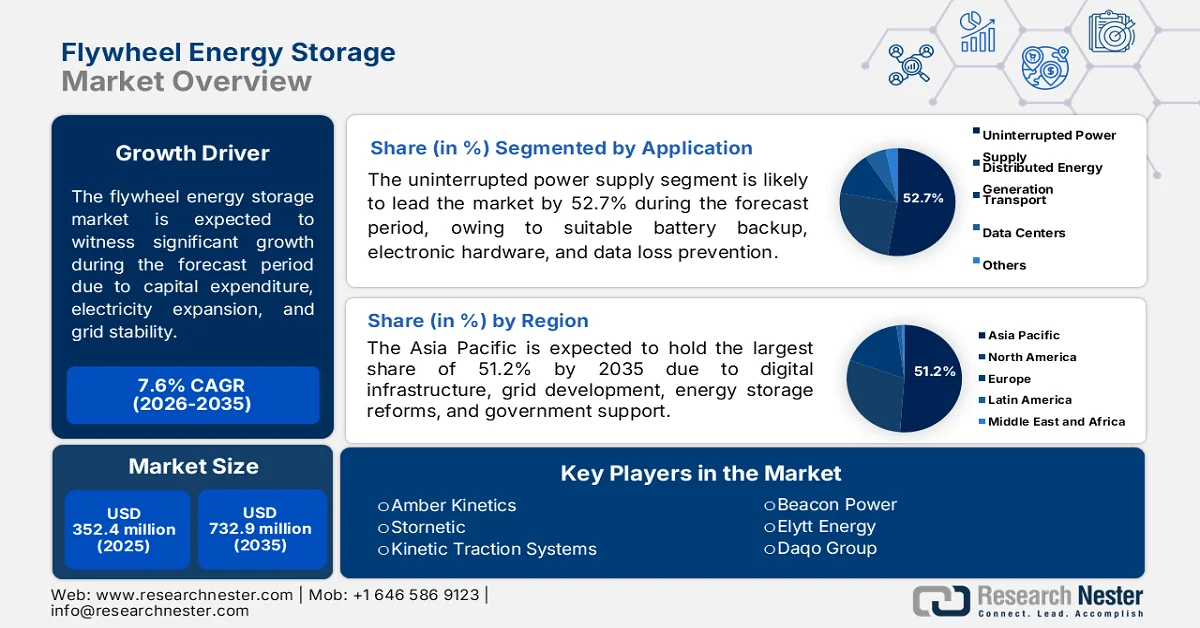
Flywheel Energy Storage Market size was over USD 352.4 million in 2025 and is predicted to cross USD 732.9 million by the end of 2035, witnessing more than 7.6% CAGR during the forecast period i.e., between 2026-2035. In 2026, the industry size of flywheel energy storage is estimated at USD 379.1 million.
The worldwide flywheel energy storage market is steadily growing, owing to industrial capital spending, the presence of advanced infrastructure, the landscape of the electricity sector, and regulatory frameworks. According to a data report published by the IEA Organization in July 2026, the global electricity requirement is projected to grow by 3.6% in 2026 and further by 3.8% by the end of 2027, indicating a 3% growth from 2025. In addition, the electricity consumption is expected to reach 30,700 TWh by the same year, in comparison to 28,600 TWh as of 2025. Besides, renewable generation is expected to be over 8% in 2026, and is also poised to boost its share of global electricity generation from 33% to 37% by 2027. Moreover, there has been a boost in electrification across different industries, which has raised electricity needs in the majority of economies since 2024, thus positively impacting the market’s upliftment.
Total Finalized Electricity Consumption in Global Economies, 2024
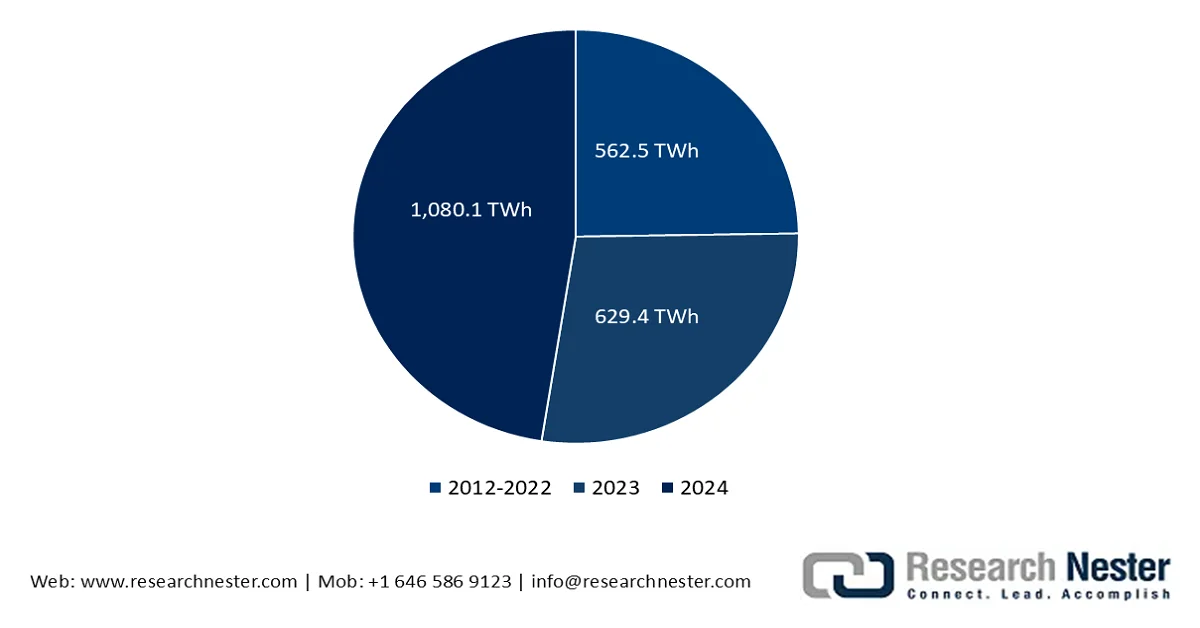
Source: IEA Organization
Furthermore, hybrid energy storage configurations, microgrid applications, the integration of automated energy management systems, and the implementation of innovative materials are a few trends that are responsible for boosting the market globally. As per a data report published by the IEA Organization in 2025, there was growth in the worldwide energy demand by 2.2% as of 2024, which demonstrated a rapid rate than the yearly average of 1.3% in 2023. This uplift was partly based on the effect of severe weather, which roughly added 0.3 percentage points to the growth. However, despite this, energy requirements were stable, as the worldwide economy strengthened by 3.2% as of 2024, which is consistent with its long-term average. Therefore, with this expansion, there is a huge growth opportunity and exposure for the market based on demand for different energy sources.
Global Energy Demand Growth Share by Source Type, 2024
|
Source Type |
Growth % |
|
Renewables |
38 |
|
Natural Gas |
28 |
|
Coal |
15 |
|
Oil |
11 |
|
Nuclear |
8 |
Source: IEA Organization
Key Flywheel Energy Storage Market Insights Summary:
Regional Highlights:
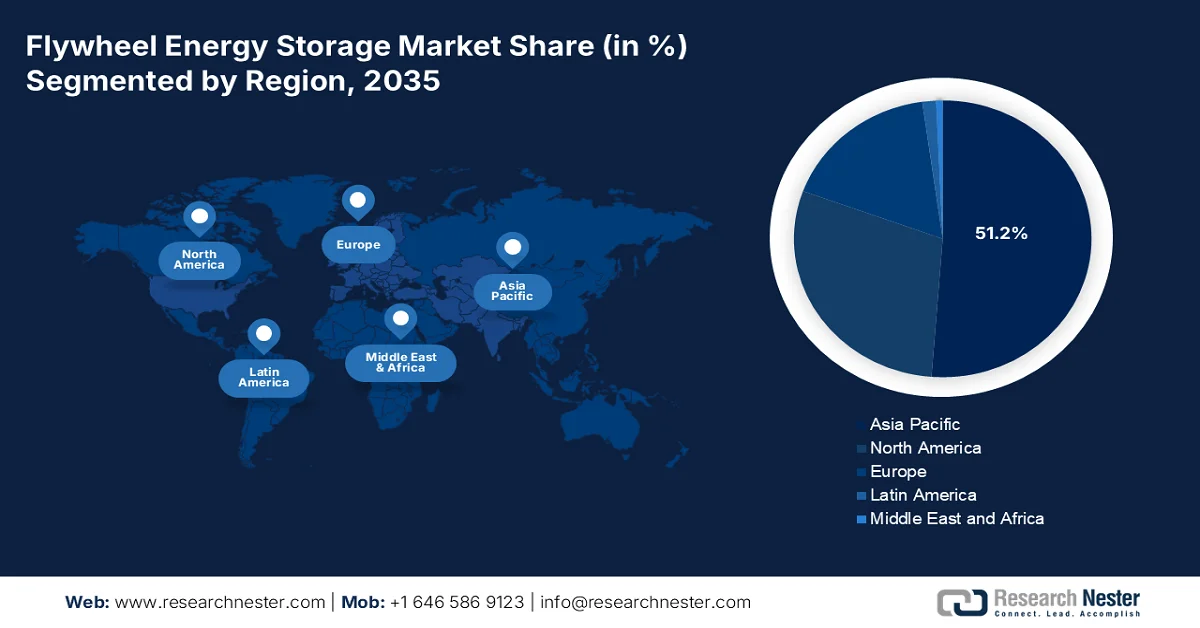
- The Asia Pacific flywheel energy storage market is anticipated to secure a dominant 51.2% share by 2035, underpinned by rapid renewable energy installations, digitalized infrastructure expansion, smart grid development, and supportive energy storage policies
- Europe is projected to witness a 17.2% share during the forecast period in the market, bolstered by robust industrial power quality applications, stringent grid stability requirements, and ambitious renewable energy targets
- The market in the U.S. accounts for 22.7% of the global share, owing to the expansion of energy storage capacities based on upcoming planned projects that are readily available
Segment Insights:
- The uninterrupted power supply sub-segment is forecast to command 52.7% of the flywheel energy storage market by 2035, fueled by rising demand for instant emergency backup power, protection of sensitive electronic equipment, and prevention of data loss caused by voltage fluctuations and power surges
- The solid steel segment under the rim type is expected to capture a significant share of the market throughout 2026-2035, supported by its exceptional durability, strength, and versatility alongside expanding global steelmaking capacity
Key Growth Trends:
- Demand for grid inertia
- Expansion of digital infrastructure
Major Challenges:
- High capital intensity and long payback periods
- Grid integration and interoperability complexities
Key Players: Piller Power Systems (Germany), Calnetix Technologies (U.S.), ABB (Switzerland), PUNCH Flybrid (Dumarey Flybrid) (UK), Amber Kinetics (U.S.), Stornetic (Germany), Kinetic Traction Systems (Italy), Beacon Power (U.S.), Elytt Energy (Spain), Daqo Group (China), Honghui Energy (China), Siemens Energy (Germany), Qnetic (U.S.), Rocky Mountain Power (U.S.).
Global Flywheel Energy Storage Market Forecast and Regional Outlook:
Market Size & Growth Projections:
- 2025 Market Size: USD 352.4 million
- 2026 Market Size: USD 379.1 million
- Projected Market Size: USD 732.9 million by 2035
- Growth Forecasts: 7.6% CAGR (2026-2035)
Key Regional Dynamics:
- Largest Region: Asia Pacific (51.2% Share by 2035)
- Fastest Growing Region: Europe
- Dominating Countries: China, United States, Japan, Germany, South Korea
- Emerging Countries: India, Singapore, Malaysia, Thailand, Saudi Arabia
Last updated on : 5 August, 2026
Flywheel Energy Storage Market - Growth Drivers and Challenges
Growth Drivers
- Demand for grid inertia: The growing need for grid inertia is considered a notable driver for the market since traditional thermal power facilities are gradually retiring. In this regard and as stated in the 2025 IRENA Organization article, the overall worldwide renewable power generation capacity and shipment is poised to triple by 2030, reaching over 11,000 GW. This is readily possible under the 1.5-degree Celsius Scenario in the World Energy Transitions Outlook, with wind and solar photovoltaic power significantly accounting for nearly 90% of renewable energy capacity additions. Besides, the yearly investment in renewable power generation is focused on reaching USD 1,300 billion by the end of 2030, thus positively impacting the market expansion.
- Expansion of digital infrastructure: The aspect of strengthening data centers requires a suitable, unlimited power supply, which positively fuels the market globally. As stated in an article published by the IDCA Organization in 2026, countries with innovative digital infrastructure usually witness nearly 40% higher gross domestic product (GDP) growth rates in comparison to restricted infrastructure. Based on this, governmental supportive strategies tend to ensure that economies can develop, maintain, and strengthen their respective digital infrastructure to meet the evolving requirements of the digital age. Moreover, the expansion of broadband accessibility in remote and rural regions also cater to the market’s upliftment globally.
Challenges
- High capital intensity and long payback periods: Large-scale energy and power projects, whether in distributed generation, grid-scale storage, or transport electrification, require massive upfront investment in infrastructure, equipment, and installation. This deters smaller players and slows adoption in price-sensitive regions. In this regard, financing becomes difficult when returns are stretched over decades, especially in emerging economies where interest rates are high. Meanwhile, even when operational savings are clear, the initial cash outflow creates a significant barrier. Besides, utilities and industrial end users often delay decisions, preferring to extend the life of existing assets rather than commit to new, unproven systems with uncertain long-term economic viability, thus restricting the flywheel energy storage market’s growth.
- Grid integration and interoperability complexities: The aspect of integrating distributed energy resources, UPS systems, and renewable generation into aging grid infrastructure presents technical and regulatory hurdles in the market. Inverters, control systems, and communication protocols vary widely across manufacturers, making seamless interoperability difficult. Likewise, utilities struggle to manage bidirectional power flows, voltage fluctuations, and frequency stability when multiple decentralized sources feed into the network. Moreover, end users in data centers and telecom face compatibility issues when connecting on-site generation with utility supply. Besides, standardization is slow, and retrofitting legacy equipment adds cost and risk, and these integration bottlenecks often delay project commissioning and reduce overall system reliability.
Flywheel Energy Storage Market Size and Forecast:
| Report Attribute | Details |
|---|---|
|
Base Year |
2025 |
|
Forecast Period |
2026-2035 |
|
CAGR |
7.6% |
|
Base Year Market Size (2025) |
USD 352.4 million |
|
Forecast Year Market Size (2035) |
USD 732.9 million |
|
Regional Scope |
|
Flywheel Energy Storage Market Segmentation:
Application Segment Analysis
The uninterrupted power supply sub-segment, which is part of the application segment, is projected to account for the largest share of 52.7% in the flywheel energy storage market by the end of 2035. The sub-segment’s upliftment is primarily attributed to the provision of instant emergency battery backup, shielding sensitive electronic hardware, and preventing sudden data loss from power surges and voltage fluctuations. According to an article published by the Department of Energy in July 2026, Federal Energy Management Program (FEMP)-based products accounted for an ENERGY STAR-specific 900-watt voltage-independent UPS, which meets the required 98.4% efficiency level. This readily saves money when the expenses are not more than USD 36, as of 2023, and also over the less efficient standardized model with a 97.3% efficiency, thus ensuring continuous flow of power supply.
Lifelong Energy Cost Savings for Uninterrupted Voltage-Independent UPS, 2026
|
Model Efficiency Levels |
Availability |
ENERGY STAR |
Less Efficient |
|
Average Efficiency (kWh) |
99.3% |
98.4% |
97.3% |
|
Yearly Energy Utilization (kWh) |
44 |
97 |
163 |
|
Yearly Energy Expense |
USD 5 |
USD 11 |
USD 18 |
|
Lifetime Energy Expense |
USD 24 |
USD 53 |
USD 89 |
|
Lifetime Energy Cost Savings |
USD 65 |
USD 36 |
- |
Source: Department of Energy
Rim Type Segment Analysis
During the forecast period, the solid steel segment under the rim type is anticipated to capture a significant share of the flywheel energy storage market. The segment’s growth is effectively driven by its role as the cornerstone of modern infrastructure, daily life, and engineering, and it further offers an unmatched combination of versatility, durability, and strength. As per a data report published by OECD in June 2026, there was an increase in steel excess capacity to 640 million tons as of 2025. In addition, it is continuously surpassing the overall OECD steel production by over 200 million tons, while it is further predicted to rise steadily and reach 745 million tons by the end of 2028. Besides, the worldwide steelmaking capacity has also surged for 4 consecutive years, which reached a new high of 2,445 million tons as of 2025, thereby positively impacting the sub-segment’s growth and expansion.
End user Segment Analysis
Based on the end user segment, the healthcare sub-segment is expected to grab a considerable share in the flywheel energy storage market by the end of the stipulated timeline. The sub-segment’s development is highly propelled by the provision of instant backup power for stabilizing electrical grids and life-support systems against outages. As per the January 2023 World Economic Forum data report, the global healthcare industry witnessed unprecedented growth, with total healthcare expenditure reaching USD 12 trillion as of 2022, indicating an increase from USD 8.5 trillion in previous years. Besides, a record USD 23.1 billion was funded by 128 therapeutic-based biopharma organizations that went public globally, particularly across areas of advanced therapies, thereby making it suitable for bolstering the sub-segment’s exposure and development.
Our in-depth analysis of the flywheel energy storage market includes the following segments:
|
Segment |
Subsegments |
|
Application |
|
|
Rim Type |
|
|
End user |
|

Vishnu Nair
Head - Global Business DevelopmentCustomize this report to your requirements — connect with our consultant for personalized insights and options.
Flywheel Energy Storage Market - Regional Analysis
APAC Market Insights
The Asia Pacific flywheel energy storage market is anticipated to grab the highest share of 51.2% by the end of 2035. The market’s upliftment in the region is primarily driven by rapid renewable energy installations, digitalized infrastructure expansion, smart grid development, and the implementation of energy storage policies and favorable government strategies. According to the 2024 Renewables Now data report, China accounted for 85% of the region's investment in the manufacturing of renewable energy and enabling technologies as of 2022, while the rest of the region constituted 4.3%. Likewise, China further accounted for 75% of renewable energy manufacturing and 16% of the rest of Asia as of 2023, thus positively fueling the market’s growth. Besides, positive development also emerged in Southeast Asia, wherein Singapore, Malaysia, Thailand, and Lao People’s Democratic Republic agreed to a power integration project, thereby bolstering the market exposure in the region.
The Japan market is growing significantly, owing to renewable energy and grid stability adoption, government and financial incentives, growth in data centers, energy security, and technological innovations. As stated in an article published by the U.S. Energy Information Administration in May 2024, the country’s tactical energy plan and green transformation decarbonization power supply bill significantly targeted fossil fuel generation sources, which accounted for 59% of the generation mix by the end of 2030 in comparison to 31% as of 2022. Besides, policies targeted an increase in renewable generation sources' share, such as biomass, geothermal, hydropower, wind, and solar, from 26% as of 2022 to between 36% and 38% by 2030, as well as a surge in nuclear generation share from 5% to between 20% and 22% in the same year, thus positively fueling the market growth.
Energy Policy for Zero-Carbon Electricity Generation, 2022 and 2030
|
Source Type |
2022 (%) |
2030 (%) |
|
Natural Gas |
34 |
20 |
|
Coal |
31 |
19 |
|
Renewables |
26 |
38 |
|
Nuclear |
5 |
20 |
|
Other |
4 |
3 |
Source: U.S. Energy Information Administration
The aspects of manufacturing leadership, massive grid infrastructure investments, strong renewable energy targets, the high-quality development of the energy storage industry, and the existence of industrial policies are certain factors for enhancing the market in China. As per an article published by Carbon Brief Organization in April 2026, the country’s two largest power grid operators invested an overall USD 24.5 billion (167.5 billion yuan) in 2026. In addition, the country also spent over USD 1.4 billion (10 billion yuan) on connecting the newest energy projects to the grid, indicating an increase of 50% from 2025. Besides, the 2 state-owned enterprises are readily planned to invest USD 146 billion (I trillion yuan) every year within 2030, thereby demonstrating an optimistic outlook for the market’s exposure and growth.
Europe Market Insights
Europe flywheel energy storage market is expected to emerge as the fastest-growing region with a share of 17.2% during the forecast period. The market’s development in the region is highly propelled by robust industrial power quality applications, strict grid stability requirements, and ambitious renewable energy targets. According to a data report published by Bruegel in February 2025, interconnector owners tend to substantially earn revenues from arbitrage between electricity pricing zones, which amount to USD 18.1 billion (€16 billion) as of 2022. Besides, the region’s overall yearly investment demand is predicted to amount between USD 73.8 billion (€65 billion) and USD 113.6 billion (€100 billion) by the end of 2030. Simultaneously, Eurelectric’s projection of expanding distribution grid investment readily amounted to USD 76.1 billion (€67 billion), thus positively fueling market development.
The Germany market is gaining increased traction, owing to the engineering and automotive industries, the requirement for advanced energy storage technologies, a robust regulatory framework, innovation in advanced materials, and leadership in critical infrastructure and data centers. As stated in an article published by ITA in July 2026, the country installed 842 MW of grid-scale battery energy storage systems (BESS) as of 025, which accounts for a record build that almost doubled the 450 MW capacity from 2024. Besides, there has been growth in the energy capacity, which rose by 1.6 GWh and successfully reached 3.5 GWh in total. Moreover, the government constituted the commitment to gaining % renewable electricity by the end of 2030, which gradually reshaped energy system demands and created a sustained need for flexible storage assets that are capable of supporting decarbonization, integrating renewable energy, and stabilizing the grid.
The generous investment in renewable energy, defense, and aerospace integration, along with the presence of a strong nuclear fleet, investment in storage solutions, proactive support, and research in innovative energy storage are a few trends that are responsible for enhancing the market in France. As per an article published by the U.S. Energy Information Administration in July 2025, the country increased its cross-border electricity deliveries by 48% from 70 TWh as of 2023 to 103 TWh in 2024. Additionally, the electricity generation in the country also increased by 45 TWh as of 2024, and meanwhile, the consumption relatively remained steady. Besides, domestic electricity exports to Germany and Belgium increased gradually, but the country also exported more electricity to Spain, the UK, Italy, and Switzerland, thus boosting the market upliftment.
North America Market Insights
North America flywheel energy storage market is predicted to witness a considerable share of 29.4% by the end of the stipulated timeline. The market’s growth in the region is effectively fueled by innovative grid infrastructure, the early adoption across several sectors, strong policy support, the integration of renewable sources, and the growing need for lifetime power supply in healthcare and data centers. According to an article published by the U.S. Energy Information Administration in November 2024, there was an increase in yearly expenditure by major utilities for delivering and producing electricity by 12% from USD 287 billion to USD 320 billion as of 2023. Based on this, capital investment in electric infrastructure fueled this increase, which doubled aging generation, ensured infrastructure delivery, and utility installation in terms of battery storage, solar and wind generation, and natural gas, thus driving the market growth.
The U.S. market is gaining increased exposure, owing to frequency regulation demands, critical grid inertia needs, AI infrastructure and hyperscale data center requirements, along with generous investments and federal policy support. As stated in an article published by the World Resources Institute in February 2026, data centers tend to represent almost 12% of overall electricity consumption in the country by the end of 2028. Besides, nearly gigawatts of data centers are projected to come online by the end of 2030, which is almost 9 times New York City’s peak demand for grid within 5 years. This significantly adds to increasing power bills in the country, with more than USD 60 billion worth of rate increases. Besides, the population usually pays nearly 10% more for electricity on average in comparison to 2024, thereby proliferating the market exposure.
Data Center Availability Across the U.S., 2026
|
State |
Number of Data Centers |
|
Virginia |
566 |
|
Texas |
391 |
|
California |
287 |
|
Illinois |
195 |
|
Georgia |
95 |
|
Ohio |
194 |
|
Arizona |
146 |
|
New York |
133 |
|
Oregon |
1 |
|
Florida |
107 |
Source: World Resources Institute
The renewable integration, remote power applications, investment tax credits, federal and provincial policy frameworks, as well as a rise in electricity demand and coal phaseout, are highly responsible for boosting the flywheel energy storage market in Canada. As per an article published by the Government of Canada in May 2026, electricity demand grew by almost 50%, based on which regulations are predicted to diminish by about 181 megatons of cumulative greenhouse gas emissions by 2050 from the national electricity generation industry. Besides, over 80% of the country’s electricity derives from non-emitting and renewable sources, including wind, nuclear, hydro, and solar power. Moreover, the overall electricity generation accounted for 584,000 GWh as of 2022, thus positively contributing to the market’s upliftment in the country.
Electricity Generation Mix in Canada, 2022
|
Electricity Source |
Generation % |
|
Hydro |
64 |
|
Nuclear |
14 |
|
Natural Gas |
10 |
|
Other Renewables |
7 |
|
Coal |
4 |
|
Other Fuels |
1 |
|
Other Generation |
1 |
Source: Government of Canada
Key Flywheel Energy Storage Market Players:
- Piller Power Systems (Germany)
- Calnetix Technologies (U.S.)
- ABB (Switzerland)
- PUNCH Flybrid (Dumarey Flybrid) (UK)
- Amber Kinetics (U.S.)
- Stornetic (Germany)
- Kinetic Traction Systems (Italy)
- Beacon Power (U.S.)
- Elytt Energy (Spain)
- Daqo Group (China)
- Honghui Energy (China)
- Siemens Energy (Germany)
- Qnetic (U.S.)
- Rocky Mountain Power (U.S.)
- Company Overview
- Business Strategy
- Key Product Offerings
- Financial Performance
- Key Performance Indicators
- Risk Analysis
- Recent Development
- Regional Presence
- SWOT Analysis
- Piller Power Systems integrates high-power flywheels into its systems to ensure seamless, battery-free power protection for mission-critical industrial and data center applications. Their solutions focus on delivering high power density and grid stabilization through advanced flywheel energy storage.
- Calnetix Technologies leverages its patented high-speed motor generator and magnetic bearing technologies to develop integrated flywheel systems that are used for microgrid stability, ship electrification, and terrestrial power generation. The company is a recognized innovator, integrating its core technologies into complete energy storage solutions for government and commercial applications.
- ABB is a key global provider of grid-stabilization technology that incorporates flywheel storage, exemplified by their PowerStore systems, which provide fast-responding power for frequency regulation and renewable integration in microgrids. They deliver turnkey, high-power flywheel solutions to support grid stability and extend the life of associated battery systems in utility and industrial applications.
- PUNCH Flybrid (Dumarey Flybrid) is a specialist in high-performance flywheel energy storage systems for mobile applications, focusing on reducing fuel consumption and emissions in construction, industrial, and off-highway vehicles. Their technology recovers and reuses energy in highly dynamic load cycles to enable engine downsizing and improved efficiency.
- Amber Kinetics manufactures the A32 FESS, which can store energy for up to four hours. Their systems provide sustainable energy storage for a range of applications, from grid firming to remote microgrids, with a focus on reliability and environmental sustainability.
Here is a list of key players operating in the global market:
The global flywheel energy storage market remains highly consolidated, with Tier 1 players such as Piller, Calnetix Technologies, and ABB commanding the majority of the total market revenue, primarily driven by their established footholds in UPS and grid frequency regulation. Moreover, competition is defined by technical differentiation in bearing technology and power electronics, with a growing focus on hybrid configurations that pair flywheels with batteries to optimize lifecycle costs. Besides, in October 2023, Siemens Energy delivered the first-ever hybrid grid stabilization along with a large-scale battery storage facility in Ireland. The purpose of this was to combine these two technologies into a single grid connection for ensuring grid stabilization, thus positively impacting the global flywheel energy storage industry.
Corporate Landscape of the Market:
Recent Developments
- In July 2026, Qnetic commenced the assembly of its first-ever full-scale 200 kWh Pulsar prototype in China through significant foundation and excavation, which is followed by technical validation.
- In January 2025, Rocky Mountain Power and Torus signed a memorandum of understanding outlining a tactical partnership, which includes the exploration of 70 megawatts of demand response capacity by utilizing Torus Nova technology.
- In July 2022, ABB and S4 Energy entered into a partnership and successfully powered its KINEXT energy storage flywheels for stabilizing electricity grids, particularly in Europe under the 9-megawatt energy storage project.
- Report ID: 8721
- Published Date: Aug 05, 2026
- Report Format: PDF, PPT
- Explore a preview of key market trends and insights
- Review sample data tables and segment breakdowns
- Experience the quality of our visual data representations
- Evaluate our report structure and research methodology
- Get a glimpse of competitive landscape analysis
- Understand how regional forecasts are presented
- Assess the depth of company profiling and benchmarking
- Preview how actionable insights can support your strategy
Explore real data and analysis
Frequently Asked Questions (FAQ)
About this Report
Connect with our Expert


Report, 2026-2035



Copyright @ 2026 Research Nester. All Rights Reserved.
