Cell Isolation Market Outlook:
Cell Isolation Market size was valued at USD 16.5 billion in 2025 and is expected to reach USD 63 billion by the end of 2035, registering around 14.4% CAGR during the forecast period, i.e., 2026-2035. In 2026, the industry size of cell isolation is estimated at USD 18.8 billion.
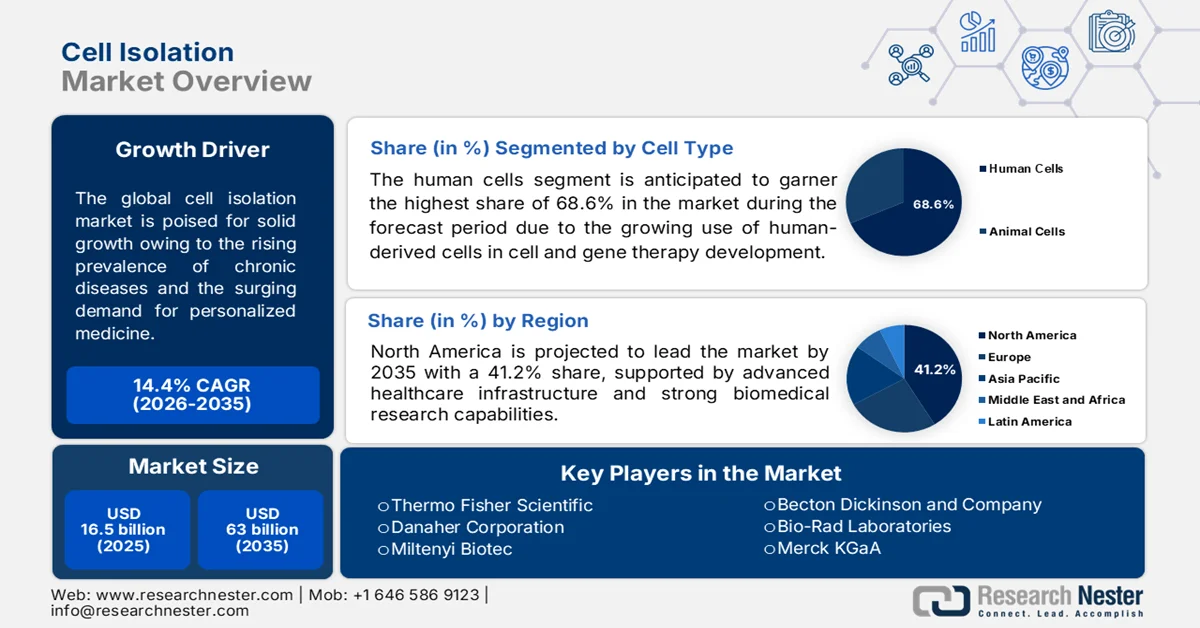
The global cell isolation market is growing continuously, which is positively influenced by factors including the rising prevalence of chronic diseases and the surging demand for personalized medicine. In addition, the growing investments in biopharmaceutical research, particularly in stem cell studies, oncology, and immunology, are accelerating the adoption of advanced separation techniques. According to the article published by the World Health Organization in September 2025, around 18 million people lost their lives to NCDs before the age of 70, with 82% of these premature deaths occurring in low- and middle-income countries. It also mentions that cardiovascular diseases were the leading cause, responsible for at least 19 million deaths, followed by cancers being 10 million, chronic respiratory diseases 4 million, and diabetes-related deaths being more than 2 million. Together, these four disease groups heighten demand in the market.
Furthermore, the expanding pipeline of cell-based therapies and biomanufacturing activities worldwide is creating lucrative growth opportunities for players in the cell isolation market, cementing it as a major pillar in modern biotechnology and clinical therapy. For instance, AstraZeneca in February 2024 announced a total of USD 300 million investment to establish a new cell therapy manufacturing facility in Rockville, focused on advancing CAR-T cell therapy production for cancer clinical trials and future commercial supply. It is an 84,000-square-foot facility that will support next-generation cell therapy development, and it will initially manufacture cell therapies for global cancer trials. It may later expand into additional disease areas.
Key Cell Isolation Market Insights Summary:
Regional Highlights:
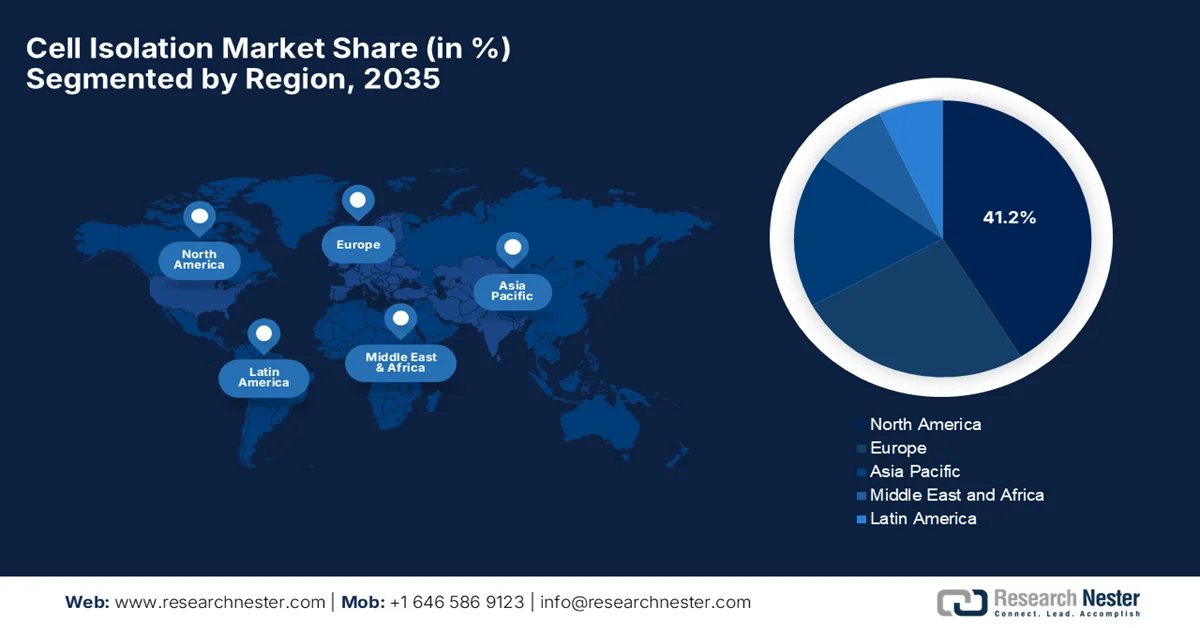
- The North America cell isolation market is anticipated to account for the largest revenue share of 41.2% by 2035, underpinned by robust healthcare infrastructure, substantial pharmaceutical R&D investments, and increasing funding for advanced cell therapy manufacturing capabilities
- Asia Pacific is projected to register the fastest growth in the market during 2026-2035, fueled by expanding healthcare infrastructure, rising biomedical research activities, and supportive regulatory pathways for cell-based therapies
Segment Insights:
- The human cells segment is projected to capture a dominant 68.6% share of the cell isolation market by 2035, driven by the increasing utilization of human-derived cells in regenerative medicine, cancer immunotherapy, precision medicine, and cell and gene therapy development
- The consumables segment is expected to hold a considerable share of the market by 2035, propelled by recurring demand for reagents, magnetic beads, antibodies, and standardized cell isolation workflows across research and therapeutic applications
Key Growth Trends:
- Stem cell research funding
- Biopharmaceutical R&D investments
Major Challenges:
- High cost of cell isolation instruments and consumables
- Technical complexity and requirement for skilled professionals
Key Players: Thermo Fisher Scientific (U.S.), Danaher Corporation (U.S.), Miltenyi Biotec (Germany), Becton Dickinson and Company (U.S.), Bio-Rad Laboratories (U.S.), Merck KGaA (Germany), STEMCELL Technologies (Canada), Sony Biotechnology (U.S.), Charles River Laboratories International, Inc. (U.S.), pluriSelect Life Science (Germany).
Global Cell Isolation Market Forecast and Regional Outlook:
Market Size & Growth Projections:
- 2025 Market Size: USD 16.5 billion
- 2026 Market Size: USD 18.8 billion
- Projected Market Size: USD 63 billion by 2035
- Growth Forecasts: 14.4% CAGR (2026-2035)
Key Regional Dynamics:
- Largest Region: North America (41.2% share by 2035)
- Fastest Growing Region: Asia Pacific
- Dominating Countries: United States, China, Japan, Germany, United Kingdom
- Emerging Countries: India, Singapore, South Korea, Australia, United Arab Emirates
Last updated on : 13 July, 2026
Cell Isolation Market - Growth Drivers and Challenges
Growth Drivers
- Stem cell research funding: The substantial investments, along with governmental funds for stem cell research, deliberately accelerate demand in the cell isolation market. These stem cells offer immense potential for regenerative medicine and tissue engineering. Meanwhile, increased funding enables academic and private research institutes to purchase advanced cell isolation products, allowing therapeutic development. For instance, the Maryland Stem Cell Research Commission in May 2026 generously awarded more than USD 12.6 million through the Maryland Stem Cell Research Fund to support 38 projects advancing stem cell and regenerative medicine research, clinical trials, and commercialization across Maryland. This particular funding will accelerate innovative therapies and technologies targeting diseases such as cancer, diabetes, Parkinson’s disease, stroke, and sickle cell disease.
- Biopharmaceutical R&D investments: The aspect of massive R&D spending by pharmaceutical and biotechnology companies is boosting growth in the market. Developing novel biologics, monoclonal antibodies, and cell therapies requires extensive cell isolation workflows. Apart from this, companies across different nations are making investments in scalable, GMP-compliant cell separation technologies to streamline drug discovery pipelines. In this context, Miltenyi Biotec announced the launch of its first office in India and announced plans to establish a Cell and Gene Therapy (CGT) Centre of Excellence in Hyderabad, which will provide advanced training, research support, and manufacturing solutions for scientists, clinicians, and industry professionals. The primary aim of this expansion is to strengthen India's CGT ecosystem by enabling local development and commercialization of innovative therapies, which include CAR T-cell treatments, through its automated technologies and strategic collaborations.
Challenges
- High cost of cell isolation instruments and consumables: The high cost which is associated with cell isolation instruments, reagents, kits, and consumables is a major hurdle for cell isolation market adoption. This is particularly witnessed among academic institutions, small biotechnology companies, and research laboratories, which have limited budgets. Technologies such as fluorescence-activated cell sorting, magnetic-activated cell sorting, and automated isolation platforms require substantial initial investments and ongoing operational expenses. In addition, the need for specialized equipment, skilled work professionals, and regular maintenance increases the overall cost burden, thus causing restrictions to widespread adoption in this field.
- Technical complexity and requirement for skilled professionals: The cell isolation processes consist of complex workflows that require specialized knowledge, technical expertise, and careful handling in order to achieve high-purity and viable cell populations. Also, any type of variation in sample quality, cell type, and isolation protocols can affect consistency and reproducibility, creating challenges for researchers and clinical users, negatively impacting market expansion. Meanwhile, advanced techniques such as flow cytometry-based sorting and single-cell isolation need trained professionals who are capable of operating instruments and interpreting results more accurately. In this context, companies need to focus on automation to simplify workflows and reduce dependency on properly trained specialists.
Cell Isolation Market Size and Forecast:
| Report Attribute | Details |
|---|---|
|
Base Year |
2025 |
|
Forecast Period |
2026-2035 |
|
CAGR |
14.4% |
|
Base Year Market Size (2025) |
USD 16.5 billion |
|
Forecast Year Market Size (2035) |
USD 63 billion |
|
Regional Scope |
|
Cell Isolation Market Segmentation:
Cell Type Segment Analysis
The human cells segment is anticipated to garner the highest share of 68.6% in the cell isolation market during the forecast period. The segment’s dominant position is mainly driven by growing use of human-derived cells in cell and gene therapy development, cancer immunotherapy, stem cell research, regenerative medicine, precision medicine, and clinical diagnostics. In addition, the continual expansion of regulatory approvals for cell-based therapies and the widespread adoption of human primary cells in drug discovery and biomarker research strengthen the segment's market leadership. In December 2024, the U.S. Food & Drug Administration (FDA) approved Ryoncil (remestemcel-L-rknd), which is the pioneer mesenchymal stromal cell therapy, for treating steroid-refractory acute graft-versus-host disease (SR-aGVHD) in pediatric patients aged two months and older.
Product Segment Analysis
By the end of 2035, consumables, which are under the product category is projected to grow with a considerable share in the market. The segment’s growth is largely attributable to recurring demand for reagents, magnetic beads, antibodies, separation media, buffers, kits, filters, and disposable labware that are required for every cell isolation procedure. In addition, growing laboratory automation and increasing adoption of standardized cell isolation workflows drive sustained demand for consumables across various end users. As stated by Thermo Fisher Scientific in September 2024, its CTS Detachable Dynabeads CD4 and CD8 magnetic Dynabeads provide a scalable and efficient solution for isolating highly pure CD4+ and CD8+ T-cell populations for cell therapy development. It is designed to preserve cell viability, functionality, and key T-cell phenotypes, and these detachable beads support downstream applications such as expansion, gene editing, and adoptive cell therapies.
India Centrifuges Imports by Country in 2024: Shipment Value and Import Quantity Analysis
|
Partner Country |
Trade Value (1000 USD) |
Quantity (Item) |
|
World (Total Imports) |
75,957.88 |
19,541,200 |
|
Germany |
31,929.02 |
4,905 |
|
China |
20,366.56 |
17,861,700 |
|
U.S. |
5,805.89 |
4,067 |
|
Italy |
3,146.29 |
75,545 |
|
Sweden |
3,008.64 |
33 |
|
Japan |
2,332.11 |
239,380 |
|
Denmark |
1,755.39 |
153 |
|
Poland |
1,400.91 |
129 |
|
Korea, Rep. |
1,142.95 |
1,327,590 |
|
UK |
1,051.03 |
626 |
|
Thailand |
903.49 |
65 |
Source: WITS
Technique Segment Analysis
On the basis of technique, magnetic-activated cell separation is projected to capture a noteworthy share in the market over the forecast years. Its high specificity, rapid processing capability, scalability, and compatibility with automated cell isolation workflows are certain factors boosting the segment’s leadership. The technique enables efficient separation of targeted cell populations using antibody-conjugated magnetic beads, offering advantages such as high cell recovery, minimal cell damage, and reproducible results. In April 2024, GenScript Biotech Corporation announced a strategic partnership for the cell isolation phase of cell therapy manufacturing automation with Multiply Labs. In this collaboration, Multiply Labs’ robotic automation system will be integrated with GenScript’s GMP-grade CytoSinct 1000 cell isolation solution, thus creating the first fully automated bead-based cell isolation process.
Our in-depth analysis of the cell isolation includes the following segments:
|
Segment |
Subsegments |
|
Cell Type |
|
|
Product |
|
|
Technique |
|
|
End user |
|
|
Cell Source |
|

Vishnu Nair
Head - Global Business DevelopmentCustomize this report to your requirements — connect with our consultant for personalized insights and options.
Cell Isolation Market - Regional Analysis
North America Market Insights
North America cell isolation market is anticipated to garner the highest share of 41.2% during the forecast period. The region’s dominance is mainly propelled by robust healthcare infrastructure and extensive biomedical research. The market also benefits from heavy investments in pharmaceutical R&D, along with a high prevalence of chronic diseases such as cancer, and strong government funding for stem cell initiatives. Johnson & Johnson in February 2026 announced a more than USD 1 billion investment to build a next-generation cell therapy manufacturing facility in Montgomery County, Pennsylvania, expanding its U.S. advanced medicine manufacturing capabilities. This facility will leverage cutting-edge cell therapy technologies to support the company’s pipeline of innovative treatments for cancer, immune-mediated, and neurological diseases.
An exceptional concentration of biotechnology firms, academic institutions, and leading research centers is fueling extensive growth of the market in the U.S. Market expansion is primarily propelled by substantial pharmaceutical investments into cell and gene therapies, along with robust federal funding and favorable policies for stem cell research. In February 2024, the National Institute of Allergy and Infectious Diseases announced the launch of a funding opportunity to support the development of innovative cell- and gene-based therapies that are aimed at achieving long-term HIV remission or elimination. The program will fund multidisciplinary research focused on genome editing, advanced cell therapies, novel delivery methods, and scalable manufacturing approaches to accelerate HIV cure strategies. It also mentioned the funding pool of USD 13.5 million, and the initiative is expected to support 3 to 4 research program awards of up to USD 2.2 million in direct costs each.
In Canada, the cell isolation market is projected for noteworthy expansion, which is supported by strong government initiatives and public funding for regenerative medicine and stem cell research. The market also benefits from a highly collaborative research ecosystem, wherein prestigious academic networks work along with growing biotechnology clusters to advance cellular therapies. The Government of Canada in March 2025 generously made an investment of USD 49.9 million in STEMCELL Technologies through the strategic innovation fund to support the development of two advanced biomanufacturing facilities in British Columbia. This USD 222 million project will expand domestic production of critical inputs for vaccines, therapeutics, diagnostics, tissue engineering, immunotherapy, and cell and gene therapies.
APAC Market Insights
Asia Pacific market is projected to expand at the fastest rate from 2026 to 2035. The region’s leadership is largely attributable to expanding healthcare infrastructure and the growth of biomedical industries across major economies such as China, Japan, and India. Market momentum is driven by a massive patient pool requiring advanced therapeutics for chronic diseases and evolving regulatory pathways that accelerate cell-based research. In August 2023, Singapore launched a new 2,000 sq m Advanced Cell Therapy and Research Institute facility with the main goal of expanding local cell and gene therapy manufacturing capabilities and accelerating patient access to advanced treatments. This facility includes 14 GMP-compliant clean suites, translational laboratories, and quality control facilities to support various end users in developing cell therapies, thus making it suitable for bolstering the market’s growth.
The massive state-led investments in biotechnology and precision medicine are effectively fueling the growth of China cell isolation market. Government initiatives and funding for translational research heavily support advancements in stem cell therapy and regenerative medicine, thus encouraging more players to make investments in the country’s market. In this context, Beijing in December 2024 introduced a three-year action plan 2024-2027 to accelerate innovation and industrial development in the cell and gene therapy sector with a collective goal of aiming to establish the city as a global hub for advanced therapies. Therefore, by 2027, Beijing aims to support more than 20 cell and gene therapy companies, achieve more than 15 new clinical trial approvals, and advance more than 5 innovative products toward market approval.
In India, the cell isolation market is growing exceptionally on account of a rapidly expanding biotechnology sector and a surge in contract research and manufacturing activities. Market expansion is propelled by the rising proliferation of research academic institutes, along with the gradual adoption of automated laboratory workflows by local biopharmaceutical companies. In December 2025, the Press Information Bureau stated that the Department of Biotechnology reported major achievements in 2025, highlighting India’s expanding bio-economy, which grew to USD 165.7 billion in 2024 with a target of USD 300 billion by 2030. These initiatives strengthened the country’s biotech innovation ecosystem through startup support, research infrastructure, AI-biotechnology collaborations, and development of healthcare, agricultural, and industrial biotechnology solutions.
Department of Biotechnology (DBT) Achievements 2025: Key Statistics, Biotech Growth, Innovations and Milestones
|
Indicator |
Data |
|
Global biotech ranking |
12th worldwide; 3rd in Asia Pacific |
|
Biofoundry Network |
6 Biofoundries established |
|
GenomeIndia Project |
10,000 whole-genome sequences accessible |
|
BRCP period |
2025-26 to 2030-31 (support till 2037-38) |
|
MTB genome sequencing |
17,000+ isolates sequenced |
|
Space Biotechnology |
1st human muscle stem-cell experiment on ISS (Axiom-4); microalgae & cyanobacteria studies |
|
National Biopharma Mission |
2 COVID vaccines, MRI scanner, 9 diagnostic kits, bioreactors, ventilators |
|
BioNEST Centers |
75 centers |
|
E-YUVA Centers |
19 centers |
|
Startup support |
3,000+ biotech startups |
|
Products commercialization pipeline |
800+ products |
Source: PIB
Europe Market Insights
The Europe market is expected to expand at a considerable rate during the discussed time frame. The region benefits from strong academic research traditions and high medical research standards. In addition, a strong collaborative network between regional universities and biotechnology firms and strict compliance with advanced manufacturing standards for biopharmaceuticals continually propel the demand for high-purity cell separation technologies. In June 2024, Bayer AG and Charité - Universitätsmedizin Berlin announced the launch of the Berlin Center for Gene and Cell Therapies to create a leading biotech ecosystem in Berlin for advanced cell and gene therapies. This center will receive around USD 91.3 million in federal funding to integrate research, clinical development, start-up incubation, and GMP-certified manufacturing facilities to accelerate the translation of innovative therapies from laboratories to patients.
An elite network of academic research institutes, biotechnology firms, and an influential pharmaceutical industry is visibly reshaping the growth dynamics of the market in Germany. The country’s market also benefits from biopharmaceutical manufacturers rapidly adopting highly automated, GMP-compliant cell separation systems to satisfy strict regional quality standards, accelerating the development of novel biologics and personalized therapeutics nationwide. In February 2023, BioNTech SE completed construction of its first in-house plasmid DNA manufacturing facility in Marburg, Germany, with the main goal of strengthening production capabilities for mRNA-based vaccines, cancer therapies, and cell therapies. This facility, developed with an investment of USD 46 million, is designed to improve manufacturing flexibility, reduce delivery timelines and enhance supply chain autonomy.
The UK cell isolation market is being supported by substantial government and private venture funding for genomics, immunology, and regenerative medicine research. In addition, a highly collaborative ecosystem linking prestigious academic universities with innovative biotechnology startups accelerates the clinical development of cell-based therapies, steadily increasing the demand for cell separation technologies across the nation. In February 2026, New England Biolabs announced the launch of the Monarch Mag Cell-free DNA (cfDNA) extraction kit that allows scalable and reproducible isolation of low-abundance cfDNA from plasma, serum, urine, and cerebrospinal fluid. The automation-compatible, magnetic bead-based workflow supports sample volumes of 1 to 4 mL and improves recovery of fragmented DNA down to 50 base pairs for biomarker discovery and diagnostic applications, thus positively impacting the market’s growth.
Key Cell Isolation Market Players:
- Thermo Fisher Scientific (U.S.)
- Danaher Corporation (U.S.)
- Miltenyi Biotec (Germany)
- Becton Dickinson and Company (U.S.)
- Bio-Rad Laboratories (U.S.)
- Merck KGaA (Germany)
- STEMCELL Technologies (Canada)
- Sony Biotechnology (U.S.)
- Charles River Laboratories International, Inc. (U.S.)
- pluriSelect Life Science (Germany)
- Akadeum Life Sciences (U.S.)
- BioLegend (U.S.)
- Company Overview
- Business Strategy
- Key Product Offerings
- Financial Performance
- Key Performance Indicators
- Risk Analysis
- Recent Development
- Regional Presence
- SWOT Analysis
- Thermo Fisher Scientific is considered to be a leading player in the market, which is offering a broad portfolio of cell separation solutions. The company benefits from its extensive life sciences ecosystem, global reach, and strong presence in research, biotechnology, and clinical applications.
- Danaher Corporation also maintains a strong position in the market through its life science businesses, particularly Beckman Coulter, which provides cell separation and sorting technologies. Besides, the firm offers advanced flow cytometry, cell analysis, and isolation platforms, which are used across research and clinical workflows.
- Miltenyi Biotec is recognized as a specialized leader in terms of cell isolation and cell separation technologies, especially through its MACS® magnetic-activated cell sorting platform. In addition, the company provides a wide range of reagents, instruments, and automated solutions for isolating immune cells, stem cells, and certain other cell populations.
- Becton Dickinson and Company is a major competitor in the market through its advanced flow cytometry and cell sorting technologies. Also, the firm provides instruments and solutions that enable precise identification, separation, and characterization of cell populations for research as well as clinical applications.
- Bio-Rad Laboratories participates in the market by providing cell sorting, separation, and analysis solutions that deliberately support life science research and biotechnology applications. The company focuses on delivering reliable technologies for isolating and studying specific cell populations, with applications in immunology, genomics, and biomedical research.
Here is a list of key players operating in the global market:
The cell isolation market is moderately consolidated, which hosts leading life science companies, and they are competing through advanced separation technologies, automation capabilities, and strong global distribution networks. Pioneering manufacturers in this field are highly focused on magnetic-activated cell sorting, fluorescence-activated cell sorting, and integrated cell processing solutions, which are for research and clinical applications. Leaders in the market are consistently gaining competitive advantages through innovation and partnerships in cell therapy and single-cell analysis. In this context, in September 2025, Zeon Corporation announced the acquisition of patents for Deterministic Cell Separation (DCS) technology from GPB Scientific, Inc., with the main goal of accelerating innovation in cell therapy and life sciences.
Corporate Landscape of the Market:
Recent Developments
- In September 2025, Charles River Laboratories International, Inc. entered into a partnership with Akadeum Life Sciences to integrate its GMP-grade human T cell leukopak isolation kit into the cell therapy flex platform. This collaboration incorporates Akadeum’s Microbubble technology, which uses buoyancy-based separation to improve T-cell recovery.
- In July 2024, STEMCELL Technologies announced the launch of the CellPore™ Transfection System, which is a mechanoporation-based technology that enables gentle and efficient delivery of molecules into mammalian cells for cell engineering research.
- Report ID: 8666
- Published Date: Jul 13, 2026
- Report Format: PDF, PPT
- Explore a preview of key market trends and insights
- Review sample data tables and segment breakdowns
- Experience the quality of our visual data representations
- Evaluate our report structure and research methodology
- Get a glimpse of competitive landscape analysis
- Understand how regional forecasts are presented
- Assess the depth of company profiling and benchmarking
- Preview how actionable insights can support your strategy
Explore real data and analysis
Frequently Asked Questions (FAQ)
About this Report
Connect with our Expert


Report, 2026-2035



Copyright @ 2026 Research Nester. All Rights Reserved.
