Brain Implants Market Outlook:
Brain Implants Market size was valued at USD 2.9 billion in 2025 and is expected to continue its robust growth, reaching USD 8.8 billion by 2035, expanding at a CAGR of 11.9% during the forecast period, i.e., 2026-2035. In 2026, the industry size of brain implants is estimated at USD 3.2 billion.
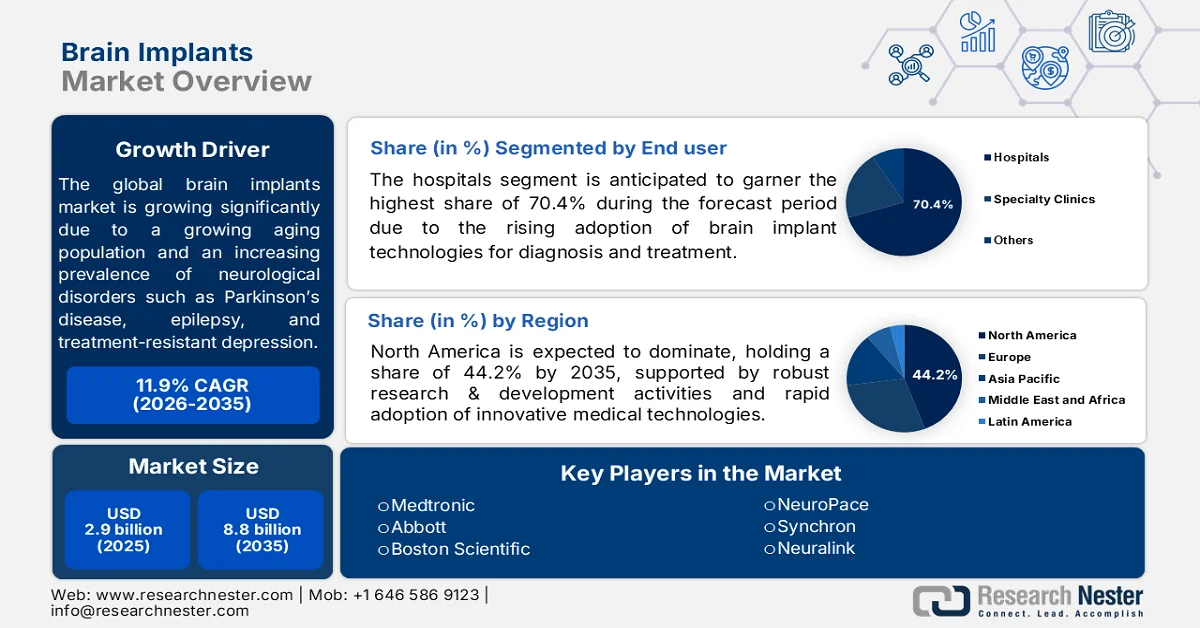
The global brain implants market is projected to experience explosive growth owing to the continuously growing aging population and an increasing prevalence of neurological disorders such as Parkinson’s disease, epilepsy, and treatment-resistant depression. Technological innovation is the primary catalyst for market growth, wherein advancements in wireless communication, micro-manufacturing, and AI significantly improve signal processing and device longevity. In August 2023, the article published by the World Health Organization (WHO) disclosed that the global prevalence of Parkinson's disease has doubled over the past 25 years, with more than 8.5 million people affected in a year. Also, PD caused 5.8 million disability-adjusted life years (DALYs) and around 329,000 deaths worldwide.
Furthermore, rising healthcare expenditures, coupled with expanding clinical trials for next-generation brain-computer interfaces, are attracting substantial venture capital and public funding, benefiting the overall market globally. According to the article published by the National Institutes of Health (NIH) in March 2024, a systematic review of 26 studies over two decades found that the mean inflation-adjusted cost of the deep brain stimulation device was USD 21,496, surgery alone cost USD 14,685, and the total cost of surgery was USD 40,943. The total cost of DBS treatment up to 1 year of follow-up averaged USD 47,632 ± 23,067, showing substantial variation across countries and healthcare systems.
Key Brain Implants Market Insights Summary:
Regional Highlights:
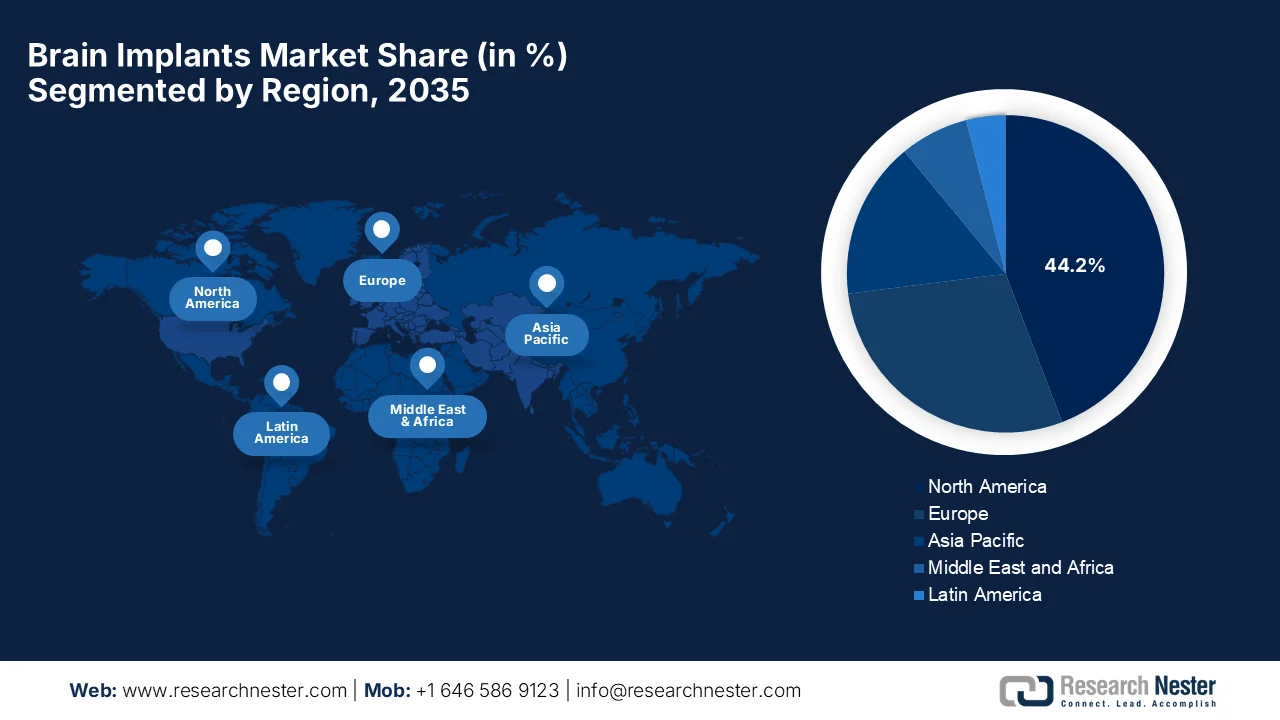
- North America market is projected to command 44.2% of the market by 2035, bolstered by advancements in neurotechnology and the rising prevalence of neurological disorders such as Parkinson’s disease, epilepsy, and chronic pain
- Asia Pacific is poised to witness the fastest growth in the market throughout 2026-2035, fueled by rapidly developing healthcare infrastructures across emerging economies
- The brain implants market in the U.S. accounts for almost 73.7% of the share in North America, which is driven by the strong adoption of neurostimulation technologies and a favorable reimbursement environment.-
Segment Insights:
- The hospitals segment is anticipated to account for 70.4% of the brain implants market by 2035, underpinned by the increasing number of neurological disorders requiring advanced surgical interventions
- Deep brain stimulation is expected to secure a considerable share of the market by 2035, accelerated by rising adoption of minimally invasive neurosurgical procedures and technological advancements in implantable devices
Key Growth Trends:
- Advancements in brain-computer interfaces
- Increasing research and development investments
Major Challenges:
- High financial and accessibility barriers
- Stringent and protracted regulatory pathways
Key Players: Medtronic (Ireland), Abbott (U.S.), Boston Scientific (U.S.), NeuroPace (U.S.), Synchron (U.S.), Neuralink (U.S.), Ability Neurotech (Netherlands), Vivani Medical, Inc. (U.S.), Cortigent, Inc. (U.S.).
Global Brain Implants Market Forecast and Regional Outlook:
Market Size & Growth Projections:
- 2025 Market Size: USD 2.9 billion
- 2026 Market Size: USD 3.2 billion
- Projected Market Size: USD 8.8 billion by 2035
- Growth Forecasts: 11.9% CAGR (2026-2035)
Key Regional Dynamics:
- Largest Region: North America (44.2% Share by 2035)
- Fastest Growing Region: Asia Pacific
- Dominating Countries: United States, Germany, Japan, China, United Kingdom
- Emerging Countries: China, India, South Korea, Singapore, Australia
Last updated on : 13 July, 2026
Brain Implants Market - Growth Drivers and Challenges
Growth Drivers
- Advancements in brain-computer interfaces: The breakthroughs in the development of brain-computer interfaces dramatically fuel market optimism and commercial interest. Improvements in micro-manufacturing, wireless telemetry, and biocompatible materials allow for less invasive, highly durable devices. In November 2025, an NIH article revealed that brain implants and artificial intelligence are advancing neurological treatments by enabling closed-loop systems that detect brain signals and deliver targeted stimulation. The article also outlined that brain research–machine interfaces help patients with paralysis control devices through neural signals, thus positively benefiting the market’s exposure.
- Increasing research and development investments: The substantial investments from governments and private companies in brain-computer interface research are remarkably contributing to the market expansion. Funding initiatives are supporting clinical trials, product development, and commercialization of advanced neural implants, thereby improving accessibility of brain implant solutions. As of December 2023, INBRAIN is developing a graphene-based brain implant to treat neurological disorders such as Parkinson’s disease by detecting and controlling abnormal brain signals. This technology uses graphene’s unique properties to create a sensitive brain-computer interface, for which the European Investment Bank provided a USD 22 million venture debt loan, thus driving the market’s growth.
Challenges
- High financial and accessibility barriers: The exorbitant cost of purchasing devices and undergoing complex neurosurgery causes restrictions on the market accessibility to a fraction of wealthy individuals. Developing neural implants necessitates extensive research, high-end specialized components, and advanced micro-manufacturing. Other than device manufacturing expenses, patients need to afford those highly technical neurosurgical procedures, lengthy hospital stays, and years of post-operative care. This financial strain is being exacerbated by an absence of insurance reimbursement frameworks for certain experimental neurotechnologies. Therefore, medical institutions in developing economies face huge financial hurdles in acquiring these technologies, thus causing a hindrance to market reach.
- Stringent and protracted regulatory pathways: The regulatory approval process for implantable medical devices is exceptionally slow as well as complex. Regulatory agencies across different nations enforce rigorous multi-phase clinical trial guidelines to guarantee patient safety. Also, sourcing reliable evidence through clinical human trials might take many years owing to the difficulty which is associated with recruiting eligible participants. In this context, manufacturers in the market need to carefully prove both absolute safety and long-term efficacy. Meanwhile, this long process causes delays to commercialization, burns through venture funding, and creates a high-risk environment for healthcare investors. Furthermore, the absence of standardized international assessment guidelines across global territories compels companies to duplicate expensive trials to enter new geographic regions.
Brain Implants Market Size and Forecast:
| Report Attribute | Details |
|---|---|
|
Base Year |
2025 |
|
Forecast Period |
2026-2035 |
|
CAGR |
11.9% |
|
Base Year Market Size (2025) |
USD 2.9 billion |
|
Forecast Year Market Size (2035) |
USD 8.8 billion |
|
Regional Scope |
|
Brain Implants Market Segmentation:
End user Segment Analysis
The hospitals segment is anticipated to garner the highest share of 70.4% in the end user segment of the brain implants market during the forecast period. The segment’s dominant position is attributed to the increasing number of neurological disorders requiring advanced surgical interventions. In addition, the rising adoption of brain implant technologies for diagnosis and treatment, the availability of specialized neurosurgical facilities, and the growing presence of skilled healthcare professionals are positioning the segment for explosive growth. In November 2025, Apollo Hospitals Greams Road announced the launch of Tamil Nadu’s first centre of excellence for Parkinson’s disease and deep brain stimulation, which offers advanced neurological care and precision neurosurgery. This facility uses next-generation brain-sensing DBS technology to provide personalized treatments aimed at improving mobility and independence.
Product Segment Analysis
By the conclusion of the forecast period, deep brain stimulation is expected to attain a considerable share in the brain implants market. The segment’s growth is largely attributable to rising adoption of minimally invasive neurosurgical procedures and technological advancements in implantable devices. In addition, the growing clinical evidence supporting the efficacy of deep brain stimulation therapies also propels the segment’s leadership. For instance, Medtronic received U.S. FDA approval in February 2025 for an optional adaptive deep brain stimulation programming feature for its Activa®, Percept™ and SenSight™, which is a deep brain stimulation therapy system. This technology enables more responsive stimulation of brain regions such as the subthalamic nucleus and globus pallidus internus for patients with medication-resistant symptoms of Parkinson’s disease.
Application Segment Analysis
Under the application segment, epilepsy is projected to grow at a significant rate in the market during the discussed timeframe. The segment’s growth is propelled primarily by rising prevalence of drug-resistant epilepsy, increasing adoption of implantable neuromodulation therapies, and continuous advancements in seizure-monitoring and stimulation technologies. In February 2024, the World Health Organization stated that epilepsy affects around 50 million people worldwide, making it one of the most prevalent neurological disorders. The article also mentions that around 80% of epilepsy patients live in low- and middle-income nations, where access to diagnosis and treatment remains limited. An estimated 5 million new cases are diagnosed each year, thus denoting a wider scope.
Our in-depth analysis of the brain implants market includes the following segments:
|
Segment |
Subsegments |
|
End user |
|
|
Product |
|
|
Application |
|

Vishnu Nair
Head - Global Business DevelopmentCustomize this report to your requirements — connect with our consultant for personalized insights and options.
Brain Implants Market - Regional Analysis
North America Market Insights
North America brain implants market is anticipated to dominate with a total share of 44.2% over the forecasted years. The region’s dominance in this field is mainly propelled by advancements in neurotechnology and a rising prevalence of neurological disorders such as Parkinson’s disease, epilepsy, and chronic pain. The regional expansion is also being supported by substantial research and development investments and early adoption of advanced medical devices. In September 2024, APD Association reported that Parkinson’s disease affects around 1 million people in the U.S., which is about 1 in every 336 people. The article also stated that the number of cases continues to rise, with around 90,000 new diagnoses each year and a new diagnosis occurring approximately every six minutes, thus denoting a lucrative opportunity for the market to grow.
The continuous technological innovations from leading pioneers are responsibly uplifting the U.S. market. The country’s market growth is primarily propelled by extensive funding from both private venture capital and government initiatives such as the BRAIN Initiative. For instance, in June 2026, Paradromics achieved a first-in-human implantation of its wireless Connexus brain-computer interface at the University of Michigan Health as part of the Connect-One clinical trial for patients with speech difficulties. This particular implant uses 421 microelectrodes to capture brain signals and aims to restore communication by converting neural activity into synthesized text and speech, thus making it suitable for standard market growth.
In Canada, the market is growing at a noteworthy pace, which is propelled by strong public healthcare infrastructure and advanced research networks across leading academic medical centers. This expansion is supported by government funding for neuroscience research and collaborative public-private partnerships aimed at addressing neurological conditions. In September 2025, University Health Network reported that it performed Canada’s first-ever Neuralink brain-computer interface implant surgeries at Toronto Western Hospital. These procedures are part of the CAN-PRIME clinical trial evaluating the safety and performance of Neuralink’s wireless BCI and surgical robot for people with paralysis.
APAC Market Insights
Asia Pacific brain implants market is expected to grow at the fastest rate from 2026 to 2035. The region’s expansion is majorly propelled by rapidly developing healthcare infrastructures across emerging economies. Growth is heavily supported by government initiatives to modernize medical facilities, expand medical tourism, and rising disposable incomes that increase access to advanced therapeutics. In September 2025, the Japan Agency for Medical Research and Development (AMED) stated that the project for medical devices and healthcare supports research and development of advanced medical devices and healthcare technologies using innovations such as AI and IoT to improve disease diagnosis, treatment, prevention, and quality of life. It also promotes the creation of innovative medical devices in Japan by translating basic research outcomes into practical healthcare solutions, thus making it suitable for driving the market’s growth.
A heightening focus on high-end medical device domestic manufacturing, fueled by national initiatives such as the China brain project are propelling the growth of the market in China. In addition, domestic companies and academic institutions are developing native brain-computer interfaces and deep brain stimulation systems to compete with multinational corporations. In April 2026, Neuracle Medical Technology developed NEO, which is the world’s first brain-computer interface approved for commercial use, receiving approval from China’s national medical device regulator in March 2026. This coin-sized implant is placed inside the skull to detect brain signals and enable people with partial paralysis to control devices such as robotic gloves.
In India, the market is gaining exposure, which is facilitated by the ongoing modernization of private healthcare networks and a rising middle class with increasing affordability. In addition, the country's growing prominence as a hub for affordable medical tourism and government initiatives such as Make in India encourage the local assembly, manufacturing, and clinical trial validation of cost-effective neuromodulation devices. For instance, Medtronic announced the launch of its adaptive deep brain stimulation system in India in April 2026 to improve symptom management and quality of life for people living with Parkinson’s disease. This technology uses BrainSense™ capabilities to automatically adjust stimulation in real time based on brain signals and patient needs, offering more personalized therapy than conventional DBS, thus positively contributing to the market’s expansion.
Europe Market Insights
The Europe brain implants market is expected to progress steadily during the forecast period. The region benefits from high healthcare spending per capita and a significant burden of age-related neurodegenerative diseases. Market growth is also supported by robust clinical research environments and widespread public reimbursement frameworks that lower patient out-of-pocket costs for complex neurological procedures. In May 2026, the ReverseParalysis project, which was funded by the EU, developed a fully implantable brain–spine interface that reconnects the brain and spinal cord, thereby enabling people with paralysis to regain movement by bypassing damaged nerve pathways. This system combines brain implants, spinal stimulation, and AI to translate brain signals into precise muscle movements. This technology, being advanced by ONWARD Medical, is expected to move toward broader clinical use within the next 5 to 10 years.
A highly advanced healthcare system, substantial public healthcare expenditure, along with a pioneering position in the region's medical technology manufacturing, are reshaping the growth dynamics of the market in Germany. Market growth is also being supported by the country’s statutory health insurance system, which ensures reimbursement for neurosurgical procedures such as deep brain stimulation. For instance, in July 2025, CorTec GmbH announced the first human implantation of its Brain Interchange™ brain-computer interface, which is developed in Germany, as part of an FDA-approved clinical trial for stroke patients at Harborview Medical Center in Seattle. This closed-loop, wireless BCI continuously records brain activity and delivers real-time electrical stimulation, whereas the trial, funded by the NIH, has the main goal of evaluating the safety and effectiveness of this personalized neurotechnology.
In the UK, the market is projected for solid growth, which is driven by the country’s prominent life sciences sector and advanced clinical research networks. In addition, the country’s market expansion is heavily supported by the National Health Service (NHS), which provides a centralized framework for the adoption and structured reimbursement of sophisticated neuromodulation therapies. In June 2025, the UK Medical Research Council established the Centre of Research Excellence in Restorative Neural Dynamics by providing up to USD 68 million over 14 years to develop next-generation brain stimulation therapies. This center will be working with partners including Amber Therapeutics, and the programme aims to accelerate first-in-human trials, commercialization, and adoption of innovative brain stimulation technologies within the UK’s NHS.
Key Brain Implants Market Players:
- Medtronic (Ireland)
- Abbott (U.S.)
- Boston Scientific (U.S.)
- NeuroPace (U.S.)
- Synchron (U.S.)
- Neuralink (U.S.)
- Ability Neurotech (Netherlands)
- Vivani Medical, Inc. (U.S.)
- Cortigent, Inc. (U.S.)
- Company Overview
- Business Strategy
- Key Product Offerings
- Financial Performance
- Key Performance Indicators
- Risk Analysis
- Recent Development
- Regional Presence
- SWOT Analysis
- Medtronic is the global leader in the market which is offering one of the industry's most prominent portfolios of implantable neuromodulation devices. The company holds a strong position through continuous innovation in adaptive DBS technology, sensing-enabled neurostimulators, and rechargeable implant systems.
- Abbott is also a major manufacturer of implantable neuromodulation devices with a strong presence in the market through its Infinity DBS system. The firm is highly focused on delivering personalized therapy for movement disorders by integrating directional lead technology and wireless programming aspects.
- Boston Scientific is yet another prominent player that is leading in terms of implantable brain stimulation technologies. The company's DBS systems incorporate multiple independent current control and directional stimulation technologies that enable therapy for patients with Parkinson's disease as well as essential tremor.
- NeuroPace is well recognized for its RNS® system, which is the first commercially available closed-loop brain implant designed to treat drug-resistant focal epilepsy. In addition, the firm’s specialization in adaptive neurostimulation has established it as a predominant leader in this field.
- Synchron is an emerging neurotechnology company that is highly focused on developing minimally invasive implantable BCI systems. The company has strengthened its market position through multiple clinical studies and strategic collaborations.
Here is a list of key players operating in the global market:
The global market is characterized by a moderately consolidated competitive landscape, and it is being led by a handful of multinational medical device manufacturers with extensive neuromodulation portfolios. Pioneering companies intensely compete through innovations in deep brain stimulation, closed-loop neuromodulation, rechargeable implant systems, and certain MRI-compatible devices. Apart from this, well-established companies dominate commercialized therapeutic brain implants, whereas emerging manufacturers are advancing implantable brain-computer interface technologies for neurological restoration, thereby increasing competitive intensity in this sector. For instance, researchers at the Illinois Institute of Technology in May 2026 completed the third implantation of the wireless Intracortical Visual Prosthesis, which is designed to restore artificial vision by directly stimulating the brain’s visual cortex. Implanted at Rush University Medical Center, the system includes 34 wireless stimulators with 544 electrodes and aims to improve navigation and basic visual tasks for people with total blindness.
Corporate Landscape of the Market:
Recent Developments
- In June 2026, Ability Neurotech received regulatory approval in the Netherlands to begin a clinical trial of its fully implantable, battery-free brain-computer interface for people with amyotrophic lateral sclerosis. This study will evaluate whether the device can restore speech and communication in everyday home settings.
- In January 2026, Vivani Medical, Inc. subsidiary Cortigent, Inc. presented its Orion® brain implant technology at the Neuromodulation Society Annual Meeting 2026. This particular investigational system is designed to restore visual perception in blind individuals and has completed a six-year early feasibility study.
- Report ID: 8669
- Published Date: Jul 13, 2026
- Report Format: PDF, PPT
- Explore a preview of key market trends and insights
- Review sample data tables and segment breakdowns
- Experience the quality of our visual data representations
- Evaluate our report structure and research methodology
- Get a glimpse of competitive landscape analysis
- Understand how regional forecasts are presented
- Assess the depth of company profiling and benchmarking
- Preview how actionable insights can support your strategy
Explore real data and analysis
Frequently Asked Questions (FAQ)
About this Report
Connect with our Expert


Report, 2026-2035



Copyright @ 2026 Research Nester. All Rights Reserved.
