Global Brain Machine Interface Market
- An Outline of the Global Brain Machine Interface Market
- Market Definition and Segmentation
- Study Assumptions and Abbreviations
- Research Methodology & Approach
- Primary Research
- Secondary Research
- Data Triangulation
- SPSS Methodology
- Executive Summary
- Growth Drivers
- Major Roadblocks
- Opportunities
- Prevalent Trends
- Government Regulation
- Growth Outlook
- Competitive White Space Analysis – Identifying Untapped Market Gaps
- Risk Overview
- SWOT
- Technological Advancement
- Technology Maturity Matrix for Brain Machine Interface
- Recent News
- Regional Demand
- Global Brain Machine Interface by Geography – Strategic Comparative Analysis
- Strategic Segment Analysis: Brain Machine Interface Demand Landscape
- Brain Machine Interface Demand Trends Driven by Medical Rehabilitation, Robotics, and AI (2026-2038)
- Root Cause Analysis (RCA) for discovering problems of the Brain Machine Interface Market
- Porter Five Forces
- PESTLE
- Comparative Positioning
- Brain Machine Interface – Key Player Analysis (2038)
- Competitive Landscape: Key Suppliers/Players
- Competitive Model: A Detailed Inside View for Investors
- Company Market Share, 2038 (%)
- Business Profile of Key Enterprise
- Neuralink
- Synchron
- Paradominics
- Precision Neuroscience
- Blackrock Neurotech
- Emotiv
- Bitbrain
- Business Profile of Key Enterprise
- Global Brain Machine Interface Market Outlook
- Market Overview
- Market Revenue by Value (USD Million), Volume (Thousand Tons), and Compound Annual Growth Rate (CAGR)
- Brain Machine Interface Market Segmentation Analysis (2026-2038)
- By Component
- Hardware, Market Value (USD Million), and CAGR, 2026-2038F
- Software, Market Value (USD Million), and CAGR, 2026-2038F
- By Technology
- Invasive, Market Value (USD Million), and CAGR, 2026-2038F
- Partially Invasive, Market Value (USD Million), and CAGR, 2026-2038F
- Non-Invasive, Market Value (USD Million), and CAGR, 2026-2038F
- By End User
- Healthcare, Market Value (USD Million), and CAGR, 2026-2038F
- Communication and Control, Market Value (USD Million), and CAGR, 2026-2038F
- Entertainment and Games, Market Value (USD Million), and CAGR, 2026-2038F
- Smart Home Control, Market Value (USD Million), and CAGR, 2026-2038F
- Others, Market Value (USD Million), and CAGR, 2026-2038F
- Regional Synopsis, Value (USD Million), 2026-2038
- North America Market Value (USD Million) and CAGR & Y-o-Y Growth Trend, 2026-2038F
- Europe Market Value (USD Million) and CAGR & Y-o-Y Growth Trend, 2026-2038F
- Asia Pacific Market Value (USD Million) and CAGR & Y-o-Y Growth Trend, 2026-2038F
- Latin America Market Value (USD Million) and CAGR & Y-o-Y Growth Trend, 2026-2038F
- Middle East and Africa Market Value (USD Million) and CAGR & Y-o-Y Growth Trend, 2026-2038F
- By Component
- Market Overview
- North America Market
- Overview
- Market Value (USD Million), Current and Future Projections, 2026-2038
- Increment $ Opportunity Assessment, 2026-2038
- Segmentation (USD million), 2026-2038, By
- By Component
- Hardware, Market Value (USD Million), and CAGR, 2026-2038F
- Software, Market Value (USD Million), and CAGR, 2026-2038F
- By Technology
- Invasive, Market Value (USD Million), and CAGR, 2026-2038F
- Partially Invasive, Market Value (USD Million), and CAGR, 2026-2038F
- Non-Invasive, Market Value (USD Million), and CAGR, 2026-2038F
- By End User
- Healthcare, Market Value (USD Million), and CAGR, 2026-2038F
- Communication and Control, Market Value (USD Million), and CAGR, 2026-2038F
- Entertainment and Games, Market Value (USD Million), and CAGR, 2026-2038F
- Smart Home Control, Market Value (USD Million), and CAGR, 2026-2038F
- Others, Market Value (USD Million), and CAGR, 2026-2038F
- Country Level Analysis, Value (USD Million)
- U.S. Market Value (USD Million) and CAGR & Y-o-Y Growth Trend, 2026-2038F
- Canada Market Value (USD Million) and CAGR & Y-o-Y Growth Trend, 2026-2038F
- By Component
- Overview
- Europe Market
- Overview
- Market Value (USD Million), Current and Future Projections, 2026-2038
- Increment $ Opportunity Assessment, 2026-2038
- Segmentation (USD million), 2026-2038, By
- By Component
- Hardware, Market Value (USD Million), and CAGR, 2026-2038F
- Software, Market Value (USD Million), and CAGR, 2026-2038F
- By Technology
- Invasive, Market Value (USD Million), and CAGR, 2026-2038F
- Partially Invasive, Market Value (USD Million), and CAGR, 2026-2038F
- Non-Invasive, Market Value (USD Million), and CAGR, 2026-2038F
- By End User
- Healthcare, Market Value (USD Million), and CAGR, 2026-2038F
- Communication and Control, Market Value (USD Million), and CAGR, 2026-2038F
- Entertainment and Games, Market Value (USD Million), and CAGR, 2026-2038F
- Smart Home Control, Market Value (USD Million), and CAGR, 2026-2038F
- Others, Market Value (USD Million), and CAGR, 2026-2038F
- Country Level Analysis, Value (USD Million)
- UK Market Value (USD Million) and CAGR & Y-o-Y Growth Trend, 2026-2038F
- Germany Market Value (USD Million) and CAGR & Y-o-Y Growth Trend, 2026-2038F
- France Market Value (USD Million) and CAGR & Y-o-Y Growth Trend, 2026-2038F
- Italy Market Value (USD Million) and CAGR & Y-o-Y Growth Trend, 2026-2038F
- Spain Market Value (USD Million) and CAGR & Y-o-Y Growth Trend, 2026-2038F
- Netherlands Market Value (USD Million) and CAGR & Y-o-Y Growth Trend, 2026-2038F
- Russia Market Value (USD Million) and CAGR & Y-o-Y Growth Trend, 2026-2038F
- Switzerland Market Value (USD Million) and CAGR & Y-o-Y Growth Trend, 2026-2038F
- Poland Market Value (USD Million) and CAGR & Y-o-Y Growth Trend, 2026-2038F
- Belgium Market Value (USD Million) and CAGR & Y-o-Y Growth Trend, 2026-2038F
- Rest of Europe Market Value (USD Million) and CAGR & Y-o-Y Growth Trend, 2026-2038F
- By Component
- Overview
- Asia Pacific Market
- Overview
- Market Value (USD Million), Current and Future Projections, 2026-2038
- Increment $ Opportunity Assessment, 2026-2038
- Segmentation (USD million), 2026-2038, By
- By Component
- Hardware, Market Value (USD Million), and CAGR, 2026-2038F
- Software, Market Value (USD Million), and CAGR, 2026-2038F
- By Technology
- Invasive, Market Value (USD Million), and CAGR, 2026-2038F
- Partially Invasive, Market Value (USD Million), and CAGR, 2026-2038F
- Non-Invasive, Market Value (USD Million), and CAGR, 2026-2038F
- By End User
- Healthcare, Market Value (USD Million), and CAGR, 2026-2038F
- Communication and Control, Market Value (USD Million), and CAGR, 2026-2038F
- Entertainment and Games, Market Value (USD Million), and CAGR, 2026-2038F
- Smart Home Control, Market Value (USD Million), and CAGR, 2026-2038F
- Others, Market Value (USD Million), and CAGR, 2026-2038F
- Country Level Analysis, Value (USD Million)
- China Market Value (USD Million) and CAGR & Y-o-Y Growth Trend, 2026-2038F
- India Market Value (USD Million) and CAGR & Y-o-Y Growth Trend, 2026-2038F
- South Korea Market Value (USD Million) and CAGR & Y-o-Y Growth Trend, 2026-2038F
- Australia Market Value (USD Million) and CAGR & Y-o-Y Growth Trend, 2026-2038F
- Indonesia Market Value (USD Million) and CAGR & Y-o-Y Growth Trend, 2026-2038F
- Malaysia Market Value (USD Million) and CAGR & Y-o-Y Growth Trend, 2026-2038F
- Vietnam Market Value (USD Million) and CAGR & Y-o-Y Growth Trend, 2026-2038F
- Thailand Market Value (USD Million) and CAGR & Y-o-Y Growth Trend, 2026-2038F
- Singapore Market Value (USD Million) and CAGR & Y-o-Y Growth Trend, 2026-2038F
- New Zeeland Market Value (USD Million) and CAGR & Y-o-Y Growth Trend, 2026-2038F
- Rest of Asia Pacific Excluding Japan Market Value (USD Million) and CAGR & Y-o-Y Growth Trend, 2026-2038F
- By Component
- Overview
- Latin America Market
- Overview
- Market Value (USD Million), Current and Future Projections, 2026-2038
- Increment $ Opportunity Assessment, 2026-2038
- Year-on-Year Growth Forecast (%)
- Segmentation (USD million), 2026-2038, By
- By Component
- Hardware, Market Value (USD Million), and CAGR, 2026-2038F
- Software, Market Value (USD Million), and CAGR, 2026-2038F
- By Technology
- Invasive, Market Value (USD Million), and CAGR, 2026-2038F
- Partially Invasive, Market Value (USD Million), and CAGR, 2026-2038F
- Non-Invasive, Market Value (USD Million), and CAGR, 2026-2038F
- By End User
- Healthcare, Market Value (USD Million), and CAGR, 2026-2038F
- Communication and Control, Market Value (USD Million), and CAGR, 2026-2038F
- Entertainment and Games, Market Value (USD Million), and CAGR, 2026-2038F
- Smart Home Control, Market Value (USD Million), and CAGR, 2026-2038F
- Others, Market Value (USD Million), and CAGR, 2026-2038F
- Country Level Analysis, Value (USD Million)
- Brazil Market Value (USD Million) and CAGR & Y-o-Y Growth Trend, 2026-2038F
- Argentina Market Value (USD Million) and CAGR & Y-o-Y Growth Trend, 2026-2038F
- Mexico Market Value (USD Million) and CAGR & Y-o-Y Growth Trend, 2026-2038F
- Rest of Latin America Market Value (USD Million) and CAGR & Y-o-Y Growth Trend, 2026-2038F
- By Component
- Overview
- Middle East & Africa Market
- Overview
- Market Value (USD Million), Current and Future Projections, 2026-2038
- Increment $ Opportunity Assessment, 2026-2038
- Year-on-Year Growth Forecast (%)
- Segmentation (USD million), 2026-2038, By
- By Component
- Hardware, Market Value (USD Million), and CAGR, 2026-2038F
- Software, Market Value (USD Million), and CAGR, 2026-2038F
- By Technology
- Invasive, Market Value (USD Million), and CAGR, 2026-2038F
- Partially Invasive, Market Value (USD Million), and CAGR, 2026-2038F
- Non-Invasive, Market Value (USD Million), and CAGR, 2026-2038F
- By End User
- Healthcare, Market Value (USD Million), and CAGR, 2026-2038F
- Communication and Control, Market Value (USD Million), and CAGR, 2026-2038F
- Entertainment and Games, Market Value (USD Million), and CAGR, 2026-2038F
- Smart Home Control, Market Value (USD Million), and CAGR, 2026-2038F
- Others, Market Value (USD Million), and CAGR, 2026-2038F
- Country Level Analysis, Value (USD Million)
- Saudi Arabia Market Value (USD Million) and CAGR & Y-o-Y Growth Trend, 2026-2038F
- UAE Market Value (USD Million) and CAGR & Y-o-Y Growth Trend, 2026-2038F
- Israel Market Value (USD Million) and CAGR & Y-o-Y Growth Trend, 2026-2038F
- Qatar Market Value (USD Million) and CAGR & Y-o-Y Growth Trend, 2026-2038F
- Kuwait Market Value (USD Million) and CAGR & Y-o-Y Growth Trend, 2026-2038F
- Oman Market Value (USD Million) and CAGR & Y-o-Y Growth Trend, 2026-2038F
- South Africa Market Value (USD Million) and CAGR & Y-o-Y Growth Trend, 2026-2038F
- Rest of Middle East & Africa Market Value (USD Million) and CAGR & Y-o-Y Growth Trend, 2026-2038F
- By Component
- Overview
- Global Economic Scenario
- World Economic Outlook
- About Research Nester
- Our Global Clientele
- We Serve Clients Across World
Brain Machine Interface Market Outlook:
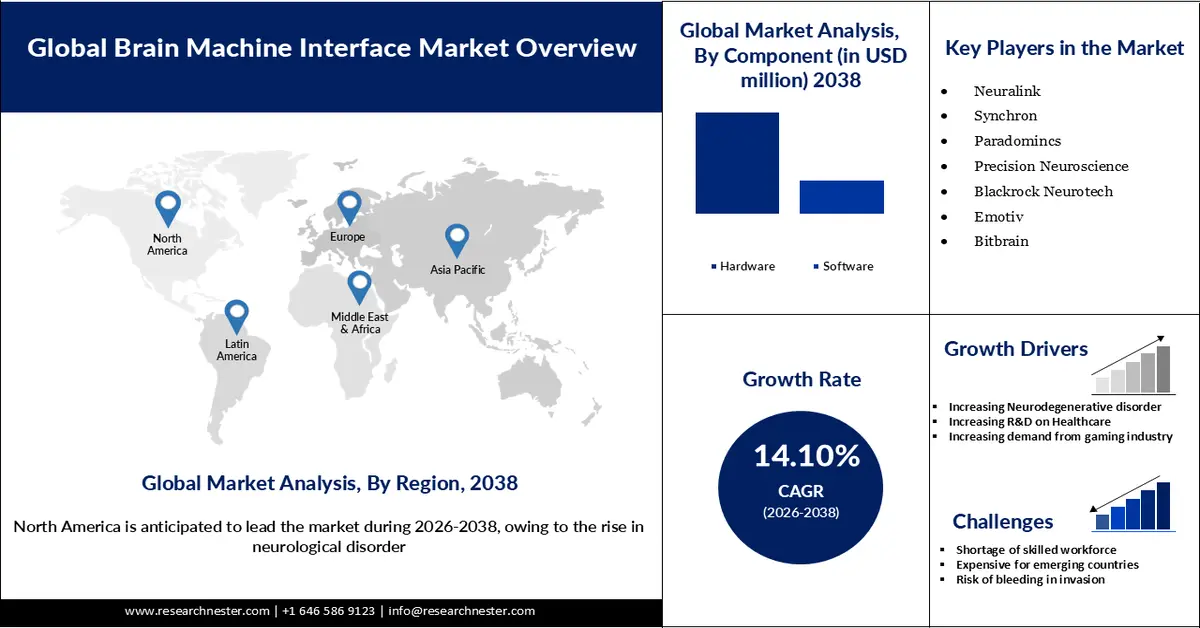
Brain Machine Interface Market size was valued at USD 2.13 billion in 2025 and is projected to reach USD 11.23 billion by the end of 2038, rising at a CAGR of 14.10% during the forecast period (2026-2038). In 2026, the industry size of brain machine interface is estimated at USD 8.83 billion.
One of the primary growth drivers for the global Brain‑Machine Interface (BMI) / Brain‑Computer Interface (BCI) market is the rising prevalence of neurological disorders and increasing demand for neurorehabilitation and assistive technologies. As neurodegenerative diseases (such as Alzheimer’s, Parkinson’s, ALS) and conditions from stroke or paralysis affect a growing portion of the population, especially with ageing demographics worldwide, there is a mounting need for technological solutions that restore motor function, communication, and quality of life. According to a global analysis published in 2024, more than 3 billion people worldwide, roughly 43% of the global population, were estimated to be living with a neurological condition. Advances in neuroscience, signal-processing, artificial intelligence, and neural decoding technologies, combined with better non-invasive interfaces, are making BMIs more effective, reliable, and accessible, thus broadening the potential user base. Moreover, rising global healthcare expenditure and increasing funding into neurotech R&D have allowed hospitals, research institutes, and private firms to invest in BMI/BCI development and deployment.
Key Brain Machine Interface Market Insights Summary:
Regional Insights:
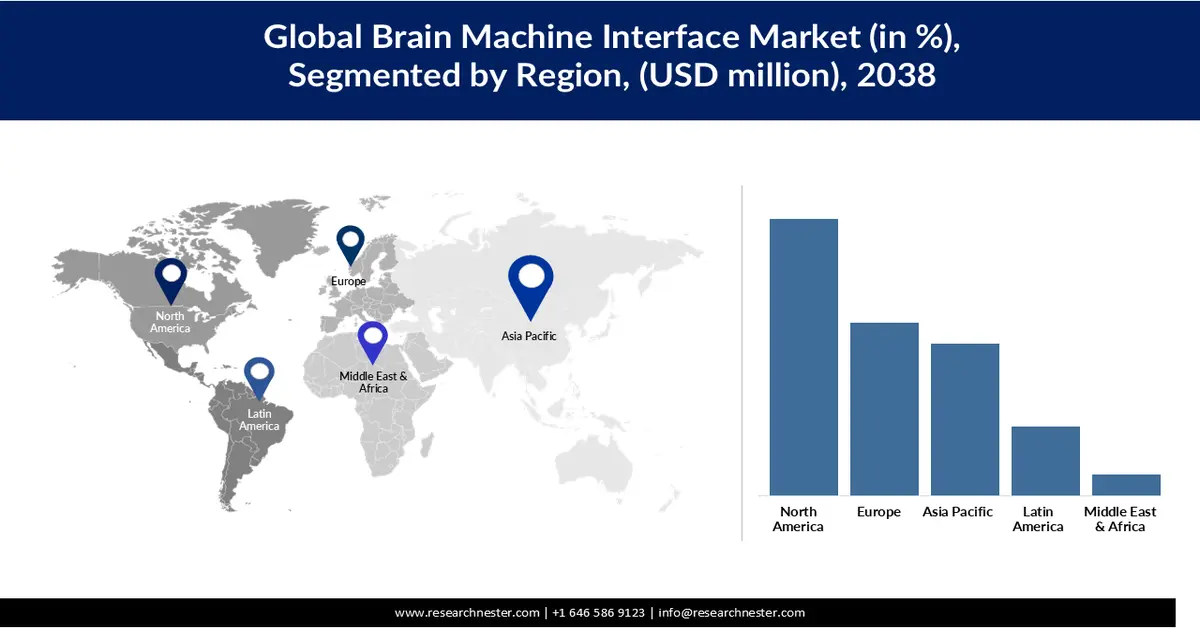
- North America is anticipated to secure nearly a 40% share of the brain machine interface market by 2038, underpinned by advanced healthcare infrastructure and strong AI and machine-learning capabilities.
- Europe is projected to capture 25% of the market by 2038, propelled by rising healthcare and rehabilitation demand among neuro patients.
Segment Insights:
- The hardware segment is expected to account for a 72% share by 2038 in the brain machine interface market, bolstered by escalating demand for sensors and gears within the industry.
- The non-invasive segment is projected to grow at a CAGR of 13.78% between 2026 and 2038, supported by increasing adoption of robotic arms, exoskeletons, and assistive movement devices that avoid surgical implantation of sensors.
Key Growth Trends:
- Rising geriatric population
- Increasing R&D on healthcare engineering
Major Challenges:
- Shortage of skilled workforce
- Expensive for emerging countries
Key Players: Neuralink (U.S.), Synchron (U.S.), Paradomincs (U.S.), Precision Neuroscience (U.S.), Blackrock Neurotech (U.S.), Emotiv (U.S.), Bitbrain (Spain).
Global Brain Machine Interface Market Forecast and Regional Outlook:
Market Size & Growth Projections:
- 2025 Market Size: USD 2.13 billion
- 2026 Market Size: USD 8.83 billion
- Projected Market Size: USD 11.23 billion by 2038
- Growth Forecasts: 14.10% CAGR (2026-2038)
Key Regional Dynamics:
- Largest Region: North America (40% share by 2038)
- Fastest Growing Region: Asia Pacific
- Dominating Countries: United States, Brazil, China, Norway, United Kingdom
- Emerging Countries: China, India, Singapore, South Korea, Japan
Last updated on : 4 December, 2025
Brain Machine Interface Market - Growth Drivers and Challenges
Growth Drivers
- Rising geriatric population: The rising global population of older adults is becoming a major growth engine for the brain-machine interface (BMI) market. As of 2019, there were about 703 million people aged 65 or older worldwide, and that number is projected to more than double, reaching roughly 1.5 billion by 2050. Because aging is associated with a higher incidence of neurological disorders, neurodegeneration, mobility impairments, stroke, dementia, and other chronic conditions, the demand for assistive, therapeutic, and restorative technologies rises. Older individuals increasingly need solutions for motor-control loss, paralysis, communication impairments, and quality-of-life maintenance, all areas where BMIs and related neuro-prosthetic tools can help.
As the share of the elderly grows, health-system pressure increases, creating both social need and financial incentive for investments in neurotechnology and rehabilitation. According to the World Health Organization (WHO), between 2015 and 2050, the global share of people aged 60 and older is projected to rise from 12% to 22%. Additionally, in developed and many middle-income countries, improved life expectancy and lower birth rates accelerate the pace of population aging, which increases the pool of potential beneficiaries of BMI technologies, expanding the market’s addressable population.Thus, as more people enter older age and the proportion of the elderly in the population increases, the demand for BMIs (for rehabilitation, assistive devices, neuro-prosthetics, or long-term care) is likely to grow significantly. This demographic shift makes aging population dynamics one of the primary macro-trends driving global interest, investment, and growth in the brain machine interface market. - Increasing R&D on healthcare engineering: Advanced healthcare ensures consistent patient-centric care. Governments and healthcare agencies have ramped up research and development in healthcare engineering, where the focus is primarily on improving patients suffering from serious complications and neurological disorders. The development and innovation of these agencies have boosted the market expansion as new generation machines, such as BMI, are aiding people to live a stable life. Many manufacturers are leveraging the government-based funding to develop their R&D to obtain enhanced patient-centric care.
Challenges
- Shortage of skilled workforce: The brain interface development requires knowledge of engineering and healthcare. The cross-domain knowledge enables the developers to understand requirements and develop patient-centric systems. Globally, such skills are in shortage leading to slowed growth of the market. BMI devices require precision setup as they contain essential sensors and wiring that need to be adjusted properly. Identifying such a skilled technician for the installation of the brain machine interface can be challenging, which may prevent market growth.
- Expensive for emerging countries: The brain machine interface can be quite costly, especially for emerging countries where technological advancements are less. Moreover, the brain machine interface often needs frequent maintenance to ensure a smooth operation. The sensors and signal amplifiers are often expensive to repair, and damage to them can drain the patient financially, slowing down the adoption in developing countries. The implementation of BMI includes costs associated with clinical trials that require research on neuroscience, AI model development, and regulatory compliance, which further prohibit the adoption of the brain-machine interface.
Brain Machine Interface Market Size and Forecast:
| Report Attribute | Details |
|---|---|
|
Base Year |
2025 |
|
Forecast Year |
2026-2038 |
|
CAGR |
14.10% |
|
Base Year Market Size (2025) |
USD 2.13 billion |
|
Forecast Year Market Size (2038) |
USD 11.23 billion |
|
Regional Scope |
|
Brain Machine Interface Market Segmentation:
Components Segment Analysis
The hardware segment will dominate the market with a 72% market share by 2038 because of the rising demand for sensors and gears within the industry. The components of BMI are mostly hardware, such as sensors and signal amplifiers, which are crucial for the development of a brain-machine interface. Brain machine interface is rising in certain healthcare divisions to ensure better patient monitoring and operation. The emerging companies employ a less complex BMI system and focus more on the usage of hardware to ease patients' usability. The software segment is also projected to grow in the future, driven by innovative digitized sensors that will eliminate the need for a physical sensor.
Technology Segment Analysis
The non-invasive segment is expected to expand at a CAGR of 13.78% between 2026 and 2038, supported by growing adoption of robotic arms, exoskeletons, and assistive movement devices that avoid surgical implantation of sensors, an advantage particularly valuable for patients with paralysis or neurological impairments. In contrast, the invasive segment is projected to grow at a CAGR of 14.19% by 2038, driven by its ability to capture high-fidelity neural signals with superior precision. Advancements in implantable electrode arrays have significantly enhanced signal quality, enabling complex capabilities such as vision restoration, where external cameras interface directly with the brain to generate visual perception. Together, these factors position invasive BMIs as the leading technology for advanced, high-performance neural restoration applications.
End User Segment Analysis
The healthcare segment is expected to secure a significant share of the brain-machine interface (BMI) market due to the escalating burden of neurological disorders and the continuous push for advanced, patient-centric care. Ongoing innovations in BMI technologies are enabling more precise therapeutic interventions and improving the quality of life for individuals with conditions such as dementia, paralysis, and motor-function impairments. These systems allow robotic-assisted limb movement, ensuring controlled, accurate mobility for patients who otherwise lack neuromuscular control. As healthcare providers adopt BMIs to address a broader range of neurological needs, the demand for such technologies continues to rise, ultimately accelerating the expansion of the healthcare segment within the global brain machine interface market.
Our in-depth analysis of the global brain machine interface market includes the following segments:
|
Components |
|
|
Technology |
|
|
End-User |
|

Vishnu Nair
Head - Global Business DevelopmentCustomize this report to your requirements — connect with our consultant for personalized insights and options.
Brain Machine Interface Market - Regional Analysis
North America Market Insights
North America is projected to command nearly 40% of the global brain–machine interface (BMI) market by 2038, supported by advanced healthcare infrastructure and strong capabilities in AI and machine learning, both of which are central to BMI development and deployment. The region’s rapidly evolving gaming sector, known for early adoption of novel human–machine interaction technologies, is further accelerating demand. Together, these factors create a strong ecosystem for both clinical and non-clinical BMI applications.
Canada continues to strengthen its position through a healthcare model focused on affordability and high-quality patient outcomes. Its commitment to medical innovation, especially in neurotechnology and digital health, is enabling the rapid expansion of both invasive and non-invasive BMI research. As a result, Canada is increasingly viewed as an emerging hub for next-generation BMI development.
The U.S. market is witnessing a sharp increase in BMI adoption as government agencies, research institutions, and private companies scale investments in neural engineering and assistive technologies. Rising incidences of neurological conditions such as stroke, paralysis, and neurodegenerative disorders have amplified the urgency for effective rehabilitation solutions. This, combined with world-leading R&D capacity, is expected to substantially boost BMI deployment across clinical, military, and commercial domains.
Europe Market Insights
The brain machine interface market of Europe is projected to hold 25% of the market share, fueled by strong demand in healthcare and rehabilitation of neuro patients. Europe is prevalent in ageing patients, which is leading to neurological issues such as stroke and dementia. Adoption of BMI can successfully assist such patients and ensure enhanced support for them as BMIs are operated through robots that can assess the patient's needs and offer them the required motion and activity. Europe is also enhancing the research and development in the field of machine learning and brain-machine interface, which may further support market expansion.
The UK’s strong R&D is backed by investment, which allows independent as well as agencies to establish newer technology to implement and innovate the brain-machine interface. The rapid investment in clinical trials and in the development of AI models is fueling the growth of the market. The UK has introduced an ultrasound-based BMI that will assess the patient's signal activity as well as neural pathways that will enable better control of the mind.
Germany has a strong market for non-invasive BMI, which is driven by accurate results and precision actions. Germany is investing massively in neurotechnology, which comprises brain brain-machine interface that acts as a support to patients' mobility and actions. Germany considers non-invasive technology as it contains less risk of bleeding and internal damage, allowing patients to stay worry-free during the usage.
Asia Pacific Market Insights
APAC is projected to hold a market share of 22% by 2038, driven by the healthcare sector and rising health concerns and lifestyle changes. People in the region are suffering from chronic neurological disorders such as Parkinson's and Dementia, which are challenging their day-to-day activities. The market growth is supported by the expansion in R&D, especially in neuroscience, which is further driving the market towards growth. The gaming industry of the region is also quite strong, which uses a non-invasive brain machine interface by which the gaming experience can be richer and smoother. Asia Pacific has well-established manufacturers for brain machine interface that aim to develop cost-efficient BMIs.
The prevalence of stroke and other neurological disorders is quite high in India, which makes the brain-machine interface market quite suitable for India. As the neurological cases rise in India, government-led funding towards improved R&D is supporting the growth of the market. Digital health advancement is also booming in India, where patients are being monitored and operated on through robots that aim to serve patients accurately and precisely.
China’s brain machine interface market is valued at USD 88.24 million, which is driven by the high adoption in neurorehabilitation. It is developing invasive brain machine interfaces that can allow patients to respond more efficiently, as invasive BCIs can read and interpret the signals better than non-invasive BCIs. China holds one of the biggest gaming industries, which is fueled by innovation and newer technologies. The brain machine interface employs robotic arms and limbs that can be used to enhance the gaming experience.
Key Brain Machine Interface Market Players:
- Neuralink (U.S.)
- Company Overview
- Business Strategy
- Key Product Offerings
- Financial Performance
- Key Performance Indicators
- Risk Analysis
- Recent Development
- Regional Presence
- SWOT Analysis
- Synchron (U.S.)
- Paradomincs (U.S.)
- Precision Neuroscience (U.S.)
- Blackrock Neurotech (U.S.)
- Emotiv (U.S.)
- Bitbrain (Spain)
- Neuralink develops implantable brain cells that are capable of treating neurological disorders such as paralysis. Recent reports suggest that clinical and human trials have begun, and it may soon be available for patients.
- Synchron aims to restore autonomy among people suffering from chronic neurological issues. The technology adopted uses an electrode array through blood vessels, which receives signals and then processes them into commands for the computer.
- Paradomincs is based in Texas, which has developed a system that can transfer neural data from the skin through a wireless link. The product is specifically designed for patients who have severe motor impairment and are unable to communicate normally.
- Precision Neuroscience primarily aims to build a minimally invasive brain interface that is capable of collecting a large amount of neural data and processing it for actions and communications. Their flagship product, Layer 7 Cortical Interface, sticks to the brain rather than penetrating deeply.
- Blackrock Neurotech is known for its implantable brain computer interface is semi-invasive. Their technology and research have been used in many labs, which have powered the adoption of invasive brain implants. Their state-of-the-art creation, MoveAgain, has made it to clinical trials and soon will be rolled out for human trials.
Here are a few areas of focus covered in the competitive landscape of the market:
The players operating in the global brain machine interface market are expected to face intense competition during the forecast timeline. The market is associated with both established key players and new entrants. However, the market is moderately fragmented. New entrants impose immense competition for the existing players, prohibiting them from acquiring the majority of the revenue share. Specialised manufacturers maintain a competitive landscape in the market. Key players in the market are significantly supported by the governments for research and innovation.
Corporate Landscape of the Global Brain Machine Interface Market Key Players
Recent Developments
- In March 2025, Synchron partnered with Nvidia for neural signal processing, which will improve the accuracy and predictability of the neural decoding. The company is also expanding into its cognitive AI to train and decode neural data better.
- In May 2025, Neuralink’s patented speech restoration device was approved by the US FDA, which will help people suffering from speech problems to communicate more effectively.
- Report ID: 8274
- Published Date: Dec 04, 2025
- Report Format: PDF, PPT
- Explore a preview of key market trends and insights
- Review sample data tables and segment breakdowns
- Experience the quality of our visual data representations
- Evaluate our report structure and research methodology
- Get a glimpse of competitive landscape analysis
- Understand how regional forecasts are presented
- Assess the depth of company profiling and benchmarking
- Preview how actionable insights can support your strategy
Explore real data and analysis
Frequently Asked Questions (FAQ)
About this Report
Connect with our Expert


Report, 2026-2038



Copyright @ 2026 Research Nester. All Rights Reserved.
