Pharmaceutical Packaging Machinery Market Outlook:
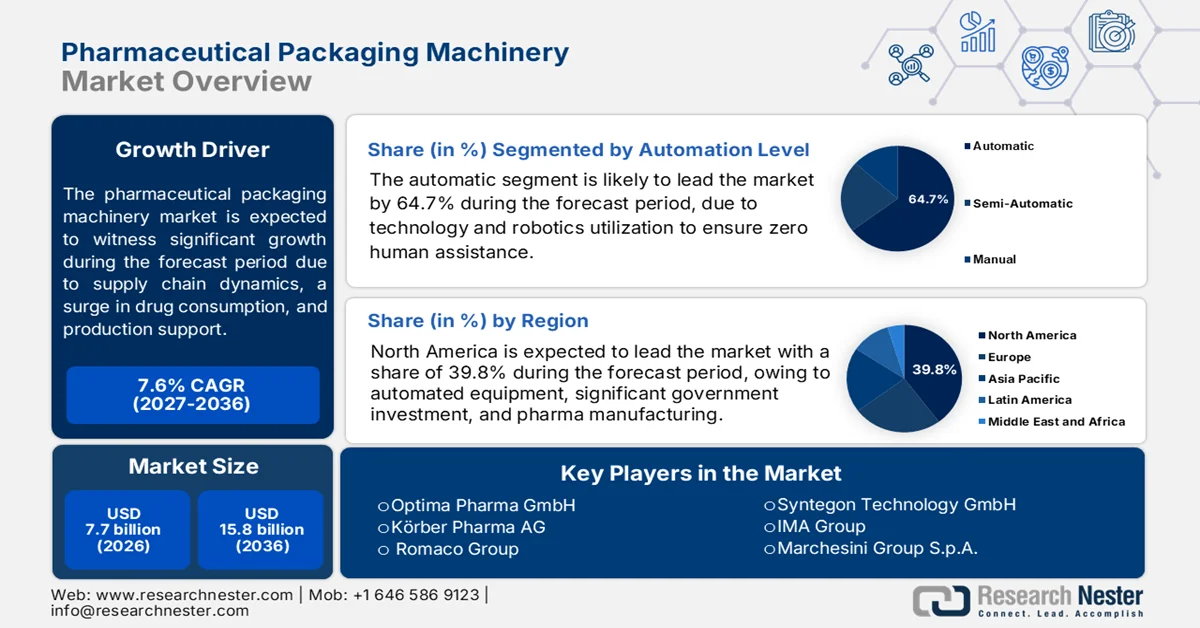
Pharmaceutical Packaging Machinery Market size was valued at USD 7.7 billion in 2026 and is projected to reach USD 15.8 billion by the end of 2036, registering around 7.6% CAGR during the forecast period i.e., between 2027-2036. In 2027, the industry size of pharmaceutical packaging machinery is estimated at USD 8.2 billion.
The worldwide pharmaceutical packaging machinery market is presently witnessing a fundamental transformation by evolving from a production support into a tactical pillar for drug quality, regulatory compliance, and supply chain resilience. According to official statistics published by the World Health Organization in January 2026, the 2025 WHO Model List comprises more than 520 medicines, including 374 for the young population. Besides, the Global Health Observatory noted that the proportion of health infrastructures with a standard set of crucial medicines and available and cost-effective on a sustainable basis across low- and middle-income nations ranges between 8% and 41%. Therefore, due to such demand for medicines, there is a huge growth and expansion opportunity for the market, especially in terms of packaging pharmaceutical products.
Country-Wise Import-Based Medicaments Shipment, 2024
|
Country Name |
Trade Value (USD 1,000) |
Quantity (Kilograms) |
|
European Union |
131,713,072.3 |
904,636,000 |
|
Germany |
55,663,233.2 |
646,349,000 |
|
Switzerland |
44,181,622.8 |
76,602,900 |
|
U.S. |
28,216,086.8 |
98,969,700 |
|
Italy |
26,316,204.9 |
278,547,000 |
|
Ireland |
24,047,865.8 |
107,869,000 |
|
Slovenia |
24,043,524.7 |
34,466,000 |
Source: WITS
Furthermore, e-commerce growth in pharmaceuticals, followed by sustainability-based equipment retrofits, reshoring pharmaceutical supply chains, and a transition from bottles to blister packaging are certain trends that are responsible for bolstering the pharmaceutical packaging machinery market. As stated in an article published by OECD in November 2025, governments across 35 nations collectively offered USD 73 billion for health-based research and development. For instance, the U.S. effectively accounted for almost 2/3rd of the overall budget, amounting to USD 49.5 billion, which is followed by USD 3.7 billion in the UK and USD 3.3 billion in Japan. In addition, government-based budgets further increased by roughly 13% in real terms, thereby making it suitable for positively impacting the market’s growth and exposure.
Key Pharmaceutical Packaging Machinery Market Insights Summary:
Regional Highlights:
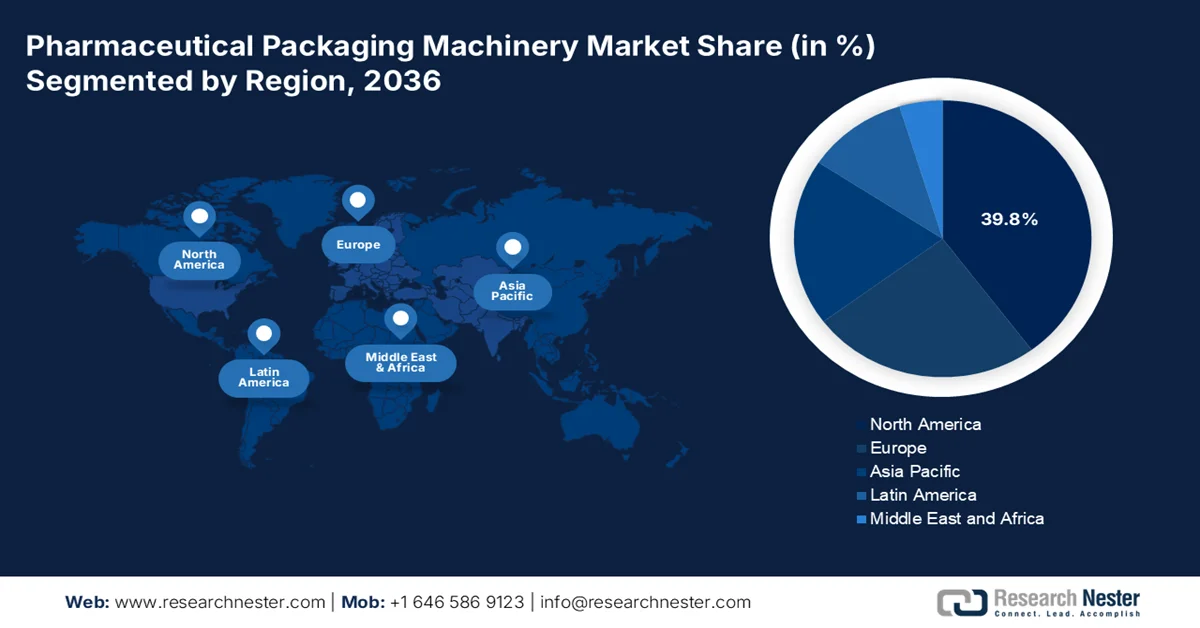
- North America pharmaceutical packaging machinery market is projected to secure a 39.8% share by 2036, supported by the adoption of sterilized and automated packaging equipment, a robust pharmaceutical manufacturing base, and substantial government investments in pharmaceutical and chemical facilities
- Asia Pacific is poised to be the fastest-growing region during 2027-2036, driven by expanding pharmaceutical manufacturing, rising generic drug production, and increasingly stringent regulatory compliance requirements
Segment Insights:
- The automatic segment is projected to command a 64.7% share of the pharmaceutical packaging machinery market by 2036, propelled by the increasing utilization of robotics and technology for sorting, filling, and sealing products without human assistance
- The primary packaging equipment segment is expected to account for a 54.5% share by 2036, owing to its critical role in safeguarding drug purity, potency, and stability through precise dosing, container closure integrity, and contamination-free packaging
Key Growth Trends:
- Rise in generic drug production
- Consolidated contract manufacturing organizations
Major Challenges:
- Integration with legacy systems
- Supply chain disruptions and raw material volatility
Key Players: Syntegon Technology GmbH, IMA Group, Marchesini Group S.p.A., Uhlmann Pac-Systeme GmbH & Co. KG, Optima Pharma GmbH, Körber Pharma AG, Romaco Group, Harro Höfliger Verpackungsmaschinen GmbH, Bausch + Ströbel Maschinenfabrik Ilshofen GmbH + Co. KG, MG2 S.r.l.
Global Pharmaceutical Packaging Machinery Market Forecast and Regional Outlook:
Market Size & Growth Projections:
- 2026 Market Size: USD 7.7 billion
- 2027 Market Size: USD 8.2 billion
- Projected Market Size: USD 15.8 billion by 2036
- Growth Forecasts: 7.6% CAGR (2027-2036)
Key Regional Dynamics:
- Largest Region: North America (39.8% share by 2036)
- Fastest Growing Region: Asia Pacific
- Dominating Countries: United States, Germany, Japan, China, United Kingdom
- Emerging Countries: India, South Korea, Brazil, Mexico, Singapore
Last updated on : 1 September, 2026
Pharmaceutical Packaging Machinery Market - Growth Drivers and Challenges
Growth Drivers
- Rise in generic drug production: The upsurge in the demand for generic medicines, especially from China and India, is considered a primary growth driver for the pharmaceutical packaging machinery market. According to a data report published by the PIB Government in March 2026, India is regarded as the largest supplier of generic medicines, significantly accounting for nearly 20% of worldwide supply, and readily manufacturing almost 60,000 generic brands across 60 therapeutic segments. Besides, the country also comprises more than 3,000 organizations and 10,500 manufacturing facilities that tend to support the production. Based on these aspects, the yearly turnover of the pharma industry eventually reached approximately USD 49.3 billion (Rs. 4.7 lakh crore) as of 2025, thus bolstering the market’s upliftment.
- Consolidated contract manufacturing organizations: The ongoing consolidation within the contract manufacturing organization (CMO) landscape is fundamentally reshaping demand dynamics for the pharmaceutical packaging machinery market. As larger CMOs acquire smaller, specialized players, they inherit disparate, often outdated equipment fleets that lack the standardization required for efficient, high-volume production. This drives substantial investment in new, integrated packaging lines capable of handling diverse client portfolios with minimal changeover times. Simultaneously, the broader trend of pharmaceutical companies outsourcing drug production to focus on core R&D and commercialization is intensifying.
Challenges
- Integration with legacy systems: The modern packaging machinery often features advanced automation, IoT connectivity, and AI-driven quality controls, yet many production facilities still rely on outdated legacy infrastructure. Simultaneously, seamless integration between new high-speed equipment and older line systems poses significant technical hurdles, including incompatible communication protocols, data synchronization issues, and physical space constraints. Besides, retrofitting existing plants demands extensive customization, lengthy downtime, and specialized engineering expertise. Moreover, without proper integration, manufacturers cannot fully leverage real-time monitoring or predictive maintenance capabilities. This fragmentation reduces overall line efficiency and undermines the potential benefits of the pharmaceutical packaging machinery market.
- Supply chain disruptions and raw material volatility: The production of pharmaceutical packaging machinery relies on a global network of specialized components, including precision sensors, stainless steel, servo motors, and control systems. Besides, geopolitical tensions, trade restrictions, and transportation bottlenecks frequently disrupt this fragile supply chain. Likewise, shortages of critical parts lead to extended lead times and delayed project deliveries, frustrating end-user expectations. Meanwhile, raw material price fluctuations further squeeze margins, making cost forecasting extremely challenging, and manufacturers are often forced to maintain large safety inventories, tying up working capital, thus limiting the market growth.
Pharmaceutical Packaging Machinery Market Size and Forecast:
| Report Attribute | Details |
|---|---|
|
Base Year |
2026 |
|
Forecast Year |
2027-2036 |
|
CAGR |
7.6% |
|
Base Year Market Size (2026) |
USD 7.7 billion |
|
Forecast Year Market Size (2036) |
USD 15.8 billion |
|
Regional Scope |
|
Pharmaceutical Packaging Machinery Market Segmentation:
Automation Level Segment Analysis
Based on the automation level, the automatic segment is projected to grab the highest share of 64.7% in the pharmaceutical packaging machinery market by the end of 2036. The segment’s upliftment is highly driven by the utilization of robotics and technology to sort, fill, and seal products with the absence of human assistance. According to an article published by MDPI in November 2025, the growth and development of the plastic-based pharmaceutical packaging sector has been effectively profound, and is eventually predicted to be worth USD 107.6 billion by the end of 2034. Besides, the pharmaceutical industry is anticipated to generate 300 million tons of plastic waste every year, based on which the industry is witnessing increased pressure to adopt sustainable practices. Therefore, based on the growth and a focus on sustainability, the segment is continuously expanding.
Machinery Type Segment Analysis
During the forecast period, the primary packaging equipment segment under the machinery type is expected to account for the second-highest share of 54.5% in the market. The segment’s growth is effectively fueled by its role as the backbone of pharmaceutical production, as it directly contacts the drug product and safeguards its purity, potency, and stability throughout its lifecycle. This machinery category includes vial fillers, blister forming and sealing machines, liquid fillers, tube fillers, and capsule fillers, each tailored to specific dosage forms. These systems must operate with exceptional precision to ensure accurate dosing, container closure integrity, and contamination-free environments. Meanwhile, aseptic processing capabilities, cleanroom compatibility, and advanced validation protocols are non-negotiable requirements.
Application Segment Analysis
Based on the application segment, the parenterals sub-segment is predicted to garner the third-highest share of 29.8% in the market by the end of the stipulated timeline. The sub-segment’s development is primarily attributed to its emergence as one of the most demanding and critically regulated areas within pharmaceutical packaging. Besides, packaging machinery for injectable products must uphold absolute sterility, precision, and integrity, as any compromise directly impacts patient safety. Moreover, vial filling, syringe filling, and ampoule sealing require advanced aseptic processing environments, often integrated with isolator technologies and real-time monitoring systems. The complexity of biologics, vaccines, and monoclonal antibodies further elevates packaging requirements, necessitating gentle handling to preserve product efficacy.
Our in-depth analysis of the pharmaceutical packaging machinery includes the following segments:
|
Segment |
Subsegments |
|
Automation Level |
|
|
Machinery Type |
|
|
Application |
|
|
Packaging Format |
|
|
End user |
|

Vishnu Nair
Head - Global Business DevelopmentCustomize this report to your requirements — connect with our consultant for personalized insights and options.
Pharmaceutical Packaging Machinery Market - Regional Analysis
North America Market Insights
North America pharmaceutical packaging machinery market is anticipated to register the largest share of 39.8% by the end of 2036. The market’s upliftment is primarily fueled by the adoption of sterilized and automated packaging equipment, the presence of a strong pharmaceutical manufacturing base, and generous government investments in pharmaceutical and chemical facilities. According to an article published by the CSIS Organization in September 2025, the biopharmaceutical industry is regarded as a critical pillar, especially in the U.S., significantly accounting for roughly 3.4% of the gross domestic product (GDP) as of 2022. Besides, the Budget Laboratory at Yale University predicted a 25% ad-based tariff, which increased medication expenses by an average of nearly USD 600 every year per household in the country, thus positively impacting the market’s upliftment in the region.
The pharmaceutical packaging machinery market in the U.S. is growing significantly, owing to comprehensive sterilization, an increase in the pharmaceutical supply chain, and track-and-trace abilities. As stated in an article published by Brookings in March 2026, the pharmaceutical supply chain in the overall region is intertwined with worldwide production networks, particularly in Asia. Based on this, 70% to 80% of active pharmaceutical ingredients utilized in domestic medicines originated from India and China, eventually serving as dominant suppliers. Besides, prescription drugs in the country were priced over 250%, in comparison to 32 other nations. Additionally, this readily contributed to cross-border purchasing with regional import of low-cost medications from Mexico and Canada, thus enhancing the market’s demand.
The wide-ranging regulatory update, distinct sustainability agenda, suitable guidance on co-packaged drug products, and the government’s robust commitment to adopting packaging solutions are certain factors that are bolstering the market in Canada. As per an article published by the Government of Canada in October 2025, Environment and Climate Change Canada has continuously supported 55 projects with more than USD 10 million through significant funding for the Zero Plastic Waste Initiative and Advancing a Circular Plastics Economy for Canada. Additionally, this particular funding, which is leveraged by USD 7 million in private and public funds, tends to support awareness and education, along with evaluation of practices and technologies, circular solutions, actions to overcome plastic pollution and waste, as well as community clean-ups, all of which are positively impacting the market growth in the country.
Reuse or Refill Stream Funding in Canada for Packaging, 2025
|
Company Name |
Location |
Funding Amount (USD) |
Project Purpose |
|
Saskatchewan Waste Reduction Council |
Saskatoon, Saskatchewan |
75,000 |
Assess the feasibility of adopting reusable packaging for food product types. |
|
Town of Banff |
Banff, Alberta |
186,680 |
Reduction of single-use items by establishing new opportunities and enhancing present ones. |
|
Reposit |
Ottawa, Ontario |
250,000 |
Unveil cleaning products and personal care in reusable packaging. |
|
University of Toronto Trash Team |
Winnipeg, Manitoba |
158,400 |
Implementing a reusable take-out food packaging system. |
Source: Government of Canada
APAC Market Insights
The Asia Pacific market is expected to emerge as the fastest-growing region during the forecast period. The market’s development in the region is highly propelled by an expansion in pharmaceutical manufacturing, a rise in generic drug production, and an increase in regulatory compliance requirements. According to an article published by NLM in September 2023, more than 95% of China’s 170,000 drugs are considered generic, and there is a separate comprehensive class of generic drugs, which are known as me-too drugs. In this regard, policy-makers in the country are aiming to ensure equitable accessibility to cost-effective, efficient, safe, and sustainable drug supplies. Therefore, based on these drug availability and government concerns, there is a huge growth opportunity for the market in the overall region.
The pharmaceutical packaging machinery market in China is gaining increased traction, owing to massive national drug consumption, suitable industrial policies for promoting pharmaceutical production, packaging equipment, and the government’s focus on quality standards. As stated in an article published by the HHR Organization in June 2022, the government ensured public security authority for drug utilization in the country into a system known as the Dynamic Control System (DCS). In addition, since the launch of this particular system, 785,900 individuals have been a part. Moreover, the Ministry of Public Security noted that there were 4.7 million people registered in the DCS, which further included 2.2 million drug users, while 2.5 million were former drug users. Therefore, based on these drug users, there is a huge demand for pharmaceutical packaging, due to which the market is expanding in the nation.
The aspects of rapid regulatory modernization, growth in pharmaceuticals, an increase in drug exports, and expansion in vaccine and biologics production capacity are a few factors that are positively enhancing the pharmaceutical packaging machinery market in India. Based on an article published by the PIB Government in March 2026, during the pandemic, the country successfully supplied more than 2 billion vaccine doses, which included licensed and indigenously developed vaccines. Besides, there has been a rise in complete immunization coverage from 62% to 98.4% as of January 2026. Likewise, the national percentage of zero-dose children to the overall population has reduced from 0.1% as of 2023 to 0.06% in 2024, thereby demonstrating an optimistic outlook for the market’s development.
Europe Market Insights
Europe market is expected to grab a considerable share by the end of the stipulated timeline. The market’s growth in the region is effectively fueled by strict regulatory frameworks, sustainability demands, a boom in biologics, and a transition to sustainable packaging materials. According to an article published by NLM in May 2022, the biosimilar competition in the region readily yielded an overall saving of USD 2.6 billion (EUR 2.3 billion), with an estimated half of the savings eventually originating from reduced price lists and the other half from hospital tender discounts. In addition, savings for biosimilars amounted to less than 4% of total regional pharmaceutical spending, thereby demonstrating a huge growth opportunity for the market in the region.
The market in Germany is gaining increased exposure, owing to the presence of a machinery manufacturing base, industry giants, the maintenance of technological superiority through generous research and development, and digital twin solutions. Based on an article published by ITA in August 2025, advanced manufacturing in the country is continuously expanding, with a rise in exports from USD 955 billion as of 2022 to more than USD 1 trillion in 2023, and further USD 991 billion in 2024. Meanwhile, the 2024 U.S. Advanced Manufacturing exports to the nation readily amounted to USD 37 billion, while the valuation of U.S. exports was estimated to be valued at USD 43 billion. Therefore, based on the expansion and export facilities, the market is continuously enhancing in the overall country.
Advanced Manufacturing Industry Growth in Germany, 2022-2024
|
Components |
2022 (USD Million) |
2023 (USD Million) |
2024 (USD Million) |
|
Total Exports |
955,316 |
1,026,836 |
991,050 |
|
Total Imports |
753,557 |
764,300 |
721,621 |
|
Imports from the U.S. |
35,978 |
38,998 |
36,753 |
|
Trade Deficit/Surplus |
201,759 |
262,536 |
269,429 |
|
EUR-USD Exchange Rate |
1.05 |
1.08 |
1.082 |
Source: ITA
The concentration of packaging machinery manufacturers, tactical private equity investments, long-lasting engineering traditions, and suitable government policies are a few trends that are responsible for fueling the market in Italy. As per an article published by the European House Ambrosetti in September 2023, the country constitutes the largest foreign capital with USD 20 billion, in comparison to France’s USD 36 billion and Spain’s USD 35 billion. Based on this capital, a marked optimization is crucial for consolidating economic recovery in both the medium and long-term. This is extremely suitable for attracting international investments, particularly in strategic sectors with increased research and development intensity, skilled employment, multiple economic activities, and an improved pharmaceutical industry, thus making it suitable for driving market development.
Key Pharmaceutical Packaging Machinery Market Players:
- Syntegon Technology GmbH (Germany)
- Company Overview
- Business Strategy
- Key Product Offerings
- Financial Performance
- Key Performance Indicators
- Risk Analysis
- Recent Development
- Regional Presence
- IMA Group (Italy)
- Marchesini Group S.p.A. (Italy)
- Uhlmann Pac-Systeme GmbH & Co. KG (Germany)
- Optima Pharma GmbH (Germany)
- Körber Pharma AG (Germany)
- Romaco Group (Germany/Italy)
- Harro Höfliger Verpackungsmaschinen GmbH (Germany)
- Bausch + Ströbel Maschinenfabrik Ilshofen GmbH + Co. KG (Germany)
- MG2 S.r.l. (Italy)
- Syntegon Technology GmbH is a global leader in processing and packaging systems, offering comprehensive solutions for both sterile liquid and solid dosage forms. The company differentiates itself through its strong focus on digitalization, service networks, and sustainable packaging innovations.
- IMA Group is one of the world's largest manufacturers of automatic packaging machines, with a diversified portfolio covering primary and secondary packaging for pharmaceuticals. The company's strength lies in its ability to provide integrated, high-speed lines across multiple dosage forms, including liquids, solids, and parenterals.
- Marchesini Group S.p.A. specializes in complete, turnkey packaging lines for pharmaceutical products, ranging from blister machines to cartoners and end-of-line systems. The company is recognized for its strong after-sales support, modular designs, and expertise in serialization and track-and-trace integration.
- Uhlmann Pac-Systeme GmbH & Co. KG is a premier manufacturer of blister packaging and cartoning systems, with a reputation for precision engineering and high-performance equipment. The company focuses on offering integrated solutions that combine primary packaging, serialization, and case packing for solid dosage forms.
- Optima Pharma GmbH specializes in sterile filling and packaging machinery for liquid pharmaceuticals, particularly for vials, syringes, and cartridges. The company distinguishes itself through its expertise in aseptic processing, isolator technology, and customized solutions for sensitive biologics and vaccines.
Here is a list of key players operating in the global market:
The global pharmaceutical packaging machinery market is characterized by a moderately consolidated competitive landscape, with a handful of Europe-headquartered leaders commanding significant market share through comprehensive product portfolios and extensive global service networks. Meanwhile, Europe-based manufacturers, particularly from Germany and Italy, dominate the premium segment with integrated, high-speed packaging lines for solid dosage and sterile applications. Besides, in June 2023, Corning Incorporated and SGD Pharma proclaimed a joint venture, with the establishment of the newest glass tubing facility and expanded pharmaceutical manufacturing in India. This permitted SGD Pharma to implement Corning’s Velocity® Vial technology platform, thus boosting the pharmaceutical packaging machinery industry’s growth.
Corporate Landscape of the Market:
Recent Developments
- In December 2025, Marchesini Group and AST entered a tactical partnership, which combined the global reach, technologies, and expertise for strengthening their position in sterile fill-finish production by delivering innovative, integrated, and wide-ranging solutions.
- In October 2025, LOG Pharma Primary Packaging joined forces with Dow Inc. and represented its advanced barrier-based ecoline packaging solutions, with the combination of cost-efficiencies, performance, and sustainability.
- In July 2025, Antares Vision Group and Oròbix launched AI-GO, which is a standard artificial intelligence that readily caters to revolutionizing visual inspection controls in both the manufacturing and pharmaceutical industries.
- Report ID: 8748
- Published Date: Sep 01, 2026
- Report Format: PDF, PPT
- Explore a preview of key market trends and insights
- Review sample data tables and segment breakdowns
- Experience the quality of our visual data representations
- Evaluate our report structure and research methodology
- Get a glimpse of competitive landscape analysis
- Understand how regional forecasts are presented
- Assess the depth of company profiling and benchmarking
- Preview how actionable insights can support your strategy
Explore real data and analysis
Frequently Asked Questions (FAQ)
About this Report
Connect with our Expert


Report, 2027-2036



Copyright @ 2026 Research Nester. All Rights Reserved.
