Bioprocess Validation Market Outlook:
Bioprocess Validation Market size was valued at USD 538.1 million in 2025 and is expected to exceed USD 1.37 billion by the end of 2035, expanding at over 9.8% CAGR during the forecast period i.e., between 2026-2035. In 2026, the industry size of bioprocess validation is estimated at USD 590.8 million.
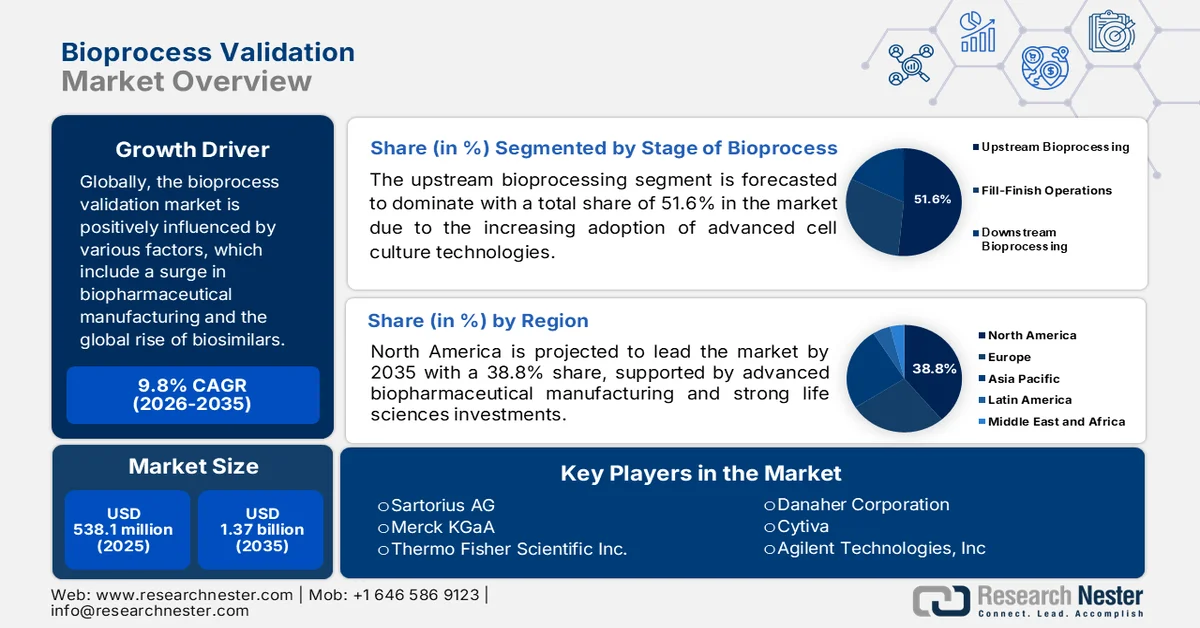
Globally, the bioprocess validation market is positively influenced by various factors, which include a surge in biopharmaceutical manufacturing and the global rise of biosimilars. In addition, accelerated approval pathways for advanced therapies, such as cell and gene therapies, are compelling manufacturers to adopt consistent testing protocols early in development. According to the article published by the Organization for Economic Co-operation and Development (OECD) in November 2025, in a span of a decade, biosimilars significantly expanded their presence across ten major therapy areas, increasing their share of the accessible biologics market from 1% to 22% across 25 countries. The article also outlines that in 2023, biosimilars accounted for more than one-quarter of the accessible market in countries such as Italy, Spain, Sweden, Austria, and Portugal, thus elevating the growth potential of the market.
Furthermore, market momentum is effectively fueled by the widespread adoption of single-use technologies and automated testing workflows, which streamline production and reduce cross-contamination risks. Pharmaceutical companies across the globe outsource these specialized, high-stakes compliance processes to contract development and manufacturing organizations, due to which the demand for third-party testing, outsourcing services, and advanced analytical software continues to scale across all major manufacturing regions. For instance, in November 2024, Lonza launched the first GMP batch from its mammalian manufacturing facility located at Portsmouth, which is a milestone in expanding its biologics manufacturing capabilities. This facility incorporates advanced technologies, including high-titer and N-1 perfusion processes with single-use systems, to efficiently support small- to mid-scale production of mammalian-derived biologics.
Key Bioprocess Validation Market Insights Summary:
Regional Highlights:
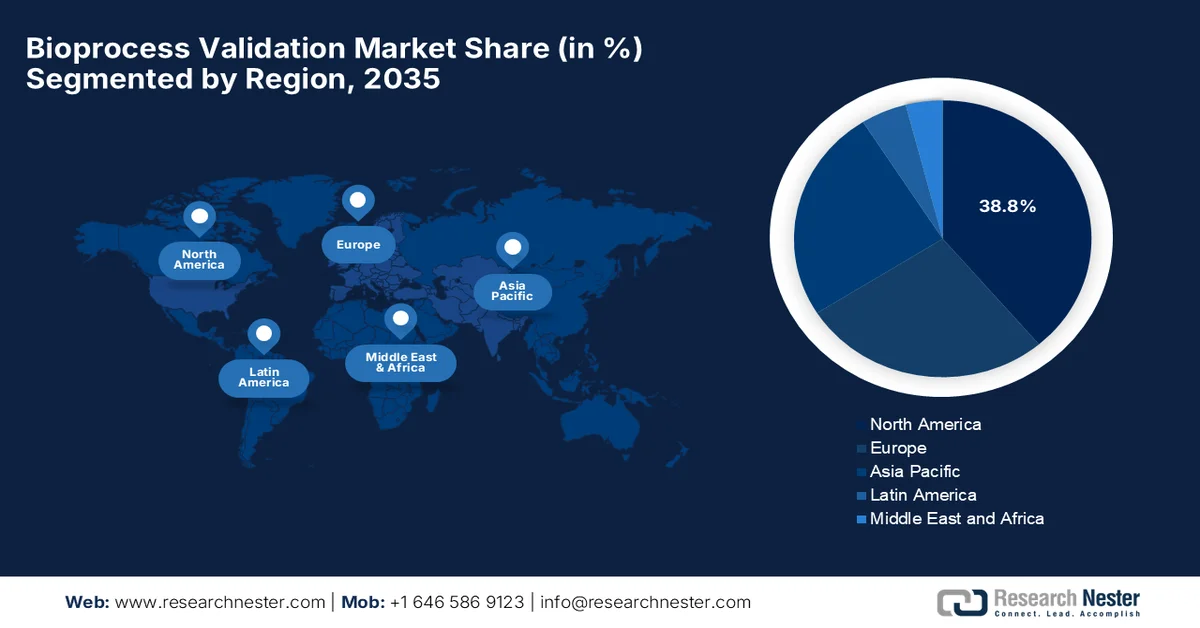
- North America is anticipated to command 38.8% share by 2035 in the bioprocess validation market, propelled by a highly sophisticated biopharmaceutical manufacturing ecosystem and substantial life sciences research funding
- Asia Pacific is poised to witness the fastest growth throughout 2026-2035, fueled by massive capital investments in local biopharmaceutical manufacturing infrastructure and the strategic relocation of international production facilities
Segment Insights:
- Upstream bioprocessing is projected to account for 51.6% share by 2035 in the bioprocess validation market, driven by the increasing adoption of advanced cell culture technologies, rising production of biologics and vaccines, and growing demand for optimized and scalable manufacturing processes
- Validation of filtration systems is expected to secure a considerable share in the market during 2026-2035, underpinned by the increasing adoption of single-use filtration technologies, rising production of biologics and vaccines, stringent regulatory requirements for sterility assurance, and the critical role of filtration validation in ensuring product safety, purity, and consistent manufacturing performance
Key Growth Trends:
- Single-use technology adoption
- Growth of contract manufacturing organizations
Major Challenges:
- High complexity of regulatory compliance and validation requirements
- High Cost and resource intensity of validation activities
Key Players: Sartorius AG (Germany),Merck KGaA (Germany),Thermo Fisher Scientific Inc. (U.S.),Danaher Corporation (U.S.),Cytiva (U.S.),Agilent Technologies, Inc. (U.S.),Repligen Corporation (U.S.),Getinge AB (Sweden),Parker Hannifin Corporation (U.S.),3M Company (U.S.),Meissner Filtration Products, Inc. (U.S.),Solaris Biotechnology S.r.l. (Italy),Eppendorf SE (Germany),LFB BIOMANUFACTURING (France),Saint-Gobain Bioprocess Solutions (France),VERDOT (France).
Global Bioprocess Validation Market Forecast and Regional Outlook:
Market Size & Growth Projections:
- 2025 Market Size: USD 538.1 million
- 2026 Market Size: USD 590.8 million
- Projected Market Size: USD 1.37 billion by 2035
- Growth Forecasts: 9.8% CAGR (2026-2035)
Key Regional Dynamics:
- Largest Region: North America (38.8% Share by 2035)
- Fastest Growing Region: Asia Pacific
- Dominating Countries: United States, Germany, China, Japan, Switzerland
- Emerging Countries: India, South Korea, Singapore, Ireland, Australia
Last updated on : 13 July, 2026
Bioprocess Validation Market - Growth Drivers and Challenges
Growth Drivers
- Single-use technology adoption: A major shift from stainless-steel systems to single-use technologies accelerates market growth. These disposable bioreactors and components lower cross-contamination risks and reduce cleaning validation times. But they introduce new compliance demands, such as extractables and leachables testing, which creates a continuous need for advanced validation workflows, prompting a favorable business environment. As of January 2024 data, the U.S. Food and Drug Administration (FDA) regulates the reprocessing of single-use medical devices to make sure they remain safe and effective after cleaning, sterilization, and reuse. It also mentions that reprocessors need to meet strict validation, labeling, quality, and reporting requirements similar to those of original manufacturers, thus enhancing adoption in the market.
- Growth of contract manufacturing organizations: The continual expansion of biopharmaceutical manufacturing outsourcing is boosting demand for bioprocess validation services. Contract manufacturing organizations support multiple drug developers and require validated processes to meet diverse client and regulatory expectations, positively benefiting the market. In November 2023, FUJIFILM Biotechnologies announced Janssen Supply Group, LLC as the first tenant for its new biopharmaceutical manufacturing facility in Holly Springs, North Carolina. It also mentions that this long-term partnership will support manufacturing of Janssen’s clinical and commercial pipeline, expanding FUJIFILM Biotechnologies’ global biologics manufacturing capacity.
Challenges
- High complexity of regulatory compliance and validation requirements: This factor has skewed growth in the market. Regulatory agencies across different nations require manufacturers to demonstrate that every stage of the production process consistently delivers products meeting predefined standards. Validation activities include process validation, cleaning validation, analytical method validation, computer system validation, and equipment qualification, which involve extensive documentation, risk assessments, and periodic revalidation. These regulatory expectations also evolve with the adoption of continuous manufacturing and advanced therapies, which in turn require manufacturers to frequently update validation protocols, thus increasing operational complexity.
- High Cost and resource intensity of validation activities: The validation studies mostly consist of multiple production batches, extensive laboratory testing, equipment qualification, environmental monitoring, and documentation before regulatory approval can be obtained. Therefore, smaller biotechnology companies and emerging biologics manufacturers operating in the market face budget constraints that limit their ability to establish in-house validation capabilities, increasing dependence on external service providers. In addition, implementing digital validation systems, automation platforms, and advanced analytical technologies also increases capital expenditure. Furthermore, the growing complexity of biologics, biosimilars, and cell and gene therapies in turn expands validation requirements, adding additional financial and operational burdens on manufacturers who are seeking faster commercialization.
Bioprocess Validation Market Size and Forecast:
| Report Attribute | Details |
|---|---|
|
Base Year |
2025 |
|
Forecast Year |
2026-2035 |
|
CAGR |
9.8% |
|
Base Year Market Size (2025) |
USD 538.1 million |
|
Forecast Year Market Size (2035) |
USD 1.37 billion |
|
Regional Scope |
|
Bioprocess Validation Market Segmentation:
Stage of Bioprocess Segment Analysis
The upstream bioprocessing segment is forecasted to dominate with a total share of 51.6% in the bioprocess validation market during the discussed timeframe. The segment’s dominance is mainly attributable to the increasing adoption of advanced cell culture technologies, rising production of biologics and vaccines, and growing demand for optimized and scalable manufacturing processes. Upstream operations, which include cell line development, media preparation, and bioreactor-based cultivation, are critical stages that directly influence product quality, yield, and consistency, that makes validation essential. In September 2025, FUJIFILM Biotechnologies announced the inauguration of its commercial-scale cell culture manufacturing facility in Holly Springs, North Carolina, which consists of 8 × 20,000L mammalian bioreactors with plans to double capacity through future expansion.
Process Type Segment Analysis
The validation of filtration systems, which is a part of the process type, is anticipated to garner a considerable share in the bioprocess validation market during the forecast period. The growth of the segment is driven primarily by the increasing adoption of single-use filtration technologies, rising production of biologics and vaccines, stringent regulatory requirements for sterility assurance, and the important role of filtration validation in ensuring product safety, purity, and consistent manufacturing performance. Filtration systems are essential in bioprocessing for removing contaminants, microorganisms, and unwanted particulates during downstream purification and sterile processing. As biologics manufacturing expands, manufacturers across different nations are focusing on validated filtration processes to minimize contamination risks and maintain product quality.
Process Component Segment Analysis
By the end of 2035, the filters segment is projected to hold a significant share in the bioprocess validation market. The increasing adoption of single-use filtration systems and growing emphasis on contamination control are driving the sub-segment’s leadership. The expansion of biologics production facilities and the shift toward advanced manufacturing platforms are expected to increase the need for validated filtration solutions. In January 2026, Sartorius announced the expansion of its bio-circular product portfolio by extending ISCC Plus certification to additional manufacturing sites in Germany and Tunisia, which enables greater use of renewable raw materials in bioprocessing products. The company’s certified Sartopore Evo filters and Flexsafe bags reduce dependency on fossil-based plastics, thereby maintaining compatibility with existing biopharmaceutical workflows.
Our in-depth analysis of the bioprocess validation market includes the following segments:
|
Segment |
Subsegments |
|
Stage of Bioprocess |
|
|
Process Type |
|
|
Process Component |
|
|
Test Type |
|
|
Cell Source |
|
|
End user |
|

Vishnu Nair
Head - Global Business DevelopmentCustomize this report to your requirements — connect with our consultant for personalized insights and options.
Bioprocess Validation Market - Regional Analysis
North America Market Insights
North America bioprocess validation market is projected to attain the highest share of 38.8% during the forecast period. The region’s dominant position is primarily propelled by a highly sophisticated biopharmaceutical manufacturing ecosystem and substantial life sciences research funding. An expanding pipeline of innovative biologics, biosimilars, and novel cell and gene therapies is also a major catalyst for regional market expansion. For instance, in April 2025, Novartis announced its plans to invest a total of USD 23 billion over five years to expand its U.S. manufacturing and R&D footprint, which includes 10 facilities, 7 of them new, creating nearly 1,000 direct and 4,000 additional jobs. This investment will enable Novartis to manufacture 100% of its key medicines end-to-end in the country by covering technologies such as biologics, small molecules, gene and cell therapy, and radioligand therapies.
The strict enforceability of data integrity and risk-based validation models is responsibly boosting the growth of the U.S. market. The country’s robust regulatory environment forces domestic manufacturers to continuously upgrade their software, biosensors, and testing protocols. The commercialization of localized cell, gene, and mRNA therapies creates a high-volume demand for complex analytical services such as sterile barrier testing and bioburden testing. In March 2024, the U.S. FDA issued the final ICH Q2(R2) validation of analytical procedures, which provides updated principles for validating analytical procedures, including approaches for spectroscopic data analysis. This new guidance establishes a harmonized, science- and risk-based framework to support regulatory evaluation and improve flexibility in post-approval analytical procedure changes.
Canada market is gaining traction owing to the federal government’s support to rebuild domestic vaccine and therapeutic pipelines. The country’s public and private investment influx has established dense biologics corridors, thus significantly driving regional demand for cGMP-compliant cleaning, equipment, and facility validation. In October 2024, Moderna’s Canada-based manufacturing facility in Laval, Quebec, received a Drug Establishment License (DEL) from Health Canada, which confirms compliance with safety and quality standards and enables drug substance production. This approval supports the facility’s transition toward end-to-end mRNA vaccine manufacturing in Canada, including vaccines for COVID-19, RSV, and seasonal influenza, which are subject to approvals.
APAC Market Insights
The Asia Pacific bioprocess validation market is projected to expand at the fastest rate from 2026 to 2035. The region’s upliftment in this field is majorly propelled by massive capital investments in local biopharmaceutical manufacturing infrastructure and the strategic relocation of international production facilities. Governments across key economic hubs such as China, India, South Korea, and Japan are heavily subsidizing domestic biologics and biosimilar initiatives to secure regional drug supply chains. In July 2024, Lotte Biologics began construction of a USD 3.4 billion biopharmaceutical manufacturing plant in Songdo, Incheon, as part of its strategy to become a top global CDMO. This project includes three biopharma plants with a 360,000L manufacturing capacity by 2030, which was followed by Lotte’s entry into the CDMO market in 2022 and acquisition of a BMS facility in 2023.
The government's primary focus on localizing drug supply chains under suitable initiatives is supporting the growth of the market in China. To support massive domestic biomanufacturing hubs, the National Medical Products Administration (NMPA) has remarkably tightened data integrity and compliance frameworks, which align closely with international standards like the PIC/S guidelines. In this context, in September 2023, the National Medical Products Administration (NMPA) submitted an application to join the Pharmaceutical Inspection Co-operation Scheme (PIC/S) and received applicant status confirmation in November 2023. In this context, NMPA aims to strengthen cooperation with PIC/S, improve drug inspection standards, and enhance the quality management system for pharmaceutical regulation, thus denoting a positive market outlook.
In India, the market is being supported by the country's position as a global powerhouse for affordable generics, vaccines, and biosimilars. In addition, the Central Drugs Standard Control Organization (CDSCO) is steadily updating local compliance mandates, driving domestic firms to substitute legacy, manual tracking methods with advanced process analytical technology software, automated rapid-microbiology testing, and rigorous extractables and leachables testing workflows. In February 2026, the Press Information Bureau reported that India is progressing towards becoming a global biopharma hub through Biopharma SHAKTI, with a total investment of USD 1.2 billion over five years to strengthen biologics, biosimilars, research, manufacturing, and clinical trials. The government is expanding the ecosystem through the National Biopharma Mission, NIPER upgrades, regulatory reforms, and support for biotech startups to develop innovative healthcare solutions.
Europe Market Insights
Europe bioprocess validation market is growing significantly on account of a high concentration of global pharmaceutical giants along with the presence of biotechnology hubs across Germany, France, the UK, and Switzerland. The region's intense focus on sustainability and environmental efficiency is proactively driving the integration of automated validation systems and optimized single-use workflows that reduce water and chemical consumption. In June 2026, as stated by Europe Commission, the European Biotech Act I aims to strengthen the region’s biotechnology sector by simplifying rules for genetically modified micro-organisms and updating organ processing regulations to support scientific innovation. The Council of the EU has agreed on its negotiating position to create a faster, clearer regulatory framework, thus supporting the market’s expansion.
The country’s prominent engineering infrastructure and massive biopharmaceutical hubs are driving the upliftment of Germany market. The market is highly characterized by the early and aggressive integration of Industry 4.0 technologies, where artificial intelligence, advanced biosensors, and digital twins are routinely validated to enable real-time release testing. For instance, in September 2024, Merck KGaA and Siemens signed a memorandum of understanding in order to accelerate smart manufacturing and digital transformation across healthcare, life science, and electronics sectors. This partnership will leverage the Siemens Xcelerator platform to enable modular, flexible, and sustainable production systems, reducing time to market and operational complexity, thus making it suitable for standard market growth.
The UK market is expanding at a noteworthy pace, which is backed by the government's long-term life sciences vision and a powerful ecosystem of advanced therapy medicinal products. The country’s market is also propelled by a robust network of manufacturing innovation hubs, which actively foster the adoption of automated process analytical technology software and single-use technologies. Based on government data published in October 2024, it launched the life sciences innovative manufacturing fund, allocating around USD 660 million in capital grants to support investments in the manufacture of human medicines, diagnostics, and medical technologies. This fund supports eligible projects with total costs of at least USD 10 million, thereby helping expand domestic manufacturing capacity and strengthen the UK's resilience for future health emergencies.
Key Bioprocess Validation Market Players:
- Sartorius AG (Germany)
- Merck KGaA (Germany)
- Thermo Fisher Scientific Inc. (U.S.)
- Danaher Corporation (U.S.)
- Cytiva (U.S.)
- Agilent Technologies, Inc. (U.S.)
- Repligen Corporation (U.S.)
- Getinge AB (Sweden)
- Parker Hannifin Corporation (U.S.)
- 3M Company (U.S.)
- Meissner Filtration Products, Inc. (U.S.)
- Solaris Biotechnology S.r.l. (Italy)
- Eppendorf SE (Germany)
- LFB BIOMANUFACTURING (France)
- Saint-Gobain Bioprocess Solutions (France)
- VERDOT (France)
- Company Overview
- Business Strategy
- Key Product Offerings
- Financial Performance
- Key Performance Indicators
- Risk Analysis
- Recent Development
- Regional Presence
- SWOT Analysis
- Sartorius AG is one of the leading providers of bioprocess technologies that support validation throughout biologics manufacturing. The company has strengthened its position through continuous investments in terms of digital bioprocessing, automation, and cell and gene therapy manufacturing platforms.
- Merck KGaA is a major participant in the market through its Life Science business, which has been offering solutions for process development, validation, quality control, and GMP manufacturing. In addition, the firm emphasizes end-to-end bioprocess workflows, which are designed to enhance manufacturing efficiency.
- Thermo Fisher Scientific Inc. is a foundational player in this sector, which offers one of the industry's broadest portfolios for bioprocess validation. The company’s technologies support process validation, analytical method validation, filtration validation, and manufacturing quality assurance for biologics, vaccines, and advanced therapies.
- Danaher Corporation is serving the market primarily through its life sciences businesses, including Pall Corporation and other biotechnology-focused operating companies. Besides, the company differentiates itself by integrating advanced automation, digital analytics, and continuous bioprocessing technologies that improve manufacturing efficiency.
- Cytiva is considered to be a leading manufacturer of bioprocess technologies that support process development, validation, and commercial-scale biologics manufacturing. The firm is highly focused on enabling flexible and scalable manufacturing for monoclonal antibodies, vaccines, recombinant proteins, and cell and gene therapies.
Here is a list of key players operating in the global market:
The bioprocess validation market is witnessing intense competition, which is led by global life science and analytical technology companies that manufacture validation products and platforms for biopharmaceutical manufacturing. Market leaders are highly focused on portfolios of products that span process validation, cleaning validation, analytical method validation, filtration integrity testing, and digital validation solutions that support regulatory compliance. Apart from this, competition is effectively driven by technological innovation, integration of automation and data management, global service capabilities, and compliance with international GMP standards. In March 2026, Thermo Fisher Scientific announced the completion of its USD 8.875 billion acquisition of Clario Holdings, Inc., to strengthen its clinical research capabilities by integrating Clario’s endpoint data platform into its laboratory products and biopharma services segment.
Corporate Landscape of the Market:
Recent Developments
- In June 2026, Sartorius and LFB BIOMANUFACTURING expanded their collaboration to provide an integrated, end-to-end solution from cell line development to the first GMP drug substance batch, simplifying and accelerating the journey to clinical trials.
- In April 2026, Saint-Gobain Bioprocess Solutions and VERDOT formed a strategic partnership to develop and commercialize a next-generation integrated PUPSIT (Pre-Use Post-Sterilization Integrity Testing) solution for biopharmaceutical manufacturers, supporting compliance with EU GMP Annex 1 sterility requirements.
- Report ID: 8668
- Published Date: Jul 13, 2026
- Report Format: PDF, PPT
- Explore a preview of key market trends and insights
- Review sample data tables and segment breakdowns
- Experience the quality of our visual data representations
- Evaluate our report structure and research methodology
- Get a glimpse of competitive landscape analysis
- Understand how regional forecasts are presented
- Assess the depth of company profiling and benchmarking
- Preview how actionable insights can support your strategy
Explore real data and analysis
Frequently Asked Questions (FAQ)
About this Report
Connect with our Expert


Report, 2026-2035



Copyright @ 2026 Research Nester. All Rights Reserved.
