Bioprocess Automation Market Outlook:
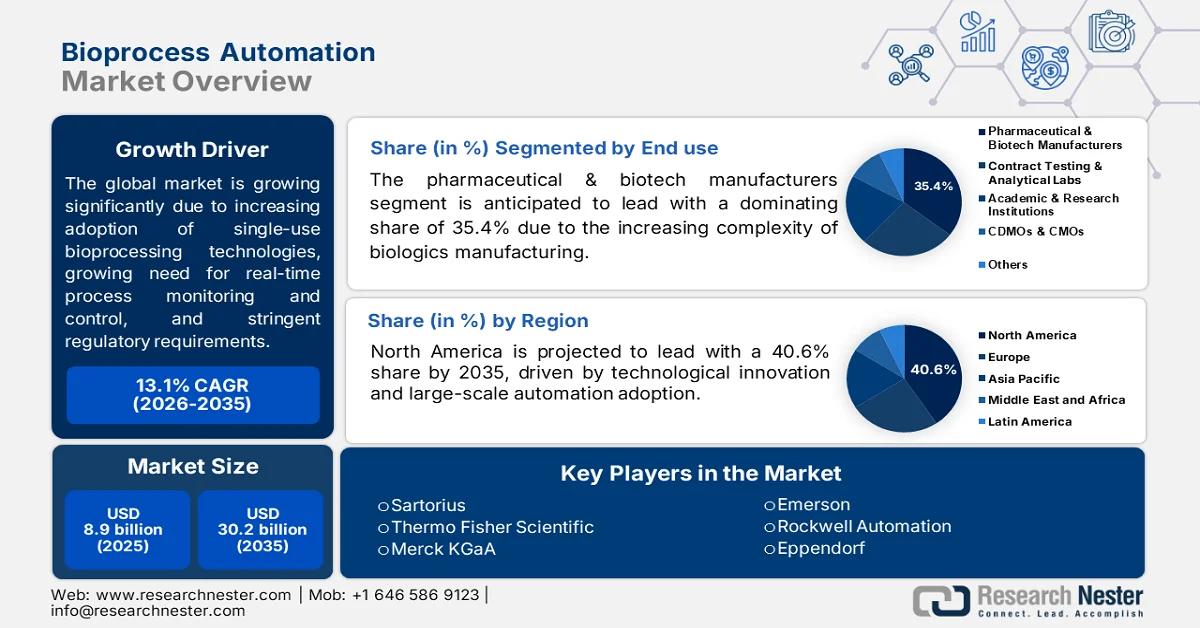
Bioprocess Automation Market size was valued at USD 8.9 billion in 2025 and is expected to reach USD 30.2 billion by the end of 2035, registering around 13.1% CAGR during the forecast period, i.e., 2026-2035. In 2026, the industry size of bioprocess automation is evaluated at USD 10 billion.
The bioprocess automation market is positioned for immense growth beyond medical applications into different sectors such as industrial biotechnology, biofuels, food processing, and agriculture. Manufacturers across these industries are deploying automation with a main goal to optimize yield, ensure precise environmental control within bioreactors, and scale up complex biological production lines. The BioIndustry Association in November 2025 stated that intelligent automation is transforming bioprocessing by connecting sensors, robotics, software, and real-time data in order to improve efficiency, consistency, and decision-making. It also mentions the BALANCE platform, which combines automated sampling, biosensing, AI optimization, and digital-twin technology to continuously monitor and improve bioprocess conditions. Also, this approach can improve scalability, quality, and speed to market.
Furthermore, momentum in the bioprocess automation market is intensely fueled by the integration of advanced supervisory control and data acquisition systems, programmable logic controllers, and edge computing, which bridge the gap between biological workflows and traditional factory floor operations. In August 2023, Sartorius integrated Emerson’s DeltaV distributed control system into its Biostat STR Generation 3 bioreactors, thereby creating a pre-engineered solution that simplifies equipment integration in biopharmaceutical manufacturing. This standardized configuration and built-in DeltaV technologies can reduce equipment integration time by up to 80%, thus contributing to the market’s expansion.
Key Bioprocess Automation Market Insights Summary:
Regional Highlights:
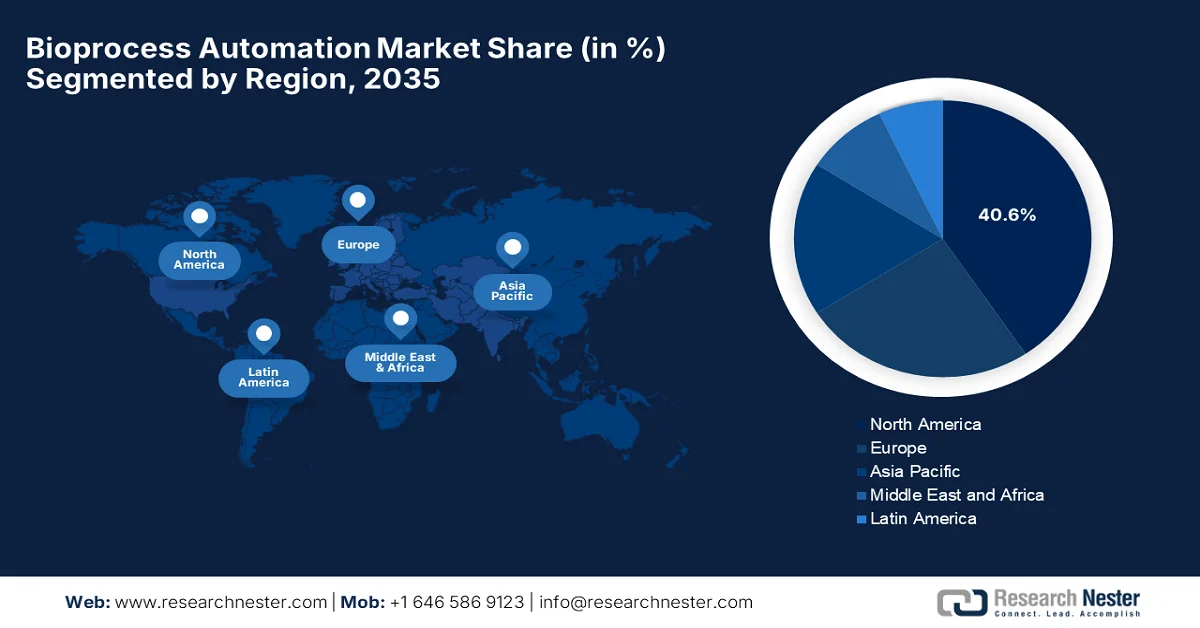
- North America is expected to hold the leading 40.6% share during 2026-2035 in the bioprocess automation market, strengthened by technological innovation, large-scale industrial deployments, and a mature biopharmaceutical and industrial biotechnology ecosystem.
- Asia Pacific is projected to register the fastest growth from 2026 to 2035, propelled by rapid industrialization and substantial investments in healthcare infrastructure.
Segment Insights:
- Pharmaceutical & biotech manufacturers is forecast to account for a substantial 35.4% share over the forecast period, supported by the increasing complexity of biologics manufacturing and stringent regulatory requirements.
- Upstream is anticipated to secure a notable revenue share by the end of the forecast period, with increasing adoption of single-use bioreactors and growing demand for real-time monitoring and control of critical process parameters fostering its expansion.
Key Growth Trends:
- Rising global demand for sustainable bio-products
- Growing adoption of single-use technologies
Major Challenges:
- Astronomical capital expenditure and uncertain ROI
- Severe shortage of specialized, dual-discipline talent
Key Players: Sartorius (Germany), Thermo Fisher Scientific (U.S.), Merck KGaA (Germany), Emerson (U.S.), Rockwell Automation (U.S.), Eppendorf (Germany), Cytiva (U.S.), Repligen (U.S.), Tata Elxsi (India).
Global Bioprocess Automation Market Forecast and Regional Outlook:
Market Size & Growth Projections:
- 2025 Market Size: USD 8.9 billion
- 2026 Market Size: USD 10 billion
- Projected Market Size: USD 30.2 billion by 2035
- Growth Forecasts: 13.1% CAGR (2026-2035)
Key Regional Dynamics:
- Largest Region: North America (40.6% Share by 2035)
- Fastest Growing Region: Asia Pacific
- Dominating Countries: United States, China, Japan, Germany, France
- Emerging Countries: Canada, India, South Korea, France, Germany
Last updated on : 25 August, 2026
Bioprocess Automation Market - Growth Drivers and Challenges
Growth Drivers
- Rising global demand for sustainable bio-products: The pressure for eco-friendly solutions is increasing from both consumers and regulatory bodies, which in turn is boosting the biofuels, biochemicals, and alternative protein sectors. Scaling these complex organic products efficiently requires tight process margins wherein automation provides the exact precision and resource efficiency. In this context, the Press Information Bureau (PIB) stated in March 2025 that India’s bioeconomy expanded to USD 165.7 billion in 2024 and is targeted to reach USD 300 billion by 2030, driven by biotechnology, innovation, and sustainable development. It also mentions that government initiatives such as the BioE3 Policy, National Biopharma Mission, Bio-agriculture and Biotech-KISAN are strengthening biomanufacturing, healthcare, agriculture, research and rural development, positively benefiting the bioprocess automation market.
- Growing adoption of single-use technologies: The adoption of single use bioprocessing is surging, which is creating strong demand for compatible automation solutions. Single-use systems offer flexible manufacturing and lower contamination risks. Therefore, their suitability for biologics, vaccines, and cell and gene therapies encourages manufacturers to integrate automated monitoring and control technologies across production workflows. In this regard, Sartorius Stedim Biotech expanded its Aubagne, France, facilities in June 2025 with nearly double the cleanroom space, automated single-use bag production, and a new logistics platform to improve manufacturing capacity and delivery speed. The company has also added a 1,900-square-meter laboratory for product development, customer demonstrations, and training, thus benefiting the bioprocess automation market.
Challenges
- Astronomical capital expenditure and uncertain ROI: Implementing bioprocess automation needs substantial investments that restrict widespread adoption. High initial costs arise from purchasing advanced hardware, software licenses, and specialized analytical tools, such as process analytical technology. Other than this equipment, there is a need to make investments in terms of system integrators, process validation, and facility retrofitting. In the case of small-to-medium biotechs and startups, this astronomical capital expenditure can be completely prohibitive. Therefore, compounding this challenge is the difficulty in calculating a clear return on investment, thus negatively impacting the growth of the bioprocess automation market.
- Severe shortage of specialized, dual-discipline talent: The bioprocess automation market faces a critical bottleneck which is due to a shortage of qualified talent. Effective automation requires professionals who possess deep knowledge in terms of both biology and software engineering, a rare dual-discipline skill set. Traditional bioprocess engineers do not have the advanced programming, data science, and cyber-physical systems knowledge needed to manage modern automated plants. At the same time, standard software engineers rarely understand the delicate, non-linear realities of living cellular cultures and biological systems. This severe talent gap drives up recruitment costs and forces companies to depend on external consultants.
Bioprocess Automation Market Size and Forecast:
| Report Attribute | Details |
|---|---|
|
Base Year |
2025 |
|
Forecast Period |
2026-2035 |
|
CAGR |
13.1% |
|
Base Year Market Size (2025) |
USD 8.9 billion |
|
Forecast Year Market Size (2035) |
USD 30.2 billion |
|
Regional Scope |
|
Bioprocess Automation Market Segmentation:
End use Segment Analysis
The pharmaceutical & biotech manufacturers sub-segment within the end use category is projected to hold the leading position, accounting for a substantial 35.4% of the market share over the forecast period. The sub-segment’s growth in the bioprocess automation market is largely attributable to the increasing complexity of biologics manufacturing and stringent regulatory requirements. In addition, the expansion of biologics, cell and gene therapies is increasing the need for integrated process control and automated workflows, positioning the sub-segment for extensive growth. In April 2024, Merck introduced the world’s first modular commercial production line based on a new automation standard, which is especially designed to accelerate pharmaceutical and advanced materials manufacturing while improving efficiency. It was developed along with Siemens, and the system uses standardized Module Type Packages to connect production equipment, reducing integration time, investment costs, and carbon emissions.
Process Stage Segment Analysis
By the conclusion of the forecast period, the upstream sub-segment is projected to attain a notable revenue share in the bioprocess automation market. This growth is extensively driven by the increasing adoption of single-use bioreactors and rising demand for real-time monitoring and control of critical process parameters. In addition, the growing need to improve cell culture productivity, batch consistency, and process reproducibility is positioning it for sustained expansion. Upstream operations involve highly sensitive parameters such as pH, dissolved oxygen, temperature, agitation, and nutrient supply, making automated sensing and control especially valuable. Furthermore, the shift toward intensified and flexible biomanufacturing is encouraging manufacturers to deploy integrated bioreactor control, process analytical technology, and data-management platforms.
Product and Services Segment Analysis
On the basis of product and services, the automation hardware is expected to lead with a substantial revenue share in the bioprocess automation market from 2026 to 2035. The increasing deployment of bioreactor control systems, sensors, pumps, mass flow controllers, and other process-control equipment is driving the sub-segment’s leadership. The growing adoption of single-use bioprocessing and intensified manufacturing is increasing demand for integrated hardware capable of real-time monitoring and precise control of critical process parameters. In May 2024, Sartorius and Sanofi collaborated to develop and commercialize an integrated and continuous biomanufacturing platform that combines modularity, flexibility, and standardized processes for biopharmaceutical production. This particular platform will integrate hardware, consumables, and process automation across development and commercial scales.
Our in-depth analysis of the bioprocess automation market includes the following segments:
|
Segment |
Subsegments |
|
End use |
|
|
Process Stage |
|
|
Product & Service |
|

Vishnu Nair
Head - Global Business DevelopmentCustomize this report to your requirements — connect with our consultant for personalized insights and options.
Bioprocess Automation Market - Regional Analysis
North America Market Insights
North America bioprocess automation market is anticipated to lead the global industry with a total share of 40.6% from 2026 to 2035. The region’s leadership is primarily attributable to its role as a hub for technological innovation and large-scale industrial deployments. North America also benefits from a highly mature biopharmaceutical and industrial biotechnology ecosystem, along with dense concentrations of contract development and manufacturing organizations investing heavily in smart factory initiatives. In this context, Genentech, which is part of the Roche Group, started construction of a new USD 700 million manufacturing facility in Holly Springs, North Carolina, in August 2025, focused on producing next-generation metabolic medicines, including obesity treatments. This 65,000-square-meter site will use advanced automation, digital systems, and modern biomanufacturing technologies.
A strong push towards modernizing facilities with advanced industrial hardware in biopharma, biofuels, and industrial fermentation sectors is deliberately boosting growth in the U.S. bioprocess automation market. The country’s market is also propelled by strategic federal support for domestic supply chain resilience and advanced biomanufacturing infrastructure. In September 2024, the U.S. Department of Energy stated that its Bioenergy Technologies Office is accelerating biotechnology and biomanufacturing to build a stronger and more sustainable U.S. bioeconomy. Its initiatives support sustainable aviation fuels, bio-based products, biomass utilization, emissions reduction, and large-scale demonstration projects while creating jobs and strengthening domestic energy security, thus contributing to the market’s expansion.
The Canada bioprocess automation market is gaining traction, which is driven by a growing network of specialized biotechnology firms, research hubs, and domestic contract manufacturers seeking to scale production efficiency. Market momentum is also sustained by federal and provincial initiatives aimed at boosting domestic bio-manufacturing capacity and developing sustainable green technologies such as biofuels and bio-products. Based on government data published in March 2025, Canada is supporting OmniaBio’s expansion in Hamilton to develop AI- and robotics-enabled manufacturing for advanced cell and gene therapies. This particular project aims to improve manufacturing efficiency by five times and reduce production and supply costs by up to 50%, thereby helping increase access to treatments for cancer and other chronic diseases.
APAC Market Insights
The Asia Pacific bioprocess automation market is projected to experience the fastest growth rate from 2026 to 2035. The region’s progress in this sector is majorly propelled by rapid industrialization and massive investments in healthcare infrastructure. Countries such as China, India, South Korea, and Japan are leading this transformation as local manufacturers are opting for advanced automated bioreactors, distributed control systems, and smart sensors to scale up production. PIB in July 2026 stated that India is expanding the use of AI and biotechnology in genomics, healthcare, medical imaging, bioinformatics, and biomanufacturing through initiatives such as GenomeIndia, IBDC, Bio-AI Hubs, and ANRF programmes. Also, these efforts have produced major outcomes, which include more than 10,000 sequenced India-based genomes, large biological and medical-imaging repositories, and AI tools for precision medicine, cancer diagnosis, crop health, and maternal care.
A shift toward digital transformation, Industry 4.0 integration, and the local manufacturing of advanced therapeutics, i. e biologics, biosimilars, and cell and gene therapies, are some of the important factors driving growth of the bioprocess automation market in China. Government initiatives that are prioritizing biopharmaceutical self-reliance and technological innovation have accelerated the adoption of automated systems across upstream and downstream processing. Based on government data that was published in February 2026, China is expanding bio-manufacturing by using microbes and biotechnology to turn industrial waste and agricultural resources into valuable products such as animal feed, fuels, medicines, and supplements. In addition, this sector is receiving strong government support and is combined with AI to speed up research, improve crop traits, and reduce the cost and time of drug development.
The Japan bioprocess automation market is gaining momentum, which is driven by a strong emphasis on precision engineering, quality control, and the integration of advanced robotics. The country also benefits from government support for regenerative medicine, cell therapies, and biopharmaceuticals, which are encouraging the market to shift toward fully automated, closed systems that ensure high batch reproducibility and minimize contamination risks. In March 2025, Astellas Pharma and YASKAWA Electric agreed to establish a joint venture that is aimed at advancing cell therapy manufacturing through robotics and digital technologies. Besides, this venture will use YASKAWA’s dual-arm robot, Maholo, along with Astellas’ expertise in cell therapy research and manufacturing to create processes that are highly precise, consistent, and efficient.
Europe Market Insights
The Europe bioprocess automation market is highly mature and influential, and it is expected to represent consistent growth throughout the forecast period. The region’s growth is effectively propelled by its biopharmaceutical infrastructure, strict regulatory compliance, and a strong commitment to sustainability and green manufacturing. The market benefits from the widespread adoption of Industry 4.0 principles, where domestic biopharma companies and contract development and manufacturing organizations integrate AI, ML, and digital twins into their workflows to achieve real-time process monitoring and optimization. There is a profound shift toward modular facility designs and automated single-use technologies to increase manufacturing flexibility for advanced therapeutics, thus benefiting overall market expansion.
A long-standing expertise in industrial engineering and the early adoption of the national Industry 4.0 framework are two main catalyzing factors for the bioprocess automation market in Germany. Driven by the rapid development of biologics, personalized medicine, and advanced therapies, the country’s facilities are heavily shifting toward modular, plug-and-play automated platforms and single-use technologies to speed up time-to-market. In September 2024, Sartorius and G-CON announced a partnership to accelerate the development of flexible and sustainable facilities for pharmaceutical manufacturing. The collaboration combines Sartorius’ ProcessGo® manufacturing solutions with G-CON’s modular POD® cleanrooms, creating configurable, manufacturing-ready spaces that can be deployed more quickly.
The France bioprocess automation market is growing at a rapid pace of progress which is, driven by the government’s active support for high-tech medical re-industrialization and the local production of innovative medications. The market is defined by a strong emphasis on digital transformation. Apart from this, key market dynamics include the widespread integration of advanced data analytics, artificial intelligence, and automated process analytical technology to ensure precise quality control and compliance with regional manufacturing standards. In addition, the country’s competitive ecosystem benefits from a strong network of domestic engineering-specialized firms, tech startups, and global automation leaders who are collaborating within major bio-clusters to build highly flexible, smart manufacturing facilities.
Key Bioprocess Automation Market Players:
- Sartorius (Germany)
- Thermo Fisher Scientific (U.S.)
- Merck KGaA (Germany)
- Emerson (U.S.)
- Rockwell Automation (U.S.)
- Eppendorf (Germany)
- Cytiva (U.S.)
- Repligen (U.S.)
- Tata Elxsi (India)
- Company Overview
- Business Strategy
- Key Product Offerings
- Financial Performance
- Key Performance Indicators
- Risk Analysis
- Recent Development
- Regional Presence
- SWOT Analysis
- Sartorius competes in this market with its Biobrain® Automation Platform, which offers modular automation for upstream, downstream, and fluid-management processes. Besides, its platform supports DCS, SCADA, and MES integration, batch control, monitoring, and cGMP requirements.
- Thermo Fisher Scientific is a predominant leader in this sector, which offers automated bioprocessing through its DynaDrive Single-Use Bioreactor and TruBio control software. These solutions provide scalable bioreactor systems, automated control, data management, and process consistency from development to manufacturing.
- Merck KGaA’s Bio4C ACE™ software provides automated bioprocess control and monitoring, including recipe-driven automation, remote operation, process analytics, alarms, and data-integrity functions to improve reproducibility and compliance.
- Emerson is a prominent player that leverages the DeltaV™ automation platform and integrates process control, analytics, MES, SCADA, and operations-management technologies. Its life-sciences solutions focus on scalable automation, data integration, operational efficiency, and process optimization.
- Rockwell Automation provides FactoryTalk® PharmaSuite® MES and related automation solutions for various industries such as life-sciences manufacturing, emphasizing production optimization, regulatory compliance, digital integration, and improved manufacturing visibility.
Here is a list of key players operating in the global market:
Leading manufacturers in the global bioprocess automation market are intensely competing through integrated automation platforms, bioreactor control systems, process-control software, MES, and data-management solutions. Major players in this industry leverage broad biopharmaceutical portfolios and global service networks, whereas some specialized manufacturers compete through application-specific automation and scalable bioprocess systems. Apart from this, differentiation in this sector centers on process scalability, digital integration, and automation-enabled process control. In this context, Emerson in March 2024 expanded its DeltaV brand into an automation platform that integrates DCS, SIS, SCADA, MES, and operations management software. This platform is especially designed to simplify data access and support smarter, safer, and more sustainable industrial operations.
Corporate Landscape of the Market:
Recent Developments
- In April 2026, Rockwell Automation and Cytiva launched Figurate SCADA to simplify digital integration in biopharmaceutical manufacturing. This platform connects equipment and software from multiple vendors through an open, scalable architecture with centralized monitoring and control.
- In May 2025, Rockwell Automation introduced FactoryTalk PharmaSuite 12.00, which is an updated manufacturing execution system especially designed to support pharmaceutical and biopharmaceutical production with greater scalability, flexibility, and faster deployment.
- In November 2024, Tata Elxsi, DENSO Robotics Europe, and AAtek launched a Robotics and Automation Innovation Lab in Frankfurt to advance automation across pharmaceuticals, life sciences, and healthcare.
- Report ID: 8746
- Published Date: Aug 25, 2026
- Report Format: PDF, PPT
- Explore a preview of key market trends and insights
- Review sample data tables and segment breakdowns
- Experience the quality of our visual data representations
- Evaluate our report structure and research methodology
- Get a glimpse of competitive landscape analysis
- Understand how regional forecasts are presented
- Assess the depth of company profiling and benchmarking
- Preview how actionable insights can support your strategy
Explore real data and analysis
Frequently Asked Questions (FAQ)
About this Report
Connect with our Expert


Report, 2026-2035



Copyright @ 2026 Research Nester. All Rights Reserved.
