Unified Communications (UC) Hardware Market Outlook:
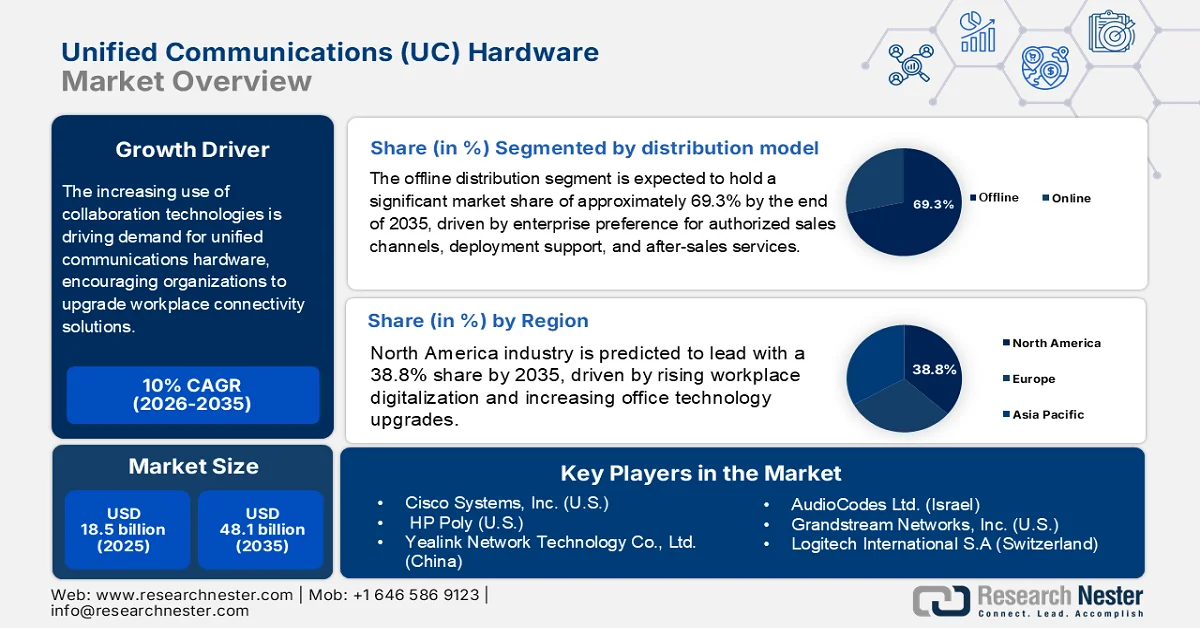
Unified Communications (UC) Hardware Market size was valued at USD 18.5 billion in 2025 and is expected to reach USD 48.1 billion by the end of 2035, growing at around 10% CAGR during the forecast period, i.e., 2026-2035. In 2026, the industry size of unified communications (UC) hardware is evaluated at USD 20.4 billion.
The unified communications (UC) hardware market is registering a stable growth due to the rising demand for modern workplace collaboration solutions. UC devices include IP phones, video conferencing systems, collaboration displays, headsets, webcams, and other collaboration devices that help employees connect through voice, video, and messaging on a single platform. As businesses continue to keep changing traditional communication methods with advanced collaboration hardware, the demand for high-quality UC devices is growing among corporate offices, educational institutions, healthcare facilities, and government organizations.
Companies are investing more in workplace modernization to improve connectivity and support employees working from different locations. As hybrid work has become a common part of workforce operations, companies are equipping offices and remote employees with collaboration devices that provide better audio, video, and meeting experiences. According to the U.S. National Institute of Standards and Technology (NIST), organizations require secure enterprise telework and remote access technologies to support employees working beyond traditional office environments. As organizations continue to improve employee collaboration, investment in UC hardware is expected to grow during the forecast period. This is one of the reasons for the demand of IP phones, video conferencing systems, headsets, webcams, and collaboration devices that help employees stay connected throughout the workday.
While many businesses are changing older connectivity equipment with modern devices that can help multiple coordination function on a single system. Instead of using separate phones, conference equipment, and messaging tools, organizations are choosing UC hardware that makes daily operations easier to manage. Due to more organizations continue upgrading their coordination equipment, demand for unified communications hardware is expected to grow throughout the forecast period. This change is encouraging businesses to invest in new IP phones, video conferencing devices, headsets, and collaboration equipment that can support changing workplace requirements.
Key Unified Communications (UC) Hardware Market Insights Summary:
Regional Highlights:
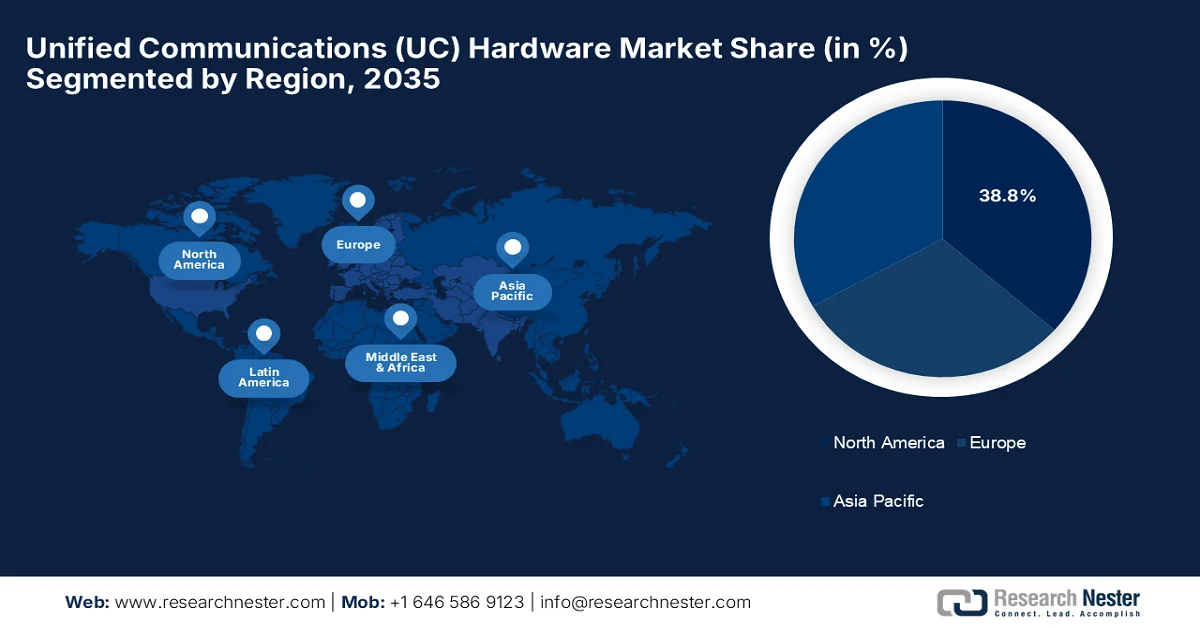
- North America is projected to command approximately 38.8% of the unified communications (UC) hardware market by 2035, reinforced by the increasing use of digital workplace solutions and rising upgrades of office collaboration equipment
- Europe is poised for notable expansion in the forecast period, stimulated by increasing digitalization across businesses and public organizations
Segment Insights:
- The offline sub-segment is expected to capture around 69.3% of the unified communications (UC) hardware market by 2035, bolstered by the need for product consultation, installation, technical support, and after-sales services for enterprise connectivity projects
- The IP telephony hardware sub-segment is anticipated to retain its leading position through 2035, fueled by growing adoption of reliable internet-based calling systems and ongoing upgrades to modern communication infrastructure
Key Growth Trends:
- Growing Adoption of Cloud-Based UC Platforms
- Increasing Investment in Digital Infrastructure
Major Challenges:
- High Initial Deployment Costs
- Compatibility with Existing Communication Systems
Key Players: Cisco Systems, Inc. (U.S.), HP Poly (U.S.), Yealink Network Technology Co., Ltd. (China), AudioCodes Ltd. (Israel), Grandstream Networks, Inc. (U.S.), Logitech International S.A (Switzerland).
Global Unified Communications (UC) Hardware Market Forecast and Regional Outlook:
Market Size & Growth Projections:
- 2025 Market Size: USD 18.5 billion
- 2026 Market Size: USD 20.4 billion
- Projected Market Size: USD 48.1 billion by 2035
- Growth Forecasts: 10% CAGR (2026-2035)
Key Regional Dynamics:
- Largest Region: North America (38.8% Share by 2035)
- Fastest Growing Region: Europe
- Dominating Countries: United States, China, Germany, Japan, United Kingdom
- Emerging Countries: India, South Korea, Singapore, United Arab Emirates, Saudi Arabia
Last updated on : 16 July, 2026
Unified Communications (UC) Hardware Market - Growth Drivers and Challenges
Growth Drivers
- Growing Adoption of Cloud-Based UC Platforms: Businesses are increasing their spending on cloud services as part of long-term digital transformation strategies, creating greater demand for enterprise hardware that can supports cloud-based workplace applications. As organizations enhance cloud environments, they also need compatible devices, which include IP phones, headsets, webcams, and conference systems to ensure seamless organizations connectivity. According to Eurostat, approximately 45.5% of EU enterprises purchased cloud computing services in 2023, compared with 38.9% in 2021, which reflects the increasing use of cloud technologies across companies. This continued shift toward cloud services is anticipated to support the adoption of UC hardware during the forecast period.
- Increasing Investment in Digital Infrastructure: Organizations are enhancing digital infrastructure to improve connectivity and support daily operations. According to the International Telecommunication Union (ITU), an estimated 5.5 billion people, representing 68% of the global population, were using the Internet in 2024, that showcase the continued expansion of digital connectivity globally. Companies are increasing investment in workplace technology to improve operational efficiency and can help long-term business growth.
- Rising Adoption of AI-Enabled Workplace Communication: Companies are introducing digital workplace solutions that can help employees collaborate more efficiently and improve everyday enterprise operations. AI-powered features which includes meeting transcription, background noise reduction, intelligent camera framing, and virtual assistants are encouraging organizations to upgrade their coordination hardware with devices that can help these capabilities. According to the OECD, AI adoption among enterprises with 10 or more employees in the European Union increased from 8.0% in 2023 to 13.5% in 2024, that highlights the rapid integration of AI into business operations. As organizations continue adopting AI-enabled workplace technologies, demand for UC hardware is expected to increase throughout the forecast period.
Challenges
- High Initial Deployment Costs: Businesses need to invest in connectivity hardware that can help with day-to-day operations and collaboration, adding to their overall costs. Small and medium-sized enterprises can delay these investments because of tight budgets and competing strategic priorities. While purchasing UC hardware usually requires a significant investment, especially if it is for large organizations that are upgrading multiple offices or meeting spaces. Moreover, hardware purchases, organizations may also need to spend on installation, maintenance, and replacement expenses. These cost-related factors can limit the adoption of UC hardware, particularly among businesses that have limited budgets.
- Compatibility with Existing Communication Systems: Many organizations still use older office communication equipment that continues to meet their daily needs. Due to this, some businesses prefer to keep using their current equipment instead of upgrading immediately. Therefore, the implementation of new unified communications hardware can be delayed, especially among organizations that replace equipment only when it becomes outdated. Replacing these devices with new UC hardware may require some changes to the existing office setup and additional spending.
Unified Communications (UC) Hardware Market Size and Forecast:
| Report Attribute | Details |
|---|---|
|
Base Year |
2025 |
|
Forecast Year |
2026-2035 |
|
CAGR |
10% |
|
Base Year Market Size (2025) |
USD 18.5 billion |
|
Forecast Year Market Size (2035) |
USD 48.1 billion |
|
Regional Scope |
|
Unified Communications (UC) Hardware Market Segmentation:
Distribution Model Segment Analysis
Based on the distribution model, the offline sub-segment is anticipated to account for the largest share of the UC hardware market, holding approximately 69.3% by the end of 2035. Businesses having large number of employees continue to purchase unified communications hardware through authorized distributors and technology partners because these channels provide product consultation, installation, technical support, and after-sales services. Offline purchasing is a preferred option, because enterprise connectivity projects often need customized hardware deployment and integration. According to the U.S. General Services Administration (GSA), strategic acquisition and professional technology services help organizations implement and manage enterprise technology solutions efficiently. As enterprise continue investing in coordination infrastructure, the offline distribution channel is expected to maintain its leading position in the unified communications hardware market.
Hardware Type Segment Analysis
Based on the hardware type, the IP telephony hardware sub-segment is anticipated to account for the largest share of the UC hardware market by the end of 2035. IP telephony hardware continues to be largely used by companies for everyday team collaboration because it provides reliable connectivity and supports modern internet-based calling systems. As more companies are changing their connectivity infrastructure to advanced, demand for IP telephony hardware is anticipated to remain strong, which is supported by the segment’s leading position in the unified communications hardware market. Organizations across industries are highly replacing conventional office phones with IP-based communication devices, because they are easier to manage and integrate with UC platforms. According to the U.S. Federal Communications Commission (FCC), Voice over Internet Protocol (VoIP) technology enables voice services over broadband networks, supporting the growing use of internet-based business coordination.
Organization Size Segment Analysis
Based on the organization size segment, the large enterprises sub-segment is anticipated to account for the largest share of the UC hardware market by the end of 2035. Large organizations usually manage employees across different organization units, offices, and locations, having a reliable interaction is an important part of their daily work. These companies have large budget, which allow them to purchase or replace UC devices more often than compare to smaller organization. According to the U.S. Small Business Administration (SBA), larger firms generally have greater resources to invest in workforce, which continues to support the strong demand for UC hardware. To maintain seamless coordination, they often need to purchase connectivity equipment as their workforce expands and business activities grow.
Our in-depth analysis of the unified communications hardware market includes the following segments:
|
Segment |
Sub-segment |
|
Distribution Model |
|
|
Hardware Type |
|
|
End-user Industry |
|
|
Organization Size |
|

Vishnu Nair
Head - Global Business DevelopmentCustomize this report to your requirements — connect with our consultant for personalized insights and options.
Unified Communications (UC) Hardware Market - Regional Analysis
North America Market Insights
North America unified communications (UC) hardware market is anticipated to account for the largest share of approximately 38.8% by the end of 2035, driven by the increasing use of digital workplace solutions and rising upgrades of office collaboration equipment. Across the region, organizations are replacing older office phones and meeting devices with IP phones, video conferencing systems, collaboration bars, and professional audio equipment to improve day-to-day collaboration. According to the U.S. Bureau of Economic Analysis (BEA) businesses invested approximately USD 2.2 trillion in nonresidential fixed assets in 2023, showcasing continued investment in workplace infrastructure. As companies continue upgrading their offices, the demand for unified communications hardware is expected to remain strong throughout the forecast period.
The U.S. continues to lead the North American unified communications hardware market due to ongoing investment in high-speed connectivity and digital infrastructure. For improving broadband coverage, organizations are rising use of cloud-based calling, virtual meeting services, and digital collaboration across multiple business locations. According to the Federal Communications Commission (FCC), the Rural Digital Opportunity Fund (RDOF) is investing approximately USD 20.4 billion to expand broadband access across underserved areas of the country. As reliable internet access continues to improve, organizations are anticipated to increase the deployment of unified communications hardware that supports connected workplaces.
Canada is expected to register steady growth as the government continues expanding high-speed internet infrastructure across the country. According to the Government of Canada, the Universal Broadband Fund provides up to CAD 3.225 billion to expand high-speed Internet access nationwide. As more companies gain access to reliable broadband networks, demand for UC hardware is anticipated to increase steadily. Better broadband availability is helping businesses adopt cloud-based collaboration tools and workplace communication equipment, especially in remote regions.
Europe Market Insights
Europe unified communications (UC) hardware market is anticipated to witness significant growth during the forecast period, which is supported by increasing digitalization across businesses and public organizations. According to the European Commission, the Digital Decade programme aims for more than 90% of SMEs to reach at least a basic level of digital intensity by 2030. As organizations continue to increase their digital capabilities, the implementation of unified communications hardware is expected to increase across the region. For improving collaboration, simplify business processes, and support connected working environments, companies are adopting integrated workplace technologies.
Germany is predicted to cater to the majority share of the unified communications hardware market in Europe, owing to an increase in the digitalization focus across industrial and manufacturing industries. In this regard, and as stated in Destatis, 23% of enterprises in Germany with over 10 employees readily employed their very own IT specialists as of 2024, which indicated generous investments in digitalized business capabilities. Besides, since companies are continuing to expand their digital workplaces, the need for UC hardware is increasingly surging. Moreover, organizations are integrating connected workplace technologies to optimize suitable coordination between production facilities, administrative locations, and engineering departments.
The UK is attesting a sturdy market growth as businesses remain increasing the use of cloud-based business software across different trades. The growing dependence on cloud applications is inspiring organizations to adopt well-suited workplace hardware that supports voice, video, and collaboration services. As cloud implementation continues escalating across the country, the need for unified communications hardware is expected to increase throughout the forecast period.
APAC Market Insights
The Asia Pacific UC hardware market is projected to witness the fastest progress during the forecast period, which is supported by the rapid digitalization of organization and growing implementation of smart office solutions across emerging and developed regions. Companies are increasing digital work settings to progress operational efficiency and employee collaboration. Moreover, to the International Telecommunication (UTU), the Asia-Pacific region reported for approximately 2.7 billion internet users in 2024, which helping it in being the world's largest associated region. The growing digital network is anticipated to create new growth opportunities for unified communications hardware across the region.
Japan is anticipated to account for a substantial share of the Asia Pacific unified communications hardware market due to constant investment in digital business transformation and workplace modernization. Companies are implementing advanced collaboration technologies to improve productivity while addressing workforce issue that are caused by an aging population. Moreover, Japan’s Ministry of Internal Affairs and Communication (MIC), showcase approximately 86.2% of initiatives used cloud computing services in 2023. The rising use of cloud services is anticipated to inspire greater adoption of unified communications hardware across Japanese businesses.
Across trades, China is addressing a strong market development as enterprises continue increasing digital infrastructure and accelerating enterprise digital conversion. Growing investment in smart engineering, corporate digitalization, and business connectivity is increasing the need for advanced work association solutions. Besides, this stated to the CNNIC, China had nearly 1.12 billion internet users by 2024 end, that showcase a strong foundation for enterprise digital services. As organizations remain increasing connected business surroundings, the adoption of UC hardware is anticipated to increase steadily.
Key Unified Communications (UC) Hardware Market Players:
- Cisco Systems, Inc. (U.S.)
- HP Poly (U.S.)
- Yealink Network Technology Co., Ltd. (China)
- AudioCodes Ltd. (Israel)
- Grandstream Networks, Inc. (U.S.)
- Logitech International S.A (Switzerland)
- Company Overview
- Business Strategy
- Key Product Offerings
- Financial Performance
- Key Performance Indicators
- Risk Analysis
- Recent Development
- Regional Presence
- SWOT Analysis
- Cisco Systems, Inc. is a foremost provider of enterprise networking and UC solutions. Its hardware portfolio contains the Cisco IP Phone 8800 Series, Desk Series collaboration devices, and Room Series video conferencing systems for business communication and association.
- HP Poly focusses in workplace association devices that are designed for hybrid work settings. Its major products include Poly Studio video bars, Poly Voyager headsets, Poly Sync speakerphones, and CCX Series business media phones.
- Yealink Network Technology Co., Ltd. manufacturers unified communications hardware market for businesses of all sizes. Its product portfolio that contains SIP IP phones, MeetingBar video collaboration systems, MVC Microsoft Teams Rooms solutions, and wireless conferencing devices.
- AudioCodes Ltd. Pay attention on voice networking and enterprise communication hardware. The company offers 450HD IP phones, MediaPack analog gateways, session border controllers (SBCs), and Meeting Insights solutions for unified communications platforms.
- Grandstream Networks, Inc. provides communication and networking products for enterprise and SMB customers. Its portfolio includes GRP Series carrier-grade IP phones, GVC video conferencing systems, DP DECT cordless phones, and UCM IP PBX appliances.
- Logitech International S.A. it is known for its workplace association peripherals and video conferencing solutions. Its flagship products contain the Rally Bar, Rally Bar Mini, Brio webcams, Zone wireless headsets, and Logi Dock that can be used for modern meeting rooms and hybrid workplaces.
Here is a list of key players operating in the global unified communications hardware market:
The UC hardware market is perceiving steady competition as manufacturers are paying attention on increasing their product contributions to meet changing business requirements. Many are introducing connectivity devices with better audio, video, and call quality to support offices, contact centers, and other business environments. Companies are also enlightening compatibility with largely used communication platforms while growing their presence across different regions through partnerships and distribution channels. Therefore, manufacturers are investing in product improvements and new technologies to meet changing customer need and reinforce their position in the unified communications hardware market.
Corporate Landscape of the Unified Communications Hardware Market:
Recent Developments
- In February 2026, HP unveiled the newest workplace devices as well as meeting room solutions, and also enhanced its unified communications portfolio for modernized business environments.
- In June 2025, Cisco strengthened its very own Webex portfolio and readily simplified business demands, which led to increased and efficient collaboration across different organizations.
- In February 2025, Yealink launched its latest business communication products and technologies at Integrated Systems Europe (ISE) 2025, which is one of the world's largest exhibitions for audiovisual and connectivity technologies.
- Report ID: 8672
- Published Date: Jul 16, 2026
- Report Format: PDF, PPT
- Explore a preview of key market trends and insights
- Review sample data tables and segment breakdowns
- Experience the quality of our visual data representations
- Evaluate our report structure and research methodology
- Get a glimpse of competitive landscape analysis
- Understand how regional forecasts are presented
- Assess the depth of company profiling and benchmarking
- Preview how actionable insights can support your strategy
Explore real data and analysis
Frequently Asked Questions (FAQ)
About this Report
Connect with our Expert


Report, 2026-2035



Copyright @ 2026 Research Nester. All Rights Reserved.
