Hardware-in-the-Loop Testing Market Outlook:
Hardware-in-the-Loop Testing Market size was valued at USD 920.9 million in 2025 and is projected to reach USD 2.22 billion by the end of 2035, registering around 9.2% CAGR during the forecast period, i.e., 2026-2035. In 2026, the industry size of hardware-in-the-loop testing is estimated at USD 1 billion.
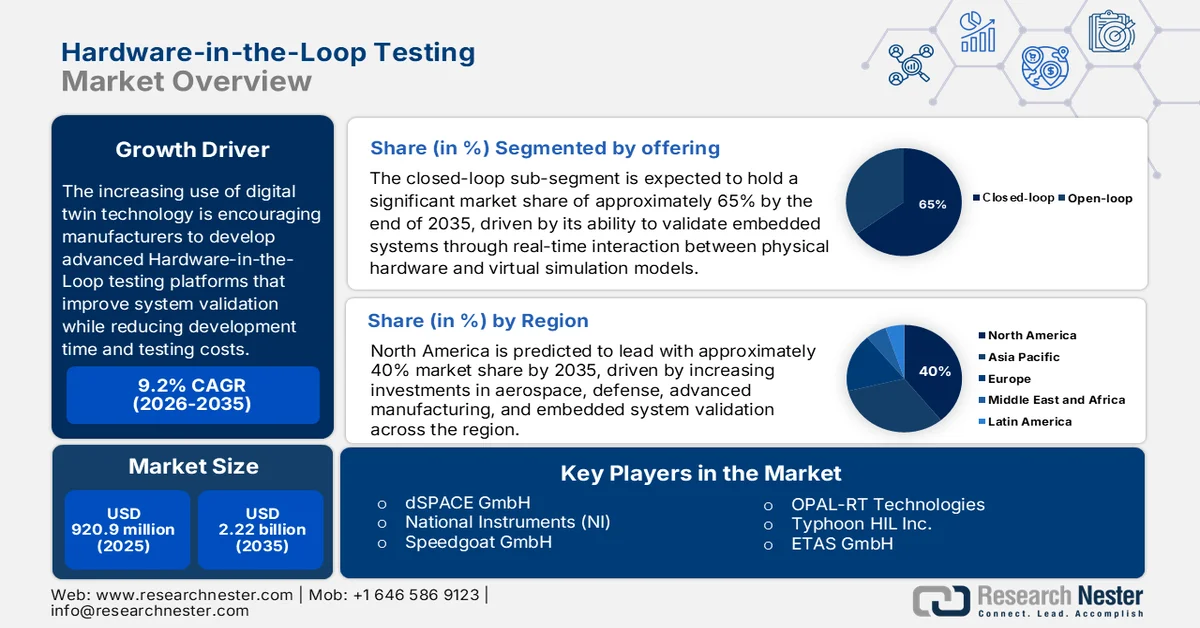
The global hardware-in-the-loop testing market is primarily driven by the rising development and production of electric and software-defined vehicles, which needed advanced real-time testing to validate electronic control units (ECUs), battery management systems, ADAS, and autonomous driving technologies before physical deployment. As automotive manufacturers continue to integrate complex electronic architectures, the need for HIL platforms is increasing to reduce development time, improve system reliability, and lower validation costs. Moreover, it is stated by the International Energy Agency (IEA), that the global electric car sales exceeded 17 million units in 2024, accounting for more than 20% of total new car sales globally, that reflects the rapid expansion of vehicle electrification that is accelerating demand for HIL testing solutions.
The continuous developments in autonomous driving technologies, connected vehicles, aerospace electronics, and industrial automation are increasing the use of HIL testing across multiple industries. Modern HIL platforms support real-time simulation, digital twin integration, AI-enabled validation, and multi-domain testing, which is improving the testing of complex embedded systems across different applications. Moreover, according to the Federal Aviation Administration (FAA), 172,624 U.S. civil aircraft were equipped with ADS-B avionics as of April 2026, that reflects the growing deployment of advanced electronic and avionics systems that needed excessive testing and validation before operation. This trend is helping the long-term implementation of Hardware-in-the-Loop testing solutions among automotive, aerospace, defense, and industrial applications.
Key Hardware-in-the-Loop Testing Market Insights Summary:
Regional Highlights:
- North America is projected to account for 40% share by 2035, supported by increasing investments in aerospace, defense, advanced manufacturing, and embedded system validation
- Europe is expected to secure a significant share of the hardware-in-the-loop testing market throughout 2026-2035, fueled by expanding simulation-based testing across automotive, aerospace, and industrial applications alongside rising semiconductor investments under the European Chips Act
Segment Insights:
- The hardware-in-the-loop testing market closed-loop sub-segment is anticipated to capture 65% share by 2035, benefiting from its ability to provide real-time feedback between physical hardware and virtual models for testing complex systems such as ECUs, ADAS, battery management systems, and autonomous driving technologies
- The hardware sub-segment is projected to maintain its leading position throughout 2026-2035, accounting for the dominant share as a result of the increasing need for real-time simulators, including I/O modules, interface devices, and other testing equipment used to validate complex embedded systems
Key Growth Trends:
- Rising industrial automation and robotics deployment
- Increasing Complexity of Embedded Software
Major Challenges:
- High Cost of HIL Testing Implementation
- Difficulty in Testing Complex Embedded Systems
Key Players: dSPACE GmbH, National Instruments (NI), Speedgoat GmbH, OPAL-RT Technologies, Typhoon HIL Inc., ETAS GmbH.
Global Hardware-in-the-Loop Testing Market Forecast and Regional Outlook:
Market Size & Growth Projections:
- 2025 Market Size: USD 920.9 million
- 2026 Market Size: USD 1 billion
- Projected Market Size: USD 2.22 billion by 2035
- Growth Forecasts: 9.2% CAGR (2026-2035)
Key Regional Dynamics
- Largest Region: North America (40% share by 2035)
- Fastest Growing Region: Asia Pacific
- Dominating Countries: United States, Germany, China, Japan, South Korea
- Emerging Countries: India, Singapore, Brazil, Mexico, United Arab Emirates
Last updated on : 27 July, 2026
Hardware-in-the-Loop Testing Market - Growth Drivers and Challenges
Growth Drivers
- Rising industrial automation and robotics deployment: Manufacturers are increasingly implementing industrial robots and automated production systems to improve productivity, quality, and operational efficiency. These automated systems depend on embedded controllers and real-time control software that must be tested carefully before deployment, which is one of the reasons for the higher demand for Hardware-in-the-Loop testing solutions. Besides this, it is stated by the International Federation of Robotics (IFR) that approximately 542,076 industrial robots were installed globally in 2024, marking the second-highest annual installation level on record. The growing use of industrial robots is helping the adoption of HIL testing across manufacturing and industrial automation applications.
- Increasing Complexity of Embedded Software: In embedded systems, the development of software-based functions is increasing the need among automotive, aerospace, industrial equipment, and medical device applications. As these systems include more software functions, manufacturers need to test embedded controllers properly to confirm reliable performance before deployment. Hardware-in-the-Loop testing allows developers to test controllers in simulated conditions, which helps in identifying issues earlier and reduces development time. Therefore, it is stated by the Eclipse Foundation’s 2024 IoT & Embedded Developer Survey found that 75% of respondents are involved in embedded software development, which reflects the rising role of embedded technologies across industries. This development of software-driven applications is contributing to the demand for Hardware-in-the-Loop testing solutions.
Challenges
- High Cost of HIL Testing Implementation: While setting up Hardware-in-the-Loop testing, it requires a high investment in equipment, software tools, and testing infrastructure. Many small and medium-sized companies find it difficult to manage the cost of these advanced testing systems. Moreover, there are constant upgrades and maintenance needs for new advanced technologies, which further increase the overall expenses associated with HIL testing implementation.
- Difficulty in Testing Complex Embedded Systems: As embedded systems become more advanced with the integration of connected technologies, autonomous features, and multiple electronic components, testing them through HIL platforms becomes more complicated. Ensuring accurate simulations, managing different communication protocols, and integrating various hardware and software components require specialized technical knowledge. These challenges can increase testing time and make it difficult for some companies to implement HIL solutions effectively.
Hardware-in-the-Loop Testing Market Size and Forecast:
| Report Attribute | Details |
|---|---|
|
Base Year |
2025 |
|
Forecast Year |
2026-2035 |
|
CAGR |
9.2% |
|
Base Year Market Size (2025) |
USD 920.9 million |
|
Forecast Year Market Size (2035) |
USD 2.22 billion |
|
Regional Scope |
|
Hardware-in-the-Loop Testing Market Segmentation:
Offering Segment Analysis
By the end of 2035, the closed-loop sub-segment, which falls under the offering segment, is expected to continue to hold the largest share of the hardware-in-the-loop testing market. Closed-loop HIL is predicted to reach approximately 65% of the hardware-in-the-loop testing market, owing to its ability to provide real-time feedback between physical hardware and virtual models, which is one of the reasons it is well-suited for testing complex systems such as ECUs, ADAS, battery management systems, and autonomous driving technologies. Its growing use in electric vehicles and safety-critical applications is expected to support segment growth throughout the forecast period.
Component Segment Analysis
The hardware sub-segment is expected to dominate the hardware-in-the-loop testing market during the forecast period. The increasing need for real-time simulators drives the growth of this segment, including input/output (I/O) modules, interface devices, and other testing equipment used to validate complex embedded systems. As industries continue to develop advanced electronic control units and software-driven products, the demand for reliable HIL hardware is increasing. Moreover, according to the U.S. Department of Defense, the FY 2026 defense budget request is approximately USD 961.6 billion, which reflects constant investment in advanced electronic and mission-critical systems that require extensive testing before deployment.
Testing Phase Segment Analysis
By the end of the forecast period, the design validation sub-segment is anticipated to hold the largest position in the hardware-in-the-loop testing market. Manufacturers are increasingly using HIL testing during the early stages of product development to identify software and hardware issues before physical prototypes are built, which helps in reducing development time and testing costs. Additionally, it is stated by the International Federation of Robotics (IFR), that approximately 541,302 industrial robots were installed globally in 2023, highlighting the growing need to validate embedded control systems and automation software before deployment.
Our in-depth analysis of the hardware-in-the-loop testing market includes the following segments:
|
Segment |
Subsegments |
|
Offering |
|
|
Testing Phase |
|
|
End-user |
|
|
Component |
|

Vishnu Nair
Head - Global Business DevelopmentCustomize this report to your requirements — connect with our consultant for personalized insights and options.
Hardware-in-the-Loop Testing Market - Regional Analysis
North America Market Insights
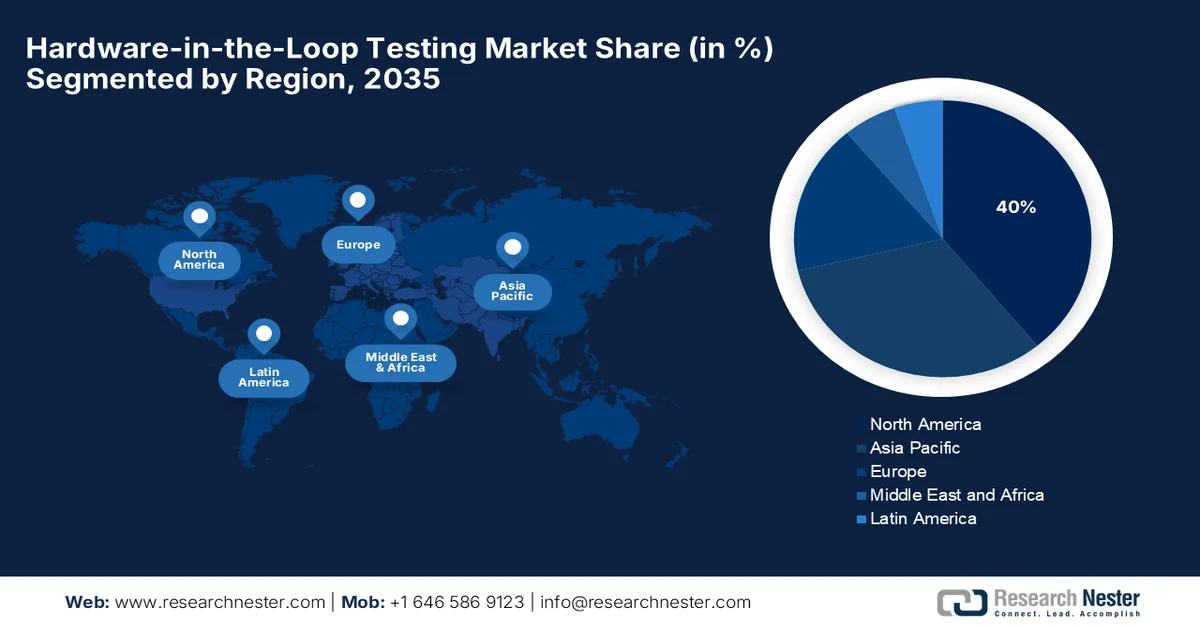
The North America hardware-in-the-loop testing market is anticipated to hold the largest share, approximately 40% by the end of 2035, driven by increasing investments in aerospace, defense, advanced manufacturing, and embedded system validation. The region benefits from the strong presence of HIL solution providers, increasing research activities, and the early implementation of real-time simulation technologies across safety-critical industries. Moreover, according to the U.S. National Science Foundation (NSF), domestic U.S. research and experimental development (R&D) totaled USD 937 billion in 2023, which reflects constant investment in advanced engineering technologies that support the adoption of HIL testing across multiple industries.
The hardware-in-the-loop testing market in the U.S. is expected to register stable growth due to increasing investments in aerospace and defense technologies, where constant testing of embedded systems is important before deployment. HIL testing is largely used to evaluate flight control systems, avionics, and other safety-critical applications under simulated conditions. Moreover, it is stated by the U.S. Department of announced that its FY2026 budget includes USD 13.4 billion for autonomy and autonomous systems, that includes unmanned aerial, ground, maritime, and enabling autonomy software. These advanced autonomous platforms require extensive simulation and validation, supporting the adoption of hardware-in-the-loop testing market across defense applications.
The country is strengthening its engineering capabilities through research programs and advanced manufacturing initiatives, which increase the need for simulation-based testing platforms. The Canada hardware-in-the-loop testing market is projected to register stable growth due to growing investments in aerospace research, defense technologies, and intelligent transportation systems. However, according to the Government of Canada, Canada's defence industry generated CAD 17.3 billion in revenues in 2024, supporting continued investment in advanced defence technologies and embedded systems where Hardware-in-the-Loop testing plays an important role during product development.
Europe Market Insights
The use of hardware-in-the-loop testing is growing across Europe as manufacturers continue developing more advanced electronic systems for automotive, aerospace, and industrial applications. Simulation-based testing is becoming an important part of product development to reduce testing time and improve system performance. Moreover, it is recorded by the European Commission that the Chips for Europe Initiative will mobilize around EUR 43 billion in public and private investments under the European Chips Act. This is creating additional opportunities for HIL testing technologies across the region.
Germany is projected to remain a key market for hardware-in-the-loop testing as manufacturers continue developing advanced semiconductor and embedded electronic technologies. Consistent testing has become highly important to check electronic control systems before deployment. Therefore, according to Germany Trade & Invest (GTAI), Germany's semiconductor industry generated more than EUR 17 billion in revenue in 2025. This is contributing to the demand for HIL testing solutions across the country.
For the hardware-in-the-loop testing market, France witnesses a steady market as the country continues to evolve its aerospace and space technologies. HIL testing is widely used to confirm avionics, navigation systems, and other embedded electronics before deployment. Besides this, according to the French Ministry for the Economy and Finance, France 2030 has allocated EUR 54 billion to accelerate innovation across strategic industries, including aerospace, electronics, and digital technologies. This is contributing to the implementation of HIL testing solutions across the country's aerospace sector.
APAC Market Insights
The Asia Pacific hardware-in-the-loop testing market is anticipated to witness strong growth during the forecast period due to the rapid increase of electronics manufacturing, automotive production, and advanced embedded system development across the region. As manufacturers continue introducing software-driven products, the need for consistent testing during product development is growing. Therefore, according to Japan's Ministry of Economy, Trade and Industry (METI), the government approved up to JPY 920 billion to support Rapidus in establishing advanced semiconductor manufacturing capabilities. The constant growth of the electronics industry is creating favorable opportunities for the adoption of HIL testing solutions.
Japan is emerging as a key market for hardware-in-the-loop testing with the continued progress of robotics and precision engineering technologies. As manufacturers develop more sophisticated control systems, HIL testing is becoming an important part of product validation. Besides, as recorded by the International Federation of Robotics (IFR), Japan produced approximately 38% of the global industrial robot supply in 2023. This is contributing to the increasing use of HIL testing across advanced manufacturing applications.
The implementation of hardware-in-the-loop testing is increasing in China alongside the country's shift toward intelligent manufacturing. As production systems become more software-focused, simulation-based testing is being used to improve product validation before commercial deployment. Furthermore, it is said by the Ministry of Industry and Information Technology (MIIT), China had over 421 national-level smart manufacturing demonstration factories by the end of 2024. This is one of the reasons for the growing use of HIL testing across the manufacturing sector.
Key Hardware-in-the-Loop Testing Market Players:
- dSPACE GmbH (Germany)
- National Instruments (NI) (U.S.)
- Speedgoat GmbH (Switzerland)
- OPAL-RT Technologies (Canada)
- Typhoon HIL Inc. (Switzerland)
- ETAS GmbH (Germany)
- Company Overview
- Business Strategy
- Key Product Offerings
- Financial Performance
- Key Performance Indicators
- Risk Analysis
- Recent Development
- Regional Presence
- SWOT Analysis
- dSPACE GmbH develops Hardware-in-the-Loop testing and real-time simulation systems for the sector like automotive, aerospace, and industrial sectors, its platform is used to test electronic control units such as (ECUs), ADAS, electric powertrains, and autonomous driving systems before deployment.
- National Instruments (NI) provides test and measurement solutions for industries which includes as automotive, aerospace, electronics, and industrial automation. NI VeriStand software and PXI-based systems are used for hardware-in-the-loop testing market, which helps engineers confirm embedded control systems and improve product development.
- Speedgoat GmbH provides real-time target machines which is designed for Hardware-in-the-Loop testing and rapid control prototyping. Its solutions are largely used with MATLAB® and Simulink® for developing and confirming control systems in automotive, aerospace, robotics, and industrial automation applications.
- OPAL-RT Technologies specializes in real-time digital simulation and HIL systems for power systems, transportation, aerospace, and industrial applications, its OPAL-RT HIL Simulator allows engineers to test complicated control systems which comes under realistic operating conditions before deployment.
- Typhoon HIL Inc. develops Hardware-in-the-Loop simulators for power electronics, renewable energy, electric vehicles, and microgrid applications. The HIL404 and HIL606 platforms give consistent real-time simulation for confirming power conversion and control systems.
- ETAS GmbH provides embedded software, measurement, calibration, and HIL testing solutions for the automotive industry. Its LABCAR system has largely been used to confirm fEUCs, vehicle electronics, and software functions, helping manufacturers improve product quality and shorten development cycles.
Here is a list of key players operating in the global hardware-in-the-loop testing market:
While product innovation remains a key area of attention as companies continue to improve real-time simulation capabilities, digital twin integration, and cloud-based testing to match the changing customer requirements. At the same time, vendors are working closely with OEMs and engineering partners to rise the use of HIL platforms across new applications. The global hardware-in-the-loop testing market is slightly competitive, where notable players and specialized solution providers competing among automotive, aerospace, industrial, and energy applications. Their competitive strategies also include increasing into high-growth markets and strengthening long-term customer relationships through wider solution portfolios and technical support.
Corporate Landscape of the Hardware-in-the-Loop Testing Market:
Recent Developments
- In May 2026, OPAL-RT launched OPAL-RT 4DRIVE, a new division that is focusing on simulation and validation solutions for autonomous vehicles and robotics.
- In May 2025, Speedgoat announced the Pulse Real-Time Target Machine, a compact system that is designed for rapid control prototyping and entry-level Hardware-in-the-Loop testing.
- In June 2025, ETAS GmbH and ThunderSoft announced a collaboration to develop a pre-integrated middleware solution for software-defined vehicles, combining ETAS’ vehicle software platform with ThunderSoft’s Aqua Drive OS to support high-performance computing vehicle architectures.
- Report ID: 8698
- Published Date: Jul 27, 2026
- Report Format: PDF, PPT
- Explore a preview of key market trends and insights
- Review sample data tables and segment breakdowns
- Experience the quality of our visual data representations
- Evaluate our report structure and research methodology
- Get a glimpse of competitive landscape analysis
- Understand how regional forecasts are presented
- Assess the depth of company profiling and benchmarking
- Preview how actionable insights can support your strategy
Explore real data and analysis
Frequently Asked Questions (FAQ)
About this Report
Connect with our Expert


Report, 2026-2035



Copyright @ 2026 Research Nester. All Rights Reserved.
