Hybrid Work Hardware Market Outlook:
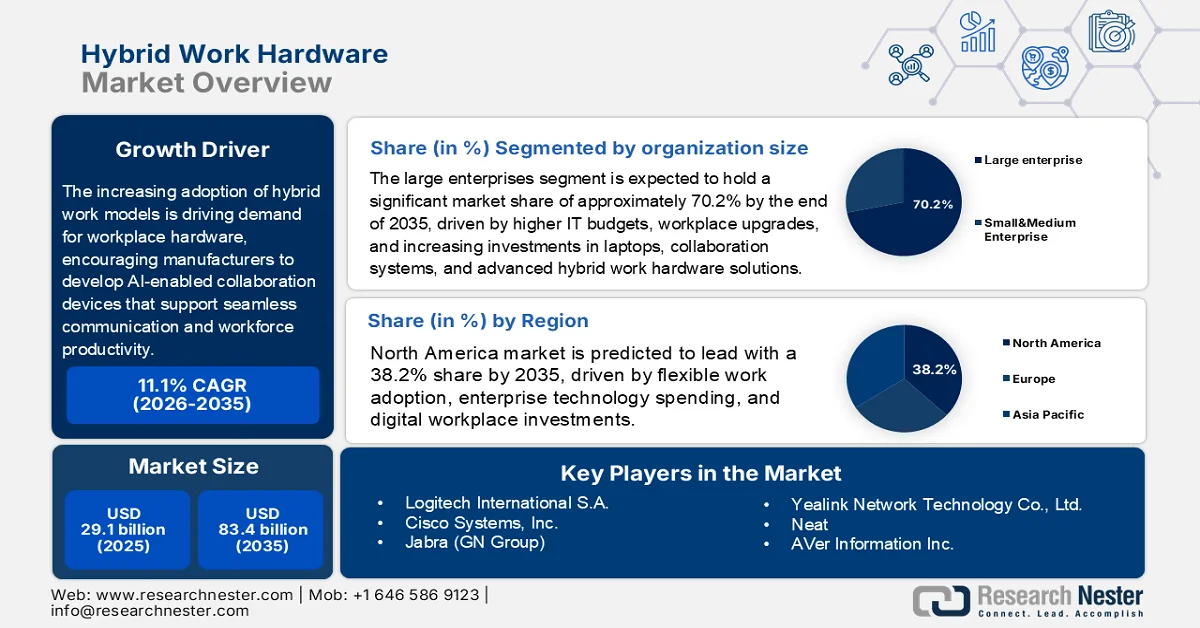
Hybrid Work Hardware Market size was valued at USD 29.1 billion in 2025 and is expected to reach USD 83.4 billion by the end of 2035, registering around 11.1% CAGR during the forecast period, i.e., 2026-2035. In 2026, the industry size of hybrid work hardware is estimated at USD 32.3 billion.
The hybrid work hardware market is anticipated to register considerable growth due to the increasing implementation of a hybrid work culture among businesses and public organizations. As employees continue dividing their time between offices and remote locations, companies are investing in laptops, webcams, headsets, docking stations, monitors, collaboration displays, and video conferencing equipment to help with daily work activities. Besides this, the U.S. Bureau of Labour Statistics (BLS) shows that some or almost all employee want to work form home in 2024, the percentage was approximately 22.8%, which highlights the continued need for flexible workplace arrangements. This current shift is predicted to support the need for hybrid work hardware throughout the forecast period.
Organizations are also increasing investments in workplace revamp by upgrading meeting rooms and collaborative offices with advanced audio-visual equipment and intelligent conferencing solutions. Businesses are adopting combined hardware that supports high-quality communication, which can improve employee collaboration and enhance operational efficiency. Moreover, it is stated from the Cisco's Global Hybrid Work Study, that approximately 60.4% of employees reported that their productivity has increased under hybrid working arrangements, which encourages organizations to invest in advanced collaboration devices and modern workplace hardware.
Manufacturers are announcing workplace devices with artificial intelligence features to improve meeting experiences and everyday productivity. The advanced devices, including AI-enabled webcams, headsets, and conferencing equipment, can automatically reduce background noise, improve video quality, and support meeting transcription, inspiring businesses to replace older workplace devices. Moreover, the Stanford AI Index Report 2025 highlighted that enterprise AI adoption continued to increase across industries as organizations highly unified AI into everyday business activities. As companies are constantly adopting AI-enabled workplace technologies, the need for hybrid work hardware is expected to grow throughout the forecast period.
Key Hybrid Work Hardware Market Insights Summary:
Regional Highlights:
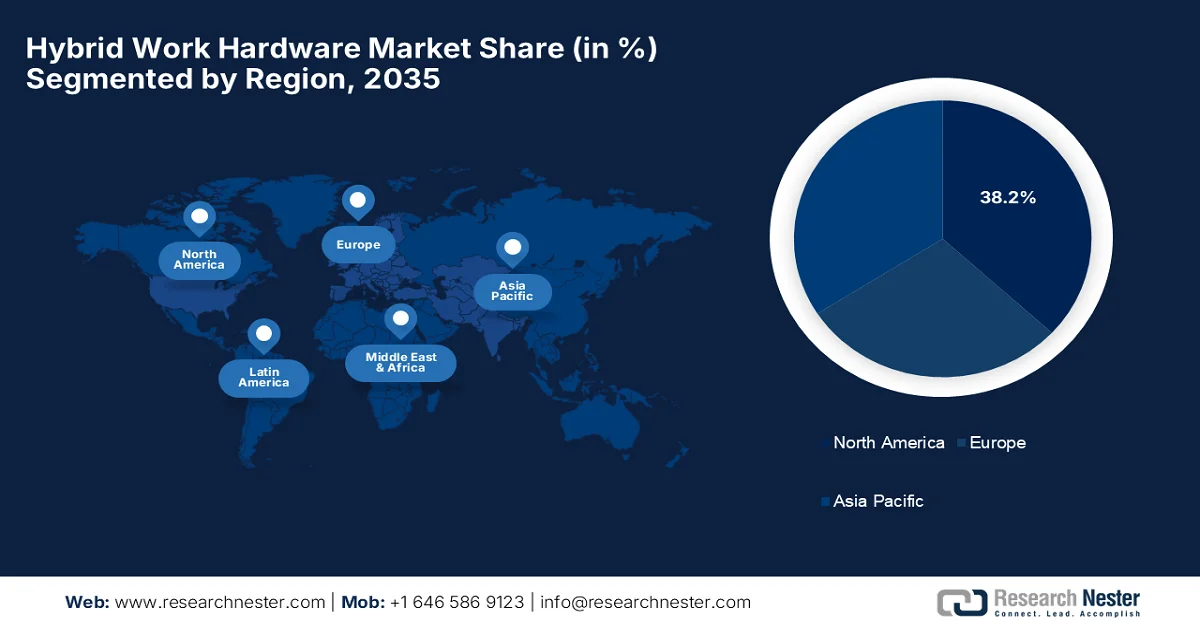
- North America hybrid work hardware market is projected to command 38.2% of the market share by 2035, underpinned by expanding adoption of flexible work models, robust enterprise technology spending, and sustained investments in digital workplace infrastructure
- Europe is anticipated to secure a significant share of the market by 2035, buoyed by rising investments in workplace technology and the accelerating adoption of digital business solutions across industries
Segment Insights:
- The large enterprises segment in the hybrid work hardware market is expected to capture 70.2% of the market share by 2035, fueled by increasing investments in collaboration devices, conferencing systems, and workplace hardware to support distributed workforces
- The offline distribution channel is forecast to maintain its dominant position in the market through 2035, propelled by growing demand for customized enterprise deployments, technical consultation, and on-site implementation services
Key Growth Trends:
- Rising adoption of bring your own device (BYOD) policies
- Expansion of flexible office spaces
Major Challenges:
- High hardware replacement and maintenance costs
- Difficulty in managing hardware across multiple work locations
Key Players: Logitech International S.A. (Switzerland), Cisco Systems, Inc. (U.S., Jabra (GN Group) (Denmark), Yealink Network Technology Co., Ltd. (China), Neat (Norway), AVer Information Inc. (Taiwan).
Global Hybrid Work Hardware Market Forecast and Regional Outlook:
Market Size & Growth Projections:
- 2025 Market Size: USD 29.1 billion
- 2026 Market Size: USD 32.3 billion
- Projected Market Size: USD 83.4 billion by 2035
- Growth Forecasts: 11.1% CAGR (2026-2035)
Key Regional Dynamics:
- Largest Region: North America (38.2% Share by 2035)
- Fastest Growing Region: Europe
- Dominating Countries: United States, Germany, China, Japan, United Kingdom
- Emerging Countries: India, South Korea, Singapore, United Arab Emirates, Canada
Last updated on : 22 July, 2026
Hybrid Work Hardware Market - Growth Drivers and Challenges
Growth Drivers
- Rising adoption of bring your own device (BYOD) policies: This is inspiring businesses to invest in connectivity hubs, monitors, webcams, keyboards, and professional headsets that allow employees to connect personal devices with workplace systems. Organizations are highly implementing Bring Your Own Device policies to improve workforce adaptability and reduce device management costs. As BYOD use increases across organizations, demand for hybrid work is anticipated to increase throughout the forecast period. Moreover, it is stated by the U.S. National Institute of Standards and Technology (NIST) acknowledges laptops, smartphones, and tablets as common BYOD devices that need secure enterprise access, which highlights the growing importance of compatible workplace accessories.
- Expansion of flexible office spaces: Businesses are increasingly choosing coworking spaces and flexible office facilities to reduce operational costs while giving employees an adaptable work setting. The development of flexible office spaces is creating new opportunities for the hybrid work hardware market. These workplaces needed meeting room displays, connectivity hubs, webcams, collaboration bars, conferencing systems, and professional audio equipment to help with daily business events. Besides this, it is stated that International Workplace Group (IWG), that approximately 83% of CEO’s have already permitted teams to work from multiple locations, while 30% of corporate real estate portfolios are expected to comprise flexible workspaces by 2030. As workers continue growing shared office facilities and businesses are adopting flexible workspace models, the need for hybrid work hardware is predicted to increase throughout the forecast period.
- Growing demand for high-performance computing devices: Organizations are upgrading monitors, docking stations, webcams, professional headsets, and high-performance laptops to improve efficiency and ensure smooth daily operations. Businesses are steadily investing in high-performance workplace devices to support resource-comprehensive applications which includes virtual collaboration, content creation, engineering software, and data analytics. Moreover, this is stated by the international telecommunication union (ITU), that approximately 5.5 billion people around 68% of the global population, used the Internet in 2024, that showcase the continued expansion of digital workplaces and connected business surroundings. As organizations continue refining workplace performance and employee efficiency, the need for hybrid work hardware is showing growth in the forecast period.
Challenges
- High hardware replacement and maintenance costs: Companies need to replace workplace models from time to time as devices become old or no longer meet business requirements. Whereas small and medium-sized enterprises may delay these purchases because of limited budgets and other business priorities. Some devices need more frequent updates, which includes laptops, monitors, webcams, docking stations, headsets, and meeting room equipment, which can increase overall business expenses, especially for organizations with a large labor force. Therefore, many organizations continue using existing equipment for longer periods, which can slow the adoption of new hybrid work hardware during the forecast period.
- Difficulty in managing hardware across multiple work locations: Managing workplace hardware becomes more difficult as employees work from offices, homes, and common workspaces. Where companies must confirm all office devices are available wherever employees are located, while also managing replacements and routine support. While continuing consistent hardware availability among multiple locations can needed an additional time, coordination, and operational resources. For companies whose employees are working across different countries or cities, these challenges can slow down the purchasing decisions and limit investment in hybrid work hardware during the forecast period.
Hybrid Work Hardware Market Size and Forecast:
| Report Attribute | Details |
|---|---|
|
Base Year |
2025 |
|
Forecast Period |
2026-2035 |
|
CAGR |
11.1% |
|
Base Year Market Size (2025) |
USD 29.1 billion |
|
Forecast Year Market Size (2035) |
USD 83.4 billion |
|
Regional Scope |
|
Hybrid Work Hardware Market Segmentation:
Organization Size Segment Analysis
Based on the organization size segment, the large enterprises sub-segment is anticipated to account for the largest share of the hybrid work hardware market, holding approximately 70.2% by the end of 2035. Large administrations continue to invest in laptops, conferencing systems, collaboration displays, docking stations, and professional audio equipment to support employees working across multiple office locations and remote environments. These businesses also benefit from larger IT budgets and long-term technology procurement strategies, that enables faster placement of workplace hardware. Therefore, it is said by the Eurostat, that approximately 94% of large enterprises conducted remote meetings through online platforms in 2024, which reflects the increasing dependence on digital collaboration infrastructure. The growing use of virtual collaboration is expected to encourage continued investment in hybrid work hardware across large enterprises.
Distribution Channel Segment Analysis
Based on the distribution channel, the offline sub-segment is anticipated to account for the largest share of the hybrid work hardware market by the end of 2035. An offline workplace remains the preferred option for enterprise projects that need customized placement and technical assistance. Businesses prefer purchasing workplace hardware through offline channels because the company’s deployments often require customized solutions, technical guidance, and on-site implementation services. Moreover, according to the U.S. General Services Administration (GSA), professional technology purchase and integrated solutions help organizations implement and manage enterprise IT infrastructure efficiently. As enterprises continue investing in workplace modernization, the offline distribution channel is predicted to maintain its leading position throughout the forecast period.
Product Type Segment Analysis
For the product type segment, the computing devices sub-segment is predicted to account for the largest share of the market, by the end of 2035. Laptops, desktops, and tablets remain the primary workplace devices that are used by employees working across office and remote environments. Where companies continue to invest in advanced computing devices to improve workforce productivity, support business applications, and enable secure access to company systems. The growing dependence on digital workflows and enterprise applications remain to reinforce the demand for computing devices across workplaces. As businesses continue strengthening digital workplaces, the need for computing devices is expected to remain strong throughout the forecast period.
Our in-depth analysis of the hybrid work hardware includes the following segments:
|
Segment |
Subsegments |
|
Organization Size |
|
|
Product Type |
|
|
End user |
|
|
Distribution |
|

Vishnu Nair
Head - Global Business DevelopmentCustomize this report to your requirements — connect with our consultant for personalized insights and options.
Hybrid Work Hardware Market - Regional Analysis
North America Market Insights
North America is predicted to cater for the largest share of the hybrid work hardware market, approximately 38.2% the end of 2035, which is reinforced by the global adoption of flexible work arrangements, high enterprise technology expenditure, and continuous investments in digital workplaces. Across the region, organizations are constantly upgrading laptops, connectivity hubs, webcams, partnership displays, and conferencing equipment to support employees who are working in multiple locations. The region also benefits from strong IT infrastructure and early adoption of workplace technologies. Moreover, organizations across North America continue to increase investments in digital workplace technologies and modern office infrastructure to improve collaboration and support flexible work arrangements. This ongoing trend is expected to strengthen demand for hybrid work hardware throughout the forecast period.
The hybrid work hardware market in the U.S. continues to lead the regional market as businesses increase workplace updates to help flexible working models. Many organizations are redesigning meeting spaces with advanced conferencing systems while upgrading employee workstations to improve teamwork and operational efficiency. Therefore, according to the according to the Federal Reserve's Economic Well-Being of U.S. Households in 2024 report, that approximately 41% of workers worked from home at least some of the time in the week before the survey, reflecting the continued need for digital workplace technologies and compatible hybrid work hardware.
Canada is emerging as an important market for hybrid work hardware due to the increasing digital transformation initiatives among businesses and government organizations. Where employers are directing on providing employees with consistent workplace experiences by regulating workplace devices across corporate offices and remote work settings. Besides this, it is stated by according to Statistics Canada, approximately 20.1% of Canadians usually worked most of their hours from home in 2023, that showcase the continued implementation of flexible work arrangements across the country.
Europe Market Insights
Europe is expected to hold a significant share of the market by the end of 2035, and is supported by growing investments in workplace technology across industries. Businesses are preparing workplaces with modern hardware to improve employee productivity and collaboration across different business locations. Beside this, it is stated by Eurostat, that approximately 45.5% of companies in the European union has purchased cloud computing services in 2023, that showcase the growing use of digital technologies by businesses.
Germany is predicted to account for a major share of the European market due to the strong presence of manufacturing, automotive, and engineering industries that need effective workplace management. Businesses are training offices and production facilities with modern conferencing and collaboration hardware to improve communication between distributed teams. The country's constant focus on industrial innovation and connected workplaces is inspiring organizations to modernize workplace environments.
Employers are investing in conferencing systems, collaboration displays, and professional workplace hardware to provide a constant working experience across office and remote environments. The United Kingdom is anticipated to register steady growth in the hybrid work hardware market due to the continued implementation of flexible working practices across businesses. It is stated by the Office for National Statistics (ONS), that more than 28% of working adults in Great Britain have worked in a hybrid model during autumn 2024, that showcase the constant preference for flexible work arrangements.
APAC Market Insights
Businesses are improving office connectivity by arranging modern communication devices that support teams from different locations and digital business operations. Asia Pacific is registering the fastest growth in the market by the end of 2035, due to the enhancement of digital structure and rising enterprise technology implementation across emerging and developed countries. It is to the Asian Development Bank (ADB), approximately 98.76% of the population in developing Asia was covered by a mobile network and/or ICT in 2024, that reflect the region's expanding digital connectivity and creating favorable conditions for workplace technology adoption. As organizations continue expanding digital offices, demand for hybrid work hardware is expected to rise steadily.
Organizations are arranging professional communication hardware to help efficient teamwork between employees working from different locations. Japan hybrid work hardware market is predicted to hold for a significant share of the Asia Pacific, due to the country's increasing focus on improving workplace productivity within an aging population. Beside this, it is stated by Japan’s Ministry of Land, Infrastructure, Transport and Tourism (MLIT), the share of employed teleworkers in Japan was approximately 24.6% in FY2024, reflecting the continued adoption of flexible work practices across the country.
Australia is predicted to account for a steady market growth as businesses continue expanding flexible employment policies across various industries. Employers are standardizing workplace devices to provide employees with a consistent work experience regardless of where they perform their jobs. Moreover, it is said by the Australian Bureau of Statistics (ABS) that approximately 36% of employed people have usually worked from home at least once a week during 2023. This current shift is expected to support steady demand for hybrid work hardware throughout the forecast period.
Key Hybrid Work Hardware Market Players:
- Logitech International S.A. (Switzerland)
- Cisco Systems, Inc. (U.S.
- Jabra (GN Group) (Denmark)
- Yealink Network Technology Co., Ltd. (China)
- Neat (Norway)
- AVer Information Inc. (Taiwan)
- Company Overview
- Business Strategy
- Key Product Offerings
- Financial Performance
- Key Performance Indicators
- Risk Analysis
- Recent Development
- Regional Presence
- SWOT Analysis
- Logitech International S.A. develops workplace collaboration devices that contain webcams, video conferencing systems, keyboards, mice, and headsets. Its Logitech Rally Bar, Brio webcams, and Zone wireless headsets are largely used in hybrid workplaces.
- Cisco Systems, Inc. provides enterprise association through its Webex portfolio, which includes video conferencing devices, IP phones, and collaboration room systems. The company focuses on secure messaging and workplace meetings with AI features.
- Jabra (GN Group) pay attention to workplace audio and intelligent video solutions that improve communication across hybrid offices. It includes headset family and PanaCast conferencing cameras that are largely adopted for professional meetings and team collaboration.
- Yealink Network Technology Co., Ltd. continues to expand its workplace collaboration portfolio by introducing communication solutions for offices of different sizes
- Neat focuses on creating collaboration hardware that is easy to arrange and operate in modern workplaces. Its products are built to streamline virtual meetings by giving compatibility with leading video conferencing platforms.
- AVer Information Inc. strengthens its market position through AI-powered conferencing and presentation solutions for business and education customers.
Here is a list of key players operating in the global market:
The global hybrid work hardware market is moderately competitive, with established technology companies and workplace hardware providers serving enterprise customers globally. Their competitive differentiation highly depends on AI-enabled meeting features, that includes seamless compatibility with unified communication platforms, and easy device management capabilities. Market participants are paying attention on increasing their portfolios with digital conferencing devices, professional audio equipment, video collaboration systems, and workplace communication solutions to meet the evolving need of hybrid work environments. Companies are also strengthening deliberate partnerships, product innovation, and global distribution networks to enhance their enterprise customer base. Moreover, continuous investments in smart workplace technologies and integrated collaboration solutions are expected to intensify competition throughout the forecast period.
Corporate Landscape of the Market:
Recent Developments
- In January 2026, Logitech International S.A. announced the Rally AI Camera and Rally AI Camera Pro, which increases its enterprise association portfolio with AI-powered conference cameras that are designed for large meeting spaces and hybrid workplaces.
- In September 2025, Jabra (GN Group) collaborated with Lenovo to launch the second-generation PanaCast 50 Room System, that is an AI-optimized video conferencing solution planned to increase hybrid meetings with greater flexibility and improved collaboration capabilities.
- Report ID: 8679
- Published Date: Jul 22, 2026
- Report Format: PDF, PPT
- Explore a preview of key market trends and insights
- Review sample data tables and segment breakdowns
- Experience the quality of our visual data representations
- Evaluate our report structure and research methodology
- Get a glimpse of competitive landscape analysis
- Understand how regional forecasts are presented
- Assess the depth of company profiling and benchmarking
- Preview how actionable insights can support your strategy
Explore real data and analysis
Frequently Asked Questions (FAQ)
About this Report
Connect with our Expert


Report, 2026-2035



Copyright @ 2026 Research Nester. All Rights Reserved.
