Spiral Membrane Market Outlook:
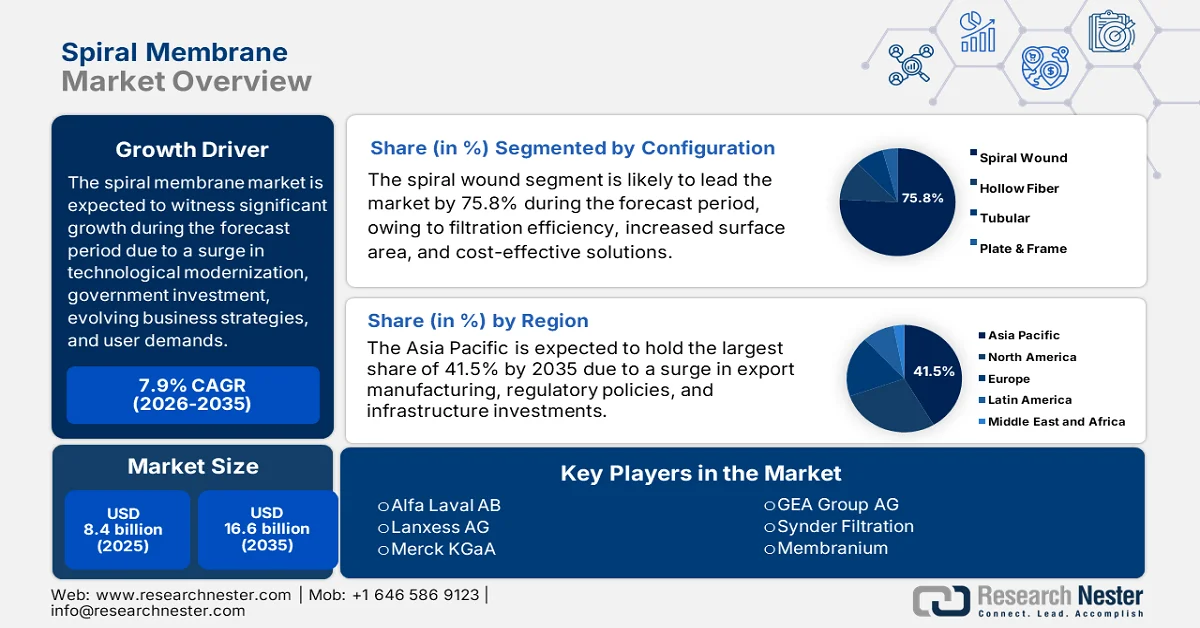
Spiral Membrane Market size was valued at over USD 8.4 billion in 2025 and is expected to reach USD 16.6 billion by the end of 2035, growing at a CAGR of 7.9% during the forecast period, i.e., 2026-2035. In 2026, the industry size of spiral membrane is evaluated at USD 9 billion.
The global spiral membrane market is currently experiencing transformative shifts, which are fueled by charging end user expectations, evolving business models, and technological innovation, along with government funding, regional dynamics, and regulatory frameworks. According to official statistics published by the World Economic Forum in December 2025, the latest water-based venture funds are estimated to reach USD 6.7 trillion by the end of 2030 and further to USD 22 trillion by the end of 2050 worldwide. Besides, Microsoft’s international water consumption has increased by 34% as of 2022, which is driven by artificial intelligence (AI) model training. Moreover, Ofwat in the UK has expanded its Innovation Fund until 2030 with an additional USD 533 million, thus bringing the overall funding to USD 800 million for more than 10 years, thus suitable for the market upliftment.
Furthermore, the digital transformation and smart membrane systems, advanced material innovations beyond traditional polymers, circular economy, end-of-life membrane management, modular and decentralized system architectures, along with water-as-a-service and performance-based business models, are certain trends that are proliferating the spiral membrane market globally. As stated in an article published by the World Health Organization (WHO) in September 2023, almost 1.7 billion people utilize a drinking water source contaminated with faeces. However, in 2022, 73% of the worldwide population, which is about 6 billion people, utilized a safely managed drinking-water-service that is easily located on premises and readily available when required, along with being free from contamination, thereby denoting a huge growth opportunity for the market.
Key Spiral Membrane Market Insights Summary:
Regional Highlights:
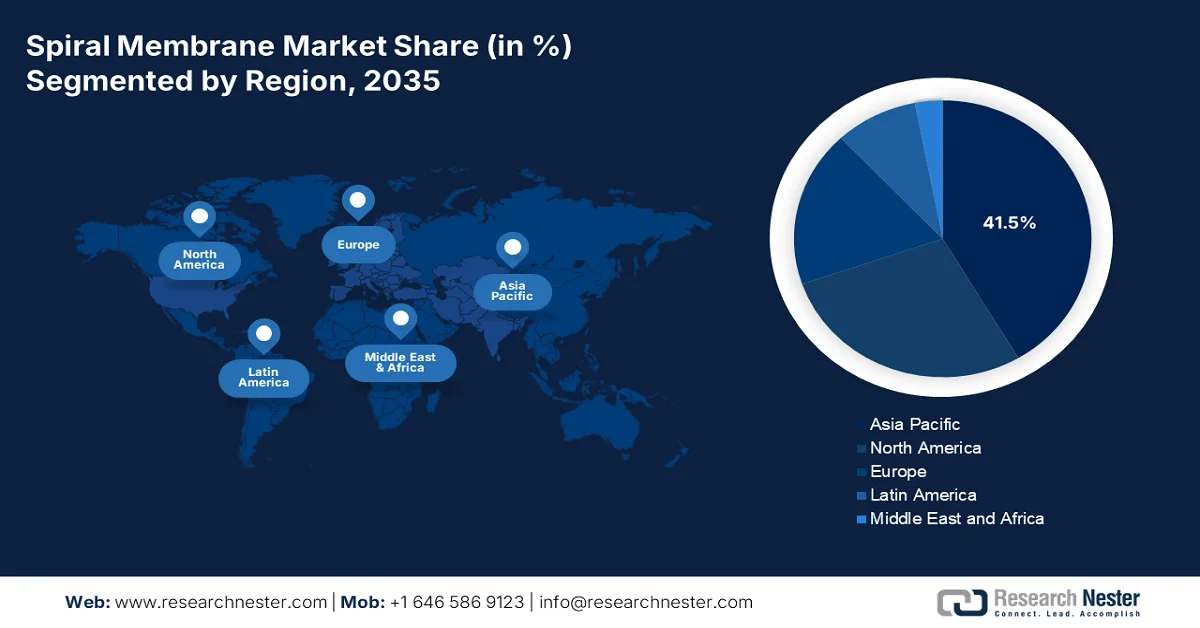
- Asia Pacific spiral membrane market is projected to capture a 41.5% share by 2035, attributed to expanding industrial activities, rising water infrastructure investments, and stringent regulatory enforcement
- Europe is anticipated to witness the fastest growth in the forecast period for the spiral membrane industry, fueled by sustainability initiatives, decarbonization targets, and advancements in water treatment technologies
Segment Insights:
- The spiral wound sub-segment in the spiral membrane market is projected to account for a 75.8% share by 2035, propelled by its superior filtration efficiency, compact design advantages, and cost-effective high surface area solutions
- The 8 inches sub-segment is expected to secure the second-largest share by 2035, driven by its balanced performance in operational efficiency, system flexibility, and widespread adoption across water treatment applications
Key Growth Trends:
- Increase in water reuse
- Expansion of biotechnology and pharmaceutical manufacturing
Major Challenges:
- Membrane fouling and scaling
- High initial investment expenses
Key Players: DuPont de Nemours, Inc. (U.S.), SUEZ Water Technologies & Solutions (France), Toray Industries, Inc. (Japan), Hydranautics (Nitto Denko Corporation) (Japan), LG Water Solutions (LG Chem) (South Korea), Koch Membrane Systems, Inc. (U.S.), Pall Corporation (U.S.), Pentair PLC (U.K.), Alfa Laval AB (Sweden), Lanxess AG (Germany), Merck KGaA (Germany), GEA Group AG (Germany), Synder Filtration (U.S.), Membranium (Russia), Applied Membranes, Inc. (U.S.), Microdyn-Nadir GmbH (Germany), Toyobo Co., Ltd. (Japan), Vontron Membrane Technology Co., LTD (China), Uniqflux Membranes LLP (India), Hyflux Ltd. (Singapore), PPG (U.S.), ZwitterCo (U.S.).
Global Spiral Membrane Market Forecast and Regional Outlook:
Market Size & Growth Projections:
- 2025 Market Size: USD 8.4 billion
- 2026 Market Size: USD 9 billion
- Projected Market Size: USD 16.6 billion by 2035
- Growth Forecasts: 7.9% CAGR (2026-2035)
Key Regional Dynamics:
- Largest Region: Asia Pacific (41.5% Share by 2035)
- Fastest Growing Region: Europe
- Dominating Countries: United States, China, Germany, Japan, India
- Emerging Countries: South Korea, Singapore, United Arab Emirates, Brazil, Mexico
Last updated on : 18 March, 2026
Spiral Membrane Market - Growth Drivers and Challenges
Growth Drivers
- Increase in water reuse: Industries facing corporate sustainability, discharge regulations, and water scarcity targets are increasingly implementing spiral membrane systems, suitable enough for zero liquid discharge and water reutilization. Based on government estimates published by the EPA Government in October 2025, recycled water is a reliable supply of water, with more than 500 facilities in the U.S. recycling water to cater to meeting community requirements. Besides, water recycling offers approximately 7.5 million gallons of recycled water every day to Chevron’s Richmond refinery. In addition, this strategy assists in conserving enough drinking water for more than 83,000 residents by utilizing recycled water for industrial purposes, thus denoting an optimistic outlook for the spiral membrane market development.
- Expansion of biotechnology and pharmaceutical manufacturing: The rapid expansion of biotechnology and pharmaceutical manufacturing, especially for advanced therapeutics and biologics, is creating specialized demand for the spiral membrane market in critical applications globally. According to official statistics published by the PIB Government in December 2025, the bioeconomy industry in India effectively grew from USD 10 billion to USD 165.7 billion, along with a clear trajectory to USD 300 billion by the end of 2030. Besides, as per an article published by the UNIDO Organization in December 2025, quarterly indices of industrial production (IIPs) are presently available for an estimated 120 countries and readily covering 97.5% of international manufacturing value added (MVA). Additionally, quarterly manufacturing trade data comprised nearly 60 nations, demonstrating almost 90% of the overall manufacturing trade, thus fueling the market exposure.
- Innovation in food and beverage: The food and beverage sector is increasingly adopting the spiral membrane market for fractionation, clarification, and concentration-based applications that provide efficiency advantages and product quality over conventional thermal processes. As stated in an article published by NLM in November 2022, every year, approximately 265 million meals are readily served to hospitalized patients. Besides, the food and beverage industry is positioned in the top 3 industries that offer agricultural product inputs into the aged care sector, significantly accounting for 18% of overall intermediate inputs. Therefore, with this increase in the sector’s exposure, especially in the healthcare industry, the spiral membrane market is gaining increased exposure across different regions.
Challenges
- Membrane fouling and scaling: Membrane fouling represents the most persistent technical challenge in the spiral membrane market, fundamentally impacting operational efficiency and total cost of ownership. Fouling occurs when suspended solids, organic matter, microorganisms, or mineral scales accumulate on the membrane surface or within its pore structure, progressively blocking the filtration pathways. This accumulation reduces the permeate flux and increases the transmembrane pressure required to maintain production, directly translating to higher energy consumption. The financial implications of fouling are substantial. Each cleaning cycle not only incurs direct chemical costs but also requires system downtime, reducing overall plant availability and productivity.
- High initial investment expenses: The substantial capital expenditure required for spiral membrane systems creates a formidable barrier to market penetration, particularly in price-sensitive developing regions and among small-to-medium enterprises. Complete system installations, encompassing membranes, pressure vessels, high-pressure pumps, instrumentation, and control systems, depend on capacity and configuration requirements. This upfront financial commitment often exceeds the budgetary constraints of potential adopters, even when the long-term operational economics favor membrane technology over conventional treatment methods. In emerging markets where access to capital is constrained and competing investment priorities abound, this extended return horizon significantly dampens adoption rates, thus negatively impacting the spiral membrane market.
Spiral Membrane Market Size and Forecast:
| Report Attribute | Details |
|---|---|
|
Base Year |
2025 |
|
Forecast Year |
2026-2035 |
|
CAGR |
7.9% |
|
Base Year Market Size (2025) |
USD 8.4 billion |
|
Forecast Year Market Size (2035) |
USD 16.6 billion |
|
Regional Scope |
|
Spiral Membrane Market Segmentation:
Configuration Segment Analysis
The spiral wound sub-segment, which is part of the configuration segment, is anticipated to garner the largest share of 75.8% in the spiral membrane market by the end of 2035. The sub-segment’s upliftment is highly fueled by its importance for increasing filtration efficiency in compact spaces and providing high surface area, durable, and cost-effective solutions. Besides, this configuration's dominance derives from its ingenious engineering design that maximizes membrane surface area within a compact cylindrical form factor. The spiral wound element consists of flat membrane sheets separated by feed spacers, wrapped around a central permeate collection tube, creating a sandwich-based structure that achieves packing densities and significantly surpasses plate-and-frame alternatives. This efficiency translates directly to reduced capital costs, as smaller pressure vessels and simplified piping networks can achieve equivalent treatment capacity compared to bulkier configurations.
Membrane Diameter Segment Analysis
During the forecast period, the 8 inches sub-segment, part of the membrane diameter segment, is projected to account for the second-largest share in the spiral membrane market. The sub-segment’s growth is highly driven by its optimized balance of membrane surface area, operational efficiency, and system design flexibility. The engineering sophistication of 8-inch elements has evolved considerably, with manufacturers optimizing feed spacer thickness and membrane leaf counts to balance fouling resistance against energy consumption. The sub-segment's growth is reinforced by its ubiquitous adoption across reverse osmosis and nanofiltration applications, particularly in desalination, municipal drinking water production, and industrial wastewater treatment, thus proliferating the sub-segment’s expansion.
Polymer Type Segment Analysis
The polyamide segment in the spiral membrane market is expected to hold the third-largest share by the end of the stipulated timeline. The segment’s development is highly propelled by its effective utilization for the thin-film composite active layer in spiral-wound membranes, primarily owing to its outstanding performance in water treatment, especially for nanofiltration and reverse osmosis. According to official statistics published by NLM in April 2024, PA-66 and PA-6 significantly account for 90% of overall polyamide products. Besides, in the case of PA-66, the preparation constitutes a 30% hexamethylene diamine aqueous solution, along with adding adipic acid with a similar molar mass as hexamethylene diamine to prepare nylon 66 salt at a temperature ranging from 40 to 50 degrees Celsius, thereby making it suitable for bolstering the segment growth.
Our in-depth analysis of the spiral membrane market includes the following segments:
|
Segment |
Subsegments |
|
Configuration |
|
|
Membrane Diameter |
|
|
Polymer Type |
|
|
Technology |
|
|
End use |
|
|
Application |
|

Vishnu Nair
Head - Global Business DevelopmentCustomize this report to your requirements — connect with our consultant for personalized insights and options.
Spiral Membrane Market - Regional Analysis
APAC Market Insights
The Asia Pacific in the spiral membrane market is anticipated to garner the highest share of 41.5% by the end of 2035. The market’s upliftment is highly attributed to industrial expansion, water infrastructure investment, regulatory enforcement, and export manufacturing. According to official statistics published by the ADB Organization in December 2025, over 60% of the region’s population, which is nearly 2.7 billion people, has been effectively lifted from extreme water insecurity for more than the past 12 years. Besides, critical weather incidents such as saltwater intrusion, rise in sea levels, and storm surges have threatened the region, already accounting for 41% of the global floods. Moreover, the Asia Water Development Outlook (AWDO) has estimated that USD 4 trillion is poised to be offered by the end of 2040 or USD 250 billion every year for catering to the region’s hygiene, sanitation, and water demands.
The spiral membrane market in China is growing significantly, owing to the stringent enforcement of water pollution control laws, industrial facilities’ ability to effectively install advanced treatment systems, and the presence of large petrochemical complexes. As stated in an article published by the ITA in September 2025, the country is regarded as the largest economy for environmental technological products, continuously growing at a yearly rate of 12.8%. As of 2022, the industry in the country significantly generated USD 329 billion in operating income, accounting for 1.85 of GDP and readily employing more than 3.2 million people. Based on this, the country has effectively aimed to gain a sewage treatment rate of more than 95% across country-level areas and an increase in the recycled water utilization rate to over 25% in water-scarce cities, particularly at the prefecture level, thus responsible for driving the market.
The government support for environmental and manufacturing compliance, increased focus on research and development for separation technologies, the implementation of PLI schemes, and strengthened manufacturing capabilities are certain factors that are responsible for uplifting the spiral membrane market in India. Based on government estimates published by the PIB Government in January 2026, the country comprises a network of 43,228 groundwater level monitoring stations, along with 712 Jal Shakti Kendras, and 53,264 Atal Jal Water Quality Monitoring Stations. Meanwhile, groundwater comprises almost 99% of Earth’s liquid freshwater, providing substantial environmental, social, and economic benefits to the nation. Besides, the provision of suitable investments for different water treatment strategies is positively impacting the market growth in the country.
Water Treatment Funding Opportunities in India (2026)
|
Funding Amount |
Reason |
|
USD 20,794.5 |
Water conservation and rainwater harvesting structures |
|
USD 3,910 |
Conventional water bodies restoration |
|
USD 11,210.0 |
Reuse and recharge structures development |
|
USD 22,019.2 |
Watershed development work completion |
|
USD 1.64 billion |
Intensive afforestation activities |
Source: PIB Government
Europe Market Insights
Europe in the spiral membrane market is expected to emerge as the fastest-growing region during the forecast period. The market’s development in the region is highly propelled by sustainability transformation, Europe Green Deal, technologies to improve water quality, and industrial decarbonization. According to official statistics published by the Europe Electric Organization in May 2023, the region has originally committed to reducing almost 40% of carbon dioxide emissions by the end of 2030 and also set an aspiration of 80% to 95% reduction by 2050. Besides, the new decarbonization target has aimed in diminishing the region’s net greenhouse gas emissions by almost 55% by the end of 2030 and achieve climate neutrality by 2050. Therefore, with this increased focus on decarbonization, there is a huge growth opportunity for the market in the overall region.
The spiral membrane market in the UK is gaining increased exposure, owing to modernization in water infrastructure, generous funding opportunities for manufacturing across tactical sectors, the suitable provision of carbon capture, and clean energy supply chains. As per an article published by the UK Government in April 2025, the country is home to 7 major industrial clusters, which significantly produce 50% of overall domestic industrial emissions. Besides, the presence of a robust carbon capture, utilization and storage (CCUS) industry tends to support high-skilled and well-paid employment, and further contributes to the potential to generate USD 5.1 billion to USD 6.4 billion as gross value added every year. In addition, this is projected to support 50,000 employment opportunities by the end of 2030, thereby making it suitable for driving the market development in the country.
The aspects of government allocation programs, a massive shift towards cleaner technologies, the existence of chemical companies, and ensuring long-lasting investments in membrane-based separation technologies to reduce energy intensity are certain factors for boosting the spiral membrane market in Germany. Based on an article published by the Clean Energy Wire in December 2025, renewable energy sources covered almost 56% of the country’s gross electricity consumption as of 2025. Additionally, there has been a further surge in the renewables share by 0.7% points in comparison to previous years, owing to an increase in installed solar power capacity. Besides, there has also been an increase in solar power output by 18.7%, while the robust growth in installed capacity tend to eb sustained, with over 17 GW added to the energy system, which is creating an optimistic outlook for the market development.
North America Market Insights
North America in the spiral membrane market is projected to witness considerable growth by the end of the stipulated timeline. The market’s growth in the region is highly driven by a strict environmental regulatory framework, the presence of a mature water infrastructure undergoing significant modernization, the increased adoption of innovative membrane technologies, and high replacement demand. According to official statistics published by the WEF Organization in November 2025, the Water Environment Federation in the region has significantly projected to invest USD 1.8 trillion in water infrastructure by the end of 2044. This goes beyond unlocking almost USD 4.6 trillion in economic output, which is followed by bolstering USD 1.5 trillion, and supporting more than 950,000 employment opportunities every year, thus driving the market demand in the overall region.
The spiral membrane market in the U.S. is gaining increased exposure, owing to the existence of federal regulations, substantial government infrastructure funding, advanced filtration technologies, and the upgradation of water infrastructure. Based on government estimates published by the EPA Government in March 2025, granular activated carbon (GAC) is regarded as a proven technology with high removal efficiencies of almost 99.9%, especially for different volatile organic compounds. Besides, adsorptive media is also another technology with the benefit of high removal efficiencies for certain inorganic contaminants, including over 99% for arsenic and nearly 99% for fluoride. Therefore, with the availability of such technologies for water treatment, the market is gradually gaining increased exposure in the overall country.
The aspects of water infrastructure investments, strict environmental policies focused on sustainability, focus on environmental conservation, industrial wastewater treatment applications, and the demand for energy and sustainable solutions are certain factors that are fueling the spiral membrane market in Canada. As stated in an article published by the Government of Canada in November 2025, the country’s government has deliberately increased the planned funding, which has increased from USD 12,600,000 to USD 24,926,551 for each order of government, which has brought the overall investment in the wastewater treatment project to USD 49,853,102. Besides, the government has initiated an additional investment of USD 24.9 million to support Quebec in this particular project, thereby denoting a positive impact for the market growth.
Key Spiral Membrane Market Players:
- DuPont de Nemours, Inc. (U.S.)
- SUEZ Water Technologies & Solutions (France)
- Toray Industries, Inc. (Japan)
- Hydranautics (Nitto Denko Corporation) (Japan)
- LG Water Solutions (LG Chem) (South Korea)
- Koch Membrane Systems, Inc. (U.S.)
- Pall Corporation (U.S.)
- Pentair PLC (U.K.)
- Alfa Laval AB (Sweden)
- Lanxess AG (Germany)
- Merck KGaA (Germany)
- GEA Group AG (Germany)
- Synder Filtration (U.S.)
- Membranium (Russia)
- Applied Membranes, Inc. (U.S.)
- Microdyn-Nadir GmbH (Germany)
- Toyobo Co., Ltd. (Japan)
- Vontron Membrane Technology Co., LTD (China)
- Uniqflux Membranes LLP (India)
- Hyflux Ltd. (Singapore)
- PPG (U.S.)
- ZwitterCo (U.S.)
- Company Overview
- Business Strategy
- Key Product Offerings
- Financial Performance
- Key Performance Indicators
- Risk Analysis
- Recent Development
- Regional Presence
- DuPont de Nemours, Inc. is a pioneering force in the spiral membrane market, leveraging its iconic FilmTec brand to set industry benchmarks for reverse osmosis and nanofiltration technologies. The company's relentless focus on innovation ensures its membranes remain the preferred choice for desalination and water reuse projects worldwide.
- SUEZ Water Technologies & Solutions combines deep expertise in water treatment with a comprehensive portfolio of spiral membranes, offering integrated solutions that address complex municipal and industrial challenges. The company's commitment to digital monitoring and service-based models enhances the performance and longevity of its membrane systems.
- Toray Industries, Inc. stands as a global leader in advanced materials, producing high-performance spiral membranes that excel in durability and contaminant rejection across diverse applications. The company's substantial investment in research and development drives continuous improvements in membrane efficiency and fouling resistance.
- Hydranautics (Nitto Denko Corporation) is renowned for its engineering excellence and reliable membrane products that serve critical water treatment and industrial separation needs. The company's strong technical support and customization capabilities foster enduring partnerships with system integrators and end-users.
- LG Water Solutions (LG Chem) has rapidly emerged as a significant competitor in the global membrane market, leveraging LG Chem's material science prowess to deliver innovative and energy-efficient products. The company's strategic focus on customer-centric solutions and expanding production capacity strengthens its position in key growth regions.
Here is a list of key players operating in the global spiral membrane market:
The global spiral membrane market is characterized by a moderately consolidated competitive landscape, with the top players accounting for a significant portion of worldwide revenue. The market is dominated by established multinational corporations with strong research and development capabilities in polymer chemistry and membrane manufacturing. Key players such as DuPont and Toray Industries maintain leadership positions through extensive patent portfolios and long-standing relationships with engineering, procurement, and construction firms. Besides, in March 2025, Alfa Laval received a significant order for an advanced filtration plant for its utilization as a modernized factory, particularly in Asia. This plant is readily valued at an estimated USD 9.2 million, and it is one of the largest membrane orders, which is positively driving the overall spiral membrane industry worldwide.
Corporate Landscape of the Spiral Membrane Market:
Recent Developments
- In December 2025, Toray Industries, Inc. declared that it has created technology to upscale the latest high-sensitivity and high-durability nanofiltration membrane element that tends to efficiently recover increased yields of high-purity lithium while recycling automotive lithium-ion batteries.
- In November 2025, PPG proclaimed unveiling of an ultrafiltration (UF) antifouling membrane for industrial water purification and treatment to its portfolio of spiral-wound filter elements. This membrane has been developed to meet the growing demand for sustainable UF filtration solutions.
- In April 2025, ZwitterCo declared the availability of the newest product line of sanitary super filtration spiral membrane elements that features its second-generation SF technology. These particular membranes are FDA-approved for their utilization in whey processing, which includes the production of products such as whey protein isolate and whey protein concentration.
- Report ID: 8446
- Published Date: Mar 18, 2026
- Report Format: PDF, PPT
- Explore a preview of key market trends and insights
- Review sample data tables and segment breakdowns
- Experience the quality of our visual data representations
- Evaluate our report structure and research methodology
- Get a glimpse of competitive landscape analysis
- Understand how regional forecasts are presented
- Assess the depth of company profiling and benchmarking
- Preview how actionable insights can support your strategy
Explore real data and analysis
Frequently Asked Questions (FAQ)
About this Report
Connect with our Expert


Report, 2026-2035



Copyright @ 2026 Research Nester. All Rights Reserved.
