Shape Memory Polymer Market Outlook:
Shape Memory Polymer Market size was valued at USD 2.1 billion in 2025 and is expected to cross USD 5.3 billion by the end of 2035, expanding at more than 9.9% CAGR during the forecast period, 2026-2035. In 2026, the industry size of shape memory polymer is assessed at USD 2.3 billion.
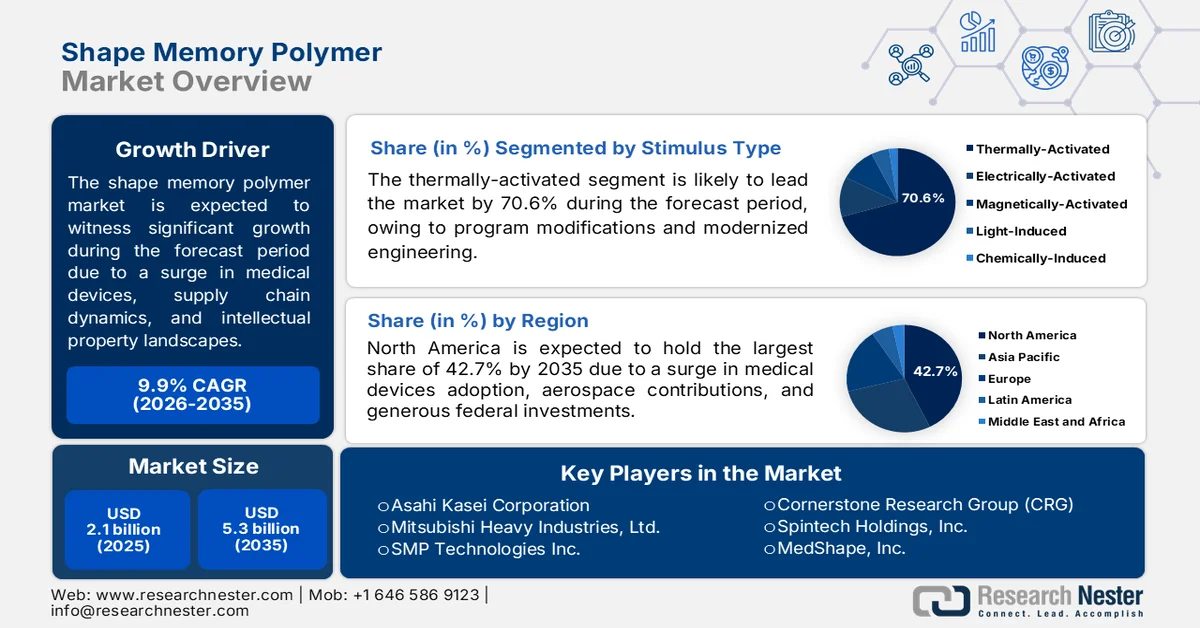
The global shape memory polymer market is continuously being reshaped by factors beyond the traditional narrative of medical devices, material substitution, and 4D printing. Emerging dynamics, such as raw material supply chain reconfiguration, evolving intellectual property landscapes, and cross-industrial regulatory philosophies, are driving the market expansion. According to official statistics published by NLM in September 2025, these polymers comprise biodegradable d,l-lactide-co-trimethylene carbonate (PDLLA-co-TMC), which are usually adjusted to 5: , 7:3, 8:2, and 9:1. Additionally, this PDLLA-co-TMC copolymer is used to ensure fine-tuning of glass transition temperature, ranging between 19.2 degrees Celsius and 44.2 degrees Celsius. Besides, these fibers tend to exhibit outstanding shape memory attributes, with a fixed ratio of 98% and recovery ratio of 94%, respectively, thus bolstering the shape memory polymer market upliftment.
Furthermore, the decentralized micro-factories for the shape memory polymer market component production, radiative cooling films, open-source formulations, dual-utilized export control arbitrage, and waste stream segregation at recycling facilities are a few trends that are fueling the industry exposure. As stated in an article published by NLM in February 2026, the worldwide peak electricity demand is projected to surge by an estimated 40% by the end of 2035, demonstrating a trend that is massively driven by an increase in the need for space cooling. Besides, passive radiative cooling technology operates to reduce heat gain and emit internal heat into cold deep space, roughly 3 K, through the atmospheric transmission window, ranging between 8 and 13 μm. Meanwhile, in terms of component production, the ongoing supply of natural polymers also makes it suitable for expanding the shape memory polymer market exposure.
2024 Natural Polymers Export and Import Analysis
|
Countries/Component |
Export (USD) |
Import (USD) |
|
China |
1.0 billion |
- |
|
Sweden |
583.0 million |
- |
|
U.S. |
344.0 million |
500.0 million |
|
South Korea |
- |
263.0 million |
|
Germany |
- |
229.0 million |
|
Global Trade Valuation |
3.7 billion |
|
|
Global Trade Share |
0.01% |
|
|
Product Complexity |
0.6 |
|
Source: OEC
Key Shape Memory Polymer Market Insights Summary:
Regional Highlights:
- North America is anticipated to dominate the shape memory polymer market with a 42.7% share by 2035, stimulated by rising adoption of minimally invasive medical implants, aerospace advancements, and sustained federal investments in advanced manufacturing
- Asia Pacific is projected to witness the fastest expansion in the market throughout 2026–2035, accelerated by strong semiconductor integration, expanding automotive production, rapid industrialization, and increasing 4D technology adoption
Segment Insights:
- The thermally-activated segment is forecast to capture a 70.6% share of the shape memory polymer market by 2035, fueled by its growing utilization in programmable engineering applications requiring heat-responsive property modifications
- The biomedical and healthcare segment is anticipated to secure the second-highest share in the market during 2026–2035, supported by expanding medical device deployment, advanced treatment integration, and increasing healthcare infrastructure investments
Key Growth Trends:
- Precision agriculture microrobot demand
- Luxury automotive personalization
Major Challenges:
- Regulatory ambiguity and certification fragmentation
- End user risk aversion and failure liability
Key Players: BASF SE, Covestro AG, Evonik Industries AG, DuPont de Nemours, Inc., The Lubrizol Corporation, Asahi Kasei Corporation, Mitsubishi Heavy Industries, Ltd., SMP Technologies Inc., Cornerstone Research Group (CRG), Spintech Holdings, Inc., MedShape, Inc., Shape Memory Medical, Inc., EndoShape, Inc., Composite Technology Development, Inc., Nanoshel LLC, Smith & Nephew plc, 3M Innovative Properties Co., Boston Scientific Scimed, Inc., Johnson & Johnson Vision Care, Guangzhou Manborui Material Technology Co., Ltd., FUGO Precision 3D.
Global Shape Memory Polymer Market Forecast and Regional Outlook:
Market Size & Growth Projections:
- 2025 Market Size: USD 2.1 billion
- 2026 Market Size: USD 2.3 billion
- Projected Market Size: USD 5.3 billion by 2035
- Growth Forecasts: 9.9% CAGR (2026-2035)
Key Regional Dynamics:
- Largest Region: North America (42.7% Share by 2035)
- Fastest Growing Region: Asia Pacific
- Dominating Countries: United States, China, Japan, Germany, South Korea
- Emerging Countries: India, Singapore, Canada, France, United Kingdom
Last updated on : 13 May, 2026
Shape Memory Polymer Market - Growth Drivers and Challenges
Growth Drivers
- Precision agriculture microrobot demand: The agricultural technology industry is gradually scaling the deployment of micro-robots, which is responsible for driving the shape memory polymer market growth globally. According to official statistics published by the ACS Publications in June 2025, collagenase motors incubated with spheroids and readily exposed to calcium iron usually demonstrate a 3-fold increase in motor penetration in comparison to control groups. In addition, motors that are decorated with magnetic nanoparticles tend to deliver heat through magnetic hyperthermia, thus diminishing cell viability to an estimated 60% to 70% in comparison to more than 90% in controls. Therefore, this particular microrobot demands micro-actuators that have low power, are lightweight, and have the capability of ensuring high-cycle operation, thus driving the market growth.
- Luxury automotive personalization: The aspect of mass-market automotive has significantly adopted the shape memory polymer industry for functional applications, such as thermal flaps and air intakes. As stated in a data report published by the Automotive Skills Development Council in 2026, the automotive industry is considered one of the main driving forces for the India-based economy, readily accounting for almost 7% of total gross domestic product (GDP) and employing 32 million workers. Furthermore, the industry is projected to employ 45 million people by the end of 2026, effectively creating an additional employment of almost 35 million. Therefore, with this continuous increase in employment, the industry is eventually expanding, with increase provision of personalization to engage consumers, thus enhancing the shape memory polymer market demand.
Automotive Employment in India (in Million), 2018-2026
|
Segment |
2018 |
2019 |
2020 |
2021 |
2022 |
2023 |
2024 |
2025 |
2026 |
|
Manufacturing & R&D |
4.1 |
3.9 |
4.3 |
4.6 |
4.8 |
5.1 |
5.4 |
5.7 |
6.0 |
|
OEM |
0.3 |
0.3 |
0.3 |
0.3 |
0.3 |
0.3 |
0.3 |
0.4 |
0.42 |
|
Auto Comp |
1.7 |
1.6 |
1.8 |
1.9 |
2.0 |
2.1 |
2.2 |
2.3 |
2.4 |
|
RM |
2.0 |
2.0 |
2.1 |
2.3 |
2.5 |
2.6 |
2.8 |
2.9 |
3.1 |
|
Dealership Sales |
3.0 |
2.7 |
2.7 |
2.8 |
3.0 |
3.1 |
3.4 |
3.6 |
3.8 |
|
Vehicle Service Total |
5.0 |
5.3 |
5.6 |
5.8 |
6.0 |
6.2 |
6.5 |
6.7 |
7.0 |
|
Authorized Service Center |
2.0 |
2.1 |
2.2 |
2.3 |
2.3 |
2.4 |
2.5 |
2.6 |
2.8 |
|
Roadside Mechanics |
3.0 |
3.2 |
3.4 |
3.5 |
3.6 |
3.7 |
3.9 |
4.1 |
4.2 |
|
Total |
29.4 |
30.7 |
32.6 |
34.3 |
35.8 |
37.6 |
40.0 |
42.4 |
45.0 |
Source: Automotive Skills Development Council
- Prosthetic socket dynamic fit-systems: The worldwide prosthetics industry is currently experiencing an increase in the demand for dynamic fit systems that automatically adjust socket geometry, which is proliferating the shape memory polymer market. As per an article published by the MIT Solve in April 2023, the World Health Organization (WHO) has estimated that 1 in 10 people needing mobility aids, such as orthotics and prosthetics, have suitable access to them. This readily means that out of the 35 million to 40 million people globally, only 4 million have access to prosthetics, owing to poor supply chains and increased expenses. Besides, 0.5% of the population across low and middle-income nations requires the utilization of orthotics and prosthetics, thus positively impacting the market demand and exposure.
Challenges
- Regulatory ambiguity and certification fragmentation: The presence of end users in regulated industries faces a dizzying, often contradictory approval landscape that stretches certification timelines beyond commercial viability. In medical devices, the same SMP composition that receives FDA clearance for a neurovascular implant may require entirely new biocompatibility testing for an orthopedic application simply because the implantation site has different pH or mechanical loading conditions. Besides, regulators have not yet established standardized test protocols for key SMP-specific failure modes, such as incomplete recovery after various cycles or gradual property degradation under constant physiological strain, thus limiting the shape memory polymer market expansion.
- End user risk aversion and failure liability: Based on this roadblock, the most sophisticated material science means nothing if procurement managers and design engineers refuse to spec it. The shape memory polymer market introduced a failure mode that conventional materials simply do not possess. This caters to the sudden inability to remember or execute the programmed shape change at the critical moment of deployment. A metal spring either meets its torque specification or it does not; there is no scenario where it partially recovers or recovers ten seconds too late. However, these particular polymers are susceptible to subtle degradation from moisture absorption, UV exposure, or micro-damage during handling, all of which can shift activation temperature or reduce recovery force without visible warning signs.
Shape Memory Polymer Market Size and Forecast:
| Report Attribute | Details |
|---|---|
|
Base Year |
2025 |
|
Forecast Year |
2026-2035 |
|
CAGR |
9.9% |
|
Base Year Market Size (2025) |
USD 2.1 billion |
|
Forecast Year Market Size (2035) |
USD 5.3 billion |
|
Regional Scope |
|
Shape Memory Polymer Market Segmentation:
Stimulus Type Segment Analysis
The thermally-activated segment, part of the stimulus type, is anticipated to account for the highest share of 70.6% in the shape memory polymer market by the end of 2035. The segment’s upliftment is primarily attributed to its necessity in modernizing engineering, owing to its ability to undergo drastic programmable modification in properties, such as light emission, solubility, and shape in response to severe heat. According to official statistics published by NLM in April 2025, oleophilic polymer brush layers, which behave as thermally activated polymers, are readily prepared on a silicon-based wafer by utilizing a surface-driven atom transfer radical polymerization. Its initial thickness in the collapsed and dry stage ranges from 150 to 250 nm, which depends on the detailed synthesis, thereby making it suitable for bolstering the segment’s exposure globally.
End use Industry Segment Analysis
Based on the end use industry, the biomedical and healthcare segment is projected to garner the second-highest share in the shape memory polymer market during the forecast period. The segment’s growth is effectively driven by its importance for modernized medicine, by combining advanced treatments, enhancing patient care, and escalating disease diagnosis. As stated in an article published by the WHO in 2026, globally, there are approximately 2 million different types of medical devices in the biomedical and healthcare industry, which are categorized into over 7,000 generic device groups. Besides, based on the January 2024 ITA article, the healthcare industry in India has successfully reached more than USD 370 billion as of 2022, which is further predicted to reach over USD 610 billion by the end of 2026, thus driving the market growth and demand.
Material Type Segment Analysis
By the end of the stipulated timeline, the polyurethane shape memory polymer sub-segment, which is part of the material type, is expected to grab the third-highest share. The sub-segment’s development is highly propelled by its emergence as crucial smart materials that effectively return to a pre-set shape upon exposure to stimuli, including electricity, light, and heat, by combining rapid recovery and high elasticity. As per an article published by NLM in June 2022, polyurethanes are the 6th most comprehensively utilized polymer globally, with production of almost 25 million tons, and further projected to grow in the coming 5 years by 6.8%. Therefore, this increased demand originates from high popularity, along with outstanding mechanical and physical properties, thus denoting an optimistic outlook for the shape memory polymer market’s growth and upliftment.
Our in-depth analysis of the shape memory polymer market includes the following segments:
|
Segment |
Subsegments |
|
Stimulus Type |
|
|
End use Industry |
|
|
Material Type |
|
|
Application Type |
|
|
Form/Product Design |
|
|
Functionality |
|

Vishnu Nair
Head - Global Business DevelopmentCustomize this report to your requirements — connect with our consultant for personalized insights and options.
Shape Memory Polymer Market - Regional Analysis
North America Market Insights
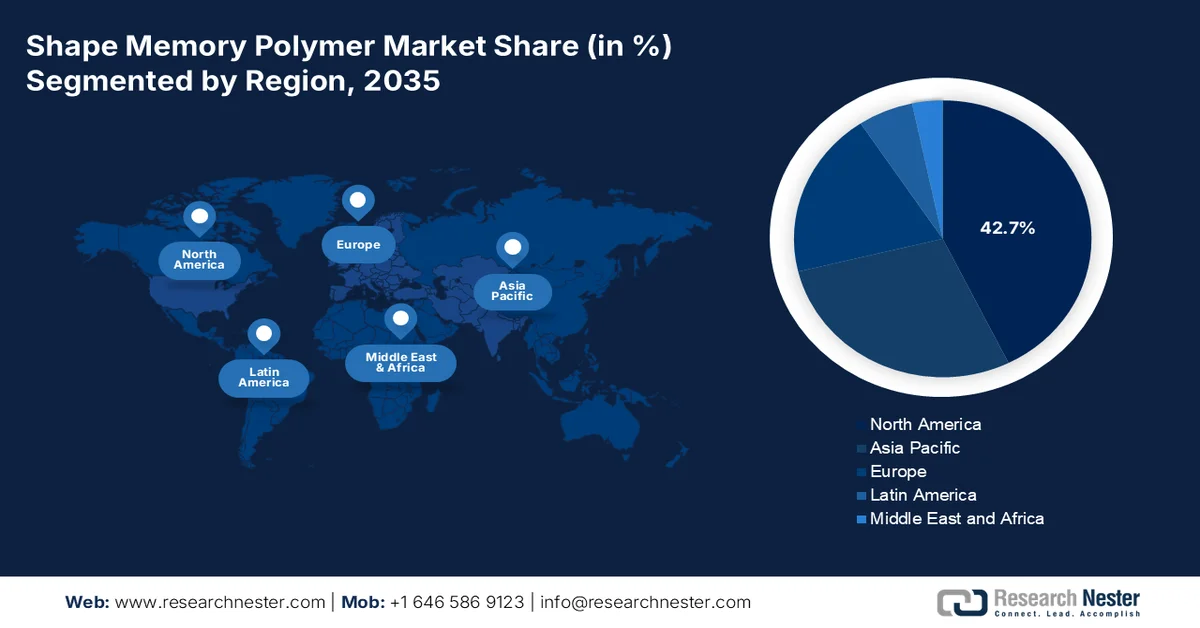
North America in the shape memory polymer market is anticipated to account for the largest share of 42.7% by the end of 2035. The market’s upliftment in the region is primarily attributed to the continuous adoption of minimally invasive embolization devices, orthopedic applications, and structural heart implants by the healthcare industry, the presence of major aerospace manufacturers, and the sustained federal funding for biobased chemicals and advanced manufacturing. According to official statistics published by Duke Health in July 2025, the health facility pioneered a world-first technique that has the ability to expand by almost 20% of the donor pool for pediatric heart transplants, especially in the U.S., and provide hope to the patient population. Besides, every year, nearly 700 children are readily added to the waitlist for a pediatric heart transplant, of which 10% to 20% die while waiting, thus ensuring the need for pacemakers for heart muscles, for which the shape memory polymer market is growing in the region.
2024 Pacemakers Export and Import Analysis in North America
|
Countries |
Export (USD) |
Import (USD) |
|
U.S. |
376.0 million |
1.8 billion |
|
Costa Rica |
1.9 million |
3.6 million |
|
Canada |
881,000 |
63.3 million |
|
Panama |
640,000 |
2.0 million |
|
Mexico |
520,000 |
20.8 million |
|
Dominican Republic |
371,000 |
3.3 million |
|
Anguilla |
240,000 |
- |
|
Cayman Islands |
125,000 |
384,000 |
Source: OEC
The shape memory polymer market in the U.S. is growing significantly, owing to regulatory catalysts, biomedical innovation, aerospace and defense modernization, advanced materials manufacturing infrastructure, automotive lightweighting mandates, and increased focus on smart mandates and energy efficiency policy. Based on government estimates published by the ITA in 2023, the foreign direct investment (FDI) into the domestic aerospace industry totaled more than USD 20 billion. In addition, the majority of the foreign-owned domestic affiliates in the industry supported more than 40,000 employment opportunities as of 2022. Moreover, this particular industry continues to employ almost 550,000 workers, demonstrating suitable improvements and advancements, which is responsible for enhancing the shape memory polymer market exposure in the country.
The presence of public healthcare innovation mandates, a robust academic-industrial research pipeline, sustainable materials policies, the integration of the aerospace supply chain, and cold climate adaptive technologies are certain factors that are boosting the shape memory polymer market in Canada. As per an article published by Statistique Canada in December 2025, the high green-intensity industries usually maintain substantial productivity benefits of 50% to 60% across low green-intensity sectors. Moreover, as a resource-rich country with 14.6% of its GDP associated with natural resource extraction, related industries, and energy production, Canada is heavily focused on achieving sustainability objectives. Besides, green employment opportunities through task analysis cater to 2% to 4% of domestic employment, thereby denoting an optimistic outlook for the market upliftment.
APAC Market Insights
The Asia Pacific in the shape memory polymer market is expected to emerge as the fastest-growing region during the forecast period. The market’s development in the country is highly propelled by strength in electronics manufacturing, semiconductor integration, and automotive production, along with suitable government policies, investments in innovative manufacturing technologies, a rise in the healthcare industry demand, rapid industrialization, and an increase in the 4D adoption. According to official statistics published by the Semiconductor Organization in May 2026, the year-to-year sales in March 2025 for semiconductors accounted for 108.5% in the region, with 74.8% in China and 7.4% in Japan. In addition, the month-to-month sales increased in China by 12.7%, 9.8% in the overall region, and 7.1% in Japan, thereby denoting a huge growth opportunity for the shape memory polymer market.
The shape memory polymer market in China is gaining increased traction, owing to prioritizing advanced smart materials by offering direct funding, suitable growth in the automotive industry, leading to an increased demand in battery thermal management, as well as domination in consumer electronics manufacturing. As per an article published by The State Council in December 2025, there has been a rise in the combined operating revenues of the country’s electronic information manufacturing industry by 8.3% to USD 1.9 trillion, while an increase in overall domestic profits has been observed, accounting for 12.8% to USD 83.6 billion. Besides, the country produced 1 billion smartphones, demonstrating an increase by 0.7%. Simultaneously, the country’s integrated circuit output effectively reached 386.6 billion units, indicating a 10.2% year-on-year surge, thus positively catering to the market’s welfare.
The aspects of rapid development of the minimally invasive and biomedical device industry, an increase in the latest industrial robots installation in the automotive sector, the comprehensive adoption of endoscopic surgery, technological innovation in adaptive materials, and supply chain dynamics forming an integrated ecosystem are a few trends that are responsible for fueling the shape memory polymer market in Japan. Besides, the market in the country was valued at USD 67.5 million as of 2025, which is expected to be worth USD 71.4 million by the end of 2026, and further reach USD 325.6 million by the end of 2035, mounting at a 24.1% growth rate. Moreover, based on the April 2026 NLM article, an overall 7,028 endoscopic surgeries have been conducted in the country as of 2023, with endoscopic carpal tunnel release as the most performed surgery, accounting for 2,407 patients, which is 38% of the patient population, followed by 1,287 or 22.6% of patients for endoscopic sinus surgery, thus proliferating the market demand.
Europe Market Insights
Europe in the shape memory polymer market is projected to experience suitable expansion by the end of the stipulated timeline. The market’s growth in the region is effectively fueled by a strict regulatory framework, especially in medical device applications, driving advancement in high-quality formulations, the presence of chemical players, focus on sustainability, and the development of eco-friendly biobased polymer alternatives. According to official statistics published by MedTech Europe in September 2025, there exists 4% of high public health risk, which is followed by 26% of high risk for individual patients, 49% of medium risk for individual patients, and 21% for low risk for individual patients. Besides, in terms of patent applications, the number was more than 15,700 that have been filed in the Europe Patient Office, demonstrating a 1.2% reduction in comparison to previous years, thereby ensuring a positive impact on the shape memory polymer market growth.
Europe-Based Patent Application Across Different Fields, 2024
|
Field Type |
Patent Applications |
|
Computer Technology |
16,815 |
|
Electrical Machinery, Apparatus, Energy |
16,142 |
|
Digital Communication |
15,983 |
|
Medical Technology |
15,701 |
|
Transport |
10,026 |
|
Measurement |
9,601 |
|
Biotechnology |
8,479 |
|
Pharmaceuticals |
8,359 |
|
Other Special Machines |
6,258 |
|
Organic Fine Chemistry |
6,092 |
Source: MedTech Europe
The shape memory polymer market in Germany is gaining increased exposure, owing to the largest chemical producer that maintains expanded research and development in polyurethane-specific products, the automotive industry is readily undergoing transformation towards electric vehicles, and growth in the medical device industry. As stated in an article published by the Clean Energy Wire Organization in January 2026, there has been a surge in electric car registrations by 43% as of 2024. Additionally, in comparison to 2023, the sales were almost 545,000 electric cards, accounting for a 4.0%. Moreover, in total, the newest car registration surged by 1.4% to 2.9 million, while the share of battery-driven electric vehicles increased by 19.1%. Meanwhile, electric vehicle sales in the country are gradually increasing with the government’s approach to increase the number to 15 million by the end of 2030, thus enhancing the shape memory polymer market demand.
The regional transition investments, manufacturing relocation trends, a rapidly modernizing chemical regulatory environment, the utilization of NextGeneration recovery funds, and contributions made by chemical manufacturers are a few trends that are responsible for fueling the shape memory polymer market in Spain. As per an article published by Structural Change and Economic Dynamics in April 2026, the Spain Can Plan is considered an industrial policy, with an estimated 6.billion allocation for enhancing and modernizing the competitiveness of the domestic economy. Besides, the industrial sector readily contributed 12.3% to the nation’s gross value added (GVA). Moreover, the Strategic Projects for Economic Recovery and Transformation (PERTEs), which cater to nearly 30% of the overall mobilized resources, thus creating a huge growth opportunity for the market in the country.
Key Shape Memory Polymer Market Players:
- BASF SE (Germany)
- Covestro AG (Germany)
- Evonik Industries AG (Germany)
- DuPont de Nemours, Inc. (U.S.)
- The Lubrizol Corporation (U.S.)
- Asahi Kasei Corporation (Japan)
- Mitsubishi Heavy Industries, Ltd. (Japan)
- SMP Technologies Inc. (Japan)
- Cornerstone Research Group (CRG) (U.S.)
- Spintech Holdings, Inc. (U.S.)
- MedShape, Inc. (U.S.)
- Shape Memory Medical, Inc. (U.S.)
- EndoShape, Inc. (U.S.)
- Composite Technology Development, Inc. (U.S.)
- Nanoshel LLC (U.S.)
- Smith & Nephew plc (UK)
- 3M Innovative Properties Co. (U.S.)
- Boston Scientific Scimed, Inc. (U.S.)
- Johnson & Johnson Vision Care (U.S.)
- Guangzhou Manborui Material Technology Co., Ltd. (China)
- FUGO Precision 3D (U.S.)
- Company Overview
- Business Strategy
- Key Product Offerings
- Financial Performance
- Key Performance Indicators
- Risk Analysis
- Recent Development
- BASF SE leverages its deep expertise in polyurethane chemistry to develop thermally responsive SMP formulations suitable for industrial actuators and smart packaging applications. The company focuses on integrating its SMPs into existing high-volume manufacturing workflows, prioritizing process stability and material consistency over niche specialty grades.
- Covestro AG concentrates on SMP solutions for the automotive and textile sectors, emphasizing thermoplastics that can be recycled or reprocessed after their shape-memory function is exhausted. The company's strategic approach centers on pairing SMPs with digital simulation tools, allowing engineers to predict recovery behavior without extensive physical prototyping.
- Evonik Industries AG targets the high end of the shape memory polymer market by developing implant-grade polymer systems designed for long-term biocompatibility and precise degradation timing. Their work focuses on resorbable SMPs that gradually transfer mechanical load to healing tissue, eliminating the need for secondary extraction surgeries.
- DuPont de Nemours, Inc. applies its heritage in high-performance elastomers to create SMPs capable of surviving extreme thermal and chemical environments found in downhole oil and gas equipment. The company prioritizes fail-safe recovery mechanisms, ensuring that actuation occurs reliably even after years of dormant storage.
- The Lubrizol Corporation specializes in thermoplastic polyurethane SMPs that offer exceptional strain recovery and surface finish quality for medical device housings and catheters. The company works closely with original equipment manufacturers to tailor glass transition temperatures precisely to body temperature, enabling passive actuation without external heating.
Here is a list of key players operating in the global shape memory polymer market:
The shape memory polymer market is characterized by a diverse mix of large multinational chemical conglomerates and specialized medical device firms, with the latter often holding significant influence in the high-value biomedical segment. Key players are intensely focused on securing regulatory clearances and expanding clinical applications to drive adoption, particularly for embolization and structural heart procedures. Strategic initiatives include substantial investments in R&D to enhance biocompatibility and recovery precision, alongside geographic expansion into high-growth Asia Pacific markets, where demand from the automotive and consumer electronics sectors is surging. Besides, in December 2025, Shape Memory Medical Inc. declared that its IMPEDE® Embolization Plug product successfully received certification as a Class III device under the Europe Medical Device Regulation (MDR) 2017/745, thus denoting a huge expansion for the shape memory polymer industry globally.
Corporate Landscape of the Market:
Recent Developments
- In January 2026, FUGO Precision 3D entered into a tactical partnership with Graphy Inc., which marked a crucial milestone in the organization’s objective to market ahead of its commercial launch.
- In August 2025, SMP Technologies effectively received the acceptance for a public subsidy from the National Center for Industrial Property Information and Training (INPIT) for Foreign Application Subsidy, which was Application Support, particularly for expanding shape memory polymer properties.
- Report ID: 8562
- Published Date: May 13, 2026
- Report Format: PDF, PPT
- Explore a preview of key market trends and insights
- Review sample data tables and segment breakdowns
- Experience the quality of our visual data representations
- Evaluate our report structure and research methodology
- Get a glimpse of competitive landscape analysis
- Understand how regional forecasts are presented
- Assess the depth of company profiling and benchmarking
- Preview how actionable insights can support your strategy
Explore real data and analysis
Frequently Asked Questions (FAQ)
About this Report
Connect with our Expert


Report, 2026-2035



Copyright @ 2026 Research Nester. All Rights Reserved.
